
Benzaldehyde Market Size and Share
Market Overview
| Study Period | 2021 - 2031 |
|---|---|
| Market Size (2026) | USD 345.02 Million |
| Market Size (2031) | USD 445.40 Million |
| Growth Rate (2026 - 2031) | 5.24 % |
| Fastest Growing Market | Asia-Pacific |
| Largest Market | Asia-Pacific |
| Market Concentration | High |
Major Players *Disclaimer: Major Players sorted in no particular order Image © Mordor Intelligence. Reuse requires attribution under CC BY 4.0. | |
Benzaldehyde Market Analysis by Mordor Intelligence
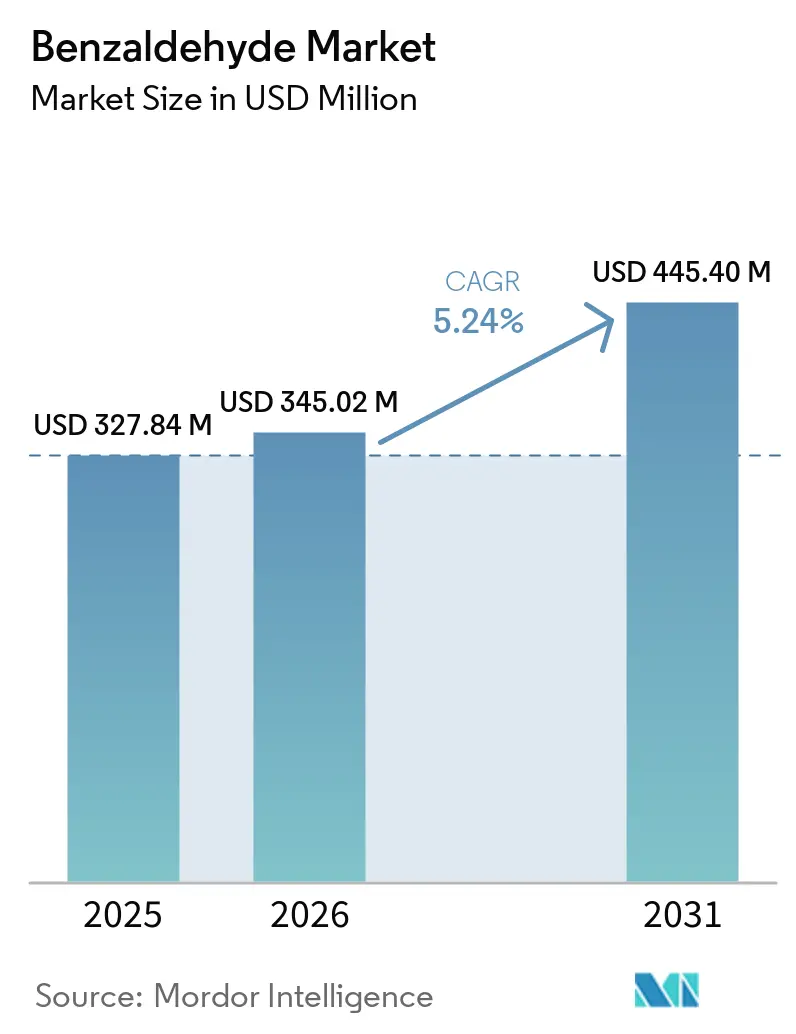
The Benzaldehyde Market size was valued at USD 327.84 million in 2025 and is estimated to grow from USD 345.02 million in 2026 to reach USD 445.40 million by 2031, at a CAGR of 5.24% during the forecast period (2026-2031). Demand centers on pharmaceutical intermediate synthesis, flavor and fragrance formulations, and agrochemical production. Benzaldehyde remains difficult to replace in precision synthesis because it supports condensation, reductive amination, and Knoevenagel reactions. Cosmetics and personal care also support demand because the material adds an almond-like scent and can stabilize formulations. Procurement decisions increasingly depend on grade, traceability, and process route rather than on capacity alone. The benzaldehyde market is, therefore, shaped by the ability of suppliers to meet distinct food, pharmaceutical, fragrance, and industrial requirements.
Key Report Takeaways
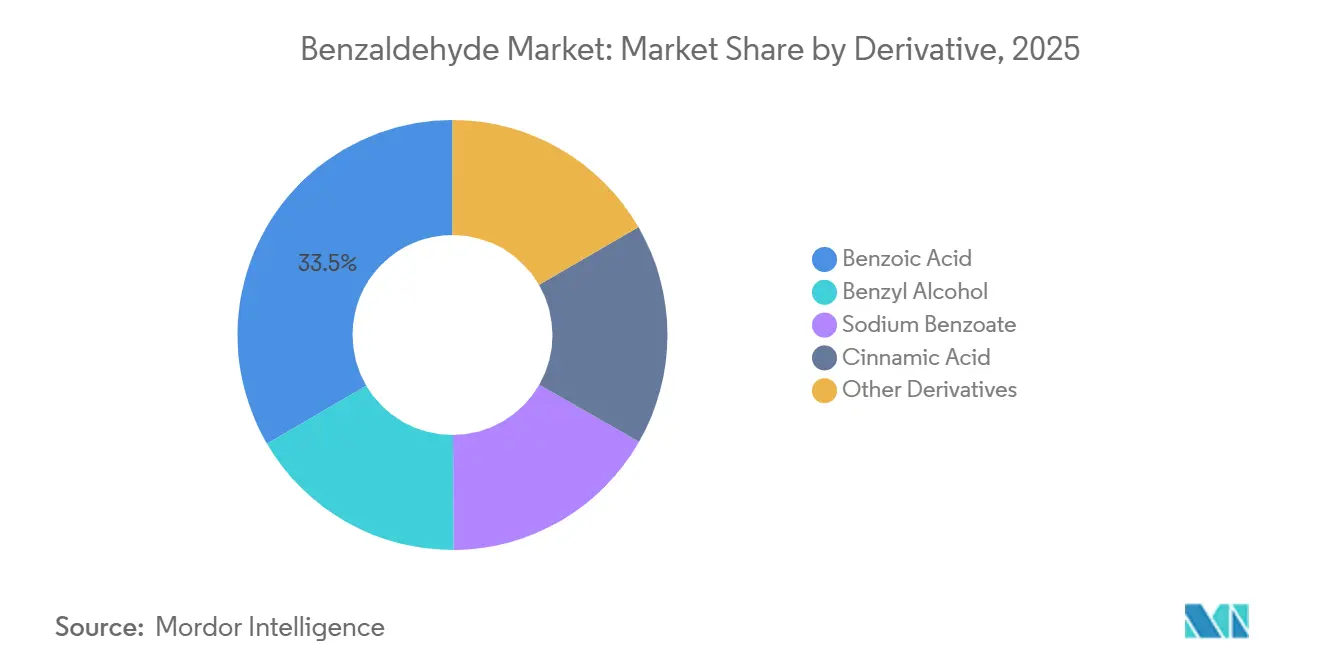
- By derivative, benzoic acid held 33.45% of the benzaldehyde market share in 2025 and is projected to advance at a 6.13% CAGR through 2031.
- By process, the toluene oxidation process held 39.56% of the benzaldehyde market share in 2025 and is projected to advance at a 6.45% CAGR through 2031.
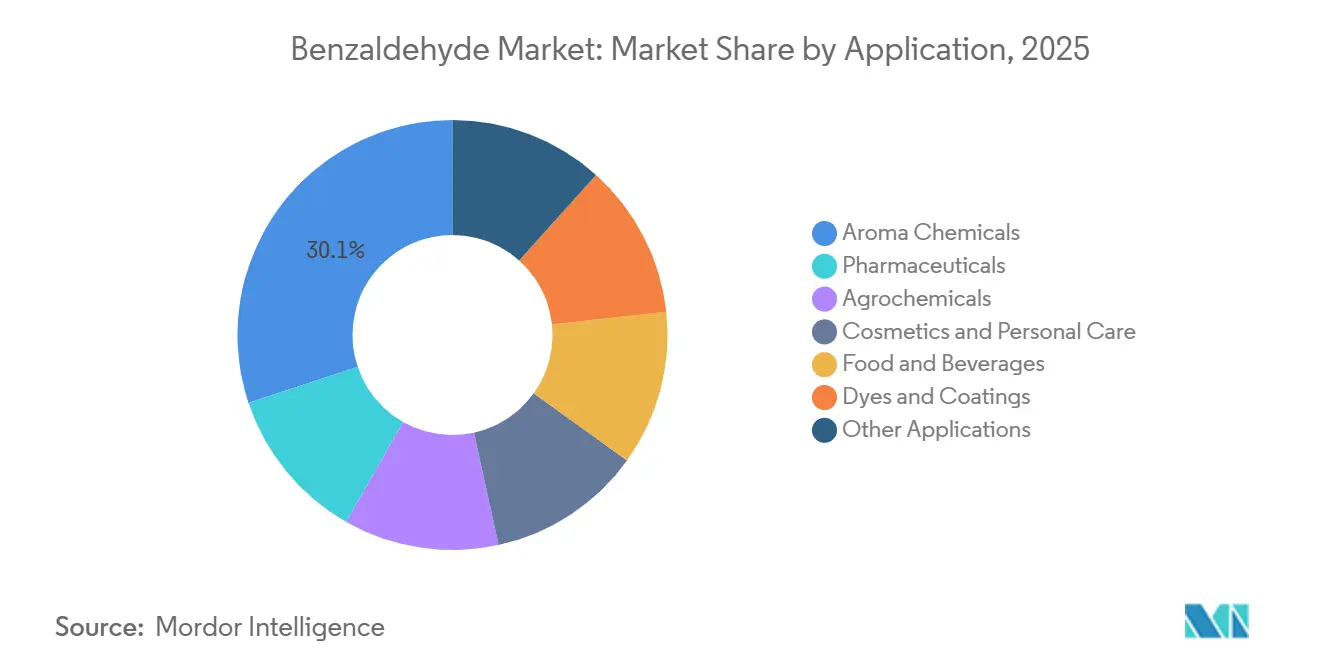
- By application, aroma chemicals held 30.13% of the benzaldehyde market share in 2025, while cosmetics and personal care are projected to advance at a 6.77% CAGR through 2031.
- By geography, Asia-Pacific held 40.38% of the benzaldehyde market share in 2025 and is projected to advance at a 5.89% CAGR through 2031.
Note: Market size and forecast figures in this report are generated using Mordor Intelligence’s proprietary estimation framework, updated with the latest available data and insights as of January 2026.
Market Trends and Insights
Drivers Impact Analysis of Benzaldehyde Market*
| Driver | (~) % Impact on CAGR Forecast | Geographic Relevance | Impact Timeline |
|---|---|---|---|
| Expansion of Pharmaceutical Intermediate Manufacturing | +1.5% | Global, with concentration in India, China, and EU | Medium term (2–4 years) |
| Growth in Flavor and Fragrance Formulations | +1.2% | Global; highest uptake in North America, EU, and APAC | Long term (≥ 4 years) |
| Rising Agrochemical Intermediate Consumption | +0.9% | APAC core (China, India), spillover to South America | Medium term (2–4 years) |
| Increasing Demand for Food Preservatives and Flavoring | +0.7% | Global; led by Asia-Pacific and North America | Short term (≤ 2 years) |
| Shift to Chlorine-Free Catalytic Oxidation | +0.4% | North America and EU; early gains in APAC leading producers | Long term (≥ 4 years) |
| Source: Mordor Intelligence | |||
Expansion of Pharmaceutical Intermediate Manufacturing
Benzaldehyde serves as a precursor for pseudoephedrine, phenylglycine, and several antihypertensive active pharmaceutical ingredients. Pharmaceutical buyers require reliable purity, traceable documentation, and consistent batches. Food Chemicals Codex and European Pharmacopoeia requirements distinguish pharmaceutical-grade material from industrial grades. China had strong production capacity in 2024, but high-purity pharmaceutical-grade material still faced import dependence. That gap supports investment in domestic capacity that can meet demanding specifications. The benzaldehyde market rewards suppliers that can maintain 99.95% purity and provide complete batch records. This requirement makes reliable purification, analytical testing, and batch release controls central to supplier selection. It also means that customers can place greater value on dependable documentation when they manage regulated product portfolios.
Growth in Flavor and Fragrance Formulations
Flavor and fragrance demand includes natural benzaldehyde for premium and clean-label products and synthetic material for industrial food processing and mass-market personal care. Benzaldehyde has a Generally Recognized as Safe status from the U.S. Food and Drug Administration when used as a food flavoring under good manufacturing practice. Food and Agriculture Organization (FAO) and World Health Organization guidance recognize its use in food, cosmetics, and pharmaceutical products, with an acceptable daily intake of 5 mg/kg body weight per day expressed as benzoic acid equivalents. These uses support demand across bakery, confectionery, beverages, fragrances, and personal care. The benzaldehyde market benefits because the same chemistry can serve several formulation categories.
Rising Agrochemical Intermediate Consumption
Benzaldehyde is a building block for herbicide, fungicide, and insecticide intermediates. China produced 3.42 million metric tons of chemical pesticide active ingredients by the end of October 2025. That production signaled solid demand for aromatic aldehyde feedstocks within the country. India also supports consumption as agrochemical and pharmaceutical manufacturers increase local production. The benzaldehyde market benefits where import substitution programs reduce dependence on European suppliers. Demand from crop protection applications remains linked to agricultural production cycles.
Increasing Demand for Food Preservatives and Flavoring
Benzoic acid is the main benzaldehyde derivative and is used for food preservation through sodium benzoate. The FAO and World Health Organization permit benzoic acid in numerous food categories under the Codex Alimentarius framework. Benzaldehyde also contributes almond and cherry notes to bakery, confectionery, and beverage formulations. Food processing growth in ASEAN, South Asia, and Sub-Saharan Africa supports demand for food-grade applications. The benzaldehyde market is supported by these routine uses because they serve high-volume consumer products. Food applications also create a connection between derivative demand and direct flavoring demand. This overlap allows benzaldehyde and its derivatives to participate in several stages of food formulation and preservation. It also makes food-safety documentation relevant to more than one product route.
Restraints Impact Analysis of Benzaldehyde Market*
| Restraint | (~) % Impact on CAGR Forecast | Geographic Relevance | Impact Timeline |
|---|---|---|---|
| Toluene Feedstock Price Volatility | -0.8% | Global; most acute in China and South/Southeast Asia | Short term (≤ 2 years) |
| Environmental and Process-Residue Compliance Costs | -0.5% | EU, North America, China (urban chemical parks) | Medium term (2–4 years) |
| Purity-Specification Fragmentation Across End Uses | -0.3% | Global; most pronounced in EU and North America export lanes | Long term (≥ 4 years) |
| Source: Mordor Intelligence | |||
Toluene Feedstock Price Volatility
Toluene availability and pricing can affect the economics of benzaldehyde production. Changes in crude oil and naphtha conditions can pass through to aromatic feedstock costs. Such movements can narrow margins and make fixed-price supply agreements less attractive. Downstream pharmaceutical and food buyers may then have less certainty over contract terms. Producers without direct access to toluene supply can face greater pressure during higher-cost periods. The benzaldehyde market is exposed to this risk in China, India, and other Asian supply centers.
Environmental and Process-Residue Compliance Costs
The toluene chlorination process produces benzyl chloride and hydrogen chloride byproducts that require controlled handling and treatment. Environmental enforcement is becoming more demanding in Chinese industrial parks and European chemical zones. Jiangsu Province's structural adjustment regulations took effect in January 2026 and restricted outdated benzaldehyde production equipment. These rules encourage investment in lower-residue alternatives. The benzaldehyde market consequently faces higher compliance costs for chlorination-based production. Producers using oxidation routes have a clearer fit with buyers seeking lower chlorine-related process exposure.
*Our forecasts treat driver/restraint impacts as directional, not additive. The impact forecasts reflect baseline growth, mix effects, and variable interactions.
Benzaldehyde Market Segment Analysis
By Derivative:
Benzoic Acid Chemistry Anchors the Value ChainBenzoic acid held 33.45% of the benzaldehyde market share in 2025 and is projected to advance at a 6.13% CAGR through 2031. Its demand rests on food preservation through sodium benzoate, pharmaceutical excipients, and alkyd resin production. The benzaldehyde market size for benzoic acid is supported by its use across both consumer and industrial value chains. Sodium benzoate demand is linked to processed food consumption in the Asia-Pacific. Pharmaceutical synthesis gives the derivative another established application. LANXESS produces Purox B benzoic acid at Botlek in the Netherlands under an ISO 14067 carbon-footprint methodology and International Sustainability and Carbon Certification Plus certification. These credentials show how compliance can support premium positioning. The derivative serves preservation, pharmaceutical, and resin applications, so its suppliers must address different customer expectations. Food preservation demand can call for stable regulatory documentation, pharmaceutical uses can require higher purity, and resin customers can emphasize dependable industrial performance. These requirements make the product portfolio broader than a single end-use category. This diversity makes product grade and supporting documentation relevant throughout the benzaldehyde market.
Benzyl alcohol serves as a pharmaceutical solvent, a cosmetic preservative, and an industrial coating. Sodium benzoate continues to benefit from expansion in processed foods across ASEAN and South Asia. Cinnamic acid is used in fragrance formulations and ultraviolet absorber synthesis. Benzoin and mandelic acid intermediates remain smaller but higher-value derivative applications. Standard-grade benzoic acid from chlorination routes faces a substantial Chinese supply. Pharmaceutical-grade benzoic acid that meets National Formulary, Food Chemicals Codex, and European Pharmacopoeia requirements remains more constrained. The benzaldehyde industry, therefore, has distinct competitive conditions for standard and regulated derivative grades.



By Process:
Toluene Oxidation Process Redefines Purity StandardsThe toluene oxidation process held 39.56% of the benzaldehyde market share in 2025 and is projected to advance at a 6.45% CAGR through 2031. It offers a lower chlorine-byproduct profile than chlorination and can align more closely with food-grade and pharmaceutical-grade requirements. Liquid-phase air oxidation can achieve benzaldehyde yields of 88% to 92%. China had used oxidation for 72% of domestic benzaldehyde production, and its role was increasing as smaller chlorination facilities faced tighter environmental controls. A 2026 study reported 86% benzaldehyde selectivity from toluene using magnesium-doped manganese-based layered double oxide catalysts. The benzaldehyde market size for oxidation-based supply can expand where these process improvements are commercialized.
The toluene chlorination process remains relevant for industrial-grade and cost-sensitive materials. Gujarat Alkalies and Chemicals Limited commissioned a Dahej chlorotoluenes plant with 7,200 metric tons per annum of benzaldehyde capacity. The facility targets pharmaceutical, perfumery, flavoring, and solvent-grade applications. Oxidation serves premium-grade demand where purity and lower process residues matter most. Chlorination remains useful where production costs receive greater emphasis. These parallel routes will continue to shape supplier strategies in the benzaldehyde industry. Buyers seeking premium material can favor lower-residue processes, while cost-sensitive users can continue to value established chlorination economics. The benzaldehyde market will continue to contain both routes because the requirements of its end uses are not identical.
By Application:
Aroma Chemicals Lead, Cosmetics and Personal Care AccelerateAroma chemicals held 30.13% of the benzaldehyde market share in 2025. The segment uses benzaldehyde for its bitter-almond scent and as a precursor for rose, jasmine, and cherry aroma compounds. These compounds are used in perfumes and household products. Pharmaceutical applications use benzaldehyde as an intermediate for pseudoephedrine, phenylglycine, and antihypertensive products. Agrochemical demand remains cyclical but provides a steady outlet. Food and beverages also consume material for almond and cherry flavoring under applicable food-safety requirements.
Cosmetics and personal care are projected to advance at a 6.77% CAGR through 2031. The benzaldehyde market supports soaps, shampoos, lotions, and skincare products through fragrance and preservative functions. South Korea, Japan, India, and China are important personal care growth centers in the Asia-Pacific. Rising income and urbanization support the use of scented personal care products. Bio-based benzaldehyde from amygdalin hydrolysis or lignin fermentation is attracting premium interest from luxury beauty brands. Suppliers of synthetic material face greater demand for International Sustainability and Carbon Certification (ISCC) Plus certification or mass-balance carbon-footprint data. This application may increase the value placed on sustainable sourcing claims. Personal care customers can assess fragrance performance, preservative function, and the available evidence on ingredient origin at the same time. These expectations add another element to commercial discussions in the benzaldehyde market. Suppliers may need to support customers with evidence on formulation performance, product handling, and relevant sustainability credentials. Premium beauty products are particularly sensitive to the consistency of these supporting claims. This can encourage customers to favor suppliers that can provide reliable quality information across repeated purchase cycles. It reinforces the role of documentation in premium personal care sourcing. The same documentation can help customers compare synthetic and bio-derived sourcing options without changing their required product-performance standards. This consideration remains relevant for premium formulation teams.
Geography Analysis
APAC Benzaldehyde Market
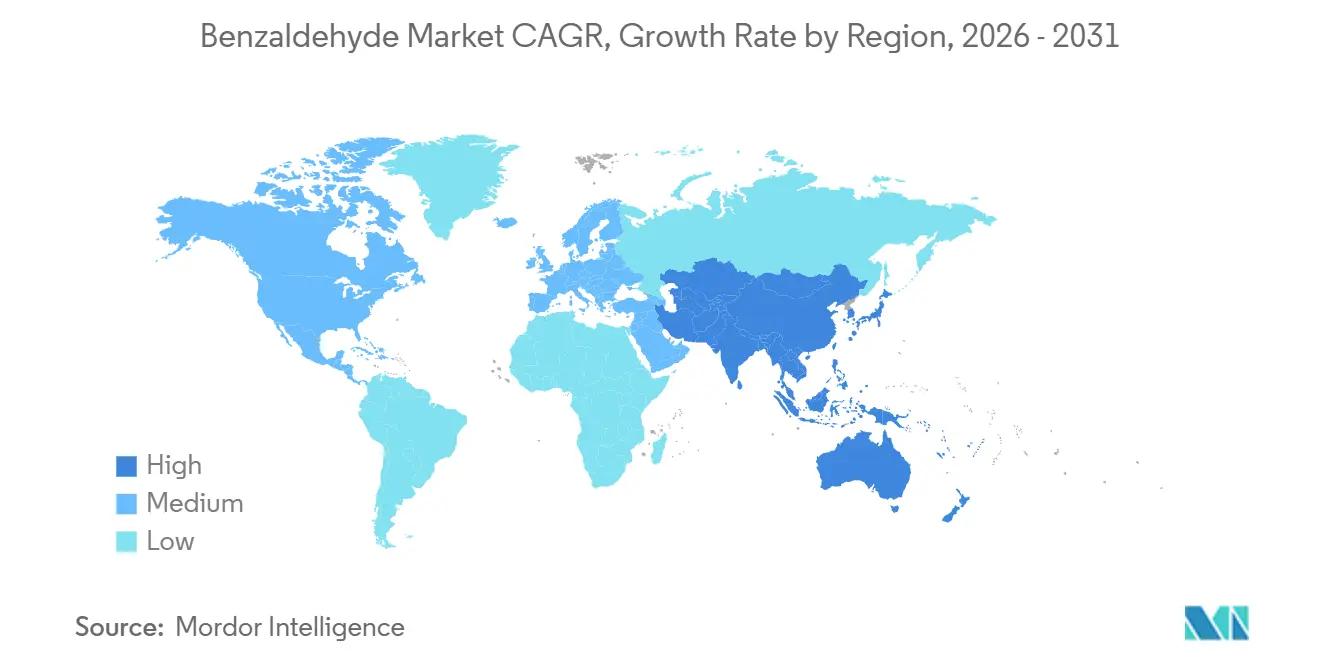
Asia-Pacific held 40.38% of the benzaldehyde market share in 2025 and is projected to advance at a 5.89% CAGR through 2031. China provides production scale, while India is expanding manufacturing, and ASEAN is adding consumption. Jiangsu, Shandong, and Zhejiang form China's core production areas. The benzaldehyde market size in the Asia-Pacific also benefits from food processing and personal care demand. The region combines major production locations with a large set of downstream manufacturing customers. This combination supports local supply relationships as well as exports to other regions.
North America, Europe and APAC Benzaldehyde Market
Gujarat Alkalies and Chemicals Limited began dispatching benzaldehyde from its Dahej facility in July 2025. The plant has 7,200 metric tons per annum of benzaldehyde capacity and is India's largest chlorotoluenes facility. Its added capacity supports domestic availability for pharmaceutical, perfumery, flavoring, and solvent applications. It also creates a supply option for export customers in Europe, the United States, and South Asia. Japan and South Korea are high-value demand centers for pharmaceutical-grade material. ASEAN countries are important consumers as food processing and personal care manufacturing develop. This gives regional producers exposure to demand from both established high-value markets and developing markets. India also has a growing role as a production hub and consumption center within the benzaldehyde market.
The Americas and EMEA Benzaldehyde Market
North America is a premium-demand region for pharmaceutical-grade and Food Chemicals Codex-grade benzaldehyde. LANXESS operates its Kalama site in the United States using a chlorine-free oxidation route and supplies certified material to food and fragrance compounders. Europe has stringent registration and quality requirements for aromatic aldehydes. Germany, the United Kingdom, France, and Nordic countries support demand through fragrances, pharmaceutical synthesis, and coatings. LANXESS announced the closure of its Widnes, United Kingdom, production site during 2026 as part of an annual savings program. Brazil leads South American demand through agribusiness and personal care, while Saudi Arabia and South Africa lead consumption in the Middle East and Africa. These markets are smaller than Asia-Pacific but have room for demand as local food, cosmetic, pharmaceutical, and specialty chemical activities develop. Their role is linked to the continuing maturity of downstream industries.

Competitive Landscape
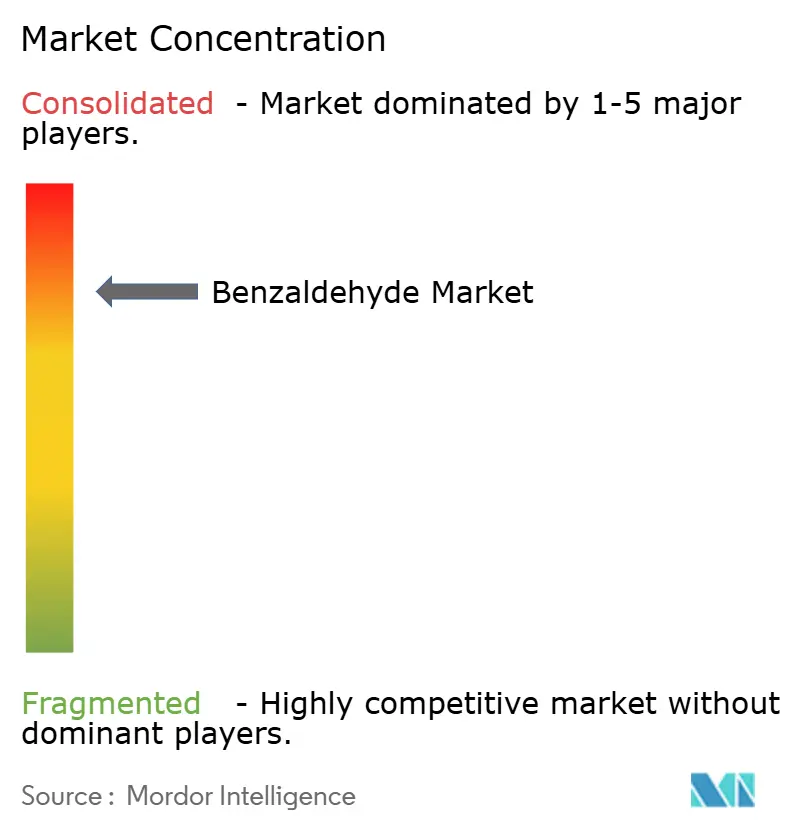
The benzaldehyde market is moderately consolidated, with the top five players including KLJ Group, LANXESS, Valtris Specialty Chemicals, Synova Chemicals, and Gujarat Alkalies and Chemicals Limited. Valtris Specialty Chemicals has a position in North America, Europe, and Middle East and Africa specialty plasticizer and biocide applications. Wuhan Youji Industries Co., Ltd. and Hubei Kelin Bolun New Materials Co., Ltd. compete on cost in industrial and food-grade products. Jayshree Aromatics Limited and KLJ Group are expanding capacity and regulatory credentials for export opportunities. Supply of high-purity pharmaceutical-grade benzaldehyde remains limited in South and Southeast Asia. This creates an opportunity for manufacturers that can qualify under the International Council for Harmonisation Q7 Good Manufacturing Practice requirements. It also reinforces the importance of quality systems for suppliers seeking higher-margin applications.
LANXESS has certified five benzaldehyde production sites under International Sustainability and Carbon Certification Plus. It uses a mass-balance approach for raw materials and publishes product carbon-footprint data calculated under ISO 14067 and validated by TÜV Rheinland[1]LANXESS, “LANXESS Reduces CO2 Footprint for Products at Botlek Site,” LANXESS, lanxess.com. In September 2025, the company shifted its Botlek site to low-emission electricity for benzaldehyde, benzoic acid, benzyl alcohol, and sodium benzoate production. This removed fossil fuel use at the site for those products. In May 2025, it presented certified benzaldehyde at Chemspec Europe for food, personal care, and coatings value chains. These moves place verified sustainability information alongside product performance in customer discussions. The approach responds to procurement teams that consider process route, raw material accounting, and documented product carbon footprints. It can differentiate producers in applications where buyers seek both performance and verified environmental information.
Gujarat Alkalies and Chemicals Limited also expanded the Indian supply base with its Dahej plant in 2025[2]Gujarat Alkalies and Chemicals Limited, “GACL Flags Off First Dispatch of Benzyl Alcohol and Benzaldehyde from India's Largest Chlorotoluenes Plant,” Gujarat Alkalies and Chemicals Limited, gacl.com. Its integrated configuration includes benzaldehyde, Benzyl Alcohol, and benzyl chloride. Valtris Specialty Chemicals participated in CHINAPLAS 2026 in Shanghai to present its specialty chemical and polymer-additive portfolio to Asia-Pacific customers. Competition depends on scale, certification, route selection, and the ability to support regulated customers. Cost-led suppliers can address standard industrial demand, while certified producers are positioned for applications with more exacting requirements. This distinction explains why production volumes alone do not determine supplier strength. Suppliers with traceable high-purity material can avoid direct competition with commodity grades. The benzaldehyde market continues to offer a clear role for global producers and regional suppliers with focused technical capabilities. Global suppliers can support customers across multiple grades and geographies, while regional producers can serve local demand and targeted export lanes. Competition, therefore, reflects more than nameplate capacity because specifications, certifications, and customer service remain important.
Benzaldehyde Industry Leaders
KLJ Group
LANXESS
Valtris Specialty Chemicals
Synova Chemicals
Gujarat Alkalies and Chemicals Limited
- *Disclaimer: Major Players sorted in no particular order
Benzaldehyde Market Companies Covered in this Report
- Axxence Aromatic GmbH
- Golden Glory Chemical Limited
- Gujarat Alkalies and Chemicals Limited
- Hefei TNJ Chemical Industry Co., Ltd.
- Hosea Chem
- Hubei Kelin Bolun New Materials Co., Ltd.
- Jayshree Aromatics Limited
- Kadillac
- KLJ Group
- LANXESS
- Synova Chemicals
- Valtris Specialty Chemicals
- Wuhan Youji Industries Co., Ltd.
- Zaoyang Cixiang Pharmtech Co., Ltd.

Recent Industry Developments in Benzaldehyde Market
- August 2025: LANXESS announced the closure of its aroma chemicals plant in Widnes, United Kingdom, reducing regional production capacity for aroma chemicals. The shutdown could tighten supply availability and influence the regional competitive landscape for benzaldehyde and related aroma intermediates.
- July 2025: Gujarat Alkalies and Chemicals Limited dispatched its first benzaldehyde production from its new chlorotoluenes plant at Dahej, India. The start-up adds domestic benzaldehyde capacity and strengthens India’s supply base for downstream applications.


Global Benzaldehyde Market Report Scope
Benzaldehyde is an aromatic aldehyde characterized by a distinctive almond-like odor and versatile chemical reactivity, making it an important intermediate in organic synthesis. It is used to produce a range of downstream chemicals and formulations serving fragrance, pharmaceutical, agricultural, food, and specialty chemical applications.
The Benzaldehyde Market is segmented by derivative, process, application, and geography. By derivative, the market is segmented into benzoic acid, benzyl alcohol, sodium benzoate, cinnamic acid, and other derivatives. By process, the market is segmented into toluene oxidation process and toluene chlorination process. By application, the market is segmented into aroma chemicals, pharmaceuticals, agrochemicals, food and beverages, dyes and coatings, cosmetics and personal care, and other applications. The report also covers the market size and forecasts for benzaldehyde in 15 countries across major regions. For each segment, the market sizing and forecasts have been done on the basis of value (USD).
| Benzoic Acid |
| Benzyl Alcohol |
| Sodium Benzoate |
| Cinnamic Acid |
| Other Derivatives |
| Toluene Oxidation Process |
| Toluene Chlorination Process |
| Aroma Chemicals |
| Pharmaceuticals |
| Agrochemicals |
| Food and Beverages |
| Dyes and Coatings |
| Cosmetics and Personal Care |
| Other Applications |
| Asia-Pacific | China |
| India | |
| Japan | |
| South Korea | |
| ASEAN Countries | |
| Rest of Asia-Pacific | |
| North America | United States |
| Canada | |
| Mexico | |
| Europe | Germany |
| United Kingdom | |
| France | |
| Italy | |
| NORDIC Countries | |
| Rest of Europe | |
| South America | Brazil |
| Argentina | |
| Rest of South America | |
| Middle East and Africa | Saudi Arabia |
| South Africa | |
| Rest of Middle East and Africa |
| By Derivative | Benzoic Acid | |
| Benzyl Alcohol | ||
| Sodium Benzoate | ||
| Cinnamic Acid | ||
| Other Derivatives | ||
| By Process | Toluene Oxidation Process | |
| Toluene Chlorination Process | ||
| By Application | Aroma Chemicals | |
| Pharmaceuticals | ||
| Agrochemicals | ||
| Food and Beverages | ||
| Dyes and Coatings | ||
| Cosmetics and Personal Care | ||
| Other Applications | ||
| By Geography | Asia-Pacific | China |
| India | ||
| Japan | ||
| South Korea | ||
| ASEAN Countries | ||
| Rest of Asia-Pacific | ||
| North America | United States | |
| Canada | ||
| Mexico | ||
| Europe | Germany | |
| United Kingdom | ||
| France | ||
| Italy | ||
| NORDIC Countries | ||
| Rest of Europe | ||
| South America | Brazil | |
| Argentina | ||
| Rest of South America | ||
| Middle East and Africa | Saudi Arabia | |
| South Africa | ||
| Rest of Middle East and Africa | ||


Key Questions Answered in the Report
What is the size of the benzaldehyde market?
The benzaldehyde market stands at USD 345.02 million in 2026 and is projected to reach USD 445.40 million by 2031.
What is driving benzaldehyde demand?
Pharmaceutical intermediates, flavor and fragrance formulations, agrochemicals, food preservation, and personal care products support demand.
Which derivative led the market demand in 2025?
Benzoic acid held a 33.45% share in 2025.
Which process is expected to grow fastest through 2031?
The toluene oxidation process is projected to advance at a 6.45% CAGR through 2031.
Page last updated on:





