
Bentonite Market Size and Share
Market Overview
| Study Period | 2021 - 2031 |
|---|---|
| Market Size (2026) | USD 2.41 Billion |
| Market Size (2031) | USD 3.10 Billion |
| Growth Rate (2026 - 2031) | 5.16 % |
| Fastest Growing Market | Asia-Pacific |
| Largest Market | Asia-Pacific |
| Market Concentration | Medium |
Major Players *Disclaimer: Major Players sorted in no particular order Image © Mordor Intelligence. Reuse requires attribution under CC BY 4.0. | |
Bentonite Market Analysis by Mordor Intelligence
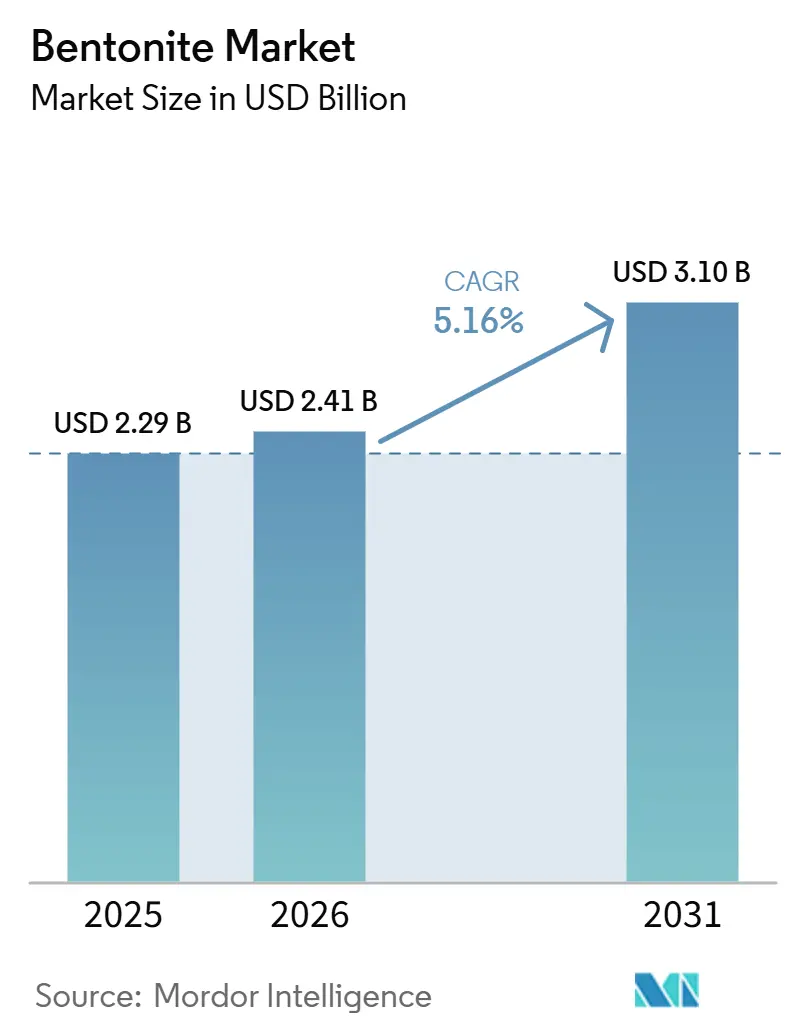
The Bentonite Market was valued at USD 2.29 billion in 2025 and is estimated to grow from USD 2.41 billion in 2026 to reach USD 3.10 billion by 2031, at a CAGR of 5.16% during the forecast period (2026–2031). The bentonite market draws demand from drilling fluids, foundry casting, iron ore pelletization, civil engineering, and specialized pharmaceutical and personal care uses. Its swelling capacity, viscosity control, and adsorption properties support use in both high-volume industrial activities and specialized formulations. This range of uses reduces dependence on any one demand cycle and gives the bentonite market a more diversified base than many industrial mineral categories. Large deposits remain concentrated in the United States, Turkey, and India, while the strongest consumption growth is centered in South and Southeast Asia, increasing the importance of freight access and supply contracts. Otherwise, mine permitting, rehabilitation duties, and transportation costs limit how quickly new suppliers can respond when demand rises.
Key Report Takeaways
- By product, sodium bentonite held 57.30% of the bentonite market share in 2025, while calcium bentonite is forecast to grow at a 6.12% CAGR through 2031.
- By application, drilling muds accounted for 24.63% of the bentonite market share in 2025, while civil engineering is forecast to expand at a 6.19% CAGR through 2031.
- By end-use industry, construction held 21.60% of the bentonite market share in 2025, while water and wastewater treatment is forecast to grow at a 6.07% CAGR through 2031.
- By geography, Asia-Pacific accounted for 38.72% of the bentonite market share in 2025 and is forecast to expand at a 5.82% CAGR through 2031.
Note: Market size and forecast figures in this report are generated using Mordor Intelligence’s proprietary estimation framework, updated with the latest available data and insights as of January 2026.
Global Bentonite Market Trends and Insights
Drivers Impact Analysis*
| Driver | (~) % Impact on CAGR Forecast | Geographic Relevance | Impact Timeline |
|---|---|---|---|
| Growing Demand for Sodium Bentonite in Oil and Gas Drilling Fluid Applications | +1.4% | North America (Permian Basin, Gulf of Mexico), Middle -East, Asia-Pacific | Short term (≤ 2 years) |
| Increasing Utilization of Bentonite as a Binder in Foundry Sand Casting | +0.9% | Global, strongholds in Asia-Pacific and Europe | Medium term (2-4 years) |
| Expansion of Iron Ore Pellet Production Supporting Demand for Bentonite Binders | +0.8% | Asia-Pacific (India, China), South America (Brazil) | Medium term (2-4 years) |
| Increasing Use of Bentonite in Civil Engineering and Water Containment Applications | +1.0% | Asia-Pacific, Europe, North America | Long term (≥ 4 years) |
| Growing Demand for High-Purity Bentonite in Cosmetics, Pharmaceuticals, and Personal Care Products | +0.6% | North America, Europe, China | Medium term (2-4 years) |
| Source: Mordor Intelligence | |||
Growing Demand for Sodium Bentonite in Oil and Gas Drilling Fluid Applications
Sodium bentonite forms a low-permeability filter cake on borehole walls and helps water-based drilling fluids control fluid loss. These functions make substitution with synthetic products costly or technically limited in many standard well designs. Upstream investment in offshore and unconventional resources supports continued procurement by drilling fluid service providers. Baker Hughes rig-count data through mid-2025 showed stable activity in the Permian Basin and Gulf of Mexico, supporting demand for drilling inputs in those operating areas. Deepwater wells require premium grades that can perform under high temperature and salinity conditions, which only a limited group of Wyoming and Turkish deposits can supply consistently. This difference between commodity and premium material supports a wider separation in pricing and strengthens the position of suppliers with high-swelling sodium deposits.
Expansion of Iron Ore Pellet Production Supporting Demand for Bentonite Binders
Iron ore pellet production requires sodium bentonite to provide green strength and thermal stability during pellet handling and firing. Each metric ton of pellets used in blast furnace steelmaking requires 5-8 kilograms of binder, linking steel capacity additions to bentonite purchasing volumes. India’s Ministry of Steel has targeted 300 million metric tons of steel production by 2030, supporting the outlook for additional pelletizing capacity[1]Ministry of Steel, Government of India, “National Steel Policy,” Government of India, steel.gov.in.. Ashapura Minechem commissioned 2 bentonite mines in Kutch during FY2026, with 300,000 metric tons of annual capacity intended for pelletizing and other industrial uses. Conventional blast furnace pelletizing is expected to remain a substantial source of demand through 2031. Polymer binders are gaining technical acceptance in lower-carbon steel routes because they can reduce silica impurities, although the supplied evidence indicates limited displacement of bentonite in conventional pelletizing during the forecast period.
Increasing Use of Bentonite in Civil Engineering and Water Containment Applications
Civil engineering is the fastest-growing application in the bentonite market, with a forecast 6.1% CAGR through 2031. Tunneling, diaphragm wall work, horizontal directional drilling, and landfill sealing are driving this demand. LKAB Minerals supplied bentonite for annulus grouting on the HS2 rail tunneling project during May 2026, where the material helped stabilize ground, transfer loads, and create a watertight seal. A 2026 study found that polymer-modified bentonite landfill liners achieved permeability below 10⁻⁷ cm/s with 7% bentonite content. Requirements under the U.S. Resource Conservation and Recovery Act and the EU Landfill Directive continue to support low-permeability containment barriers. These requirements support qualified geosynthetic clay liner solutions in major waste management systems.
Growing Demand for High-Purity Bentonite in Cosmetics, Pharmaceuticals, and Personal Care Products
Pharmaceutical-grade bentonite must meet controls for viscosity, pH, acid demand, moisture, heavy metals, and microbiological content. These specifications restrict the group of suppliers that can qualify material for pharmaceutical use. The resulting approval requirements create a premium segment within the broader Bentonite market. Demand for natural and certified ingredients is extending use into skincare, anti-dandruff shampoos, facial cleansers, and pressed powders. Bentonite can serve as a binder, rheology modifier, suspension stabilizer, and opacifier, which can reduce ingredient complexity in some formulations. Suppliers with Organic Materials Review Institute (OMRI)-listed or ECOCERT-authorized grades can maintain higher prices across mass and prestige personal care categories.
Restraints Impact Analysis*
| Restraint | (~) % Impact on CAGR Forecast | Geographic Relevance | Impact Timeline |
|---|---|---|---|
| Variability in Bentonite Ore Quality Affecting Processing Efficiency and Product Performance | -0.5% | Global, most acute in emerging producer regions | Long term (≥ 4 years) |
| High Transportation and Bulk Logistics Costs Impacting Market Competitiveness | -0.7% | Global, highest impact in landlocked and export-dependent markets | Short term (≤ 2 years) |
| Stringent Environmental Regulations Governing Mining Operations and Land Rehabilitation | -0.4% | North America, Europe, Australia | Medium term (2-4 years) |
| Source: Mordor Intelligence | |||
Variability in Bentonite Ore Quality Affecting Processing Efficiency and Product Performance
Differences in smectite content, iron phases, and montmorillonite purity can change swelling index, cation exchange capacity, and viscosity yield. These properties determine whether the material can meet the needs of industrial customers. Quality assurance must begin at the mine and continue through processing because small mineralogical changes can affect engineered barrier and geotechnical uses. Acid activation, sodium carbonate addition, and blending raise raw-material costs for calcium bentonite by 30-50%. Activated grades also sell at a 20-40% discount to natural sodium bentonite because performance gaps can remain. This issue favors producers with large uniform deposits and internal quality systems, while limiting smaller suppliers’ ability to secure long-term contracts for drilling, foundry, and liner applications.
High Transportation and Bulk Logistics Costs Impacting Market Competitiveness
Bentonite has a low bulk density of 0.6-0.9 metric tons per cubic meter, creating an unfavorable freight profile. A standard 40-foot container reaches volumetric capacity at 12-16 metric tons, below its 25-28 metric ton payload limit. Wyoming shipments to Midwest industrial users add USD 40-80 per metric ton, while shipments from Gujarat or Rajasthan to southern Indian pelletizing plants add USD 20-35 per metric ton over 1,000-1,500 km. Minerals Technologies Inc. raised bentonite prices late in 2025 to offset logistics and raw-material costs. Rail access and port-adjacent grinding facilities, therefore, have become important competitive assets in the bentonite market. Suppliers that rely on complex multimodal routes face greater exposure to disruption and cost escalation.
*Our forecasts treat driver/restraint impacts as directional, not additive. The impact forecasts reflect baseline growth, mix effects, and variable interactions.
Segment Analysis
By Product: Sodium Bentonite Anchors Value, Calcium Grades Accelerating
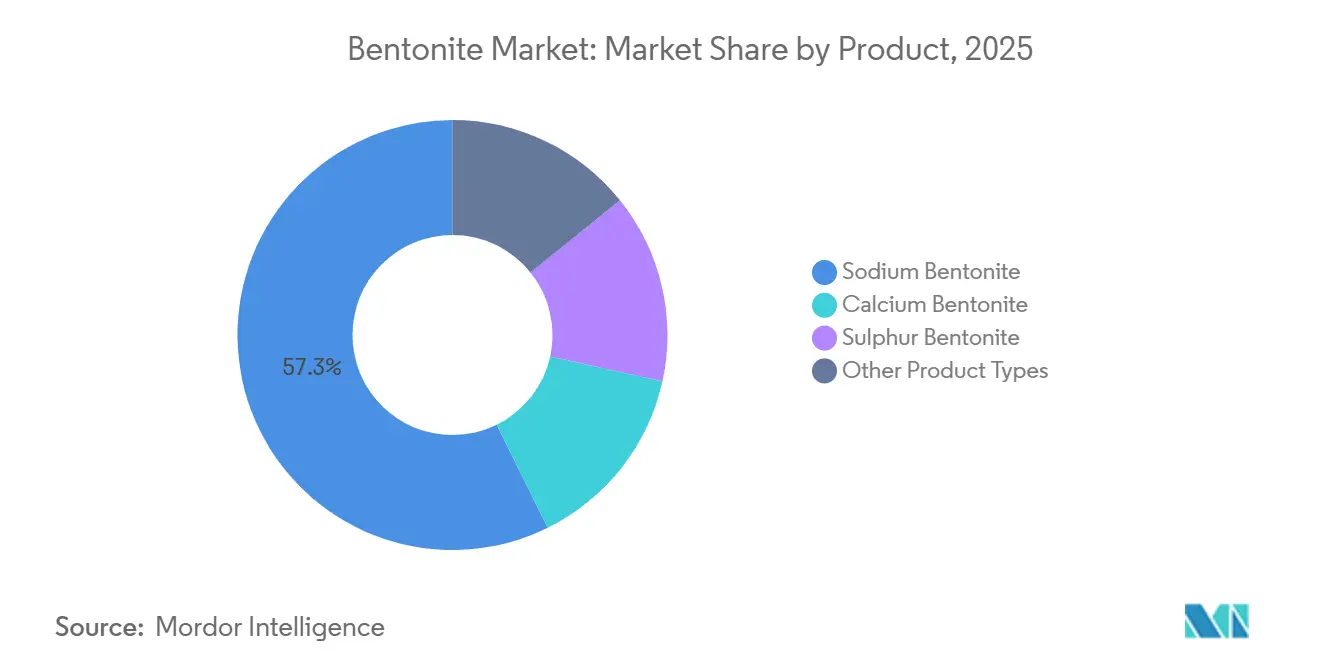
Sodium bentonite held 57.30% of the bentonite market share in 2025, supported by use in drilling fluids, geosynthetic clay liners, foundry green sand, and premium cat litter. Its ability to swell to 15-20 times its dry volume remains important in applications that require strong sealing or fluid-control performance. Calcium bentonite is the fastest-growing product category, with a forecast CAGR of 6.12% from 2026 to 2031. This growth is tied to edible oil refining in Asian markets, where it serves as bleaching earth, and to animal-feed applications for mycotoxin adsorption. Calcium deposits are more available than sodium deposits in several relevant markets, which supports their role in local supply chains.
Clariant’s TERRANA feed additive range uses selected calcium bentonite for animal-feed detoxification applications and is produced under industrial food-safety standards. This type of processing shifts calcium material from lower-specification applications into products with more defined performance requirements. Sulfur bentonite is used as a slow-release sulfur fertilizer and soil amendment in North and South American crop production. Organo-bentonite and modified grades are used in paints, coatings, and polymer systems.



By Application: Drilling Muds Dominant, Civil Engineering, the Structural Growth Engine
Drilling muds accounted for 24.63% of the bentonite market size in 2025 because sodium bentonite remains important for wellbore stability, fluid-loss control, and cuttings transport. Civil engineering is forecast to grow at a 6.19% CAGR through 2031, the highest rate among the listed applications. Its demand base includes tunneling, horizontal directional drilling, diaphragm walls, and waste-containment liners. Iron ore pelletizing remains a major use, with global pellet output of 450–500 million metric tons requiring a reliable bentonite binder supply. Foundry sand also remains important because automotive casting and precision metalworking use green sand systems.
Cat litter is a smaller but higher-margin application in North America and Europe, where clumping, absorbency, and dust control determine product positioning. Absorbents, adsorbents, sealants, refining, and agricultural binders each account for a smaller share of the application mix. Their combined presence gives the bentonite market a broad demand base across industrial and consumer uses. Civil engineering now expands faster than drilling muds, changing the historic pattern in which oil and gas activity set the main demand cycle.
By End-Use Industry: Construction Leads, Water Treatment Sector Gains Structural Momentum
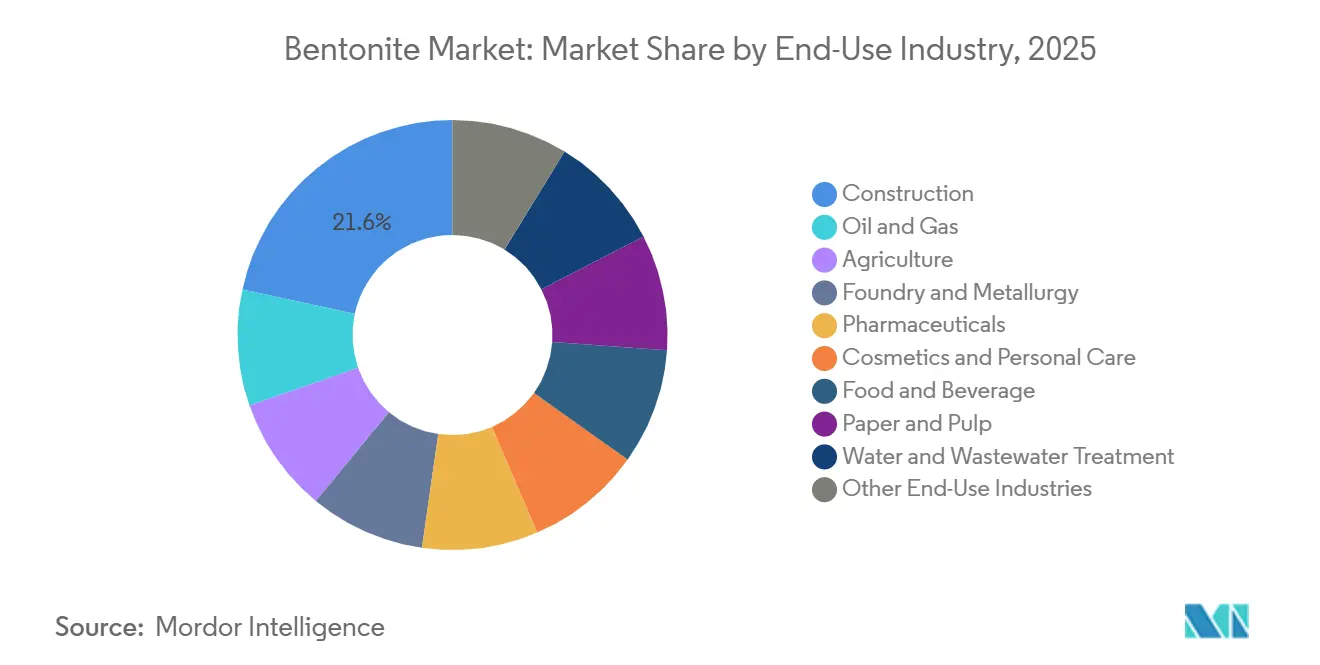
Construction held 21.60% of revenue in 2025, making it the largest end-use in the bentonite industry. Demand comes from waterproofing, slurry trench construction, pile boring, and infrastructure work in emerging markets. Water and wastewater treatment is forecast to grow at a 6.07% CAGR from 2026 to 2031, the fastest rate among listed end-use industries. Tighter discharge standards in electronics, semiconductor manufacturing, and municipal systems increase interest in bentonite’s adsorption of heavy metals and organic contaminants. Oil and gas remain the second-largest end-use but are linked to exploration and production budgets.
Foundry and metallurgy provide stable demand through automotive casting and steel production. Agriculture, pharmaceuticals, cosmetics, and personal care form a higher-growth group as demand increases for natural ingredients and controlled formulations. Food and beverage uses include wine and beer clarification and edible oil refining. Ceramics, paper, and pulp are mature applications with few growth drivers beyond capacity additions in Asia.
Geography Analysis
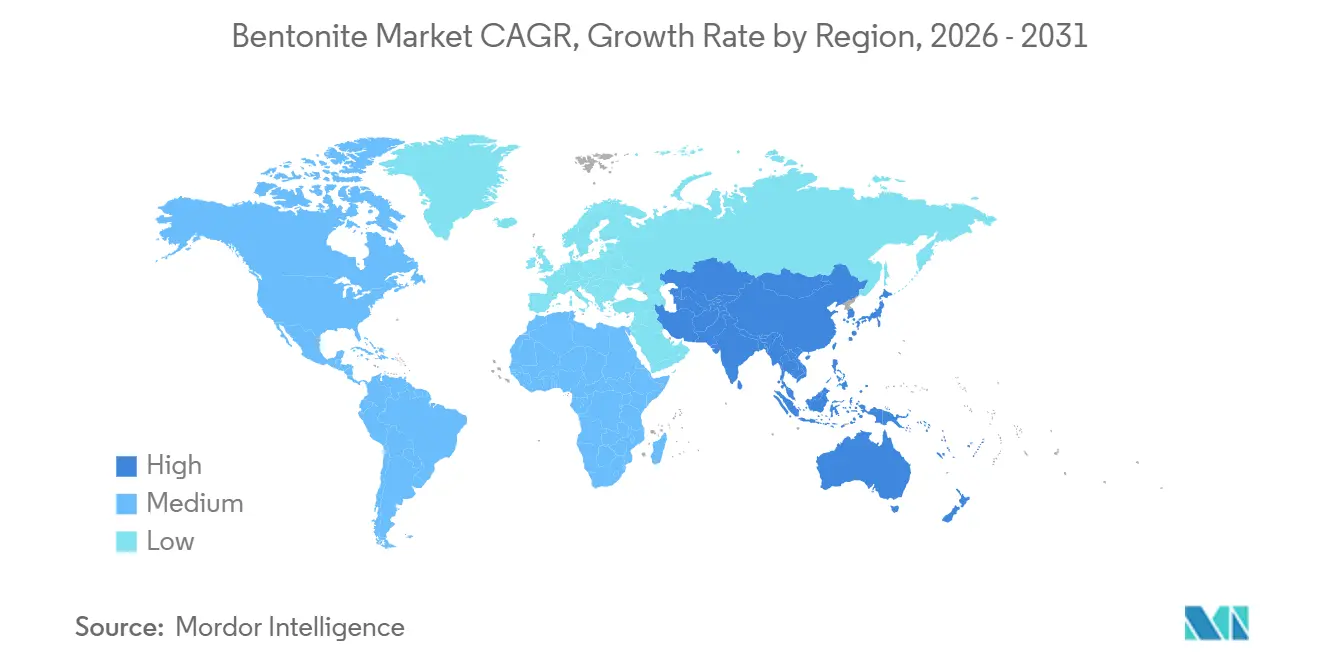
Asia-Pacific held 38.72% of revenue in 2025 and is forecast to expand at a 5.82% CAGR through 2031, giving it the leading share of the bentonite market. China’s steel sector drives regional pelletizing demand, while construction and environmental remediation add further uses. India follows in regional demand because of its expanding steel sector, pipeline investment, and pharmaceutical-grade consumption linked to generic drug manufacturing. Ashapura Minechem’s Q3 FY2026 bentonite segment revenue reached INR 2.31 billion (approximately USD 25.4 million), and 2 commissioned Kutch mines are expected to strengthen its supply position. Japan and South Korea remain premium demand centers for high-specification drilling and foundry grades.
Southeast Asian markets, including Indonesia and Vietnam, add civil-engineering demand as infrastructure programs expand. In North America, the majority of bentonite comes from Wyoming sodium deposits that are recognized for their high swelling performance. U.S. demand in the bentonite market from shale drilling, foundry activity, and cat litter supported pricing through most of 2025. North American sodium bentonite Free on Board (FOB) prices ranged from USD 185-290 per metric ton in 2025, with premium drilling and specialty grades at the upper end of that range. The Bureau of Land Management approved the Black Hills Bentonite Mine in Natrona County, Wyoming, in early 2026, which supports additional domestic supply capacity[2]Bureau of Land Management, “BLM Approves Black Hills Bentonite Mine in Natrona County, Wyoming,” Bureau of Land Management, blm.gov..
Europe relies on domestic deposits, including calcium bentonite from Greece and activated grades from Turkey, alongside U.S. and Indian imports. European consumption is increasingly tied to environmental sealing and pharmaceutical and cosmetic grades, while energy and beneficiation costs supported firmer pricing in 2025. South America is led by Brazil, where major iron ore pelletizing operations provide structurally important binder demand. Argentina adds demand through soil conditioning and animal-feed mycotoxin adsorption. The Middle-East and Africa form a smaller demand base, supported by drilling in Saudi Arabia and construction in Gulf Cooperation Council states. South Africa hosts Imerys’ Cape Bentonite operations and acts as a regional supply point. Infrastructure gaps and logistics complexity limit near-term realization of the longer-term potential in both regions.

Competitive Landscape
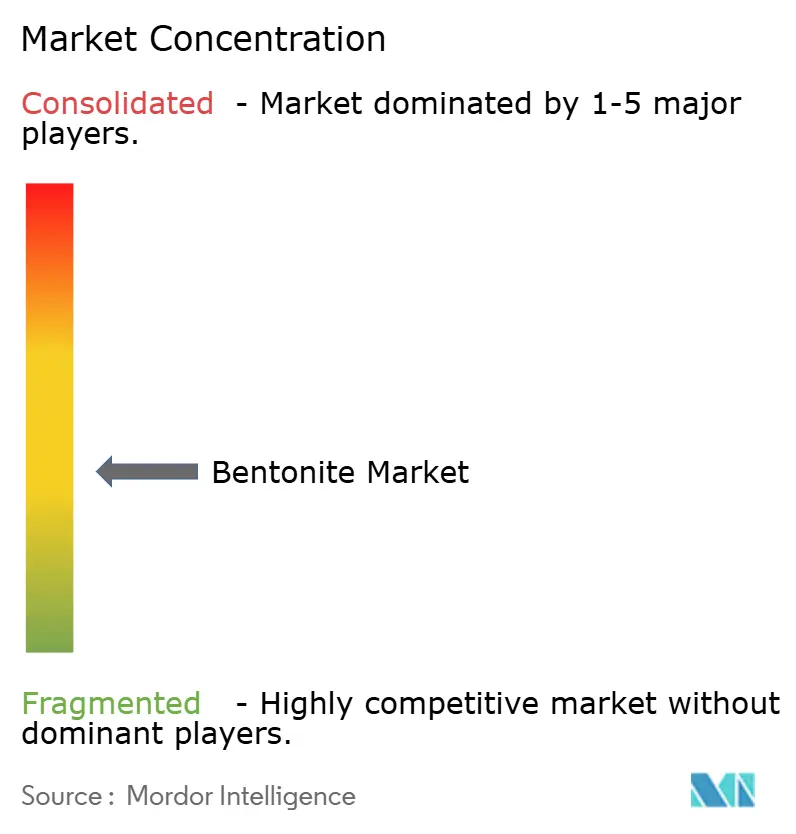
The market is moderately fragmented with top players including Minerals Technologies Inc., Imerys, Clariant AG, Wyo-Ben Inc., and Ashapura Group. Below these companies, many regional miners and processors in Turkey, China, and India compete on delivered cost and geographic proximity. These companies generally have less technical service capacity and fewer certifications for premium end uses. Product breadth, logistics infrastructure, and technical support shape the ability to win longer-term customer contracts in the bentonite market.
Minerals Technologies filed patents during 2025 for bentonite applications in drilling fluids and fine chemical processes, adding intellectual property to its product-performance strategy. Imerys launched Project Horizon in 2026, a cost-reduction program that includes organizational simplification and production-capacity optimization across specialty minerals activities. Clariant presented BENTONIL and TIXOTON drilling additives for tunneling, pipe jacking, horizontal directional drilling, and vertical drilling at STUVA Expo 2025. These actions show a focus on technical performance, cost control, and specialized civil-engineering demand. ISO product certifications and API drilling-grade requirements favor established suppliers that can document consistent product quality.
High-purity pharmaceutical and cosmetic grades remain an attractive opening because certified supply is concentrated among a limited group of producers. Polymer-enhanced bentonite for advanced liner systems also creates a specialty opportunity where higher performance can support premium pricing. Canbensan in Turkey and Shandong Huawei Bentonite in China have gained regional positions through integrated operations and cost advantages. Their expansion into premium drilling and specialty uses remains limited by deposit consistency and certification needs. GHCL signed a January 2024 memorandum for USD 413 million of Gujarat investment, including USD 113 million for bentonite and sand mining in Saurashtra, indicating a large planned expansion of Indian supply capacity. Competitive conditions in the bentonite market, therefore, combine leading integrated suppliers with a broad base of regional competitors that concentrate on local service and delivered-cost advantages.
Bentonite Industry Leaders
Imerys
Clariant AG
Minerals Technologies Inc.
Wyo-Ben, Inc.
Ashapura Group
- *Disclaimer: Major Players sorted in no particular order

Recent Industry Developments
- July 2026: The Deendayal Port Authority in Kandla, India, set a milestone by dispatching 38,500 metric tons of bentonite onto the MV BUZZARD in 22 hours and 25 minutes. This loading operation highlighted India's position in bentonite production, supported by strong international export demand.
- May 2026: The Bureau of Land Management Casper Field Office approved the Black Hills Bentonite Mine Project in Natrona County, Wyoming, aligning with the executive order to expand domestic energy and mineral production. The project adds to Wyoming's established bentonite mining corridor and is expected to increase sodium bentonite supply capacity.


Global Bentonite Market Report Scope
Bentonite is a highly absorbent, swelling clay primarily composed of the mineral montmorillonite. It typically forms from weathered volcanic ash and can absorb significant amounts of water, expanding to multiple times its original volume to form a gel-like paste.
The bentonite market is segmented by product, application, end-use industry, and geography. By product, the market is segmented into sodium bentonite, calcium bentonite, sulphur bentonite, and other product types. By application, the market is segmented into drilling muds, foundry sands, iron ore pelletizing, cat litter, civil engineering, absorbents and adsorbents, binder, refining, sealants, and other applications. By end-use industry, the market is segmented into construction, oil and gas, agriculture, foundry and metallurgy, pharmaceuticals, cosmetics and personal care, food and beverage, paper and pulp, water and wastewater treatment, ceramics, and other end-use industries. The report also covers the market size and forecasts for bentonite in 16 countries across major regions. For each segment, the market sizing and forecasts have been done on the basis of value (USD).
| Sodium Bentonite |
| Calcium Bentonite |
| Sulphur Bentonite |
| Other Product Types |
| Drilling Muds |
| Foundry Sands |
| Iron Ore Pelletizing |
| Cat Litter |
| Civil Engineering |
| Absorbents and Adsorbents |
| Binder |
| Refining |
| Sealants |
| Other Applications |
| Construction |
| Oil and Gas |
| Agriculture |
| Foundry and Metallurgy |
| Pharmaceuticals |
| Cosmetics and Personal Care |
| Food and Beverage |
| Paper and Pulp |
| Water and Wastewater Treatment |
| Other End-Use Industries |
| Asia-Pacific | China |
| India | |
| Japan | |
| South Korea | |
| Rest of Asia-Pacific | |
| North America | United States |
| Canada | |
| Mexico | |
| Europe | Germany |
| United Kingdom | |
| France | |
| Italy | |
| Russia | |
| Rest of Europe | |
| South America | Brazil |
| Argentina | |
| Rest of South America | |
| Middle-East and Africa | Saudi Arabia |
| South Africa | |
| Rest of Middle-East and Africa |
| By Product | Sodium Bentonite | |
| Calcium Bentonite | ||
| Sulphur Bentonite | ||
| Other Product Types | ||
| By Application | Drilling Muds | |
| Foundry Sands | ||
| Iron Ore Pelletizing | ||
| Cat Litter | ||
| Civil Engineering | ||
| Absorbents and Adsorbents | ||
| Binder | ||
| Refining | ||
| Sealants | ||
| Other Applications | ||
| By End-Use Industry | Construction | |
| Oil and Gas | ||
| Agriculture | ||
| Foundry and Metallurgy | ||
| Pharmaceuticals | ||
| Cosmetics and Personal Care | ||
| Food and Beverage | ||
| Paper and Pulp | ||
| Water and Wastewater Treatment | ||
| Other End-Use Industries | ||
| By Geography | Asia-Pacific | China |
| India | ||
| Japan | ||
| South Korea | ||
| Rest of Asia-Pacific | ||
| North America | United States | |
| Canada | ||
| Mexico | ||
| Europe | Germany | |
| United Kingdom | ||
| France | ||
| Italy | ||
| Russia | ||
| Rest of Europe | ||
| South America | Brazil | |
| Argentina | ||
| Rest of South America | ||
| Middle-East and Africa | Saudi Arabia | |
| South Africa | ||
| Rest of Middle-East and Africa | ||


Key Questions Answered in the Report
What is the size of the bentonite market?
The bentonite market stands at USD 2.41 billion in 2026 and is projected to reach USD 3.10 billion by 2031.
Which product led the bentonite market in 2025?
Sodium bentonite led with a 57.30% share in 2025 because of its performance in drilling fluids, liners, foundry sand, and cat litter.
Which application is expected to grow fastest through 2031?
Civil engineering is forecast to grow at a 6.19% CAGR through 2031, supported by tunneling, horizontal directional drilling, diaphragm walls, and containment systems.
Which region has the strongest outlook for the Bentonite market?
Asia-Pacific held 38.72% of revenue in 2025 and is forecast to expand at a 5.82% CAGR through 2031. China, India, and Southeast Asia provide the main regional demand base. Steelmaking, pelletizing, infrastructure work, pharmaceutical production, and civil engineering account for the region’s broad use of bentonite grades.
Page last updated on:





