
Battery Storage Inverter Market Size and Share
Market Overview
| Study Period | 2022 - 2032 |
|---|---|
| Market Size (2027) | USD 8.29 Billion |
| Market Size (2032) | USD 13.12 Billion |
| Growth Rate (2027 - 2032) | 9.62 % |
| Fastest Growing Market | Asia-Pacific |
| Largest Market | Asia-Pacific |
| Market Concentration | Medium |
Major Players *Disclaimer: Major Players sorted in no particular order Image © Mordor Intelligence. Reuse requires attribution under CC BY 4.0. | |
Battery Storage Inverter Market Analysis by Mordor Intelligence
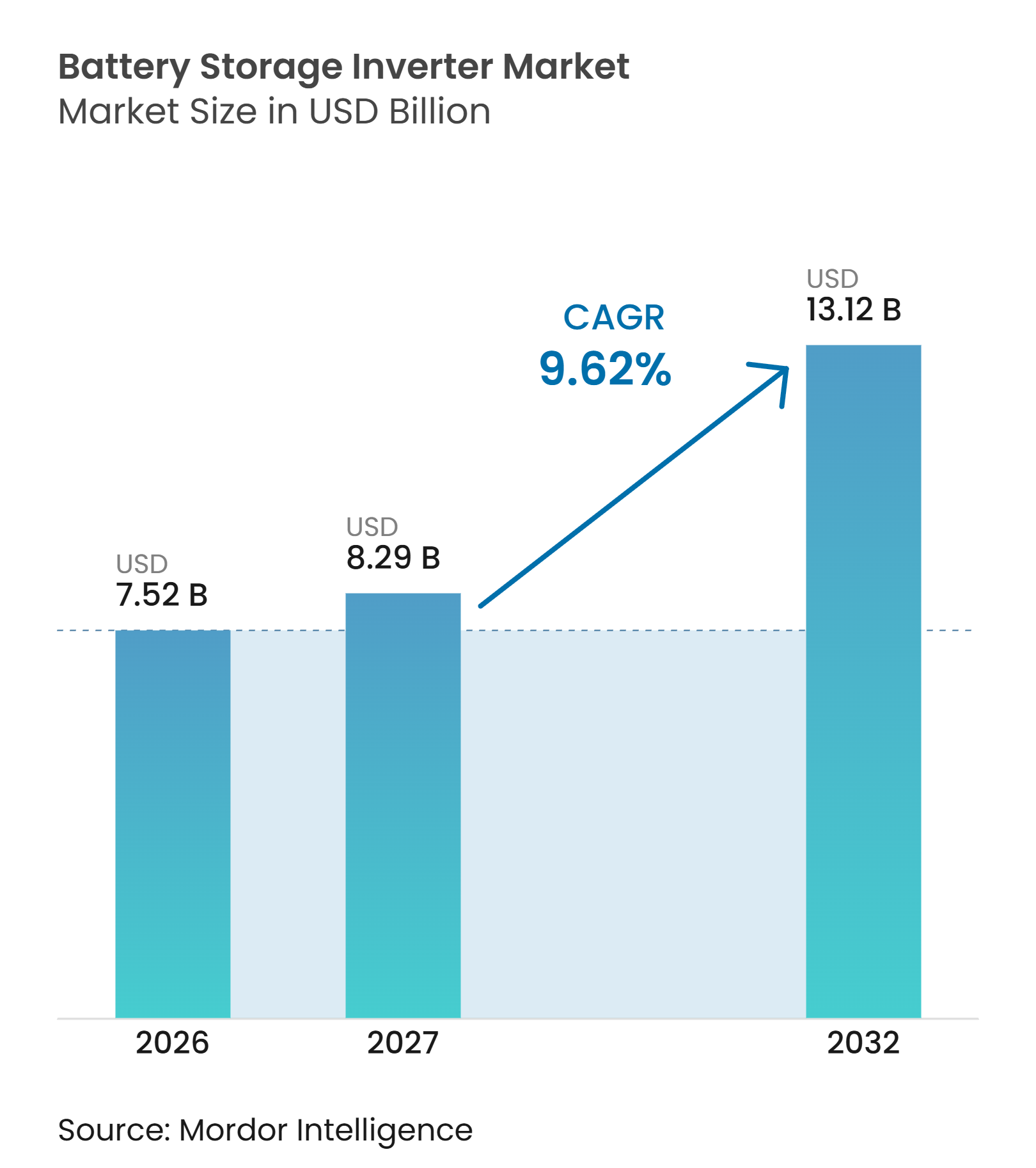
The global battery storage inverter market size is expected to grow from USD 7.5 billion in 2026 to USD 8.3 billion in 2027 and is forecast to reach USD 13.1 billion by 2032 at 9.6% CAGR over 2027-2032. The battery storage inverter market is moving beyond basic energy conversion as grids replace synchronous thermal generation and need equipment that can regulate voltage, frequency, and synthetic inertia. This change makes power conversion performance, grid-code compliance, and service capability more important in purchasing decisions. For the battery storage inverter market, this means technical specifications increasingly influence selection before price comparisons begin. Owners are assessing fault ride-through, reactive power support, response speed, and maintenance arrangements alongside the rated power of each system. Procurement teams also need confidence that control settings can be updated as operating rules evolve. Those requirements favor suppliers that can support design, commissioning, and later software revisions over the operating life of an asset. Silicon carbide power electronics and grid-forming controls are becoming important features for large projects, especially where heat, network stability, or high renewable output create operating constraints. Data centers are opening a higher-specification opportunity because AI workloads need rapid power response and reliable transitions between grid-connected and islanded operation. At the same time, project economics remain exposed to financing costs, component supply concentration, changing policy rules, and slow interconnection processes.
Key Report Takeaways
- By inverter type, Three-Phase held 59.4% of revenue in 2026 and is forecast to expand at a 10.1% CAGR through 2032.
- By inverter architecture, Central Inverters held 42.3% of revenue in 2026, while Hybrid Inverters are forecast to expand at an 11.3% CAGR through 2032.
- By power rating, Above-1-MW systems held 41.7% of revenue in 2026, while the 501 kW-1 MW category is forecast to expand at a 9.8% CAGR through 2032.
- By application, Utility Scale held 54.8% of revenue in 2026, while Data Centers and Critical Infrastructure are forecast to expand at an 11.7% CAGR through 2032.
- By battery type, Lithium-Ion held 84.7% of revenue in 2026, while Sodium-Ion is forecast to expand at a 12.6% CAGR through 2032.
- By geography, Asia-Pacific held 57.3% of revenue in 2026 and is forecast to expand at a 10.3% CAGR through 2032.
Note: Market numbers in this report are based on Mordor Intelligence's proprietary estimation framework, which combines nine months of actuals with Q4 projections for base year 2026.
Market Trends and Insights
Drivers Impact Analysis of Battery Storage Inverter Market*
| Driver | (~) % Impact on CAGR Forecast | Geographic Relevance | Impact Timeline |
|---|---|---|---|
| Renewable Energy Integration and Curtailment Reduction | +2.2% | Global, with highest relevance in China, India, Germany, and the United States | Long term (≥ 4 years) |
| Utility Demand for Grid Stability and Ancillary Services | +1.8% | Global, with early gains in Australia, the United Kingdom, ERCOT, and Germany | Medium term (2-4 years) |
| Falling Battery Storage and Power Electronics Costs | +1.5% | Global, with the strongest cost leverage in Asia-Pacific | Short term (≤ 2 years) |
| Government Incentives, Storage Mandates and Capacity Payments | +1.4% | North America and Europe, with spillover to Asia-Pacific and MEA | Medium term (2-4 years) |
| Data Center, Microgrid and Critical-Load Resilience Requirements | +1.2% | North America, Asia-Pacific, and Europe | Medium term (2-4 years) |
| Grid-Forming Inverter Adoption After Synchronous Generation Retirement | +1.0% | Australia, the United Kingdom, Germany, the United States, and Saudi Arabia | Medium term (2-4 years) |
| Source: Mordor Intelligence | |||
Renewable Energy Integration and Curtailment Reduction
Variable renewable generation creates periods when networks cannot absorb available electricity, particularly in areas with concentrated solar and wind additions, because transmission expansion and dispatch rules do not always keep pace with the generation buildout. The challenge is most visible when high output occurs during low-demand periods, when available generation has limited local value unless it can be stored or moved across the network. The battery storage inverter market benefits when storage can absorb that energy and return it during higher-value demand periods. Curtailment in Inner Mongolia, Gansu, Rajasthan, and CAISO has created localized demand for flexible, rapidly dispatchable storage configurations. China’s New-Type Energy Storage Scale-up Action Plan targets 180 GW of cumulative new-type storage by 2027 and identifies CNY 250 billion in related direct investment, which supports demand for large power conversion systems. The policy direction favors modular AC-block systems that can be deployed at scale and provide controlled dispatch. In the battery storage inverter market, this changes the preferred product from a standalone converter to an integrated system element that must work with the battery, plant controller, protection equipment, and the grid operator’s instructions. Standardized blocks can support repeat deployment, but each project still requires settings that reflect local network conditions. Suppliers that understand both standardized manufacturing and site-level integration are better positioned as programs become larger. It also shifts attention from small behind-the-meter products toward equipment suited to network-level storage projects.
Utility Demand for Grid Stability and Ancillary Services
Grid operators are shifting from voluntary support standards toward formal technical obligations for inverter-based storage. This development supports the battery storage inverter market because grid-forming capability can create recurring service revenue as well as satisfy connection requirements. Germany’s Momentanreserve market opened in 2026 with long-term contracts for battery systems that can maintain frequency within a ±0.2 Hz band. Australia’s 2025 Transition Plan for System Security identified 10 operating grid-forming battery sites with combined capacity of 1,070 MW and a pipeline of 94 projects.[1] Requirements still vary by jurisdiction, which increases compliance costs for multi-country projects and can extend development timelines when equipment must be reconfigured or separately tested. The absence of a single common approach also makes it harder for owners to use the same approved platform across a geographically diverse portfolio. Suppliers with tested designs and grid-code certification across several markets can use that complexity as a practical advantage.
Falling Battery Storage and Power Electronics Costs
Lower battery costs are improving the economics of storage projects and are widening the addressable base for power conversion equipment. As cell costs decline, the inverter and related electrical equipment represent a larger share of installed system value, rather than a supporting component chosen mainly on initial purchase cost. Buyers can then give more weight to conversion losses, thermal management, spare-parts needs, and field service when comparing otherwise similar storage proposals. This places more focus on efficiency, footprint, cooling, and lifetime performance in the battery storage inverter market. Even modest conversion losses can matter across the long operating life of a storage asset, particularly where a system cycles often or faces high ambient temperatures. Reduced heat can also lower cooling needs and simplify container design. These operating considerations make the selection process broader than the inverter’s initial rated efficiency. They also increase the value of stable performance under changing load and temperature conditions. GE Vernova introduced its 1.5 kV SiC FLEXINVERTER in May 2025, highlighting higher power density and lower levelized storage costs.[2] SMA introduced the Sunny Central Storage UP-S with silicon carbide MOSFET technology in March 2025, reporting conversion efficiency above 99.2%.[3] Sungrow’s PowerTitan 3.0, introduced in June 2025, also used liquid-cooled silicon carbide power conversion and reported 99.3% round-trip efficiency.[4]
Data Center, Microgrid and Critical-Load Resilience Requirements
AI data centers need stable power during fast changes in computing load, which creates a distinct use case for grid-forming storage. The battery storage inverter market can serve this demand with systems that respond at the sub-cycle level and operate with medium-voltage switchgear, while retaining predictable control during very short changes in demand. That need is different from a conventional backup system because the equipment must manage normal operating variations as well as an outage or planned islanding event. A 2026 study modeled grid-forming battery storage as a line-interactive UPS for hyperscale facilities and examined its ability to manage short-duration power steps during grid-to-islanded transitions. Prevalon launched its Hybrid Power Stabilizer for data center applications in February 2026 and reported 1.3 GW of contracted deployments. The United States Department of Energy identifies storage paired with on-site generation as a way to reduce blackout exposure and address constrained interconnection conditions. These requirements favor purpose-designed platforms with cybersecurity controls, rapid response, and compatible protection systems.
Restraints Impact Analysis of Battery Storage Inverter Market*
| Restraint | (~) % Impact on CAGR Forecast | Geographic Relevance | Impact Timeline |
|---|---|---|---|
| High Upfront System and Installation Costs | -1.2% | Global, with strongest relevance in Southeast Asia, Africa, and Latin America | Long term (≥ 4 years) |
| Interconnection Delays and Fragmented Grid-Code Requirements | -0.9% | North America, Europe, and Asia-Pacific | Medium term (2-4 years) |
| Semiconductor, IGBT and Silicon-Carbide Supply Volatility | -0.6% | Global, with supply concentrated in the United States, Europe, Japan, and China | Medium term (2-4 years) |
| Revenue Uncertainty from Policy, Tariff, and Ancillary-Service Changes | -0.7% | North America, Europe, and Asia-Pacific | Medium term (2-4 years) |
| Source: Mordor Intelligence | |||
High Upfront System and Installation Costs
Total system cost remains a constraint even when battery cell prices decline. Inverter hardware, switchgear, civil works, commissioning, and testing cannot fall at the same pace as electrochemical cells. This limits the battery storage inverter market in countries where financing is expensive or contract structures are less developed. Southeast Asia, Sub-Saharan Africa, and Latin America often have strong resilience needs but fewer creditworthy off-takers and less concessional capital, which makes long payback periods more difficult to finance and can limit the pool of viable storage developers. The barrier can remain even where local solar resources, diesel displacement, or reliability needs provide a clear operational case for storage. IEC 62109 and IEC 61800 compliance testing adds cost and time, especially where local test facilities are limited. Storage-as-a-Service and capacity-payment structures can move capital risk to providers and investors, but these models remain less established outside advanced economies.
Interconnection Delays and Fragmented Grid-Code Requirements
Interconnection queues can delay financing, equipment orders, and project commissioning for years. This creates uneven order timing for the battery storage inverter market, even where storage demand is strong, since a developer may be unable to place an equipment order until network studies and cost responsibilities are settled. The resulting uncertainty affects manufacturers as well as project owners because expected demand can move between quarters without a change in end-user need. A Joule study reported more than 2,600 GW of generation and storage capacity seeking the United States bulk-power interconnection and a median interconnection duration of 56 months. Technical requirements also vary among independent system operators, transmission organizations, and distribution utilities. Equipment certified to IEEE 1547 may require further work for VDE-AR-N 4120 or the United Kingdom’s G99 requirements. The Department of Energy’s 2025 interconnection roadmap identifies inconsistent requirements as a systemic issue and supports wider use of IEEE 1547.
*Our forecasts treat driver/restraint impacts as directional, not additive. The impact forecasts reflect baseline growth, mix effects, and variable interactions.
Battery Storage Inverter Market Segment Analysis
By Inverter Type:
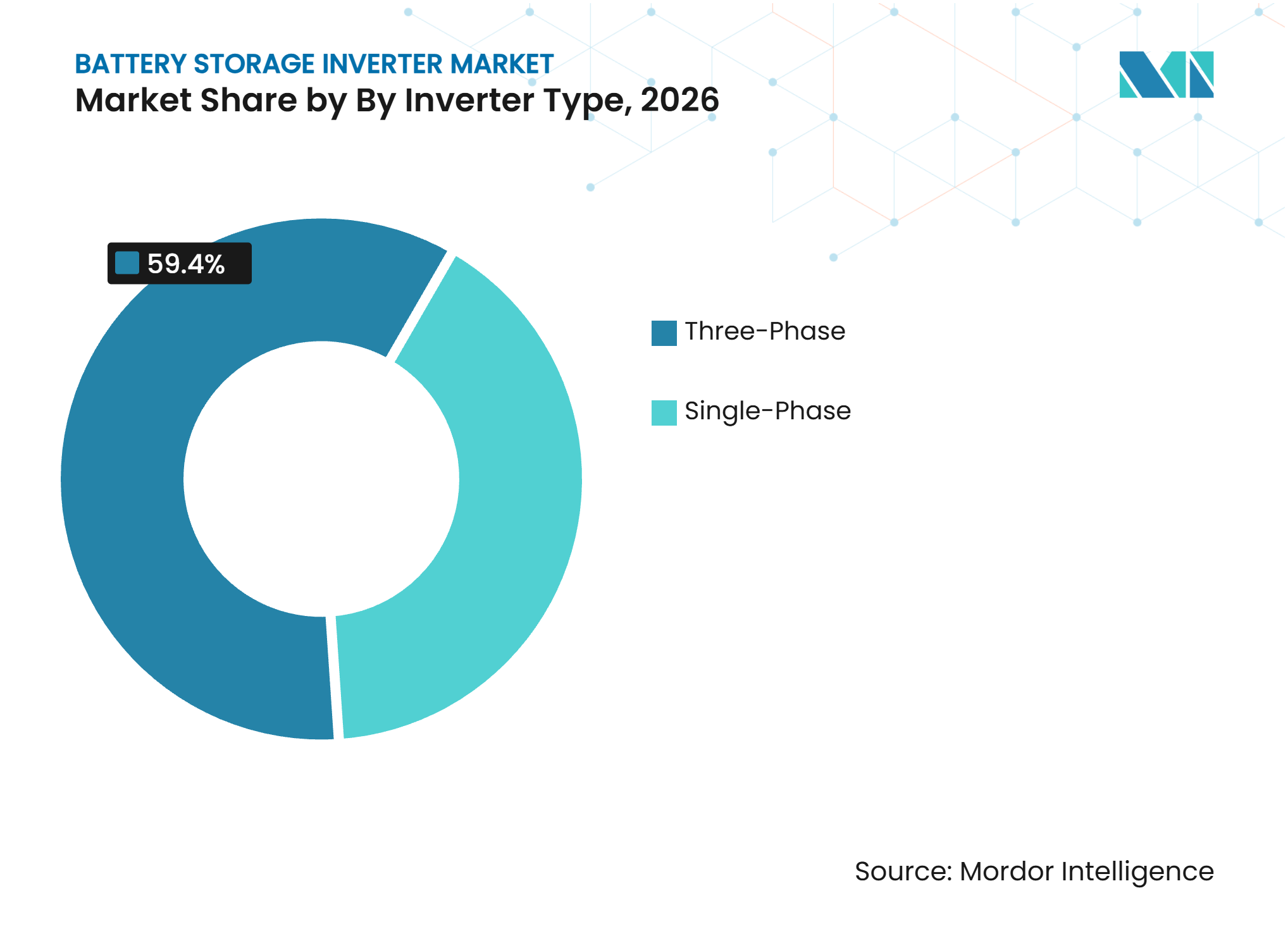
Three-Phase Configurations Anchor Utility and Industrial ScaleThree-Phase systems held 59.4% of the battery storage inverter market share in 2026. Their lead reflects the electrical design of utility-scale and commercial storage, where balanced loads and high power output are essential. Three-phase equipment reduces current per phase for a given output and supports larger AC-coupled systems. The move toward 1,500 V DC bus designs reinforces this position by allowing fewer and larger inverter units for each MW installed. Fewer units can reduce wiring complexity, switchgear needs, and engineering work. These features make three-phase configurations well suited to projects that must meet demanding grid-support obligations.
Sungrow’s PowerTitan 3.0 illustrates this direction because its three-phase silicon carbide conversion system operates continuously at 450 kW per unit. The platform is intended for multi-megawatt AC-block configurations used by grid-scale developers. Single-Phase systems remain relevant for residential and small commercial sites where grid connections use a single phase. Heiwit received CEI 0-21 certification for a grid-connected sodium-ion inverter in 2025, providing a certified path for residential sodium-ion storage in Italy. The battery storage inverter industry still needs single-phase products for distributed installations. However, larger utility, microgrid, and critical-load projects continue to favor three-phase control architecture.



By Inverter Architecture:
Hybrid Growth Accelerates as Co-Location Becomes StandardCentral Inverters accounted for 42.3% of the battery storage inverter market size in 2026, while Hybrid Inverters are projected to grow at 11.3% CAGR through 2032. Central systems retain a cost-per-kW advantage for very large storage stations and simplify monitoring across a centralized plant. Hybrid equipment combines solar conversion, bidirectional battery conversion, and grid connection in one unit. This can reduce component counts, installation footprint, and system complexity. These benefits matter in urban commercial sites, residential installations, and off-grid community projects. Co-located solar and storage is making this design more relevant across several customer groups.
SolarEdge launched its Nexis residential solar-and-storage system in Germany in March 2026 with a silicon carbide hybrid inverter design. String Inverters are also gaining interest in utility projects because distributed strings can limit exposure to a single point of failure. Modular systems remain smaller in scale, yet their stepwise expansion suits data centers and other critical facilities. ABB’s 34.5 kV HiPerGuard UPS supports modular expansion up to 25 MW per configuration. The battery storage inverter market, therefore, has room for several architectures rather than a single universal design, because site conditions, existing solar equipment, service practices, and desired redundancy differ materially across customers. This keeps architecture selection closely tied to the operating purpose of each installation instead of simple equipment preference. The key distinction is whether buyers value centralized cost efficiency, redundancy, incremental expansion, or combined solar-storage functionality.
By Power Rating:
Large-Scale Systems Set the Commercial AnchorAbove-1-MW systems accounted for 41.7% of the battery storage inverter market size in 2026. These systems serve projects that provide black-start capability, inertia replacement, and multi-hour energy arbitrage. Larger systems can reduce balance-of-plant cost and make grid-code compliance easier to manage at the project level. Developers also use fewer units when capacity rises into the hundreds of MWh. This simplifies engineering and can reduce switchgear and cabling requirements. The battery storage inverter market is therefore linked closely to the growing scale of utility procurement. Large procurements can create a demand profile that is less frequent but far larger than distributed installations, which adds visibility and variability to supplier order books. System owners also expect equipment partners to coordinate with EPC contractors, battery suppliers, and grid operators. As a result, product availability, factory testing, and on-site commissioning capability can be as important as nameplate rating. The same project scale that improves cost efficiency can raise the consequences of delayed delivery or incomplete compliance documentation.
BYD Energy Storage’s July 2026 contract for Masdar’s project covers a 1,644 MW and 11,275 MWh battery station, demonstrating the scale at which large platforms operate. The 501 kW-1 MW category is forecast to grow at 9.8% CAGR through 2032. It addresses large commercial sites, microgrids, and distribution-connected storage that do not require transmission-scale equipment. UL 9540 and UL 1741 SA provide part of the United States compliance pathway for these systems. Lower ratings remain important for residential and small commercial solar-storage installations. New Jersey’s Garden State Energy Storage Program is one example of policy support for distributed deployments
By Application:
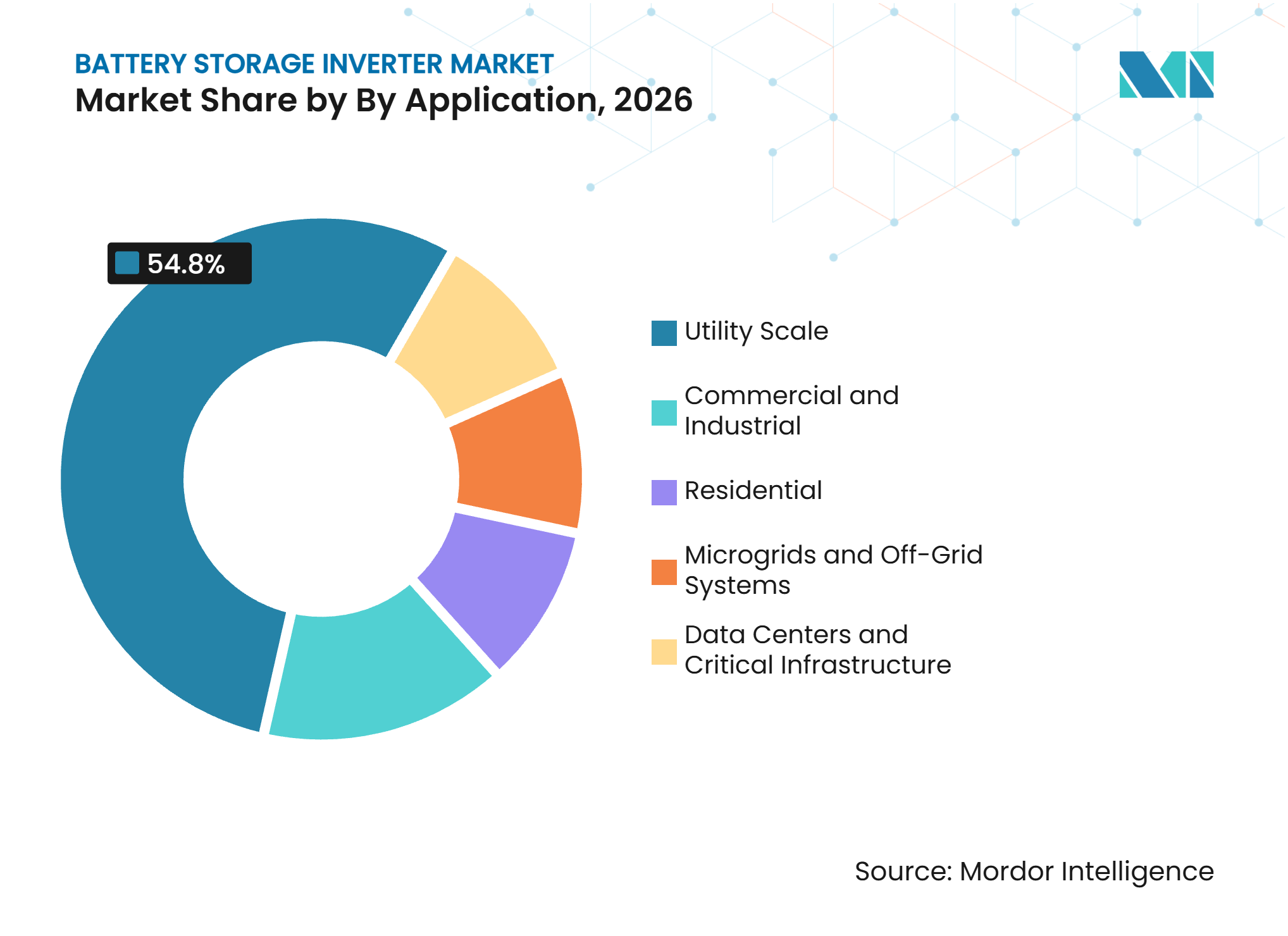
Utility Scale Leads While Data Centers Drive the Next Growth WaveUtility Scale held 54.8% of revenue in 2026, while Data Centers and Critical Infrastructure are projected to grow at 11.7% CAGR through 2032. Utility projects continue to lead because governments and system operators need large-scale flexibility for renewable integration. China, the United States, the United Kingdom, and Gulf markets have sizable procurement programs. Data center requirements differ from utility use because AI load changes demand fast control and smooth grid-to-islanded transfers. These facilities also value direct medium-voltage connection and application-specific control software. The result is a premium requirement set that can support specialized products.
Commercial and industrial customers are adopting peak shaving, Storage-as-a-Service, and self-consumption models without always funding systems directly. Germany, Italy, and Japan support this path through renewable self-consumption goals. Residential customers are responding to net-metering reform and self-consumption rules in Europe and Australia. Microgrids and off-grid systems remain important where reliability is weak or last-mile networks are limited. The battery storage inverter market also benefits where systems can provide resilience without waiting for new transmission capacity. These applications require manufacturers to balance standardized equipment with local requirements for connection, safety, and service.

By Battery Type:
Lithium-Ion Commands the Market as Sodium-Ion CommercializesLithium-Ion pairings held 84.7% of the battery storage inverter market size in 2026. The position reflects established supply chains, proven cycle-life data, and mature integration processes. Lithium-ion systems have also shaped common battery management communications, including CAN bus, Modbus, and CANopen. This supports suppliers that already have firmware libraries and approved integration profiles. New battery chemistries require more than a cell substitution because control settings, safety procedures, and certification may need revision. Lithium-ion, particularly LFP, therefore remains the reference point for many current inverter designs.
Sodium-Ion is forecast to grow at 12.6% CAGR through 2032 as its cost position and inverter compatibility improve. Its wider state-of-charge voltage window can complicate DC bus control when compared with LFP. Suppliers are addressing this through firmware changes and purpose-built battery management interfaces. SMA’s Sunny Island X 50 was integrated into a sodium-ion installation near Bremen Airport in September 2025 using DC-DC conversion stages. Lead-Acid remains relevant in selected backup and UPS installations where replacement economics favor established technology. Flow batteries remain focused on 4-12-hour applications where deep discharge and independent energy scaling can justify higher capital costs in applications that place greater value on duration and operating flexibility than on compact installation. Their role remains narrower than lithium-ion in the current battery storage inverter market, but it illustrates why conversion equipment must accommodate different voltage and control characteristics.
Geography Analysis
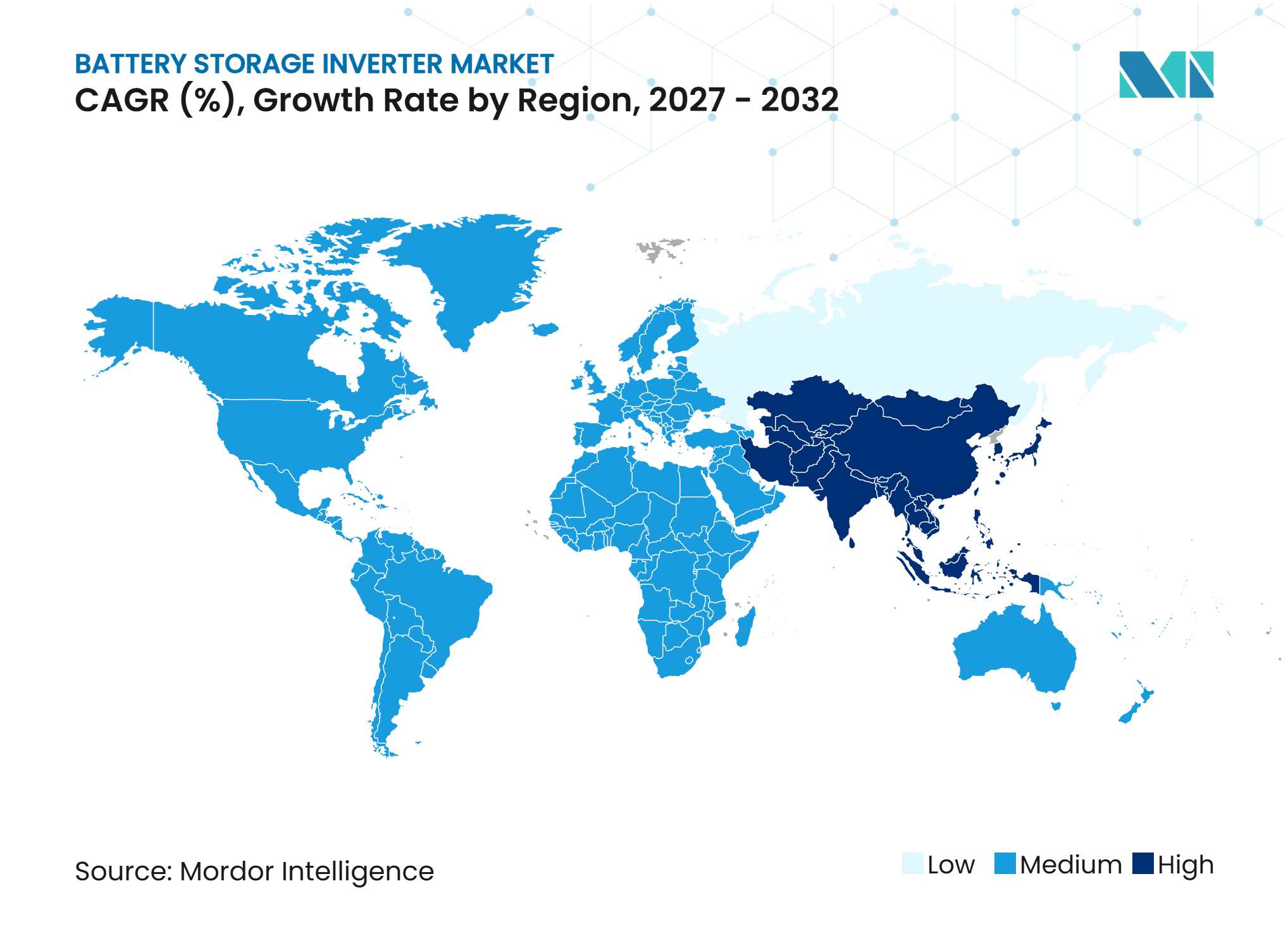
Asia-Pacific held 57.3% of revenue in 2026 and is expected to grow at 10.3% CAGR through 2032. China is central to regional demand because its large renewable base and storage targets require substantial power conversion capacity. The country’s 2025-2027 storage plan targets 180 GW of new-type storage by 2027. Grid-forming storage is also becoming more relevant as operators address stability needs in systems with high renewable output. India, Japan, South Korea, Australia, and Southeast Asia form the next group of demand centers. Their drivers vary from manufacturing incentives and grid procurement to renewable additions and resilience needs. This diversity means that the battery storage inverter market does not move uniformly across Asia-Pacific. Some countries prioritize bulk capacity for system balancing, while others focus on commercial self-consumption or resilient supply for remote and weak-grid locations. Manufacturers must adapt product ratings, certifications, service networks, and commercial terms to those different conditions. Regional manufacturing depth can help suppliers compete, but local approval and after-sales support remain important in project execution.
North America and Europe are the next largest regional markets, but both face policy changes and interconnection constraints. In the United States, domestic-content credit rules encourage local manufacturing while adding planning complexity for projects that use imported components. Europe added 36 GWh of battery storage in 2025, a 48% increase from the previous year, and cumulative installed capacity moved beyond 100 GWh. Germany installed 6.6 GWh in 2025, while the United Kingdom installed 5.2 GWh. Germany’s new Momentanreserve mechanism provides a longer-term revenue structure for grid-forming systems. These developments support demand for equipment that meets local technical and commercial requirements.
South America and the Middle East and Africa remain smaller but important long-term areas for the battery storage inverter market. The Abu Dhabi Round-the-Clock project combines 5.2 GW of solar with 19 GWh of storage to supply 1 GW of continuous output and is scheduled for commissioning in 2027. Sungrow agreed in May 2026 to provide 7.5 GWh of storage systems and 2.6 GW of solar inverters for the project. Saudi Arabia, the UAE, South Africa, and Kenya are active markets in the wider region. Brazil, Chile, and Colombia are supporting demand through hydropower complementarity and rising solar penetration. BYD and Skysense announced a 300 MWh energy storage alliance for Mexico and the wider Latin American region in October 2025.
Competitive Landscape
Market Concentration
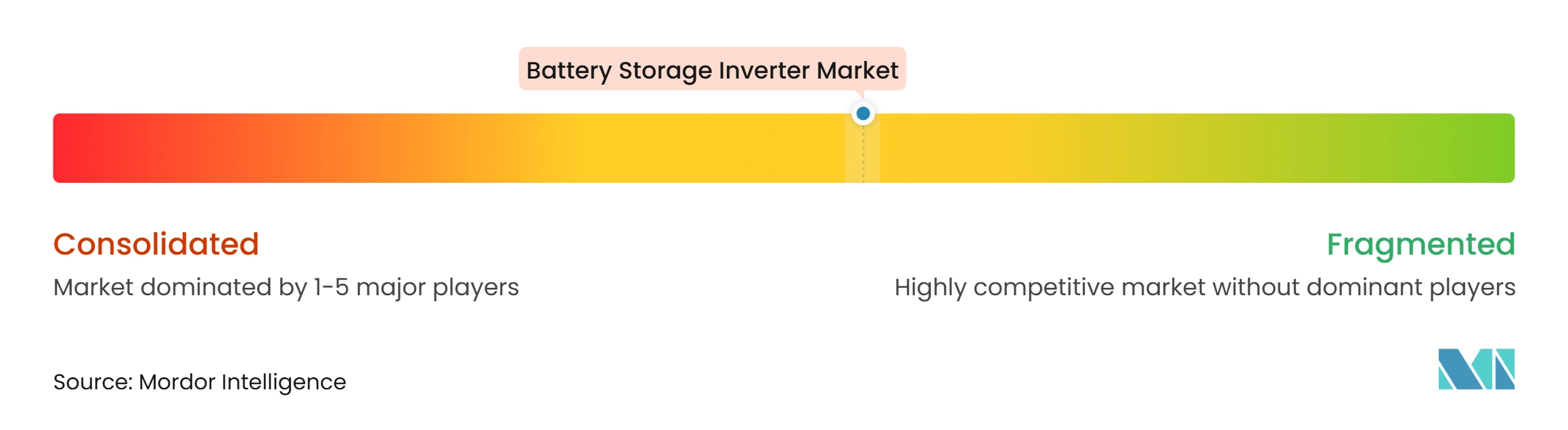
The battery storage inverter market has a moderately consolidated global structure, with leading suppliers retaining strong positions in their core regions and applications. Sungrow and Huawei Digital Power are prominent in utility and large commercial projects through manufacturing scale and integrated inverter-storage platforms. ABB, Schneider Electric, Siemens Energy, and GE Vernova compete in high-reliability applications that require proven engineering, service coverage, and compliance credentials. Grid-forming controls, silicon carbide designs, and long-term maintenance support are becoming important points of competition. This structure gives established suppliers advantages in complex projects while leaving room for specialized firms. Regional differences in grid rules also make local technical support valuable. In the battery storage inverter market, suppliers must often show that the same core product can meet varying protection, testing, communications, and grid-support requirements. This favors companies that have local engineering resources or proven partners, particularly where customers require support during commissioning and subsequent compliance checks. It also creates a role for specialists who understand a narrow application or a national market. Competition is therefore shaped by implementation capability as well as manufacturing scale.
GE Vernova launched its 1.5 kV SiC FLEXINVERTER in May 2025 and manufactures it in Chennai and Pittsburgh. The launch supports projects that prioritize higher density, lower cooling needs, and domestic-content positioning in the United States. SolarEdge launched Nexis in Germany in March 2026 for residential solar-storage installations. Prevalon’s February 2026 Hybrid Power Stabilizer targets the more specialized data center segment. These moves show how competitors are separating through utility scale, distributed hybrid systems, and critical-load applications. The battery storage inverter industry is also seeing more attention to software that can coordinate equipment from different vendors.
Smaller firms are using grid-forming and silicon carbide designs to enter portions of the market that once depended mainly on established suppliers. Others, including Dynapower and TMEIC, focus on applications where certification and specialized engineering can support pricing. UL 9540A testing, UL 1741 SA functions, National Electrical Code requirements, and IEC 62933 standards raise the qualification threshold for larger projects. This can limit the number of suppliers that can serve critical infrastructure and utility-scale sites. At the same time, central and string inverter products face continued price pressure where large Chinese manufacturers use cost advantages and broad production capacity. Suppliers without clear silicon carbide and grid-forming plans risk losing access to higher-value applications. Market concentration score: 6 out of 10, because the leading group has meaningful global influence but regional suppliers and application specialists continue to prevent a highly concentrated structure.
Battery Storage Inverter Industry Leaders
-
Sungrow Power Supply Co., Ltd.
-
Huawei Digital Power Technologies Co., Ltd.
-
ABB Ltd.
-
SMA Solar Technology AG
-
Power Electronics España, S.L.
- *Disclaimer: Major Players sorted in no particular order
Battery Storage Inverter Market Companies Covered in this Report
- ABB Ltd.
- BYD Company Limited
- Delta Electronics, Inc.
- Dynapower Company LLC
- Eaton Corporation plc
- Fluence Energy, Inc.
- General Electric Company
- GoodWe Technologies Co., Ltd.
- Hitachi Energy Ltd.
- Huawei Digital Power Technologies Co., Ltd.
- Ingeteam Power Technology, S.A.
- KACO new energy GmbH
- Nidec Corporation
- Parker Hannifin Corporation
- Power Electronics Espana, S.L.
- Schneider Electric SE
- Siemens Energy AG
- Sineng Electric Co., Ltd.
- SMA Solar Technology AG
- SolarEdge Technologies Ltd.
- SolaX Power Network Technology (Zhejiang) Co., Ltd.
- Sungrow Power Supply Co., Ltd.
- Tesla, Inc.
- TMEIC Corporation
Recent Industry Developments in Battery Storage Inverter Market
- July 2026: BYD Energy Storage signed a contract with Masdar to supply 11.275 GWh of battery storage (1,644 MW) for the Abu Dhabi Round-the-Clock renewable project, the largest single battery storage order in BYD's history, targeting commissioning in 2027 for the world's first gigascale round-the-clock renewable initiative.
- May 2026: Sungrow signed to deliver 7.5 GWh of its PowerTitan 3.0 storage platform plus 2.6 GW of solar inverters for the Abu Dhabi Round-the-Clock project, pairing its grid-forming SiC power conversion system with the world's largest utility storage deployment.
- April 2026: ABB launched the 34.5 kV HiPerGuard UPS system, a grid-connected uninterruptible power supply designed for AI hyperscale data centers, achieving 98% efficiency and supporting modular expansion up to 25 MW, with integrated battery management and peak-shaving functions via ABB's Power Exchanger technology.
- March 2026: SolarEdge launched its Nexis residential solar-and-storage system in Germany, incorporating SiC-based inverter switches to reduce weight per kW by up to 20% relative to competing European platforms and targeting the co-located solar-storage segment under Germany's self-consumption regulatory framework.
Global Battery Storage Inverter Market Report Scope
The Global Battery Storage Inverter Market comprises the market for power conversion equipment designed to convert the direct current (DC) electricity stored in batteries into alternating current (AC) electricity for use by electrical grids, buildings, industrial facilities, and other power-consuming systems. Battery storage inverters also convert AC electricity into DC electricity during battery charging and manage the bidirectional flow of power between battery systems and electrical networks. These inverters support energy storage applications such as renewable energy integration, peak shaving, load shifting, backup power, frequency regulation, and grid stabilization. The market includes single-phase and three-phase inverters, central, string, modular, and hybrid inverter architectures, as well as equipment configured for different power ratings and battery technologies. Battery storage inverters are deployed across utility-scale energy storage projects, commercial and industrial facilities, residential installations, microgrids, off-grid systems, and data centers and other critical infrastructure.
The Global Battery Storage Inverter Market is segmented by Inverter Type (Single-Phase and Three-Phase); By Inverter Architecture (Central Inverters, String Inverters, Modular Inverters, and Hybrid Inverters); By Power Rating (Below 100 kW, 100–500 kW, 501 kW–1 MW, and Above 1 MW); By Application (Utility Scale, Commercial and Industrial, Residential, Microgrids and Off-Grid Systems, and Data Centers and Critical Infrastructure); and By Battery Type (Lithium-Ion, Lead-Acid, Flow Batteries, Sodium-Ion, and Other Battery Types). The market is also segmented geographically across 26 countries in key regions. For each segment, market sizing and forecasts are provided on the basis of value (USD).
Segmentation Overview
| Single-Phase |
| Three-Phase |
| Central Inverters |
| String Inverters |
| Modular Inverters |
| Hybrid Inverters |
| Below 100 kW |
| 100-500 kW |
| 501 kW-1 MW |
| Above 1 MW |
| Utility Scale |
| Commercial and Industrial |
| Residential |
| Microgrids and Off-Grid Systems |
| Data Centers and Critical Infrastructure |
| Lithium-Ion |
| Lead-Acid |
| Flow Batteries |
| Sodium-Ion |
| Other Battery Types |
| North America | United States |
| Canada | |
| Mexico | |
| Europe | Germany |
| France | |
| Italy | |
| Spain | |
| United Kingdom | |
| Poland | |
| Netherlands | |
| Russia | |
| Rest of Europe | |
| Asia-Pacific | China |
| India | |
| Japan | |
| South Korea | |
| Australia | |
| Indonesia | |
| Malaysia | |
| Thailand | |
| Philippines | |
| Rest of Asia-Pacific | |
| South America | Brazil |
| Argentina | |
| Colombia | |
| Rest of South America | |
| Middle East and Africa | Saudi Arabia |
| United Arab Emirates | |
| South Africa | |
| Kenya | |
| Egypt | |
| Nigeria | |
| Rest of Middle East and Africa |
| By Inverter Type | Single-Phase | |
| Three-Phase | ||
| By Inverter Architecture | Central Inverters | |
| String Inverters | ||
| Modular Inverters | ||
| Hybrid Inverters | ||
| By Power Rating | Below 100 kW | |
| 100-500 kW | ||
| 501 kW-1 MW | ||
| Above 1 MW | ||
| By Application | Utility Scale | |
| Commercial and Industrial | ||
| Residential | ||
| Microgrids and Off-Grid Systems | ||
| Data Centers and Critical Infrastructure | ||
| By Battery Type | Lithium-Ion | |
| Lead-Acid | ||
| Flow Batteries | ||
| Sodium-Ion | ||
| Other Battery Types | ||
| By Geography | North America | United States |
| Canada | ||
| Mexico | ||
| Europe | Germany | |
| France | ||
| Italy | ||
| Spain | ||
| United Kingdom | ||
| Poland | ||
| Netherlands | ||
| Russia | ||
| Rest of Europe | ||
| Asia-Pacific | China | |
| India | ||
| Japan | ||
| South Korea | ||
| Australia | ||
| Indonesia | ||
| Malaysia | ||
| Thailand | ||
| Philippines | ||
| Rest of Asia-Pacific | ||
| South America | Brazil | |
| Argentina | ||
| Colombia | ||
| Rest of South America | ||
| Middle East and Africa | Saudi Arabia | |
| United Arab Emirates | ||
| South Africa | ||
| Kenya | ||
| Egypt | ||
| Nigeria | ||
| Rest of Middle East and Africa | ||
Key Questions Answered in the Report
What is driving demand for battery storage inverters?
Renewable integration, grid stability needs, and rising demand for resilient power at data centers are expanding demand for advanced power conversion systems.
How large is the battery storage inverter market?
The battery storage inverter market size is expected to grow from USD 7.52 billion in 2026 to USD 8.29 billion in 2027 and is forecast to reach USD 13.12 billion by 2032 at 9.6% CAGR over 2027-2032.
Which inverter configuration leads utility-scale storage projects?
Three-Phase configurations held 59.4% of revenue in 2026 because they support balanced loads and higher power output.
Which battery chemistry is most widely paired with inverters?
Lithium-Ion held 84.7% of revenue in 2026, supported by established supply chains and integration standards.
Which application is growing fastest?
Data Centers and Critical Infrastructure is forecast to grow at 11.7% CAGR through 2032 as facilities need rapid and reliable power support.
Which region is expected to grow fastest?
Asia-Pacific held 57.3% of revenue in 2026 and is forecast to grow at 10.3% CAGR through 2032.