
Battery Slurry Dispersant Market Size and Share
Market Overview
| Study Period | 2021 - 2031 |
|---|---|
| Market Size (2026) | USD 0.74 Billion |
| Market Size (2031) | USD 1.33 Billion |
| Growth Rate (2026 - 2031) | 12.43 % |
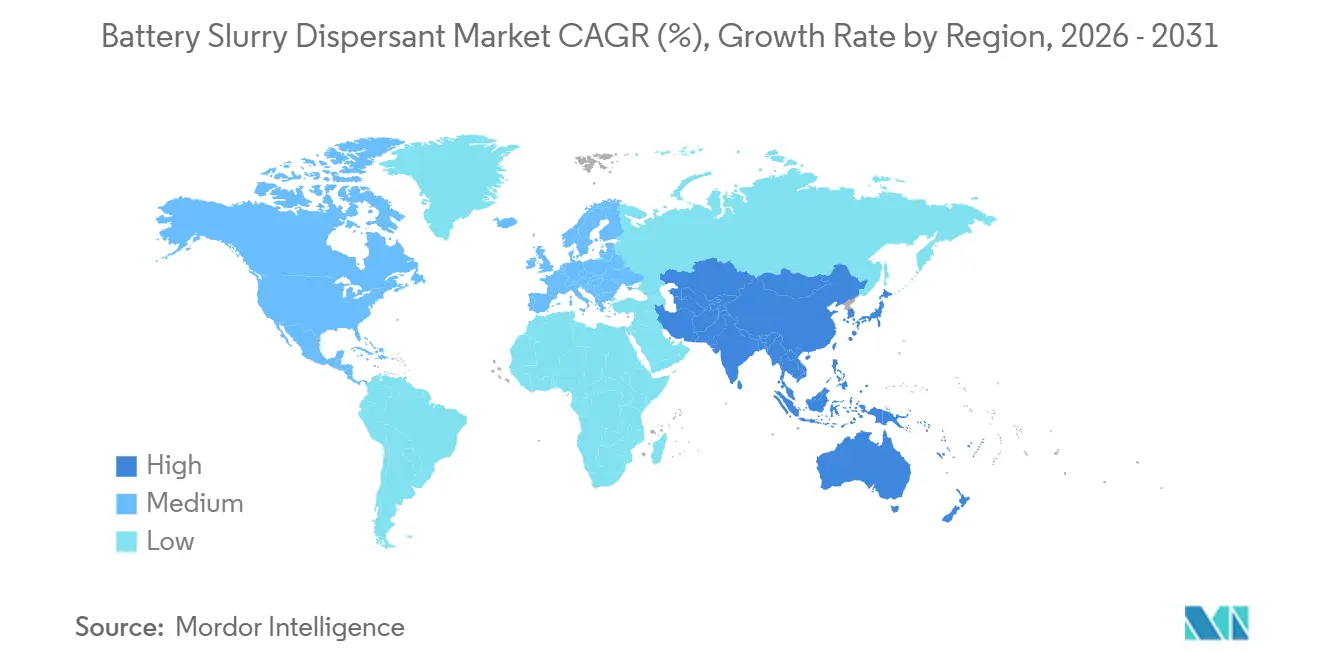
| Fastest Growing Market | Asia-Pacific |
| Largest Market | Asia-Pacific |
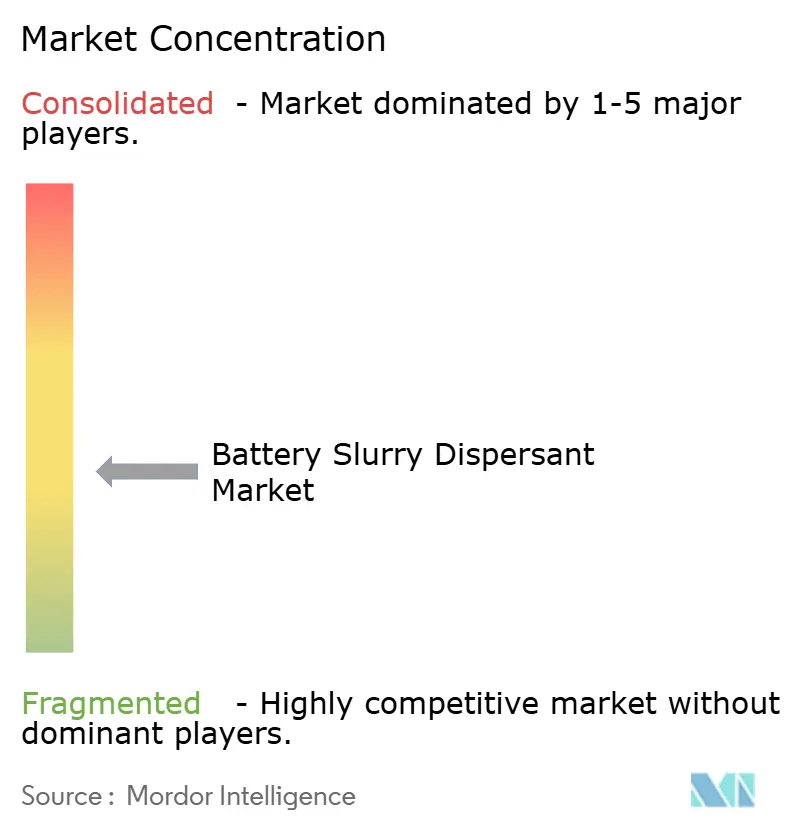
| Market Concentration | Medium |
Major Players *Disclaimer: Major Players sorted in no particular order Image © Mordor Intelligence. Reuse requires attribution under CC BY 4.0. | |
Battery Slurry Dispersant Market Analysis by Mordor Intelligence
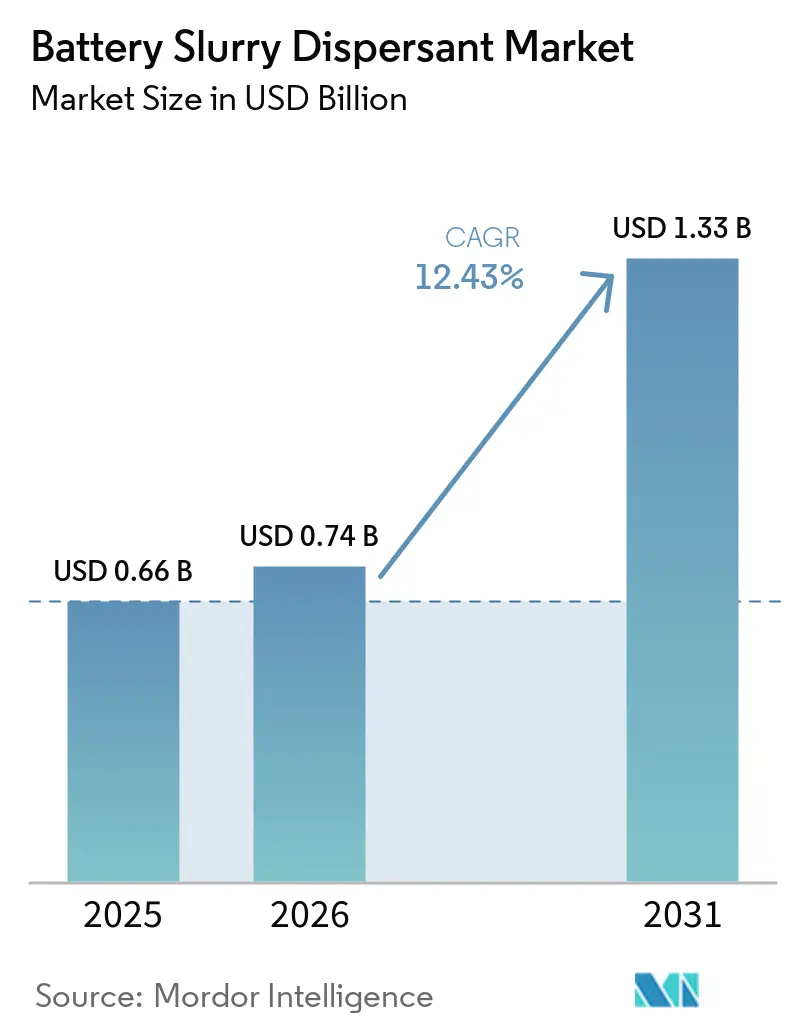
The Battery Slurry Dispersant market size was valued at USD 0.66 billion in 2025 and is estimated to grow from USD 0.74 billion in 2026 to reach USD 1.33 billion by 2031, at a CAGR of 12.43% during the forecast period (2026-2031). Battery slurry dispersants stabilize electrode slurries, reduce particle agglomeration, control viscosity, and support uniform coating on current collector foils. Their role becomes more important as cell makers use more complex chemistries, higher solids loadings, and thicker electrodes. Gigafactory construction for electric vehicles and grid-scale storage provides a durable demand base for the battery slurry dispersant market. Manufacturers increasingly treat dispersant selection as a process control decision because it can affect coating consistency, electrode yield, and electrochemical performance. Water-based processing and sodium-ion cell production also create opportunities for formulations that incumbent products may not address.
Key Report Takeaways
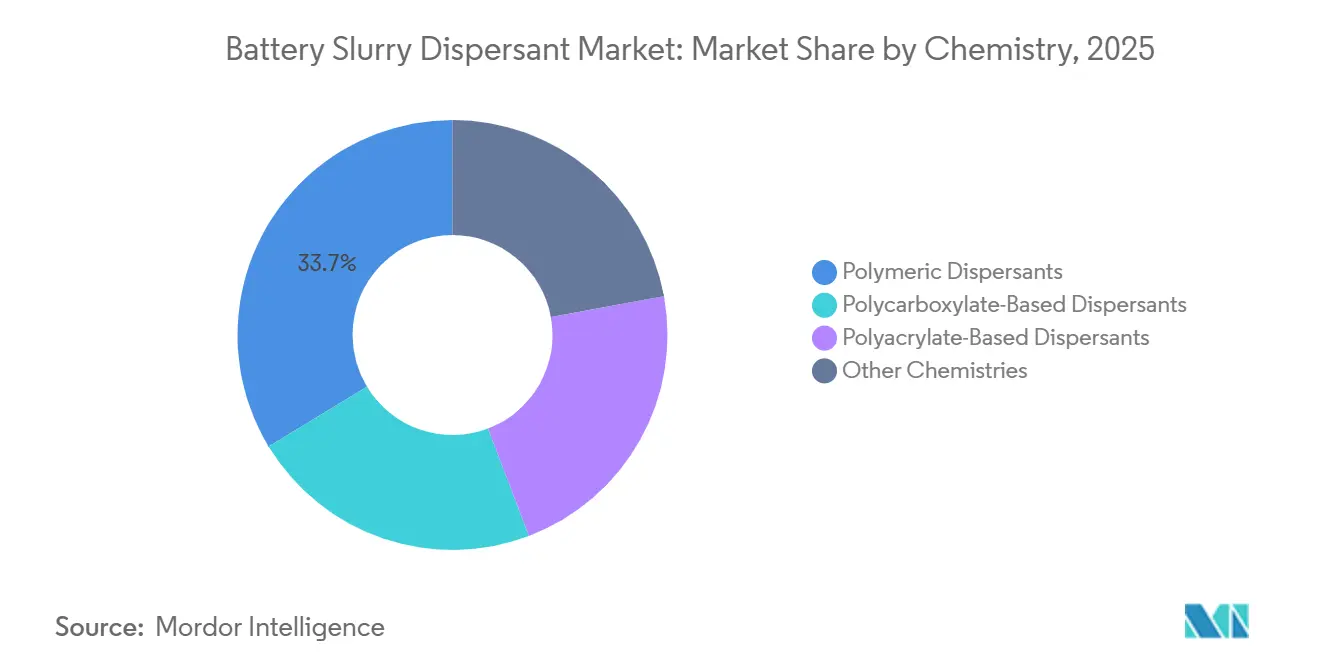
- By chemistry, polymeric dispersants held 33.67% of the battery slurry dispersant market share in 2025 and are projected to advance at a 13.41% CAGR through 2031.
- By battery chemistry, lithium iron phosphate (LFP) and lithium manganese iron phosphate (LMFP) batteries held 42.24% of the battery slurry dispersant market share in 2025, while sodium-ion batteries are projected to advance at a 14.56% CAGR through 2031.
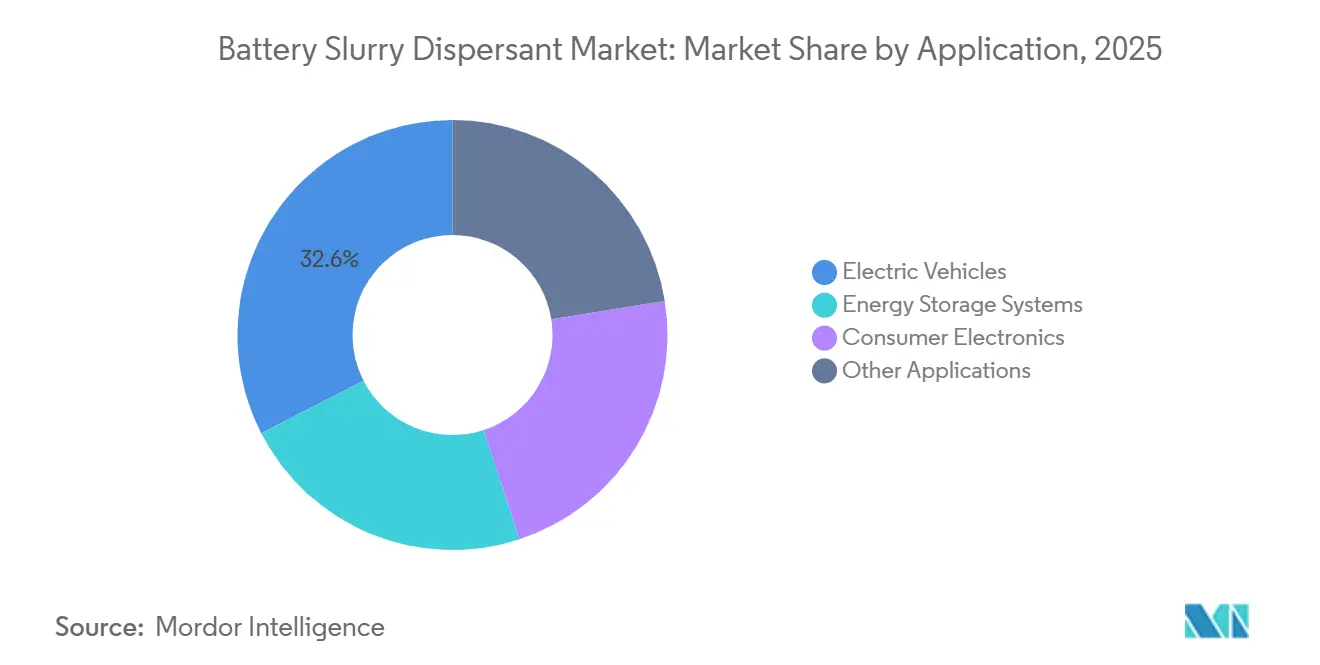
- By application, electric vehicles held 32.56% of the battery slurry dispersant market share in 2025 and are projected to advance at a 14.77% CAGR through 2031.
- By geography, Asia-Pacific held 45.56% of the battery slurry dispersant market share in 2025 and is projected to advance at a 13.65% CAGR through 2031.
Note: Market size and forecast figures in this report are generated using Mordor Intelligence’s proprietary estimation framework, updated with the latest available data and insights as of January 2026.
Market Trends and Insights
Drivers Impact Analysis of Battery Slurry Dispersant Market*
| Driver | (~) % Impact on CAGR Forecast | Geographic Relevance | Impact Timeline |
|---|---|---|---|
| Electric Vehicle and Energy Storage Battery Production Expansion | +4.5% | Global | Short term (≤ 2 years) |
| Adoption of Silicon, LFP, LMFP, and High-Nickel Electrode Chemistries | +3.2% | APAC core, spillover to North America & EU | Medium term (2-4 years) |
| Shift Toward Water-Based and Lower-NMP Processing | +2.1% | North America & EU | Medium term (2-4 years) |
| Higher-Solids Electrode Slurry Processing | +1.8% | Global | Short term (≤ 2 years) |
| Conductive Carbon and CNT Network Optimization | +1.2% | APAC core, spillover to North America & EU | Medium term (2-4 years) |
| Source: Mordor Intelligence | |||
Electric Vehicle and Energy Storage Battery Production Expansion
Battery cell capacity additions are creating a clear demand base for the battery slurry dispersant market through the rest of the decade. Hyundai-SK Battery Manufacturing America began commercial production in July 2026 at its USD 5 billion, 35 gigawatt-hour (GWh) plant in Bartow County, Georgia. Panasonic Energy is ramping its 32 GWh cylindrical-cell facility in De Soto, Kansas, which broadens the United States (U.S.) demand for qualified electrode materials. New production sites need suppliers to validate dispersants against local equipment, material specifications, and coating settings. That validation typically takes 6 to 18 months, which makes approved supplier relationships difficult to replace. Capacity announcements can therefore signal demand 12 to 24 months before a plant reaches full cell output, giving suppliers a planning window that is uncommon for many specialty additives.
Higher-Solids Electrode Slurry Processing
Higher-solids slurry processing is a central route to improving electrode production efficiency and energy density in the battery slurry dispersant market. Formulations above 60 weight percent (wt%) solids require dispersants that lower viscosity while keeping particles evenly distributed. Elementis states that its EXCELSPERSE FX 9000, designed for lithium iron phosphate (LFP) cathode slurries above 65 wt% solids, can reduce viscosity by up to 30% compared with conventional dispersants. Borregaard reports that Vanisperse LI can support graphite electrode mass loadings above 10 mg/cm² while retaining suitable casting rheology. Higher solids levels can reduce solvent use, drying energy, and mixing time, but they do not necessarily raise dispersant volume in direct proportion to electrode output. The change favors higher-value products because manufacturers pay for reliable processing at demanding loadings rather than for commodity dosage alone.
Shift Toward Water-Based and Lower-NMP Processing
Water-based and lower-N-methyl-2-pyrrolidone (NMP) processing is changing the formulation requirements for the battery slurry dispersant market in North America and Europe. A 2025 study found that a kosmotropic aqueous process for nickel manganese cobalt (NMC) cathodes reduced material costs by 96%, capital costs by 95%, and operating costs by 23% by removing the solvent recovery process. The transition requires different anchor groups because carboxylate and sulfonate functionalities are more effective in aqueous media than the amide and amine anchors used in N-methyl-2-pyrrolidone (NMP) systems. Products developed for NMP processing cannot simply be transferred to water-based cathode slurries without further technical work. The U.S. Environmental Protection Agency (EPA) identifies NMP as presenting an unreasonable risk to health under the Toxic Substances Control Act (TSCA)[1]. Suppliers that qualify aqueous-compatible products for high-nickel cathodes before demand scales can address a need that is distinct from the established NMP-based product base.
Adoption of Silicon, LFP, LMFP, and High-Nickel Electrode Chemistries
The adoption of silicon, LFP, lithium manganese iron phosphate (LMFP), and high-nickel electrode chemistries increases the number of formulation needs within the battery slurry dispersant market. Each active material has different particle morphology, surface chemistry, and agglomeration behavior. A 2025 study showed that a ternary P(VP-AA-AM) copolymer suppresses gelation in LMFP cathode slurries through polarity, hydrogen bonding, and steric stabilization. Nano-silicon particles can have surface areas above 100 m²/g, increasing the specialized dispersion requirements per unit of electrode area. LFP and LMFP systems favor suppliers that can demonstrate control of carbon-coated particles and viscosity rebound. High-nickel cathodes require equally careful interfacial control because surface basicity can affect binder behavior during slurry preparation.
Restraints Impact Analysis of Battery Slurry Dispersant Market*
| Restraint | (~) % Impact on CAGR Forecast | Geographic Relevance | Impact Timeline |
|---|---|---|---|
| Chemistry-Specific Compatibility Requirements | -1.5% | Global | Long term (≥ 4 years) |
| Supply Chain Exposure to Specialty Polymer and Surfactant Feedstocks | -1.2% | North America & EU, APAC | Medium term (2-4 years) |
| Dosage Trade-Off Between Dispersion and Electrochemical Resistance | -0.8% | Global | Long term (≥ 4 years) |
| Source: Mordor Intelligence | |||
Chemistry-Specific Compatibility Requirements
Chemistry-specific compatibility requirements limit the ability of suppliers to use one dispersant across all electrode platforms in the battery slurry dispersant market. A product that stabilizes an LFP slurry can be unsuitable for high-nickel NMC811 or silicon-anode systems. The anchor groups that work on iron-phosphate surfaces may interfere with lithium-ion transport at layered oxide or silicon surfaces during cycling. Research shows that small changes in dispersant chemistry or concentration can alter carbon-binder network formation, yield stress, and coating uniformity. Battery makers must therefore qualify several grades across electrode lines, which adds inventory, documentation, and validation work. Dosage control adds another constraint because a 2025 study found that LMFP slurry dosing above 0.05 wt% increased impedance and accelerated capacity fade, while dosing below 0.01 wt% did not prevent phase separation.
Supply Chain Exposure to Specialty Polymer and Surfactant Feedstocks
Specialty polymer and surfactant feedstocks expose the battery slurry dispersant market to cost and availability risks. Polymeric dispersants depend on intermediates such as acrylic acid, maleic anhydride, allyl polyethers, and specialty amines. Production of these inputs is concentrated among a limited group of chemical producers, and supply disruptions can create material price volatility. Lubrizol identifies raw material availability and supply chain resilience as important operating concerns for battery materials suppliers. Dispersants normally represent 1 wt% or less of electrode solids, which limits suppliers’ ability to offset higher input prices through scale. Cell makers also prioritize electrochemical qualification, so a disruption at one approved supplier can affect coating lines when no rapid substitute is available.
*Our forecasts treat driver/restraint impacts as directional, not additive. The impact forecasts reflect baseline growth, mix effects, and variable interactions.
Battery Slurry Dispersant Market Segment Analysis
By Chemistry:
Polymeric Dispersants Lead with Broad Formulation CompatibilityPolymeric dispersants held 33.67% of the battery slurry dispersant market size in 2025, supported by their broad ability to provide steric stabilization. Their long polymer chains adsorb onto active material and conductive carbon surfaces, which can reduce viscosity across several electrode chemistries. This capability gives polymeric grades an advantage where manufacturers need products that support more than one formulation family. BASF describes CGPS 313D8, CGPS 513, and CGPS 277B as products for LFP and LMFP cathode slurry systems. The product family is intended to improve milling efficiency, lower viscosity, and improve storage stability while maintaining electrochemical performance, and can reduce the need for separate rheology additives in high-solids slurries.
Polycarboxylate-based dispersants are gaining relevance in aqueous electrode processing, especially for graphite anodes and water-processed cathodes. Polyacrylate-based grades have a distinct role in high-nickel NMC systems, where pH control during slurry preparation is important for limiting binder degradation. Other chemistries include surfactant-based products, phosphate esters, block copolymers, and specialty grades for carbon nanotube (CNT) concentrates, silicon-anode systems, and solid-state electrolyte slurries, while Nouryon’s AkuPure NC provides more than 99.5% carboxymethyl cellulose (CMC) content and low trace-metal levels for lithium-ion anode slurry processing. Borregaard states that Vanisperse LI works at 1 wt% of carbon content in water-based electrode systems and supports higher mass loadings with suitable roll-to-roll casting rheology. These alternatives widen the technical scope of the battery slurry dispersant market, and bio-derived dispersants are appearing in qualification programs that could support their future position in the battery slurry dispersant industry.

By Battery Chemistry:
Diversifying Cathode Families Multiply Dispersant SpecificationsLFP and LMFP batteries accounted for 42.24% of the battery slurry dispersant market share in 2025, driven by their lower cost, thermal safety, and use in energy storage and automotive applications. L&F completed its Daegu LFP cathode plant in May 2026 with 30,000 metric tons of initial annual capacity and plans to expand it to 60,000 metric tons by the first half of 2027, extending LFP cathode production beyond China and broadening the potential customer base for compatible dispersants. LMFP particles have a high surface area because of carbon-coating processes used to improve conductivity. This increases the risk of agglomeration and viscosity rebound, making effective slurry stabilization important. Suppliers that can demonstrate compatibility with LFP and LMFP lines can support the chemistry family with the largest current demand base.
Sodium-ion batteries are the fastest-growing battery chemistry segment and are projected to advance at a 14.56% CAGR from 2026 to 2031. CATL signed a 3-year, 60 GWh sodium-ion battery supply agreement with Beijing HyperStrong Technology in April 2026, signaling gigawatt-hour-scale delivery for energy storage applications, and the International Energy Agency identifies 2026 as a pivotal year for sodium-ion scaling. Prussian-blue analog cathodes contain crystal water that can interact adversely with many NMP-soluble polymeric dispersants, while layered transition-metal oxide sodium-ion cathodes have different surface basicity profiles from lithium-ion counterparts. These needs create a new technical field within the battery slurry dispersant market. NMC and nickel cobalt aluminum (NCA) batteries have high dispersant value requirements because nickel levels above 80% can create polyvinylidene fluoride (PVDF) binder defluorination risks, while lithium cobalt oxide (LCO), lithium manganese oxide (LMO), silicon-anode, and solid-state systems remain smaller but technically demanding opportunities.
By Application:
Electric Vehicles Drive Both Market Share and GrowthElectric vehicles represented 32.56% of application demand in 2025 and are projected to advance at a 14.77% CAGR through 2031. The Hyundai-SK plant in Georgia and Tata Agratas’ planned 40 GWh Somerset facility create dispersed demand locations that need regional battery material supply chains. Automotive customers are using LFP for entry-level electric vehicles and high-nickel NMC for premium platforms. A single gigafactory can therefore need qualified dispersants across 2 or more chemistry families. This raises the importance of technical support and local qualification, increases formulation work for suppliers, and makes sourcing decisions more complex.
Energy storage systems provide a separate source of demand for the battery slurry dispersant market. LG Energy Solution and General Motors retooled their Spring Hill, Tennessee, plant for LFP battery production for grid-scale energy storage in March 2026, supported by USD 70 million of investment. Eni Storage Systems expects European stationary storage demand to increase from 36 GWh in 2025 to 138 GWh by 2030. Consumer electronics demand is mature, although silicon-anode use in premium portable devices supports specialized water-based dispersants. Industrial batteries, power tools, medical devices, aerospace, and defense place more emphasis on consistent performance and supply security, which can offer favorable margins.
Geography Analysis
APAC Battery Slurry Dispersant Market
Asia-Pacific held 45.56% of the battery slurry dispersant market size in 2025 and is projected to advance at a 13.65% CAGR through 2031. China’s concentration of cell production, active-material output, and domestic dispersant development supports the region’s position in the battery slurry dispersant market. EVE Energy Co. announced 2 manufacturing plants with a combined annual capacity of 110 GWh in April 2026, spanning stationary storage and electric vehicle battery production in southern and eastern China, while domestic suppliers develop composite dispersants with polysiloxane backbone architectures for high-compaction LFP systems. South Korea adds demand through sodium-ion material development, including the K-Sodium Alliance involving EcoPro BM, Soulbrain, and AK Chemicals. Japan supports automotive-grade CNT dispersion demand, and artience Co., Ltd. is targeting a 20% global share of the CNT dispersion market for lithium-ion batteries by fiscal year (FY) 2032 through 5 production bases in 4 regions.
North America and Europe Battery Slurry Dispersant Market
North America and Europe are expanding outside APAC, with regulations changing both demand and chemistry needs in the battery slurry dispersant market. The U.S. EPA’s TSCA finding on NMP supports a shift toward aqueous-compatible dispersants in U.S. cell plants. BASF expanded U.S. manufacturing for Licity anode binders in Monaca, Pennsylvania, and Chattanooga, Tennessee, in March 2025. European REACH requirements favor established suppliers with the resources and registrations to support additive compliance. Eni Storage Systems began construction in Brindisi in July 2026 for a battery manufacturing hub intended to reach 16 GWh of annual LFP cell and module output by 2030, creating demand for local supply and water-based product development.
South America, MEA and ASEAN Battery Slurry Dispersant Market
South America and Middle-East and Africa remain early-stage areas for the battery slurry dispersant market. Brazil’s electric vehicle expansion is supported by government incentives, while Argentina’s lithium sector creates pressure for downstream battery capability, but neither country currently produces cells at a scale that creates substantial dispersant demand. Saudi Arabia’s Vision 2030 includes domestic energy storage manufacturing ambitions, but regional dispersant use remains mostly import-dependent and concentrated in small energy storage installations. South Africa’s minerals-to-battery plans and ASEAN electric vehicle assembly growth may support later demand, depending on upstream investment decisions during the 2026-2031 period.
Competitive Landscape
The battery slurry dispersant market is moderately concentrated, with the top five players including BASF, Evonik Industries AG, Ashland, Lubrizol, and ALTANA. BASF, Evonik Industries AG, Arkema, and Nouryon use formulation capabilities, regulatory registrations, and relationships with tier-1 cell manufacturers to compete across several product categories. ALTANA’s BYK division offers the BYK-ET 3000, BYK-ET 3002, and BYK-ET 3003 series for battery applications. It supports these products through battery laboratories in Germany, Japan, and China, allowing local technical work on electrode chemistries and process conditions. Suppliers increasingly compete on documented cell-level performance rather than slurry viscosity results alone, favoring companies with multi-platform research and technical service.
Evonik Industries AG’s TEGO Surten E family includes wetting and dispersing agents, defoamers, and liquid dispersants for solid-state electrolyte systems. This broader offering helps leading suppliers serve more formulation needs within one customer relationship. Opportunities remain in sodium-ion, aqueous high-nickel cathode, and water-based silicon-anode dispersants, where standard products and dominant suppliers have not yet emerged. The artience Co., Ltd.’s LIOACCUM CNT dispersion platform addresses uniform CNT dispersion in cathode slurries and received U.S. Patent 12,492,126 in December 2025[2]. Its battery supply security plan for CNT dispersions was approved by Japan’s Ministry of Economy, Trade and Industry in September 2024, showing how product specialization, intellectual property, and public supply-chain programs can reinforce technical positioning.
Chinese producers are increasing their focus on LFP and LMFP-specific dispersants, using demanding nanoscale LMFP particles to develop composite polymer architectures. This effort places pressure on international suppliers in chemistry areas where local production and application knowledge are closely linked. The International Electrotechnical Commission (IEC) Technical Committee 21 is developing sodium-ion battery standards, with a committee draft targeted for late 2026. The battery slurry dispersant market combines the scale advantages of multinational suppliers with openings for specialists that solve narrow formulation problems, and no supplier has established a universal product across battery chemistries, processing methods, and regional qualification requirements.
Battery Slurry Dispersant Industry Leaders
-
BASF
-
Evonik Industries AG
-
Ashland
-
Lubrizol
-
ALTANA
- *Disclaimer: Major Players sorted in no particular order
Battery Slurry Dispersant Market Companies Covered in this Report
- ALTANA
- Arkema
- artience Co., Ltd.
- Ashland
- BASF
- Borregaard AS
- Cargill, Incorporated
- Evonik Industries AG
- Kao Corporation
- LG Chem
- Lubrizol
- Nouryon
- Synthomer plc
- ZEON CORPORATION
Recent Industry Developments in Battery Slurry Dispersant Market
- July 2026: Eni Storage Systems broke ground on an integrated LFP battery manufacturing facility in Brindisi, with combined Brindisi–Teverola production targeted at 16 GWh annually by 2030, including planned LFP cathode active material production and battery recycling operations. This expansion increases European LFP electrode manufacturing capacity, supporting additional demand for slurry dispersants used to achieve uniform dispersion of cathode materials during electrode production.
- June 2026: Hyundai-SK Battery Manufacturing America began commercial production at its USD 5 billion, 35 GWh battery plant in Georgia, supplying cells to Hyundai Motor Group Metaplant America. The large-scale electrode manufacturing capacity increases demand for slurry-processing additives such as dispersants, which help achieve uniform dispersion of active materials during electrode production, supporting growth in the battery slurry dispersant market.
Global Battery Slurry Dispersant Market Report Scope
Battery slurry dispersants are functional additives used during electrode slurry preparation to improve the distribution and stability of active materials, conductive agents, and binders. They help control particle agglomeration and slurry properties, supporting consistent electrode coating, processing efficiency, and battery performance.
The Battery Slurry Dispersant Market is segmented by chemistry, battery chemistry, application, and geography. By chemistry, the market is segmented into polymeric dispersants, polycarboxylate-based dispersants, polyacrylate-based dispersants, and other chemistries (surfactant-based, phosphate ester, block copolymer, and specialty dispersants). By battery chemistry, the market is segmented into LFP and LMFP batteries, NMC and NCA batteries, sodium-ion batteries, and other battery chemistries (LCO, LMO, silicon-anode, and solid-state batteries). By application, the market is segmented into electric vehicles, energy storage systems, consumer electronics, and other applications (industrial batteries, power tools, medical devices, aerospace, and defense). The report also covers the market size and forecasts for battery slurry dispersants in 15 countries across major regions. For each segment, the market sizing and forecasts have been done on the basis of value (USD).
Segmentation Overview
| Polymeric Dispersants |
| Polycarboxylate-Based Dispersants |
| Polyacrylate-Based Dispersants |
| Other Chemistries (Surfactant-Based, Phosphate Ester, Block Copolymer, and Specialty Dispersants) |
| LFP and LMFP Batteries |
| NMC and NCA Batteries |
| Sodium-Ion Batteries |
| Other Battery Chemistries (LCO, LMO, Silicon-Anode, and Solid-State Batteries) |
| Electric Vehicles |
| Energy Storage Systems |
| Consumer Electronics |
| Other Applications (Industrial Batteries, Power Tools, Medical Devices, Aerospace, and Defense) |
| Asia-Pacific | China |
| India | |
| Japan | |
| South Korea | |
| ASEAN Countries | |
| Rest of Asia-Pacific | |
| North America | United States |
| Canada | |
| Mexico | |
| Europe | Germany |
| United Kingdom | |
| France | |
| Italy | |
| NORDIC Countries | |
| Rest of Europe | |
| South America | Brazil |
| Argentina | |
| Rest of South America | |
| Middle-East and Africa | Saudi Arabia |
| South Africa | |
| Rest of Middle-East and Africa |
| By Chemistry | Polymeric Dispersants | |
| Polycarboxylate-Based Dispersants | ||
| Polyacrylate-Based Dispersants | ||
| Other Chemistries (Surfactant-Based, Phosphate Ester, Block Copolymer, and Specialty Dispersants) | ||
| By Battery Chemistry | LFP and LMFP Batteries | |
| NMC and NCA Batteries | ||
| Sodium-Ion Batteries | ||
| Other Battery Chemistries (LCO, LMO, Silicon-Anode, and Solid-State Batteries) | ||
| By Application | Electric Vehicles | |
| Energy Storage Systems | ||
| Consumer Electronics | ||
| Other Applications (Industrial Batteries, Power Tools, Medical Devices, Aerospace, and Defense) | ||
| By Geography | Asia-Pacific | China |
| India | ||
| Japan | ||
| South Korea | ||
| ASEAN Countries | ||
| Rest of Asia-Pacific | ||
| North America | United States | |
| Canada | ||
| Mexico | ||
| Europe | Germany | |
| United Kingdom | ||
| France | ||
| Italy | ||
| NORDIC Countries | ||
| Rest of Europe | ||
| South America | Brazil | |
| Argentina | ||
| Rest of South America | ||
| Middle-East and Africa | Saudi Arabia | |
| South Africa | ||
| Rest of Middle-East and Africa | ||
Key Questions Answered in the Report
What is the size of the battery slurry dispersant market?
The battery slurry dispersant market stands at USD 0.74 billion in 2026 and is projected to reach USD 1.33 billion by 2031.
What drives demand for battery slurry dispersants?
New battery cell capacity, higher-solids electrodes, water-based processing, and specialized battery chemistries support demand in the battery slurry dispersant market.
Which chemistry type held the largest share in 2025?
Polymeric dispersants held 33.67% in 2025 because they provide broad stabilization across multiple electrode formulations.
Which battery chemistry is projected to grow fastest through 2031?
Sodium-ion batteries are projected to advance at a 14.56% CAGR through 2031, supported by commercial-scale supply agreements.