
Battery Power Tools Market Size and Share
Market Overview
| Study Period | 2022 - 2032 |
|---|---|
| Market Size (2027) | USD 29.59 Billion |
| Market Size (2032) | USD 41.11 Billion |
| Growth Rate (2027 - 2032) | 6.79 % |
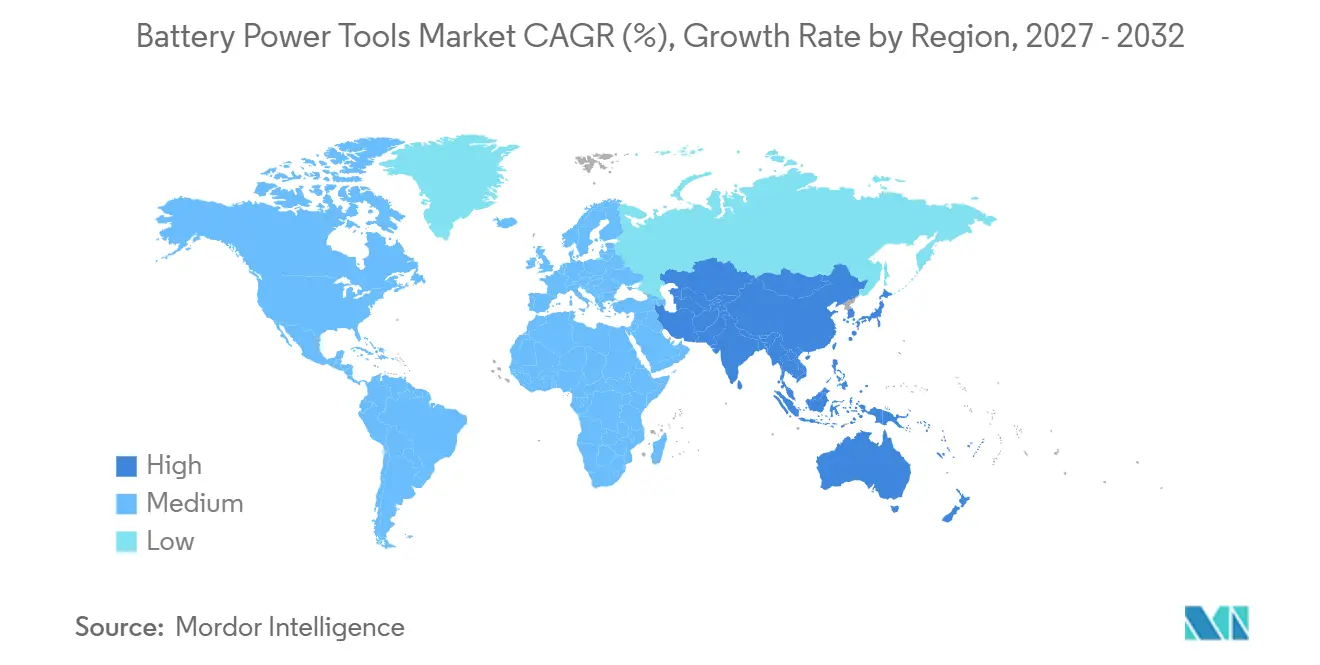
| Fastest Growing Market | Asia-Pacific |
| Largest Market | Asia-Pacific |
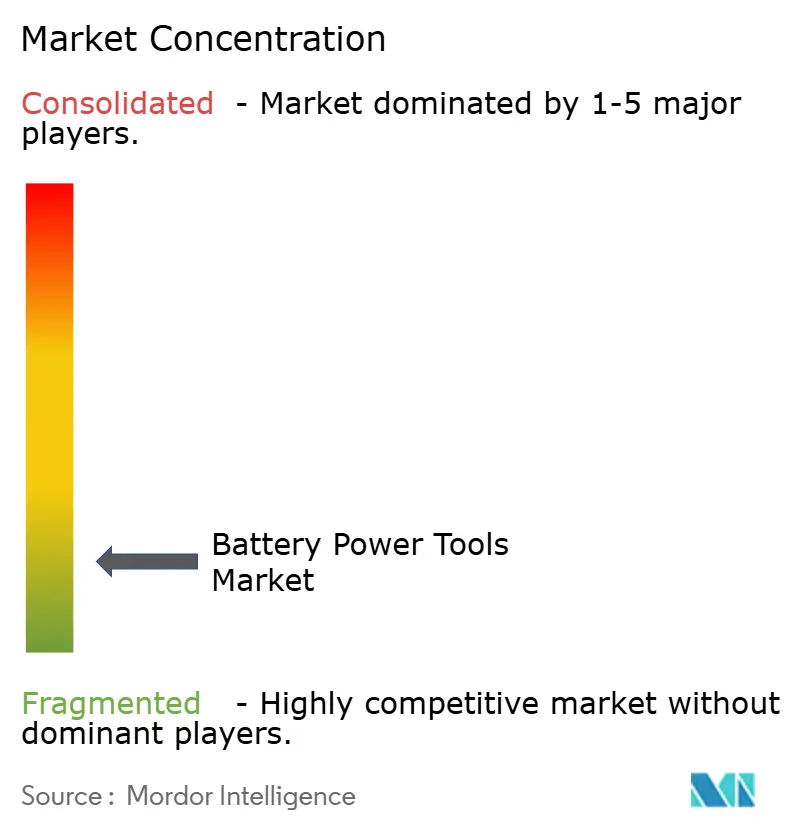
| Market Concentration | Low |
Major Players *Disclaimer: Major Players sorted in no particular order Image © Mordor Intelligence. Reuse requires attribution under CC BY 4.0. | |
Battery Power Tools Market Analysis by Mordor Intelligence
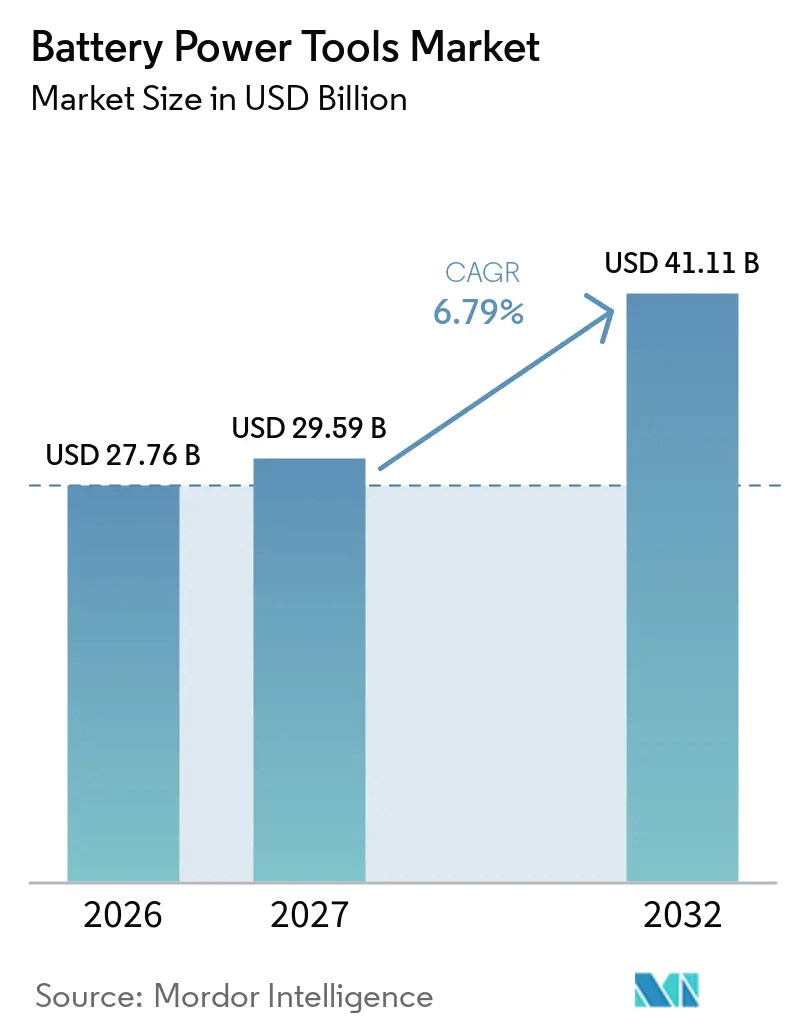
The Battery Power Tools Market size is expected to grow from USD 27.76 billion in 2026 to USD 29.59 billion in 2027 and is forecast to reach USD 41.11 billion by 2032 at 6.79% CAGR over 2027-2032. Cordless platforms now support routine work across construction, maintenance, industrial assembly, and home improvement. Lower battery costs and better power delivery are improving the economics of cordless ownership for users with regular workloads. Platform breadth has become a major purchase consideration because a shared battery can support multiple tools and accessories. Manufacturers are investing in charging speed, high-output packs, and connected fastening systems to protect customer loyalty. Safety, replacement-pack costs, and fragmented interoperability continue to limit conversion for occasional users and price-sensitive buyers.
Key Report Takeaways
- By product type, Drills and Drivers held 36.6% revenue share in 2026, while Impact Wrenches and Impact Drivers are forecast to grow at a 6.9% CAGR through 2032.
- By battery type, Lithium-ion batteries held 90.5% revenue share in 2026 and are forecast to grow at a 7.3% CAGR through 2032.
- By end user, Industrial Users held 39.8% revenue share in 2026, while Residential and DIY users are forecast to grow at a 7.1% CAGR through 2032.
- By geography, Asia-Pacific held 33.4% revenue share in 2026 and is forecast to grow at a 7.5% CAGR through 2032.
Note: Market numbers in this report are based on Mordor Intelligence's proprietary estimation framework, which combines nine months of actuals with Q4 projections for base year 2026.
Market Trends and Insights
Drivers Impact Analysis of Battery Power Tools Market*
| Driver | (~) % Impact on CAGR Forecast | Geographic Relevance | Impact Timeline |
|---|---|---|---|
| Cordless Replacement in Professional Workflows | +1.8% | Global, strongest in North America and Europe | Short term (≤ 2 years) |
| Lithium-Ion Energy Density and Fast Charging | +1.4% | Global, fastest adoption in Asia-Pacific | Medium term (2-4 years) |
| Expansion of Cross-Tool Battery Platforms | +0.8% | Global, with cross-brand alliances in Europe | Medium term (2-4 years) |
| Industrial Electrification and Traceable Assembly | +0.7% | North America, Europe, Japan, and South Korea | Long term (≥ 4 years) |
| Infrastructure, Renovation, and Labor Productivity Needs | +0.5% | North America and Asia-Pacific | Medium term (2-4 years) |
| Outdoor Equipment Electrification | +0.3% | Global, led by Asia-Pacific and North America | Medium term (2-4 years) |
| Source: Mordor Intelligence | |||
Cordless Replacement of Corded Tools in Professional Workflows
Professional trades have moved beyond early adoption of cordless tools. Battery products reduce setup work and help crew’s complete tasks in locations without convenient access to power. These benefits matter when contractors face limited labor availability and tight project schedules. Techtronic Industries reported that MILWAUKEE revenue grew 7.9% in local currency during 2025, with 10.3% underlying growth after temporary tariff-related product suspensions were excluded.[1] The result indicates sustained demand for professional cordless platforms rather than a one-time replacement cycle. The Battery Power Tools market therefore benefits from workflow changes that favor mobility, faster task changes, and fewer cables on active sites.
Lithium-Ion Energy Density and Fast-Charging Improvements
Improved cells are expanding the range of applications suitable for cordless equipment. Bosch introduced its Expert 18 V battery range in September 2025 with tabless-cell technology for 18 V cordless tools.[2] Bosch stated that the 8.0 Ah EXBA18 V-80 can reach a full charge in 39 minutes in Power Boost mode. Faster charging reduces idle time for users who rely on a limited number of packs during a shift. Research published in ACS Nano found that patterned cathode nanostructures can improve energy and power density at the same time.[3] The Battery Power Tools market gains when charging and runtime become less restrictive in demanding work.
Expansion of Cross-Tool Battery Platforms
A broad battery platform can influence a customer more than an isolated tool specification. Users can add tools without purchasing a separate battery and charger for every new product. This lowers the cost of building a fleet and improves charging management across a worksite. Einhell reported that Power X-Change (PXC) product revenue grew 8% in the first half of 2026, while PXC revenue exceeded 58% of group revenue. Platform loyalty can also increase demand for accessories and replacement packs after the initial tool purchase. The Battery Power Tools market benefits because a common battery family turns separate purchases into an integrated ownership decision.
Industrial Electrification, Automation, and Traceable Assembly
Factory users are adopting cordless equipment for mobility and for documented fastening quality. Connected tools can record torque and angle data for each fastener during an assembly process. Atlas Copco offers the W-IRTT wireless torque transducer for cableless verification and Open Protocol data integration.[4] Makita announced an agreement in March 2026 to acquire Panasonic Electric Works Company’s power tool business, including factory fastening equipment and IoT-enabled data management solutions.[5] This move connects battery and motor capabilities with traceable fastening requirements. The Battery Power Tools market can gain higher-value industrial demand assembly plants shift from basic tools to connected solutions.
Restraints Impact Analysis of Battery Power Tools Market*
| Restraint | (~) % Impact on CAGR Forecast | Geographic Relevance | Impact Timeline |
|---|---|---|---|
| High Replacement-Pack Cost and Total Cost of Ownership | -0.8% | Global, strongest in emerging and price-sensitive markets | Medium term (2-4 years) |
| Thermal Safety, Counterfeit Packs, and Charger Compatibility Risk | -0.4% | Global, acute in North America and Southeast Asia online channels | Short term (≤ 2 years) |
| Lithium, Cobalt, and Nickel Price Volatility | -0.3% | Global, strongest in battery supply-dependent manufacturing markets | Medium term (2-4 years) |
| Fragmented Battery Interoperability Standards | -0.2% | Global, strongest among multi-brand professional users | Medium term (2-4 years) |
| Source: Mordor Intelligence | |||
High Replacement-Pack Cost and Total Cost of Ownership
Battery replacement costs remain a barrier for small contractors and occasional users. A user with only one or two tools may find it difficult to spread the cost of packs across a large tool fleet. This issue is more acute in markets where corded products remain the lower-cost option. The economy improves as a user adds compatible products within one battery family. Right to Repair Europe raised concerns in its May 2026 feedback on the EU Batteries Regulation that expanded exemptions could limit practical access to aftermarket service channels. Replacement availability, repairability, and pack pricing will shape the pace of Battery Power Tools market adoption among value-focused users.
Thermal Safety, Counterfeit Packs, and Charger Compatibility Risk
Battery safety affects confidence in cordless products and aftermarket charging equipment. The U.S. Consumer Product Safety Commission recalled Greenworks and Kobalt yard power tools in 2026 because USB-C batteries could create a fire hazard. The commission also recalled DR Power lithium-ion battery packs in 2025 because of fire and burn hazards. The Power Tool Institute warns that counterfeit and knock-off packs can lack the protections used in legitimate battery systems. These events make authorized channels and compatible charging systems more important for manufacturers. The Battery Power Tools market faces slower adoption where users cannot easily distinguish safe products from poorly engineered alternatives.
*Our forecasts treat driver/restraint impacts as directional, not additive. The impact forecasts reflect baseline growth, mix effects, and variable interactions.
Battery Power Tools Market Segment Analysis
By Product Type:
Impact Tools Gain Ground Alongside Drill LeadershipDrills and Drivers held 36.6% of the Battery Power Tools market share in 2026. Their leading position reflects their use in fastening, drilling, installation, repair, and routine maintenance. They are often the first cordless tool purchased by professional and home users. That role introduces buyers to a manufacturer’s battery platform and related tool range. Impact Wrenches and Impact Drivers are projected to expand at a 6.9% CAGR through 2032. Their growth is tied to the replacement of pneumatic products in automotive service and industrial assembly.
High-torque cordless tools are becoming more credible in heavy-duty fastening applications. This supports demand in workshops, fleet maintenance, and production environments that previously relied on air-powered equipment. Saws and cutting tools remain important for wood framing, structural steel, concrete work, and general construction. Grinders serve metal fabrication and surface preparation, while hammers, demolition tools, and nailers address work that still needs high output or specialized attachments. Hilti expanded its Nuron range with more than 60 heavy-duty tools and accessories in October 2025, covering applications including breaking, concrete cutting, wood cutting, and soil compaction. The Battery Power Tools market also gains platform loyalty from measurement, thermal imaging, and site-lighting products.
By Battery Type:
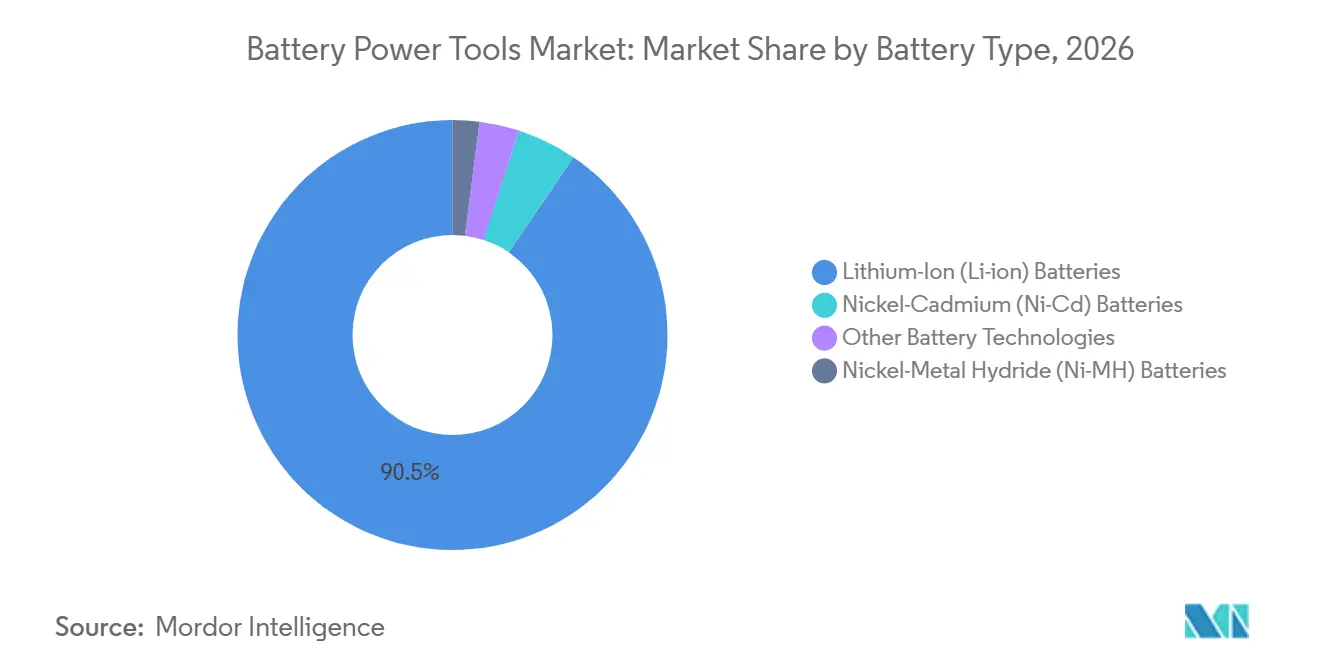
Lithium-Ion Maintains a Clear LeadLithium-ion batteries accounted for 90.5% of the Battery Power Tools market size in 2026 and are projected to grow at a 7.3% CAGR through 2032. This position reflects their energy density, cycle life, and compatibility with brushless motor systems. Major original equipment manufacturers have adopted lithium-ion as the standard chemistry for most new cordless platforms. Advances in cells and thermal management continue to improve high-load performance. Bosch’s Expert 18 V range uses tabless-cell technology and spans capacities from 4.0 Ah to 15.0 Ah. These improvements support the use of cordless tools in applications that once favored corded or pneumatic equipment.
Nickel-Cadmium batteries continue to decline as legacy replacement demand falls. Restrictions on cadmium use also limit the case for new Ni-Cd designs in regulated markets. Nickel-Metal Hydride batteries retain a limited place in some entry-level applications but receive little major manufacturer investment. The Battery Power Tools industry is therefore centered on improving a single dominant chemistry rather than balancing several equal alternatives. Research on cathode structures points to additional gains in energy and power performance without changing the fundamental lithium-ion platform. The Battery Power Tools market benefits from continuity that preserves compatibility for users with existing battery families.
By End User:
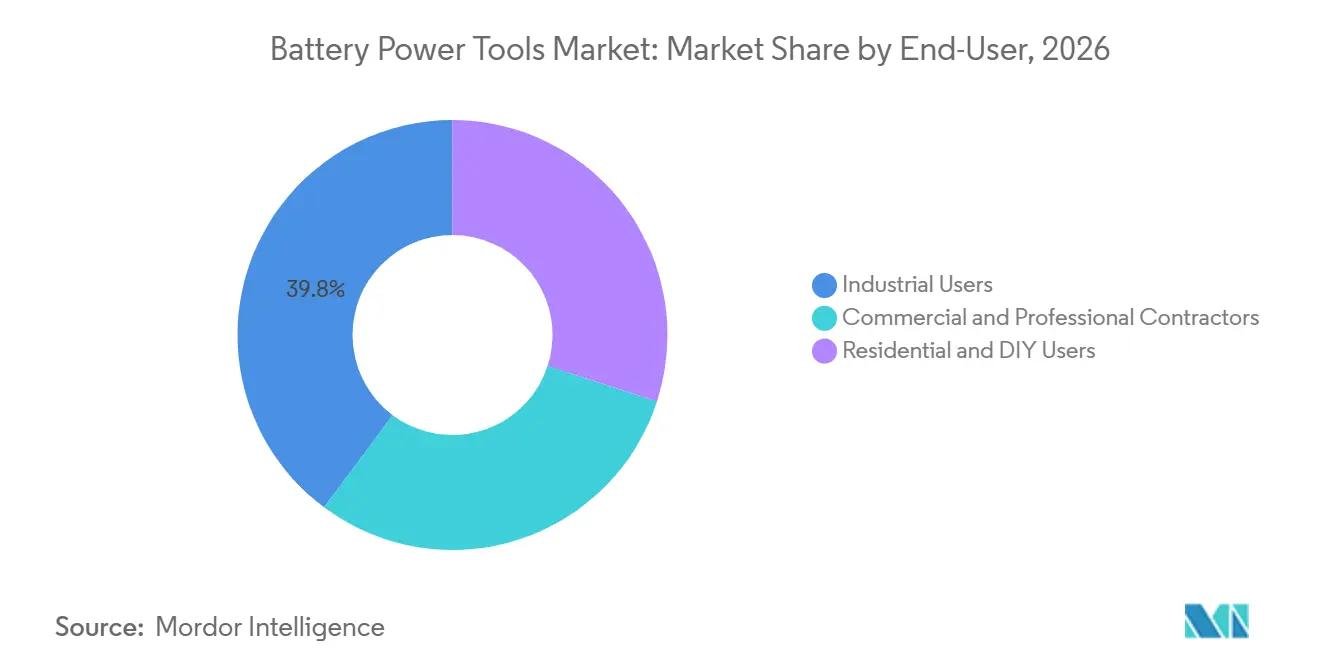
Industrial Demand Anchors Sales While DIY Use ExpandsIndustrial users held 39.8% of the Battery Power Tools market share in 2026. Automotive plants, energy infrastructure, heavy equipment service teams, and process facilities require reliable tools with repeatable output. Tool uptime and torque accuracy are essential in these operating environments. Connected battery-powered tools add per-fastener records, error prevention, and process documentation. Makita’s planned acquisition of Panasonic’s fastening business shows the importance of factory-focused precision assembly tools. The Battery Power Tools market serves industrial customers with more than mobility because they increasingly need quality data and traceability.
Residential and DIY users are forecast to grow at a 7.1% CAGR through 2032. Wider retail distribution and better price-to-performance levels are making battery platforms more accessible. The RYOBI 18 V ONE+ system illustrates the appeal of a broad range where batteries remain compatible with older products. Commercial and professional contractors also benefit from shared-platform economics but need higher output and durability. The Battery Power Tools industry must manage the growing presence of consumer-grade products on commercial sites. The Battery Power Tools market can respond through clearer product positioning, site-safety guidance, and accessible professional service.
Geography Analysis
APAC Battery Power Tools Market
Asia-Pacific held 33.4% revenue share in 2026 and is projected to grow at a 7.5% CAGR through 2032. The region combines manufacturing capacity with growing domestic use of cordless equipment. China remains central to global electric power tool production, according to the China Hardware, Electronics and Chemical Trading Association. The shift from corded and pneumatic products to lithium-ion tools creates Battery Power Tools market demand beyond export manufacturing. India, Vietnam, and Indonesia also add construction, industrialization, and supply-chain investment to the regional outlook.
North America and Europe Battery Power Tools Market
North America remains a major demand center because of construction activity, professional contractor use, and broad retail access. Contractors value cordless systems that reduce setup time and support work across dispersed job locations. Stanley Black & Decker reported USD 13.2 billion in 2025 revenue for its Tools & Outdoor segment and noted volume pressure in North American retail during the fourth quarter. The result shows that housing and retail cycles can affect Battery Power Tools market demand even when cordless adoption remains established. Europe benefits from manufacturing expertise, cross-brand platform development, and attention to battery safety and repairability.
South America and MEA Battery Power Tools Market
South America is smaller and remains sensitive to tool price and infrastructure spending. Brazil and Argentina support regional demand, although premium battery platforms face affordability constraints. Middle East and Africa show early-stage potential from construction programs and growing distribution coverage. Einhell stated that it planned its first substantial revenues from the Middle East, Africa, and the Indian subcontinent in the second half of 2026. The Battery Power Tools market offers expansion opportunities for brands that balance ecosystem investment with local price expectations.
Competitive Landscape
The Battery Power Tools market is fragmented around ecosystem-led manufacturers. Techtronic Industries, Stanley Black & Decker, Robert Bosch, Makita, and Hilti have wide product portfolios and established distribution. Their battery platforms encourage repeat purchases across professional, industrial, and consumer use cases. Techtronic reported total revenue of USD 15.26 billion in 2025 and strong local-currency growth for Milwaukee Tool. These companies compete through tool performance, battery compatibility, service, and shelf access. Regional brands and Chinese original equipment manufacturers exert price pressure across the Battery Power Tools market.
Product development increasingly focuses on output, charging time, and data-enabled capability. Bosch introduced tabless-cell technology in its Expert 18 V battery range in September 2025. Makita agreed to acquire Panasonic’s power tool business to extend its position in factory fastening and IoT data management. Each action supports a wider battery ecosystem and a stronger position in higher-value applications. The Battery Power Tools market rewards companies that make it easier for users to remain within one platform.
Manufacturing location has also become an important competitive consideration. Chervon opened Campus 4 in Ho Chi Minh City in April 2026 with an annual capacity of 3.5 million handheld outdoor power equipment units. The investment supports supply diversification and addresses tariff exposure for products serving the U.S. market. STIHL opened its first battery-exclusive plant in Oradea, Romania, in October 2025. The plant strengthens European battery production and supports the company’s long-term battery-product strategy. The Battery Power Tools market remains competitive because premium platform leaders, specialized industrial suppliers, and price-focused challengers pursue different customer needs.
Battery Power Tools Industry Leaders
-
Techtronic Industries Company Limited
-
Stanley Black & Decker, Inc.
-
Makita Corporation
-
Robert Bosch GmbH
-
Hilti Corporation
- *Disclaimer: Major Players sorted in no particular order
Battery Power Tools Market Companies Covered in this Report
- Adolf Würth GmbH & Co. KG
- Apex Tool Group, LLC
- Atlas Copco AB
- Chervon Holdings Limited
- Dongcheng Power Tools
- Einhell Germany AG
- Festool GmbH
- Hilti Corporation
- Ingersoll Rand Inc.
- Jiangsu Guoqiang Tools Co., Ltd.
- Koki Holdings Co., Ltd.
- Mafell AG
- Makita Corporation
- Panasonic Corporation
- Positec Group Limited
- Robert Bosch GmbH
- Snap-on Incorporated
- Stanley Black & Decker, Inc.
- Techtronic Industries Company Limited
- Zhejiang Crown Tools Manufacturing Co., Ltd.
Recent Industry Developments in Battery Power Tools Market
- March 2026: Makita Corporation announced an agreement to acquire Panasonic Corporation Electric Works Company's power tool business, encompassing factory fastening equipment, advanced torque-control technology, and IoT-enabled data management solutions. The transaction enables Makita to enter the factory-oriented precision assembly market by combining Panasonic's traceable-fastening expertise with Makita's battery and motor technology; closing is expected during FY2026 subject to regulatory approval.
- January 2026: Hilti unveiled its 2026 Nuron lineup, including the brand's first-ever cordless table saw and the B22-260 flash-charging battery, which achieves 80% charge in approximately 20 minutes with compatible chargers. Two new higher-capacity battery packs, the B22-195 (9 Ah) and B22-290 (13.5 Ah), featuring multi-tab cell technology extend the Nuron platform's heavy-duty range across sawing, grinding, and demolition applications.
- October 2025: STIHL inaugurated a EUR 125 million battery-only production facility in Oradea, Romania, its first battery-exclusive plant, establishing a European Competence Center targeting 1 million battery packs per year by 2026 and 1.8 million battery packs plus 1.7 million battery-powered tools by 2028. The facility supports STIHL's publicly stated target of approximately 35% of battery-product share of global sales by 2027 and ~80% by 2035.
- October 2025: Hilti expanded its Nuron cordless platform with more than 60 heavy-duty tools and accessories covering breaking, concrete cutting, wood cutting, and soil compaction, alongside the B22-290 battery. The expansion delivers up to 25% greater on-site efficiency versus the prior generation and brings Hilti closer to enabling fully cordless tool cribs across all major construction trade applications.
Global Battery Power Tools Market Report Scope
The battery power tools market encompasses the design, manufacturing, and distribution of cordless, portable mechanical tools powered by rechargeable battery packs, rather than direct electrical cords or pneumatic lines.
The global battery power tools market is segmented by product type, battery type, end user, and geography. By product type, the market is segmented into drills/drivers, saws, grinders, sanders/polishers, impact wrenches, hammers, nailers, and other product types. By battery type, the market is segmented into lithium-ion (Li-ion), nickel-cadmium (Ni-Cd), nickel-metal hydride (Ni-MH), and other battery types. By end user, the market is segmented into residential/do-it-yourself (DIY), commercial/professional, and industrial. The report also covers the market size and forecasts for the global battery power tools market across 26 countries in key regions. For each segment, the market sizing and forecasts have been provided on the basis of value (USD).
Segmentation Overview
| Drills and Drivers |
| Saws and Cutting Tools |
| Grinders |
| Sanders and Polishers |
| Impact Wrenches and Impact Drivers |
| Hammers and Demolition Tools |
| Nailers and Staplers |
| Other Battery-Powered Tools |
| Lithium-Ion (Li-ion) Batteries |
| Nickel-Cadmium (Ni-Cd) Batteries |
| Nickel-Metal Hydride (Ni-MH) Batteries |
| Other Battery Technologies |
| Residential and DIY Users |
| Commercial and Professional Contractors |
| Industrial Users |
| North America | United States |
| Canada | |
| Mexico | |
| Europe | Germany |
| France | |
| Italy | |
| Spain | |
| United Kingdom | |
| Poland | |
| Russia | |
| Rest of Europe | |
| Asia-Pacific | China |
| India | |
| Japan | |
| South Korea | |
| Australia | |
| Indonesia | |
| Vietnam | |
| Thailand | |
| Rest of Asia-Pacific | |
| South America | Brazil |
| Argentina | |
| Chile | |
| Rest of South America | |
| Middle East and Africa | Saudi Arabia |
| United Arab Emirates | |
| Egypt | |
| South Africa | |
| Morocco | |
| Rest of Middle East and Africa |
| By Product Type | Drills and Drivers | |
| Saws and Cutting Tools | ||
| Grinders | ||
| Sanders and Polishers | ||
| Impact Wrenches and Impact Drivers | ||
| Hammers and Demolition Tools | ||
| Nailers and Staplers | ||
| Other Battery-Powered Tools | ||
| By Battery Type | Lithium-Ion (Li-ion) Batteries | |
| Nickel-Cadmium (Ni-Cd) Batteries | ||
| Nickel-Metal Hydride (Ni-MH) Batteries | ||
| Other Battery Technologies | ||
| By End User | Residential and DIY Users | |
| Commercial and Professional Contractors | ||
| Industrial Users | ||
| By Geography | North America | United States |
| Canada | ||
| Mexico | ||
| Europe | Germany | |
| France | ||
| Italy | ||
| Spain | ||
| United Kingdom | ||
| Poland | ||
| Russia | ||
| Rest of Europe | ||
| Asia-Pacific | China | |
| India | ||
| Japan | ||
| South Korea | ||
| Australia | ||
| Indonesia | ||
| Vietnam | ||
| Thailand | ||
| Rest of Asia-Pacific | ||
| South America | Brazil | |
| Argentina | ||
| Chile | ||
| Rest of South America | ||
| Middle East and Africa | Saudi Arabia | |
| United Arab Emirates | ||
| Egypt | ||
| South Africa | ||
| Morocco | ||
| Rest of Middle East and Africa | ||
Key Questions Answered in the Report
What is the forecast growth rate for battery power tools?
The global market is forecast to grow at a 6.79% CAGR from 2027 to 2032, reaching USD 41.11 billion.
Which battery chemistry leads cordless tools?
Lithium-ion batteries dominated with a 90.5% share in 2026 and are projected to grow at a 7.3% CAGR through 2032.
Which product category has the largest demand?
Drills and drivers led overall product demand with a 36.6% share in 2026 due to their versatility across multiple use cases.
Which battery power tool product is growing fastest?
Impact wrenches and impact drivers are expanding fastest at a 6.9% CAGR through 2032 as users transition away from pneumatic equipment.
Which end user group is expanding fastest?
Residential and DIY users are the fastest-growing segment, projected at a 7.1% CAGR through 2032, driven by retail expansion and broader platform options.
Which region is the largest and fastest growing?
The Asia-Pacific region holds the top spot, commanding a 33.4% share in 2026 and leading future growth with a 7.5% CAGR through 2032.