
Battery Casing Materials Market Size and Share
Market Overview
| Study Period | 2021 - 2031 |
|---|---|
| Market Size (2026) | USD 8.21 Billion |
| Market Size (2031) | USD 13.26 Billion |
| Growth Rate (2026 - 2031) | 10.06 % |
| Fastest Growing Market | Asia-Pacific |
| Largest Market | Asia-Pacific |
| Market Concentration | Low |
Major Players *Disclaimer: Major Players sorted in no particular order Image © Mordor Intelligence. Reuse requires attribution under CC BY 4.0. | |
Battery Casing Materials Market Analysis by Mordor Intelligence
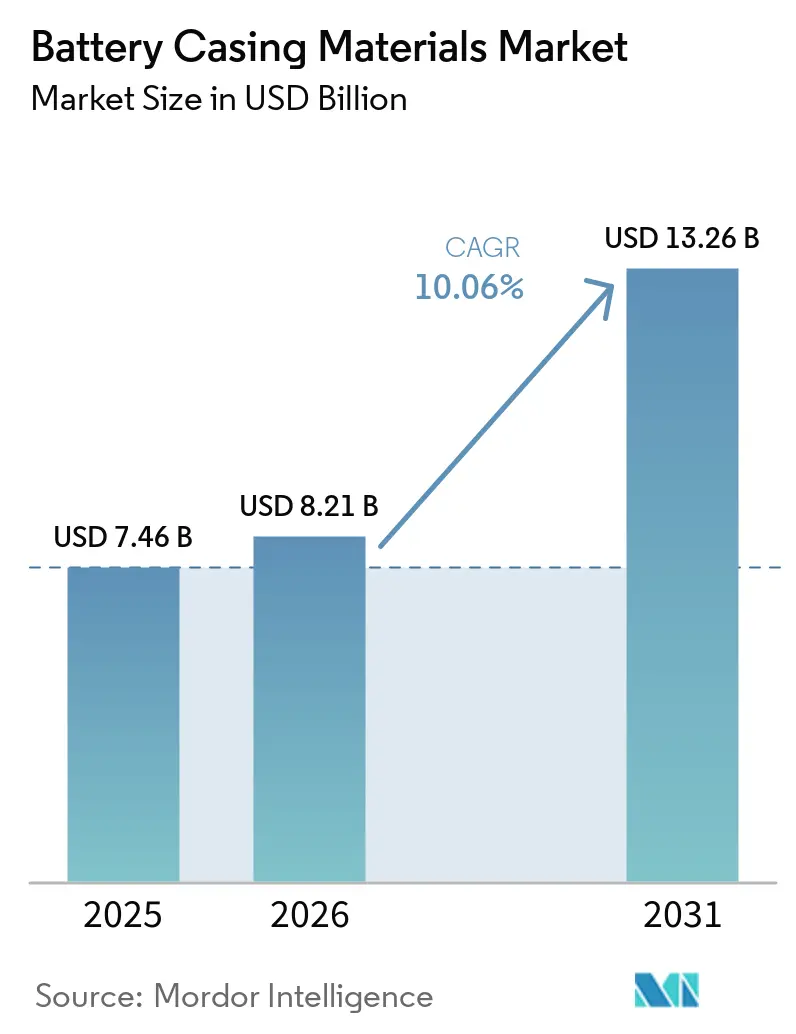
The Battery Casing Materials Market was valued at USD 7.46 billion in 2025 and is estimated to grow from USD 8.21 billion in 2026 to reach USD 13.26 billion by 2031, at a CAGR of 10.06% during the forecast period (2026–2031). Electric vehicle production and stationary storage additions are expanding the demand for battery packs that require protective housings. The battery casing materials market is also being shaped by cell-to-pack (CTP) designs, which transfer more structural, thermal, and safety functions to the pack enclosure. Aluminum remains widely specified, but polymer composites are gaining attention where vehicle weight, recyclability, and component integration matter most. Suppliers are responding through local production, material partnerships, and designs that integrate cooling, structural support, and fire protection. Long qualification cycles continue to favor suppliers with validated materials and established relationships with original equipment manufacturers.
Key Report Takeaways
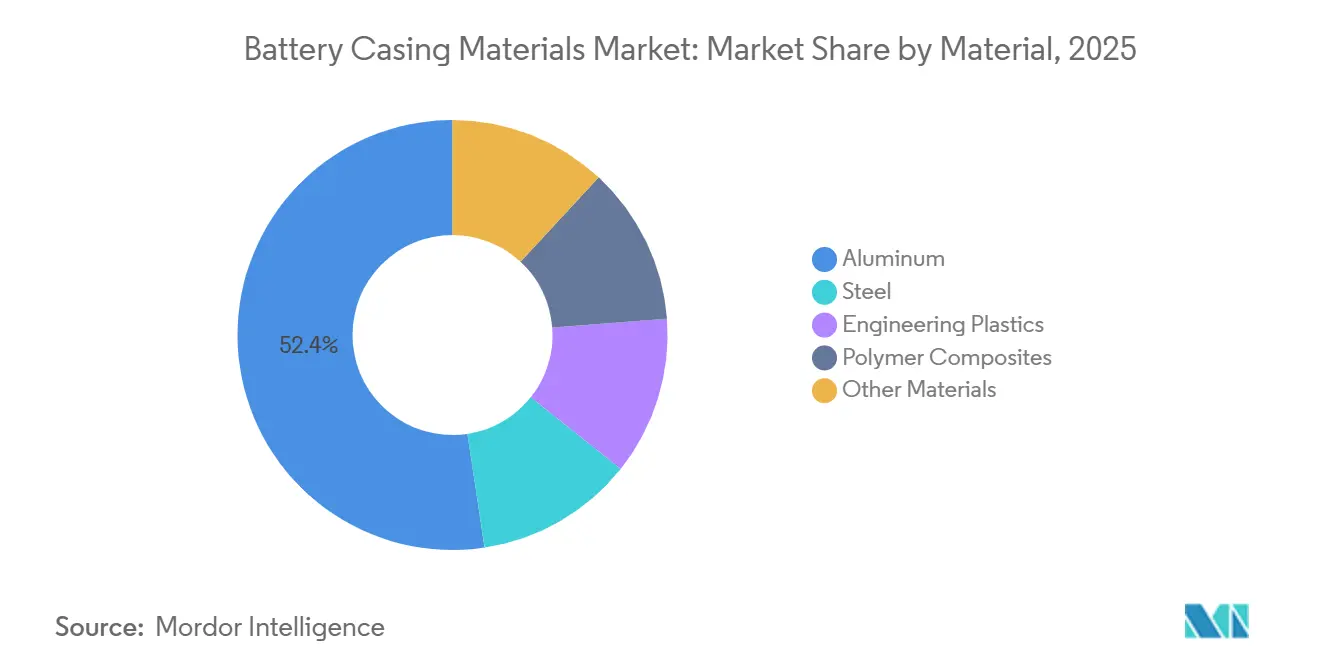
- By material, aluminum held 52.38% of the battery casing materials market share in 2025, while polymer composites are projected to advance at a 12.80% CAGR through 2031.
- By battery type, lithium-ion batteries held 70.16% of the battery casing materials market share in 2025, while sodium-ion batteries are projected to advance at an 11.15% CAGR through 2031.
- By cell format, cylindrical cells held 43.13% of the battery casing materials market share in 2025, while pouch cells are projected to advance at an 11.94% CAGR through 2031.
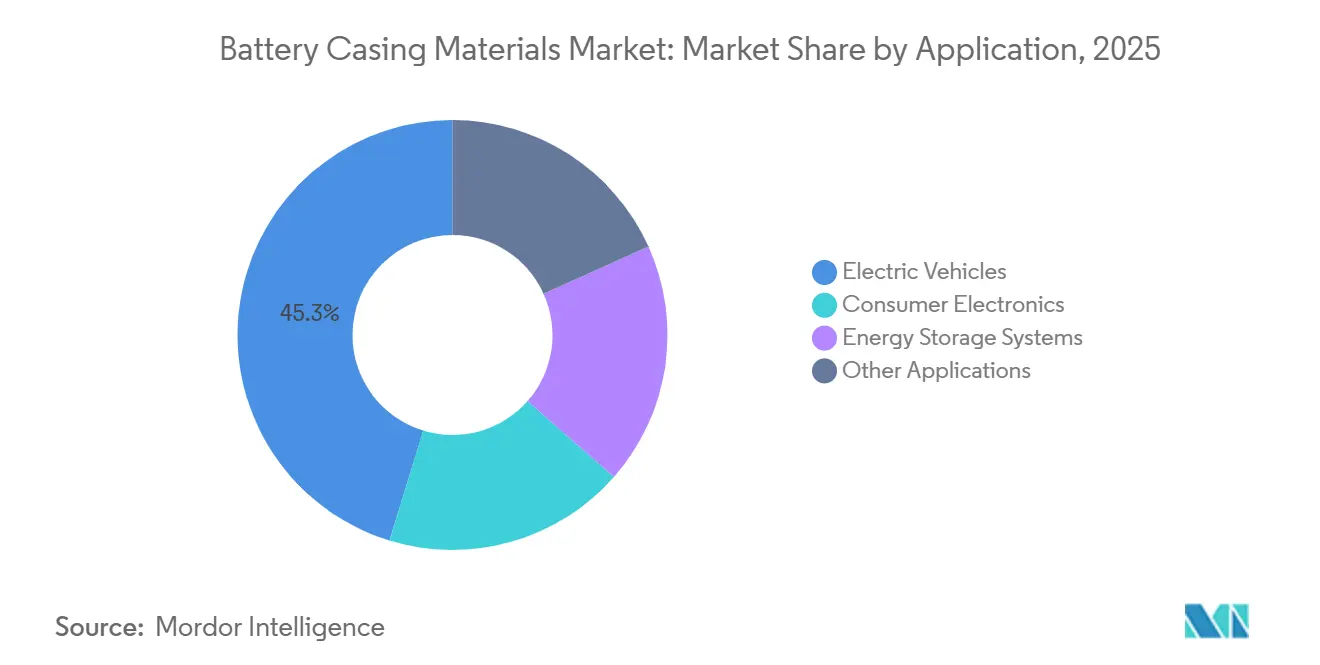
- By application, electric vehicles held 45.27% of the battery casing materials market share in 2025, while energy storage systems are projected to advance at a 13.18% CAGR through 2031.
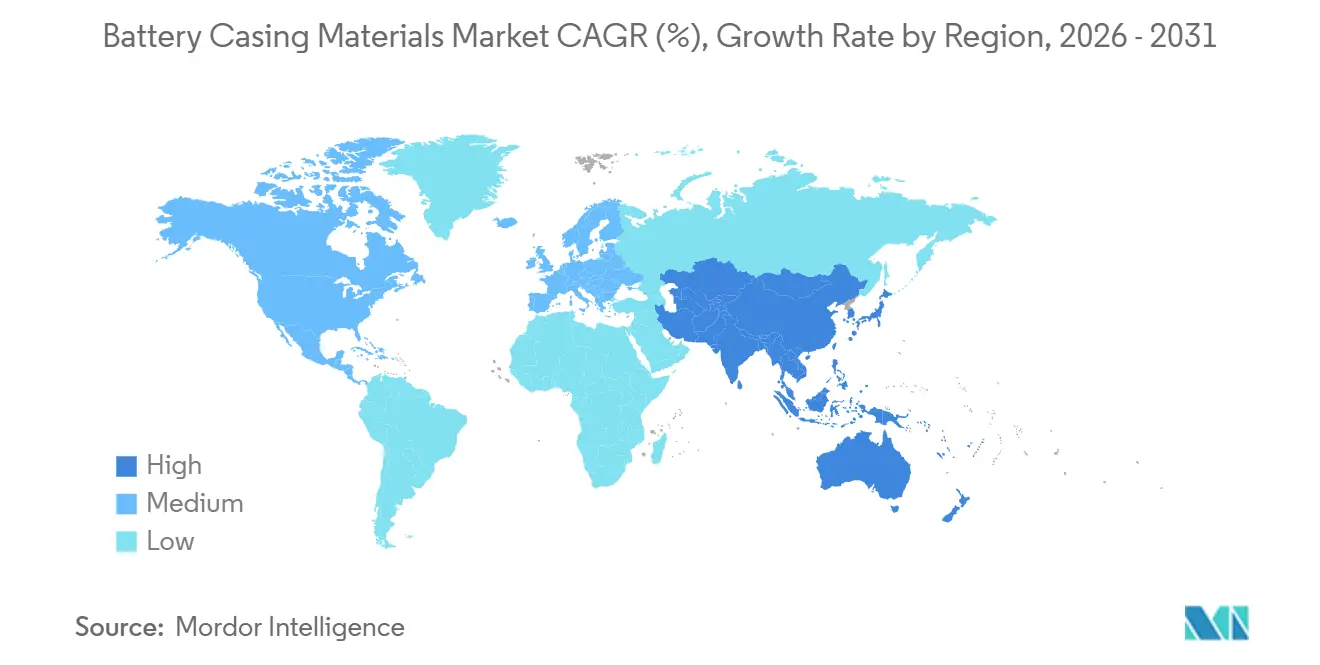
- By geography, Asia-Pacific held 37.09% of the battery casing materials market share in 2025 and is projected to advance at an 11.22% CAGR through 2031.
Note: Market size and forecast figures in this report are generated using Mordor Intelligence’s proprietary estimation framework, updated with the latest available data and insights as of January 2026.
Market Trends and Insights
Drivers Impact Analysis of Battery Casing Materials Market*
| Driver | (~) % Impact on CAGR Forecast | Geographic Relevance | Impact Timeline |
|---|---|---|---|
| Accelerating Electric Vehicle Production | +3.2% | Global, with concentration in China, Europe, and North America | Short term (≤ 2 years) |
| Rising Demand for Lightweight Battery Structures | +2.4% | Global; intensified in European and North American OEM platforms | Medium term (2-4 years) |
| Higher Fast-Charging and Thermal-Management Requirements | +1.8% | Global, led by China and Europe; emerging in North America | Medium term (2-4 years) |
| Expansion of Stationary Energy Storage Systems | +1.4% | Global; particularly US, China, and EU | Short term (≤ 2 years) |
| Battery-Pack Architecture Migration to Cell-to-Pack Designs | +0.9% | APAC core, with spillover to Europe and North America | Medium term (2-4 years) |
| Increasing Demand for Repairable, Recyclable Enclosures | +0.6% | EU-led, with expanding regulatory influence globally | Long term (≥ 4 years) |
| Source: Mordor Intelligence | |||
Accelerating Electric Vehicle Production
Global electric vehicle sales exceeded 20 million units in 2025 and are projected to reach 23.3 million in 2026, supported by China, Europe, Southeast Asia, India, and Latin America[1]. Battery electric vehicles use aluminum across battery enclosures, structural frames, and thermal-management components, making production growth relevant to material demand. Electric truck sales more than doubled in 2025 and represented 9% of worldwide truck sales, adding demand from vehicles with larger battery packs. Chinese producers supplied nearly 75% of global electric car production in 2025, concentrating sourcing while encouraging suppliers to build capacity in North America and Europe. This production scale supports the battery casing materials market because every pack requires structural containment, sealing, and thermal interfaces. Local manufacturing programs can also reduce logistics exposure for enclosure suppliers serving regional vehicle programs.
Rising Demand for Lightweight Battery Structures
Lower casing mass can improve vehicle range efficiency, which is increasing interest in multi-material battery housings. Hybrid nanocomposites using carbon fiber, glass fiber, graphene nanoplatelets, and bio-based epoxy achieved up to 45% lower weight than metallic equivalents in research published in 2026. Constellium’s ALIVE project, concluded in 2024, demonstrated 12%-35% weight savings while meeting side-pole crash, bottom-intrusion, and vibration requirements. Research in the International Journal of Automotive Science and Technology found that carbon-fiber-reinforced polymer provided higher specific energy absorption than aluminum above 100 kilometers per hour. The battery casing materials market, therefore, has scope for hybrid designs where aluminum alone cannot meet weight, safety, and manufacturing needs. Original equipment manufacturers are likely to assess material choice alongside crash performance and repairability rather than weight alone.
Higher Fast-Charging and Thermal-Management Requirements
The first 1,000-volt vehicle models appeared in 2025, and charging announcements in 2026 extended to charging times below 10 minutes. These developments increase heat loads within the battery pack and raise requirements for enclosure thermal conductivity. A 2026 simulation found that immersion cooling held battery-module temperature at 37.5 °C under 250-kilowatt charging, which was 4 °C below indirect cooling. The same study found that immersion cooling reduced the 10%-80% state-of-charge time by 11 minutes. Fraunhofer Institute for Machine Tools and Forming Technology and Amsted Automotive demonstrated aluminum foam sandwich enclosures with phase-change material in 2025, combining crash absorption, thermal buffering, and weight management. Better thermal control can extend battery life, which makes the battery casing materials market relevant to both charging performance and asset durability.
Expansion of Stationary Energy Storage Systems
The United States installed 57 gigawatt-hours and 28 gigawatts of battery energy storage systems in 2025, and deployments are set to rise to 70 gigawatt-hours and 35 gigawatts in 2026. Outdoor containerized systems require safety certification under International Electrotechnical Commission 62619 and Underwriters Laboratories 9540, which supports demand for standardized and fire-resistant enclosures. Lithium iron phosphate battery commoditization is also directing suppliers toward modular housing designs. Sodium-ion batteries are moving into selected stationary applications, and the International Energy Agency identified 2026 as a pivotal year for their commercialization. The battery casing materials market can benefit as sodium-ion chemistries create additional material-compatibility requirements for enclosure suppliers.
Restraints Impact Analysis of Battery Casing Materials Market*
| Restraint | (~) % Impact on CAGR Forecast | Geographic Relevance | Impact Timeline |
|---|---|---|---|
| High Material and Qualification Costs for Advanced Enclosures | -1.5% | Global, with disproportionate impact in cost-sensitive APAC and emerging markets | Medium term (2-4 years) |
| Complex Thermal-Runaway and Crash-Safety Validation | -1.0% | Global; most acute in EU (ECE R100) and North America (FMVSS 305) | Long term (≥ 4 years) |
| Limited Recycling Infrastructure for Multi-Material Casings | -0.7% | EU-led with global implications; compliance factors under EU Battery Regulation 2023/1542 | Long term (≥ 4 years) |
| Design Lock-In From Rapidly Changing Cell Formats and Pack Architectures | -0.4% | Global; most intense in APAC OEM platforms | Medium term (2-4 years) |
| Source: Mordor Intelligence | |||
High Material and Qualification Costs for Advanced Enclosures
Advanced polymer composite and multi-material enclosures can cost 30%-60% more per unit than comparable stamped aluminum designs in high-volume production. This cost difference limits their use in programs that cannot support a premium material bill. SGL Carbon reported a significant revenue decline from weak automotive demand in July 2026 and did not expect a meaningful near-term recovery. Qualification processes under United Nations 38.3, International Electrotechnical Commission 62619, and original equipment manufacturer crash protocols typically take 18-36 months. Those timelines raise capital at risk for suppliers introducing unfamiliar material systems. The battery casing materials market faces this cost burden mainly among material producers and Tier 1 suppliers, while a production award remains uncertain.
Complex Thermal-Runaway and Crash-Safety Validation
Thermal runaway in lithium-ion batteries can generate local flame temperatures above 1,500 °C. This condition requires active material measures or barrier integration beyond a conventional aluminum alloy casing. Research published in 2026 found that thermal-runaway propagation in CTP configurations differs from modular designs because direct interfaces can accelerate heat transfer. The resulting containment requirements can exceed the capabilities of materials validated for earlier pack designs. Regulations, including United Nations Economic Commission for Europe Regulation 100 and Federal Motor Vehicle Safety Standard 305, are being revised in several jurisdictions. Suppliers in the battery casing materials market can face re-engineering costs if final thresholds become more stringent before program launches.
*Our forecasts treat driver/restraint impacts as directional, not additive. The impact forecasts reflect baseline growth, mix effects, and variable interactions.
Battery Casing Materials Market Segment Analysis
By Material:
Polymer Composites Eroding Aluminum's Structural LeadAluminum held 52.38% of the battery casing materials market share in 2025, supported by its strength-to-weight ratio, thermal conductivity, corrosion resistance, and established global supply chain. Constellium, Novelis, Norsk Hydro ASA, and UACJ Corporation supply aluminum products used in battery enclosure systems. Constellium’s ALIVE project showed 12%-35% weight savings over baseline designs while meeting crash, vibration, and leak-test requirements. Aluminum alloys remain embedded in high-volume electric vehicle platforms because manufacturers can form, join, and source them at scale. The thyssenKrupp AG has positioned its selectrify steel housing as nearly weight-neutral against aluminum at a lower material cost.
Polymer composites are projected to advance at a 12.80% CAGR through 2031, the fastest rate among materials in the battery casing materials market. Thermoplastic solutions combine recyclability with injection-molding economics, which can support broader use in complex part designs. Trinseo launched a thermoplastic polycarbonate unidirectional tape-based battery top cover in May 2026 in 1.0 mm and 1.5 mm thin-wall configurations. A hybrid composite battery housing that used Tepex dynalite glass-fiber sheets and a flame-retardant polypropylene (PP) STAMAX tray core delivered 10%-20% weight reduction and 46% lower cost than traditional designs. The EU Battery Regulation 2023/1542, which requires cell-level repairability and recyclability from 2027, favors solutions that can be disassembled without damage.

By Battery Type:
Lithium-Ion Batteries Lead While Sodium-Ion Batteries Define the Next DisruptionLithium-ion batteries held 70.16% share in 2025, reflecting their established use in electric vehicles and stationary deployments. CATL supplied 80% of electric truck batteries in China in 2025 and led commercial CTP pack deployment. Each lithium-ion pack architecture requires an enclosure matched to its cell geometry and thermal profile. The first 1,000-volt vehicle models in China appeared in 2025, supporting material-quality upgrades within high-voltage battery systems. Lead-acid batteries remain relevant in industrial backup power, though lithium chemistries have been extending into lower-cost uses in the battery casing materials market.
Sodium-ion batteries are projected to advance at an 11.15% CAGR through 2031, making them the fastest-growing battery-type segment. Chalmers University of Technology estimated global sodium-ion production at 70 gigawatt-hours in 2025 and projected it to reach 250 gigawatt-hours by 2030. Sodium-ion systems present a separate enclosure specification where fire safety and material compatibility can be important. This opening gives suppliers a reason to develop housings that are not limited to lithium-ion battery requirements.
By Cell Format:
Cylindrical Cells Lead While Pouch Cells AccelerateCylindrical cells held 43.13% share in 2025, supported by high-volume deployment of large-format 4680-type cells. This format requires precision-machined or deep-drawn aluminum casings with tight dimensional tolerances. Producers, including Novelis and UACJ Corporation, supply cold-rolled aluminum strip for these casing requirements. A 2026 electrochemical-thermal model for 4680 cells found that enclosure-integrated thermal management was required at 3C-6C charging rates. Prismatic cells remain prevalent in China’s lithium iron phosphate electric vehicle platforms and retain established tooling in the battery casing materials market.
Pouch cells are projected to advance at an 11.94% CAGR through 2031 in the battery casing materials market. LG Energy Solution’s pouch CTP design increases space utilization to 65%-72%, compared with 40%-50% in module-to-pack architectures. SK On introduced CTP integrated packages at InterBattery 2026, including a large-area aluminum cooling package designed to provide up to 3 times conventional cooling performance. Pouch CTP enclosures must provide rigidity previously supplied by the module frame. They must also accommodate integrated thermal routing, which supports demand for hybrid aluminum-composite designs.
By Application:
Electric Vehicles Anchor Demand as Energy Storage Systems ScaleElectric vehicles held 45.27% share in 2025, making them the largest application. Automotive-grade enclosures must address side-pole crash, bottom intrusion, thermal-runaway containment, and leak-proof sealing under United Nations Economic Commission for Europe Regulation 100. The transition to CTP architectures puts structural requirements directly into the pack casing rather than the module frame. Consumer electronics remain a stable secondary application, with aluminum and engineering plastics used in smartphone and laptop battery housings.
Energy storage systems are projected to advance at a 13.18% CAGR through 2031. Stationary systems need weatherproofing to Ingress Protection (IP) 67, fire-rated cabinets compliant with Underwriters Laboratories 9540 and International Electrotechnical Commission 62619, and modular scaling from 1 megawatt to 200 megawatts. These needs differ from automotive requirements and favor suppliers that can offer certified outdoor enclosure systems. Larger stationary deployments also increase the importance of standardization, service access, and replacement planning. The U.S. storage buildout in 2026 also supports demand for fire-rated outdoor enclosure systems.
Geography Analysis
APAC Battery Casing Materials Market
Asia-Pacific held 37.09% share in 2025 and is projected to advance at an 11.22% CAGR through 2031. China produced nearly 75% of the world’s electric cars in 2025 and accounted for more than 80% of global battery cell production. This vertically integrated base creates demand from active materials through pack assembly. India’s electric two-wheeler and three-wheeler segment grew more than 30% year over year in the first quarter of 2026. LG Energy Solution and SK On are commercializing pouch CTP architectures in South Korea, while UACJ Corporation supplies precision cold-rolled aluminum to domestic and international battery manufacturers from Japan.
North America and Europe Battery Casing Materials Market
In North America, U.S. battery energy storage deployments are projected to rise to 70 gigawatt-hours and 35 gigawatts in 2026 from 57 gigawatt-hours in 2025[2]. This buildout represented USD 25.2 billion in capital investment and supports demand for fire-rated outdoor enclosure systems. Minth Group announced a USD 430 million investment in Gadsden, Alabama, in March 2026 to expand its U.S. manufacturing footprint. Europe’s battery electric vehicle production grew 36% in the first quarter of 2026, while the EU Battery Regulation is steering developers toward modular and reversibly fastened battery designs.
MEA and South America Battery Casing Materials Market
South America, and Middle-East and Africa remain emerging geographies for the battery casing materials market. Latin American electric vehicle sales rose 75% in 2025 and are projected to grow a further 45% in 2026, with Brazil and Argentina supporting regional demand. Saudi Arabia’s industrial strategy includes electric vehicle manufacturing ambitions, while South Africa’s mining and utility sectors are deploying large-format battery energy storage systems for grid stabilization. Both regions rely on imported enclosure assemblies, but local-content requirements can gradually support production closer to end-use assembly.
Competitive Landscape
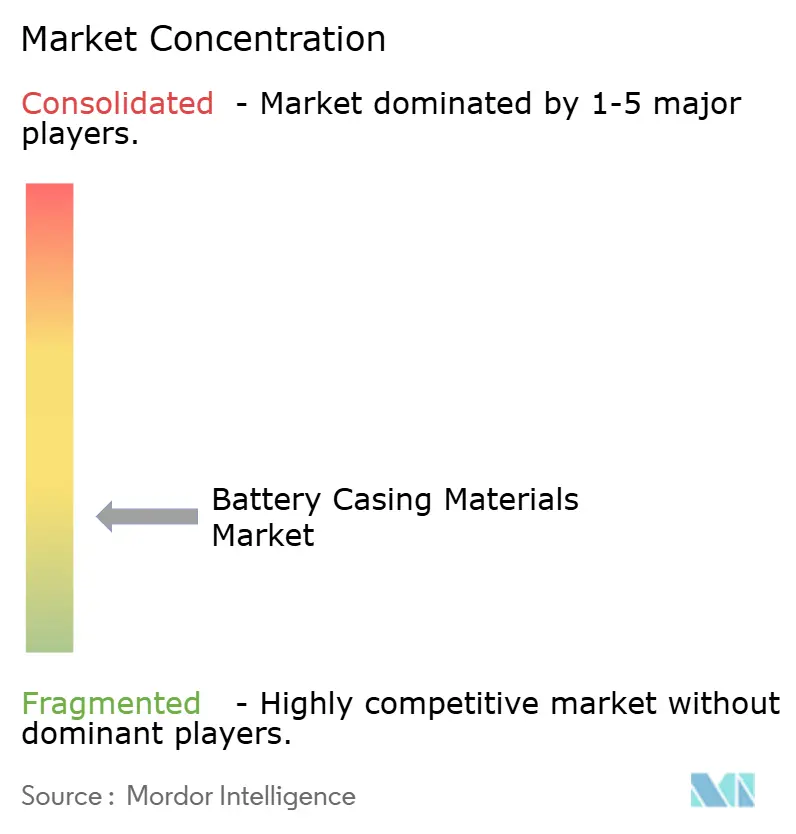
The battery casing materials market is highly fragmented, with the top five players including Minth Group, Magna International Inc., Gestamp Automoción, S.A., BENTELER International Austria GmbH, and Constellium. Global aluminum producers, including Novelis, Constellium, Norsk Hydro ASA, Gränges, and UACJ Corporation, compete on material performance and supply security. Integrated automotive Tier 1 suppliers include BENTELER International Austria GmbH, Gestamp Automoción, S.A., Magna International Inc., Minth Group, and Nemak. In the battery casing materials market, they combine material knowledge with manufacturing capability to supply enclosure systems. Specialty material companies include Covestro AG, LANXESS, SABIC, SGL Carbon, Teijin Limited, Kautex, Trinseo, and thyssenkrupp AG.
Competition in the battery casing materials market is shifting from material substitution toward system integration. Suppliers that provide finished enclosures with cooling, structural frames, and fire protection can strengthen original equipment manufacturer relationships. BENTELER International Austria GmbH unveiled integrated airtight and modular battery tray concepts in July 2026 that combine thermal management and underbody protection. Trinseo introduced its thermoplastic polycarbonate unidirectional tape-based battery top cover at the China International Battery Fair (CIBF) 2026 in Shenzhen. These moves reflect demand in the battery casing materials market for lower weight, fire resistance, and more integrated pack components.
Collaboration and joint ventures are changing competitive positions alongside internal research and development. AISIN Corporation, Toyota Tsusho Corporation, and Minth Group established ATM Automotive Parts Inc. in Windsor, Ontario, in 2026 to produce aluminum battery-securing frame parts for North American battery electric vehicle and plug-in hybrid electric vehicle platforms. The venture combines Japanese forming expertise, Minth Group’s manufacturing scale, and Toyota Tsusho Corporation’s management network. Suppliers also see scope in multi-material enclosure integration and in products for sodium-ion and solid-state chemistries, which do not have the same legacy tooling that supports aluminum in lithium-ion programs.
Battery Casing Materials Industry Leaders
-
Minth Group
-
Magna International Inc.
-
Gestamp Automoción, S.A.
-
BENTELER International Austria GmbH
-
Constellium
- *Disclaimer: Major Players sorted in no particular order
Battery Casing Materials Market Companies Covered in this Report
- BENTELER International Austria GmbH
- Constellium
- Covestro AG
- Gestamp Automoción, S.A.
- Gränges
- Kautex
- LANXESS
- Magna International Inc.
- Minth Group
- Nemak
- Norsk Hydro ASA
- Novelis
- SABIC
- SGL Carbon
- Teijin Limited
- thyssenkrupp AG
- Trinseo
- UACJ Corporation
Recent Industry Developments in Battery Casing Materials Market
- May 2026: Trinseo launched its recyclable thermoplastic polycarbonate unidirectional tape-based battery top cover at CIBF 2026 in Shenzhen. Available in 1.0 mm and 1.5 mm thin-wall configurations, it offers flame resistance, weight reduction, and circular lifecycle benefits over traditional metal and thermoset casings.
- April 2025: Hindalco delivered 10,000 aluminum battery enclosures to Mahindra from its new Chakan facility and planned to double production capacity to 160,000 enclosures annually. The development directly supported demand for aluminum in Electric Vehicle (EV) battery casing applications.
Global Battery Casing Materials Market Report Scope
Battery casing materials are materials used to form the protective outer enclosure of battery cells and packs. They provide mechanical protection, dimensional stability, thermal resistance, and electrical safety while helping protect battery components from moisture, impact, and other external stresses.
The Battery Casing Materials Market is segmented by material, battery type, cell format, application, and geography. By material, the market is segmented into aluminum, steel, engineering plastics, polymer composites, and other materials (including stainless steel, magnesium alloys, and hybrid metal-polymer structures). By battery type, the market is segmented into lithium-ion batteries, sodium-ion batteries, lead-acid batteries, and other battery types (including nickel-based batteries, solid-state batteries, and flow batteries). By cell format, the market is segmented into prismatic cells, cylindrical cells, pouch cells, and other cell formats (including coin and button cells). By application, the market is segmented into electric vehicles, energy storage systems, consumer electronics, and other applications (including industrial batteries, aerospace and defense, marine, and medical devices). The report also covers the market size and forecasts for battery casing materials in 15 countries across major regions. For each segment, the market sizing and forecasts have been done on the basis of value (USD).
Segmentation Overview
| Aluminum |
| Steel |
| Engineering Plastics |
| Polymer Composites |
| Other Materials (Stainless Steel, Magnesium Alloys, Hybrid Metal-Polymer Structures) |
| Lithium-Ion Batteries |
| Sodium-Ion Batteries |
| Lead-Acid Batteries |
| Other Battery Types (Nickel-Based Batteries, Solid-State Batteries, Flow Batteries) |
| Prismatic Cells |
| Cylindrical Cells |
| Pouch Cells |
| Other Cell Formats (Coin and Button Cells) |
| Electric Vehicles |
| Energy Storage Systems |
| Consumer Electronics |
| Other Applications (Industrial Batteries, Aerospace and Defense, Marine, Medical Devices) |
| Asia-Pacific | China |
| India | |
| Japan | |
| South Korea | |
| Rest of Asia-Pacific | |
| North America | United States |
| Canada | |
| Mexico | |
| Europe | Germany |
| United Kingdom | |
| France | |
| Italy | |
| Rest of Europe | |
| South America | Brazil |
| Argentina | |
| Rest of South America | |
| Middle-East and Africa | Saudi Arabia |
| South Africa | |
| Rest of Middle-East and Africa |
| By Material | Aluminum | |
| Steel | ||
| Engineering Plastics | ||
| Polymer Composites | ||
| Other Materials (Stainless Steel, Magnesium Alloys, Hybrid Metal-Polymer Structures) | ||
| By Battery Type | Lithium-Ion Batteries | |
| Sodium-Ion Batteries | ||
| Lead-Acid Batteries | ||
| Other Battery Types (Nickel-Based Batteries, Solid-State Batteries, Flow Batteries) | ||
| By Cell Format | Prismatic Cells | |
| Cylindrical Cells | ||
| Pouch Cells | ||
| Other Cell Formats (Coin and Button Cells) | ||
| By Application | Electric Vehicles | |
| Energy Storage Systems | ||
| Consumer Electronics | ||
| Other Applications (Industrial Batteries, Aerospace and Defense, Marine, Medical Devices) | ||
| By Geography | Asia-Pacific | China |
| India | ||
| Japan | ||
| South Korea | ||
| Rest of Asia-Pacific | ||
| North America | United States | |
| Canada | ||
| Mexico | ||
| Europe | Germany | |
| United Kingdom | ||
| France | ||
| Italy | ||
| Rest of Europe | ||
| South America | Brazil | |
| Argentina | ||
| Rest of South America | ||
| Middle-East and Africa | Saudi Arabia | |
| South Africa | ||
| Rest of Middle-East and Africa | ||
Key Questions Answered in the Report
What is the size of the battery casing materials market?
The battery casing materials market stands at USD 8.21 billion in 2026 and is projected to reach USD 13.26 billion by 2031.
What is driving demand for battery casing materials?
Electric vehicle production, fast-charging requirements, lightweight designs, and stationary energy storage deployment are supporting demand.
Which material led the battery casing materials market in 2025?
Aluminum led with 52.38% market share in 2025, supported by its strength-to-weight ratio, thermal conductivity, and established supply chain.
Which battery type is expected to grow fastest through 2031?
Sodium-ion batteries are projected to advance at an 11.15% CAGR through 2031, supported by growing interest in stationary storage applications.