
Barbecue Sauce Market Size and Share
Market Overview
| Study Period | 2022 - 2032 |
|---|---|
| Market Size (2027) | USD 1.84 Billion |
| Market Size (2032) | USD 2.43 Billion |
| Growth Rate (2027 - 2032) | 5.72 % |
| Fastest Growing Market | Asia-Pacific |
| Largest Market | North America |
| Market Concentration | Medium |
Major Players *Disclaimer: Major Players sorted in no particular order Image © Mordor Intelligence. Reuse requires attribution under CC BY 4.0. | |
Barbecue Sauce Market Analysis by Mordor Intelligence
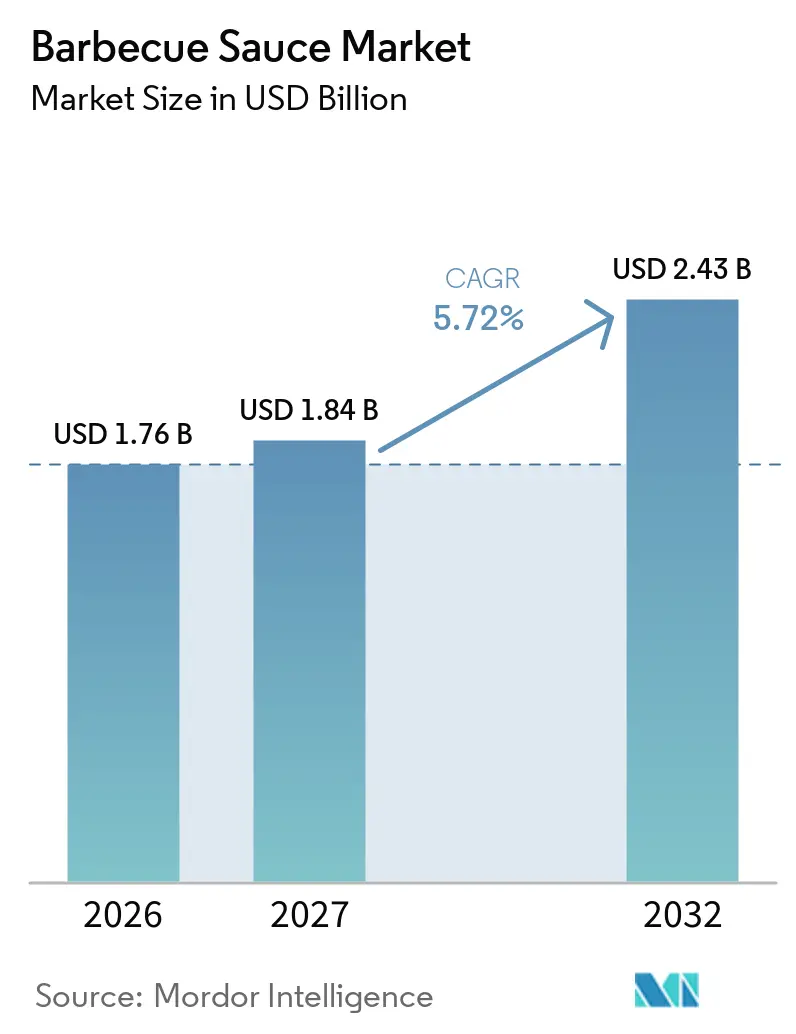
The barbecue sauce market size is expected to grow from USD 1.76 billion in 2026 to USD 1.84 billion in 2027 and is forecast to reach USD 2.43 billion by 2032 at 5.72% CAGR over 2027-2032. The barbecue sauce market benefits from regular at-home grilling, the broader use of sauces in cooking and food preparation, and sustained demand from restaurants and other foodservice operators. Product development is increasingly focused on regional recipes, smoky flavors, and sweet-and-spicy profiles to cater to diverse consumer preferences and evolving taste trends. Manufacturers are also exploring lower-sugar formulations and alternative ingredient combinations to address growing interest in products with modified nutritional profiles. At the same time, fluctuations in the costs of tomatoes, sugar, spices, vinegar, and other key ingredients, alongside emerging labeling requirements, are placing greater pressure on product formulation, sourcing, and procurement planning. These factors encourage companies to improve operational efficiency while maintaining consistent product quality and competitive pricing.
Key Report Takeaways
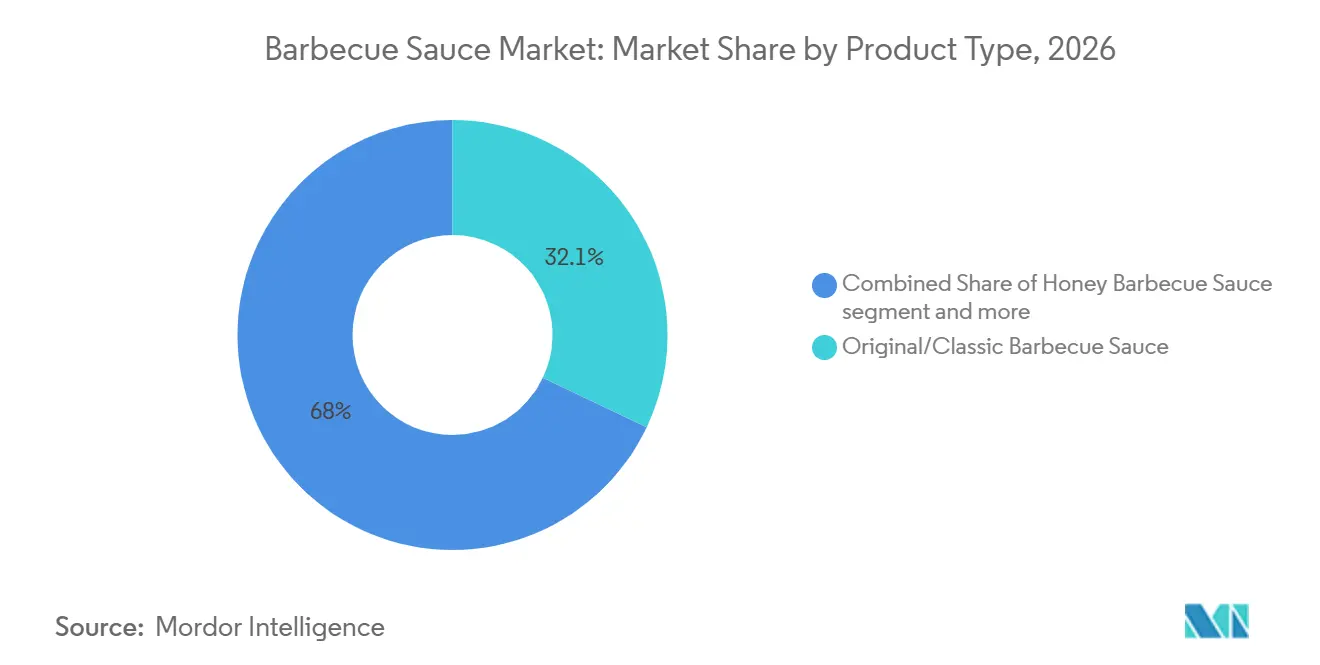
- By product type, original/classic barbecue sauce held 32.05% of the barbecue sauce market share in 2026, while spicy barbecue sauce is forecast to grow at a 7.03% CAGR through 2032.
- By packaging type, bottles held 65.37% of the barbecue sauce market share in 2026, while sachets and pouches are forecast to grow at a 6.89% CAGR through 2032.
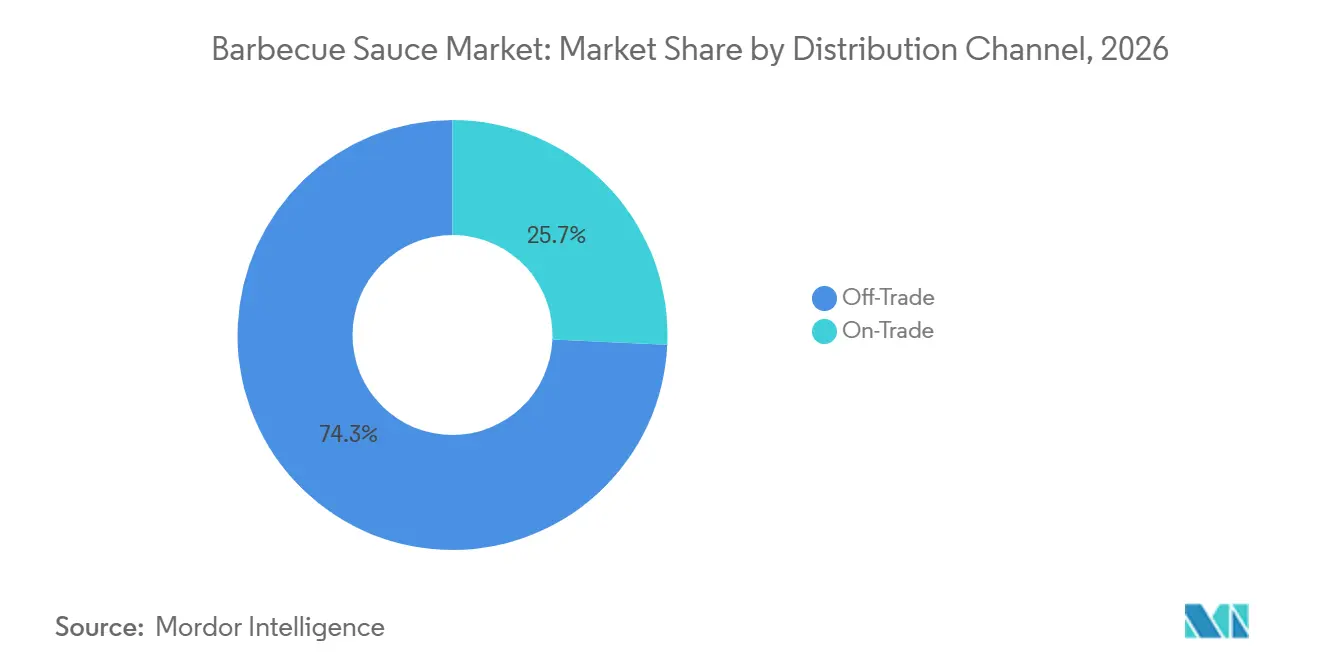
- By distribution channel, off-trade held 74.27% of the barbecue sauce market share in 2026, while on-trade is forecast to grow at a 6.77% CAGR through 2032.
- By geography, North America held 43.71% of the barbecue sauce market share in 2026, while Asia-Pacific is forecast to grow at a 7.12% CAGR through 2032.
Note: Market numbers in this report are based on Mordor Intelligence's proprietary estimation framework, which combines nine months of actuals with Q4 projections for base year 2026.
Global Barbecue Sauce Market Trends and Insights
Drivers Impact Analysis*
| Driver | (~) % Impact on CAGR Forecast | Geographic Relevance | Impact Timeline |
|---|---|---|---|
| Rising consumption of grilled, smoked, and barbecued foods | +1.8% | Global; North America core, spill-over to Asia-Pacific and Europe | Medium term (2–4 years) |
| Growing popularity of barbecue cuisine and outdoor cooking activities | +1.2% | North America & Europe; nascent adoption in Asia-Pacific and South America | Medium term (2–4 years) |
| Increasing demand for convenient, ready-to-use sauces and marinades | +1.1% | Global | Short term (≤ 2 years) |
| Expansion of quick-service restaurants and foodservice establishments | +0.9% | Global; concentrated in Asia-Pacific and Middle East | Long term (≥ 4 years) |
| Rising consumer interest in diverse flavors — smoky, spicy, sweet, tangy | +0.6% | North America primary; growing in Europe and Asia-Pacific | Short term (≤ 2 years) |
| Growing demand for premium, artisanal, and regionally inspired varieties | +0.5% | North America & Europe; emerging in Asia-Pacific urban centers | Long term (≥ 4 years) |
| Source: Mordor Intelligence | |||
Rising Consumption of Grilled, Smoked, and Barbecued Foods Fuels Baseline Demand
The barbecue sauce market is supported by grilling occasions that increasingly extend beyond a short seasonal window. Cargill reported in May 2025 that 61% of U.S. consumers were actively increasing protein intake, while 60% started meal planning around protein[1]. This behavior links sauce purchases to routine meal planning rather than occasional entertainment. Sauces used on grilled meat, poultry, and plant-based protein products can be applied before, during, and after cooking. That wider use supports repeat purchases and gives brands an opportunity to position sauces as cooking ingredients as well as table condiments. The barbecue sauce market can therefore benefit when consumers seek convenient ways to add flavor to protein-focused meals.
Growing Popularity of Barbecue Cuisine and Outdoor Cooking Activities Broadens Consumer Base
Barbecue cuisine is gaining relevance beyond traditional U.S. regional styles as consumers encounter Korean, Japanese, Argentine, and other grilled-food traditions. McCormick has identified consumer interest in flavors tied to a recognizable place or food tradition, which supports the use of regional sauces and marinades. This demand allows brands to introduce new recipes without abandoning familiar barbecue formats. Outdoor cooking also gives retailers and restaurants a clear occasion for promotional activity and new product launches. The growth of social content and restaurant menus can make unfamiliar barbecue flavors easier for households to try. Within the barbecue sauce market, products that explain flavor origin clearly can make experimentation more accessible to mainstream shoppers.
Increasing Demand for Convenient, Ready-to-Use Sauces and Marinades Raises Volume Per Occasion
Ready-to-use products address consumer demand for simpler meal preparation while retaining a distinct flavor profile. The National Barbecue and Grilling Association noted in 2026 that sauces are increasingly used as a mop, glaze, and finishing product within the same meal preparation process[2]. A single versatile product can reduce the need to buy several separate cooking ingredients. This use case can raise consumption per cooking occasion when a sauce is applied at more than one stage. It also gives manufacturers a reason to improve bottle design, instructions, and recipe communication. The barbecue sauce market is likely to favor products that solve a practical cooking task without requiring additional preparation.
Expansion of Quick-Service Restaurants and Foodservice Establishments Intensifies On-Trade Demand
Restaurant expansion increases recurring demand for standardized sauce formats and dependable supply. New restaurant units need sauces that can be delivered consistently across locations and service periods. Each unit can create recurring demand for bulk packs, portion-control formats, and customer-facing sachets. Restaurants also introduce diners to menu-specific barbecue profiles that may later be sought in retail stores. This creates a connection between foodservice menus and grocery assortments. For the barbecue sauce market, foodservice growth strengthens the case for formats that offer consistency, easy handling, and predictable portioning.
Restraints Impact Analysis*
| Restraint | (~) % Impact on CAGR Forecast | Geographic Relevance | Impact Timeline |
|---|---|---|---|
| Fluctuations in prices of tomatoes, sugar, vinegar, spices, and other key ingredients | -1.2% | Global; most acute in North America and Europe | Short term (≤ 2 years) |
| Rising consumer concerns regarding sugar, sodium, and artificial additives | -0.8% | North America & Europe; emerging in Asia-Pacific urban centers | Long term (≥ 4 years) |
| Stringent food safety, labeling, and ingredient regulations | -0.6% | North America & Europe; expanding via Codex Alimentarius in Asia-Pacific | Long term (≥ 4 years) |
| Challenges in maintaining consistent flavor, quality, and product stability | -0.4% | Global; most acute in Asia-Pacific and South America production hubs | Medium term (2–4 years) |
| Source: Mordor Intelligence | |||
Raw Material Price Volatility Compresses Margins and Complicates Procurement Planning
Raw material volatility remains a direct constraint on margins in the barbecue sauce market. The U.S. Department of Agriculture reported that retail fresh tomato prices were 12.8% higher in July 2026 than in July 2025[3]. The report also forecasted that sugar and sweets prices would increase by 7.1% in 2026. Tomato products, sugar, vinegar, and spices have different sourcing patterns, so procurement teams face varied timing and cost exposure. Larger manufacturers may have greater ability to use long-term supplier arrangements and spread procurement risk across higher volumes. Smaller companies can face more difficulty protecting product quality and price positioning when major inputs fluctuate.
Consumer Concerns Over Sugar and Sodium Content Pressure Reformulation Timelines
Consumers are paying more attention to added sugar, sodium, and ingredient lists when choosing packaged foods. The National Barbecue and Grilling Association reported that shoppers were looking for reduced-sugar and high-fructose-corn-syrup-free barbecue products while still expecting familiar flavor. The U.S. Food and Drug Administration proposed front-of-package nutrition labeling in January 2025 for saturated fat, sodium, and added sugars. These requirements can raise the importance of formulation work, sensory testing, and clear package communication. Reformulation is difficult because reducing sugar or sodium can alter viscosity, preservation, and taste. The barbecue sauce market will reward brands that can meet changing consumer expectations without weakening the flavor profile that buyers recognize.
*Our forecasts treat driver/restraint impacts as directional, not additive. The impact forecasts reflect baseline growth, mix effects, and variable interactions.
Segment Analysis
By Product Type: Spicy Variants Gain Within a Classic-Led Category
Original/classic barbecue sauce accounted for the largest share of the barbecue sauce market, representing 32.05% of the market in 2026. Its leading position is supported by widespread consumer familiarity and its versatility across different food applications. The sauce offers a balanced combination of sweet, tangy, and smoky flavors that appeals to a broad consumer base. It is commonly used in marinades, grilling, roasting, dipping, and as a table condiment for meat, poultry, and other food products. Its compatibility with traditional barbecue recipes and everyday meals supports consistent demand across household and foodservice channels.
Spicy barbecue sauce is projected to be the fastest-growing product type in the barbecue sauce market, registering a CAGR of 7.03% through 2032. Its growth is supported by increasing consumer interest in bold, intense, and differentiated flavor profiles. The rising popularity of spicy foods and sauces is encouraging manufacturers to introduce barbecue variants featuring chili peppers, jalapeños, cayenne pepper, and other heat-inducing ingredients. These products appeal to consumers seeking more adventurous flavor experiences in grilling, dipping, and meal preparation.

By Packaging Type: Flexible Formats Gain Alongside Bottled Products
Bottles accounted for the largest share of the barbecue sauce market, representing 65.37% of the market in 2026. The segment's leading position is supported by the convenience, durability, and ease of use associated with bottled packaging. Bottles allow consumers to store barbecue sauce securely and dispense controlled quantities during cooking, grilling, and meal preparation. Their suitability for repeated use makes them a preferred packaging format among households and foodservice establishments with regular sauce consumption. Furthermore, bottles are available in different sizes and materials, including plastic and glass, catering to varying consumer preferences and price points. Squeeze bottles also facilitate convenient dispensing, while transparent packaging can help consumers assess product appearance and remaining quantity.
Sachets and pouches are projected to be the fastest-growing packaging segment in the barbecue sauce market, registering a CAGR of 6.89% through 2032. Growth is supported by increasing demand for convenient, portable, and portion-controlled packaging formats. Single-serve sachets are particularly suitable for takeaway meals, quick-service restaurants, food delivery, and on-the-go consumption. Pouches provide an alternative for consumers seeking flexible packaging that can require less storage space than rigid containers. These formats also allow manufacturers to offer different serving sizes, catering to individual consumers, small households, and foodservice operators.
By Distribution Channel: On-Trade Demand Builds From a Large Retail Base
The off-trade segment accounted for the largest share of the barbecue sauce market, representing 74.27% of the market in 2026. Its leading position is supported by widespread availability through supermarkets, hypermarkets, convenience stores, and online retail platforms. These channels enable consumers to purchase barbecue sauces for household cooking, grilling, marinating, and dipping applications. The availability of multiple brands, flavor variants, packaging sizes, and price points also allows consumers to select products according to their preferences and budgets. Furthermore, the growing popularity of home cooking and backyard grilling supports the recurring purchase of barbecue sauces through retail outlets.
The on-trade segment is projected to be the fastest-growing distribution channel in the barbecue sauce market, registering a CAGR of 6.77% through 2032. Its growth is supported by demand from restaurants, quick-service restaurants, cafés, catering businesses, and other foodservice establishments. Barbecue sauces are widely used in preparing and serving burgers, grilled meats, chicken wings, sandwiches, ribs, and other menu items. The expansion of foodservice operations and the popularity of grilled and sauce-based dishes are creating additional opportunities for commercial sauce consumption.
Geography Analysis
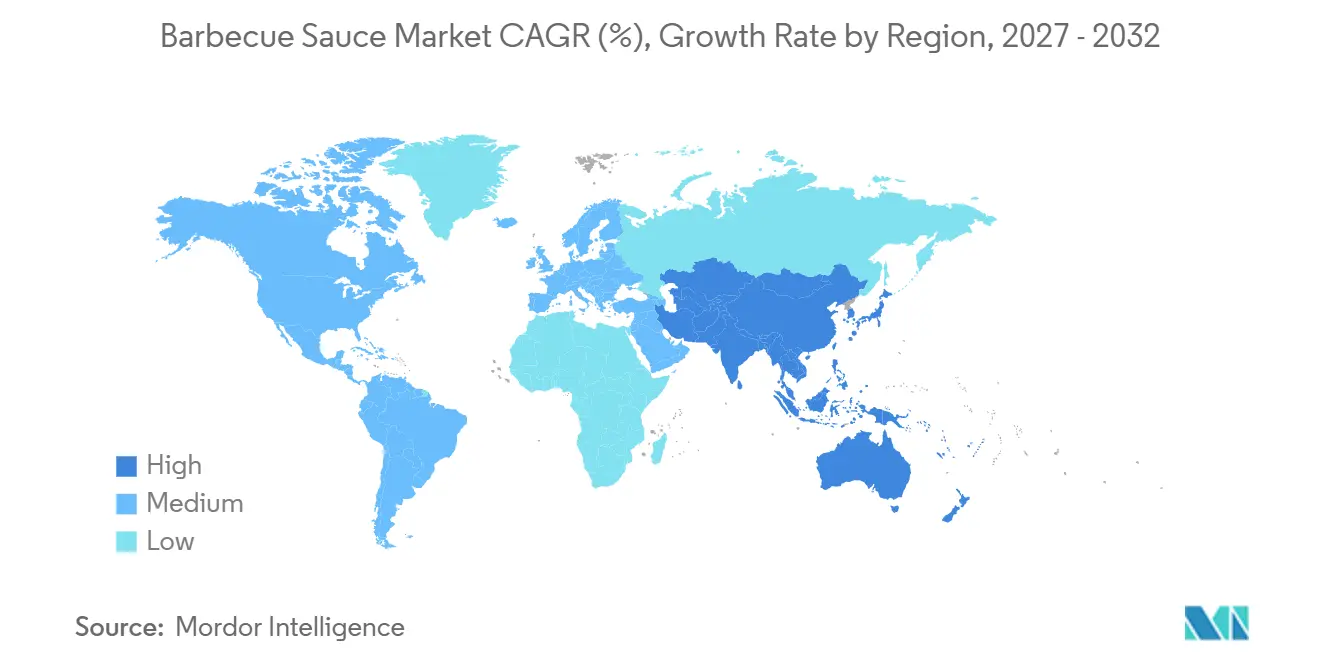
North America held 43.71% of the barbecue sauce market share in 2026. The United States provides the region’s largest base because grilling traditions, retail availability, and foodservice use are deeply established. A Maine Department of Economic and Community Development review reported USD 1.07 billion in U.S. MULO barbecue sauce dollar sales for the 52 weeks ending April 20, 2025, up 5.3% year over year. The South led sales at USD 483.7 million and represented 44% of national volume, while the West recorded 5.9% growth and the Northeast recorded 5.7% growth. Canada adds demand for grilled-food condiments and international flavor choices. Mexico contributes through foodservice development and products tailored to local spice preferences.
Asia-Pacific is forecast to grow at a 7.12% CAGR through 2032, the fastest regional rate. The barbecue sauce market size in the region is shaped by expanding restaurant networks, rising household trial, and the growing familiarity of Western and fusion cooking. South Korea provides a strong base of barbecue traditions and sauces built around fermented chili and soybean ingredients. Japan supports demand for barbecue sauces adapted to local taste preferences and grilling occasions. China, India, Vietnam, Indonesia, and Australia add a varied set of restaurant and retail opportunities. These markets differ in cuisine, income levels, and distribution systems, so companies need product and package choices that suit local conditions.
Europe has established demand in the United Kingdom and growing interest in premium barbecue products across Germany, France, Spain, Belgium, and Poland. Seasonal grilling is an important retail event in many European countries, while premium regional recipes can support value growth. Middle East and Africa present developing opportunities in the United Arab Emirates, Saudi Arabia, and South Africa. International restaurant chains and expatriate consumer groups can support demand for imported and globally inspired products in Gulf markets. South Africa’s braai culture provides a local foundation for sauces and marinades that reflect domestic taste preferences. South America, led by Brazil and Argentina, has strong grilling traditions that can support interest in U.S., Asian, and locally inspired barbecue sauces.
Competitive Landscape
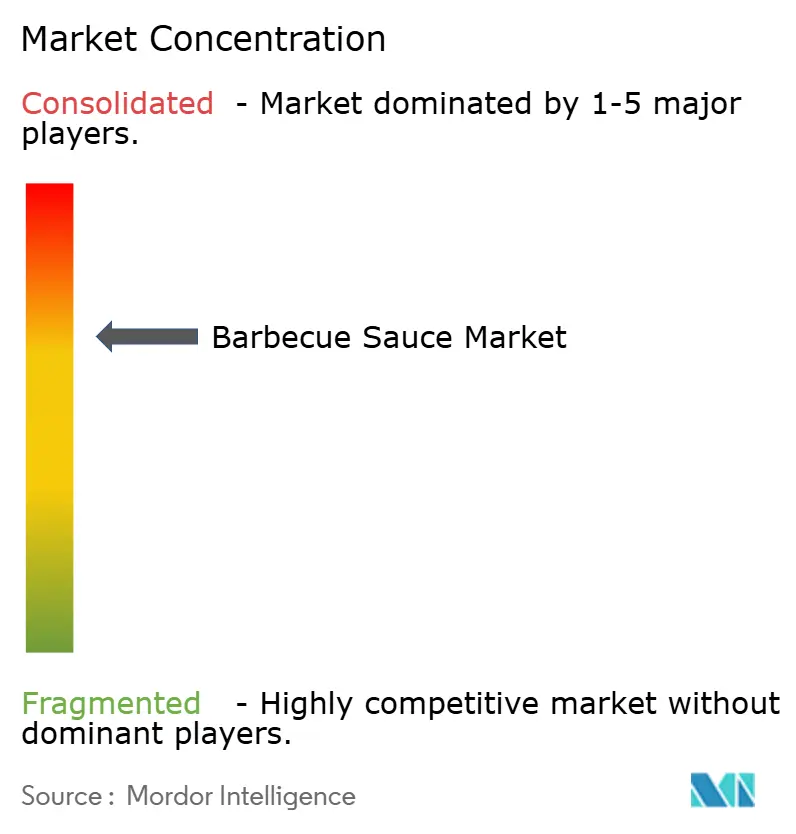
The barbecue sauce market is characterized by a consolidated competitive structure, with established food and condiment manufacturers leveraging strong brand recognition, extensive distribution networks, and diversified product portfolios. The Kraft Heinz Company, McCormick & Company, Incorporated, Conagra Brands, Inc., General Mills, Inc., and The Clorox Company are among the leading players identified in the market. Competition is driven by product differentiation, flavor innovation, pricing strategies, packaging formats, and retail availability. Established companies benefit from longstanding relationships with retailers, distributors, and foodservice operators, supporting broad market reach.
The Kraft Heinz Company maintains a competitive presence through its Kraft and Bull’s-Eye barbecue sauce brands, which offer products in original, smoky, honey, and other flavor variants. McCormick & Company, Incorporated competes through established brands such as Cattlemen’s and Stubb’s, catering to retail consumers and professional foodservice operators with a range of barbecue sauces. In March 2026, McCormick also introduced MISSION BBQ sauces through a partnership with the restaurant brand, extending restaurant-inspired flavors into retail outlets.
Conagra Brands, Inc. and General Mills, Inc. also operate across established packaged-food categories, enabling them to compete through their broader food industry capabilities and market access. The Clorox Company is included among the identified market participants, although its current official brand portfolio is primarily focused on cleaning, household care, wellness, and related categories rather than a clearly established standalone barbecue sauce brand. Across the market, competition increasingly centers on expanding flavor choices, improving product convenience, and responding to demand for differentiated barbecue sauce formulations.
Barbecue Sauce Industry Leaders
-
The Kraft Heinz Company
-
McCormick & Company, Incorporated
-
Conagra Brands, Inc.
-
General Mills, Inc.
-
The Clorox Company
- *Disclaimer: Major Players sorted in no particular order
Recent Industry Developments
- August 2026: Zaxbys partnered with Alabama native Rob Rausch to launch its first limited-edition Alabama White BBQ Sauce, featuring a rich, tangy, and peppery flavor inspired by Southern barbecue traditions. Available from August 4 at participating locations nationwide and through the Zaxbys app, the launch expands the restaurant chain’s signature sauce portfolio and promotes a regional barbecue flavor through celebrity collaboration.
- March 2026: McCormick partnered with MISSION BBQ to launch four signature barbecue sauces inspired by regional American barbecue styles: Memphis Belle, Blue Ridge Smoky Mountain, Texas Twang, and KC Classic. The sauces feature distinct sweet, smoky, tangy, and spicy flavor profiles and were introduced through online platforms and retail stores nationwide in the United States, expanding MISSION BBQ’s restaurant sauce portfolio into the at-home consumption market.
- November 2025: Kaatil launched Hot Barbeque Sauce No. 9, combining the smoky sweetness of traditional barbecue sauce with the intense, lingering heat of India's Bhoot Jolokia chilli. Designed for Indian taste preferences, the sauce can be used as a dip, spread, marinade, glaze, or grilling condiment. The launch expanded Kaatil's No. 9 product range and strengthened its focus on chilli-led flavour innovation, with distribution planned through major e-commerce platforms, retail outlets, and quick-commerce channels.
- March 2025: Bachan’s launched three new Japanese barbecue sauce flavors: Roasted Garlic, Sweet Pineapple, and Hella Hot at Natural Products Expo West, expanding the brand's portfolio with garlic-forward, fruit-based, and spicy flavor profiles. The launch reflects manufacturers' efforts to differentiate barbecue sauces through distinctive ingredients and international flavor influences.
Global Barbecue Sauce Market Report Scope
Barbecue sauce is a condiment used to enhance the flavor of grilled, smoked, roasted, and barbecued foods. It is typically prepared from ingredients such as tomatoes, vinegar, sugar, spices, and seasonings, with variations in sweetness, smokiness, tanginess, and spiciness. The barbecue sauce market is segmented by product type, packaging type, distribution channel and geography. Based on product type, the market is segmented into original/classic barbecue sauce, honey barbecue sauce, smoky barbecue sauce, spicy barbecue sauce, sweet and tangy barbecue sauce and other barbecue sauces. Based on packaging type, the market is segmented into bottles, jars, sachets and pouches, and other packaging types. Based on distribution channel, the market is segmented into off-trade and on-trade channels. By geography, the market is segmented into North America, Europe, Asia-Pacific, South America, and Middle-East and Africa. For each segment, the market sizing and forecasting have been done in value terms (USD billion).
| Original/Classic Barbecue Sauce |
| Honey Barbecue Sauce |
| Smoky Barbecue Sauce |
| Spicy Barbecue Sauce |
| Sweet and Tangy Barbecue Sauce |
| Other Barbecue Sauces |
| Bottles |
| Jars |
| Sachets and Pouches |
| Other Packaging Types |
| Off-Trade | Supermarkets/Hypermarkets |
| Convenience Stores | |
| Online Retail Stores | |
| Other Distribution Channels | |
| On-Trade |
| North America | United States |
| Canada | |
| Mexico | |
| Rest of North America | |
| Europe | Germany |
| United Kingdom | |
| Italy | |
| France | |
| Spain | |
| Belgium | |
| Poland | |
| Rest of Europe | |
| Asia-Pacific | China |
| India | |
| Japan | |
| Australia | |
| South Korea | |
| Vietnam | |
| Indonesia | |
| Rest of Asia-Pacific | |
| South America | Brazil |
| Argentina | |
| Rest of South America | |
| Middle East and Africa | South Africa |
| Saudi Arabia | |
| United Arab Emirates | |
| Egypt | |
| Morocco | |
| Nigeria | |
| Rest of Middle East and Africa |
| By Product Type | Original/Classic Barbecue Sauce | |
| Honey Barbecue Sauce | ||
| Smoky Barbecue Sauce | ||
| Spicy Barbecue Sauce | ||
| Sweet and Tangy Barbecue Sauce | ||
| Other Barbecue Sauces | ||
| By Packaging Types | Bottles | |
| Jars | ||
| Sachets and Pouches | ||
| Other Packaging Types | ||
| By Distribution Channel | Off-Trade | Supermarkets/Hypermarkets |
| Convenience Stores | ||
| Online Retail Stores | ||
| Other Distribution Channels | ||
| On-Trade | ||
| By Geography | North America | United States |
| Canada | ||
| Mexico | ||
| Rest of North America | ||
| Europe | Germany | |
| United Kingdom | ||
| Italy | ||
| France | ||
| Spain | ||
| Belgium | ||
| Poland | ||
| Rest of Europe | ||
| Asia-Pacific | China | |
| India | ||
| Japan | ||
| Australia | ||
| South Korea | ||
| Vietnam | ||
| Indonesia | ||
| Rest of Asia-Pacific | ||
| South America | Brazil | |
| Argentina | ||
| Rest of South America | ||
| Middle East and Africa | South Africa | |
| Saudi Arabia | ||
| United Arab Emirates | ||
| Egypt | ||
| Morocco | ||
| Nigeria | ||
| Rest of Middle East and Africa | ||
Key Questions Answered in the Report
What is the forecast growth rate for barbecue sauce through 2032?
The market is forecast to grow at a 5.72% CAGR from 2027 to 2032, reaching USD 2.43 billion by 2032.
Which barbecue sauce type is growing the fastest?
Spicy Barbecue Sauce is the fastest-growing product type, with a forecast CAGR of 7.03% through 2032.
Which packaging format leads barbecue sauce sales?
Bottles lead with a 65.37% share in 2026, while sachets and pouches have the highest projected growth rate at 6.89% CAGR.
How important is foodservice for barbecue sauce suppliers?
On-Trade is forecast to grow at 6.77% CAGR through 2032 as restaurant expansion supports recurring demand for standardized sauce formats.
Which region has the largest barbecue sauce demand?
North America leads with a 43.71% share in 2026, supported by established grilling habits, retail availability, and foodservice use.