
Bangladesh Textile Machinery Market Size and Share
Market Overview
| Study Period | 2020 - 2031 |
|---|---|
| Forecast Data Period | 2026 - 2031 |
| Base Year Market Size (2025) | USD 1.51 Billion |
| Market Size (2026) | USD 1.56 Billion |
| Market Size (2031) | USD 1.9 Billion |
| Growth Rate (2026 - 2031) | 4.02 % |
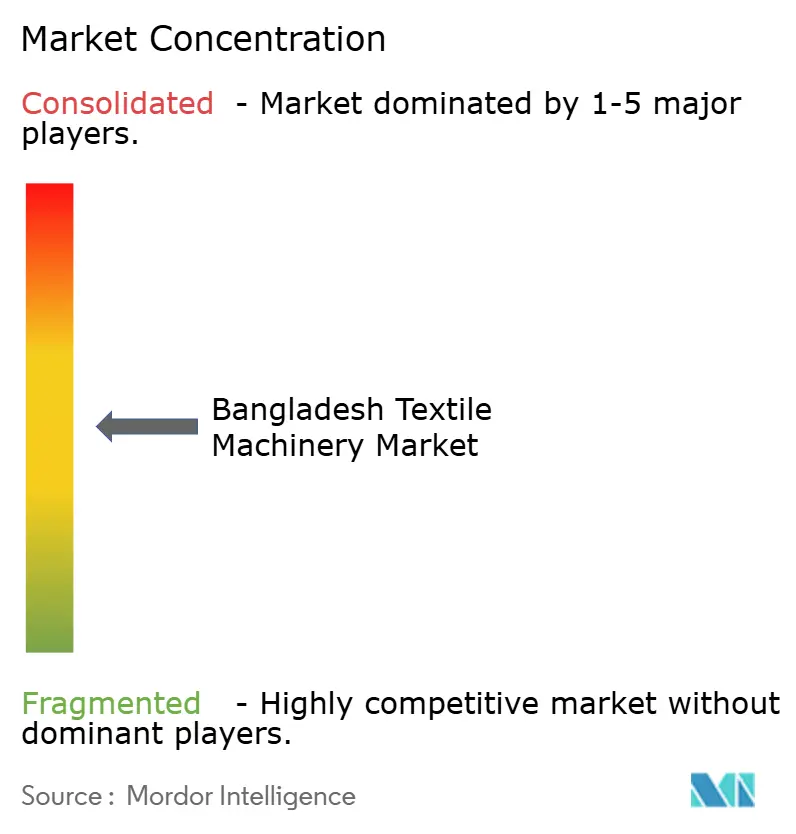
| Market Concentration | Medium |
Major Players *Disclaimer: Major Players sorted in no particular order Image © Mordor Intelligence. Reuse requires attribution under CC BY 4.0. | |
Bangladesh Textile Machinery Market Analysis by Mordor Intelligence
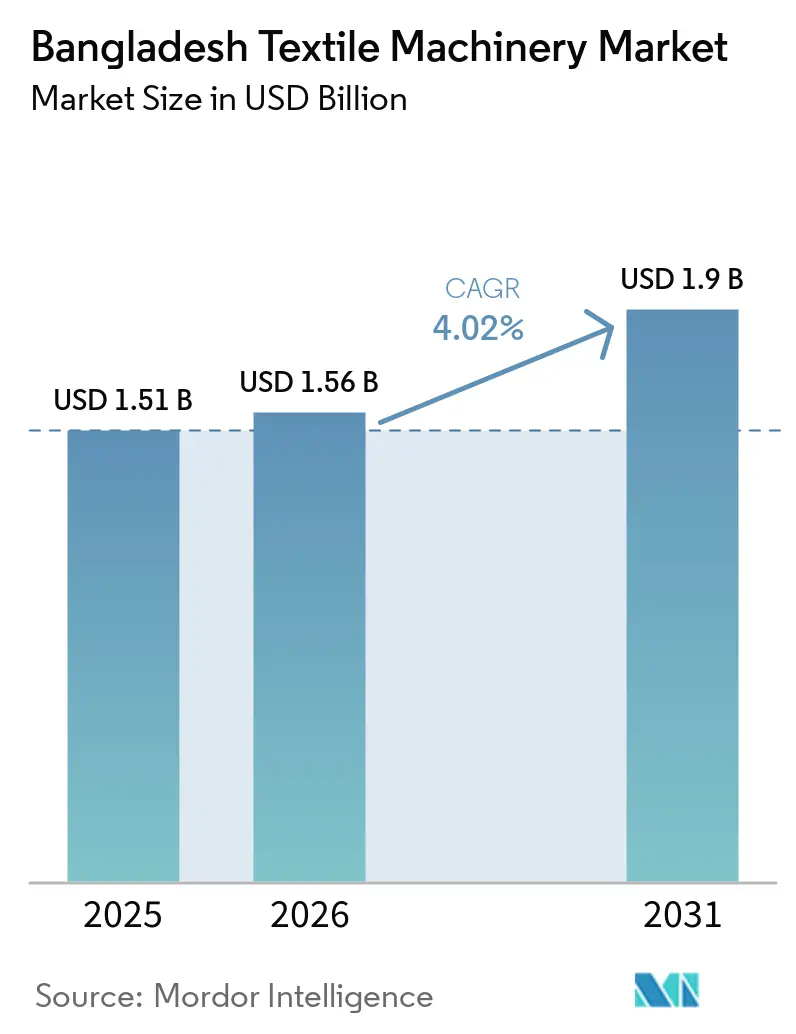
The Bangladesh Textile Machinery Market size is projected to be USD 1.51 billion in 2025, USD 1.56 billion in 2026, and reach USD 1.9 billion by 2031, growing at a CAGR of 4.02% from 2026 to 2031.
Bangladesh remained the world’s second-largest garment exporter, and ready-made garment exports reached USD 38.82 billion in 2025, supporting recurring equipment demand across spinning, weaving, knitting, dyeing, and finishing. The Bangladesh textile machinery market also draws support from USD 23 billion of cumulative backward-linkage investment, which creates demand for replacement parts, automation upgrades, and technology refreshes. Capital machinery imports fell 25.68% in FY2025, but LC openings recovered 24% year over year to USD 1.079 billion in H1 FY2026, indicating that deferred investment began to return as conditions stabilized. Policy support through machinery duty treatment and a higher incentive for locally sourced yarn strengthens the Bangladesh textile machinery market through the domestic supply-chain route.
Key Report Takeaways
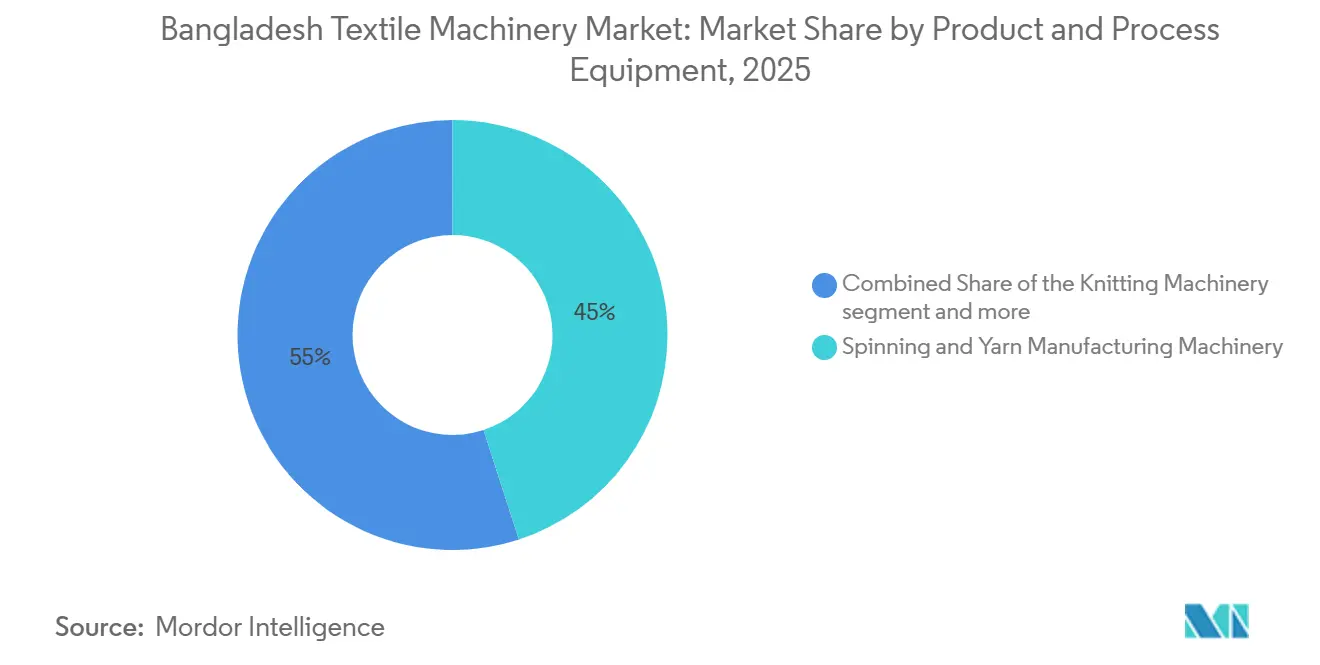
- By product and process equipment, spinning and yarn manufacturing machinery held 45% of the Bangladesh textile machinery market share in 2025, while textile printing machinery is forecast to grow at a 5.4% CAGR through 2031.
- By source of supply, imported machinery accounted for 73% of the Bangladesh textile machinery market size in 2025 and is projected to grow at a 4.4% CAGR through 2031.
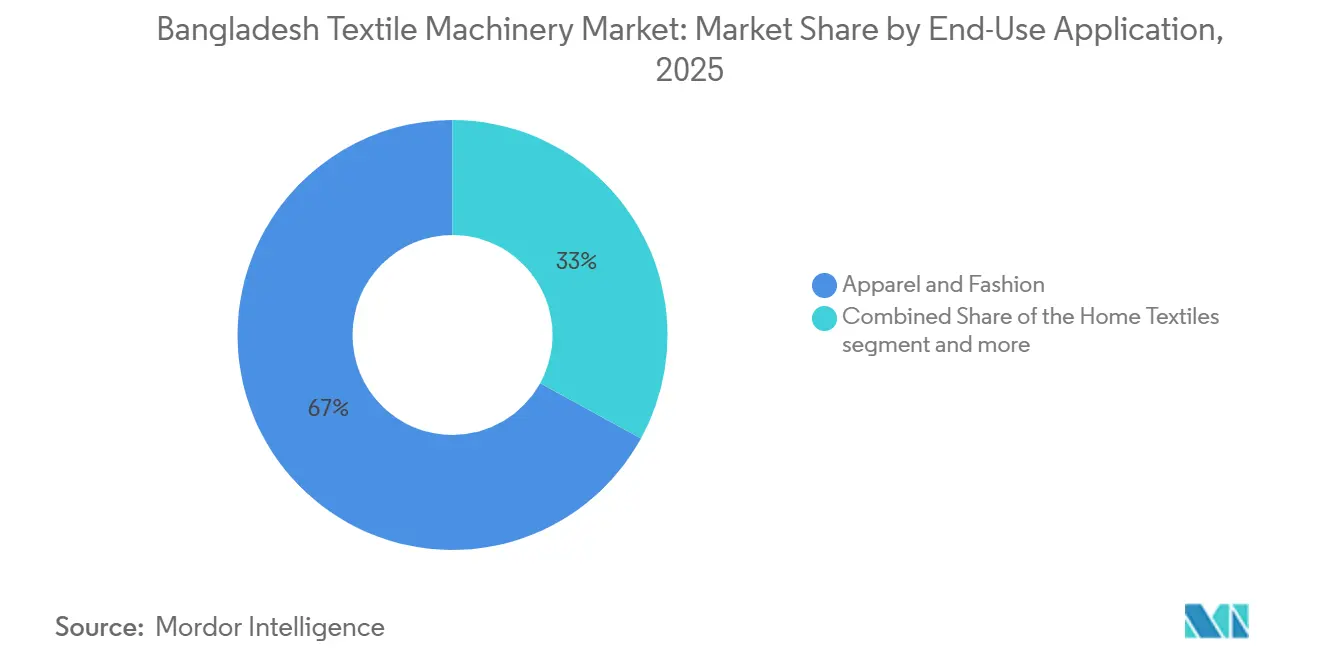
- By end-use application, apparel and fashion held 67% of machinery demand in 2025, while industrial and technical textiles are forecast to expand at a 6.2% CAGR through 2031.
Note: Market size and forecast figures in this report are generated using Mordor Intelligence’s proprietary estimation framework, updated with the latest available data and insights as of January 2026.
Bangladesh Textile Machinery Market Trends and Insights
Drivers Impact Analysis*
| Driver | (~) % Impact on CAGR Forecast | Geographic Relevance | Impact Timeline |
|---|---|---|---|
| Export-Oriented Apparel Capacity and Replacement Demand | +1.4% | Global, concentrated in Dhaka, Gazipur, and EPZ zones | Short term (≤ 2 years) |
| Backward-Linkage Investment in Yarn and Fabric Capacity | +0.9% | National, concentrated in Gazipur, Mirsarai, and Narayanganj | Medium term (2-4 years) |
| Automation for Labor Productivity and Consistent Quality | +0.8% | National, led by the Gazipur and Dhaka metro | Medium term (2-4 years) |
| Man-Made Fiber and Product-Mix Diversification | +0.7% | National, with early gains in EPZ zones and backward-linkage parks | Long term (≥ 4 years) |
| Buyer-Led Sustainability and Traceability Requirements | +0.6% | Global, concentrated in Dhaka and Gazipur LEED-certified clusters | Medium term (2-4 years) |
| Duty Relief and Green-Finance Support for Capital Machinery | +0.4% | National | Short term (≤ 2 years) |
| Source: Mordor Intelligence | |||
Export-Oriented Apparel Capacity and Replacement Demand
Bangladesh’s ready-made garment sector generated USD 38.82 billion in exports in 2025 and accounted for more than 80% of national export earnings.[1] This export base gives the Bangladesh textile machinery market a recurring need for replacement equipment, even when new capacity projects slow. More than 4,300 registered export factories operate machinery that usually requires replacement or upgrading over a 10 to 15-year cycle. Ha-meem, New Age, Snowtex, and Sparrow announced expansion plans in 2026 after tariff changes altered sourcing decisions. One reported factory plan raised production lines from 30 to 45, which required more sewing, cutting, and fabric-preparation equipment. The sector’s roadmap toward USD 100 billion in exports by 2030 includes USD 2 billion for automation, extending the replacement cycle beyond the current investment phase.
Backward-Linkage Investment in Yarn and Fabric Capacity
Bangladesh imports nearly 60% of its non-cotton yarn requirement, leaving domestic yarn production with room to expand. The July 2026 cash incentive increased from 1.5% to 5% for exporters using locally produced yarn, improving the incentive to purchase from domestic mills.[2] This policy supports higher utilization at spinning mills and can bring forward machinery upgrades in the Bangladesh textile machinery market. The country has 527 spinning mills, providing an established base for textile-sector upgrades as orders and financing improve. A USD 30 million sustainability-linked loan to Envoy Textiles in October 2025 financed automated spinning capacity and energy-efficient systems. Huarun Tex Co Ltd agreed in July 2026 to build a USD 30 million Mirsarai facility with 24,000 tonnes of annual yarn capacity and 20 million meters of gray fabric capacity.[3]
Automation for Labor Productivity and Consistent Quality
Mills are increasing automation to control labor and energy costs while meeting buyer requirements for consistent output. Rieter’s Vision 2027 set a benchmark of 1.9 tons of yarn per shift with 3 qualified operators per 10,000 spindles. This benchmark is shifting purchasing decisions toward integrated automation systems rather than isolated machinery purchases. Industry case studies suggest automated lines can enable one operator to supervise multiple machines simultaneously, versus one in conventional setups. At DTG-2025, advanced dyeing equipment showed water use of 20 to 25 liters per kilogram of fabric, compared with 200 liters for conventional processes. Connected equipment also produces production, energy, and quality data that supports buyer audits and adds demand for sensors, controls, and manufacturing-execution interfaces in the Bangladesh textile machinery market.
Man-Made Fiber and Product-Mix Diversification
Bangladesh exported USD 7.3 billion in artificial-fiber apparel in 2025, while relying heavily on imports of the fiber, yarn, and woven fabric inputs required by its synthetic and man-made-fiber apparel industry. This gap supports investment in processing capacity for polyester, viscose, and nylon. A World Bank Group diagnostic identified artificial fiber expansion and nontraditional export products as priority areas for private investment. Specialized equipment such as extrusion lines, draw-texturing machines, and precision winding systems would be required if domestic output rises. BGMEA signed a cooperative agreement / hosted a joint investment forum with the Overseas Chinese Association in Bangladesh (August 2026) to identify joint venture opportunities in upstream MMF inputs and machinery co-production. The Bangladesh textile machinery market, therefore, has an opening in systems that support higher-value materials and reduce dependence on imported inputs.
Restraints Impact Analysis*
| Restraint | (~) % Impact on CAGR Forecast | Geographic Relevance | Impact Timeline |
|---|---|---|---|
| High Upfront Cost and Restricted SME Financing | -1.1% | National, more acute for SMEs outside EPZ zones | Short term (≤ 2 years) |
| Gas and Power Reliability Risk | -0.7% | National, acutest in the Gazipur and Chittagong industrial clusters | Medium term (2-4 years) |
| Second-Hand Equipment and Low-Capex Substitution | -0.5% | National, concentrated in SME and mid-tier spinning segments | Short term (≤ 2 years) |
| Shortage of Specialized Technicians and After-Sales Coverage | -0.3% | National, specific deficits in advanced digital and automation systems | Long term (≥ 4 years) |
| Source: Mordor Intelligence | |||
High Upfront Cost and Restricted SME Financing
Energy-efficient dyeing systems, high-speed air-jet looms, and automated spinning lines cost 1.5 to 2 times more than conventional alternatives. These costs keep advanced systems beyond the immediate reach of many small and medium-sized operators. Textile-sector capital machinery imports declined 25.68% in FY2025, which reflected the gap between investment needs and available financing. Term loans for industrial capital goods carry high real interest costs, while smaller borrowers often lack the collateral or export receivables needed by lenders. BTMA reported in 2026 that 100 spinning mills were effectively nonoperational and held unsold yarn inventory valued at BDT 120 billion. Second-hand machinery and lower-capex alternatives become more attractive under these conditions, while limited specialist service coverage can raise the perceived risk of buying advanced systems.
Gas and Power Reliability Risk
Industrial gas constraints have shaped investment decisions since new connections in Chittagong were largely halted around 2005. Production has consequently concentrated in the Dhaka-Gazipur corridor, where utility access has been more reliable. Electricity and gas tariff increases raise operating costs and can delay purchases of high-speed, energy-intensive machinery. BTMA warned in 2026 that the spinning sector required urgent government action as production conditions weakened. Water stress in Gazipur adds uncertainty for wet processing and finishing investments. These constraints affect the Bangladesh textile machinery market because a mill cannot rely on projected returns when equipment uptime and utility prices remain uncertain.
*Our forecasts treat driver/restraint impacts as directional, not additive. The impact forecasts reflect baseline growth, mix effects, and variable interactions.
Segment Analysis
By Product and Process Equipment: Spinning Holds the Largest Position, While Printing Grows Fastest
Spinning and yarn manufacturing machinery accounted for 45% of the Bangladesh textile machinery market size in 2025, supported by 527 spinning mills and more than 1,800 textile installations. The category includes fiber preparation equipment, ring frames, open-end rotors, and winding systems. Trützschler reported 130 kilograms per hour from its TC 30i carding machine at Pahartoli Textile Mills in 2025. Composite mills also require rapier and air-jet looms for denim, broadloom, and technical fabrics. Picanol introduced its OmniPlus-i Connect loom in 2025 with reported electrical savings of 30% to 40% per machine.
Textile printing machinery is forecast to grow at a 5.4% CAGR through 2031, the fastest product category. Bangladesh had more than 400 digital textile printers, representing 20% to 25% of printing volume in 2025. The large conventional printing base provides a conversion opportunity as exporters seek flexible production. RBR Innovations launched the locally assembled Innova 3-in-1 system in September 2025, with more than 10 units booked. Knitting, nonwoven, and testing equipment remain smaller categories, while certification needs increase their relevance to the Bangladesh textile machinery market.

By Source of Supply: Imports Remain Central, While Local Assembly Builds a Presence
Imported machinery accounted for 73% of the Bangladesh textile machinery market size in 2025 and is expected to grow at a 4.4% CAGR through 2031. China, Germany, Japan, Italy, Switzerland, and India supply most capital equipment. Italian textile machinery exports to Bangladesh declined 6% in H1 2025 during the wider investment pause. Imports remain essential because domestic producers have limited capability in precision machinery categories. NBR amended textile machinery duty and VAT conditions in June 2025, preserving favorable import treatment.
Chinese suppliers have expanded local distribution, joint ventures, and project-financing packages. These offerings have narrowed the price and service gap for mid-tier knitting, dyeing, and printing buyers. Domestic production remains small but has increasing relevance in digital printing. RBR Innovations produces printers locally in Narsingdi, while other Chinese suppliers have local assembly or distribution operations. The Bangladesh textile machinery market will remain import-led, while assembly gradually develops in selected applications.
By End-Use Application: Apparel Provides the Largest Demand Base, While Technical Textiles Lead Growth
Apparel and fashion held 67% of the Bangladesh textile machinery market size in 2025, reflecting the export-oriented garment sector. RMG exports of USD 38.82 billion and more than 4,300 factories sustain demand for sewing, cutting, knitting, and preparation equipment. JUKI’s current plan emphasizes AI-integrated and IoT-connected sewing platforms for apparel customers. Home textiles remain a smaller, stable application in specialized dyeing and finishing facilities. Industrial and technical textiles are the smallest reported end-use category by current volume.
Industrial and technical textiles are forecast to grow at a 6.2% CAGR through 2031, the highest reported end-use rate. Growth supports nonwoven lines, coated-fabric weaving systems, calendaring equipment, and lamination machinery. Geotextiles, medical textiles, automotive textiles, and protective materials expand the range of equipment requirements. BSTI product certification also supports testing and quality-control equipment. The Bangladesh textile machinery market, therefore, broadens beyond volume garments as technical applications develop.
Geography Analysis
Gazipur is the largest procurement zone, with more than 1,900 registered garment factories and the densest spinning and dyeing cluster. The corridor needs yarn-production systems, wet-processing equipment, and automated handling. A 2025 peer-reviewed study identified Gazipur, Savar, Dhaka, Narayanganj, and Chittagong as the main textile zones. Dhaka supports compliance-oriented machinery through its concentration of export factories. Bangladesh had 268 LEED-certified garment factories in 2025, supporting connected and energy-efficient systems.
Chittagong’s share of national output declined from 40% to 10% over two decades as gas connections and infrastructure investment increasingly shifted toward Dhaka. Despite this decline, Chittagong’s export processing zone continues to host woven apparel and outerwear manufacturing facilities, benefiting from direct access to the port and associated export logistics infrastructure. The port received 15 straddle carriers in 2025 following a 13% increase in RMG export container volumes through May, enhancing its capacity to manage rising garment export shipments. Mirsarai and BSMSN are emerging as machinery installation hubs, supported by Huarun Tex’s USD 30 million project, which contributes to the development of industrial capacity in these areas. LNG allocations, streamlined customs processes, and tax incentives further support the corridor by improving energy availability, facilitating trade procedures, and encouraging industrial investment.
Narayanganj and Narsingdi have around 700 factories focused on denim, circular knitting, and wet processing. These locations need beam-dyeing machines, jigger machines, and wide-width rapier looms. Cumilla, Feni, and the wider BSMSN area are attracting investment commitments and land allocations. Their growth can spread the Bangladesh textile machinery market beyond Dhaka and Gazipur. RMG exports reached USD 38.82 billion in FY2024-25, and the industry targets USD 100 billion by 2030 through automation, backward integration, and wider production geography.
Competitive Landscape
The Bangladesh textile machinery market exhibits a medium level of market concentration, with premium European and Japanese OEMs competing against Chinese and Indian suppliers. Rieter, Trützschler, Picanol, JUKI, Karl Mayer, Murata, Saurer, Savio, and Santoni serve higher-specification requirements, combining machinery with mill-management and process-control software. Rieter’s ESSENTIAL, Trützschler’s T-CAN, and Picanol’s PicConnect add digital tools to equipment selection, while Rieter’s three-operator target is raising automation expectations among spinning mills. Chinese and Indian suppliers gain volume in knitting, dyeing, and printing through competitive pricing, local support, and financing. Lakshmi Machine Works is strengthening its position in mid-tier spinning, increasing competitive pressure on European suppliers. Picanol’s 2025 OmniPlus-i Connect launch emphasized energy efficiency in weaving, while JUKI is advancing AI- and IoT-connected sewing platforms. RBR Innovations’ Innova illustrates the emergence of Bangladesh-China local-assembly models.
The retrofit ecosystem is becoming increasingly relevant as equipment installed between 2005 and 2015 enters a technology-refresh cycle. Rising energy costs support demand for auto-doffing kits, heat-recovery systems, and production-software connectors in some mills. Local distributors influence machinery selection through technical service, engineering support, and Bengali-language assistance. Euro Group represents Trützschler, Textile Associates represents Rieter, SSM, and Luwa, while Bengal Technology and Engineering represents Monforts. These local networks can support installation, commissioning, maintenance, and spare-parts availability, helping mills reduce equipment downtime.
Bangladesh Textile Machinery Industry Leaders
-
JUKI Corporation
-
Brother Industries, Ltd.
-
Rieter Holding AG
-
Trützschler Group SE
-
Toyota Industries Corporation
- *Disclaimer: Major Players sorted in no particular order
Recent Industry Developments
- August 2026: BGMEA launched a joint initiative with the Overseas Chinese Association in Bangladesh to attract Chinese FDI and joint ventures into backward-linkage and upstream textile supply chains, explicitly targeting MMF fiber, chemicals, and advanced machinery co-production.
- July 2026: Bangladesh revised the RMG cash incentive for exporters using locally produced yarn and fabric from 1.5% to 5% for FY2026-27, effective July 1, 2026, under a Bangladesh Bank circular. The policy supports machinery utilization and replacement orders across Bangladesh’s spinning mills.
- July 2026: Huarun Tex Co Ltd signed a land lease agreement with BEPZA for a USD 30 million production facility at the Bepza Economic Zone in Mirsarai, Chittagong. The 36,000-square-meter factory will produce 24,000 tons of yarn and 20 million meters of gray woven fabric annually.
- April 2026: Envoy Textiles announced BDT 1.8 billion (USD 15 million) of investment to double open-end rotor spinning capacity from 25 to 50 tons per day at its Jamirdia facility. The project supports in-house denim yarn output and vertical integration.
Bangladesh Textile Machinery Market Report Scope
The Bangladesh Textile Machinery Market Report is segmented by product and process equipment (Spinning and Yarn Manufacturing Machinery, Weaving and Weaving Preparation Machinery, and more), By Source of Supply (Domestically Manufactured Machinery, Imported Machinery), By End-Use Application (Apparel and Fashion, Home Textiles, Industrial and Technical Textiles, Others). The Market Forecasts are Provided in Terms of Value (USD).
| Spinning and Yarn Manufacturing Machinery |
| Weaving and Weaving Preparation Machinery |
| Knitting Machinery |
| Nonwoven Machinery |
| Textile Dyeing, Processing and Finishing Machinery |
| Textile Printing Machinery |
| Textile Testing, Inspection and Quality-Control Equipment |
| Others (Textile Material Handling Equipment, Humidification Systems, fibre-recovery machinery, doffing and packaging systems, etc.) |
| Domestically Manufactured Machinery |
| Imported Machinery |
| Apparel and Fashion |
| Home Textiles |
| Industrial and Technical Textiles |
| Others (Automotive Textiles, Medical and Hygiene Textiles, Geotextiles, Agrotextiles, Protective Textiles, Carpets and Floor Coverings, and Specialty Textile Applications) |
| By Product and Process Equipment | Spinning and Yarn Manufacturing Machinery |
| Weaving and Weaving Preparation Machinery | |
| Knitting Machinery | |
| Nonwoven Machinery | |
| Textile Dyeing, Processing and Finishing Machinery | |
| Textile Printing Machinery | |
| Textile Testing, Inspection and Quality-Control Equipment | |
| Others (Textile Material Handling Equipment, Humidification Systems, fibre-recovery machinery, doffing and packaging systems, etc.) | |
| By Source of Supply | Domestically Manufactured Machinery |
| Imported Machinery | |
| By End-Use Application | Apparel and Fashion |
| Home Textiles | |
| Industrial and Technical Textiles | |
| Others (Automotive Textiles, Medical and Hygiene Textiles, Geotextiles, Agrotextiles, Protective Textiles, Carpets and Floor Coverings, and Specialty Textile Applications) |
Key Questions Answered in the Report
What is the forecast for Bangladesh textile machinery demand through 2031?
The Bangladesh textile machinery market is projected to reach USD 1.90 billion by 2031 from USD 1.56 billion in 2026, at a 4.02% CAGR. The forecast reflects equipment demand from export production and replacement cycles.
Which equipment category has the greatest demand in Bangladesh?
Spinning and yarn manufacturing machinery held 45% of demand in 2025, supported by the country’s spinning-mill base. The category includes preparation, spinning, rotor, and winding equipment.
Which textile machinery segment is growing fastest in Bangladesh?
Textile printing machinery is forecast to grow at a 5.4% CAGR through 2031 as digital printing expands. A large conventional printing base supports the shift.
Why does Bangladesh rely heavily on imported textile machinery?
Imported machinery represented 73% of the supply in 2025 because local capability remains limited in precision equipment categories. China, Germany, Japan, Italy, Switzerland, and India are major supply countries.
What is driving machinery investment by garment manufacturers?
Export production, replacement cycles, automation needs, local yarn incentives, and diversification into artificial fibers support investment. Green financing and new economic zone projects also support selected installations.
What challenges limit equipment upgrades for Bangladeshi mills?
High upfront costs, limited financing, gas and power reliability concerns, used-equipment substitution, and service gaps can delay investment. These constraints are more difficult for smaller operators.