
Banana Bread Market Size and Share
Market Overview
| Study Period | 2021 - 2031 |
|---|---|
| Market Size (2026) | USD 1.48 Billion |
| Market Size (2031) | USD 1.92 Billion |
| Growth Rate (2026 - 2031) | 5.34 % |
| Fastest Growing Market | Asia-Pacific |
| Largest Market | North America |
| Market Concentration | Low |
Major Players
*Disclaimer: Major Players sorted in no particular order Image © Mordor Intelligence. Reuse requires attribution under CC BY 4.0. |
|
Banana Bread Market Analysis by Mordor Intelligence
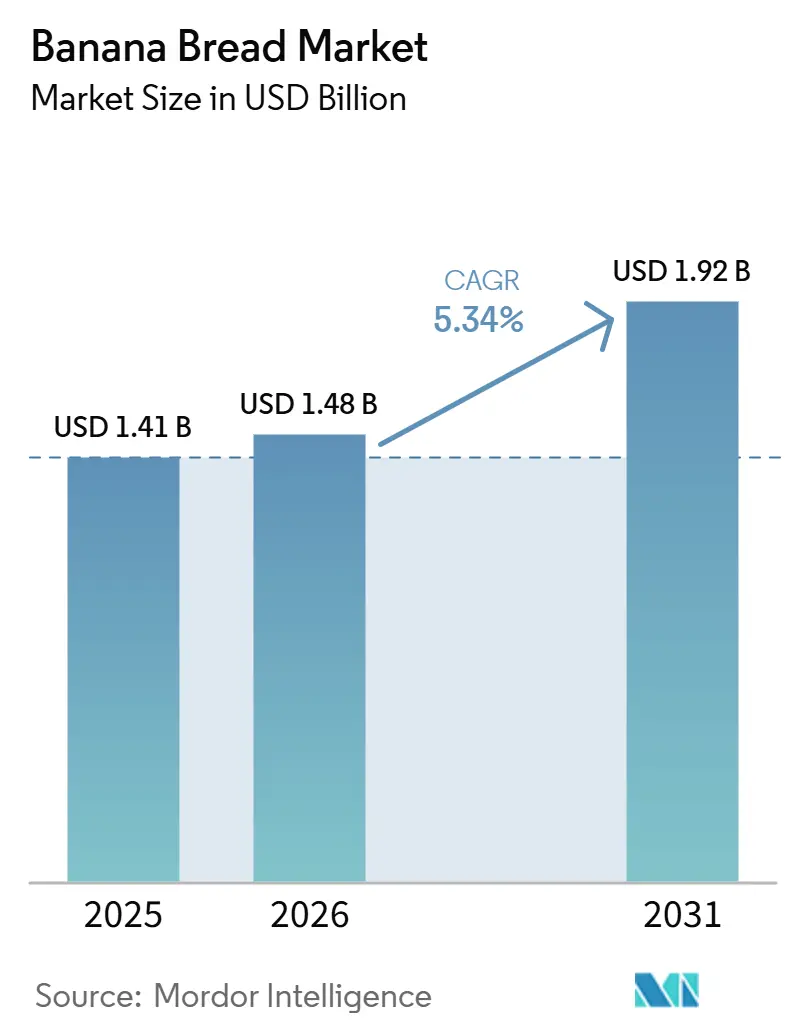
The banana bread market size is expected to grow from USD 1.41 billion in 2025 to USD 1.48 billion in 2026 and is forecast to reach USD 1.92 billion by 2031 at 5.34% CAGR over 2026-2031. The market is moving beyond home baking toward commercially made products sold through retail, foodservice, and online channels. Familiar formats still support most sales, while fruit additions, frozen products, and foodservice portions create new routes for growth. Rising interest in cleaner ingredients makes reformulation important for brands that rely on conventional high-sugar recipes. Higher banana costs, freight expense, disease risk, and shipping disruptions create margin pressure across the supply chain. Producers with diversified sourcing, credible ingredient standards, and frozen distribution capability are better placed to respond to these conditions.
Key Report Takeaways
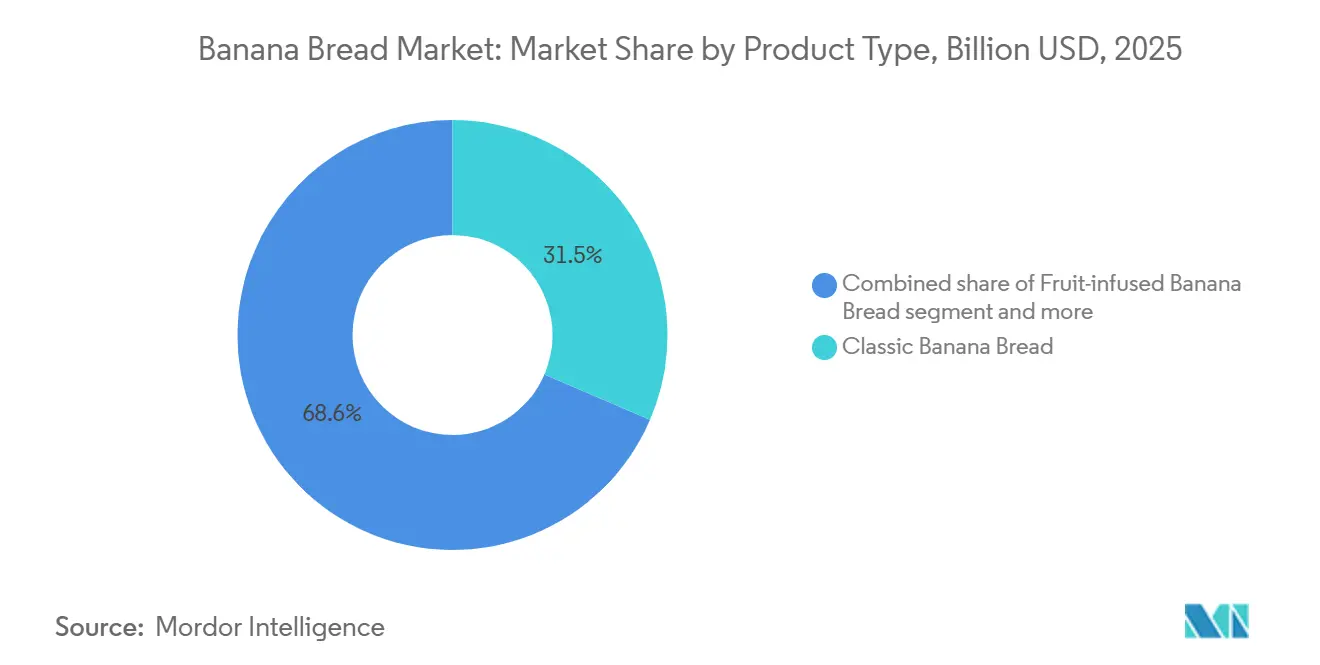
- By product type, classic banana bread held 31.45% of Banana bread market share in 2025, while fruit-infused banana bread is forecast to grow at a 5.76% CAGR through 2031.
- By form, fresh held 78.44% of Banana bread market share in 2025, while frozen is forecast to grow at a 6.68% CAGR through 2031.
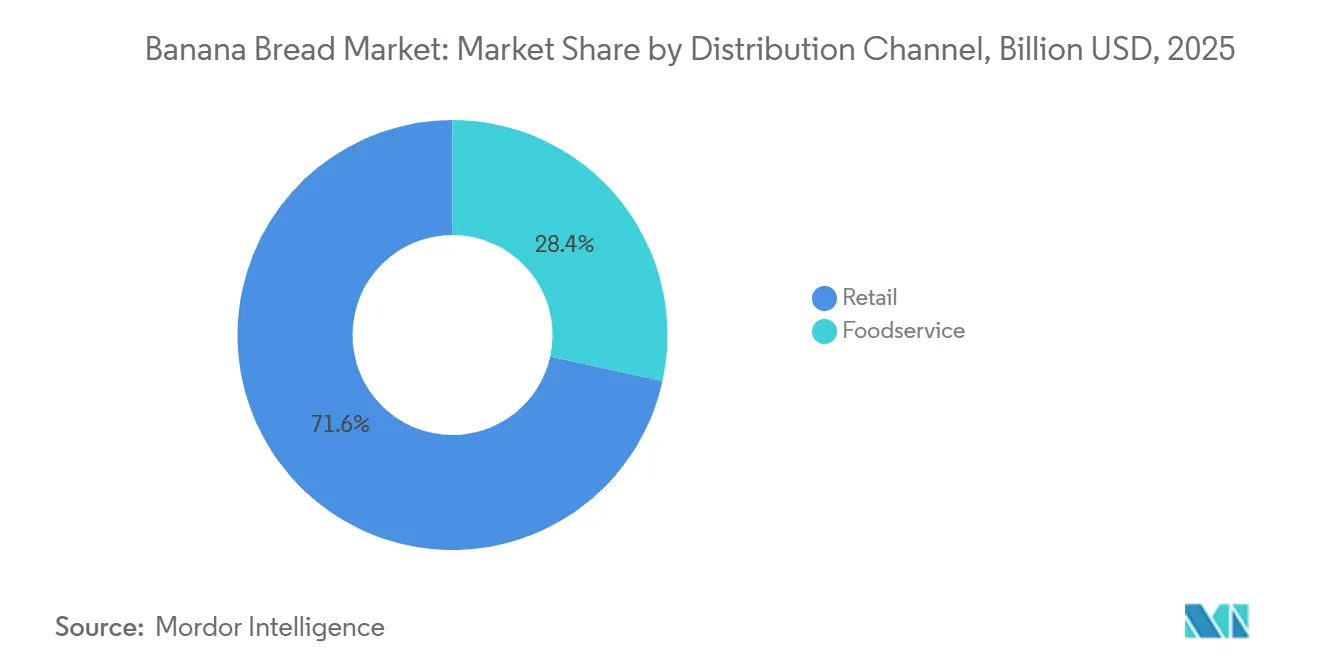
- By distribution channel, retail held 71.56% of the Banana bread market size in 2025, while foodservice is forecast to grow at a 5.75% CAGR through 2031.
- By geography, North America held 43.56% of the Banana bread market size in 2025, while Asia-Pacific is forecast to grow at a 6.44% CAGR through 2031.
Note: Market size and forecast figures in this report are generated using Mordor Intelligence’s proprietary estimation framework, updated with the latest available data and insights as of January 2026.
Market Trends and Insights
Drivers Impact Analysis of Banana Bread Market*
| Driver | (~) % Impact on CAGR Forecast | Geographic Relevance | Impact Timeline |
|---|---|---|---|
| Rising demand for convenient ready-to-eat bakery products | +1.0% | Global | Short term (≤ 2 years) |
| Growing consumer preference for healthier baked goods | +0.9% | North America and Europe | Medium term (2-4 years) |
| Increasing popularity of banana-based flavors and products | +0.7% | Global | Short term (≤ 2 years) |
| Rising demand for gluten-free and vegan banana bread | +0.8% | North America, Europe and Asia-Pacific | Medium term (2-4 years) |
| Increasing demand for premium and artisanal bakery products | +0.6% | Europe, North America | Long term (≥ 4 years) |
| Growing home baking culture and consumption of baking mixes | +0.6% | North America, Asia-Pacific | Short term (≤ 2 years) |
| Source: Mordor Intelligence | |||
Rising demand for convenient ready-to-eat bakery products
Consumers seeking convenient bakery options for breakfast and snack occasions continue to support the banana bread market. Supermarkets and convenience stores attract purchases that previously depended more heavily on meal preparation at home by offering ready-to-eat products that fit busy routines. Consumers continue to prefer products that taste familiar and satisfying, even when they lack the time or ingredients to bake from scratch. Banana bread meets this need because consumers strongly associate its ingredients, texture, and flavor with home baking. Online retail also helps artisan producers expand their reach beyond physical stores and serve customers looking for specialty or premium baked goods. A filling slice or loaf can offer a compelling value proposition when shoppers compare it with smaller packaged snacks at similar price points.
Growing consumer preference for healthier baked goods
Health-focused reformulation is reshaping product development in the banana bread market. Manufacturers now use almond flour, oat flour, and cassava-banana flour blends beyond specialized gluten-free ranges and across broader bakery offerings to appeal to consumers seeking better-for-you bakery options. They also use honey, coconut sugar, and date paste to replace refined sugar in selected products, while ripe bananas help reduce added sugar without altering the expected taste. Manufacturers are incorporating organic ingredients and cleaner labels into their product pipelines to meet rising consumer demand for transparent and recognizable ingredients. This shift is making cleaner ingredient standards an expected product feature rather than a premium add-on. However, manufacturers must preserve texture and moisture, as these qualities remain central to repeat purchases and overall product acceptance.
Increasing popularity of banana-based flavors and products
Food and beverage manufacturers use banana flavors in protein bars, smoothies, dried snacks, specialty beverages, and baked goods. This broader use strengthens consumer familiarity with banana bread and related baking mixes and helps position banana as a versatile flavor across everyday consumption occasions. Producers can emphasize banana’s natural sweetness and simple ingredient profile instead of relying solely on dessert-oriented flavor claims. They can also apply this positioning to convenience bakery ranges that cater to urban commuters seeking portable breakfast options. Interest in home baking further supports demand for mixes, as consumers can prepare familiar products in less time, reduce ingredient waste, and achieve more consistent results. In the banana bread industry, flavor familiarity can help brands introduce premium varieties while maintaining a recognizable base product that consumers already understand and trust.
Rising demand for gluten-free and vegan banana bread
The rising demand for gluten-free and vegan banana bread is emerging as a significant driver of the global banana bread market, supported by increasing consumer preference for healthier, allergen-friendly, and plant-based bakery products. Consumers with celiac disease, gluten intolerance, or lifestyle-driven dietary preferences are actively seeking baked goods made with gluten-free flours such as almond, oat, rice, and coconut flour, along with egg- and dairy-free formulations. At the same time, growing vegan populations and flexitarian consumers are encouraging manufacturers to introduce banana bread made with plant-based ingredients and clean-label recipes. In January 2025, the U.S. Food and Drug Administration (FDA) updated its guidance on food allergen labeling and gluten-free claims to help manufacturers comply with labeling requirements and improve consumer safety, strengthening consumer confidence in certified gluten-free products[1]Source: Food and Drug Administration, “Food Allergens/Gluten-Free Guidance Documents & Regulatory Information” fda.gov. This regulatory support has encouraged bakery companies to expand their gluten-free and vegan product portfolios while ensuring greater transparency in labeling.
Restraints Impact Analysis of Banana Bread Market*
| Restraint | (~) % Impact on CAGR Forecast | Geographic Relevance | Impact Timeline |
|---|---|---|---|
| Short shelf life of freshly baked banana bread | -0.6% | Global | Short term (≤ 2 years) |
| Fluctuations in banana prices and availability | -0.9% | Global | Medium term (2-4 years) |
| High sugar and calorie content in conventional formulations | -0.5% | North America and Europe | Medium term (2-4 years) |
| Competition from other bakery and snack products | -0.7% | Global | Short term (≤ 2 years) |
| Source: Mordor Intelligence | |||
Short shelf life of freshly baked banana bread
Fresh banana bread typically maintains an ambient shelf life of 2 to 4 days, so manufacturers and retailers must manage inventory planning and direct delivery carefully to limit spoilage. This issue remains significant because fresh products accounted for 78.4% of sales in 2025. Brands can use modified-atmosphere packaging and preservatives to extend product availability, but shoppers may view these measures as inconsistent with natural ingredient claims. Smaller households may also discard part of a standard loaf, which can reduce repeat purchases over time. Brands can offer individually wrapped slices, resealable packs, and bake-at-home kits to reduce waste without changing the product’s core appeal. The banana bread market also competes with other bakery and snack products that target the same impulse and breakfast occasions.
Fluctuations in banana prices and availability
Banana supply conditions continue to restrain the banana bread market through 2031. In July 2026, the Banana Association of North America stated that higher fertilizer, freight, and fuel costs, along with Fusarium TR4 disease and extreme weather, had increased financial stress across the supply chain[2]Source: Fresh Fruit Portal, “Why cheap bananas may be a thing of the past”, freshfruitportal.com. Large retailers often use bananas as loss leaders, which keeps retail prices low and places direct pressure on grower margins. Fairtrade International updated its minimum price in October 2025 to address ongoing structural cost pressures. Conventional banana bread recipes also face demand risk, as their sugar and calorie levels do not always align with consumers’ health expectations. Producers can use dual sourcing, maintain inventory buffers, and apply cost-conscious reformulation to manage supply volatility, protect margins, and respond to changing consumer preferences.
*Our forecasts treat driver/restraint impacts as directional, not additive. The impact forecasts reflect baseline growth, mix effects, and variable interactions.
Banana Bread Market Segment Analysis
By Product Type:
Classic Formats Anchor Volume While Fruit-Infused Varieties Lead GrowthClassic banana bread accounted for 31.45% of the banana bread market in 2025. Its familiarity makes it accessible to retailers and consumers, while manufacturers can produce it at a commercial scale. Producers can reduce sugar, use whole-grain flour, or add organic ingredients without changing its core flavor and texture. Chocolate banana bread remains commonly associated with café purchases and dessert occasions. Nut-based banana bread benefits from rising interest in protein-rich bakery products. Other specialty products, including protein-fortified and reduced-sugar options, give retailers more opportunities to differentiate their bakery assortments.
Fruit-infused banana bread is forecast to record a CAGR of 5.76% through 2031. Blueberry-banana and mango-banana combinations suit café and specialty retail settings, where distinctive flavors can support premium pricing. Whole-fruit additions also strengthen health-oriented product positioning. In April 2026, King Arthur Baking Company is expected to expand its range with fruit-infused mix options alongside gluten-free and celebration-oriented products. Fruit-infused products can generate retail margins 15% to 20% higher than classic formats. This margin premium can help producers manage higher ingredient costs while serving consumers who value flavor variety.



By Form:
Frozen Products Gain Ground Through Foodservice EfficiencyFresh products accounted for 78.44% of the banana bread market size in 2025. Visible baking, fresh aroma, and immediate availability support impulse purchases in supermarkets and hypermarkets. Freshly made products also maintain an artisan positioning in premium grocery and specialty stores. These attributes help retailers sustain premium pricing compared to many packaged alternatives. Fresh products remain important for retailers that use bakery counters to convey quality and variety. However, their short shelf life requires accurate demand planning and can increase waste.
Frozen products are forecast to record a 6.68% CAGR through 2031, the fastest growth rate among forms. Their three- to six-month shelf life supports wider distribution in markets with improving cold-chain systems. Par-baked products reduce labor requirements, improve consistency, and limit batch waste for quick-service restaurants and café chains. The American Frozen Food Institute reported that in 2026 that 96% of U.S. shoppers believe better-for-you foods can be found in the frozen aisle[3]Source: The American Frozen Food Institute, "Advancing the interests of the frozen food and beverage industry", affi.org. This trend supports frozen bakery products that use health-oriented ingredients and portion formats. Investment in cold-chain networks can expand the commercial reach of the banana bread market in Southeast Asia, the Middle East, and secondary South American cities.
By Distribution Channel:
Retail Remains the Primary Channel as Foodservice ExpandsRetail accounted for 71.56% of the banana bread market share in 2025. Supermarkets and hypermarkets remain the leading volume outlets for fresh and packaged products. Convenience stores support immediate consumption across transit points, offices, and dense urban locations. Online retail enables specialty brands to reach consumers seeking artisan, allergen-free, or subscription-based products. Private-label offerings have improved product quality and packaging, increasing pressure on mid-tier branded suppliers. As a result, retail remains the core route to market, while suppliers must manage price competition and shelf visibility.
Foodservice is forecast to grow at a CAGR of 5.75% through 2031. A café slice can sell for USD 4-7, while a full packaged grocery loaf generally sells for USD 3-5. This price difference encourages producers to develop portioned products with packaging and texture suited for cafés. Branded café expansion in Southeast Asia, India, and Gulf Cooperation Council countries supports demand for ready-to-serve and par-baked formats. The Elegant Farmer and other artisan producers supply this channel through wholesale relationships. Frozen specialists are increasingly well-positioned for high-volume accounts, where storage efficiency and consistent output matter more than artisan provenance.
Geography Analysis
North America and Europe Banana Bread Market
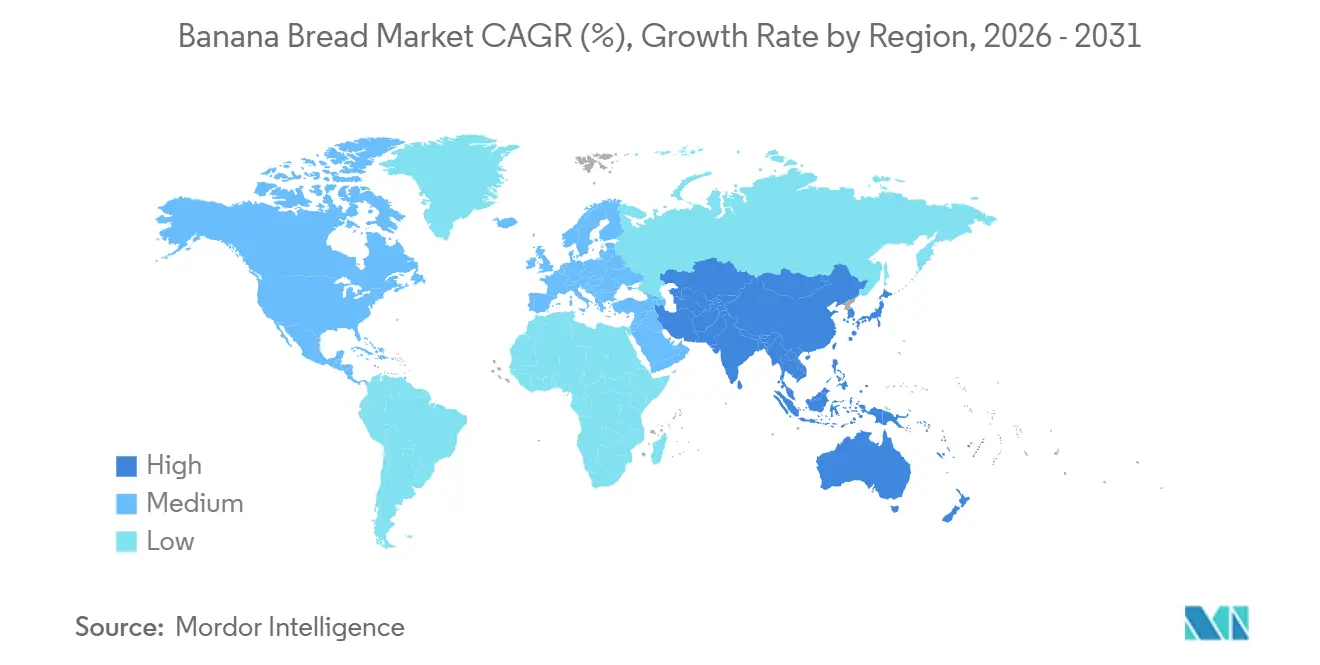
North America held 43.56% of the banana bread market share in 2025. The region benefits from developed retail networks, a strong home-baking culture, and premium grocery outlets that offer both mass-produced and artisan products. The United States contributes the largest share, as consumers purchase or prepare banana bread in home kitchens, cafés, and natural and specialty grocery stores. Canada records strong urban demand across premium and organic retail channels. Mexico’s expanding organized retail landscape and growing urban middle class are improving access to packaged variants. Europe ranks as the second-largest regional market, led by the United Kingdom, Germany, and France, where clean-label expectations remain highly developed.
APAC Banana Bread Market
Asia-Pacific is forecast to grow at a CAGR of 6.44% through 2031. In China, young urban consumers increasingly adopt banana bread through e-commerce channels as a convenient breakfast option. Local producers use ingredients such as matcha, red bean paste, and black sesame to align products with regional preferences. In India, premium bakery chains are expanding across major cities, while organized foodservice adoption is rising in Tier 1 and Tier 2 locations. Japan’s banana bread category was valued at USD 79.8 million in 2025, with low-sugar products in convenience bakery channels appealing to working commuters.
MEA and South America Banana Bread Market
South America and the Middle East and Africa remain smaller but distinct markets within the banana bread market. Brazil and Colombia benefit from consumer familiarity with banana-based foods, domestic banana availability, and rising demand for packaged bakery items. Ecuador’s position as a major banana exporter gives nearby producers a raw-material advantage over import-dependent markets. The United Arab Emirates and Saudi Arabia are seeing growing demand for specialty bakery products, supported by tourism, hospitality, and café culture. Nigeria and South Africa remain earlier-stage opportunities as retail networks expand and disposable income improves. These regions require products and distribution models that align with local price points, supply conditions, and retail infrastructure.

Competitive Landscape
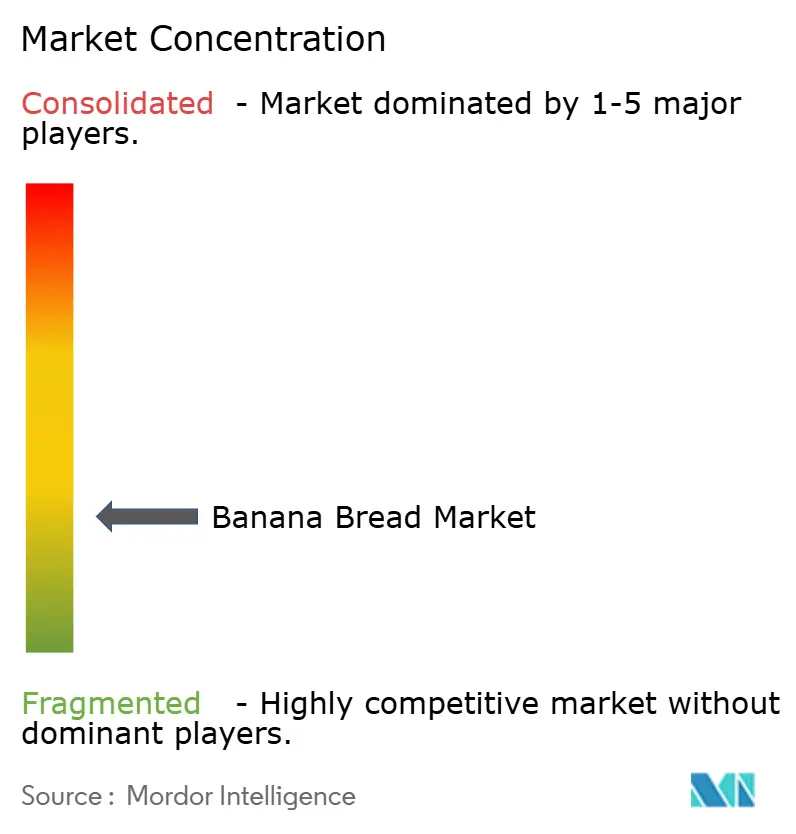
The banana bread market is fragmented, with a large number of regional bakeries, independent producers, foodservice operators, and packaged-food companies competing across different price points and product formats. The market includes traditional bakeries offering freshly baked banana bread alongside packaged brands selling sliced, frozen, and ready-to-eat products through supermarkets and online channels. Companies such as The Humming Bird Bakery and King Arthur Baking Company represent the broader bakery landscape, while numerous local bakeries compete through freshness, customization, and regional flavors.
Competition is primarily based on product quality, taste, freshness, ingredients, pricing, packaging, and product innovation. Established bakery brands and packaged-food manufacturers are expanding their offerings with variations such as chocolate chip, nut-based, fruit-infused, gluten-free, vegan, and premium banana bread products. For example, companies such as Starbucks offer banana bread as part of their foodservice bakery portfolio, while supermarket bakeries and specialty brands compete through fresh, artisanal, and premium formulations.
The fragmented competitive environment also creates opportunities for companies to expand through digital platforms, direct-to-consumer sales, retail partnerships, and foodservice distribution. Large retailers and online grocery platforms provide smaller producers with access to wider consumer markets, while established foodservice chains benefit from strong brand recognition and extensive outlet networks. In addition, consumer demand for healthier and more convenient bakery products is encouraging the development of reduced-sugar, gluten-free, vegan, and individually packaged banana bread options.
Banana Bread Industry Leaders
-
Flowers Foods, Inc.
-
The Hummingbird Bakery
-
King Arthur Baking Company, Inc.
-
Grupo Bimbo, S.A.B. de C.V.
-
General Mills, Inc.
- *Disclaimer: Major Players sorted in no particular order
Banana Bread Market Companies Covered in this Report
- Flowers Foods, Inc.
- General Mills, Inc.
- The Hummingbird Bakery
- King Arthur Baking Company, Inc.
- Grupo Bimbo, S.A.B. de C.V.
- The Elegant Farmer
- Dank Brooklyn LLC
- The Essential Baking Company
- Simple Mills, Inc.
- Big Banana Bread Co.
- Banana Manna
- Orwashers Bakery
- Havana Banana Breads
- Magnolia Table
- The Baker’s Dozen
- Theobroma Foods Pvt. Ltd.
- Bonn Group of Industries
- Elite Foods Pvt. Ltd.
- 7th Heaven
- Mama’s Banana Bread

Recent Industry Developments in Banana Bread Market
- April 2026: King Arthur Baking Company launched a new range of product mixes, including gluten-free banana bread and muffin mixes, confetti treats, and golden rolls. The launch reinforced the company’s strategy to serve diverse dietary preferences and consumption occasions within the home-baking channel, particularly as consumers continued to seek convenient, high-quality baking options at home. It also expanded the company’s premium baking mix portfolio and strengthened its commitment to the gluten-free segment.
- November 2025: King Arthur Baking Company launched a free recipe app for iOS and Android. The app featured more than 2,700 expert-tested recipes, built-in timers, step-by-step guidance, and a Bake Mode that kept the screen active during baking sessions. The platform served as a direct consumer engagement and brand loyalty tool, supported at-home bakers with practical digital assistance, and featured banana bread among its prominent categories.
- March 2025: King Arthur Baking Company introduced a Buttermilk Biscuit Flour Blend at Natural Products Expo West 2025, alongside its Bread Mix Kits lineup, which debuted at the same event in 2024. The specialty flour launch highlighted the company’s continued commitment to the premium home-baking ingredient category and reflected its focus on expanding differentiated baking solutions for home consumers.


Global Banana Bread Market Report Scope
Banana bread is a sweet, moist baked product made primarily from mashed ripe bananas, flour, sugar, eggs, and a leavening agent such as baking soda or baking powder. The banana bread market is segmented by product type, form, distribution channel and geography. Based on the product type, the market is segmented into classic banana bread, chocolate banana bread, nut-based banana bread, fruit-infused banana bread and other specialty banana breads. Based on the form, the market is segmented into fresh and frozen. Based on distribution channel, the market is segmented into retail and foodservice. By geography, the market is segmented into North America, Europe, Asia-Pacific, South America, and Middle-East and Africa. For each segment, the market sizing and forecasting have been done in value terms (USD).
| Classic Banana Bread |
| Chocolate Banana Bread |
| Nut-Based Banana Bread |
| Fruit-Infused Banana Bread |
| Other Specialty Banana Breads |
| Fresh |
| Frozen |
| Retail | Supermarkets/Hypermarkets |
| Convenience Stores | |
| Online Retail Stores | |
| Other Distribution Channels | |
| Foodservice |
| North America | United States |
| Canada | |
| Mexico | |
| Rest of North America | |
| Europe | United Kingdom |
| Germany | |
| France | |
| Italy | |
| Spain | |
| Netherlands | |
| Sweden | |
| Belgium | |
| Poland | |
| Rest of Europe | |
| Asia-Pacific | China |
| Japan | |
| India | |
| South Korea | |
| Australia | |
| Indonesia | |
| Thailand | |
| Singapore | |
| Rest of Asia-Pacific | |
| South America | Brazil |
| Argentina | |
| Chile | |
| Colombia | |
| Peru | |
| Rest of South America | |
| Middle East and Africa | United Arab Emirates |
| South Africa | |
| Saudi Arabia | |
| Nigeria | |
| Egypt | |
| Morocco | |
| Turkey | |
| Rest of Middle East and Africa |
| By Product Type | Classic Banana Bread | |
| Chocolate Banana Bread | ||
| Nut-Based Banana Bread | ||
| Fruit-Infused Banana Bread | ||
| Other Specialty Banana Breads | ||
| By Form | Fresh | |
| Frozen | ||
| By Distribution Channel | Retail | Supermarkets/Hypermarkets |
| Convenience Stores | ||
| Online Retail Stores | ||
| Other Distribution Channels | ||
| Foodservice | ||
| By Geography | North America | United States |
| Canada | ||
| Mexico | ||
| Rest of North America | ||
| Europe | United Kingdom | |
| Germany | ||
| France | ||
| Italy | ||
| Spain | ||
| Netherlands | ||
| Sweden | ||
| Belgium | ||
| Poland | ||
| Rest of Europe | ||
| Asia-Pacific | China | |
| Japan | ||
| India | ||
| South Korea | ||
| Australia | ||
| Indonesia | ||
| Thailand | ||
| Singapore | ||
| Rest of Asia-Pacific | ||
| South America | Brazil | |
| Argentina | ||
| Chile | ||
| Colombia | ||
| Peru | ||
| Rest of South America | ||
| Middle East and Africa | United Arab Emirates | |
| South Africa | ||
| Saudi Arabia | ||
| Nigeria | ||
| Egypt | ||
| Morocco | ||
| Turkey | ||
| Rest of Middle East and Africa | ||


Key Questions Answered in the Report
What is the projected value of the Banana bread market by 2031?
The Banana bread market is forecast to reach USD 1.92 billion by 2031, growing at a 5.34% CAGR from 2026.
Which product type is growing fastest in the Banana bread market?
Fruit-infused Banana Bread is expected to grow at a 5.76% CAGR through 2031, supported by interest in flavor variety and whole-fruit additions.
Why are frozen products expanding in the Banana bread market?
Frozen products are forecast to grow at a 6.68% CAGR because they offer longer storage, lower waste, and consistent output for foodservice operators.
Which sales channel is expanding fastest for banana bread?
Foodservice is expected to grow at a 5.75% CAGR through 2031, supported by cafés, quick-service restaurants, and demand for portioned products.
Which region leads demand for banana bread?
North America held 43.56% of sales in 2025, supported by established retail infrastructure, home baking, and premium grocery channels.
Page last updated on:





