
Baby High Chair Market Size and Share
Market Overview
| Study Period | 2022 - 2032 |
|---|---|
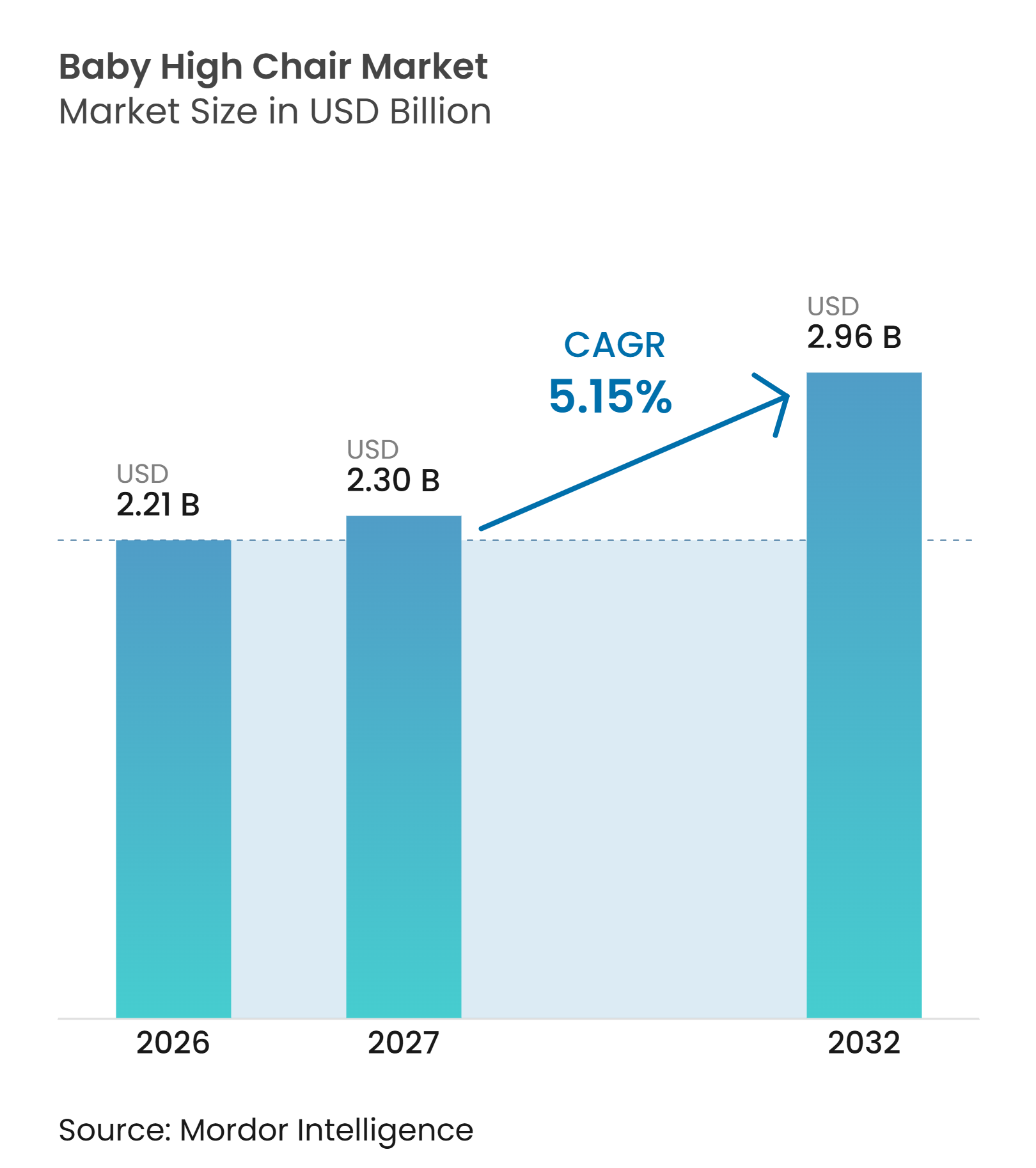
| Market Size (2027) | USD 2.30 Billion |
| Market Size (2032) | USD 2.96 Billion |
| Growth Rate (2027 - 2032) | 5.15 % |
| Fastest Growing Market | Asia-Pacific |
| Largest Market | North America |
| Market Concentration | Medium |
Major Players *Disclaimer: Major Players sorted in no particular order Image © Mordor Intelligence. Reuse requires attribution under CC BY 4.0. | |
Baby High Chair Market Analysis by Mordor Intelligence
The baby high chair market size is expected to grow from USD 2.21 billion in 2026 to USD 2.96 billion by 2032 at 5.1% CAGR over 2027-2032. Demand is supported by parents who place greater weight on infant safety, practical feeding routines, and products that remain useful as children grow. World Health Organization guidance recommends complementary feeding from 6 months, with 2-3 meals a day for infants aged 6-8 months and 3-4 meals for children aged 9-23 months, which supports the use of dedicated seating during family meals. The baby high chair market is also being shaped by a wider choice of multi-stage products, stronger online discovery, and a premium segment that connects dining furniture with home design. Manufacturers are responding through convertible formats, easier-to-clean surfaces, direct consumer communications, and wider retail distribution. Safety recalls remain a material constraint because they raise testing costs and make compliance information more important in purchase decisions.
Key Report Takeaways
-
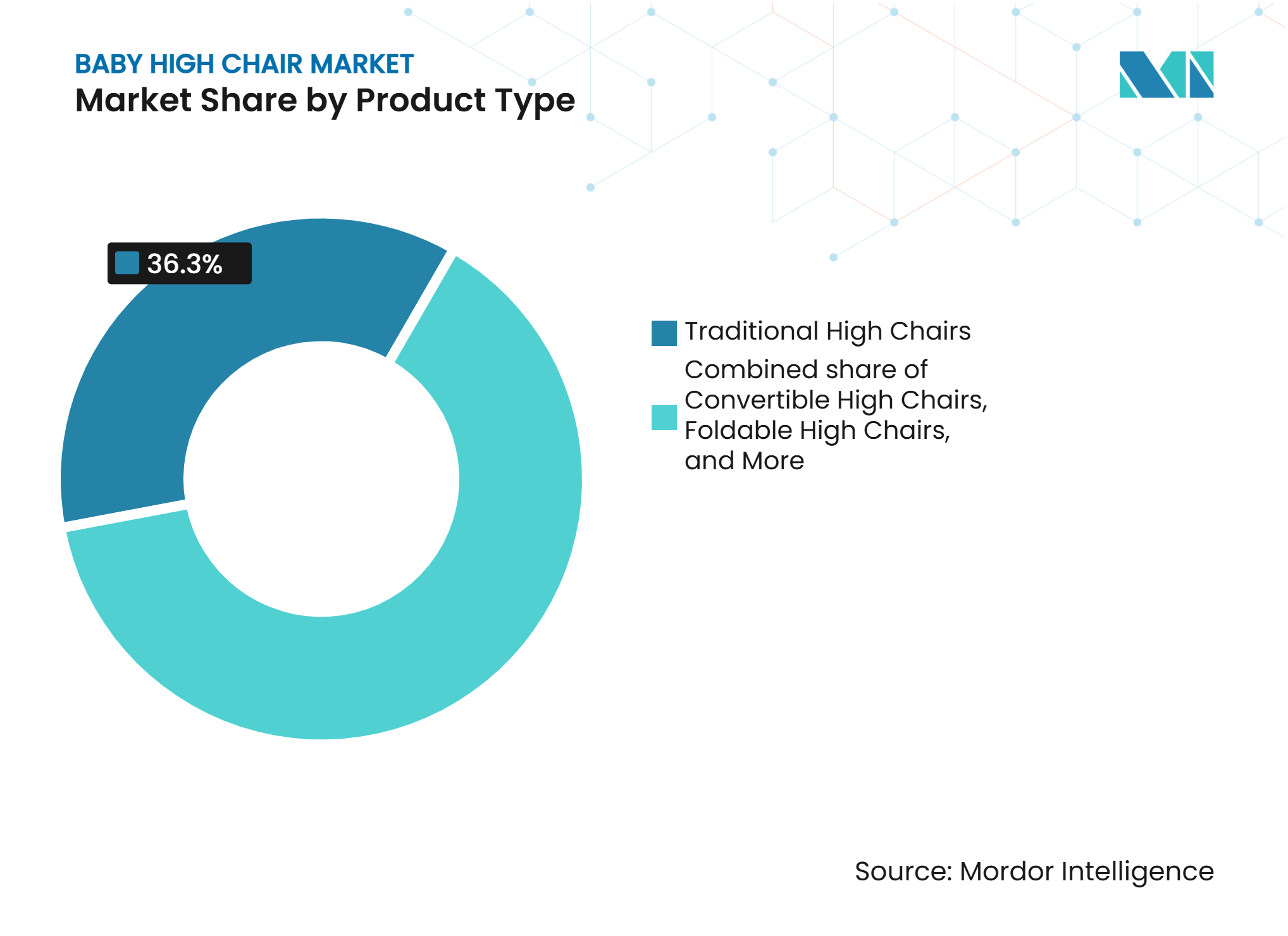
By product type, traditional high chairs held 36.3% share in 2026, while booster high chairs are projected to grow at a 7.2% CAGR through 2032.
-
By material, plastic held 57.6% share in 2026, while metal is projected to grow at a 6.8% CAGR through 2032.
-
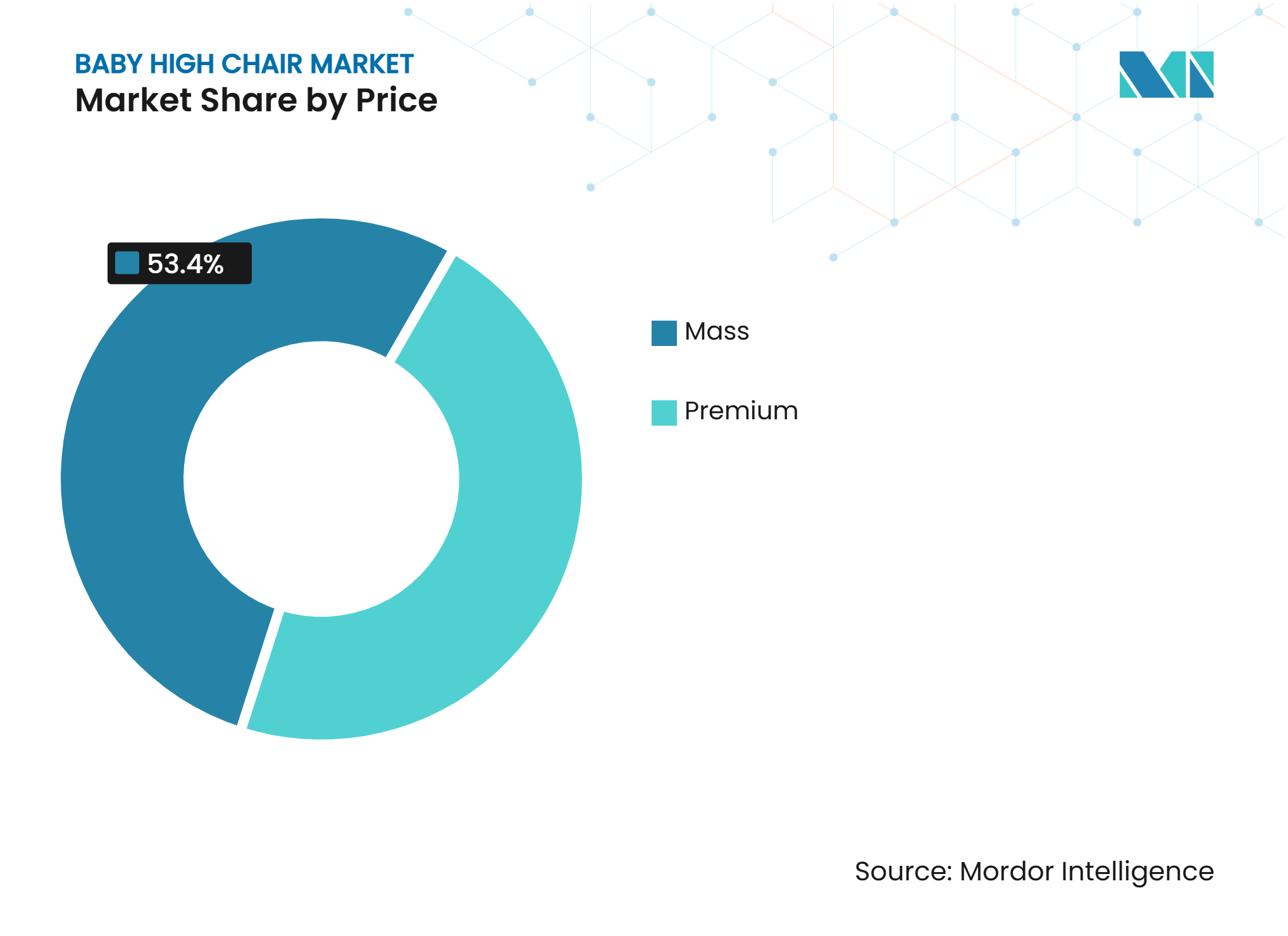
By price, the mass segment held 53.4% share in 2026, while the premium segment is projected to grow at a 7.5% CAGR through 2032.
-
By distribution channel, offline retail stores held 58.4% share in 2026, while online retail is projected to grow at an 8.1% CAGR through 2032.
-
By geography, North America held 39.2% share in 2026, while Asia-Pacific is projected to grow at a 7.8% CAGR through 2032.
Note: Market numbers in this report are based on Mordor Intelligence's proprietary estimation framework, which combines nine months of actuals with Q4 projections for base year 2026.
Market Trends and Insights
Drivers Impact Analysis of Baby High Chair Market*
| Driver | (~) % Impact on CAGR Forecast | Geographic Relevance | Impact Timeline |
|---|---|---|---|
| Rising Parental Focus on Child Safety | +1.1% | Global, strongest in North America, Europe, and urban Asia-Pacific | Medium term (2-4 years) |
| Convenience and Ease of Cleaning | +0.7% | Global, particularly North America and Western Europe | Short term (≤ 2 years) |
| Regulatory Standards and Safety Certifications | +0.6% | North America and Europe, with spillover to Asia-Pacific and Middle East and Africa | Medium term (2-4 years) |
| Product Innovation and Multifunctionality | +0.9% | Global, with premium demand in the United States, Germany, Japan, and South Korea | Long term (≥ 4 years) |
| Expansion of E-Commerce and Online Retail | +1.0% | Asia-Pacific, North America, Middle East and Africa, and South America | Medium term (2-4 years) |
| Growing Adoption of Dedicated Seated Feeding Practices | +0.5% | Global, with stronger adoption gains in developing Asia-Pacific markets | Long term (≥ 4 years) |
| Source: Mordor Intelligence | |||
Rising Parental Focus on Child Safety
Child safety has become a central consideration in the baby high chair market, especially among parents who research products before purchasing. The U.S. Consumer Product Safety Commission warned consumers in February 2025 to stop using Babimoni multifunctional high chairs because of fall and entrapment hazards, showing the seriousness of noncompliance. Recall activity encourages informed parents to favor products with clear safety documentation, restrained seating, and designs that are easy to inspect. The same pattern can cause some first-time buyers to delay their purchase when they are unsure about safety claims. China Toy and Juvenile Products Association monitoring found that sales value for high-end baby chairs priced above CNY 1,000 rose 36.5% in 2025, while unit sales stayed modest, consistent with a shift toward higher-value purchases. Manufacturers are pairing safety communication with compliance against 16 CFR Part 1231, ASTM F404-20, EN 14988:2017+A2:2024, and China’s GB 22793.1-2008 framework[1].
Product Innovation and Multifunctionality
Multi-stage designs and easy-to-clean components remain important in the baby high chair market because they can serve families from infancy through the toddler years. A chair that changes from a newborn support option into a feeding chair, booster, or child seat can reduce the need for separate purchases. Newell Brands launched the Graco Close2Baby 3-in-1 High Chair in 2025 with dishwasher-safe tray inserts and machine-washable harness straps, with features built around parent feedback. Mamas & Papas introduced the Eno system in March 2025, pairing a bouncer with a high chair frame at dining-table height. Stokke also reintroduced the Steps 2-in-1 in January 2026 for children from 6 months to 10 years. These products raise the initial price but give manufacturers a reason to compete on useful life, convenience, and practical maintenance.
Expansion of E-Commerce and Online Retail
Online retail is the fastest-growing distribution channel in the baby high chair market, with an 8.1% CAGR expected through 2032. China’s maternity and baby e-commerce grew at a positive rate of 12.6% in 2025 from the prior year, while online channels represented 46.1% of total category sales. These channels help consumers compare features, prices, reviews, and safety information before they visit a store or complete a purchase. They also make social media content and peer recommendations part of the discovery process. Lalo’s March 2025 launch of more than 40 products in over 230 Target stores and online shows how digital-native brands can connect direct selling with physical retail. The channel shift favors brands that can provide reliable product information and handle safety communication across both their own sites and marketplaces.
Growing Adoption of Dedicated Seated Feeding Practices
Dedicated seating is supported by public-health guidance on complementary feeding and family mealtimes. The World Health Organization recommends 2-3 meals a day for infants aged 6-8 months and 3-4 meals a day for children aged 9-23 months[2]. Ontario Dietitians in Public Health updated its pediatric nutrition guidance in January 2025 to recommend including infants in family meals with age-appropriate seating from the start of complementary feeding. This is particularly relevant in developing Asia-Pacific markets where awareness and household access are still expanding. Entry-level and convertible products are positioned to benefit as more families seek a practical feeding station that can be used throughout early childhood. The baby high chair market can therefore gain from health education as well as from product advertising.
Restraints Impact Analysis of Baby High Chair Market*
| Restraint | (~) % Impact on CAGR Forecast | Geographic Relevance | Impact Timeline |
|---|---|---|---|
| Stringent Safety Compliance and Recall Risk | -0.6% | North America and Europe, with growing relevance in Asia-Pacific | Medium term (2-4 years) |
| Counterfeit and Substandard Products | -0.4% | Asia-Pacific, South America, Middle East and Africa, and online-heavy channels worldwide | Medium term (2-4 years) |
| Regulatory Divergence Across Regions | -0.3% | Global manufacturers serving several jurisdictions | Long term (≥ 4 years) |
| Limited Adoption in Developing Regions | -0.5% | South America, Sub-Saharan Africa, and South and Southeast Asia | Long term (≥ 4 years) |
| Source: Mordor Intelligence | |||
Stringent Safety Compliance and Recall Risk
Safety compliance is a continuing cost and operational requirement for participants in the baby high chair market. The U.S. standard requires each model to meet specified criteria for stability, tray performance, restraint systems, entrapment prevention, and labeling. Bugaboo North America recalled 18,280 Giraffe high chairs in the United States in June 2025 after reports of legs detaching from the seat base, and it provided repair kits with replacement screws and tools. The case shows that premium positioning does not remove product safety exposure. Recalls can cause direct costs, weaken consumer confidence, and create more caution among retailers. Smaller suppliers are especially exposed because testing, documentation, corrective actions, and changing voluntary standards consume a greater share of their resources.
Counterfeit and Substandard Products
Noncompliant products sold through third-party marketplaces put pressure on prices and can weaken trust in the broader category. The February 2025 CPSC warning on Babimoni chairs followed the manufacturer’s refusal to agree to a voluntary recall, which highlighted the enforcement challenges created by cross-border selling. Marketplaces can make many sellers visible to consumers while leaving brands and regulators to identify unsafe models quickly. Legitimate manufacturers face lower-price competition from products that may not bear the same testing, material, and documentation costs. The issue is especially relevant in lower-priced online listings and developing markets with limited systems for consumer verification. The baby high chair market therefore requires brands to protect listings, communicate authentic product features, and work with retailers on compliance checks.
*Our forecasts treat driver/restraint impacts as directional, not additive. The impact forecasts reflect baseline growth, mix effects, and variable interactions.
Baby High Chair Market Segment Analysis
By Product Type:
Adjustability Sustains Traditional Formats, Portability Propels BoostersTraditional high chairs held 36.3% of the baby high chair market share in 2026. Their position comes from a full-featured design that usually includes height adjustment, a 5-point harness, a tray, and compatibility with household dining tables. Parents can use them as the main mealtime chair from early weaning into the toddler stage. Graco’s Table2Table Premier 7-in-1 received The Bump recognition for best convertible high chair in 2025, reinforcing the relevance of flexible traditional designs.
Booster high chairs are projected to grow at a 7.2% CAGR through 2032, making them the fastest-growing product type. The baby high chair market size for boosters is supported by smaller urban homes and by parents seeking a portable option for travel and dining outside the home. These products attach to an existing chair or table, so they require less dedicated floor space than a traditional model. Colugo launched its Clip On High Chair in April 2026 with Slide-to-Fit technology and a 1-minute installation design, priced at USD 69.



By Material:
Plastic Dominates on Utility, Metal Gains on Design AppealPlastic held 57.6% share in 2026. It is widely used because it supports accessible pricing, simple molding, hygienic surfaces, and components that can be placed in a dishwasher. A single-piece design can reduce crevices where food collects and makes everyday cleaning easier. Brands need to differentiate plastic products through build quality, safety documentation, and practical maintenance features.
Metal is projected to grow at a 6.8% CAGR through 2032. The baby high chair market size for metal-supported products benefits from consumer interest in long-lasting furniture and more refined home interiors. Powder-coated metal legs combined with plastic seats can improve structural feel while preserving easy-to-clean contact surfaces. Hauck entered the U.S. market in February 2026 with Arketa+ and Alpha+ high chair sets that used FSC-certified European beech wood, recycled plastic trays, and metal reinforcement.
By Price:
Mass Scale Anchors Volume, Premium Redefines Category ExpectationsThe mass segment held 53.4% of baby high chair market revenue in 2026. It serves the large base of first-time parents who require a practical and lower-cost feeding solution. In China, chairs priced below CNY 400 dominate unit sales, while products below CNY 141 accounted for 44.5% of units but 12.1% of sales value. Demand in emerging markets needs stronger household income and retail access to lift purchases.
The premium segment is projected to grow at a 7.5% CAGR through 2032. Premium products benefit from parents who want longer use, certified materials, and furniture that fits the appearance of their homes. China Toy and Juvenile Products Association monitoring showed that high-end chairs priced above CNY 1,000 recorded 36.5% growth in sales value during 2025. Stokke introduced the Tripp Trapp MoMA Edition in October 2026 at USD 399, using a collaboration with the Museum of Modern Art to reinforce its design-led positioning

By Distribution Channel:
Offline Anchors Trust, Online Commands GrowthOffline retail stores held 58.4% of baby high chair distribution revenue in 2026. This channel remains important because parents often want to test harnesses, tray positions, folding systems, and seat height before deciding. Graco expanded into the club channel in early 2026, while Hauck entered Target and Walmart with its high-chair sets. Offline retailers also give brands a place to demonstrate safety and product adjustment directly.
Online retail is projected to grow at an 8.1% CAGR through 2032. Online sales are growing as brand sites, marketplaces, and social commerce become more important in product discovery. China’s online channels represented 46.1% of baby-category sales in 2025. Online selling lets manufacturers reach parents with detailed product information, reviews, and direct service. It also increases the visibility of unsafe products and recall histories, making compliance communication essential.
Geography Analysis
North America
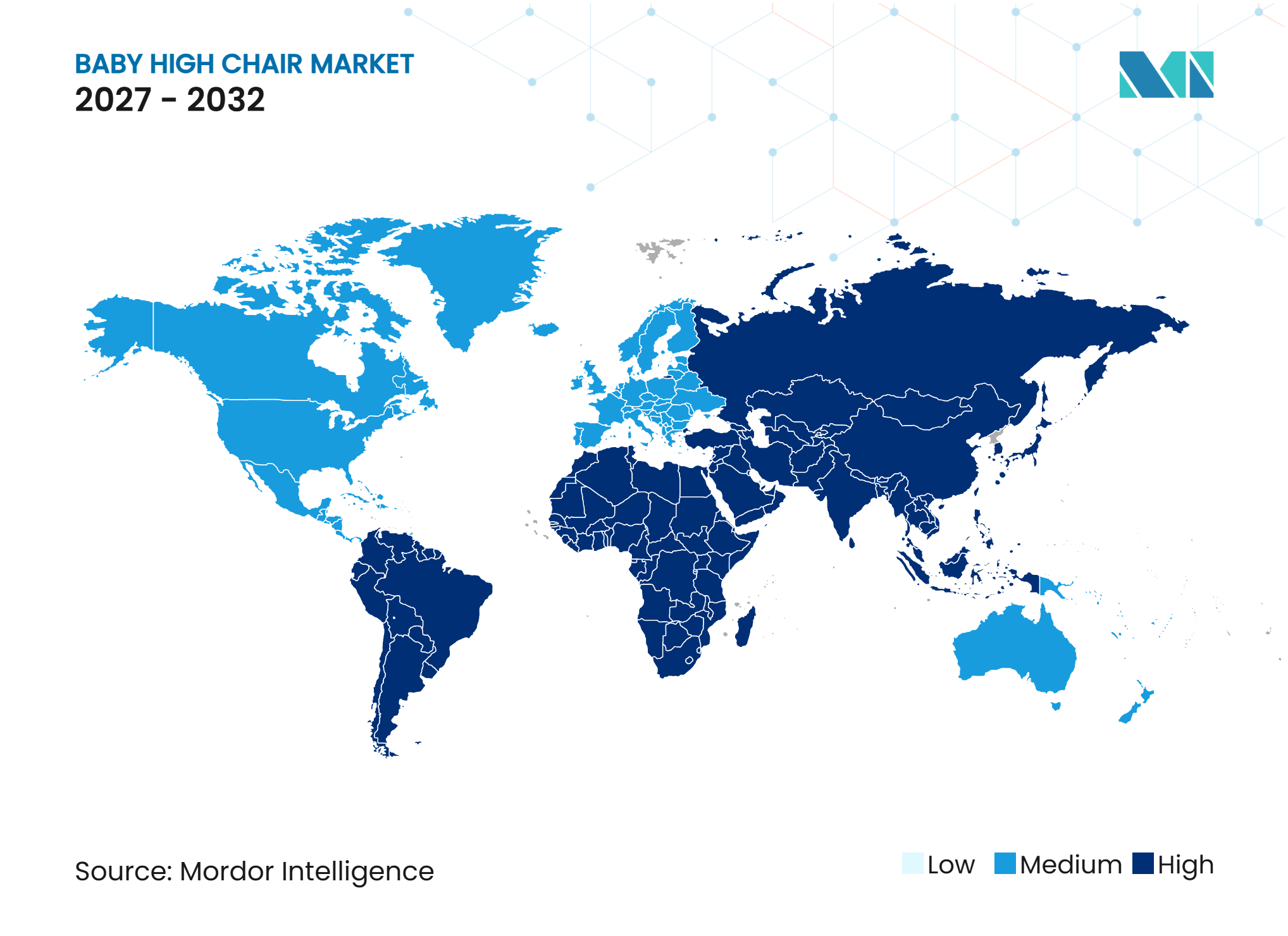
North America is projected to hold a 39.2% share of the baby high chair market in 2026, supported by strong consumer spending on premium, multifunctional, and safety-compliant childcare products. The U.S. Consumer Product Safety Commission’s (CPSC) planned recall of Bugaboo Giraffe high chairs in June 2025 is expected to increase consumer focus on secure assembly, product safety, and manufacturer oversight, encouraging brands to strengthen quality controls and compliance with safety standards. Graco is expected to report four consecutive quarters of U.S. market share growth through mid-2026, supported by demand for convertible high chairs, broader retail distribution, and availability through online sales channels. Canadian nutrition guidance recommends family mealtimes with age-appropriate seating from the start of complementary feeding, supporting the adoption of high chairs designed to provide safe and comfortable seating for infants.
Asia-Pacific
Asia-Pacific is projected to grow at a 7.8% CAGR through 2032. The baby high chair market size in the region is supported by large populations in India and Southeast Asia, higher urban incomes, and wider e-commerce access. China’s maternity and baby e-commerce sales reached CNY 223.78 billion in 2025, growing 12.6% year over year. In South Korea, online spending on baby and children’s products reached KRW 5.48 trillion in 2025, according to the country’s Ministry of Data and Statistics. India, Indonesia, and Vietnam offer stronger volume potential because household ownership remains lower in many areas.
Divergent Growth Beyond Leading Regions
Europe remains a major commercial region, led by Germany, the United Kingdom, Italy, France, and Spain. EN 14988:2017+A2:2024 provides a relevant compliance framework for manufacturers selling in Europe. South America is developing from a smaller base, with Brazil and Argentina as key centers, though currency pressure and limited modern retail slow broader adoption. Stokke expanded its Latin American reach in March 2026 through a partnership with Chilean retailer Mamás Mateas, bringing Tripp Trapp and Steps chairs into more retail and e-commerce channels. The Middle East and Africa remain earlier-stage markets where affordability and store availability still constrain access to dedicated chairs.
Competitive Landscape
Market Concentration
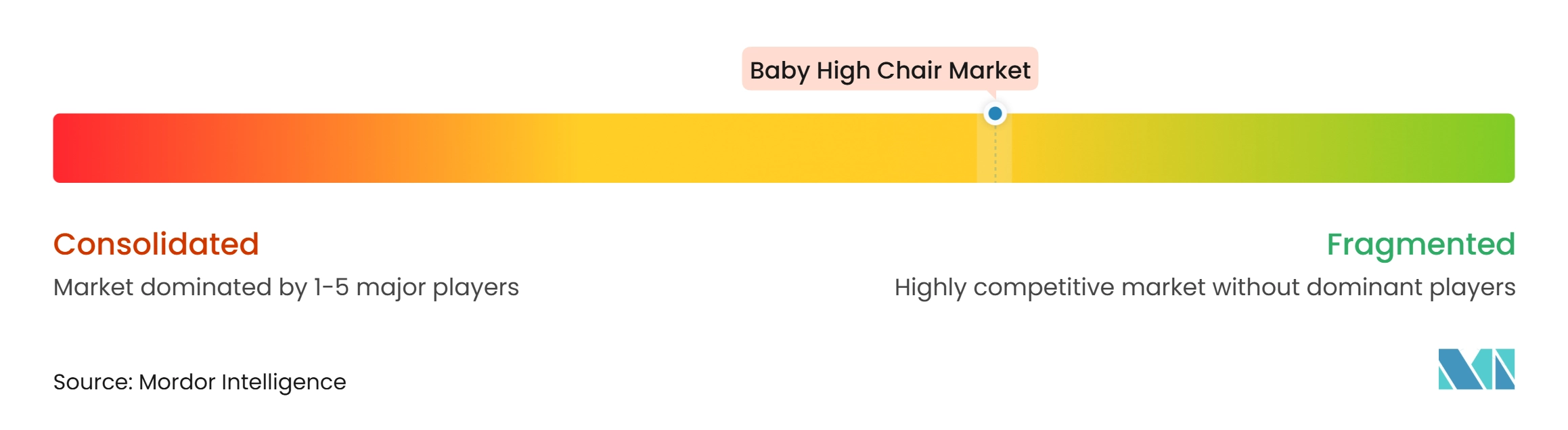
The baby high chair market is moderately fragmented, with European heritage brands, U.S. mass-market suppliers, and direct-to-consumer entrants competing across different price points. Stokke, Peg Perego, Inglesina, and Hauck compete through design, safety heritage, and material credentials. Graco recorded 4 consecutive quarters of U.S. market-share growth through mid-2026, supported by product innovation and retail execution. Intellectual property is also becoming more relevant as convertible products add mechanical features and design complexity.
Companies are using product launches and distribution agreements to create clearer positions in the baby high chair market. Hauck entered the United States in February 2026 with the Arketa+ and Alpha+ high chair sets through Target and Walmart. Stokke reintroduced Steps in January 2026 for use from 6 months to 10 years, extending its lineup of long-life products. Lalo’s Target rollout in 2025 extended a direct-to-consumer brand into more than 230 physical locations and online. These moves show that brands seek to reduce the gap between online discovery and in-store evaluation.
Product safety, sustainability credentials, and multi-stage use remain areas of competitive focus. Stokke’s October 2026 Tripp Trapp MoMA Edition used a cultural collaboration to support premium pricing and reinforce its design identity. Compliance with ASTM F404-20 in the United States and EN 14988:2017+A2:2024 in Europe narrows the space for poorly documented products. The competitive field still leaves room for companies that make durable, long-life products accessible at a lower price. However, no individual company has the share position needed to define the category across all regions and channels.
Baby High Chair Industry Leaders
-
Artsana S.p.A.
-
Newell Brands Inc.
-
Goodbaby International Holdings Limited
-
Stokke AS
-
Peg Perego S.p.A.
- *Disclaimer: Major Players sorted in no particular order
Baby High Chair Market Companies Covered in this Report
- Artsana S.p.A.
- Newell Brands Inc.
- Goodbaby International Holdings Limited
- Stokke AS
- Peg Perego S.p.A.
- Mattel, Inc.
- Evenflo Company, Inc.
- Joie International Co., Limited
- Bugaboo International B.V.
- UPPAbaby
- IKEA of Sweden AB
- Baby Trend, Inc.
- Joovy Holding Co.
- Inglesina S.p.A.
- Hauck GmbH & Co. KG
- Dorel Juvenile Group, Inc.
- Kids2, Inc.
- Lalo, Inc.
- Mockingbird
- Target Brands, Inc.
Recent Industry Developments in Baby High Chair Market
- October 2026: Stokke launched the limited-edition Tripp Trapp MoMA Edition in collaboration with The Museum of Modern Art, priced at USD 399, available at Stokke.com, MoMA Design Store, and select retailers, extending the Tripp Trapp’s 50-year design legacy into a cultural co-branding strategy.
- April 2026: Colugo entered the feeding category with the launch of its Clip On High Chair, featuring proprietary Slide-to-Fit technology and a 1-minute setup, priced at USD 69 on colugo.com and Amazon, extending Colugo’s compact, travel-friendly product range into everyday mealtimes.
- March 2026: Chilean baby products retailer Mamás Mateas completed the acquisition of the Born baby brand’s B2C business and announced a distribution partnership with Isatina, bringing Stokke’s full product range including Tripp Trapp and Steps high chairs into expanded Latin American retail and e-commerce channels.
Global Baby High Chair Market Report Scope
The Baby High Chair Market refers to the market for seating products designed to support infants and toddlers during feeding and mealtimes, featuring elevated seating positions, safety harnesses, and supportive structures to facilitate secure and convenient feeding. By product type, the market is segmented into traditional high chairs, convertible high chairs, foldable high chairs, portable/travel high chairs, booster high chairs, and others. By material, the market is divided into plastic, wood, and metal. By price, the market is segmented into mass and premium categories. By distribution channel, the market is divided into online retail stores and offline retail stores. Geographically, the market covers North America, Europe, Asia-Pacific, South America, and the Middle East and Africa, with country-level coverage across major markets, including the United States, Canada, Mexico, Germany, the United Kingdom, Italy, France, Spain, the Netherlands, Poland, Belgium, Sweden, China, India, Japan, Australia, Indonesia, South Korea, Thailand, Singapore, Brazil, Argentina, Colombia, Chile, Peru, South Africa, Saudi Arabia, the United Arab Emirates, Nigeria, Egypt, Morocco, and Turkey, along with the respective regional rest-of-country categories. Market size and growth forecasts are presented in terms of value (USD).
Segmentation Overview
| Traditional High Chairs |
| Convertible High Chairs |
| Foldable High Chairs |
| Portable / Travel High Chairs |
| Booster High Chairs |
| Others |
| Plastic |
| Wood |
| Metal |
| Mass |
| Premium |
| Online Retail Stores |
| Offline Retail Stores |
| North America | United States |
| Canada | |
| Mexico | |
| Rest of North America | |
| Europe | Germany |
| United Kingdom | |
| Italy | |
| France | |
| Spain | |
| Netherlands | |
| Poland | |
| Belgium | |
| Sweden | |
| Rest of Europe | |
| Asia-Pacific | China |
| India | |
| Japan | |
| Australia | |
| Indonesia | |
| South Korea | |
| Thailand | |
| Singapore | |
| Rest of Asia-Pacific | |
| South America | Brazil |
| Argentina | |
| Colombia | |
| Chile | |
| Peru | |
| Rest of South America | |
| Middle East and Africa | South Africa |
| Saudi Arabia | |
| United Arab Emirates | |
| Nigeria | |
| Egypt | |
| Morocco | |
| Turkey | |
| Rest of Middle East and Africa |
| By Product Type | Traditional High Chairs | |
| Convertible High Chairs | ||
| Foldable High Chairs | ||
| Portable / Travel High Chairs | ||
| Booster High Chairs | ||
| Others | ||
| By Material | Plastic | |
| Wood | ||
| Metal | ||
| By Price | Mass | |
| Premium | ||
| By Distribution Channel | Online Retail Stores | |
| Offline Retail Stores | ||
| By Geography | North America | United States |
| Canada | ||
| Mexico | ||
| Rest of North America | ||
| Europe | Germany | |
| United Kingdom | ||
| Italy | ||
| France | ||
| Spain | ||
| Netherlands | ||
| Poland | ||
| Belgium | ||
| Sweden | ||
| Rest of Europe | ||
| Asia-Pacific | China | |
| India | ||
| Japan | ||
| Australia | ||
| Indonesia | ||
| South Korea | ||
| Thailand | ||
| Singapore | ||
| Rest of Asia-Pacific | ||
| South America | Brazil | |
| Argentina | ||
| Colombia | ||
| Chile | ||
| Peru | ||
| Rest of South America | ||
| Middle East and Africa | South Africa | |
| Saudi Arabia | ||
| United Arab Emirates | ||
| Nigeria | ||
| Egypt | ||
| Morocco | ||
| Turkey | ||
| Rest of Middle East and Africa | ||
Key Questions Answered in the Report
What is the projected value of the baby high chair market by 2032?
The baby high chair market is projected to reach USD 2.96 billion by 2032, growing at a 5.1% CAGR from 2027. Demand is supported by safety-focused purchasing, structured feeding practices, multi-stage products, and wider online discovery.
Which product type is growing fastest in baby high chairs?
Booster high chairs are projected to grow at a 7.2% CAGR through 2032. Their compact design supports travel, smaller homes, and continued use after a child moves out of a traditional chair.
Why do parents select multi-stage high chairs?
Multi-stage products can support children across several stages, reducing the need for separate seating purchases. Models with washable parts, removable trays, and adaptable seating also address routine cleaning and daily use.
Which sales channel will grow fastest for baby high chairs?
In the baby high chair market, online retail is projected to grow at an 8.1% CAGR through 2032 as brand sites, marketplaces, and social commerce shape product discovery. Brands must provide clear safety information because recall histories are also visible online.