
Automotive Ultrasonic Technologies Market Size and Share
Market Overview
| Study Period | 2020 - 2032 |
|---|---|
| Market Size (2027) | USD 6.78 Billion |
| Market Size (2032) | USD 9.39 Billion |
| Growth Rate (2027 - 2032) | 6.73 % |
| Fastest Growing Market | Asia-Pacific |
| Largest Market | Asia-Pacific |
| Market Concentration | Medium |
Major Players *Disclaimer: Major Players sorted in no particular order Image © Mordor Intelligence. Reuse requires attribution under CC BY 4.0. | |
Automotive Ultrasonic Technologies Market Analysis by Mordor Intelligence
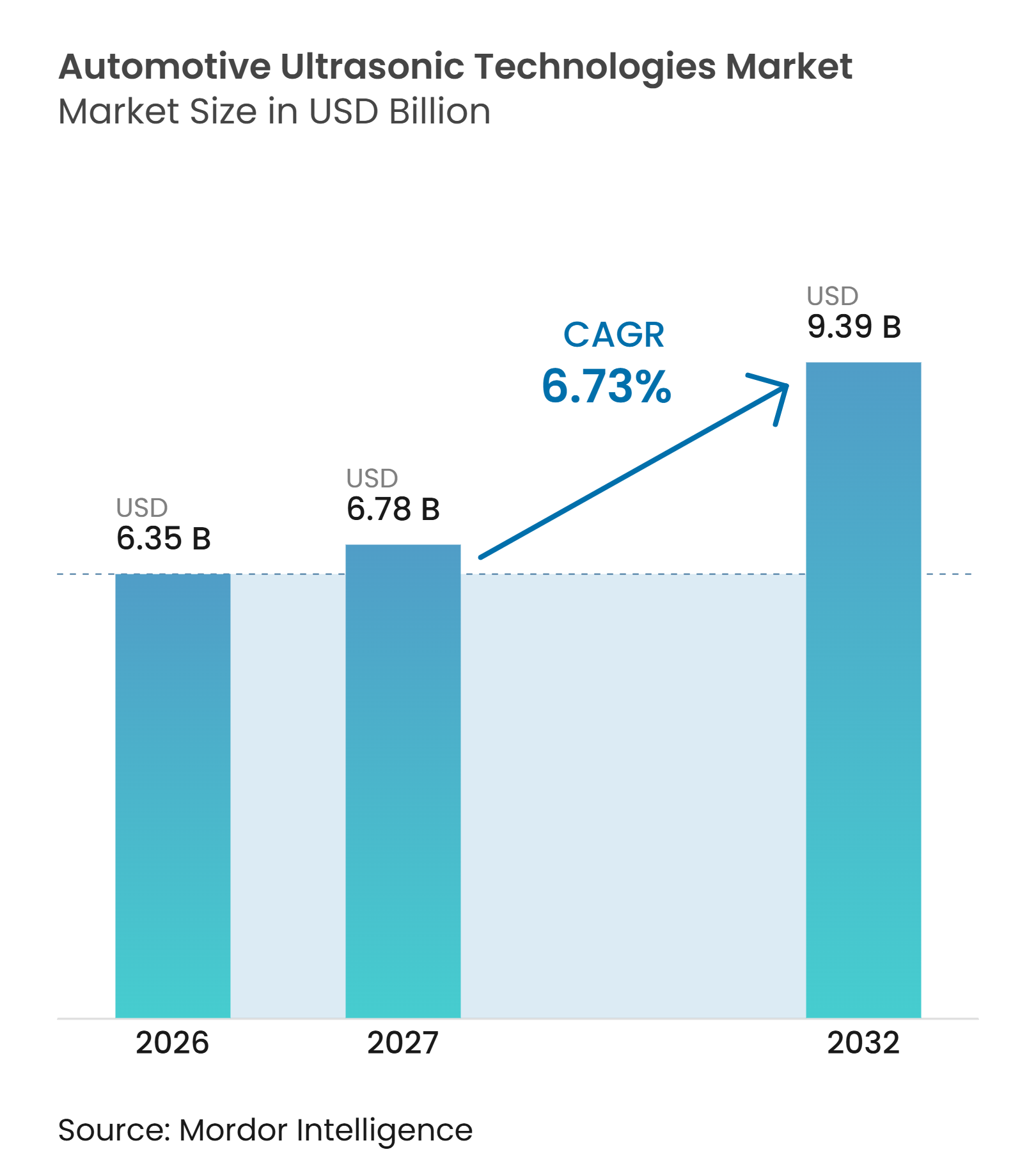
The automotive ultrasonic technologies market size was valued at USD 6.35 billion in 2026, is estimated at USD 6.78 billion in 2027, and is projected to reach USD 9.39 billion by 2032, growing at a CAGR of 6.73% from 2027 to 2032. Mandatory safety requirements are shifting proximity detection from an optional vehicle feature to a required part of vehicle design in several regulated markets. The automotive ultrasonic technologies market benefits because these rules increase factory fitment and favor suppliers that already meet automotive qualification requirements. Parking functions remain the primary source of demand, while higher sensor counts and the use of raw ultrasonic data in centralized vehicle computing systems create further content opportunities. Electric vehicle platforms and lower-cost automated parking functions are widening the addressable base for sensor arrays. Competition is increasingly shaped by interface standards, functional safety work, and the ability to support both sensor hardware and signal-processing needs.
Key Report Takeaways
-
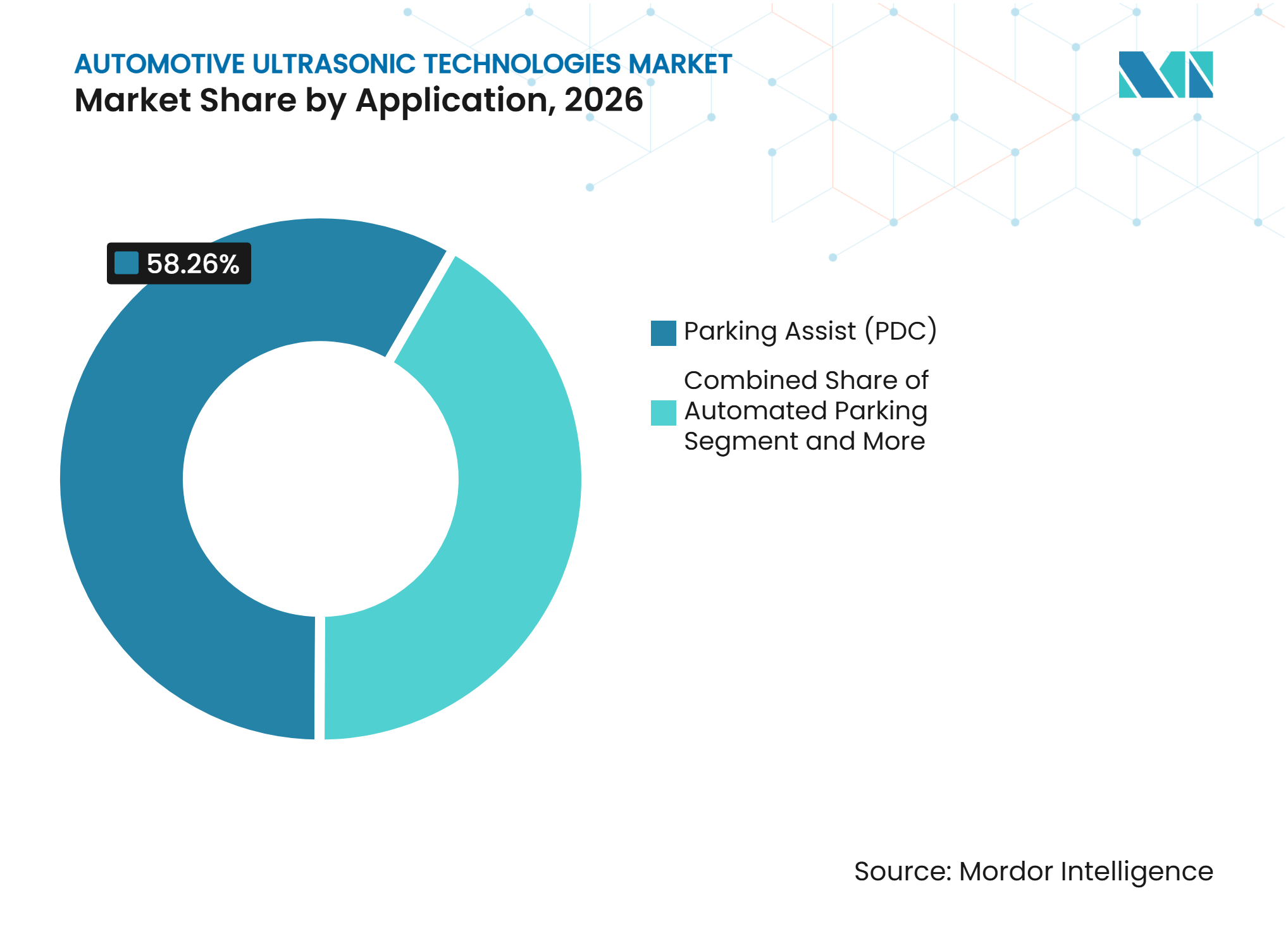
By application, Parking Assist held 58.26% of revenue in 2026, while In-Cabin Occupant and Intrusion Detection is projected to grow at a 9.83% CAGR through 2032.
-
By component, Ultrasonic Sensors and Transducers accounted for 64.18% of revenue in 2026, while Software is projected to grow at a 7.79% CAGR through 2032.
-
By sensor range, Short-Range sensors held 68.27% of revenue in 2026, while Long-Range sensors are forecast to grow at a 7.41% CAGR through 2032.
-
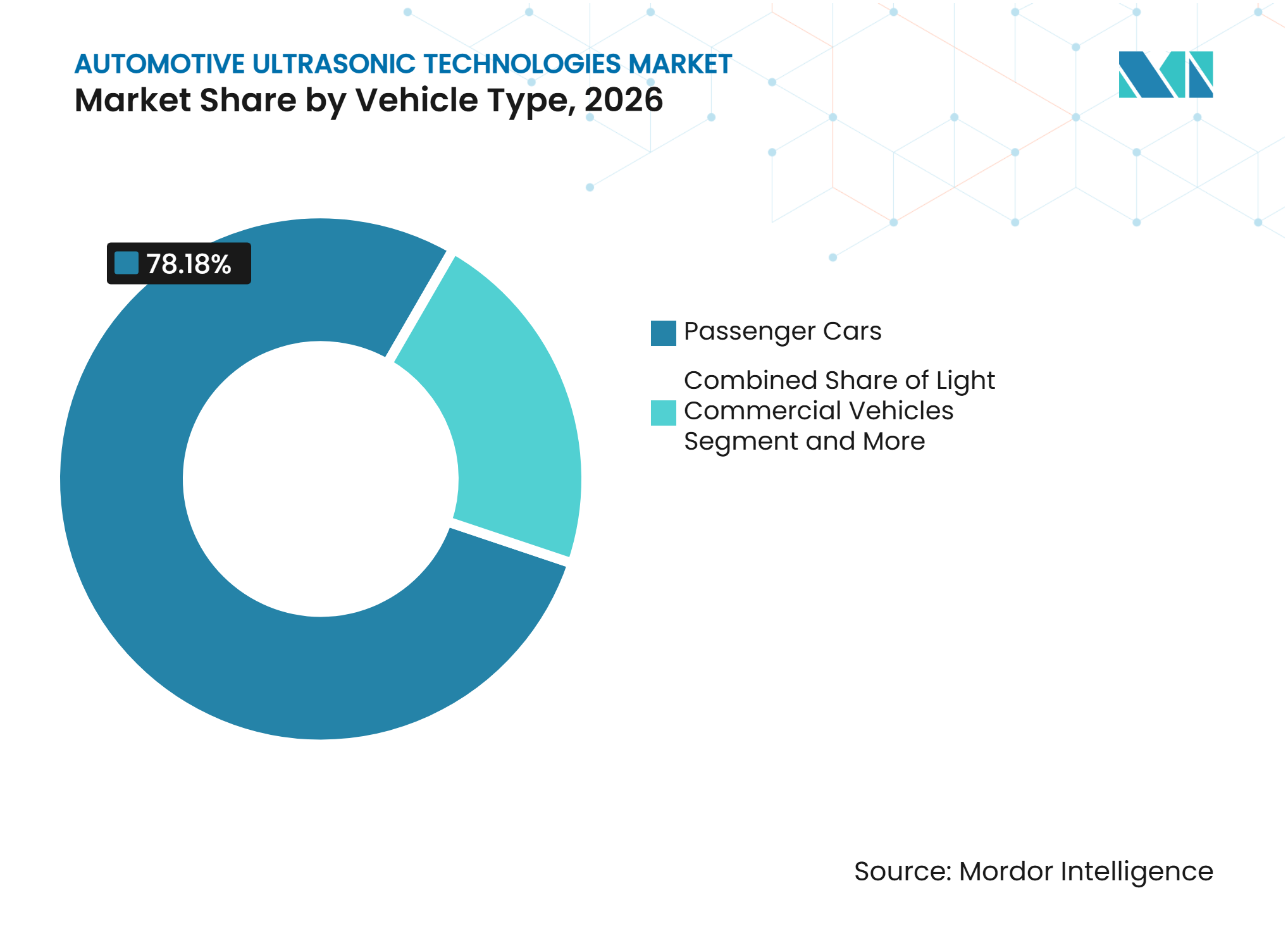
By vehicle type, Passenger Cars accounted for 78.18% of revenue in 2026, while Light Commercial Vehicles are forecast to expand at a 7.17% CAGR through 2032.
-
By sales channel, OEM accounted for 86.27% of revenue in 2026 and is projected to grow at a 6.86% CAGR through 2032.
-
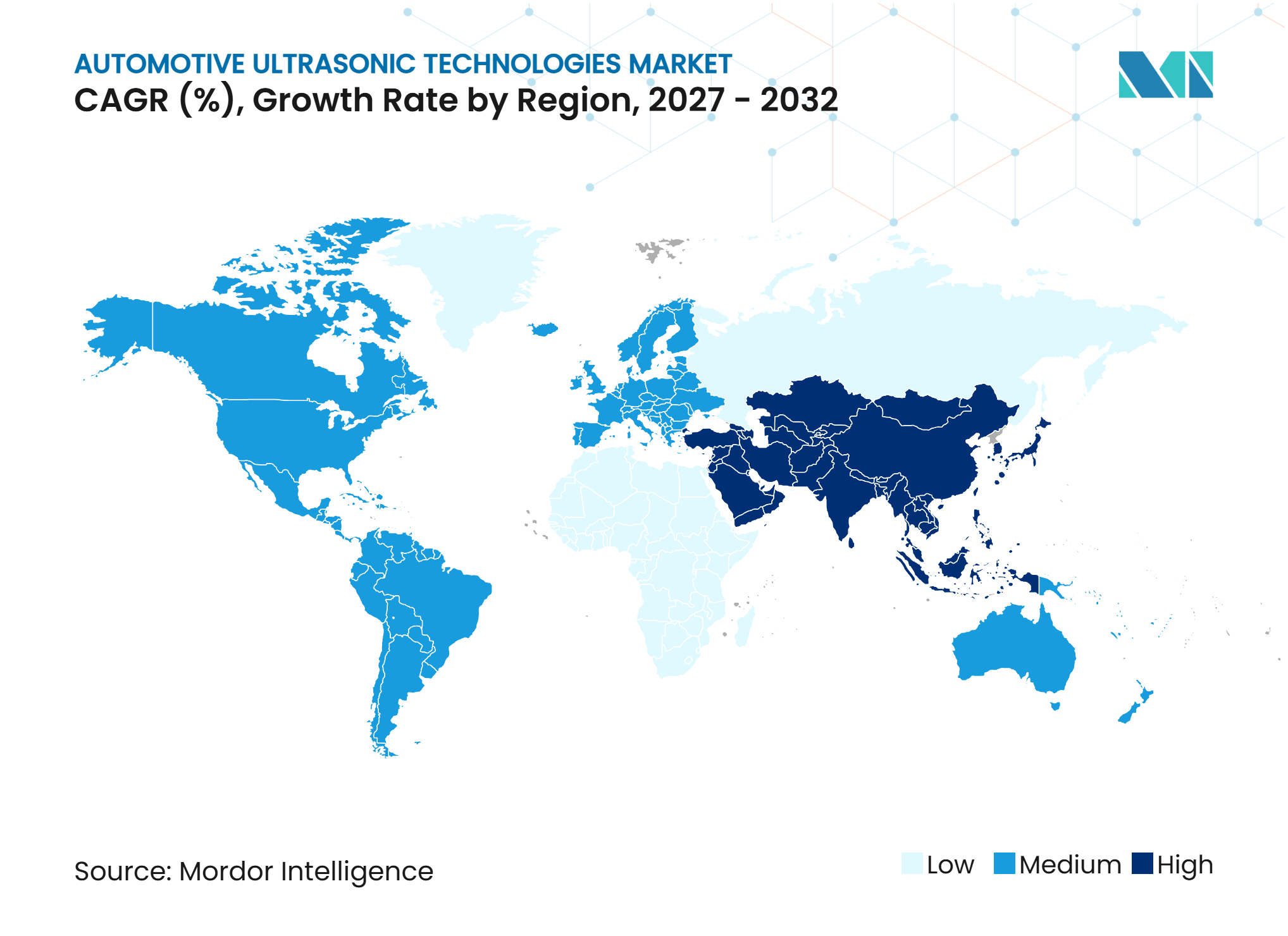
By geography, Asia-Pacific held 41.27% of revenue in 2026 and is projected to grow at a 7.74% CAGR through 2032.
Note: Market numbers in this report are based on Mordor Intelligence's proprietary estimation framework, which combines nine months of actuals with Q4 projections for base year 2026.
Market Trends and Insights
Drivers Impact Analysis of Automotive Ultrasonic Technologies Market*
| Driver | (~) % Impact on CAGR Forecast | Geographic Relevance | Impact Timeline |
|---|---|---|---|
| Increasing ADAS and Parking Automation Fitment | +1.5% | Global, with intensity in China, Europe, Japan, and South Korea | Short term (≤ 2 years) |
| Regulatory Push for Reversing, Parking and Low-Speed Safety Functions | +1.2% | EU, China, India, Japan, South Korea, and spillover to MEA | Short term (≤ 2 years) |
| Expansion of Ultrasonic Sensor Arrays in Electric Vehicles | +0.9% | China, with expansion to Europe and North America | Medium term (2-4 years) |
| Lower Cost Compared With Camera, Radar and LiDAR Alternatives | +0.8% | Global, with strongest relevance in price-sensitive Asia-Pacific and South America | Short term (≤ 2 years) |
| Digital MEMS Transducer and Signal-Processing Adoption | +0.7% | Global, led by Europe and Japan OEM platforms | Medium term (2-4 years) |
| Rising Commercial-Vehicle and Fleet Safety Requirements | +0.5% | Europe, India, and North America | Medium term (2-4 years) |
| Source: Mordor Intelligence | |||
Increasing ADAS and Parking Automation Fitment
ADAS adoption is raising the number of sensing points specified on new vehicle platforms. A move from 4 parking sensors to a 12-sensor perimeter array materially increases ultrasonic hardware content on each vehicle. This effect does not depend only on vehicle production, because the amount of sensor content grows as vehicles add assisted parking and Level 2 functions. Bosch introduced TB193 and TB293 chipsets in April 2026 that transmit raw ultrasonic signals at 1.16 Mbps to a central processor, which connects ultrasonic data to wider perception systems [1]. The automotive ultrasonic technologies market therefore gains from designs that use ultrasonic inputs alongside cameras and radar rather than treating each sensing technology as an isolated feature.
Regulatory Push for Reversing, Parking and Low-Speed Safety Functions
Vehicle safety rules are reducing the ability of manufacturers to omit low-speed detection functions on entry-level vehicles. The EU General Safety Regulation Phase 2 applies to newly manufactured vehicles from July 2026 and includes reversing detection requirements for relevant vehicles. UNECE R158 provides the related technical frame for detection-zone and coverage expectations, which makes system validation central to platform approval. ISO 23150-14:2026 sets logical interfaces between ultrasonic sensors and data-fusion units for automated-driving functions. These requirements support the automotive ultrasonic technologies market by moving demand toward qualified production systems and away from optional retrofit installations.
Expansion of Ultrasonic Sensor Arrays in Electric Vehicles
Electric vehicle programs are a major source of new sensor-array installations. Their bumper layouts and software-led parking functions support the use of multiple sensors around the vehicle. Global electric car sales exceeded 20 million units in 2025, with volumes continuing to expand across China, Europe, and North America in 2026 and 2027 [2]. Chinese new-energy vehicle brands are using larger ultrasonic arrays to support parking features on mid-priced vehicles. This design approach broadens the automotive ultrasonic technologies market because it brings multi-sensor configurations into vehicle tiers where such functions were previously limited.
Lower Cost Compared With Camera, Radar and LiDAR Alternatives
Ultrasonic technology remains economical for obstacle detection during final parking movements. Ultrasonic sensors remain useful for autonomous parking because they operate independently of lighting conditions and effectively detect curbs and nearby obstacles. Their performance is particularly relevant at short distances, where camera performance can vary, and radar systems face near-field limitations. Near-field ranging applications demonstrate the practical value of ultrasonic sensing close to the vehicle. Their cost-effectiveness and close-range capabilities enable the automotive ultrasonic technologies market to maintain a role in sensor-fusion vehicles, even as radar and camera content increases.
Digital MEMS transducers and signal-processing software also support higher-value system designs. MEMS-based approaches aim to extend practical sensing range and support more compact packages. Greater processing capability can improve echo interpretation, diagnostics, and compatibility with centralized vehicle computers. These functions create a path for suppliers to offer software and electronics content with the sensor hardware. Commercial vehicle fleets add a separate demand stream because rear detection and blind-spot coverage require multiple sensing points on larger vehicles. Factory-level qualification, reliability testing, and vehicle-bus compatibility are therefore becoming more important than supplying a stand-alone sensing element.
Restraints Impact Analysis of Automotive Ultrasonic Technologies Market*
| Restraint | (~) % Impact on CAGR Forecast | Geographic Relevance | Impact Timeline |
|---|---|---|---|
| Substitution by Radar, Camera, LiDAR and Sensor-Fusion Platforms | -1.1% | Global, with strongest effect in premium European and North American vehicles | Long term (≥ 4 years) |
| Performance Degradation in Heavy Rain, Ice, Snow and Contamination | -0.8% | Northern Europe, Canada, Northern China, and Russia | Short term (≤ 2 years) |
| Automotive-Grade Piezoelectric Material and Semiconductor Qualification Constraints | -0.6% | Global, with particular pressure in Western supply chains sourcing from China | Medium term (2-4 years) |
| Cybersecurity and Software-Update Costs for Connected Parking ECUs | -0.4% | Global, with strongest relevance in the EU under UNECE R155 and R156 | Medium term (2-4 years) |
| Source: Mordor Intelligence | |||
Substitution by Radar, Camera, LiDAR and Sensor-Fusion Platforms
Radar, camera, and lidar systems can displace ultrasonic hardware where longer range or stronger weather performance matters most. This pressure is most evident in premium vehicles, where lateral sensing and automated driving redundancy can support multiple sensor types. The effect is not uniform because parking distance control still depends on close-range information that ultrasonic systems provide well. Bosch's raw-data chipset design shows how ultrasonic sensing can remain part of a multi-modal system rather than be removed from it. The automotive ultrasonic technologies market consequently faces a shift in its technical role, with greater emphasis on data quality, integration, and fusion readiness.
Performance Degradation in Heavy Rain, Ice, Snow and Contamination
Heavy rain, snow, ice, and mud on the sensor face can reduce acoustic detection reliability. These conditions are a concern in colder regions and in fleet operations where vehicles remain in service through difficult weather. Transport research has found limitations for passive ultrasonic systems in some collision scenarios involving cyclists, which helps explain why radar is preferred for certain blind-spot functions. Sensor cleaning, self-diagnostic functions, and more robust packaging help address this limitation, but they also raise system complexity. Material qualification, semiconductor availability, cybersecurity obligations, and software-update costs add further barriers for suppliers seeking OEM platform approvals.
*Our forecasts treat driver/restraint impacts as directional, not additive. The impact forecasts reflect baseline growth, mix effects, and variable interactions.
Automotive Ultrasonic Technologies Market Segment Analysis
By Application:
Parking Assist Remains the Main Revenue BaseParking Assist accounted for 58.26% of the automotive ultrasonic technologies market share in 2026, making parking distance control the main revenue base across OEM platforms. The function is widely suited to low-speed maneuvers, where drivers need close obstacle information. It is also supported by regulatory demand for reversing detection and by broader availability of factory-installed parking systems. Automated parking is the next major application because vehicle makers are adding memory parking and remote parking capabilities to more models.
In-Cabin Occupant and Intrusion Detection is forecast to grow at a 9.83% CAGR through 2032. This application reflects demand for occupant presence detection, child-left-behind warnings, and better occupant classification for airbag-related functions. The segment has a different technical focus from parking assistance because it requires the detection of small movements and occupant presence inside the vehicle. Its growth expands the role of ultrasonic technology from external obstacle detection into cabin sensing. The application mix therefore helps the automotive ultrasonic technologies industry maintain a broader base even as conventional parking functions mature.



By Component:
Sensors and Transducers Lead While Software ExpandsUltrasonic Sensors and Transducers captured 64.18% of the automotive ultrasonic technologies market size in 2026. The component leads because each vehicle system requires physical sensing elements, and higher sensor counts directly increase unit demand. Piezoelectric and MEMS transducers remain central to converting acoustic signals into usable vehicle data. The largest hardware base is tied to passenger vehicles with multiple rear and perimeter sensors. Their position also reflects the continued importance of conventional parking-distance control in factory installations.
Software is projected to grow at a 7.79% CAGR through 2032, the strongest rate within the component mix. Software supports echo interpretation, object classification, sensor health monitoring, calibration, and updates for connected parking control units. Bosch's 2026 chipset launch illustrates the direction of travel, because the system is designed to carry richer raw ultrasonic data to a central processor. Electronic control units continue to link sensing hardware to vehicle communications and automated-parking functions. The automotive ultrasonic sensors industry is therefore adding recurring engineering and software work to a component structure that was historically led by hardware.
By Sensor Range:
Short-Range Systems Dominate Current InstallationShort-Range sensors accounted for 68.27% of revenue in 2026. Their lead aligns with the most common use case: obstacle detection during slow maneuvers at close range. These sensors support rear parking, curb detection, and perimeter coverage in locations where precision matters more than extended detection range. Short-range installations are also widely used because the sensor can be integrated into bumper designs with established automotive manufacturing processes. The large installed base gives this range category a stable role in passenger cars and commercial vehicles.
Long-Range sensors are forecast to grow at a 7.41% CAGR through 2032. Their use expands ultrasonic coverage toward automated parking space measurement, side-proximity detection, and selected cross-traffic functions. Ultrasonic arrays can deliver performance comparable to lidar in autonomous parking applications and perform effectively in tight parallel parking scenarios. Consequently, longer-range ultrasonic designs are increasingly complementing short-range radar within near-field sensing architectures. This development supports new functionality while preserving the central role of short-range sensors in the automotive ultrasonic technologies market.
By Vehicle Type:
Passenger Cars Lead While Light Commercial Vehicles GrowPassenger Cars accounted for 78.18% of revenue in 2026. Their lead reflects global production volume and broad use of rear parking sensors in regulated and higher-feature vehicle lines. Passenger vehicles are also the primary platform for assisted parking features that use multiple sensors around the vehicle perimeter. As manufacturers add more automated functions, sensor counts per passenger car can rise even when overall unit production changes little. The segment remains the main channel through which suppliers scale qualified ultrasonic modules and control-unit designs.
Light Commercial Vehicles are projected to grow at a 7.17% CAGR through 2032. Fleet operators have a direct interest in reducing low-speed collisions and improving safety around delivery vehicles. Larger vehicle dimensions create demand for rear, side, and blind-spot coverage, which can require more sensing positions than a compact passenger car. Heavy Commercial Vehicles have a smaller revenue base but need broad proximity coverage for their operating conditions. The vehicle mix gives the automotive ultrasonic technologies market exposure to both large passenger platforms and safety-led fleet upgrades.

By Sales Channel:
OEM Fitment Defines Revenue StructureOEM held 86.27% of revenue in 2026. Factory installation dominates because sensor systems must be integrated with bumpers, control units, vehicle networks, and functional-safety processes during platform development. OEM qualification includes reliability, electromagnetic compatibility, software integration, and production validation. These requirements favor suppliers with established engineering relationships and tested automotive components. Mandatory safety functions further reinforce factory fitment because compliance must be built into the vehicle design.
The OEM channel is forecast to grow at a 6.86% CAGR through 2032. The aftermarket remains relevant for replacement sensors, post-collision calibration, and regions where factory fitment remains lower. Its revenue opportunity is narrower because aftermarket systems do not typically determine the original sensor architecture of a new vehicle. Connected parking systems may still create service demand through diagnostics and calibration. The automotive ultrasonic technologies market therefore remains centered on OEM platform programs, with the aftermarket serving a focused support role.
Geography Analysis
Asia-Pacific
Asia-Pacific leads the automotive ultrasonic technologies market, supported by high vehicle production volumes, new-energy vehicle adoption, and increasing deployment of automated parking features. Asia-Pacific accounted for 41.27% of the automotive ultrasonic technologies market share in 2026 and is projected to grow at a 7.74% CAGR through 2032. China drives much of the region's volume, as domestic new-energy vehicle brands are deploying 8 to 12 sensor arrays on mid-priced platforms. The region also benefits from rapid adoption of automated parking functions and the scale of local vehicle manufacturing. Japan remains important for qualified automotive electronics and long-term OEM sourcing programs. In June 2026, Valeo announced an additional USV 10.2 order from a major Japanese automaker for a vehicle launch planned in 2028. India and South Korea add demand through commercial vehicle safety requirements and broader adoption of parking automation across more affordable models.
Europe
Europe’s market growth is primarily supported by stringent vehicle safety regulations, advanced supplier capabilities, and high-value sensor integration requirements. Europe is driven by regulatory compliance requirements and its well-established automotive supply base. General Safety Regulation Phase 2 is set to apply to newly manufactured vehicles from July 2026 and includes reversing detection requirements for relevant vehicle categories. UNECE R158 shapes detection-zone requirements, while UNECE R155 and R156 introduce cybersecurity and software-update requirements for connected vehicle systems. Germany remains significant because Bosch and Elmos Semiconductor operate within an integrated regional vehicle and electronics supply chain. Valeo stated that its USV 10.2 entered mass production for a major European customer in 2025, with a lighter harness architecture designed to improve vehicle efficiency. Europe remains a key source of technical standards, supplier qualification practices, and high-value sensor integration.
North America, South America, and Middle East and Africa
These markets present varied growth opportunities, driven by ADAS integration and commercial fleet demand in North America, replacement demand in South America, and export-oriented manufacturing in the Middle East and Africa. North America is a mature automotive ultrasonic technologies market, where widespread backup-camera adoption has shifted feature development toward integration with broader ADAS systems. The region’s commercial vehicle fleet also creates opportunities for proximity sensing and low-speed safety functions. South America is supported by passenger vehicle production and replacement demand, although factory fitment is expected to progress more gradually than in Asia-Pacific and Europe. The Middle East and Africa combine connected-mobility programs in GCC states with manufacturing and export activity in Turkey. Vehicles manufactured for distribution in Europe must comply with EU requirements, linking local assembly decisions with European safety standards. These diverse markets offer suppliers opportunities in replacement, fleet, and export-oriented programs, although adoption rates vary based on national regulations and vehicle affordability.
Competitive Landscape
Market Concentration
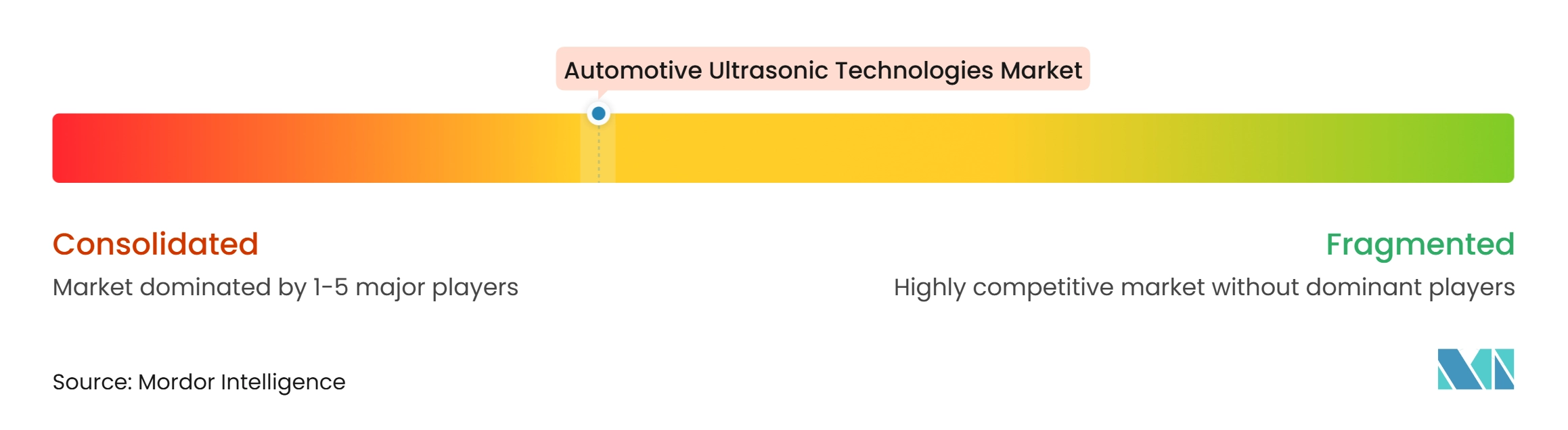
The automotive ultrasonic technologies market is moderately concentrated in ultrasonic ICs and sensor modules. A limited group of European and Japanese specialists has deep experience in parking-system electronics, while Tier 1 suppliers manage vehicle-level integration and OEM design-in work. A major ultrasonic IC supplier recently reported a significant cumulative shipment milestone, reflecting the value of long-term alignment with established parking-system architectures. Suppliers compete on reliability, processing capability, sensor packaging, and the ability to meet platform qualification schedules.
Bosch's recent introduction of the TB193 and TB293 chipsets illustrates competition moving beyond basic sensing hardware. These chipsets support raw ultrasonic signal transfer to central processors and use an open VASI bus interface for sensor-supplier flexibility. Valeo's USV order from a Japanese automaker represents a second competitive approach, where improved signal processing and reduced harness weight extend automated parking into entry-level vehicles. Elmos also introduced an AI grid-mapping kit with its ultrasonic ICs, extending its offering toward vehicle testing and object interpretation. These developments indicate that component suppliers are seeking a larger role in software-defined vehicle systems.
Key opportunities remain in contamination-tolerant packaging, remote diagnostics, calibration support, and in-cabin sensing. Suppliers must also address functional safety, cybersecurity, and software-update requirements as connected parking control units become more common. A recently published ISO standard raises the importance of interoperable interfaces between ultrasonic sensors and data-fusion units, which favors companies with established engineering resources and experience in vehicle-system validation. While the competitive environment does not eliminate opportunities for new semiconductor and transducer suppliers, market entry depends on completing lengthy automotive qualification and integration processes.
Automotive Ultrasonic Technologies Industry Leaders
-
Robert Bosch GmbH
-
Valeo SE
-
AUMOVIO SE
-
DENSO Corporation
-
Murata Manufacturing Co., Ltd.
- *Disclaimer: Major Players sorted in no particular order
Automotive Ultrasonic Technologies Market Companies Covered in this Report
- Robert Bosch GmbH
- Valeo SE
- AUMOVIO SE
- DENSO Corporation
- Murata Manufacturing Co., Ltd.
- Aptiv PLC
- Magna International Inc.
- Hyundai Mobis Co., Ltd.
- FORVIA SE
- Texas Instruments Incorporated
- Infineon Technologies AG
- Nippon Ceramic Co., Ltd.
- Ficosa International, S.A.
- Astemo, Ltd.
- NXP Semiconductors N.V.
- ZF Friedrichshafen AG
- STMicroelectronics N.V.
Recent Industry Developments in Automotive Ultrasonic Technologies Market
- June 2026: Valeo announced an additional order for its USV 10.2 next-generation ultrasonic sensor from a major Japanese automaker, with vehicle launch scheduled for Japan in 2028. The sensor reduces harness weight by 600 g and extends automated parking functionality to entry-level models through AI-based signal processing. Valeo's cumulative ultrasonic sensor production has surpassed 2 billion units.
- April 2026: Bosch unveiled its seventh-generation TB193 and TB293 ultrasonic chipsets at Auto China in Beijing. The dual-chip architecture captures raw sensor signals at 1.16 Mbps, supports AI-based object detection, and reduces energy consumption by 50%. It also introduces the open VASI bus interface standard, providing vehicle manufacturers with greater flexibility in selecting sensor suppliers.
- November 2025: Elmos Semiconductor announced it had shipped more than 2 billion ultrasonic ICs for parking systems since series production began in 1998, and introduced an AI kit that uses an AI-supported grid map to improve height differentiation and object recognition.
- June 2025: Valeo was selected by a European premium automaker to supply its Smart Safety 360 driver-assistance system, with production from 2026, including a parking ECU that manages 12 ultrasonic sensors for Level 2+ driving and parking functions.
Global Automotive Ultrasonic Technologies Market Report Scope
The Automotive Ultrasonic Technologies Market is Segmented by Application (Parking Assist (PDC), Automated/Autonomous Parking Systems, Blind Spot Detection, In-Cabin Occupant and Intrusion Detection, and Others), Component (Ultrasonic Sensors/Transducers, Electronic Control Units (ECUs), and Software), Sensor Range (Short-Range (<2.5 m) and Long-Range (2.5–5.5 m)), Vehicle Type (Passenger Cars, Light Commercial Vehicles (LCVs), and Heavy Commercial Vehicles (HCVs)), Sales Channel (OEM and Aftermarket), and Geography (North America, Europe, Asia-Pacific, South America, and Middle East and Africa). The Market Forecasts are Provided in Terms of Value (USD) and Volume (Units).
Segmentation Overview
| Parking Assist (PDC) |
| Automated Parking |
| Blind Spot Detection |
| In-Cabin Occupant / Intrusion Detection |
| Other Applications |
| Ultrasonic Sensors / Transducers |
| Electronic Control Units |
| Software |
| Short-Range (Below 2.5 m) |
| Long-Range (2.5-5.5 m) |
| Passenger Cars |
| Light Commercial Vehicles |
| Heavy Commercial Vehicles |
| OEM |
| Aftermarket |
| North America | United States |
| Canada | |
| Mexico | |
| Europe | Germany |
| France | |
| United Kingdom | |
| Italy | |
| Spain | |
| Russia | |
| Rest of Europe | |
| Asia-Pacific | China |
| Japan | |
| South Korea | |
| India | |
| Australia | |
| Rest of Asia-Pacific | |
| South America | Brazil |
| Argentina | |
| Rest of South America | |
| Middle East and Africa | Saudi Arabia |
| United Arab Emirates | |
| Turkey | |
| Israel | |
| South Africa | |
| Egypt | |
| Rest of Middle East and Africa |
| By Application | Parking Assist (PDC) | |
| Automated Parking | ||
| Blind Spot Detection | ||
| In-Cabin Occupant / Intrusion Detection | ||
| Other Applications | ||
| By Component | Ultrasonic Sensors / Transducers | |
| Electronic Control Units | ||
| Software | ||
| By Sensor Range | Short-Range (Below 2.5 m) | |
| Long-Range (2.5-5.5 m) | ||
| By Vehicle Type | Passenger Cars | |
| Light Commercial Vehicles | ||
| Heavy Commercial Vehicles | ||
| By Sales Channel | OEM | |
| Aftermarket | ||
| By Geography | North America | United States |
| Canada | ||
| Mexico | ||
| Europe | Germany | |
| France | ||
| United Kingdom | ||
| Italy | ||
| Spain | ||
| Russia | ||
| Rest of Europe | ||
| Asia-Pacific | China | |
| Japan | ||
| South Korea | ||
| India | ||
| Australia | ||
| Rest of Asia-Pacific | ||
| South America | Brazil | |
| Argentina | ||
| Rest of South America | ||
| Middle East and Africa | Saudi Arabia | |
| United Arab Emirates | ||
| Turkey | ||
| Israel | ||
| South Africa | ||
| Egypt | ||
| Rest of Middle East and Africa | ||
Key Questions Answered in the Report
What is the forecast growth rate for automotive ultrasonic sensors?
The automotive ultrasonic technologies market is forecast to grow at a 6.73% CAGR from 2027 to 2032, reaching USD 9.39 billion in 2032.
Which automotive ultrasonic sensor application has the largest revenue share?
Parking Assist leads the application mix with a 58.26% share in 2026, supported by widespread factory fitment for low-speed obstacle detection.
Which component is growing fastest in automotive ultrasonic systems?
Software is forecast to grow at a 7.79% CAGR through 2032 because of demand for echo interpretation, diagnostics, calibration, and update capability.
Why are ultrasonic sensors still used with radar and cameras?
Ultrasonic systems remain effective for close-range detection during parking, and they can supply data to multi-modal sensor-fusion systems.
Which region leads automotive ultrasonic sensor demand?
Asia-Pacific leads with 41.27% of revenue in 2026 and is forecast to record a 7.74% CAGR through 2032.