
Automotive Tire OEM Market Size and Share
Market Overview
| Study Period | 2020 - 2032 |
|---|---|
| Market Size (2027) | USD 75.76 Billion |
| Market Size (2032) | USD 94.95 Billion |
| Growth Rate (2027 - 2032) | 4.62 % |
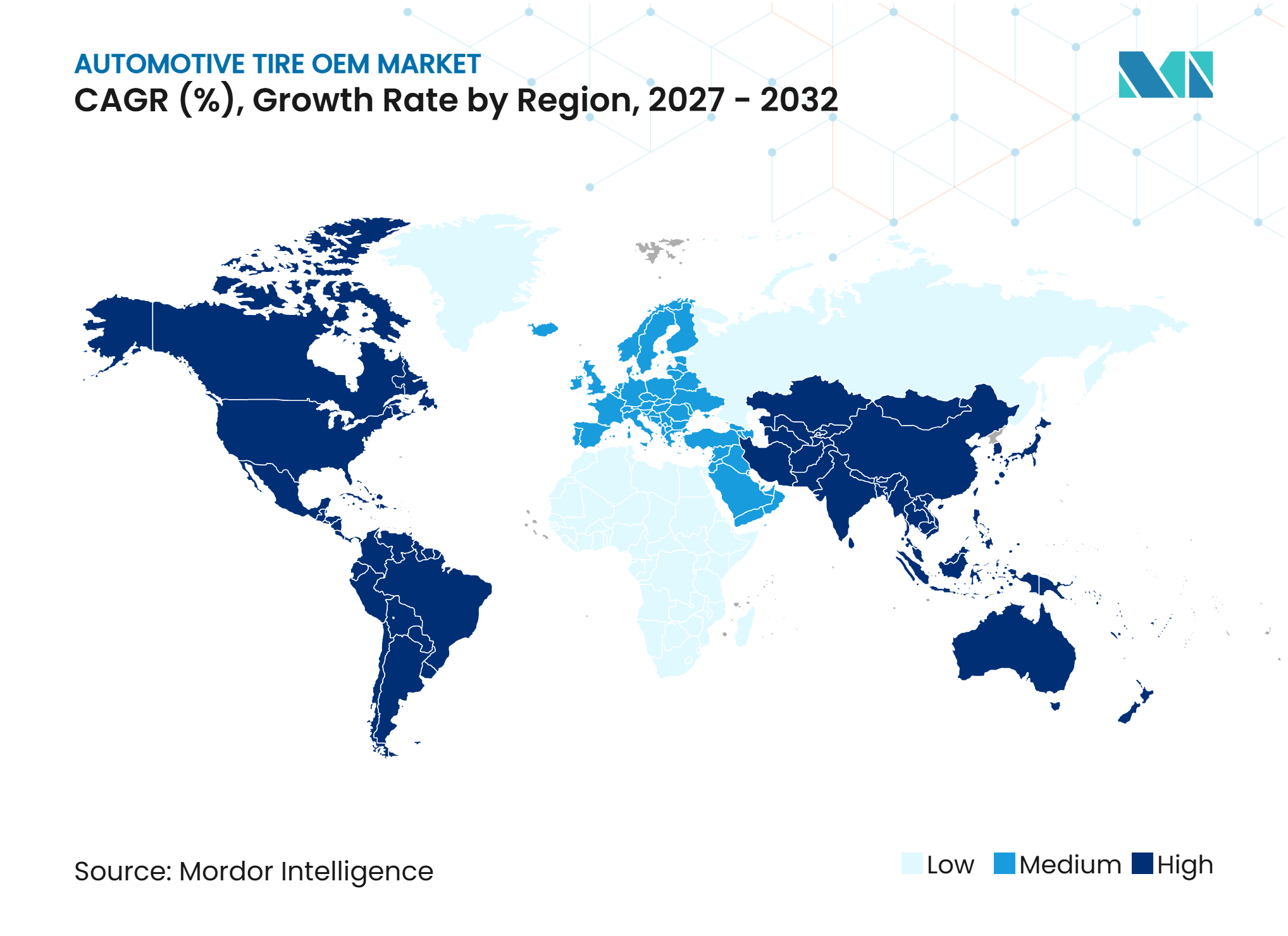
| Fastest Growing Market | South America |
| Largest Market | Asia-Pacific |
| Market Concentration | Medium |
Major Players *Disclaimer: Major Players sorted in no particular order Image © Mordor Intelligence. Reuse requires attribution under CC BY 4.0. | |
Automotive Tire OEM Market Analysis by Mordor Intelligence
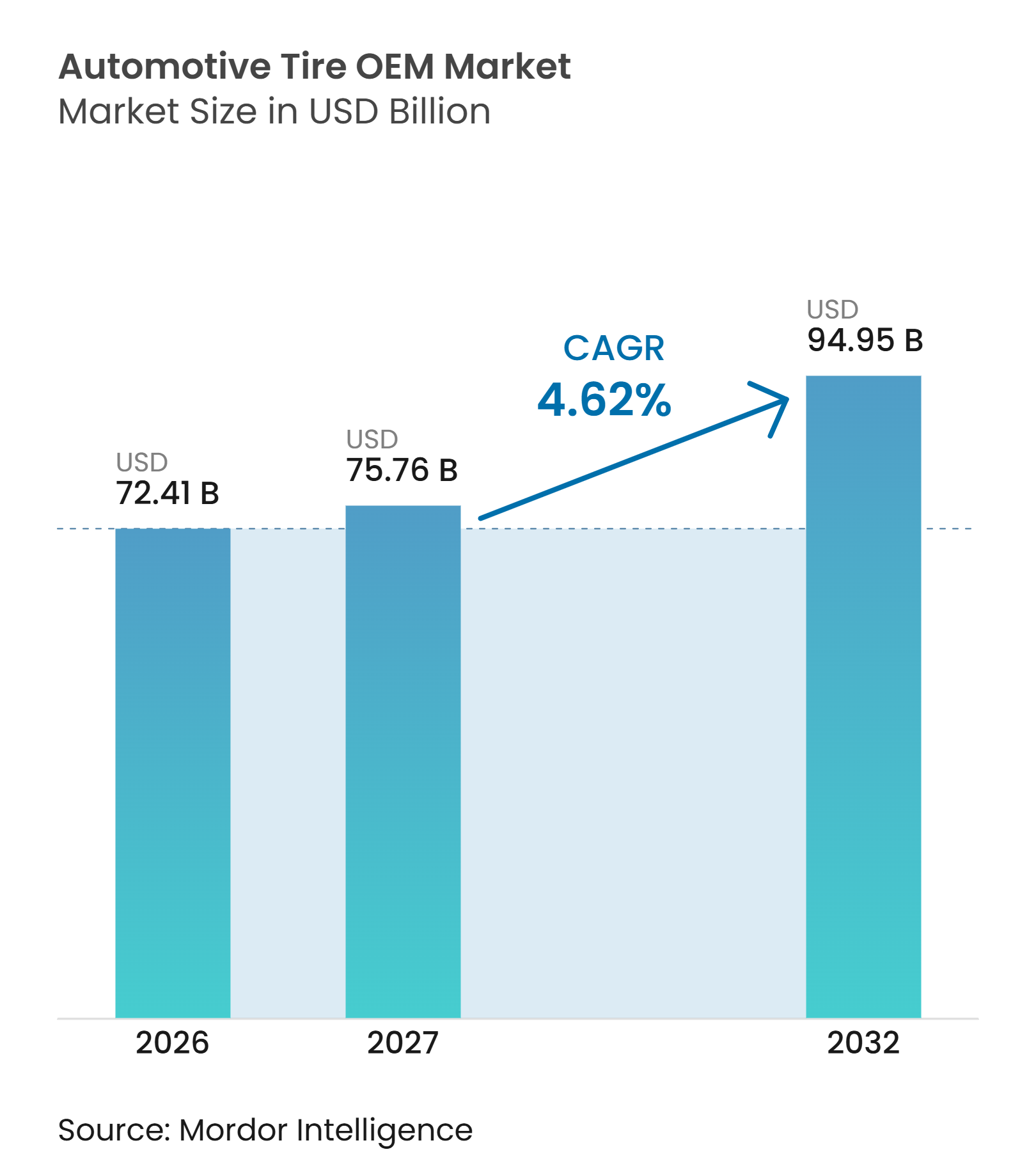
The Automotive Tire OEM Market size was valued at USD 72.41 billion in 2026 and is expected to reach USD 75.76 billion in 2027 and USD 94.95 billion by 2032, registering a CAGR of 4.62% between 2027 and 2032. The automotive tire OEM market is moving toward higher-value tire specifications, even as vehicle production growth remains uneven across mature manufacturing centers. Larger rim sizes, electric vehicle fitments, lower rolling resistance, and integrated sensors are raising the value of tires supplied with new vehicles. Supplier strategy is therefore shifting toward earlier engineering involvement with automakers, shared validation work, and faster approval cycles for new vehicle platforms as manufacturers release more differentiated vehicle lines. Local manufacturing is also becoming more important as automakers and tire companies respond to tariffs, delivery requirements, regional sourcing needs, and the need to protect assembly schedules from transport disruption. The initial factory fitment can influence a later replacement purchase, which gives OEM contracts strategic value beyond their immediate margin contribution and supports a supplier’s relationship with vehicle owners after the original sale.
Key Report Takeaways
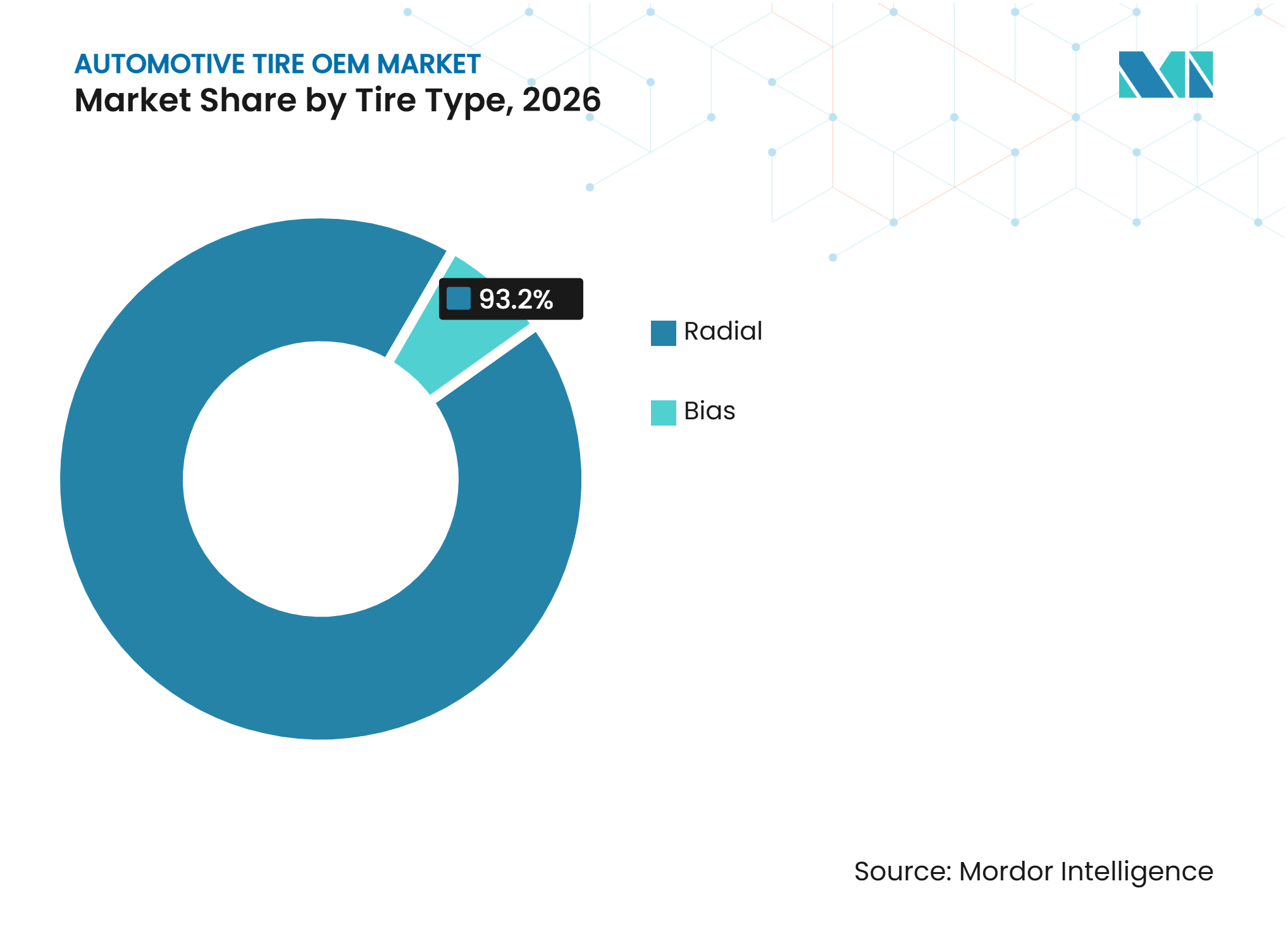
• By tire type, radial tires held 93.17% of the market share in 2026 and are projected to grow at a 5.71% CAGR through 2032.
• By tube type, tubeless tires held 87.56% of the market share in 2026 and are projected to grow at a 5.85% CAGR through 2032.
• By vehicle type, passenger cars held 67.71% of the market in 2026, while two-wheelers are forecast to expand at a 5.93% CAGR through 2032.
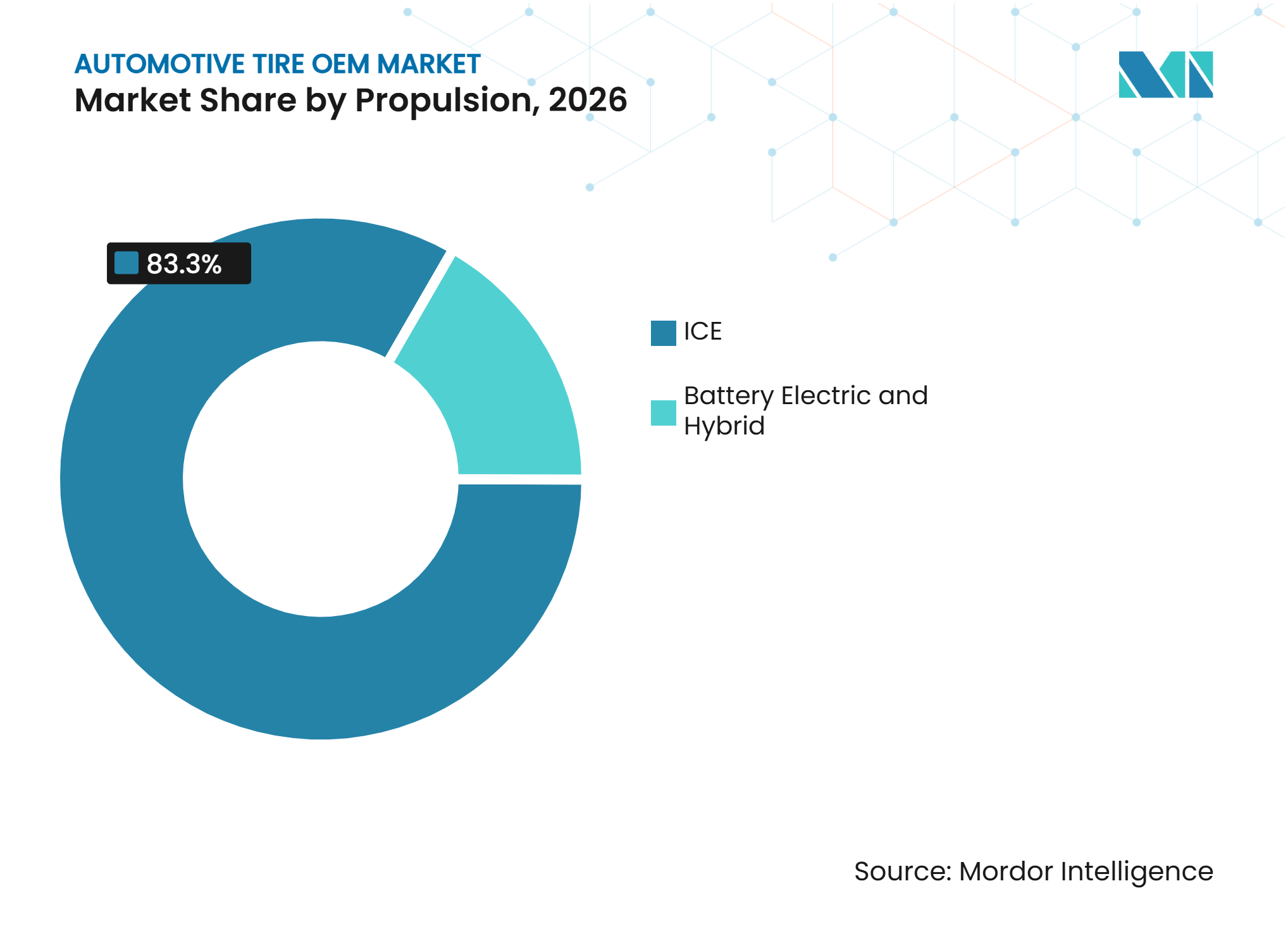
• By propulsion, ICE tires held 83.25% of the market in 2026, while Battery Electric Vehicle and hybrid tires are forecast to grow at a 6.05% CAGR through 2032.
• By rim size, the 16 to 18-inch category held 41.27% of the market in 2026, while above 21-inch tires are forecast to grow at a 6.11% CAGR through 2032.
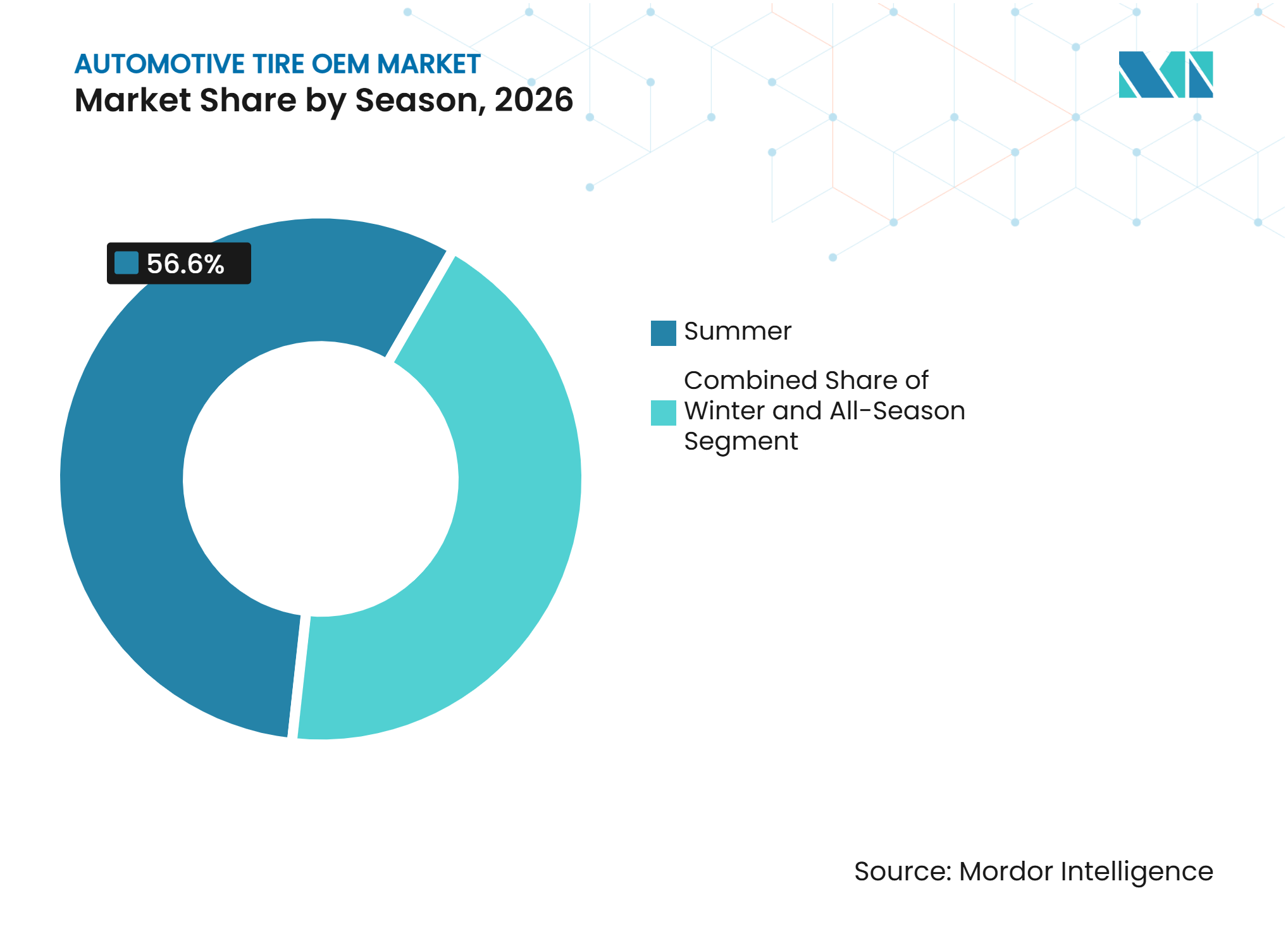
• By season, summer tires held 56.57% of the market in 2026, while winter tires are forecast to grow at a 6.01% CAGR through 2032.
• By technology, standard tires held 83.11% of the market in 2026, while sensor-embedded tires are forecast to grow at a 5.91% CAGR through 2032.
• By geography, Asia-Pacific held 45.64% of the market share in 2026, while South America is forecast to grow at a 6.15% CAGR through 2032.
Note: Market numbers in this report are based on Mordor Intelligence's proprietary estimation framework, which combines nine months of actuals with Q4 projections for base year 2026.
Market Trends and Insights
Drivers Impact Analysis of Automotive Tire OEM Market*
| Driver | (~) % Impact on CAGR Forecast | Geographic Relevance | Impact Timeline |
|---|---|---|---|
| Rising Battery Electric Vehicle and Hybrid Vehicle Fitment Demand | +1.0% | Global core; EMEA and China leading BEV adoption; North America accelerating | Long term (≥ 4 years) |
| Growth in Global Vehicle Production and New Vehicle Registrations | +0.9% | Global, with key volume gains in India, Southeast Asia, and recovering EU production centers | Short term (≤ 2 years) |
| OEM Adoption of Low Rolling Resistance and Energy-Efficient Tires | +0.8% | EU regulatory primacy; strong pull from Chinese NEV OEMs; North America SUV and truck segments | Medium term (2–4 years) |
| Increasing Premium, Performance and Vehicle-Specific Tire Fitment | +0.7% | North America, Europe, and China premium vehicle segments | Medium term (2–4 years) |
| Shorter EV Platform Cycles Increasing Tire Nomination Opportunities | +0.6% | China (fastest new EV model launch cadence globally), EU second wave | Short term (≤ 2 years) |
| OEM Dual-Sourcing and Localized Supply Strategies | +0.5% | North America (tariff-driven nearshoring), APAC supply base expansion | Short term (≤ 2 years) |
| Source: Mordor Intelligence | |||
Rising Battery Electric Vehicle and Hybrid Vehicle Fitment Demand
Battery Electric Vehicle and hybrid programs are changing tire selection from a largely standardized purchase into a vehicle-specific engineering decision. These vehicles require tires that manage higher mass, rapid torque delivery, and lower cabin noise without reducing range or handling performance. Tire pressure monitoring requirements in the United States, Europe, and China also support factory-fit systems that combine tires with vehicle electronics [1]. Hyundai Motor Group and Michelin signed their third memorandum of understanding in November 2025 to develop extreme-low rolling resistance and SmartGrip tire technologies for future mobility programs [2]. This form of collaboration places the tire supplier earlier in the vehicle development cycle and makes technical approval more difficult to replace. It also gives qualified suppliers a path to higher-value fitments as automakers broaden their electric vehicle portfolios.
OEM Adoption of Low Rolling Resistance and Energy-Efficient Tires
Low rolling resistance is becoming a central selection criterion because tire efficiency affects vehicle energy consumption and usable electric range. Continental reported that it reduced rolling resistance across its passenger car tire portfolio by an average of 15% over the prior decade [3]. Tire performance is increasingly assessed alongside the vehicle’s powertrain, aerodynamics, and battery system. Suppliers with validated compounds and testing methods can become part of an automaker’s engineering process rather than simply responding to a tire specification. This raises the importance of product development capacity, testing expertise, and vehicle-level data, making price alone less decisive in OEM nominations.
Shorter EV Platform Cycles Increasing Tire Nomination Opportunities
Faster electric vehicle product cycles are creating more frequent tire nomination opportunities, particularly in China. Each new model requires validation of tire construction, compounds, load capacity, noise performance, and rolling resistance against vehicle-level requirements. Continental stated that its virtual tire development tools can save up to 10,000 physical test tires each year. Toyo Tire introduced its THiiiNK technology framework in October 2025 to bring sensor integration, data linkage, and digital simulation into a more unified development process. Faster development can help suppliers meet compressed launch schedules while reducing physical testing needs. The advantage rests on the ability to provide dependable co-development support across repeated model launches.
OEM Dual-Sourcing and Localized Supply Strategies
Automakers are placing more emphasis on regional supply security because tariffs and cross-border disruptions can interrupt tire deliveries to assembly plants. Regional capacity is being expanded to support more local supply to vehicle plants. Local production can shorten delivery lead times and improve coordination with vehicle assembly schedules. It can also reduce exposure to future changes in trade policy. These benefits make regional capacity a competitive consideration beyond its role in avoiding import costs, particularly when vehicle makers need close coordination between tire plants, logistics teams, and assembly operations.
Restraints Impact Analysis of Automotive Tire OEM Market*
| Restraint | (~) % Impact on CAGR Forecast | Geographic Relevance | Impact Timeline |
|---|---|---|---|
| Volatility in Natural Rubber, Synthetic Rubber, Steel and Energy Costs | -0.8% | Global; production impact most severe in APAC-based tire manufacturing centers | Short term (≤ 2 years) |
| Cyclicality of Global Vehicle Production | -0.6% | Global, most acute in EU and Japan where production plateaued in 2025–2026 | Short term (≤ 2 years) |
| OEM Pricing Pressure and Long-Term Contract Margin Compression | -0.5% | Global; most intense in China where OEM vehicle price competition drives supplier squeeze | Long term (≥ 4 years) |
| Extended Homologation Timelines for Sensor-Embedded and Acoustic Tires | -0.4% | EU, North America — markets with most rigorous compliance requirements for connected and acoustic systems | Medium term (2–4 years) |
| Source: Mordor Intelligence | |||
Volatility in Natural Rubber, Synthetic Rubber, Steel and Energy Costs
Raw material price changes remain a major risk for tire suppliers because rubber compounds depend on natural rubber, synthetic rubber, carbon black, steel, and energy. Changes in the relative cost of natural and synthetic rubber can require suppliers to reconsider compound formulations, sourcing plans, procurement contracts, and the operational balance between cost control and product performance. Those changes can introduce engineering work and affect factory planning. Long-term OEM contracts may limit the speed at which tire suppliers recover unexpected input-cost increases. This makes procurement discipline and flexible manufacturing important to profitability in the automotive tire OEM market.
Extended Homologation Timelines for Sensor-Embedded and Acoustic Tires
Sensor-embedded and acoustic tires can require broader validation than conventional products because they affect connected vehicle systems, noise performance, and tire behavior. Pirelli’s Cyber Tire technology uses sensors within the tire and is designed to communicate with vehicle systems in real time. Longer approval processes can increase development costs before a supplier earns revenue from an OEM nomination. They may also delay the use of new tire technologies on mass-market platforms. Regulatory requirements for connected systems add to the testing burden in major vehicle markets. Suppliers that combine product engineering with regulatory capability are better placed to manage this constraint.
*Our forecasts treat driver/restraint impacts as directional, not additive. The impact forecasts reflect baseline growth, mix effects, and variable interactions.
Automotive Tire OEM Market Segment Analysis
By Tire Type:
Radial Construction Sustains Structural DominanceRadial tires held 93.17% of the automotive tire OEM market share in 2026 and are expected to grow at a 5.71% CAGR through 2032. This position reflects the long-standing suitability of radial construction for passenger cars, commercial vehicles, and electric vehicles. Radial designs support consistent road contact, durability, and the higher load requirements associated with new vehicle platforms. Automakers also use radial tires across a broad set of rim sizes and vehicle segments, which gives suppliers scale in development and manufacturing. Bias tires remain relevant in selected agricultural, off-road, and entry-level two-wheeler applications where operating conditions and cost priorities differ. Their narrower use limits their role in mainstream OEM vehicle programs.
Electric vehicle programs reinforce the shift toward radial tires because these vehicles need load capability, controlled noise, and efficient rolling behavior. Continental’s EcoContact 7, Michelin’s high-load offerings, and Hankook’s iON products illustrate the radial products being developed for electric vehicle applications. Vehicle makers can specify low-profile sidewalls, optimized contact patches, and higher load indexes within radial tire designs. These technical requirements leave limited opportunity for bias construction in new passenger vehicle nominations, especially where electric vehicle load, noise, and efficiency targets are closely defined. Tire makers are consequently concentrating development resources on radial compounds and structures. In the automotive tire OEM industry, radial capacity is aligned with the core growth opportunity, while bias capacity serves specialized demand.



By Tube Type:
Tubeless Fitment Signals Product UpgradingTubeless tires accounted for 87.56% of the market share in 2026 and are projected to expand at a 5.85% CAGR through 2032. Their established position reflects their use across passenger cars, motorcycles, and many commercial vehicle applications. Automakers value tubeless fitments for their compatibility with modern wheel designs and tire pressure monitoring systems. The format also supports product differentiation in vehicle categories where safety, reliability, and ease of use influence buyer expectations. Tube-type tires remain present in entry-level two-wheelers and certain commercial applications in price-sensitive markets. However, broader quality upgrading reduces their relevance in new vehicle programs.
The transition is also moving toward functional tubeless products rather than a simple replacement of one format with another. Continental’s ContiSeal technology received factory-fit approval on the Cadillac OPTIQ and Chevrolet Equinox EV, showing how self-sealing solutions can support vehicle safety and warranty objectives. Tubeless construction provides a platform for such added functionality, including sensor compatibility and puncture-response features. In India, premiumization in passenger vehicles and two-wheelers is also supporting the movement toward higher-specification fitments. Suppliers with integrated wheel, tire, and monitoring capabilities can address this demand more effectively. The result is that tubeless tires retain both the current scale and the faster growth profile within this segmentation.
By Vehicle Type:
Passenger Cars Lead While Two-Wheelers ExpandPassenger cars held 67.71% of the automotive tire OEM market size in 2026, while two-wheelers are forecast to grow at a 5.93% CAGR through 2032. Within the automotive tire OEM market, passenger cars require multiple tires per vehicle and receive regular model updates, which supports large and recurring OEM demand. Their broad range also allows tire suppliers to sell products across standard, premium, electric, and sport utility vehicle applications. Two-wheelers are growing from a lower base as motorcycle and scooter production expands in key emerging markets. This growth is linked to urban mobility needs, improving incomes, and continued investment in road infrastructure. The segment therefore offers volume growth even when passenger car output is uneven.
Passenger car requirements are becoming more specific as automakers place greater emphasis on electric range, cabin refinement, and vehicle styling. These needs support premium and specialized tires, especially for SUVs and electric vehicles. Light commercial and medium and heavy commercial vehicle demand is supported by logistics activity in Asia-Pacific and South America. By contrast, off-the-road and agricultural tire demand can be more exposed to farm income and equipment cycles. The automotive tire OEM market consequently combines a large passenger car base with targeted growth pockets in two-wheelers and selected commercial applications. Suppliers need product portfolios that address both high-volume fitments and specialized vehicle requirements without sacrificing consistent quality, delivery performance, or cost discipline across production locations.
By Propulsion:
Battery Electric and hybrid Fitment Raises Product ValueICE tires held 83.25% of the market in 2026, while Battery Electric Vehicle and hybrid tires are set to grow at a 6.05% CAGR through 2032. Within the automotive tire OEM industry, ICE and hybrid vehicles remain important because they account for a large share of current vehicle production. Hybrid vehicles also require tires that balance load capacity with fuel efficiency and low rolling resistance. Battery Electric Vehicle programs are growing faster because their technical needs differ from conventional vehicle requirements. Tire suppliers must address added vehicle mass, instantaneous torque, and quiet cabins. These factors support the use of purpose-designed compounds and constructions.
European emissions requirements and Chinese new energy vehicle range considerations make rolling resistance an important part of vehicle design. This places tire efficiency within the broader process of vehicle certification and product positioning. Giti Tire has received OEM nominations for the BYD Sealion 7, iCar 03, and Deepal S07, which shows how electric vehicle fitments can help suppliers develop OEM credentials. The automotive tire OEM market size for Battery Electric Vehicle fitments is therefore growing through both increasing vehicle production and higher technical content per tire. Hybrid demand provides a transition path because it also requires efficiency-focused tire specifications. Suppliers that can meet these performance requirements are positioned to gain opportunities across both propulsion categories.

By Rim Size:
Larger Sizes Raise the Value of Factory FitmentThe 16 to 18-inch category held 41.27% of the market in 2026, while above 21-inch tires are forecast to grow at a 6.11% CAGR through 2032. Within the automotive tire OEM market, the 16 to 18-inch range remains central to compact and midsize passenger vehicle production in markets including Germany and India. Above 21-inch tires are growing as electric SUVs and premium vehicles enter production with larger factory wheel specifications. Larger tires require detailed design work around load capacity, handling, noise, range, and appearance. This raises the value of the tire as part of the vehicle package. The pattern also supports revenue growth even if total vehicle output does not rise at the same pace.
Continental received several large-rim original-equipment approvals for electric vehicles, including the Volkswagen ID.7 and Cadillac models. Those approvals show the direct connection between larger wheel packages and electric vehicle product planning. The 19 to 21-inch range also benefits as mid-premium vehicles move beyond earlier 17 to 18-inch standards. Up to 15-inch tires face a less favorable outlook as entry-level vehicles adopt more advanced wheel and tire packages. Suppliers need to match manufacturing capacity with changing rim-size demand. This makes rim-size coverage an important measure of readiness for the automotive tire OEM market.
By Season:
Winter Tires Benefit from Electric Vehicle RequirementsSummer tires held 56.57% of the market in 2026, while winter tires are forecast to grow at a 6.01% CAGR through 2032. Within the automotive tire OEM market, summer tire demand is supported by vehicle production in Asia, Latin America, and Southern Europe, where seasonal conditions favor these products. Winter tires have a smaller base but are gaining relevance for electric vehicles in colder markets. Cold weather can affect electric vehicle range, which makes traction and rolling performance an important part of vehicle use. Automakers must therefore evaluate winter tires as part of the wider ownership experience. This supports new winter tire nominations in Nordic and Central European markets.
Nokian Tires became the official winter tire supplier for the Rivian R1 platform in North America in December 2025 with the Hakkapeliitta R5 SUV. Continental also received factory approvals for Ford’s Explorer and Capri electric SUVs across summer and all-season fitments. These examples show that automakers may use seasonal fitments to balance regional needs and vehicle efficiency. All-season tires provide another option where year-round usability is a priority. The automotive tire OEM market is thus becoming more tailored to climate, vehicle type, and regional operating conditions. Tire makers with a broad seasonal portfolio can respond to these different requirements.
By Technology:
Sensor-Embedded Tires Move Beyond Premium NichesStandard tires held 83.11% of the market in 2026, while sensor-embedded tires are projected to grow at a 5.91% CAGR through 2032. Standard products continue to dominate because they supply the large volume of mainstream passenger and commercial vehicle programs. Specialty products include run-flat, low rolling resistance, acoustic, and sensor-embedded tires. Their share remains smaller, but their role in OEM development is increasing as vehicles become more connected and electrified. Sensor-embedded tires can provide data that supports tire pressure, traction, and vehicle-system functions. This gives them stronger relevance in premium and technology-focused vehicle platforms.
Pirelli has agreed with Aston Martin to integrate Cyber Tire technology into future vehicles, using sensors that communicate with vehicle architecture. Bosch has also introduced a Bluetooth-based tire pressure sensor designed for long-life monitoring applications. These developments indicate that tire data can become a more visible part of vehicle safety and user experience. The technology must still meet requirements for durability, system integration, and regulatory approval. This creates an advantage for suppliers with strong electronics and software partnerships, particularly when automakers require reliable integration with safety and vehicle-control systems. Specialty tires are therefore moving from a premium feature toward broader OEM consideration.
Geography Analysis
Asia-Pacific: Production Scale and Faster Nomination Cycles
Asia-Pacific held 45.64% of the automotive tire OEM market share in 2026. The region combines major vehicle assembly activity in China, India, Japan, South Korea, Thailand, and Indonesia. China has a fast-moving electric vehicle landscape that requires suppliers to respond quickly to new model launches and changing automaker priorities. India provides a large opportunity in passenger vehicles and two-wheelers, while Southeast Asia combines manufacturing capacity with growing regional vehicle demand. Local investment in passenger vehicle tire production indicates that India is strategically important for regional supply planning and for meeting the varied needs of local vehicle programs. The automotive tire OEM market benefits from the region’s range of vehicle types, from cost-sensitive two-wheelers to premium electric vehicles.
South America: Recovering OEM Demand and Export-Oriented Production
South America is forecast to grow at a 6.15% CAGR through 2032, the fastest rate among the geographic segments. Brazil is central to this outlook because it has an established vehicle manufacturing base and a large domestic market. This pattern suggests that original-equipment activity can improve even when replacement demand faces more difficult conditions. The region’s assembly plants also serve export markets, helping meet consistent tire supply requirements. These conditions give the automotive tire OEM market a different growth profile from the replacement channel.
Europe, North America, Middle East, and Africa: Regulation, Localization, and New Assembly Hubs
Europe faces uneven vehicle production, but electric vehicle programs create demand for technically qualified tire suppliers in the automotive tire OEM market, especially where performance approval is exacting. Continental supplied original-equipment tires to all 10 of the highest-volume electric vehicle manufacturers in EMEA in 2025. European automakers place emphasis on rolling resistance, wet grip, noise, and tire pressure monitoring performance. These requirements are reinforced by the EU tire label and General Safety Regulation, which influence product testing and vehicle approval. The region gives suppliers with advanced compounds, acoustic technology, and established co-engineering relationships a path to premium nominations. Continental and Volkswagen developed a concept tire for the Mission Efficiency vehicle in October 2026, demonstrating the role of tire-vehicle co-development in extending electric vehicle range. The European segment remains important because technical requirements can be as influential as production volume.
Competitive Landscape
Market Concentration

The automotive tire OEM market is moderately concentrated, with Michelin, Bridgestone, Continental, Goodyear, and Pirelli collectively holding the majority of global share. Their position is strongest where electric vehicle programs require extensive technical qualification, long co-engineering relationships, consistent global manufacturing quality, and the ability to support programs across several production locations. Competition centers on tire efficiency, load capability, acoustic performance, digital development tools, and the range of available rim sizes. Large suppliers can spread research, testing, and regional manufacturing costs across global vehicle programs. Continental was re-elected as co-chair of the Tire Industry Project through 2029, alongside major industry participants, which supports its role in sustainability and traceability discussions. These capabilities make it harder for smaller suppliers to compete only on price because approval decisions also reflect technical depth, testing records, local production coverage, and ongoing engineering support.
Leading companies are using specific OEM projects to demonstrate their engineering depth. Continental and Renault presented the EcoContact 7 development program in June 2026, focusing on lower rolling resistance for electric mobility. Hyundai Motor Group and Michelin agreed in November 2025 to continue work on tire technologies for future mobility, including low rolling resistance and SmartGrip. Pirelli and Aston Martin also agreed to integrate Cyber Tire technology into future vehicles, with tire data becoming part of the vehicle system. These moves show that leading suppliers are competing through embedded engineering roles, verified performance, and continuing systems support rather than through supply scale alone. They also strengthen switching costs after an automaker approves a tire for a vehicle platform.
Chinese suppliers including Linglong, Sailun, and Giti are seeking to strengthen their international credentials through domestic electric vehicle nominations in the automotive tire OEM market, where local successes can support overseas discussions. Giti’s fitments on electric vehicle platforms and its BMW iX1 and iX2 nominations show how targeted approvals can establish a stronger position with global automakers. Smaller suppliers may find openings in affordable electric vehicle tires and sensor-ready products for commercial fleets. However, regulatory requirements around connected systems, material sourcing, and end-of-life tire management can raise entry barriers. Larger suppliers have an advantage in compliance, validation, and global production coverage.
Automotive Tire OEM Industry Leaders
-
Bridgestone Corporation
-
The Goodyear Tire and Rubber Company
-
The Yokohama Rubber Co., Ltd.
-
Pirelli and C. S.p.A.
-
Sumitomo Rubber Industries, Ltd.
- *Disclaimer: Major Players sorted in no particular order
Automotive Tire OEM Market Companies Covered in this Report
- Michelin
- Bridgestone Corporation
- The Goodyear Tire and Rubber Company
- Continental AG
- Pirelli and C. S.p.A.
- Sumitomo Rubber Industries, Ltd.
- Hankook Tire and Technology Co., Ltd.
- The Yokohama Rubber Co., Ltd.
- Toyo Tire Corporation
- Kumho Tire Co., Inc.
- Nokian Tyres plc
- Giti Tire Pte. Ltd.
- Apollo Tyres Ltd.
- MRF Limited
- CEAT Limited
- JK Tyre and Industries Limited
- Zhongce Rubber Group Co., Ltd.
- Shandong Linglong Tire Co., Ltd.
- Sailun Group Co., Ltd.
- Nexen Tire Corporation
Recent Industry Developments in Automotive Tire OEM Market
- October 2026: Continental, in collaboration with Volkswagen, developed a bespoke concept tire for the Mission Efficiency record-breaking EV, achieving rolling resistance of 4.9 kg per metric ton, approximately 25% below the EU tire label’s highest Class A rating, enabling a 1,278 km journey on a single charge. The project demonstrates the range uplift achievable through tire-vehicle co-engineering beyond what standard production compounds can deliver.
- July 2026: Yokohama Rubber began supplying its ADVAN Sport V107 tire as original equipment on the new BMW iX3, extending its premium electric vehicle fitments in Europe.
- March 2026: Continental confirmed it supplied original-equipment tires to all 10 highest-volume EV manufacturers in EMEA in 2025 and 17 of the world’s 20 highest-volume EV makers globally, with named manufacturers including BYD, Volkswagen, Stellantis, BMW, NIO, Hyundai, and Renault.
- November 2025: Hyundai Motor Group and Michelin signed their third MOU, covering joint research and development of extreme-low rolling resistance tires, SmartGrip braking technology, and virtual off-road tire development systems over a 3-year collaboration framework.
Global Automotive Tire OEM Market Report Scope
The scope of the report includes Tire Type (Radial, Bias), Tube Type (Tubeless, Tube-Type), Vehicle Type (Passenger Cars, LCV, M&HCV, Two-Wheelers, OTR), Propulsion (ICE and Hybrid, BEV), Rim Size (Up to 15, 16-18, 19-21, >21 Inches), Season (Summer, Winter, All-Season), Technology (Standard, Specialty), Geography (North America, South America, Europe, Asia-Pacific, MEA). Forecasts: Value (USD) and Volume (Units).
Segmentation Overview
| Radial |
| Bias |
| Tubeless |
| Tube-Type |
| Passenger Cars | Hatchback |
| Sedan | |
| SUV | |
| Light Commercial Vehicles | |
| Medium and Heavy Commercial Vehicles | |
| Two-Wheelers | |
| OTR and Agricultural |
| ICE |
| Battery Electric and Hybrid |
| Up to 15 Inches |
| 16 to 18 Inches |
| 19 to 21 Inches |
| Above 21 Inches |
| Summer |
| Winter |
| All-Season |
| Standard | |
| Specialty | Run-Flat |
| Low Rolling Resistance | |
| Acoustic | |
| Sensor-Embedded |
| North America | United States |
| Canada | |
| Mexico | |
| South America | Brazil |
| Argentina | |
| Chile | |
| Rest of South America | |
| Europe | Germany |
| France | |
| United Kingdom | |
| Italy | |
| Spain | |
| Russia | |
| Rest of Europe | |
| Asia-Pacific | China |
| India | |
| Japan | |
| South Korea | |
| Thailand | |
| Indonesia | |
| Australia | |
| Rest of Asia-Pacific | |
| Middle East and Africa | Middle East |
| Saudi Arabia | |
| United Arab Emirates | |
| Turkey | |
| Iran | |
| Rest of Middle East | |
| Africa | |
| South Africa | |
| Egypt | |
| Morocco | |
| Rest of Africa |
| By Tire Type | Radial | |
| Bias | ||
| By Tube Type | Tubeless | |
| Tube-Type | ||
| By Vehicle Type | Passenger Cars | Hatchback |
| Sedan | ||
| SUV | ||
| Light Commercial Vehicles | ||
| Medium and Heavy Commercial Vehicles | ||
| Two-Wheelers | ||
| OTR and Agricultural | ||
| By Propulsion | ICE | |
| Battery Electric and Hybrid | ||
| By Rim Size | Up to 15 Inches | |
| 16 to 18 Inches | ||
| 19 to 21 Inches | ||
| Above 21 Inches | ||
| By Season | Summer | |
| Winter | ||
| All-Season | ||
| By Technology | Standard | |
| Specialty | Run-Flat | |
| Low Rolling Resistance | ||
| Acoustic | ||
| Sensor-Embedded | ||
| By Geography | North America | United States |
| Canada | ||
| Mexico | ||
| South America | Brazil | |
| Argentina | ||
| Chile | ||
| Rest of South America | ||
| Europe | Germany | |
| France | ||
| United Kingdom | ||
| Italy | ||
| Spain | ||
| Russia | ||
| Rest of Europe | ||
| Asia-Pacific | China | |
| India | ||
| Japan | ||
| South Korea | ||
| Thailand | ||
| Indonesia | ||
| Australia | ||
| Rest of Asia-Pacific | ||
| Middle East and Africa | Middle East | |
| Saudi Arabia | ||
| United Arab Emirates | ||
| Turkey | ||
| Iran | ||
| Rest of Middle East | ||
| Africa | ||
| South Africa | ||
| Egypt | ||
| Morocco | ||
| Rest of Africa | ||
Key Questions Answered in the Report
What is the projected value of automotive OEM tires by 2032?
The value is projected to reach USD 94.95 billion by 2032, following a 4.62% CAGR from 2027.
Which tire construction leads factory-fit demand?
Radial tires lead with a 93.17% share in 2026 and are also forecast to grow at a 5.71% CAGR through 2032.
Why are electric vehicles changing tire specifications?
Electric vehicles require tires that manage higher loads, rapid torque, lower noise, and energy efficiency, increasing the need for specialized fitments.
Which geography is expected to grow fastest through 2032?
South America is forecast to grow at a 6.15% CAGR, supported by recovering vehicle production and OEM demand in Brazil.
What tire technologies are gaining importance for automakers?
Low rolling resistance, acoustic, self-sealing, and sensor-embedded tires are gaining importance as vehicles become more electric and connected.
How concentrated is supplier competition?
The market concentration score is 6 out of 10 because the top 5 suppliers hold over 60% combined share, while regional competitors retain meaningful opportunities.