
Automotive Pillar Market Size and Share
Market Overview
| Study Period | 2020 - 2032 |
|---|---|
| Market Size (2027) | USD 9.82 Billion |
| Market Size (2032) | USD 12.15 Billion |
| Growth Rate (2027 - 2032) | 4.35 % |
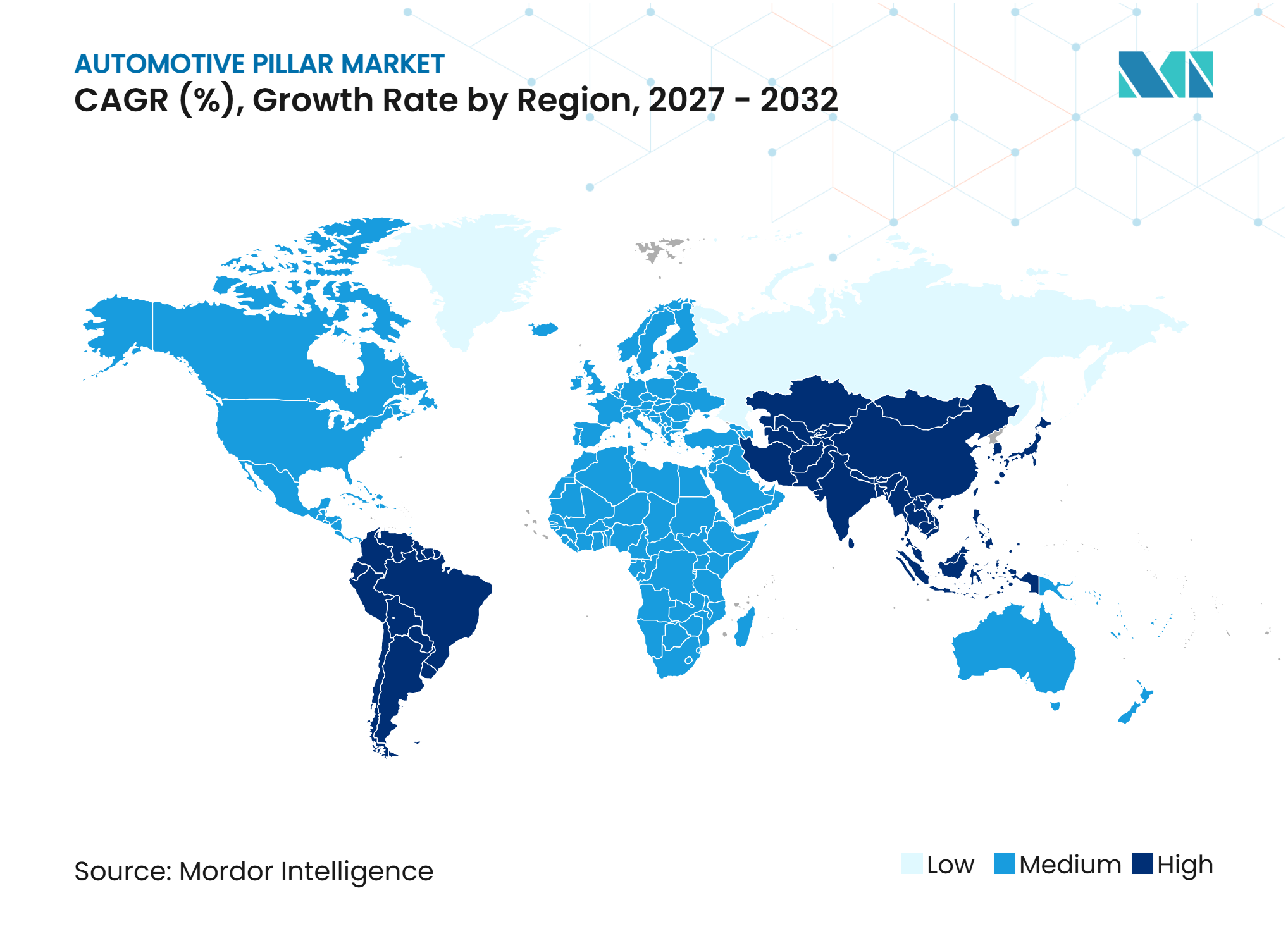
| Fastest Growing Market | South America |
| Largest Market | Asia-Pacific |
| Market Concentration | Medium |
Major Players *Disclaimer: Major Players sorted in no particular order Image © Mordor Intelligence. Reuse requires attribution under CC BY 4.0. | |
Automotive Pillar Market Analysis by Mordor Intelligence
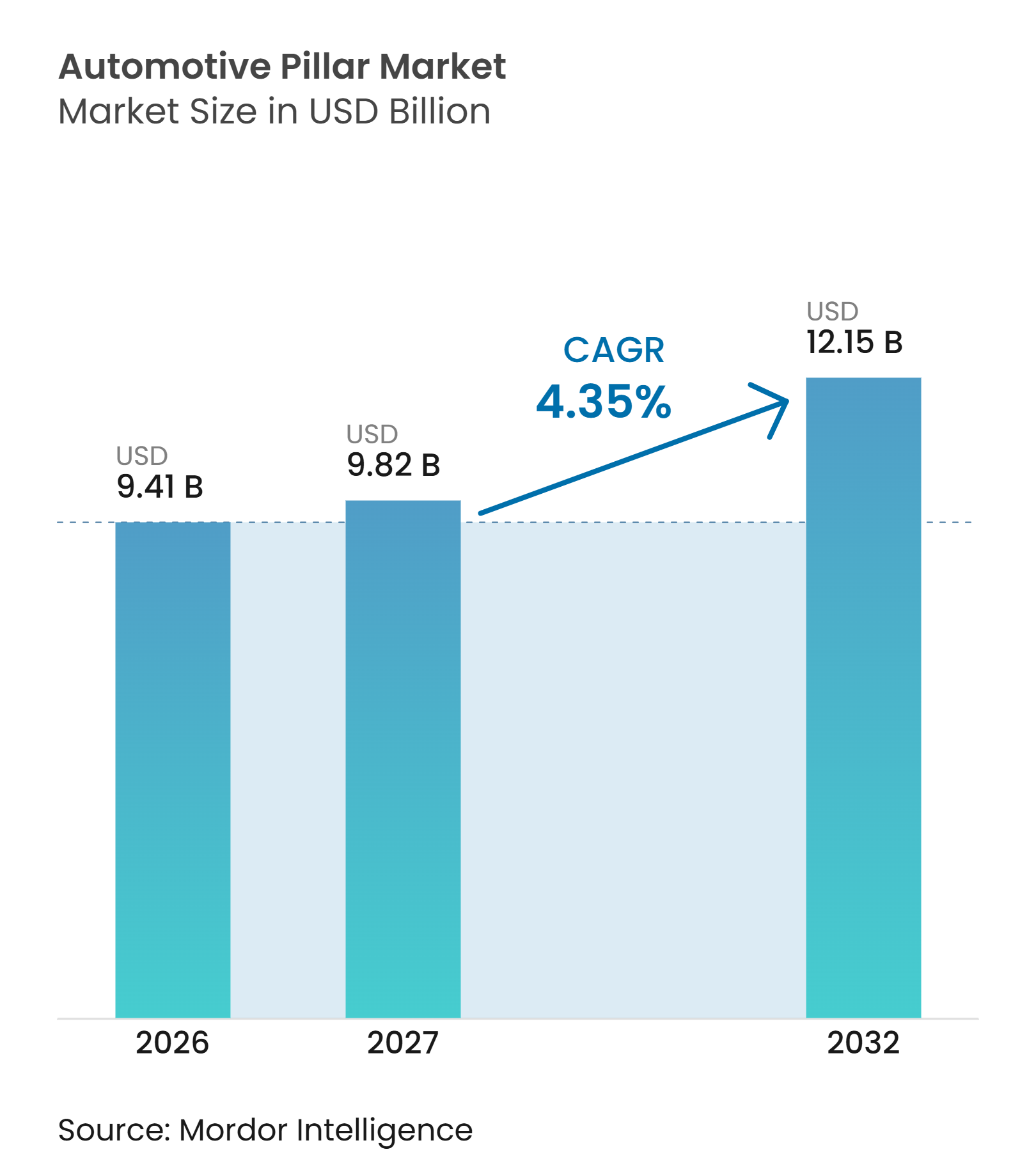
The automotive pillar market size was valued at USD 9.41 billion in 2026, is estimated at USD 9.82 billion in 2027, and is projected to reach USD 12.15 billion by 2032, growing at a CAGR of 4.35% from 2027 to 2032. Stricter side-impact and roof-crush requirements are raising the structural performance expected from vehicle pillars. Electrified platforms also increase the value of light, high-strength pillar systems because battery packs change vehicle weight and crash loading. Suppliers with hot stamping, tailored blanking, joining, and module assembly capabilities are better placed to meet these requirements. One-piece door-ring designs are moving program volume toward suppliers with large-format press capacity, while multi-material structures add joining, recycling, and validation challenges. The automotive pillar market therefore combines stable structural demand with rising technology requirements, although capital commitments can pressure supplier margins.
Key Report Takeaways
-
By pillar type, B-Pillar held a 39.21% share in 2026, while A-Pillar is projected to grow at a 7.11% CAGR through 2032.
-
By material, High-Strength Steel held a 72.39% share in 2026, while Composites are projected to grow at a 6.87% CAGR through 2032.
-
By manufacturing process, Hot Stamping accounted for 55.73% of the market in 2026, while Other Processes are projected to grow at a 7.02% CAGR through 2032.
-
By component, Structural Reinforcement held an 83.11% share in 2026, while Pillar Trim/Garnish is projected to grow at a 7.36% CAGR through 2032.
-
By vehicle type, Passenger Cars held a 75.84% share in 2026, while Heavy Commercial Vehicles are projected to grow at a 7.45% CAGR through 2032.
-
By sales channel, OEM held a 72.28% share in 2026, while Aftermarket is projected to grow at a 6.98% CAGR through 2032.
-
By geography, Asia-Pacific held a 44.87% share in 2026, while South America is projected to grow at a 6.21% CAGR through 2032.
Note: Market numbers in this report are based on Mordor Intelligence's proprietary estimation framework, which combines nine months of actuals with Q4 projections for base year 2026.
Market Trends and Insights
Drivers Impact Analysis of Automotive Pillar Market*
| Driver | (~) % Impact on CAGR Forecast | Geographic Relevance | Impact Timeline |
|---|---|---|---|
| Stricter Side-Impact and Roof-Crush Performance Requirements | +1.2% | Global, with strongest relevance in Europe, North America, and India | Short term (≤ 2 years) |
| EV Weight and Range Optimization | +0.9% | Global, led by China and South Korea, followed by Europe | Medium term (2-4 years) |
| Expansion of Hot-Stamped UHSS Door Rings | +0.8% | Asia-Pacific and North America, extending to Middle East and Africa | Medium term (2-4 years) |
| Higher ADAS and Occupant-Protection Packaging Content | +0.5% | Europe and North America, followed by Asia-Pacific | Long term (≥ 4 years) |
| Regionalization of Structural Supply Chains | +0.5% | India, ASEAN, Mexico, and South America | Medium term (2-4 years) |
| Pillar-Based Visibility and Sensing Integration | +0.4% | Europe, North America, and East Asia | Long term (≥ 4 years) |
| Source: Mordor Intelligence | |||
Stricter Side-Impact and Roof-Crush Performance Requirements
Euro NCAP’s 2026 protocol revision raises the structural engineering requirements applied to every pillar type. The Crash Protection stage includes a 60 km/h near-side barrier test using an Advanced European Mobile Deformable Barrier. It also includes pole testing and far-side sled evaluation across a broad range of occupant body sizes. These procedures heighten attention on structural areas around the windshield. In May 2025, NHTSA proposed consolidating roof-crush requirements under FMVSS 216a for vehicles below 2,722 kg. The proposal requires resistance equal to 3 times a vehicle’s curb weight, reinforcing demand for press-hardened A-pillar and B-pillar structures.
EV Weight and Range Optimization
Electric vehicle battery packs typically add 300 kg to 600 kg to a vehicle platform. This additional mass increases the importance of intrusion resistance during demanding crash events. Electric micro-commercial vehicle B-pillars have demonstrated measurable weight reduction alongside improvements in crash energy absorption and reductions in B-pillar intrusion. Electric platforms support slimmer A-pillar layouts, as they do not require the same front-end packaging as combustion vehicles. However, these smaller sections must still meet roof-crush requirements, which favors higher-grade press-hardened steel. The automotive pillar Industry gains value as higher-grade steel replaces lower-grade solutions in EV programs.
Expansion of Hot-Stamped UHSS Door Rings
One-piece door-ring architectures can replace 4 to 6 separate pillar and sill stampings with a single hot-stamped blank. This design lowers parts count but raises the capital and technical requirements for qualified suppliers. Press-hardened pillars with targeted zones and ductile areas enable controlled energy absorption. Intermediate pre-cooling can create tailored hardness within a single press-hardened stamping, where ductile areas support energy absorption and martensitic areas improve intrusion resistance. The automotive pillar market is rewarding suppliers that combine large-format hot stamping with material and process control. This shift may reduce the number of qualified structural-pillar suppliers on major programs.
Higher ADAS and Occupant-Protection Packaging Content
The A-pillar increasingly supports cameras, radar, and LiDAR systems near its structural cross-section. This creates a design conflict between visibility, sensing hardware, roof-crush performance, and available cabin space. Transparent A-pillar concepts have demonstrated improvements in pedestrian detection angles and extended visibility in intersection scenarios. Bosch has announced an 8-megapixel multi-function camera for production in China from 2026, with a 300-meter recognition range and support for fusion with up to five radar sensors. These requirements favor integrated pillar assemblies with higher design and validation content.
Restraints Impact Analysis of Automotive Pillar Market*
| Restraint | % Impact on CAGR Forecast | Geographic Relevance | Impact Timeline |
|---|---|---|---|
| Capital-Intensive Hot-Stamping and Joining Infrastructure | -0.9% | Global; most acute in Russia, South America, and Southeast Asia | Short term (≤ 2 years) |
| Multi-Material Joining and End-of-Life Recycling Complexity | -0.7% | EU-led; spill-over to North America and APAC | Medium term (2–4 years) |
| Long OEM Validation Cycles and Platform-Specific Tooling | -0.5% | Global; North America and Europe most exposed | Medium term (2–4 years) |
| Constrained Packaging for Slim Pillars and Embedded Electronics | -0.4% | EU and North America first; APAC following | Long term (≥ 4 years) |
| Source: Mordor Intelligence | |||
Capital-Intensive Hot-Stamping and Joining Infrastructure
A press-hardening line requires major investment in furnaces, water-cooled tooling, automation, and laser trimming equipment. The investment occurs before a supplier has a production part to sell. This threshold limits market entry in regions without sufficient OEM program volume. In May 2025, Atom confirmed plans to import hot-stamped structural components from China. The company cited the lack of a domestic producer that could meet volume requirements at an acceptable cost. New structural programs also face OEM validation cycles of 18 months to 36 months. These conditions increase the financial exposure for smaller suppliers in the automotive pillar industry.
Multi-Material Joining and End-of-Life Recycling Complexity
Hybrid B-pillars can pair a press-hardened steel outer panel with a CFRP inner reinforcement. This design reduces weight but adds bonding, curing, inspection, and end-of-life processing requirements. This approach can achieve notable weight reductions, with the process utilizing vacuum-assisted resin transfer molding and adhesive bonding. CFRP does not fit standard automotive shredding flows as readily as conventional steel assemblies, which complicates compliance with European end-of-life vehicle recyclability objectives. This uncertainty can slow composite adoption in high-volume automotive pillar programs.
*Our forecasts treat driver/restraint impacts as directional, not additive. The impact forecasts reflect baseline growth, mix effects, and variable interactions.
Automotive Pillar Market Segment Analysis
By Pillar Type:
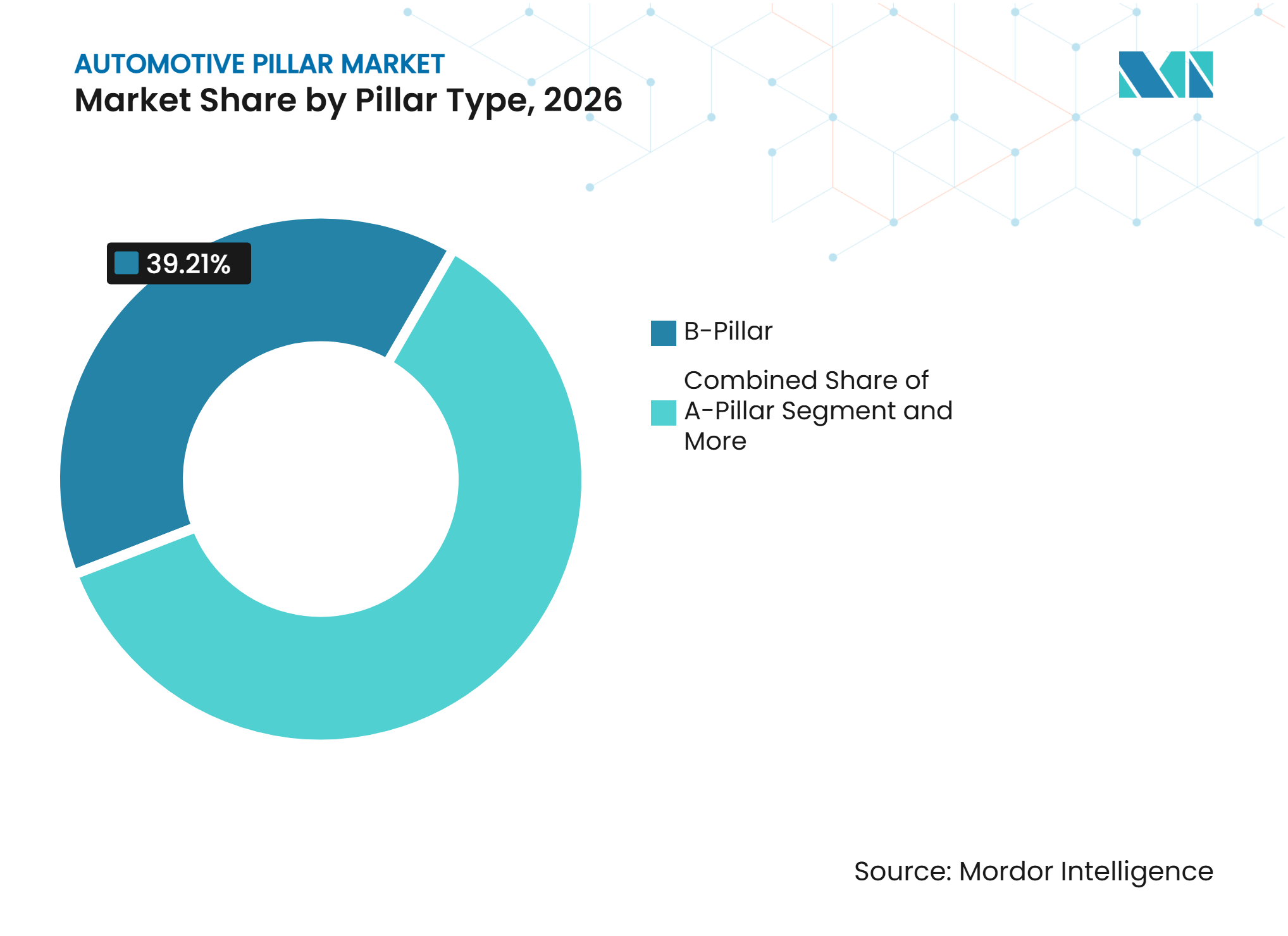
A-Pillar Gains Function Beyond StructureThe B-pillar held a 39.21% share in 2026, reflecting its central role in side-impact protection. Its location between the front and rear doors makes it a primary barrier against passenger-compartment intrusion. Moving-barrier and pole tests place high loads on this component. The B-pillar also commonly carries the highest steel grade and process complexity among vehicle pillars. OEMs increasingly integrate the B-pillar with the sill through laser-welded tailored blanks. This reduces its visibility as a standalone purchasing item but does not reduce the amount of structural steel needed for the completed body structure. The automotive pillar market size associated with B-pillars remains supported by safety requirements across vehicle classes. Door and roof load paths make material selection critical during early vehicle engineering. This keeps B-pillar decisions closely linked to body architecture, crash targets, manufacturing feasibility, and repair requirements across passenger and commercial vehicle platforms.
The A-pillar segment is projected to grow at a 7.11% CAGR through 2032. The segment is moving beyond its historic role as a windshield and roof support, as it must now balance roof-crush stiffness with driver sightlines and sensor packaging. Euro NCAP's 2026 protocol gives greater attention to windshield-area structural behavior. At IAA Mobility 2025, KIRCHHOFF Automotive displayed a Sibora high-strength steel A-pillar developed for the Porsche Panamera, along with B-pillars using 2D patch technology. C-pillar and D-pillar demand remains tied to SUV, crossover, and minivan production. Their rear roofline and passenger-protection requirements create sustained demand for steel-intensive structures. These rear pillars also contribute to body stiffness and roof support in larger vehicle bodies. Their designs vary with rear-door configuration, roofline profile, luggage-area geometry, and the protection requirements for rear-seat occupants during a collision.



By Material:
Composites Gain Ground at the Margins of High-Volume ProductionHigh-strength steel held 72.39% of the automotive pillar market share in 2026. Steel remains dominant because it offers weld compatibility, dimensional control, and a competitive cost per unit of strength. The category includes dual-phase steel and press-hardened advanced grades. It is well suited to high-volume vehicle production where throughput and repeatability are priorities. Hot-stamped steel meets demanding structural requirements without the extended curing stages associated with many composites. The material is compatible with established body shop equipment and repair practices. These production advantages support its continued role in automotive pillar programs. Steel suppliers are also developing grades that improve strength while reducing thickness and mass, allowing vehicle engineers to pursue weight reductions without abandoning familiar joining methods. This enables automakers to maintain established production flows while meeting more demanding safety and efficiency requirements.
Composites are projected to grow at a 6.87% CAGR through 2032. Carbon fiber-reinforced polymer (CFRP) and hybrid CFRP-glass fiber reinforcements are most relevant to premium and EV programs. Hybrid composite B-pillars have demonstrated meaningful reductions in weight and improvements in energy absorption compared to steel baselines. Aluminum occupies a middle position between steel and CFRP for selected upper-body and A-pillar applications, and its use is more common where weight targets outweigh higher material costs. Composite adoption remains limited by requirements related to adhesive application, elevated-temperature curing, mechanical fastening, and repair. Mid-volume automakers are evaluating composite reinforcements as costs decline. The automotive pillar market continues to favor steel for broad-volume programs, while composite designs remain more practical where vehicle programs can support higher processing costs. The material decision therefore depends on production volume, target mass, crash performance, repairability, and the maturity of the supplier's joining process.
By Manufacturing Process:
Hydroforming Addresses Slim-Pillar Engineering DemandsHot stamping accounted for 55.73% of the automotive pillar market in 2026. The process achieves tensile strengths of 1,500-2,000 MPa in complex pillar geometries by forming and quenching a steel blank in a single controlled production sequence. This makes it well suited to B-pillars and integrated door rings. The process also supports tailored blank designs with different material behavior across a single component. Hot stamping requires dedicated furnaces, tooling, automation, and quality systems, which raises barriers to entry for new suppliers. Suppliers must control heating, transfer, die quenching, trimming, and dimensional inspection to achieve repeatable output. This operational discipline, combined with an established process base, supports hot stamping's dominant position in the automotive pillar industry and explains why qualified capacity cannot be added quickly after an OEM makes a sourcing decision.
Other processes are projected to grow at a 7.02% CAGR through 2032, led by hydroforming. Hydroforming can form closed hollow sections with tailored wall thicknesses, which is useful for slender A-pillar sections that must carry sensors while meeting roof-crush targets. Internal cavity shaping can be difficult with conventional flat-blank hot stamping. Tailored hardness can also be achieved through an intermediate pre-cooling approach. Cold stamping remains relevant for lower-load C-pillar and D-pillar outer panels, while roll forming serves long sill profiles in integrated body-frame structures. Each process remains applicable where its geometry, volume, and capital profile fit the vehicle program. Hydroforming offers an additional solution in which closed sections and internal spaces are central to the part's function. Process selection also depends on the part's loading requirements, planned volume, joining method, and the vehicle manufacturer's existing body-shop equipment.
By Component:
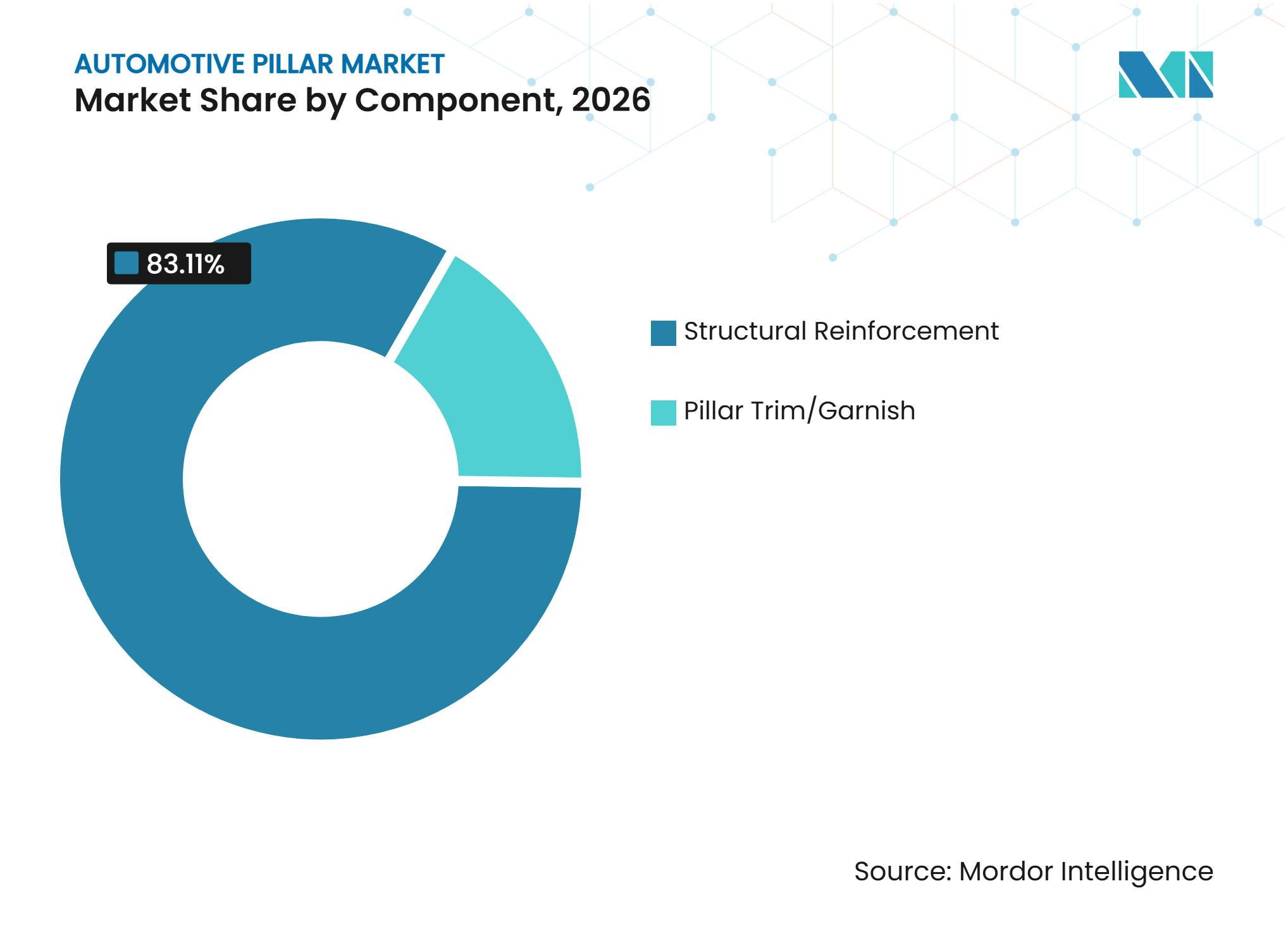
Trim and Garnish Value Rising With EV Interior RedesignStructural Reinforcement held an 83.11% share in 2026. This segment leads because load-bearing performance remains the primary reason OEMs procure pillar systems. Its value comes mainly from UHSS grades and hot-stamping cycles. Structural programs are volume-intensive and face strong cost pressure. Suppliers must meet detailed crash, dimensional, corrosion, and joining standards. Components commonly move through long OEM sourcing cycles. These relationships favor established structural suppliers with program-development experience. The automotive pillar market continues to derive most of its revenue from reinforcement assemblies rather than visible trim. Reinforcement systems must deliver performance repeatedly over long model cycles and varied vehicle configurations. This requirement makes supplier engineering discipline, process consistency, and production capacity important alongside the price of the individual part.
Pillar Trim/Garnish is projected to grow at a 7.36% CAGR through 2032. EV interior redesign is changing these components from simple covers into functional cabin interfaces. New applications include ambient-light channels, wire-harness guides, curtain-airbag deployment slots, and OLED display panels. Removing the combustion-engine firewall can free interior surfaces for new material finishes, expanding the design role of A-pillar and C-pillar trim. Integrated pillar assemblies can increase average selling prices where structural and interior functions are combined. KIRCHHOFF Automotive's 2D patch technology illustrates the movement toward more integrated pillar assemblies. Interior-focused Tier-1 suppliers may therefore compete for work once held mainly by body-structural specialists, bringing new expertise in surfaces, lighting, electronics, and cabin integration. Structural suppliers remain important because trim design must accommodate crash loads, airbag deployment, attachment systems, and repair access.

By Vehicle Type:
Fleet Safety Mandates Lift Commercial Pillar SpecificationsPassenger Cars held a 75.84% share in 2026. They remain the largest source of pillar production because of their global manufacturing volumes. Passenger vehicles also continue to adopt higher-grade side-impact and roof-crush structures. Shared architectures extend these design choices into related light commercial models. The scale of passenger-car platforms supports dedicated hot-stamping investment. Program volumes can justify specialized tooling and highly automated production. EV passenger-car designs add battery, wiring, and sensor requirements to pillar engineering. The automotive pillar market remains anchored by passenger-car demand through 2032.
Heavy Commercial Vehicles are projected to grow at a 7.45% CAGR through 2032. Regulators and fleet operators are extending cab-integrity and rollover-protection requirements across more duty cycles. Light commercial vehicles also share increasing amounts of passenger-car safety content. This narrows the material-specification gap between passenger and commercial platforms. Electric truck cab structures may require routing for battery-management wiring and thermal-management channels. These functional requirements add complexity to pillar sections. GFRP and SMC are being considered for truck cab roofs and hoods to improve payload efficiency. The structural pillar itself remains a critical safety member as surrounding cab materials become lighter. Fleet operating economics create a clear reason to reduce mass where safety performance can be maintained. This makes the relationship between lightweight cab panels and robust pillar sections especially important for future commercial-vehicle engineering.
By Sales Channel:
Aftermarket Structural Specifications Converge With OEM GradeOEM held a 72.28% share in 2026. Platform-specific contracts link Tier-1 suppliers to vehicle models over life cycles lasting 7 to 12 years. Structural pillar sourcing is largely set during vehicle development. A supplier that misses the launch window can find later entry difficult. OEM contracts also require extensive validation for crash performance, corrosion protection, and joining compatibility. These requirements reinforce the value of established engineering relationships. Consequently, the OEM channel remains the central route to volume in the automotive pillar market. Long program cycles can also provide suppliers with predictable capacity utilization.
Aftermarket is projected to grow at a 6.98% CAGR through 2032. The expansion reflects a larger global vehicle parc and more collision repairs involving structural pillar replacement. Replacement parts increasingly need OEM-equivalent hot-stamped UHSS, certified welding methods, and corrosion protection. These conditions can be important for insurance inspection and repair quality. They raise technical thresholds beyond conventional cold-stamped replacement supply. The cost gap between aftermarket and OEM-grade parts can therefore narrow. Lower-specification suppliers may find it harder to remain qualified for structural work. The automotive pillar market is gaining aftermarket value where repair standards align more closely with OEM practices. Repair networks need suitable equipment and trained technicians to work with high-strength steel without compromising vehicle integrity. This requirement supports technically capable replacement suppliers while making lower-grade parts less suitable for collision repairs involving structural members.
Geography Analysis
Asia-Pacific: Bharat NCAP and EV Architecture Rewrite Structural Pillar Demand
Asia-Pacific held 44.87% of the automotive pillar market size in 2026. China’s scaling BEV production supports early adoption of one-piece door-ring systems and higher-grade structural components. India is also raising demand for crash-rated structures as Bharat NCAP changes vehicle development priorities. Hot-stamped steel content per Indian vehicle rose from 10 kg to 60 kg during the previous 6 years. Toyota and Honda are investing in Indian assembly capacity, reinforcing the country’s role as a vehicle production center. Hyundai Steel is commercializing a 1.2 GPa third-generation automotive steel sheet that is 10% lighter than conventional 1.0 GPa UHSS grades. This material progress supports lighter future pillar structures. The automotive pillar market share held by Asia-Pacific reflects both production scale and rapid changes in vehicle architecture.
South America: Brazil’s OEM Investment Cycle Builds Local Structural Supply
South America is projected to grow at a 6.21% CAGR through 2032. Brazil supports this expansion through an OEM investment cycle that is strengthening local vehicle production. Investment programs totaling BRL 30 billion through 2033 are expected to raise annual Brazilian vehicle production to 3.2 million units by 2030. Local hot-stamping capacity is becoming more important to OEM sourcing decisions. Gestamp opened its eighth Brazilian facility in Piracicaba in June 2026. The plant received BRL 200 million in investment and is intended for combustion-engine and EV programs. Argentina adds established Tier-1 footprints that can share program management with Brazil. Currency volatility can still complicate inventory decisions and operating planning.
Localization Trends Reshape Remaining Geographies
North American pillar demand is supported by FMVSS 214 and FMVSS 216a safety requirements. In September 2025, voestalpine expanded its press-hardening cell in Cartersville, Georgia, adding 2,500 metric tonnes of annual capacity. The facility serves EV pillar and door-ring programs for North American OEMs. Europe-based suppliers are also using Morocco to combine manufacturing-cost advantages with proximity to Southern European assembly operations. BENTELER began construction of its Kenitra automotive plant in June 2025. Saudi Arabia and the UAE are attracting assembly partnerships, while Turkey remains a production hub for European OEMs. Russia presents a contrasting situation, as domestic hot-stamping capacity remains limited. In April 2025, SOLLERS localized conventional body-panel stamping, reflecting progress in local supply development despite continuing structural-component constraints. These varied conditions are increasing the role of localization in the automotive pillar market.
Competitive Landscape
Market Concentration

The automotive pillar market is fragmented, with Gestamp Automoción, Magna International, BENTELER International, Martinrea International, and KIRCHHOFF Automotive collectively holding less than 30% of market value. Regional stampers, captive OEM press shops, and mid-size independent suppliers retain meaningful positions. Gestamp operates 115 plants in 24 countries and specializes in structural and press-hardened components. In March 2026, the company announced a EUR 320 million program to expand hot-stamping capacity in India and Mexico, aligning capacity with high-growth structural supply locations. Martinrea reported CAD 210 million in annualized Lightweight Structures new-business wins in 2025. These wins involved Stellantis, Toyota, GM, and Audi, reflecting OEM demand for technically capable body-structure suppliers.
Competition is increasingly defined by press-capacity expansion and production digitization. BENTELER's Kenitra project uses its Smart Production Data Platform, incorporating connectivity and data-analysis capabilities to support a localized supply model for European OEM programs. KIRCHHOFF Automotive invested EUR 15 million in automated welding lines and an 800-tonne servo press at its German sites. Its robotic vision systems improve precision and process control for complex structural production. KIRCHHOFF also used IAA Mobility 2025 to demonstrate high-strength A-pillar and B-pillar solutions. These investments indicate that equipment, data systems, and material expertise are becoming more closely linked, raising the capability threshold for suppliers competing on major vehicle platforms.
The most accessible opportunity lies in affordable multi-material pillar systems for high-volume EV programs. Suppliers that can combine CFRP reinforcements with practical welding or adhesive processes may address a current production constraint. Smaller suppliers in ASEAN and India can also compete where local OEMs require hot-stamped door-ring capacity, with their advantage being proximity to localized vehicle programs rather than a broad international footprint. Growing demand for one-piece door-ring designs can increase their relevance if they install suitable large-format presses, though this design approach may reduce the total number of structural suppliers qualified for each platform. The automotive pillar market remains competitive, as regional specialists can win local programs, while global Tier-1 suppliers retain an advantage where platforms require validated multi-region supply, advanced press-hardening methods, and integrated engineering support.
Automotive Pillar Industry Leaders
-
Gestamp Automoción, S.A.
-
Magna International Inc.
-
Benteler International AG
-
KIRCHHOFF Automotive GmbH
-
Martinrea International Inc.
- *Disclaimer: Major Players sorted in no particular order
Automotive Pillar Market Companies Covered in this Report
- Gestamp Automocion, S.A.
- Magna International Inc.
- Benteler International AG
- Martinrea International Inc.
- thyssenkrupp AG
- KIRCHHOFF Automotive GmbH
- Autokiniton Global Group, LP
- Shiloh Industries, Inc.
- AISIN CORPORATION
- Toyota Boshoku Corporation
- Grupo Antolin-Irausa, S.A.
- UNIPRES CORPORATION
- F-TECH INC.
- H-ONE CO., LTD.
- Lingyun Industrial Corporation Limited
Recent Industry Developments in Automotive Pillar Market
- November 2026: DP Patterning, Artifex Systems, and ams OSRAM have developed a demonstrator that integrates a blind-spot warning light into the molded trim of a car's A-pillar. The flexible copper-clad aluminum circuit is manufactured at DP Patterning's plant in Norrköping, Sweden, with all production steps except LED integration taking place in Sweden.
- September 2026: Scania introduced Scania Dynamic, an update for its R and S series trucks designed to improve driver comfort, flexibility, and energy efficiency. The update can reduce energy consumption by approximately 2%, depending on the truck and operating conditions. Aerodynamic improvements include digital rear-view mirrors, side-skirt extensions, redesigned A-pillars, new door handles, and a front design supporting Increased Vehicle Dimension (IVD) rules.
- June 2026: Gestamp inaugurated its eighth Brazilian plant in Piracicaba, São Paulo, with an investment of EUR 34 million. The facility produces body-in-white components and houses a hot stamping line with an electric furnace, the first of its kind in the region, supporting local supply of high-strength structural parts.
- May 2026: Gestamp unveiled its patented Ges-HighForm and Ges-FastForming hot stamping processes at the Automotive Engineering Exposition 2026 in Yokohama. The technologies cut cycle time by up to 6 to 10 seconds, and Ges-FastForming uses twin furnaces and a double-door ring press to eliminate laser trimming.
Global Automotive Pillar Market Report Scope
The Automotive Pillar Market is Segmented by Pillar Type (A-Pillar, B-Pillar, C-Pillar, and D-Pillar), Material (High-Strength Steel, Advanced High-Strength Steel, Aluminum, and Composites), Manufacturing Process (Hot Stamping, Cold Stamping, Roll Forming, and Other Processes), Component (Structural Reinforcement and Pillar Trim/Garnish), Vehicle Type (Passenger Cars, Light Commercial Vehicles, and Heavy Commercial Vehicles), Sales Channel (OEM and Aftermarket), and Geography (North America, Europe, Asia-Pacific, South America, Middle East and Africa). The Market Forecasts are Provided in Terms of Value (USD) and Volume (Units).
Segmentation Overview
| A-Pillar |
| B-Pillar |
| C-Pillar |
| D-Pillar |
| High-Strength Steel |
| Advanced/Ultra-High-Strength Steel (Hot-Stamped) |
| Aluminum |
| Composites |
| Hot Stamping |
| Cold Stamping |
| Roll Forming |
| Other Processes (Hydroforming, and More) |
| Structural Reinforcement |
| Pillar Trim/Garnish |
| Passenger Cars |
| Light Commercial Vehicles |
| Heavy Commercial Vehicles |
| OEM |
| Aftermarket |
| North America | United States |
| Canada | |
| Mexico | |
| Europe | Germany |
| United Kingdom | |
| France | |
| Italy | |
| Spain | |
| Russia | |
| Rest of Europe | |
| Asia-Pacific | China |
| Japan | |
| South Korea | |
| India | |
| Thailand | |
| Rest of Asia-Pacific | |
| South America | Brazil |
| Argentina | |
| Rest of South America | |
| Middle East and Africa | Saudi Arabia |
| United Arab Emirates | |
| South Africa | |
| Turkey | |
| Rest of Middle East and Africa |
| By Pillar Type | A-Pillar | |
| B-Pillar | ||
| C-Pillar | ||
| D-Pillar | ||
| By Material | High-Strength Steel | |
| Advanced/Ultra-High-Strength Steel (Hot-Stamped) | ||
| Aluminum | ||
| Composites | ||
| By Manufacturing Process | Hot Stamping | |
| Cold Stamping | ||
| Roll Forming | ||
| Other Processes (Hydroforming, and More) | ||
| By Component | Structural Reinforcement | |
| Pillar Trim/Garnish | ||
| By Vehicle Type | Passenger Cars | |
| Light Commercial Vehicles | ||
| Heavy Commercial Vehicles | ||
| By Sales Channel | OEM | |
| Aftermarket | ||
| By Geography | North America | United States |
| Canada | ||
| Mexico | ||
| Europe | Germany | |
| United Kingdom | ||
| France | ||
| Italy | ||
| Spain | ||
| Russia | ||
| Rest of Europe | ||
| Asia-Pacific | China | |
| Japan | ||
| South Korea | ||
| India | ||
| Thailand | ||
| Rest of Asia-Pacific | ||
| South America | Brazil | |
| Argentina | ||
| Rest of South America | ||
| Middle East and Africa | Saudi Arabia | |
| United Arab Emirates | ||
| South Africa | ||
| Turkey | ||
| Rest of Middle East and Africa | ||
Key Questions Answered in the Report
What is the projected value of the automotive pillar market by 2032?
The automotive pillar market is projected to reach USD 12.15 billion by 2032, expanding at a 4.35% CAGR from 2027.
Which pillar type has the largest revenue share?
B-Pillar leads with 39.21% share in 2026 because it is central to side-impact protection.
Why are EVs increasing demand for advanced pillar systems?
Battery mass, roof-crush performance, and sensor packaging increase the need for light and high-strength pillar structures.
Which material dominates automotive body pillar production?
High-Strength Steel leads with 72.39% share in 2026 because of its cost, weld compatibility, and dimensional control.
Which manufacturing process leads structural pillar production?
Hot Stamping holds 55.73% share in 2026 because it can form complex shapes at strengths of 1,500 MPa to 2,000 MPa.