
Automotive Overhead Console Market Size and Share
Market Overview
| Study Period | 2020 - 2032 |
|---|---|
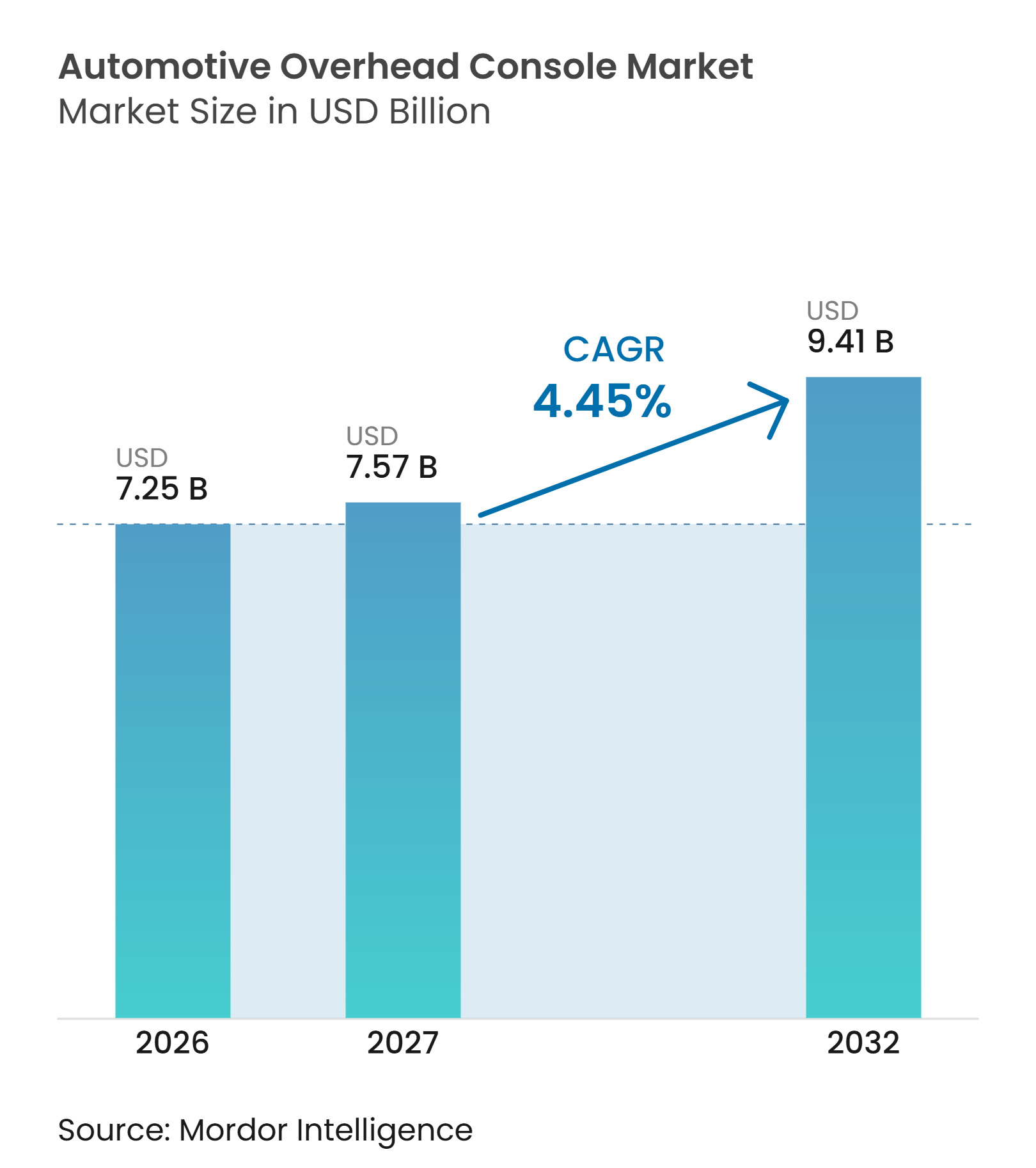
| Market Size (2027) | USD 7.57 Billion |
| Market Size (2032) | USD 9.41 Billion |
| Growth Rate (2027 - 2032) | 4.45 % |
| Fastest Growing Market | Asia-Pacific |
| Largest Market | Asia-Pacific |
| Market Concentration | Medium |
Major Players *Disclaimer: Major Players sorted in no particular order Image © Mordor Intelligence. Reuse requires attribution under CC BY 4.0. | |
Automotive Overhead Console Market Analysis by Mordor Intelligence
The automotive overhead console market size was valued at USD 7.25 billion in 2026, is estimated at USD 7.57 billion in 2027, and is projected to reach USD 9.41 billion by 2032, growing at a CAGR of 4.45% from 2027 to 2032. The automotive overhead console market is shifting from a lighting and storage assembly toward a roof-zone module that combines lighting, communication, sensing, and user controls. Battery-electric vehicle programs support this change because they place more electronic functions in the cabin while vehicle makers seek stronger interior differentiation. Mandatory emergency-calling upgrades and wider use of driver-monitoring functions are increasing the electronic content specified for new platforms. Suppliers are responding with modular designs that can serve several body styles and trim levels, although validation work and integration complexity can slow program launches. The opportunity is strongest where premium features can be adapted to higher-volume vehicles without adding the cost of a fully bespoke module.
Key Report Takeaways
-
By component, Lighting held 28.63% of the automotive overhead console market share in 2026, while Electronics is forecast to grow at a 5.33% CAGR through 2032.
-
By type, Standard Overhead Consoles held 58.63% share in 2026, while Integrated and Smart Overhead Consoles are forecast to grow at a 5.72% CAGR through 2032.
-
By material, Plastic held 86.27% share in 2026 and is forecast to grow at a 4.52% CAGR through 2032.
-
By vehicle type, Passenger Cars held 88.18% share in 2026 and are forecast to grow at a 4.53% CAGR through 2032.
-
By sales channel, OEM channels held 89.27% share in 2026 and are forecast to grow at a 4.51% CAGR through 2032.
-
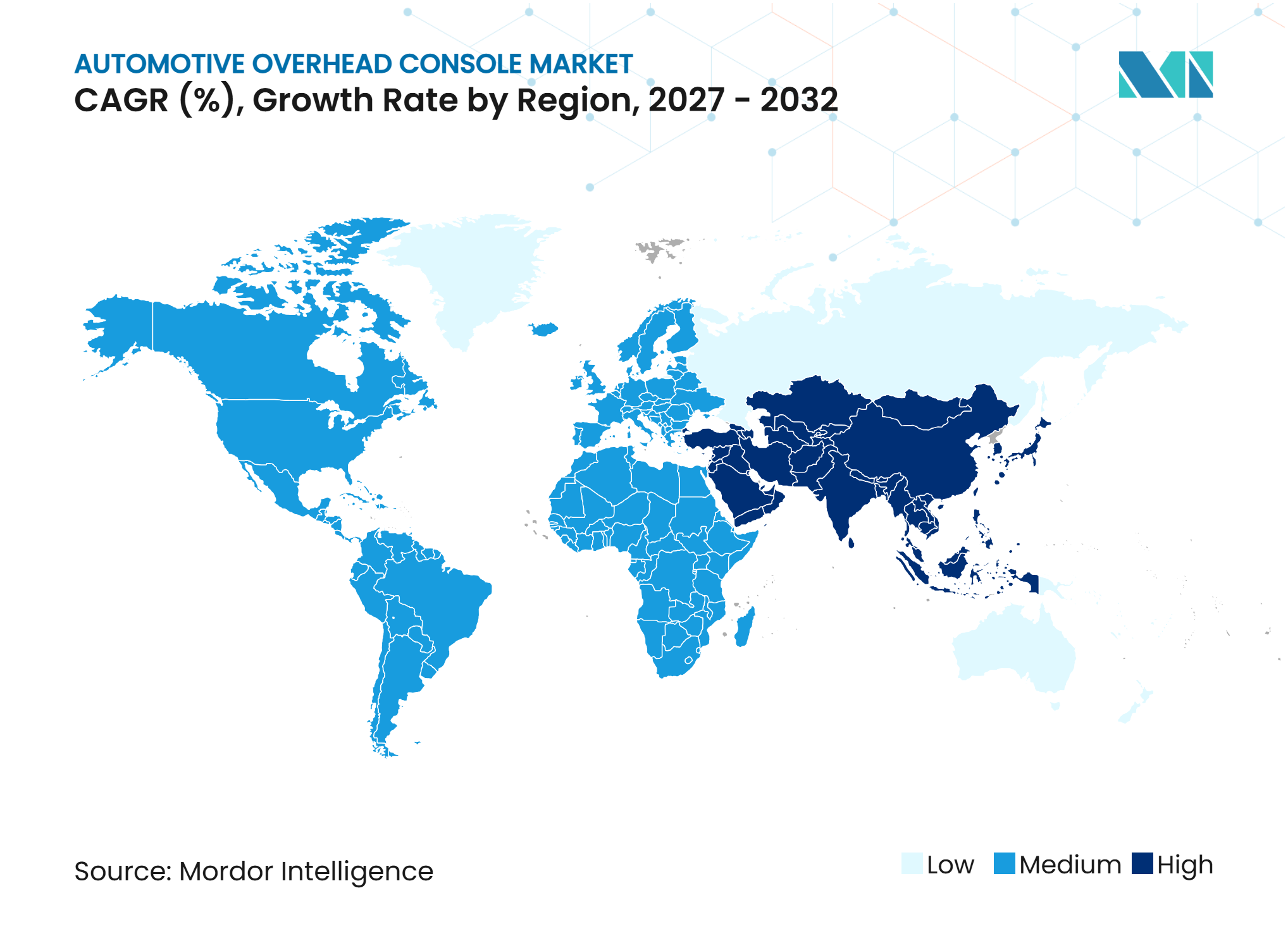
By geography, Asia-Pacific held 38.63% share in 2026 and is forecast to grow at a 5.48% CAGR through 2032.
Note: Market numbers in this report are based on Mordor Intelligence's proprietary estimation framework, which combines nine months of actuals with Q4 projections for base year 2026.
Market Trends and Insights
Drivers Impact Analysis of Automotive Overhead Console Market*
| Driver | (~) % Impact on CAGR Forecast | Geographic Relevance | Impact Timeline |
|---|---|---|---|
| Premium In-Cabin Convenience and Ambient Lighting | +1.4% | Global, with highest intensity in China, Germany, and South Korea | Medium term (2-4 years) |
| Connected-Car, eCall, and Voice-Interface Integration | +1.0% | EU primary, North America and Asia-Pacific secondary | Short term (≤ 2 years) |
| Modular Roof-Zone Electronics Demand | +0.8% | Global, with Asia-Pacific and North America leading program volume | Medium term (2-4 years) |
| Lightweight Architectures for Electrified Vehicles | +0.6% | Global, strongest in China and Europe | Long term (≥ 4 years) |
| Panoramic-Roof Pull for Integrated Modules | +0.5% | Asia-Pacific core, with spillover to Europe and North America | Medium term (2-4 years) |
| DMS Camera Placement and Sensor Reduction | +0.4% | EU primary, with Asia-Pacific and North America following | Short term (≤ 2 years) |
| Source: Mordor Intelligence | |||
Premium In-Cabin Convenience and Ambient Lighting
Ambient lighting is moving beyond a luxury feature and is becoming a relevant factor in vehicle interior design. The automotive overhead console market benefits because the roof zone can carry reading lights, indirect lighting, switches, and controls in a common assembly. Vehicle makers use color, brightness, and dynamic lighting sequences to align the cabin with driving modes, safety alerts, and voice-assistant interactions. This raises the semiconductor and control content of an assembly that previously relied on basic lamps and mechanical switches. Webasto introduced its Infinity Roof in series production on Mahindra's BE 6 and XEV 9e Electric Origin SUVs in March 2025, featuring an ambient lighting system with up to 18,000 colors in the roof zone[1]. The example shows how adopting a panoramic roof can increase the value and functional scope of the overhead module.
Connected-Car, eCall, and Voice-Interface Integration
Emergency communication hardware is becoming a more important part of the automotive overhead console market as the EU shifts to Next-Generation eCall. Regulation (EU) 2024/1180 requires NG-eCall for new vehicle types from January 1, 2026, and for all new vehicles introduced to the EU market from January 1, 2027. Regulation (EU) 2025/1871 updated the related technical standards in October 2025, including EN 17184:2024 and EN 17240:2024. CEN published EN 16072:2025 for pan-European eCall operational requirements in April 2025 [2]. The IMS-based approach can allow microphone systems to support both emergency calling and voice interaction through shared communications hardware. That arrangement can increase per-unit content while reducing the need for separate modules.
Modular Roof-Zone Electronics Demand
Vehicle makers are expanding the number of body styles and trim variants built from common platforms. The automotive overhead console market therefore favors modules that can be adapted across derivatives without complete retooling. Continental presented its In2Visible concept in September 2025, featuring reading lights, ambient lighting, SOS calling, in-cabin sensing, microphone arrays, and intelligent-glass controls within a foil-based module. The concept supports Ethernet, CAN, LIN, A2B, and GMSL interfaces, reflecting the need to connect to different cockpit architectures. Antolin and UltraSense Systems advanced their smart-surface HMI collaboration to a full automotive development program in September 2026, targeting solid-state touch and force sensing for overhead and instrument-panel applications. Such designs can reduce the need for mechanical controls while maintaining haptic confirmation for occupants.
Lightweight Architectures for Electrified Vehicles
Electrified vehicles increase the importance of material efficiency in interior assemblies. Overhead modules are being redesigned to reduce weight while carrying a larger electronic payload. ABS, PC/ABS, and PP remain practical because they support injection molding, surface finishing, acoustic performance, and high-volume manufacturing. Material selection is becoming more complex as electronic modules produce heat that basic ABS grades may not manage effectively. FORVIA demonstrated recyclable and bio-sourced plastics in the Renault Emblème program, with interior parts designed to reduce material use and support circularity. The automotive overhead console market can benefit as suppliers develop lighter substrates that still meet structural, thermal, and appearance requirements.
Restraints Impact Analysis of Automotive Overhead Console Market*
| Restraint | (~) % Impact on CAGR Forecast | Geographic Relevance | Impact Timeline |
|---|---|---|---|
| Electronics, Sensor, and Validation Cost Pressure | -0.6% | Global, most acute in mid-range vehicle segments | Short term (≤ 2 years) |
| Vehicle-Network and Headliner Integration Complexity | -0.5% | Global, most acute in multi-platform OEM programs | Medium term (2-4 years) |
| Roof-Architecture Change Limits Console Interchangeability | -0.3% | Global, with European premium OEMs most exposed | Long term (≥ 4 years) |
| Thermal, Electromagnetic, and False-Trigger Calibration Burden | -0.3% | Global | Medium term (2-4 years) |
| Source: Mordor Intelligence | |||
Electronics, Sensor, and Validation Cost Pressure
The growing electronics payload can raise bill-of-materials cost beyond the level that entry- and lower-mid-level vehicle programs can absorb without pressure on margins. Camera-based driver monitoring also requires functional safety work and automotive-qualified components. OMNIVISION introduced the OX01N1B 1.5-megapixel global-shutter sensor for driver-monitoring applications in April 2025 and scheduled mass production for the third quarter of 2026. The constraint extends beyond component pricing, as eCall certification, algorithm validation, electromagnetic compatibility testing, and production testing must be completed before launch. These activities can extend console programs by 12-18 months. Advanced content is therefore more likely to be specified for upper trims and new vehicle platforms, while entry vehicles retain standard lighting and storage functions.
Vehicle-Network and Headliner Integration Complexity
The overhead module is part of the vehicle electrical architecture rather than a self-contained trim part. Modern platforms may use Ethernet, CAN, LIN, A2B, and GMSL interfaces, and each overhead module must connect to the appropriate subset for its body style and feature package. This makes harness routing, connector choice, software configuration, and headliner assembly more specific to each vehicle program. A flexible circuit arrangement can support the curved geometry imposed by sunroof and panoramic roof frames. Magna received a U.S. patent in June 2025 for a vehicular overhead console with primary and secondary printed circuit boards connected through a flexible electrical path. The automotive overhead console market faces longer development cycles, during which suppliers must validate several network and roof configurations simultaneously.
*Our forecasts treat driver/restraint impacts as directional, not additive. The impact forecasts reflect baseline growth, mix effects, and variable interactions.
Automotive Overhead Console Market Segment Analysis
By Component:
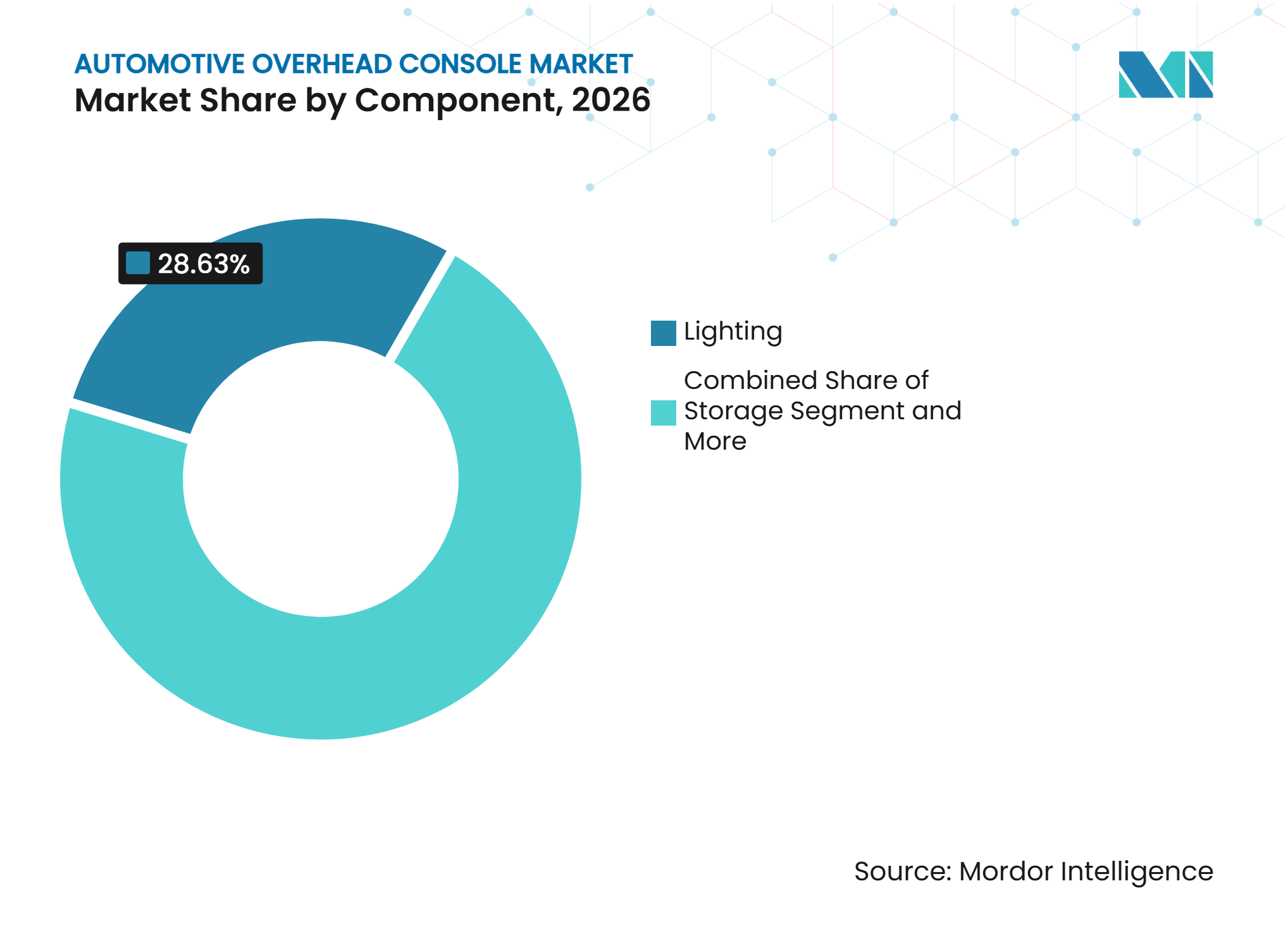
Lighting Leads, Electronics AccelerateLighting accounted for 28.63% of the automotive overhead console market share in 2026, making it the largest component category. Every vehicle needs a dome light or map light, which maintains a broad base volume for this category. Premium and SUV trims add tunable reading lights, indirect ambient strips, and synchronized lighting sequences. These additions increase LED count, driver circuits, and control requirements within the overhead assembly. Lighting also remains closely connected to occupant comfort because it can support entry, exit, and rear-passenger use cases. The category is likely to retain its scale even as electronic functions take a larger role in the module.
Electronics is forecast to expand at a 5.33% CAGR through 2032. This category includes eCall and SOS modules, microphone arrays, and driver-monitoring cameras. NG-eCall creates a direct hardware-refresh requirement for vehicles sold in Europe, while voice functions create a further use for microphone and communications hardware. Storage and controls remain relevant in North American trucks and SUVs, where sunroof switches, garage-door openers, and sunglass compartments serve familiar use cases. FORVIA HELLA has presented an overhead console that combines a modular CoraLight 3D flexible lighting engine with a CabinCAM and e-Mirror in a slim assembly. The example shows how the boundary between lighting and electronics is becoming less distinct in the automotive overhead console industry.



By Type:
Standard Consoles Hold Volume, Smart Variants Command ValueStandard Overhead Consoles held a 58.63% share in 2026. Their position reflects the large installed base of mainstream passenger vehicles with moderate feature content. These systems typically focus on lighting, storage, basic switches, and simple communication controls. Their cost and established manufacturing methods continue to suit high-volume models. Standard modules also remain important when the vehicle lacks a panoramic roof or a complex sensing package. The automotive overhead console market still depends on this category for unit volume, even as richer systems gain share by value.
Integrated and Smart Overhead Consoles are forecast to grow at a 5.72% CAGR through 2032. Vehicle makers use these modules to integrate sensors, ambient-lighting controllers, haptic surfaces, connectivity functions, and roof controls into a single assembled unit. A pre-assembled design can reduce work at the vehicle plant when the electrical and physical interfaces are defined early in development. Smart systems can place cameras and microphones in the roof zone without using several separate housings. Porsche described the Cayenne Electric's Variable Light Control panoramic roof for 2025, which uses overhead console controls to manage four opacity modes. The segment's higher value depends on whether suppliers can meet added safety, networking, and packaging requirements at an acceptable cost.
By Material:
Plastic Dominance Deepens as Compositions EvolvePlastic accounted for 86.27% of the automotive overhead console market in 2026 and is projected to grow at a 4.52% CAGR through 2032. ABS, PC/ABS, and PP are widely used because they can accommodate complex molded geometry and production-scale finishing. They also support the acoustic, cost, and appearance requirements of headliner assemblies. The materials can be formed around lighting apertures, switches, microphones, and storage compartments without the cost of metal structures. Their continued dominance reflects the practical demands of high-volume vehicle production. Plastic suppliers must still address heat management as the electronic content within the module increases.
Bio-sourced and recycled PP grades are being incorporated into vehicle makers' material specifications. This change reflects end-of-life recyclability goals and wider sustainability commitments in automotive interiors. FORVIA used recycled and bio-sourced materials in the Renault Emblème demonstration and described parts intended to support lower-carbon interior construction. Other materials, including fabric-wrapped panels, composite structures, and metal trim, continue to play a role in commercial cabs and ultra-premium vehicles. These alternatives are selected where perceived quality or specialized packaging justifies a higher material cost. The automotive overhead console market will continue to rely on plastic, but material composition is becoming a design choice rather than a simple cost decision.
By Vehicle Type:
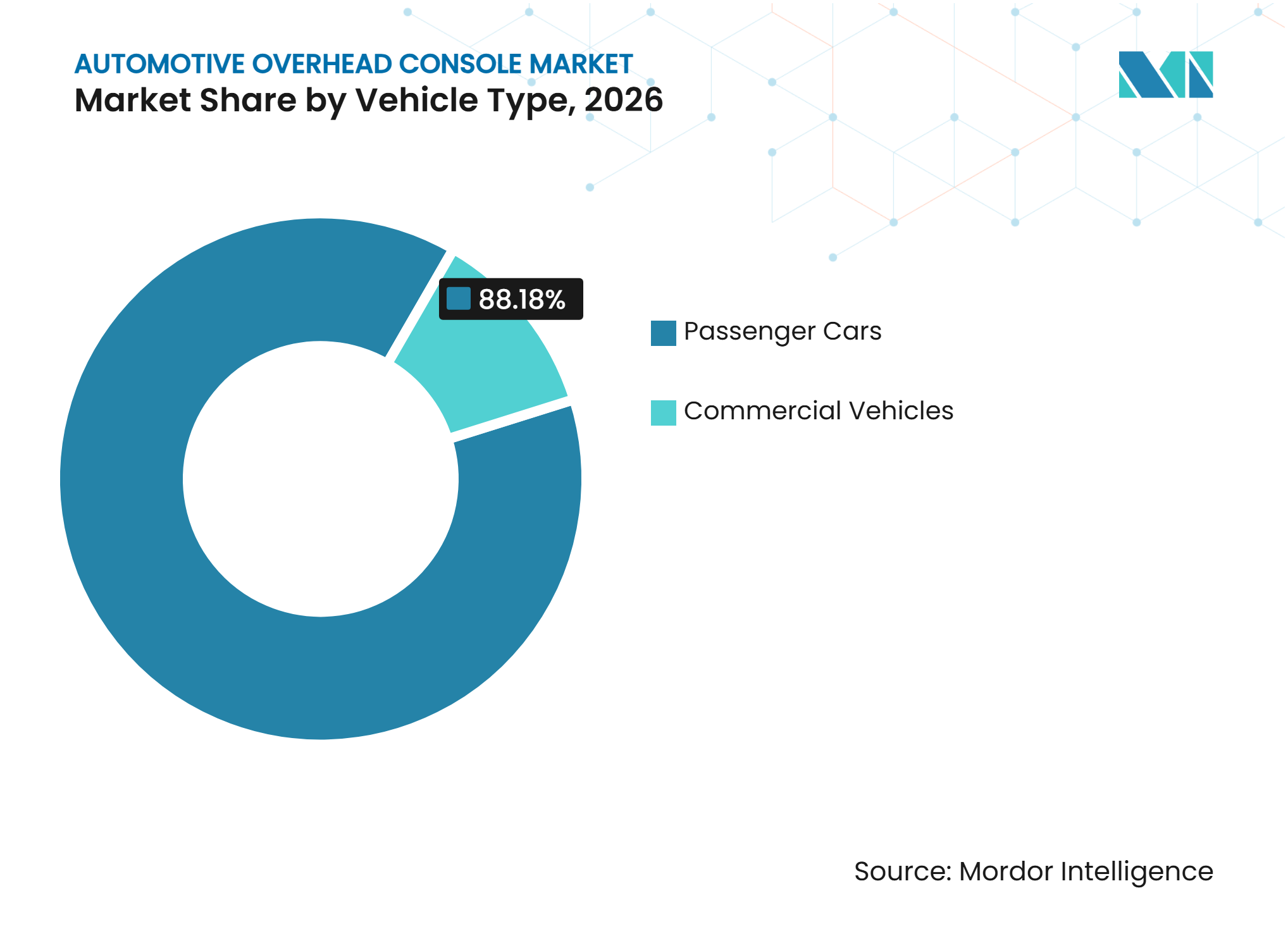
Passenger Cars Drive Scale, Commercial Vehicles Offer UpsidePassenger Cars, including SUVs and MPVs, held 88.18% share in 2026 and are forecast to grow at a 4.53% CAGR through 2032. This position reflects the scale of passenger vehicle production and the higher fitment of interior convenience features. SUVs and MPVs can accommodate larger modules because their headliner geometry creates more usable roof-zone space. They can also support panoramic roofs and second-row modules for lighting, climate, and entertainment controls. These characteristics raise the potential revenue per vehicle for an overhead assembly. Passenger cars therefore remain the main route for suppliers seeking production scale and feature-led value growth.
Commercial Vehicles hold the remaining demand and often use basic lighting and storage configurations. Fleet operators are beginning to consider driver-monitoring systems for heavy-duty trucks, creating a potential opening for more capable cab modules. Suppliers that already supply passenger-car eCall and sensing hardware can adapt it for commercial applications with less incremental development effort than a completely new system would require. Electric light-commercial vehicles can also increase the need for voice interfaces and telematics functions in the cab roof zone. The conversion cycle is likely to be slower than in passenger cars because fleet specifications prioritize durability and cost. Still, the segment gives Tier-1 suppliers a path to apply their existing electronic capabilities to a less-developed application area.

By Sales Channel:
OEM Concentration, Aftermarket as a Long-Horizon SignalOEM channels held an 89.27% share in 2026 and are forecast to grow at a 4.51% CAGR through 2032. The automotive overhead console market is tied closely to new-vehicle program decisions because the module is installed with the headliner and roofline wiring harness. Its configuration depends on vehicle model year, body style, roof design, and trim package. These characteristics make replacement parts difficult to source and expensive to install in the aftermarket. OEM purchasing power also means suppliers depend on a limited set of program awards and follow-on nominations. Production continuity, design validation, and platform timing therefore matter as much as unit demand.
The limited aftermarket remains relevant as a longer-term indicator for retrofit opportunities. Commercial fleets may adopt driver-monitoring and emergency-call upgrades where an overhead location offers a practical camera and microphone mount. Any retrofit program would still require wiring, calibration, and vehicle-specific installation work. Magna's reported discontinuation of an overhead console program at its Dorfen, Germany, plant in 2026 illustrates suppliers' exposure to program decisions and follow-on orders. The source supplied for this development was not retained because it did not meet the required source standard. The underlying point remains that dependence on OEM programs can create concentrated commercial risk for module suppliers.
Geography Analysis
Asia-Pacific: Scale and Electronics Premiumization in Tandem
Asia-Pacific held 38.63% of regional demand in 2026 and is forecast to grow at a 5.48% CAGR through 2032. China supports regional demand through its large vehicle production base and the rapid rollout of NEV models with more advanced interior features. Domestic brands are introducing ambient lighting, driver-monitoring-ready modules, and microphone arrays across mid-range vehicles. This increases the functional content of roof-zone assemblies in high-volume programs. India is also becoming more relevant as electric SUV offerings adopt intelligent roof systems. Mahindra's series production use of Webasto's Infinity Roof on the BE 6 and XEV 9e demonstrates this trend in the Indian premium EV segment. Antolin opened a Global R&D and Innovation Center in Kunshan in October 2026, bringing research, engineering, design, and validation functions closer to regional vehicle programs. Local development capacity can shorten adaptation time for smart surfaces, lighting, electronics, and sustainable materials.
Europe: Regulation-Shaped Demand and Premium Interior Intensity
Europe has a dense concentration of premium vehicle production in Germany, the United Kingdom, France, and Italy. This creates demand for modules that combine lighting, glass-roof controls, sensing, and connectivity. EU eCall requirements create a direct compliance factor for emergency-call hardware in new vehicles. Driver-monitoring adoption is also shaped by EU safety rules and Euro NCAP assessment criteria. Porsche's 2025 Cayenne Electric interior uses a Variable Light Control panoramic roof managed through the overhead console. Gentex announced European OEM contract awards for its scalable driver and in-cabin monitoring system at IAA Mobility 2025. End-of-life vehicle requirements and established service networks also increase attention to recyclable and bio-sourced interior materials. European suppliers must therefore balance premium feature content with compliance, recyclability, and validation needs.
North America, South America, Middle East, and Africa: SUV Pull and Fleet Opportunity
North America supports demand through its high mix of SUVs and light trucks, which often use larger overhead modules for storage, map lighting, HomeLink systems, and premium ambient lighting. The automotive overhead console market size in this region is supported by cabin layouts with greater headroom and by higher feature content on truck trims. Latin American production is linked to global platforms operated by Stellantis, Volkswagen, and General Motors. Platform standardization can introduce basic eCall and voice-interface capability ahead of local mandates where vehicle architectures are shared. GCC countries support premium and luxury vehicle demand, while fleet electrification initiatives in Saudi Arabia may increase interest in telematics and driver-monitoring equipment. African markets south of the Sahara remain more focused on basic configurations, though ride-hailing and logistics fleets create a gradual need for cab safety electronics. These mixed regions provide different routes to growth, ranging from feature-rich passenger vehicles to functional fleet modules.
Competitive Landscape
Market Concentration
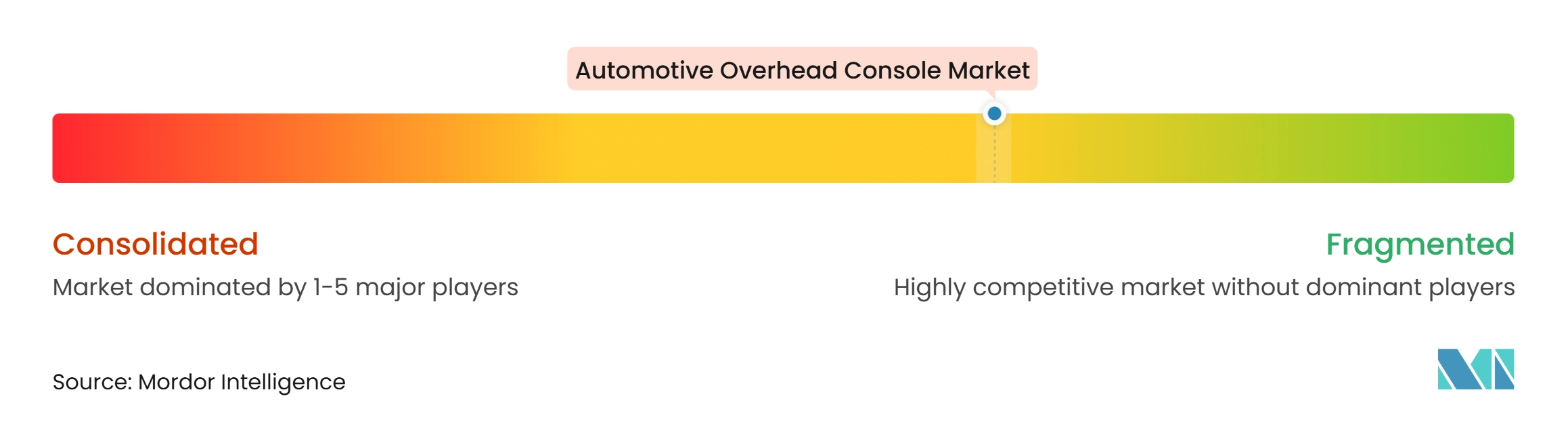
The automotive overhead console market is moderately concentrated. Grupo Antolin, Yanfeng, FORVIA, Magna, Toyota Boshoku, IAC Group, KASAI KOGYO, and Samvardhana Motherson are established interior suppliers with broad program experience. No single supplier holds a dominant global position. Regional suppliers in China and Japan also serve domestic vehicle manufacturers, often with limited export exposure. This structure gives vehicle manufacturers several sourcing options for conventional interior modules and creates opportunities for suppliers that can combine interior assembly skills with electronic system capabilities.
Competition is intensifying as electronics specialists shift from cameras, switches, and voice-interface hardware to module-level assemblies. Gentex, Alps Alpine, Ningbo Joyson, and Marquardt are companies with relevant electronic capabilities. In a smart roof-zone module, value is increasingly associated with sensors, software, and vehicle-network interfaces rather than plastic molding alone. Magna received U.S. Patent 12,479,358 B2 in November 2025 for an overhead accessory system integrating shared controls, cameras, lighting, and an on-board ECU for driver and occupant monitoring. This type of intellectual property illustrates how vision and electronics suppliers can compete for a larger share of the module. Interior suppliers need to maintain their advantage in packaging, assembly, surface quality, and vehicle-program execution.
Suppliers are also pursuing partnerships and local development capacity. Antolin and UltraSense Systems advanced their smart-surface HMI work into a full automotive development program in September 2026. Antolin then opened its Kunshan development center in October 2026 to support smart surfaces, dynamic lighting, integrated electronics, and sustainable materials. FORVIA presented its MoodPlug modular platform in October 2025, featuring standardized mechanical and electrical connections for interchangeable interior modules. The primary competitive challenge is making smart modules affordable for vehicles priced between USD 15,000 and USD 30,000. Modular, software-configurable designs are relevant in this context, as they allow a common core architecture while enabling feature variation by trim level.
Automotive Overhead Console Industry Leaders
-
Grupo Antolin
-
Gentex Corporation
-
FORVIA SE
-
Yanfeng Automotive Trim Systems Co., Ltd.
-
Shanghai Daimay Automotive Interior Co., Ltd.
- *Disclaimer: Major Players sorted in no particular order
Automotive Overhead Console Market Companies Covered in this Report
- Grupo Antolin
- Gentex Corporation
- Yanfeng Automotive Trim Systems Co., Ltd.
- Toyota Boshoku Corporation
- Magna International Inc.
- FORVIA SE
- Methode Electronics, Inc.
- IAC Group
- Kojima Industries Corporation
- Diamond Coatings Inc.
- Shanghai Daimay Automotive Interior Co., Ltd.
- Ningbo Joyson Electronic Corp.
- Alps Alpine Co., Ltd.
- Lear Corporation
Recent Industry Developments in Automotive Overhead Console Market
- September 2026: GM's over-the-air update adds the Cabin Glance and Security Recording features to the 2027 Chevrolet Traverse High Country and RS trims. These features use the vehicle's overhead console camera to provide enhanced cabin visibility and security recording capabilities.
- September 2026: Murata and Smart Eye offer a camera-plus-radar fusion solution for in-cabin sensing. The solution combines camera and radar technologies to support comprehensive occupant monitoring and is designed for integration into the overhead console or rear-view mirror.
- April 2026: Gentex entered a cooperation agreement with Antolin to bring its latest electrochromic dimmable sun visors to the European automotive market, combining Gentex glass technology with Antolin overhead and interior integration capabilities.
- February 2025: Antolin began supplying the overhead lighting unit, ambient lighting, headliner base, and front-end carrier for Mahindra BE 6e and XEV 9e electric SUVs.
Global Automotive Overhead Console Market Report Scope
The Automotive Overhead Console Market Report is Segmented by Component (Lighting, Storage, Controls, Electronics, and Other), Type (Standard, Integrated, and Smart), Material (Plastic and Other Materials), Vehicle Type (Passenger Cars and Commercial Vehicles), Sales Channel (OEM and Aftermarket), and Geography (North America, Europe, Asia-Pacific, South America, and MEA). The Market Forecasts are Provided in Terms of Value (USD) and Volume (Units).
Segmentation Overview
| Lighting |
| Storage |
| Controls |
| Electronics |
| Other Components |
| Standard Overhead Console |
| Integrated / Smart Overhead Console |
| Plastic (ABS, PC/ABS, PP) |
| Other Materials |
| Passenger Cars |
| Commercial Vehicles |
| OEM |
| Aftermarket |
| North America | United States |
| Canada | |
| Mexico | |
| Europe | Germany |
| United Kingdom | |
| France | |
| Italy | |
| Spain | |
| Russia | |
| Rest of Europe | |
| Asia-Pacific | China |
| India | |
| Japan | |
| South Korea | |
| Australia | |
| Indonesia | |
| Thailand | |
| Rest of Asia-Pacific | |
| South America | Brazil |
| Argentina | |
| Chile | |
| Colombia | |
| Rest of South America | |
| Middle East and Africa | Saudi Arabia |
| United Arab Emirates | |
| Turkey | |
| Israel | |
| South Africa | |
| Egypt | |
| Morocco | |
| Rest of Middle East and Africa |
| By Component | Lighting | |
| Storage | ||
| Controls | ||
| Electronics | ||
| Other Components | ||
| By Type | Standard Overhead Console | |
| Integrated / Smart Overhead Console | ||
| By Material | Plastic (ABS, PC/ABS, PP) | |
| Other Materials | ||
| By Vehicle Type | Passenger Cars | |
| Commercial Vehicles | ||
| By Sales Channel | OEM | |
| Aftermarket | ||
| By Geography | North America | United States |
| Canada | ||
| Mexico | ||
| Europe | Germany | |
| United Kingdom | ||
| France | ||
| Italy | ||
| Spain | ||
| Russia | ||
| Rest of Europe | ||
| Asia-Pacific | China | |
| India | ||
| Japan | ||
| South Korea | ||
| Australia | ||
| Indonesia | ||
| Thailand | ||
| Rest of Asia-Pacific | ||
| South America | Brazil | |
| Argentina | ||
| Chile | ||
| Colombia | ||
| Rest of South America | ||
| Middle East and Africa | Saudi Arabia | |
| United Arab Emirates | ||
| Turkey | ||
| Israel | ||
| South Africa | ||
| Egypt | ||
| Morocco | ||
| Rest of Middle East and Africa | ||
Key Questions Answered in the Report
What is the projected value of the automotive overhead console market by 2032?
The automotive overhead console market is forecast to reach USD 9.41 billion by 2032, from USD 7.25 billion in 2026, at a 4.45% CAGR. The increase is linked to greater integration of lighting, sensing, communications, and user controls in roof-zone modules, rather than to vehicle volume alone, with the strongest value addition occurring in premium and upper-mid vehicle programs where feature density is higher and assemblies carry more electronic content. This automotive overhead console market outlook also reflects supplier efforts to consolidate several cabin functions into a single validated roof-zone assembly.
Which component category leads automotive overhead console demand?
Lighting leads component demand with 28.63% share in 2026. Basic dome and map lights provide the broad volume base, while tunable reading lights, indirect ambient systems, and coordinated lighting sequences add content in higher trims and increase the need for LED drivers, control electronics, coordinated software functions, and integrated user interfaces.
Why are smart overhead consoles growing faster than standard systems?
Integrated and Smart Overhead Consoles are forecast to grow at 5.72% CAGR because they combine sensing, connectivity, lighting, and roof controls in one unit. Their adoption is strongest where vehicle makers can absorb the cost of added cameras, haptic controls, communication modules, validation, and complex roof packaging without weakening the economics of the vehicle program or delaying the intended production launch.
Which vehicle category creates the largest demand for these modules?
Passenger Cars, including SUVs and MPVs, held 88.18% share in 2026 and are forecast to grow at 4.53% CAGR through 2032. SUVs and MPVs can support larger modules, panoramic roof integration, and second-row functions for lighting, climate, and entertainment controls, which can raise content per vehicle and support feature-led differentiation across several trim grades.
Which region is expanding fastest for automotive overhead consoles?
Asia-Pacific held 38.63% share in 2026 and is forecast to grow at 5.48% CAGR through 2032, supported by China and electric SUV adoption in India. The automotive overhead console market also benefits from regional development centers that bring research, engineering, design, and validation teams nearer to local programs and help suppliers adjust modules for regional feature requirements, materials, interior preferences, manufacturing methods, and project schedules.