
Automotive Heat Pump Market Size and Share
Market Overview
| Study Period | 2020 - 2032 |
|---|---|
| Market Size (2027) | USD 4.71 Billion |
| Market Size (2032) | USD 8.87 Billion |
| Growth Rate (2027 - 2032) | 13.50 % |
| Fastest Growing Market | Asia-Pacific |
| Largest Market | Asia-Pacific |
| Market Concentration | Medium |
Major Players *Disclaimer: Major Players sorted in no particular order Image © Mordor Intelligence. Reuse requires attribution under CC BY 4.0. | |
Automotive Heat Pump Market Analysis by Mordor Intelligence
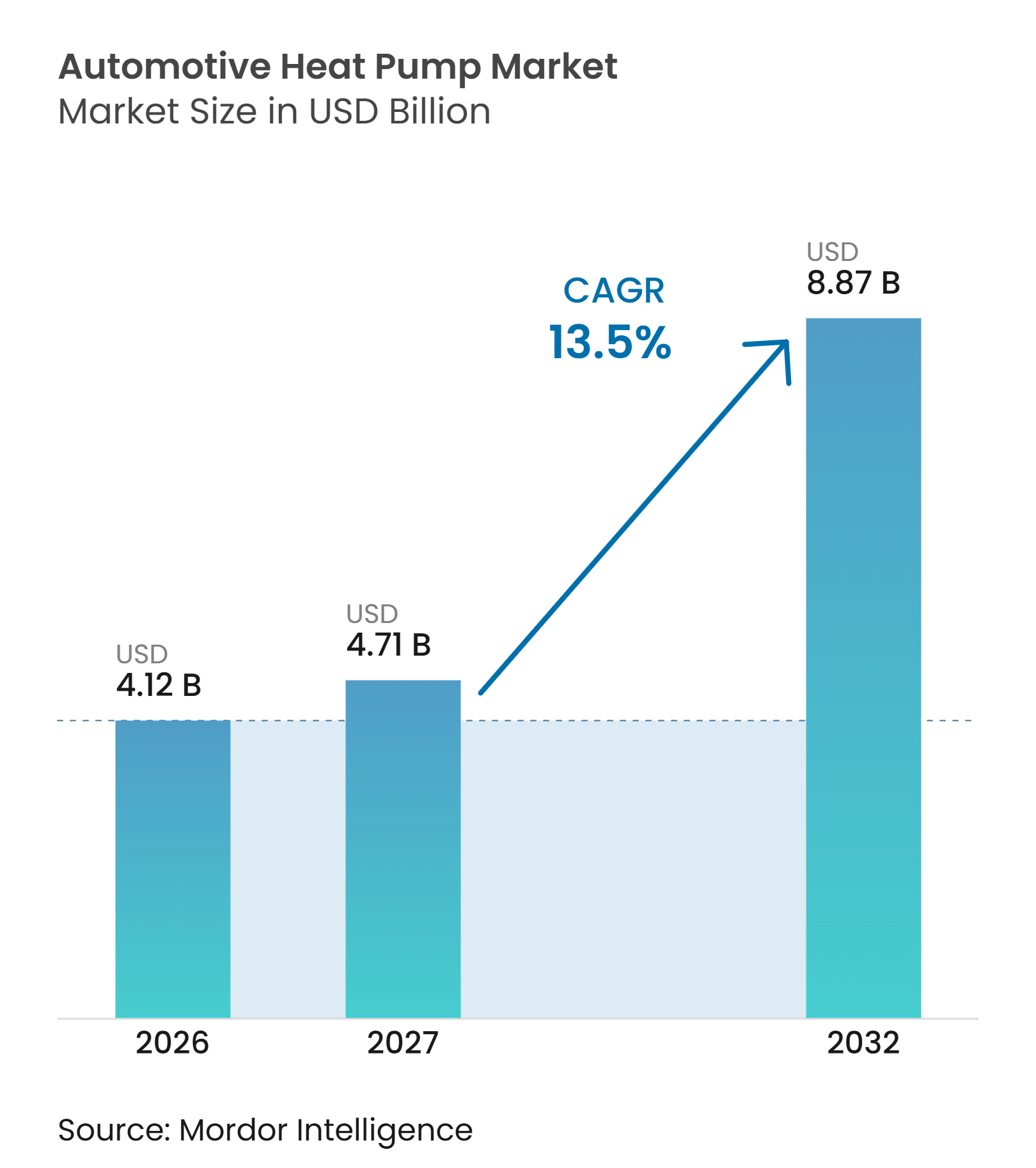
The automotive heat pump market size was valued at USD 4.12 billion in 2026 and is estimated to grow from USD 4.71 billion in 2027 to reach USD 8.87 billion by 2032 at a 13.50% CAGR over 2027-2032. The automotive heat pump market is expanding because battery electric vehicles need a dedicated way to heat cabins and control battery temperatures when engine waste heat is unavailable. A heat pump can reduce the energy draw associated with cold-weather heating, which makes it relevant to vehicle range and charging performance. Suppliers are responding by combining compressors, valves, heat exchangers, controls, and sensors into smaller thermal assemblies. Refrigerant selection is becoming a platform decision, as vehicle makers balance efficiency, service capability, cost, and changing low-global-warming-potential requirements. The automotive heat pump market is therefore moving beyond standalone HVAC hardware toward integrated systems that include controls and diagnostics.
Key Report Takeaways
-
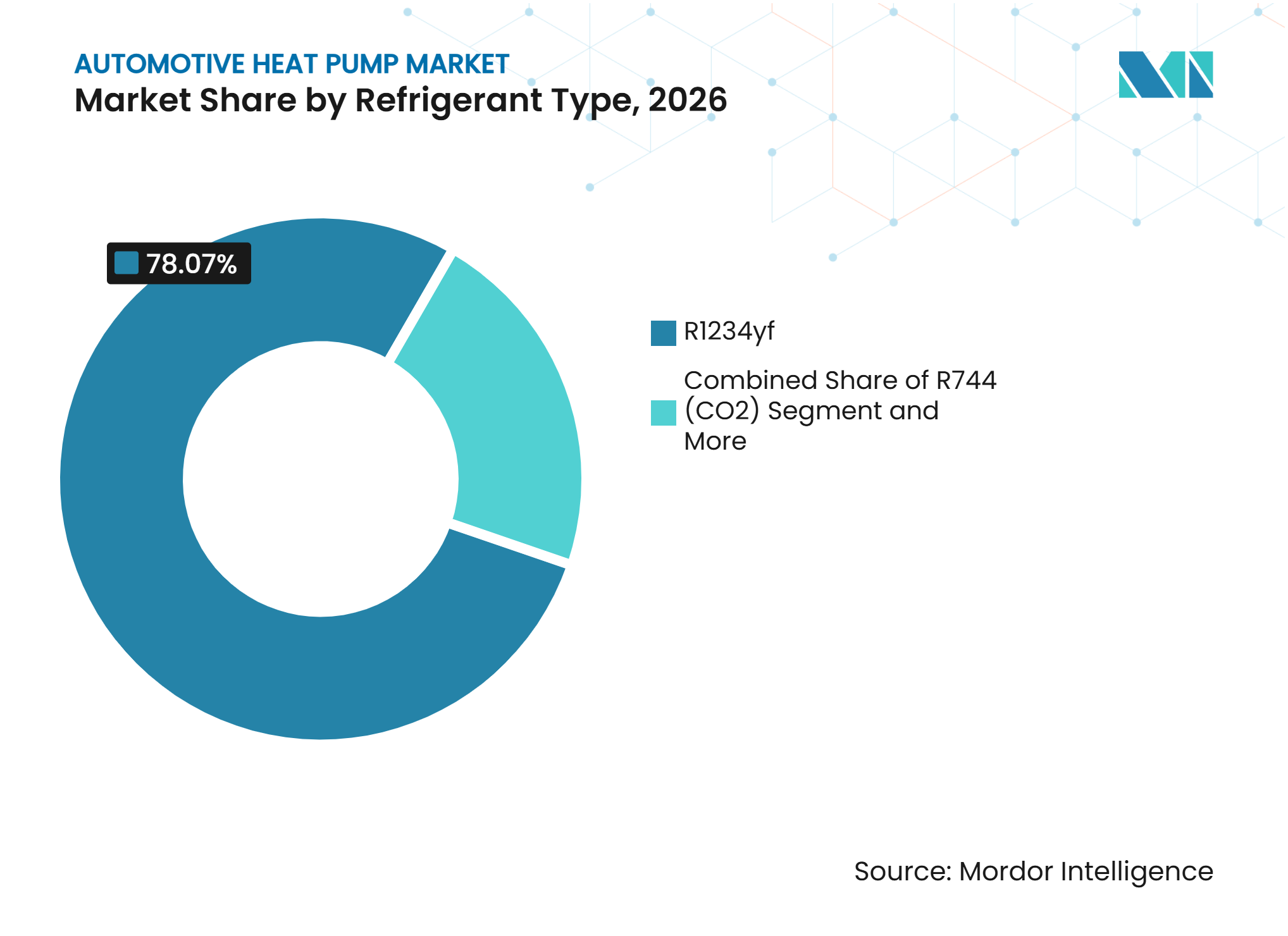
By refrigerant type, R1234yf held 78.07% of the automotive heat pump market share in 2026, while R744 is projected to grow at a 20.62% CAGR through 2032.
-
By system architecture, direct refrigerant-to-air systems represented 42.67% in 2026, while the same architecture is projected to grow at a 20.13% CAGR through 2032.
-
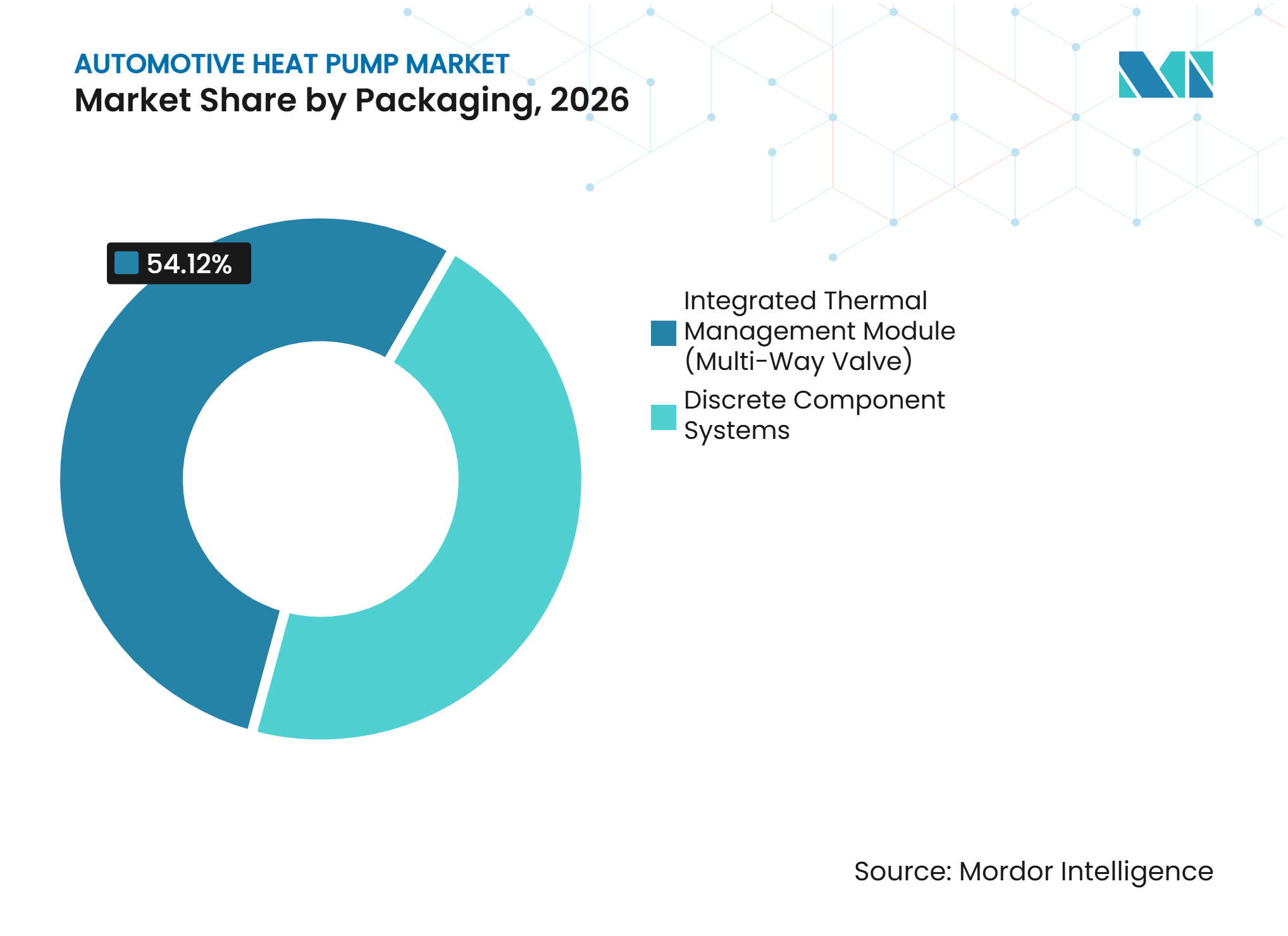
By packaging, integrated thermal management modules represented 54.12% in 2026, and are projected to grow at a 19.78% CAGR through 2032.
-
By component, controls and others represented 35.08% in 2026, while electric compressors are projected to grow at a 14.35% CAGR through 2032.
-
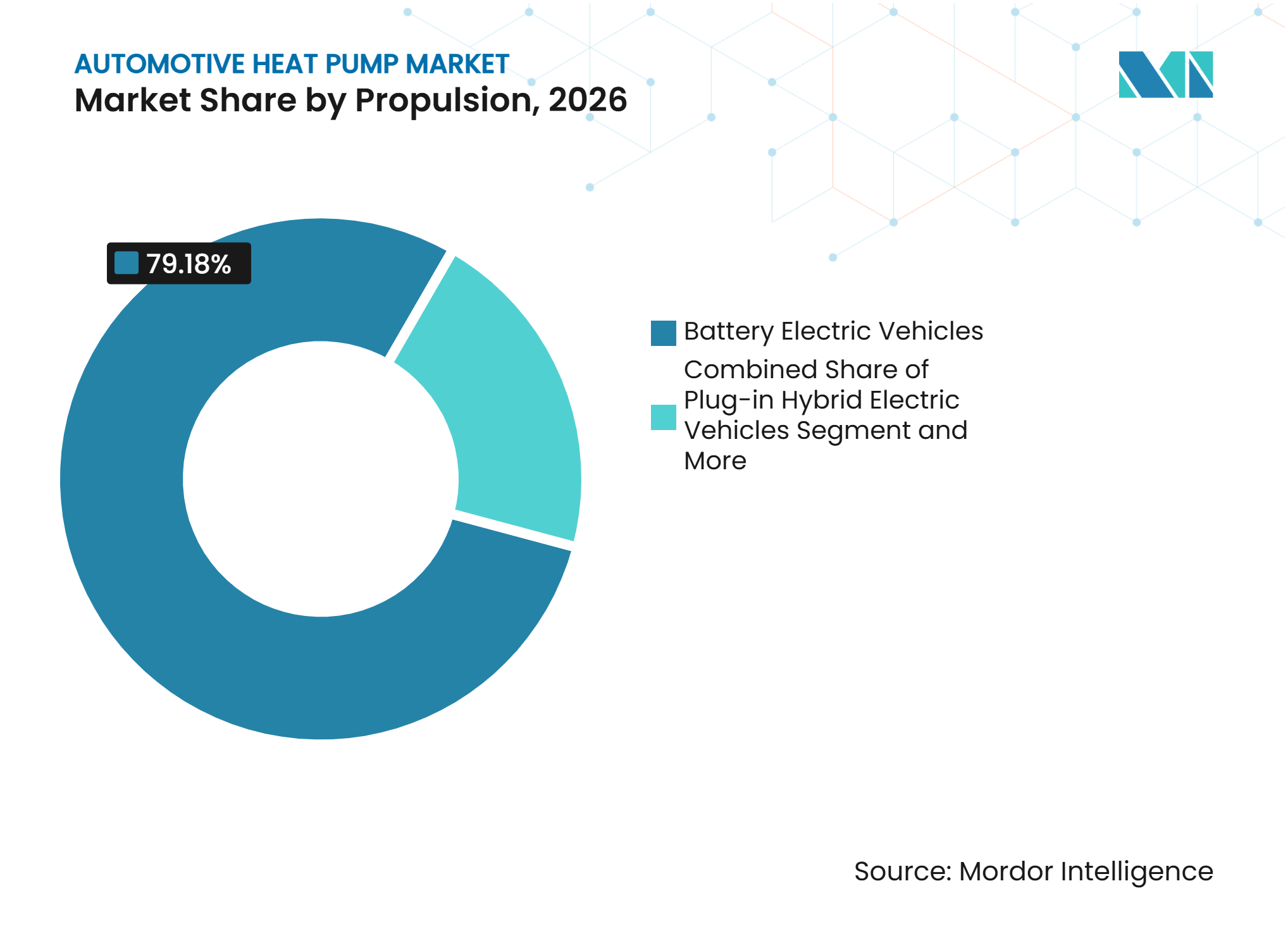
By propulsion, battery electric vehicles represented 79.18% in 2026 and are projected to grow at a 14.58% CAGR through 2032.
-
By vehicle type, passenger cars represented 61.58% in 2026, while light commercial vehicles are projected to grow at a 17.67% CAGR through 2032.
-
By geography, Asia-Pacific represented 49.85% in 2026 and is projected to grow at a 15.13% CAGR through 2032.
Note: Market numbers in this report are based on Mordor Intelligence's proprietary estimation framework, which combines nine months of actuals with Q4 projections for base year 2026.
Market Trends and Insights
Drivers Impact Analysis of Automotive Heat Pump Market*
| Driver | (~) % Impact on CAGR Forecast | Geographic Relevance | Impact Timeline |
|---|---|---|---|
| Rising BEV Heat Demand Without Engine Waste Heat | +3.5% | Global | Short term (≤ 2 years) |
| OEM Adoption of Integrated Thermal Management Modules | +2.3% | Global, particularly Europe and Asia-Pacific | Medium term (2-4 years) |
| Tighter Low-GWP Refrigerant Requirements | +1.6% | EU core, with early effects in China | Medium term (2-4 years) |
| Cold-Climate Range Preservation and Fast-Charging Preconditioning | +1.4% | North America, Europe, and North Asia | Short term (≤ 2 years) |
| Refrigerant-Centric Battery Thermal Management in Cost-Optimized EV Platforms | +0.9% | China, South Korea, and Southeast Asia | Medium term (2-4 years) |
| Commercial-Vehicle Electrification and Depot-Charging Thermal Loads | +0.7% | Europe, North America, and China | Long term (≥ 4 years) |
| Source: Mordor Intelligence | |||
Rising BEV Heat Demand Without Engine Waste Heat
Battery electric vehicles draw cabin and battery heating energy from the traction battery because they do not have combustion-engine waste heat. That basic design condition is supporting the automotive heat pump market across vehicle classes. Resistance heating can place a direct load on stored energy, while a heat pump transfers ambient or recovered heat into the vehicle. Heat pump integration is identified as an effective response to cold-weather range loss. This issue is no longer limited to premium electric vehicles, because entry-level models face the same range and comfort constraints. Suppliers are consequently working toward compact systems that meet tighter vehicle cost targets without sacrificing thermal performance.
OEM Adoption of Integrated Thermal Management Modules
Vehicle makers are moving away from separate sourcing of compressors, chillers, condensers, valves, and sensors. An integrated module can reduce assembly steps and give the supplier greater responsibility for system performance. This supports the automotive heat pump market because the module carries more content per vehicle than a set of individual components. Hanon Systems introduced an integrated cooling unit in 2026 for the BMW iX3. MAHLE also presented a module that combines the heat pump with key thermal components and controls. The approach gives vehicle makers a more repeatable installation process across related electric vehicle platforms.
Tighter Low-GWP Refrigerant Requirements
Refrigerant rules are making thermal architecture a strategic choice for vehicle makers. The European Union mobile air-conditioning framework established a global-warming-potential threshold that drove the move away from R134a in new passenger car models. The later F-Gas Regulation sets a phased reduction in hydrofluorocarbon availability and adds to procurement uncertainty for conventional refrigerant systems [1]. China’s planned transition for new passenger car mobile air-conditioning systems is also causing OEMs to evaluate future refrigerant choices early. The automotive heat pump market is benefiting because the review often requires new compressors, valves, heat exchangers, and safety measures. Natural refrigerants are receiving greater attention even where a final platform decision has not yet been made.
Cold-Climate Range Preservation and Fast-Charging Preconditioning
Cold-weather range remains a visible concern for electric vehicle buyers, particularly in northern markets. A heat pump can preserve usable energy by providing cabin heat more efficiently than resistance heating. It can also prepare a battery for fast charging by bringing it closer to the operating temperature required for efficient charging. This links thermal management to both driving range and the customer experience at public charging sites. The automotive heat pump market gains importance when manufacturers market winter performance as a vehicle attribute rather than a technical detail. DENSO has commercialized a defrosting approach that uses waste heat while the vehicle is driven, addressing a recurring operating challenge in low temperatures.
Restraints Impact Analysis of Automotive Heat Pump Market*
| Restraint | (~) % Impact on CAGR Forecast | Geographic Relevance | Impact Timeline |
|---|---|---|---|
| High Upfront System Cost and Validation Burden | -1.6% | Global, most acute in price-sensitive Asia and South America | Medium term (2-4 years) |
| R744 High-Pressure Hardware and R290 Flammability Constraints | -1.1% | Global, with flammability most acute in North America | Long term (≥ 4 years) |
| Regional Refrigerant Approval and Service-Readiness Gaps | -0.7% | North America, Southeast Asia, Middle East, and Africa | Medium term (2-4 years) |
| Cold-Climate Performance Variability and Defrost Energy Penalties | -0.5% | Northern Europe, Canada, and Northeast China | Short term (≤ 2 years) |
| Source: Mordor Intelligence | |||
High Upfront System Cost and Validation Burden
Heat pumps require more components and more control work than basic resistance-heating systems. This can be difficult to justify on lower-priced electric vehicles, especially in markets where initial purchase price remains the main buyer consideration. The system must also be validated as part of the broader vehicle safety and thermal architecture. A refrigerant change can add pressure-vessel, compressor, leak-detection, and type-approval work. These requirements can delay adoption even when the technical benefits are clear. The automotive heat pump market consequently remains more established in higher-value vehicles than in the most price-sensitive models.
R744 High-Pressure Hardware and R290 Flammability Constraints
R744 and R290 can reduce exposure to some refrigerant policy risks, but both require tailored engineering. R744 operates at much higher pressure than conventional vehicle refrigerant systems, which affects seals, pipes, compressors, and safety provisions. Its efficiency can also be more difficult to maintain in very hot climates. R290 has a different challenge because it is classed as highly flammable under the applicable safety framework. These technical constraints limit how quickly either route can be applied across all vehicle platforms. The automotive heat pump market is growing, but refrigerant innovation does not remove the need for careful system validation.
*Our forecasts treat driver/restraint impacts as directional, not additive. The impact forecasts reflect baseline growth, mix effects, and variable interactions.
Automotive Heat Pump Market Segment Analysis
By Refrigerant Type:
R1234yf Retains Broad Platform Adoption While R744 Gains GroundR1234yf held 78.07% of the refrigerant segment in 2026, reflecting its broad base across established automotive air-conditioning platforms. The automotive heat pump industry has used this refrigerant route because the associated component supply chain and service practices are familiar. It remains aligned with the EU framework for new passenger-car mobile air-conditioning systems. Vehicle makers can use existing knowledge of low-pressure system layouts when applying it to heat-pump designs. Its installed base gives suppliers a clear reason to continue improving compressors, valves, and controls for this refrigerant. At the same time, policy uncertainty is causing OEM engineering teams to consider alternatives during new platform planning.
R744 is projected to grow at a 20.62% CAGR through 2032, making it the fastest-growing refrigerant choice in the automotive heat pump market. Its low global-warming potential and cold-weather performance support interest from vehicle makers seeking a longer-term alternative. The system requires higher-pressure components and a service ecosystem that can handle the refrigerant safely. This raises the importance of supplier know-how and vehicle-level validation. R290 and other approaches retain strategic relevance where manufacturers want another route for future platforms. The segment will continue to be defined by regional approval, climate performance, and the cost of changing a vehicle architecture.



By System Architecture:
Direct Systems Set the Current Design DirectionDirect refrigerant-to-air systems held 52.16% of the system-architecture segment in 2026. The design can reduce the number of coolant-side components by allowing the refrigerant circuit to interface directly with the cabin HVAC path. This makes it attractive to vehicle makers that want to control weight, packaging space, and system complexity. Direct systems also support a clear connection between refrigerant selection and cabin heating performance. Their presence in the automotive heat pump market reflects the practical need for compact systems that can be fitted across several vehicle sizes.
Direct refrigerant-to-air systems are projected to grow at a 20.13% CAGR through 2032. The growth reflects continued interest in architectures with fewer thermal loops and lower installation complexity. These systems may be particularly suitable for R744 designs where vehicle makers seek strong cold-weather heating output. Indirect arrangements retain an important role where a secondary loop improves refrigerant containment or system flexibility. R290 designs can require this separation to keep the refrigerant outside the passenger compartment. The automotive heat pump market will therefore retain both architecture paths, even as direct systems lead the expansion.
By Packaging:
Integrated Modules Command Majority AdoptionIntegrated thermal management modules held 54.12% of the packaging segment in 2026. The majority position shows that newly launched electric vehicle platforms increasingly favor pre-assembled thermal systems over separate component sourcing. An integrated unit can bring together chillers, condensers, valves, sensors, and related controls in a more compact package. This can reduce assembly time, part count, and vehicle weight for the manufacturer. It also gives the Tier-1 supplier a larger role in validating the performance of the complete thermal system. Discrete systems still have a place in simpler entry-level vehicles where the added cost of integration cannot be justified.
Integrated thermal management modules are projected to grow at a 19.78% CAGR through 2032. Their appeal rests on the ability to combine physical components with embedded sensors and software in one assembly. This allows the supplier to support thermal diagnostics and calibration throughout the vehicle’s operating life. Valeo’s compact multi-way refrigerant valve is an example of the direction toward combining several valve functions within a smaller module. The design can reduce the number of separate parts while supporting different refrigerant choices. The automotive heat pump market is likely to see continued competition around these modules as OEMs seek faster assembly and more integrated thermal control.

By Component:
Controls Hold the Largest Share While Compressors Drive GrowthControls and others held 35.08% of the component segment in 2026. This group includes sensors, electronic control units, and thermal-management software that govern refrigerant and coolant routing across changing vehicle conditions. The controls layer manages functions that affect cabin comfort, battery protection, and charging preparation. As systems become more integrated, the software and sensor stack increasingly shapes how the thermal system performs over the vehicle’s operating life. That allows suppliers to differentiate their offering beyond the physical hardware. Heat exchangers, valves, and expansion devices remain essential across the main system designs.
Electric compressors are projected to grow at a 14.35% CAGR through 2032. They circulate refrigerant independently of an engine and are therefore fundamental to heat-pump operation in battery electric vehicles. Growth is connected to wider electric vehicle platform adoption and the need for compressor designs suited to different refrigerants. DENSO has described its work to standardize HVAC variants and make production more flexible as vehicle demand changes [2]. This approach shows why manufacturing flexibility matters as the mix of thermal-system specifications evolves. The automotive heat pump market will favor suppliers that pair capable compressors with reliable controls and heat-exchange performance.
By Propulsion:
Battery Electric Vehicles Anchor Heat-Pump AdoptionBattery electric vehicles held 79.18% of the propulsion segment in 2026. Their high share reflects the absence of engine waste heat and the need to protect range during cabin heating. Thermal management also supports battery conditioning before and during charging. This makes heat-pump fitment more closely connected to vehicle efficiency than it is in combustion-engine vehicles. The automotive heat pump market is consequently centered on battery electric vehicle platform plans. Plug-in hybrids continue to use heat pumps where electric-only driving and winter comfort matter to the customer.
Battery electric vehicles are projected to grow at a 14.58% CAGR through 2032. Greater volume can help thermal suppliers spread development and tooling costs across more vehicle programs. That supports a feedback loop in which rising electric vehicle output encourages further heat-pump standardization. Other propulsion types retain smaller but relevant use cases. Fuel-cell vehicles also need controlled thermal conditions, while certain hybrid platforms can use heat pumps during electric operation. The automotive heat pump market will remain tied to battery electric vehicle production because that platform produces the clearest efficiency case for dedicated heating.
By Vehicle Type:
Passenger Cars Provide Scale While Light Commercial Vehicles AcceleratePassenger cars held 61.58% of the vehicle-type segment in 2026. They have benefited from the earlier development of electric passenger-car platforms and the focus on range in customer purchase decisions. Vehicle makers can use heat pumps to support cabin comfort without imposing the same energy demand as resistance heaters. Passenger cars also offer suppliers a broad set of platform sizes and price points. This gives the automotive heat pump market a substantial volume base. Premium models have led adoption, but lower-priced electric cars are becoming increasingly relevant to supplier design programs.
Light commercial vehicles are projected to grow at a 17.67% CAGR through 2032. Delivery fleets have predictable routes and depot charging routines, which can make thermal preconditioning easier to manage. A heat pump can support usable range during repeated urban stops and colder conditions. Ford has stated that its purpose-developed E-Transit heat pump improves range in demanding conditions, which illustrates the operating case for electric vans. Buses and heavier commercial vehicles remain smaller opportunities but require thermal systems suited to larger cabins and longer duty cycles. The automotive heat pump market has a credible expansion path in fleets as operators seek lower energy use and more reliable route completion.
Geography Analysis
Asia-Pacific: Scale and Policy Urgency Define the Center of Gravity
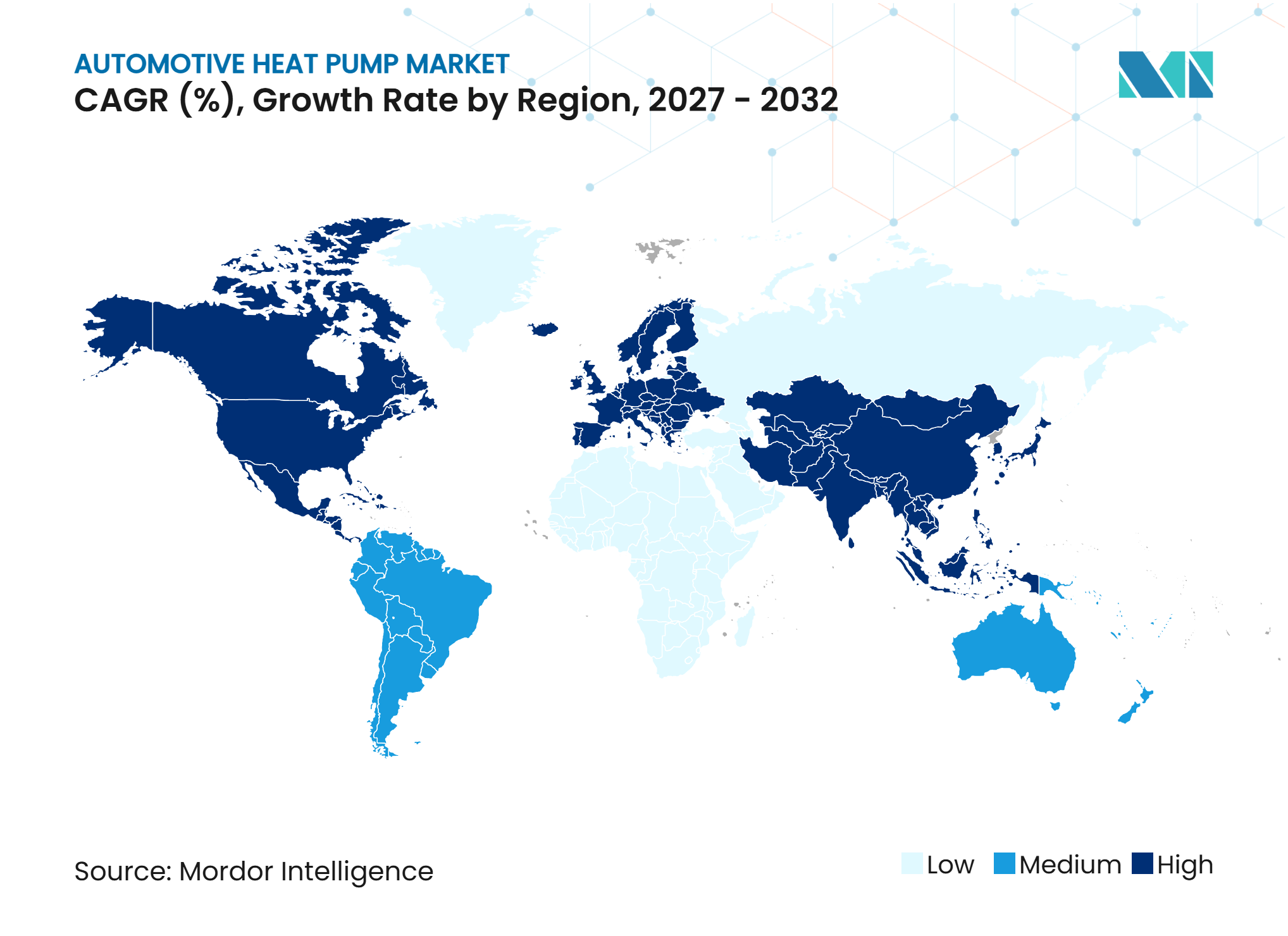
Asia-Pacific held 49.85% of the automotive heat pump market share in 2026 and is projected to grow at a 15.13% CAGR through 2032. China is the central source of demand because of its high battery electric vehicle output and its planned refrigerant transition for new passenger-car systems. The policy timetable is encouraging local and global OEMs to make refrigerant and thermal-architecture decisions earlier in the platform cycle. Domestic suppliers are strengthening their position in valves, heat exchangers, pumps, and integrated thermal assemblies for new-energy vehicles. South Korea and Japan continue to contribute compressor and system engineering that supports European and Asian vehicle programs. India, Southeast Asia, and Australia are developing opportunities as electric vehicle adoption and charging access broaden.
Europe: Regulatory Stringency Accelerates Premium Integration
Europe is a high-growth region for the automotive heat pump market because its vehicle and refrigerant rules have encouraged earlier thermal-system development. The EU mobile air-conditioning framework and F-Gas Regulation create a strong compliance influence on refrigerant selection. Cold winters in Germany, Scandinavia, and the Benelux countries strengthen the value of efficient cabin heating in battery electric vehicles. European premium brands have also moved early on integrated thermal management and R744 designs. These conditions make the region an important proving ground for higher-value modules. Local manufacturing of specialized compressors and thermal assemblies supports the supplier ecosystem.
North America, South America, Middle East and Africa, and Oceania: Different Adoption Paths
North America has medium growth potential in the automotive heat pump market, supported by electric vehicle adoption and cold-climate demand in Canada and northern U.S. states. The U.S. EPA’s mobile air-conditioning program remains a key regulatory influence because refrigerant acceptability affects the range of systems suppliers can commercialize [3]. Canada offers an early case for R744 service readiness through vehicle programs that require suitable dealer equipment. South America and Africa have lower growth potential because electric vehicle infrastructure and refrigerant-policy urgency are less developed. Price sensitivity also makes it harder to include more costly thermal systems as standard equipment. These regions may adopt heat pumps more gradually as charging access, vehicle choice, and service capability improve.
Competitive Landscape
Market Concentration

The automotive heat pump market is moderately concentrated, led by DENSO Corporation, Hanon Systems, Valeo SE, MAHLE GmbH, and Sanden Corporation. Their position is supported by long-standing OEM design relationships and the ability to supply more than one part of the thermal system. DENSO and Hanon Systems are notable for compressor capability, which remains important to system performance and supply security. Hanon Systems has built R744 compressor volume for Volkswagen Group’s MEB platform, showing how a supplier can become closely tied to a specific OEM architecture. These relationships can provide stability, but they also expose suppliers to vehicle-program concentration. Chinese suppliers, including Sanhua, Yinlun, Tuopu, and Aotecar, are increasing competitive pressure in components and thermal assemblies.
Competition is moving from component performance toward integrated systems and control software. Suppliers that own the thermal-control logic can provide calibration, diagnostics, and potential over-the-air updates as part of a wider package. This can create stronger switching costs than a commodity component relationship. DENSO’s work on a heat-pump defrosting technology that recovers waste heat reflects the value of technical differentiation within a mature component category. MAHLE’s HeatX Range+ shows another route, using heat recovery to reduce air-conditioning energy demand in electric vehicles [4]. The ability to combine proprietary controls with validated hardware will remain a central competitive factor.
There are open opportunities in lower-cost battery electric vehicles, commercial vehicle modules, and designs using refrigerants that may reduce future policy exposure. Suppliers must still demonstrate that their products can be serviced safely and economically in each sales region. Regulatory compliance is becoming part of supplier qualification rather than a downstream documentation issue. The leading companies are therefore investing in several refrigerant routes and packaging formats rather than relying on a single system design. The automotive heat pump market remains concentrated around established Tier-1 suppliers, but regional specialists can gain share where they offer lower-cost and locally adapted solutions.
Automotive Heat Pump Industry Leaders
-
DENSO Corporation
-
Hanon Systems
-
Valeo SE
-
MAHLE GmbH
-
Sanden Corporation
- *Disclaimer: Major Players sorted in no particular order
Automotive Heat Pump Market Companies Covered in this Report
- DENSO Corporation
- Hanon Systems
- MAHLE GmbH
- Valeo SE
- Sanden Corporation
- Mitsubishi Heavy Industries Thermal Systems, Ltd.
- Webasto SE
- Sanhua Automotive
- Aotecar
- Ningbo Tuopu Group Co., Ltd.
- Shanghai Highly (Group) Co., Ltd.
- Eberspaecher Group
- Konvekta AG
- Rheinmetall AG
- Robert Bosch GmbH
Recent Industry Developments in Automotive Heat Pump Market
- November 2026: Hanon Systems hosted a technology showcase with MSIL to exchange technical expertise and present next-generation thermal management technologies. The portfolio included heating, ventilation, and air conditioning (HVAC) systems, compressors, heat pump systems, integrated thermal management modules, and other key technologies.
- October 2026: Volkswagen adapted its CO2 (R744) heat pump to provide cooling and heating for its new subcompact electric vehicle class. The new design increased complexity on the coolant [glycol] side while slightly simplifying the refrigerant circuit. It also used CO2 check valves for the first time.
- June 2026: Sanden Corporation secured its first business for its newly developed high-capacity PX compressor, “Large PX (180cc),” from a major European OEM. Mass production is scheduled to begin in 2028, marking Sanden’s first production program in the high-capacity PX segment.
- February 2026: MAHLE introduced an innovative heat recovery system for efficient cabin heating in electric vehicles. Heating significantly affects EV range, particularly during winter. MAHLE HeatX Range+ reduces the energy demand for air conditioning in electric vehicles by approximately 20% compared with conventional exhaust air systems.
Global Automotive Heat Pump Market Report Scope
The scope includes segmentation by refrigerant type (R1234yf, R744 (CO2), and others (R134a, R290 secondary loop)); system architecture (direct (refrigerant-to-air) and indirect and secondary loop (refrigerant-to-coolant)); packaging (integrated thermal management module (multi-way valve) and discrete component systems); component (electric compressor, heat exchangers (chiller, condenser, and evaporator), valves and expansion devices, and controls and others); propulsion type (battery electric vehicles, plug-in hybrid electric vehicles, and others (HEV, FCEV, ICE)); and vehicle type (passenger cars, light commercial vehicles, and medium and heavy commercial vehicles (trucks and buses)). The analysis also covers regional-level segmentation, including North America, Europe, Asia-Pacific, South America, and the Middle East and Africa. Market size and growth forecasts are presented by value in USD and volume in Units.
Segmentation Overview
| R1234yf |
| R744 (CO2) |
| Others (R134a, R290 Secondary Loop) |
| Direct (Refrigerant-to-Air) |
| Indirect and Secondary Loop (Refrigerant-to-Coolant) |
| Integrated Thermal Management Module (Multi-Way Valve) |
| Discrete Component Systems |
| Electric Compressor |
| Heat Exchangers (Chiller, Condenser, Evaporator) |
| Valves and Expansion Devices |
| Controls and Others |
| Battery Electric Vehicles |
| Plug-in Hybrid Electric Vehicles |
| Others (HEV, FCEV, ICE) |
| Passenger Cars |
| Light Commercial Vehicles |
| Medium and Heavy Commercial Vehicles (Trucks, Buses) |
| North America | United States |
| Canada | |
| Rest of North America | |
| Europe | Germany |
| United Kingdom | |
| France | |
| Italy | |
| Spain | |
| Sweden | |
| Norway | |
| Netherlands | |
| Belgium | |
| Russia | |
| Rest of Europe | |
| Asia-Pacific | China |
| Japan | |
| South Korea | |
| India | |
| Australia | |
| Thailand | |
| Indonesia | |
| Malaysia | |
| Rest of Asia-Pacific | |
| South America | Brazil |
| Argentina | |
| Colombia | |
| Chile | |
| Rest of South America | |
| Middle East and Africa | Turkey |
| Saudi Arabia | |
| United Arab Emirates | |
| Israel | |
| South Africa | |
| Egypt | |
| Morocco | |
| Rest of Middle East and Africa |
| By Refrigerant Type | R1234yf | |
| R744 (CO2) | ||
| Others (R134a, R290 Secondary Loop) | ||
| By System Architecture | Direct (Refrigerant-to-Air) | |
| Indirect and Secondary Loop (Refrigerant-to-Coolant) | ||
| By Packaging | Integrated Thermal Management Module (Multi-Way Valve) | |
| Discrete Component Systems | ||
| By Component | Electric Compressor | |
| Heat Exchangers (Chiller, Condenser, Evaporator) | ||
| Valves and Expansion Devices | ||
| Controls and Others | ||
| By Propulsion | Battery Electric Vehicles | |
| Plug-in Hybrid Electric Vehicles | ||
| Others (HEV, FCEV, ICE) | ||
| By Vehicle Type | Passenger Cars | |
| Light Commercial Vehicles | ||
| Medium and Heavy Commercial Vehicles (Trucks, Buses) | ||
| By Geography | North America | United States |
| Canada | ||
| Rest of North America | ||
| Europe | Germany | |
| United Kingdom | ||
| France | ||
| Italy | ||
| Spain | ||
| Sweden | ||
| Norway | ||
| Netherlands | ||
| Belgium | ||
| Russia | ||
| Rest of Europe | ||
| Asia-Pacific | China | |
| Japan | ||
| South Korea | ||
| India | ||
| Australia | ||
| Thailand | ||
| Indonesia | ||
| Malaysia | ||
| Rest of Asia-Pacific | ||
| South America | Brazil | |
| Argentina | ||
| Colombia | ||
| Chile | ||
| Rest of South America | ||
| Middle East and Africa | Turkey | |
| Saudi Arabia | ||
| United Arab Emirates | ||
| Israel | ||
| South Africa | ||
| Egypt | ||
| Morocco | ||
| Rest of Middle East and Africa | ||
Key Questions Answered in the Report
How large is the automotive heat pump market in 2026?
The automotive heat pump market size is forecast to reach USD 8.87 billion by 2032, from USD 4.12 billion in 2026, at a CAGR of 13.50%.
Which refrigerant leads automotive heat-pump applications?
R1234yf held 78.07% of the refrigerant segment in 2026, while R744 will be the fastest-growing refrigerant choice through 2032.
Which vehicle type is creating the next heat-pump opportunity?
Light commercial vehicles are projected to grow at a 17.67% CAGR through 2032.
Which region leads automotive heat-pump demand?
Asia-Pacific held 49.85% in 2026 and is projected to grow at a 15.13% CAGR through 2032, supported by electric vehicle production and refrigerant-policy changes.