
Automotive Grille Market Size and Share
Market Overview
| Study Period | 2020 - 2032 |
|---|---|
| Market Size (2027) | USD 9.81 Billion |
| Market Size (2032) | USD 12.41 Billion |
| Growth Rate (2027 - 2032) | 4.81 % |
| Fastest Growing Market | Asia-Pacific |
| Largest Market | Asia-Pacific |
| Market Concentration | Medium |
Major Players *Disclaimer: Major Players sorted in no particular order Image © Mordor Intelligence. Reuse requires attribution under CC BY 4.0. | |
Automotive Grille Market Analysis by Mordor Intelligence
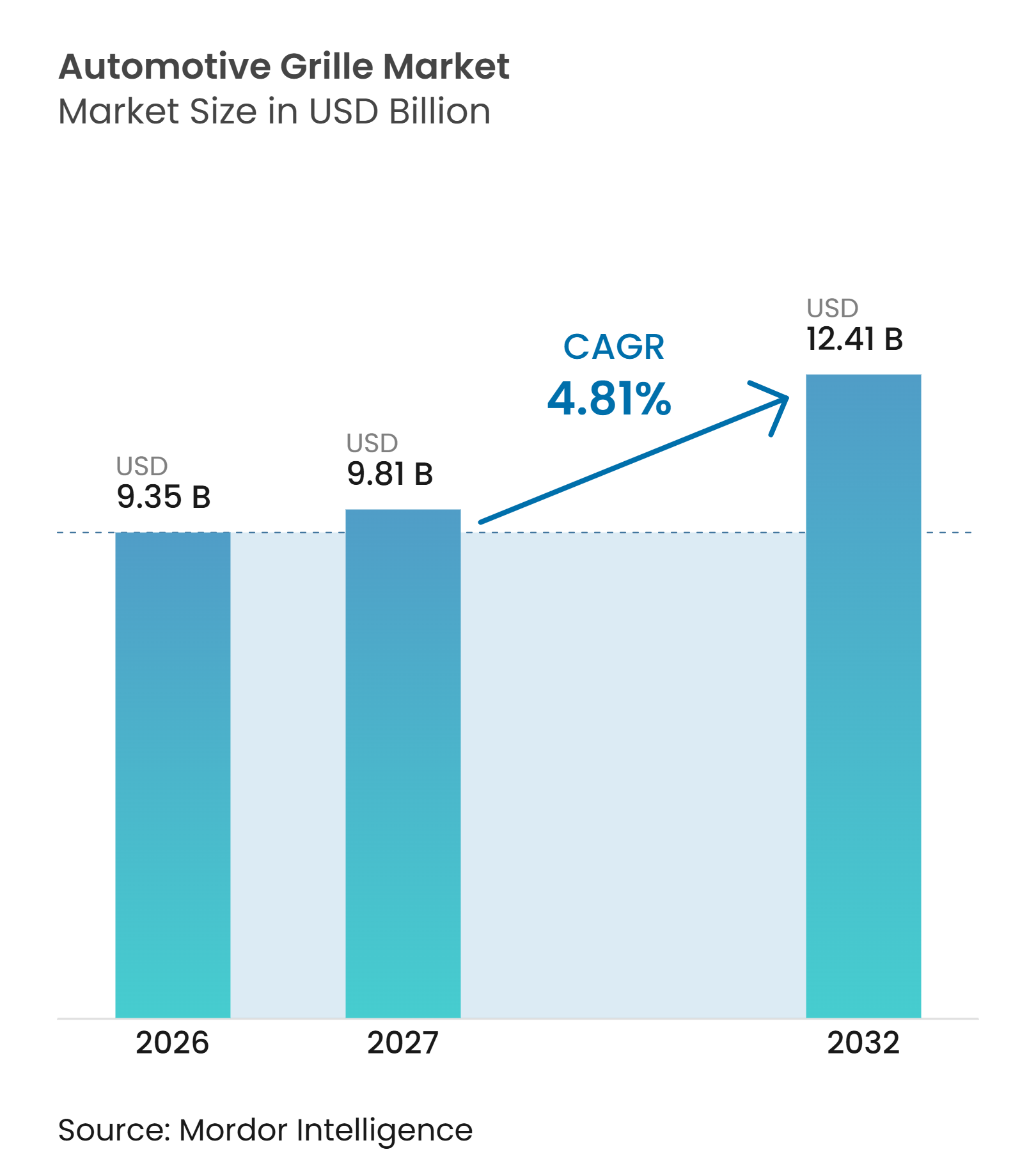
Automotive Grille Market size was valued at USD 9.35 billion in 2026, is estimated at USD 9.81 billion in 2027, and is projected to reach USD 12.41 billion by 2032, registering a CAGR of 4.81% between 2027 and 2032. The automotive grille market is moving beyond conventional cooling apertures toward front-end modules that combine airflow control, lighting, and sensor accommodation. Global vehicle production reached 96.4 million units in 2025, which widened the installed base for new grille fitments. Battery-electric vehicle programs reduce demand for open radiator grilles, but they raise requirements for lower air intakes, active shutters, illuminated panels, and radar-transparent covers. This shifts supplier value toward parts that can address aerodynamic performance, thermal management, and vehicle identity in one assembly. The automotive grille market therefore favors suppliers that can replace passive content with active or sensor-integrated alternatives.
Key Report Takeaways
-
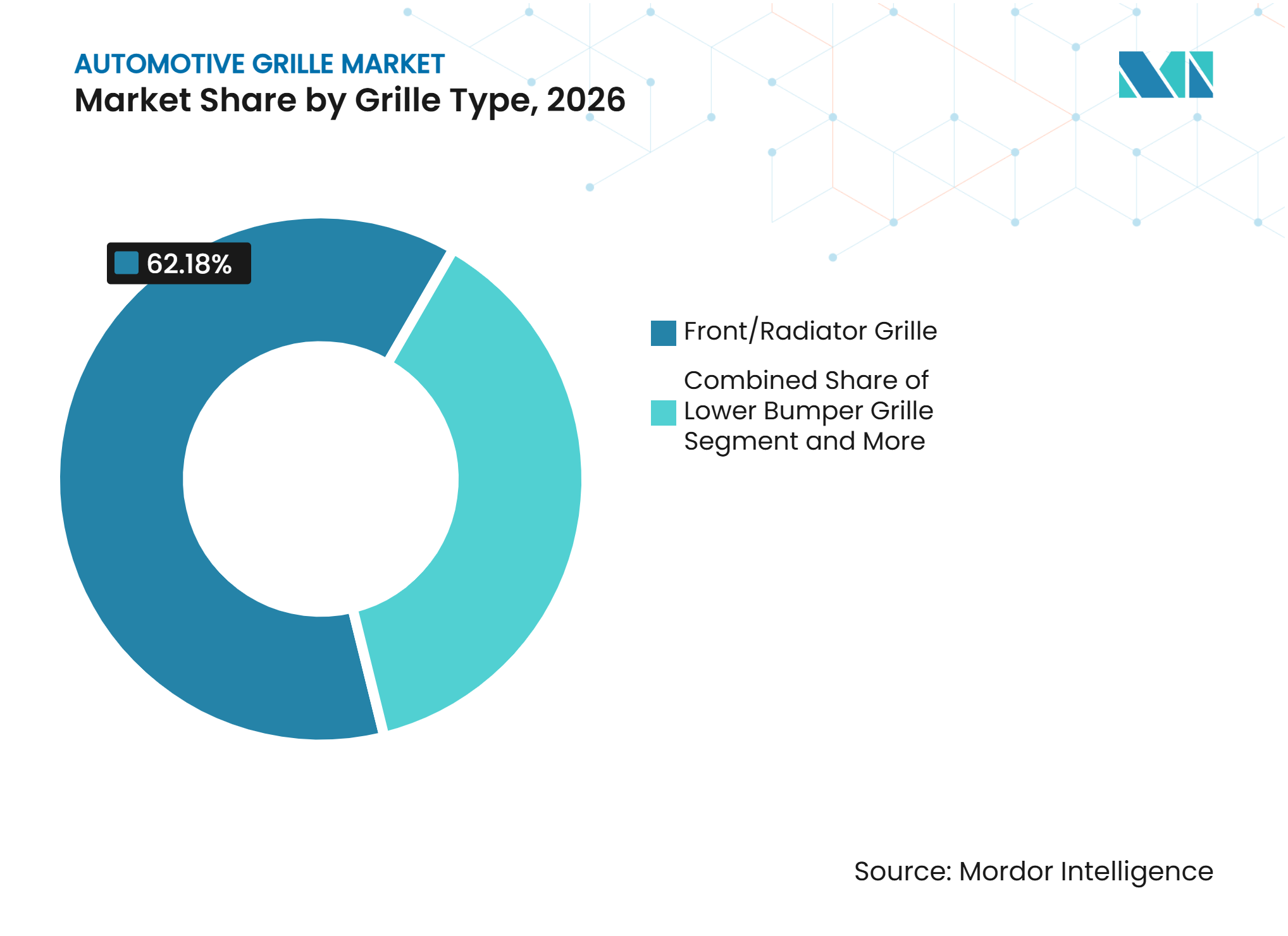
By grille type, front/radiator grilles held 62.18% of the automotive grille market share in 2026, while active grille shutters are forecast to grow at a 7.44% CAGR through 2032.
-
By material, ABS and PC-ABS held 64.27% revenue share in 2026. No separate CAGR was provided for the fastest-growing material segment.
-
By finish, painted grilles held 42.18% revenue share in 2026, while other finishes are forecast to expand at a 5.94% CAGR through 2032.
-
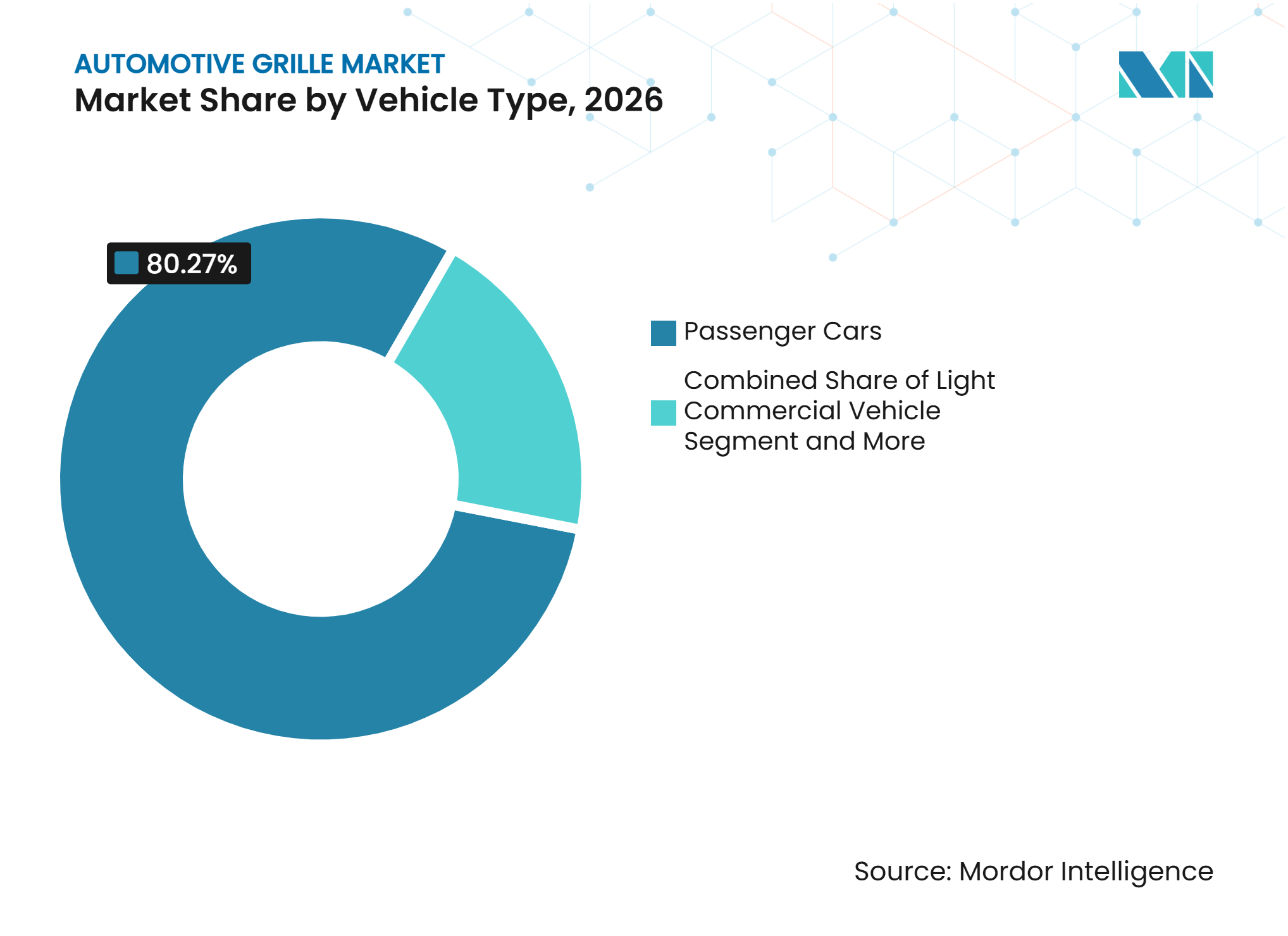
By vehicle type, passenger cars held 80.27% revenue share in 2026. No separate CAGR was provided for the fastest-growing vehicle type segment.
-
By sales channel, OEMs held 83.27% revenue share in 2026. No separate CAGR was provided for the fastest-growing sales channel segment.
-
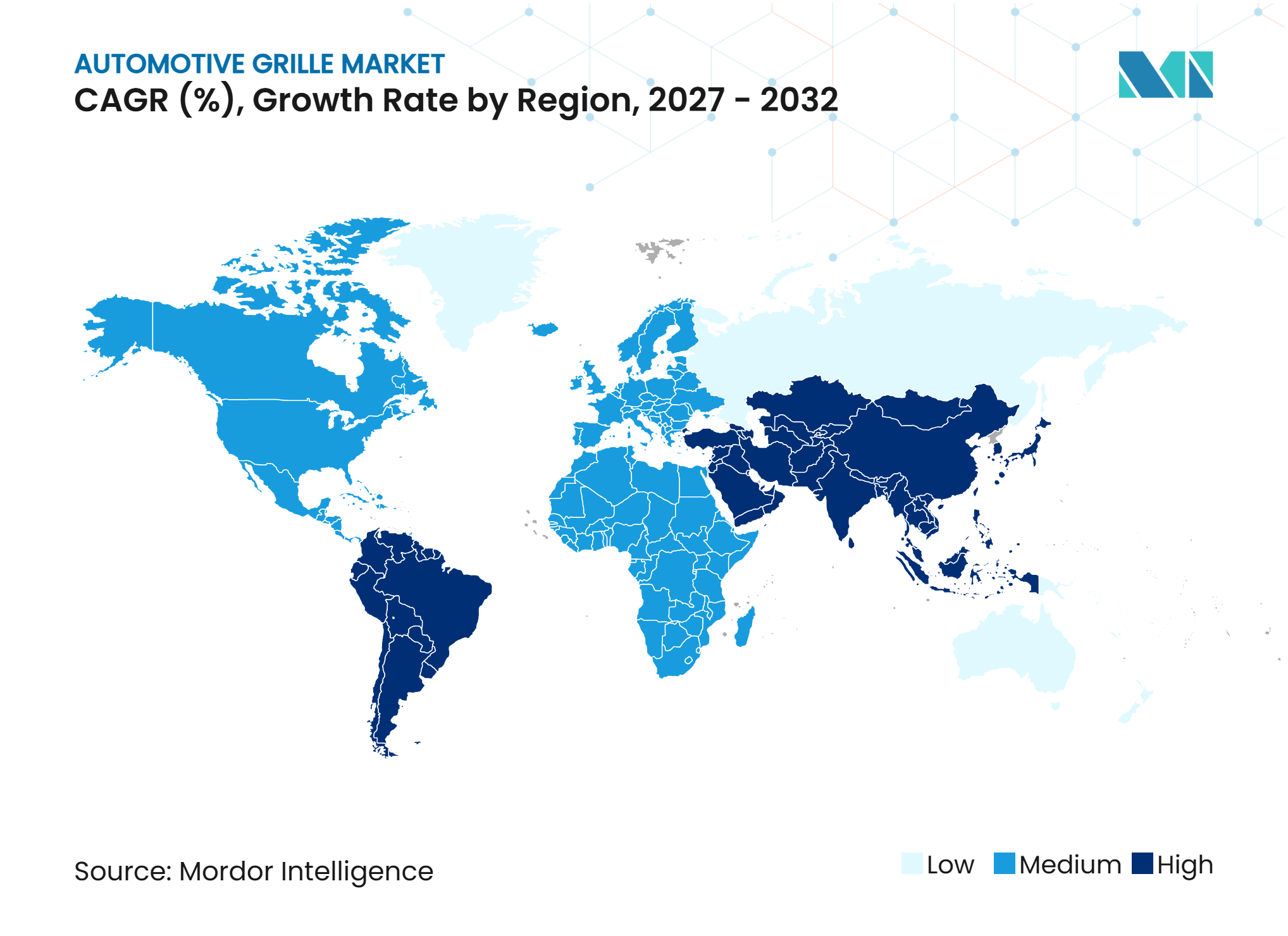
By geography, Asia-Pacific held 32.18% of the automotive grille market size in 2026 and is projected to expand at a 5.98% CAGR through 2032.
Note: Market numbers in this report are based on Mordor Intelligence's proprietary estimation framework, which combines nine months of actuals with Q4 projections for base year 2026.
Market Trends and Insights
Drivers Impact Analysis of Automotive Grille Market*
| Driver | (~) % Impact on CAGR Forecast | Geographic Relevance | Impact Timeline |
|---|---|---|---|
| Vehicle Production and Replacement Demand | +1.0% | Global, led by China, India, and Mexico | Short term (≤ 2 years) |
| Active Shutters for Aerodynamics and Thermal Control | +0.9% | North America, Europe, and Asia-Pacific | Medium term (2-4 years) |
| EV Front-End Styling and Range Optimization | +0.6% | China and Europe, with spillover to India and Southeast Asia | Medium term (2-4 years) |
| Illuminated and Sensor-Compatible Grilles | +0.5% | Europe, North America, and Japan | Long term (≥ 4 years) |
| OEM Front-End Module Integration | +0.4% | Global, with major programs in Germany and South Korea | Medium term (2-4 years) |
| Lightweight Recyclable Polymer Use | +0.4% | Global, especially Europe and China | Long term (≥ 4 years) |
| Source: Mordor Intelligence | |||
Vehicle Production and Replacement Demand
Global vehicle production reached 96.4 million units in 2025, up 3.9% from 2024. China produced 34.53 million vehicles, while India produced a record 6.49 million units during the year[1]. This higher output creates a larger base of new grille installations across passenger and commercial vehicles. Shorter model cycles in China and India can increase refresh activity for exterior components compared with longer European development cycles. Replacement demand is also supported by collision repairs, corrosion exposure, and vehicle customization in high-volume markets. Passenger car production rose 5% to 71.3 million units in 2025, sustaining demand across the automotive grille market.
Active Shutters for Aerodynamics and Thermal Control
Active grille shutters are becoming relevant to both combustion vehicles and electric vehicles. A 2025 SAE technical paper found that optimized shutter angles reduced drag coefficients by 3.21% to 3.88% in hybrid light commercial vehicles[2]. This improvement can reduce fuel use without changing the powertrain. The automotive grille market benefits because shutters add actuators, controls, and engineering content beyond a fixed molded part. A modular shutter system can also help vehicle makers apply a common solution across different platform widths. These benefits support continued adoption where fuel-economy rules and range targets influence vehicle design.
EV Front-End Styling and Range Optimization
Electric vehicles are changing the location and role of front-end airflow components. Battery packs and power electronics require managed cooling paths that are separate from a conventional engine radiator. Lower bumper grilles are therefore taking on a larger role in airflow and heat management. The Škoda Enyaq sealed the gap between its radiator panel and hood, achieved a 0.245 drag coefficient, and gained 13 km of WLTP range[3]. SAE research on standardized electric vehicle models also links front intake geometry with the balance between aerodynamic drag and heat dissipation. This leaves the automotive grille market with less conventional upper-grille content but more complex lower-fascia work.
Illuminated and Sensor-Compatible Grilles
Vehicle makers increasingly use the front face as a recognizable lighting and sensor surface. Mercedes-Benz presented the GLC EV with a 942-pixel illuminated grille panel in 2025. FORVIA’s Front Phygital Shield on the BMW iX3 combines radar-transparent surfaces, lighting, heating, and embedded driver-assistance sensors. These designs combine functions that were previously handled by separate grille, lighting, and sensor parts. They also increase the importance of polymer selection, signal transmission, sealing, and thermal design. The automotive grille market gains value where suppliers can deliver these integrated assemblies at vehicle-program scale. The approach is particularly relevant for premium electric vehicles that need a distinctive front-end design without a large radiator opening.
Restraints Impact Analysis of Automotive Grille Market*
| Restraint | (~) % Impact on CAGR Forecast | Geographic Relevance | Impact Timeline |
|---|---|---|---|
| Grille-Less EV Architectures | -1.2% | China, Europe, and India | Long term (≥ 4 years) |
| Validation and Integration Costs | -0.8% | Global, especially Germany and Japan | Medium term (2-4 years) |
| Finish Durability and Repair Constraints | -0.3% | North America and Europe | Medium term (2-4 years) |
| Material, Electronics, and Tooling Cost Volatility | -0.5% | Global, with exposure in North America and China | Short term (≤ 2 years) |
| Source: Mordor Intelligence | |||
Grille-Less EV Architectures
Battery-electric vehicles without conventional radiators have less need for open front grilles. Their closed panels can remove passive grille content from the upper front end. The resulting demand shifts toward lower air inlets, decorative surfaces, illuminated panels, and sensor covers. This creates a structural challenge for suppliers focused only on fixed radiator grilles. The automotive grille market can still grow where active shutters and integrated panels offset part of this loss. However, the value of passive content per vehicle can decline as electric vehicle adoption increases.
Validation and Integration Costs
Active and illuminated modules require more validation than passive injection-molded grilles. Actuators, electronic controls, heating systems, lighting, and radar-transparent surfaces must perform together under vehicle-level requirements. This increases development time and makes new systems harder to deploy on lower-priced vehicle programs. Finish durability and repairability also add complexity where painted, chrome, or dark finishes must match adjacent panels. Changes in polymer, metal, electronics, and tooling costs can further limit supplier margins. These pressures favor manufacturers with established vehicle-program processes and sufficient scale to absorb validation investment.
*Our forecasts treat driver/restraint impacts as directional, not additive. The impact forecasts reflect baseline growth, mix effects, and variable interactions.
Automotive Grille Market Segment Analysis
By Grille Type:
Active Shutters Expand the Role of Front-End Airflow ControlFront/radiator grilles held 62.18% of global grille revenue in 2026, reflecting the continued scale of combustion and hybrid vehicle fleets. Active grille shutters are expected to record a 7.44% CAGR through 2032, which makes them the fastest-growing grille type. Fixed front grilles remain important because they support cooling, styling, and brand recognition on mass-market vehicles. Their established position also reflects the large number of vehicles that still use engine radiators. Lower bumper grilles are gaining technical importance on electric vehicles as they direct air toward battery and electronics cooling systems.
The automotive grille market size for active shutter assemblies rises with the number of actuators, sensors, and control functions specified by the vehicle maker. Shutters can close to improve aerodynamic efficiency and open when cooling demand increases. This active control helps manufacturers manage different operating conditions without redesigning the whole front surface. It makes shutters relevant to fuel economy in combustion vehicles and range performance in electric vehicles. Integrated shutter and lighting designs can further increase the value of a front-end module. Conventional front/radiator grilles retain volume, but their content value can fall where entry-level programs use simpler designs.



By Material:
ABS and PC-ABS Retain a Broad Manufacturing AdvantageABS and PC-ABS accounted for 64.27% of global grille revenue in 2026. Their position reflects established molding processes, paint compatibility, and suitability for plated decorative parts. These materials can support high production volumes while meeting styling requirements across passenger vehicles. They provide manufacturers with flexibility to produce complex shapes for front grilles and lower apertures. Their established supply chains also fit the procurement needs of high-volume vehicle programs.
The automotive grille market continues to use polymers because vehicle makers seek lower component weight and flexible surface design. These materials can support precise geometry around air inlets, mounting points, and visible front surfaces. Radar-transparent areas may require carefully selected uncoated or compatible polymer grades when sensors sit behind the front surface. Metals remain relevant in commercial and premium applications that need rigidity or a distinctive appearance. Other plastics include polypropylene and reinforced engineering grades used in lower bumper openings. Recycled content is becoming more relevant where vehicle makers include sustainability criteria in exterior-component sourcing.
By Finish:
Painted Surfaces Lead as Chrome and Dark Treatments EvolvePainted grilles held 42.18% of global grille revenue in 2026, supported by their cost position and compatibility with body-color styling. Painted surfaces are widely used in high-volume programs because suppliers can align the grille with the vehicle’s surrounding panels. This finish also works with a range of front-end designs, from visible openings to closed decorative panels. Chrome remains significant in premium applications, where it can frame illuminated or branded front surfaces. Its use is becoming more selective as suppliers consider alternative finishing processes and durability requirements.
Other finishes are forecast to grow at a 5.94% CAGR through 2032. Gloss-black and mesh treatments are used on pickup trucks, performance sport utility vehicles, and crossovers. These finishes can support a darker appearance while allowing sensor-compatible designs. Their use can help vehicle makers place technical elements behind a cleaner front surface. They are therefore not solely a styling choice in advanced driver-assistance applications. The automotive grille market will continue to balance cost, appearance, repairability, and sensor transmission when selecting finishes.
By Vehicle Type:
Passenger Cars Maintain the Largest Installed BasePassenger cars held 80.27% of global grille revenue in 2026. Their leadership follows the global scale of passenger vehicle production and their wide range of grille specifications. Premium passenger cars increasingly use illuminated, active, and sensor-compatible assemblies. High-volume models are more likely to use painted plastic designs to control vehicle cost. This split allows the passenger car segment to support both basic and higher-value front-end modules.
Global passenger car production reached 71.3 million units in 2025, up 5% from the prior year. This production base supports continued demand for exterior components even as electric vehicles reduce the need for conventional upper grilles. Light commercial vehicles can benefit from active shutters where aerodynamic efficiency and fuel use matter. Heavy commercial vehicles also have a clear efficiency case, especially where long-distance operation makes air resistance costly. The underlying use case differs by vehicle class, but airflow management remains relevant across each class. These patterns keep passenger cars central to the automotive grille industry while creating adjacent opportunities in commercial platforms.

By Sales Channel:
OEM Nominations Determine Most Program RevenueThe OEM channel accounted for 83.27% of global grille revenue in 2026. Grille suppliers are usually selected during vehicle development, well before series production begins. The supplier must meet the vehicle maker’s design, validation, manufacturing, and quality requirements. Once a module is nominated, the supplier is embedded in the vehicle’s front-end architecture and quality process. This makes OEM sourcing relationships central to revenue stability in the automotive grille market.
OPmobility secured a bumper and grille contract in India for a light-duty truck model and delivered a production-ready solution in under 15 months. Faster development can be important in markets where manufacturers shorten model cycles. The aftermarket serves repair demand and customers seeking cosmetic changes, including gloss-black mesh or illuminated upgrades. Fitment accuracy and price remain important for functional replacement parts. Vehicle age, accident repair patterns, and customization demand can influence this channel. OEM-exclusive designs can limit direct substitution on premium vehicle lines.
Geography Analysis
Asia-Pacific: Production Scale Supports the Fastest Regional Expansion
Asia-Pacific held 32.18% of automotive grille market size in 2026 and is forecast to grow at a 5.98% CAGR through 2032. China produced 34.53 million vehicles in 2025, while new-energy vehicle output reached 16.63 million units. India produced 6.49 million vehicles in the same year, which extended the region’s supplier base. These production levels create broad demand for both standard exterior parts and advanced front-end modules. Electric vehicle growth shifts regional demand toward lower air inlets, active shutters, and sensor-ready surfaces.
North America: Efficiency Requirements Favor Active Shutter Adoption
North America produced 18.74 million vehicles in 2025, including 10.24 million units in the United States. The region has a large base of pickup trucks and sport utility vehicles where grille design, airflow control, and aftermarket styling remain relevant. Active shutters are well suited to programs where fuel efficiency and aerodynamic performance are important. Localizing front-end module production can help suppliers serve vehicle makers with shorter and more responsive supply chains.
Europe, South America, and the Middle East and Africa: Regulation and Local Demand Shape Different Paths
Europe produced 17.2 million vehicles in 2025 and remains influential in exterior-component specifications. Suppliers serving European programs must address quality management, material compliance, and the need for sensor-compatible designs. Nissha opened a German plant in 2025 for mobility exterior parts, including front grilles, which doubled its European production capacity. Brazil produced 2.64 million vehicles in 2025, providing a growing base for bumper and grille module supply. Africa’s vehicle sales increased 22% to 1.29 million units in 2025, with aftermarket replacement demand remaining more significant than OEM sourcing at this stage
Competitive Landscape
Market Concentration

The automotive grille industry is moderately concentrated, with major Tier-1 suppliers holding leading positions, although regional specialists compete in lower-cost and aftermarket applications. Magna International, OPmobility, Röchling, Valeo, FORVIA, Samvardhana Motherson, Nissha, and MINTH Group compete through front-end integration, material capability, and manufacturing footprint. The strongest suppliers can package grilles with bumper carriers, lighting, air-management parts, and sensor infrastructure. OEM nominations also favor companies with established validation processes and global quality systems.
Technology is increasingly a point of competition in the automotive grille market. FORVIA has integrated radar-transparent surfaces, lighting, heating, and driver-assistance sensors through its Front Phygital Shield application. Mercedes-Benz has used a 942-pixel illuminated grille design on the GLC EV to maintain front-end brand recognition. OPmobility demonstrated a shorter development cycle through its India bumper and grille program.
Cost remains a constraint in the automotive grille market, especially for active shutters and illuminated systems on lower-priced vehicles. Suppliers that standardize these systems can address a wider portion of vehicle volume without requiring fully bespoke engineering. Quality management and material compliance remain important for access to major OEM programs. Ownership changes can reshape capabilities in lighting and illuminated panel supply. This competitive structure rewards suppliers that combine design, electronics, surface finishing, and program management.
Automotive Grille Industry Leaders
-
Magna International Inc.
-
OPmobility SE
-
Valeo SE
-
Koch Industries, Inc.
-
FORVIA HELLA
- *Disclaimer: Major Players sorted in no particular order
Automotive Grille Market Companies Covered in this Report
- Magna International Inc.
- OPmobility SE
- Röchling SE & Co. KG
- Valeo SE
- Koch Industries, Inc.
- Toyoda Gosei Co., Ltd.
- Hyundai Mobis Co., Ltd.
- Samvardhana Motherson International Limited
- MINTH Group Limited
- Flex-N-Gate Corporation
- Montaplast GmbH
- Seoyon E-Hwa Co., Ltd.
- REHAU Industries SE & Co. KG
- Ningbo Huaxiang Electronic Co., Ltd.
- FORVIA HELLA
- Brose Fahrzeugteile SE & Co. KG
- Polytec Holding AG
- KIRCHHOFF Automotive GmbH & Co. KG
- Marelli Holdings Co., Ltd.
Recent Industry Developments in Automotive Grille Market
- July 2026: Röchling Automotive was nominated by Leapmotor International to supply active aerodynamics, exterior, and airflow management components for future European vehicle programs, with production at its plant in Araia, Spain. The award reflects growing demand for front-end airflow control solutions on electric vehicle platforms.
- June 2026: OPmobility announced the construction of a new exterior-systems manufacturing plant in the greater Toledo area of Ohio, United States. The facility will manufacture exterior components, including bumpers, grilles, and tailgates, with production scheduled to begin in the second half of 2027. The investment expands OPmobility’s North American manufacturing capacity and strengthens its proximity to automotive customers in the Midwest, a region accounting for more than 40% of United States automotive production.
- April 2026: Valeo, a global leader in automotive lighting and wiping systems, and RESRG Automotive, a major supplier of coated exterior systems and components, have expanded their strategic partnership to develop illuminated front panels and other plastic-based exterior components, including grilles, bumpers, spoilers, tailgates and rocker panels. Initially established in 2022 to serve Europe and North America, the collaboration has now been extended to include China.
- March 2026: FORVIA HELLA began series production of the first Front Phygital Shields for the all-electric BMW iX3. The front-end module integrates lighting, styling elements, and sensors, featuring vertically set BMW kidney grilles that can optionally be illuminated, along with a heated radar cover that keeps driver-assistance sensors clear of ice and snow.
Global Automotive Grille Market Report Scope
The Automotive Grille Market is segmented by grille type, material, finish, vehicle type, sales channel, and geography. By grille type, the market is segmented into front/radiator grilles, lower bumper grilles, and active grille shutters. By material, the market is segmented into ABS and PC-ABS, other plastics, and metals, including stainless steel and aluminum. By finish, the market is segmented into chrome, painted, and other finishes, including gloss black and mesh. By vehicle type, the market is segmented into passenger cars, light commercial vehicles (LCVs), and heavy commercial vehicles (HCVs). By sales channel, the market is segmented into OEM and aftermarket. By geography, the market is segmented into North America (United States, Canada, and Mexico), Europe (Germany, France, Italy, United Kingdom, Spain, Russia, and Rest of Europe), Asia-Pacific (China, Japan, India, South Korea, Australia, and Rest of Asia-Pacific), South America (Brazil, Argentina, and Rest of South America), and Middle East and Africa (Middle East, including Saudi Arabia, United Arab Emirates, Turkey, and Rest of Middle East, and Africa, including South Africa, Egypt, and Rest of Africa).
Segmentation Overview
| Front/Radiator Grille |
| Lower Bumper Grille |
| Active Grille Shutters |
| ABS and PC-ABS | |
| Other Plastics | |
| Metals | Stainless Steel |
| Aluminum |
| Chrome | |
| Painted | |
| Other Finishes | Gloss Black |
| Mesh |
| Passenger Cars |
| Light Commercial Vehicles |
| Heavy Commercial Vehicles |
| OEM |
| Aftermarket |
| North America | United States |
| Canada | |
| Mexico | |
| Europe | Germany |
| France | |
| Italy | |
| United Kingdom | |
| Spain | |
| Russia | |
| Rest of Europe | |
| Asia-Pacific | China |
| Japan | |
| India | |
| South Korea | |
| Australia | |
| Rest of Asia-Pacific | |
| South America | Brazil |
| Argentina | |
| Rest of South America | |
| Middle East and Africa | Middle East |
| Saudi Arabia | |
| United Arab Emirates | |
| Turkey | |
| Rest of Middle East | |
| Africa | |
| South Africa | |
| Egypt | |
| Rest of Africa |
| By Grille Type | Front/Radiator Grille | |
| Lower Bumper Grille | ||
| Active Grille Shutters | ||
| By Material | ABS and PC-ABS | |
| Other Plastics | ||
| Metals | Stainless Steel | |
| Aluminum | ||
| By Finish | Chrome | |
| Painted | ||
| Other Finishes | Gloss Black | |
| Mesh | ||
| By Vehicle Type | Passenger Cars | |
| Light Commercial Vehicles | ||
| Heavy Commercial Vehicles | ||
| By Sales Channel | OEM | |
| Aftermarket | ||
| By Geography | North America | United States |
| Canada | ||
| Mexico | ||
| Europe | Germany | |
| France | ||
| Italy | ||
| United Kingdom | ||
| Spain | ||
| Russia | ||
| Rest of Europe | ||
| Asia-Pacific | China | |
| Japan | ||
| India | ||
| South Korea | ||
| Australia | ||
| Rest of Asia-Pacific | ||
| South America | Brazil | |
| Argentina | ||
| Rest of South America | ||
| Middle East and Africa | Middle East | |
| Saudi Arabia | ||
| United Arab Emirates | ||
| Turkey | ||
| Rest of Middle East | ||
| Africa | ||
| South Africa | ||
| Egypt | ||
| Rest of Africa | ||
Key Questions Answered in the Report
What is driving automotive grille demand through 2032?
Vehicle production, active shutter adoption, electric-vehicle airflow needs, and integrated lighting and sensor functions support growth. The automotive grille market is projected to grow at a 4.81% CAGR through 2032.
Which grille type is growing the fastest?
Active grille shutters are the fastest-growing grille type, with a projected 7.44% CAGR through 2032. They improve airflow control for both combustion and electric vehicles.
Why are lower bumper grilles becoming more important on electric vehicles?
Electric vehicles need managed airflow for battery packs and power electronics. Lower front-end openings increasingly carry that function as upper radiator openings become smaller or closed.
Which region leads the automotive grille market?
Asia-Pacific led with a 32.18% share in 2026 and is forecast to grow at a 5.98% CAGR through 2032. China and India provide the region’s major vehicle-production base.