
Automotive Gear Position Sensor Market Size and Share
Market Overview
| Study Period | 2020 - 2032 |
|---|---|
| Market Size (2027) | USD 2.81 Billion |
| Market Size (2032) | USD 3.56 Billion |
| Growth Rate (2027 - 2032) | 4.85 % |
| Fastest Growing Market | Asia-Pacific |
| Largest Market | Asia-Pacific |
| Market Concentration | Medium |
Major Players *Disclaimer: Major Players sorted in no particular order Image © Mordor Intelligence. Reuse requires attribution under CC BY 4.0. | |
Automotive Gear Position Sensor Market Analysis by Mordor Intelligence
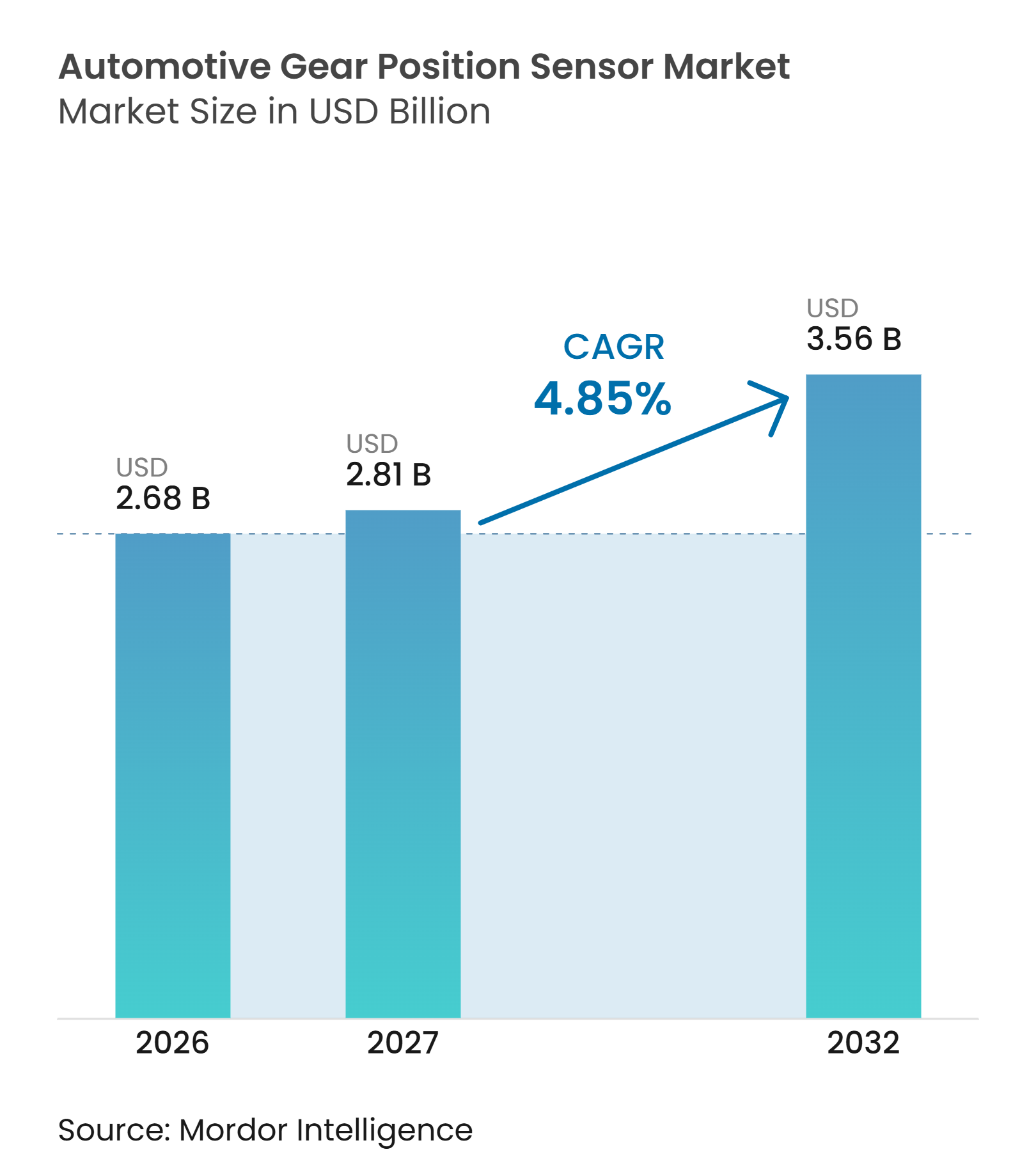
The Automotive Gear Position Sensor Market size was valued at USD 2.68 billion in 2026 and is estimated to reach USD 2.81 billion in 2027 and USD 3.56 billion by 2032, growing at a CAGR of 4.85% over 2027-2032. The automotive gear position sensor market is moving from contact-based designs toward contactless sensing that can work with electronic shift controls. Shift-by-wire systems, automatic transmissions, and electrified drivetrains are increasing the number of sensing points required in a vehicle. Suppliers are responding with digital outputs, redundant channels, and calibration functions that support vehicle safety requirements. The opportunity is strongest where transmission controls, park-lock mechanisms, and software-defined vehicle systems are integrated. Qualification periods and supply risks remain important because sensor changes can require full platform validation.
Key Report Takeaways
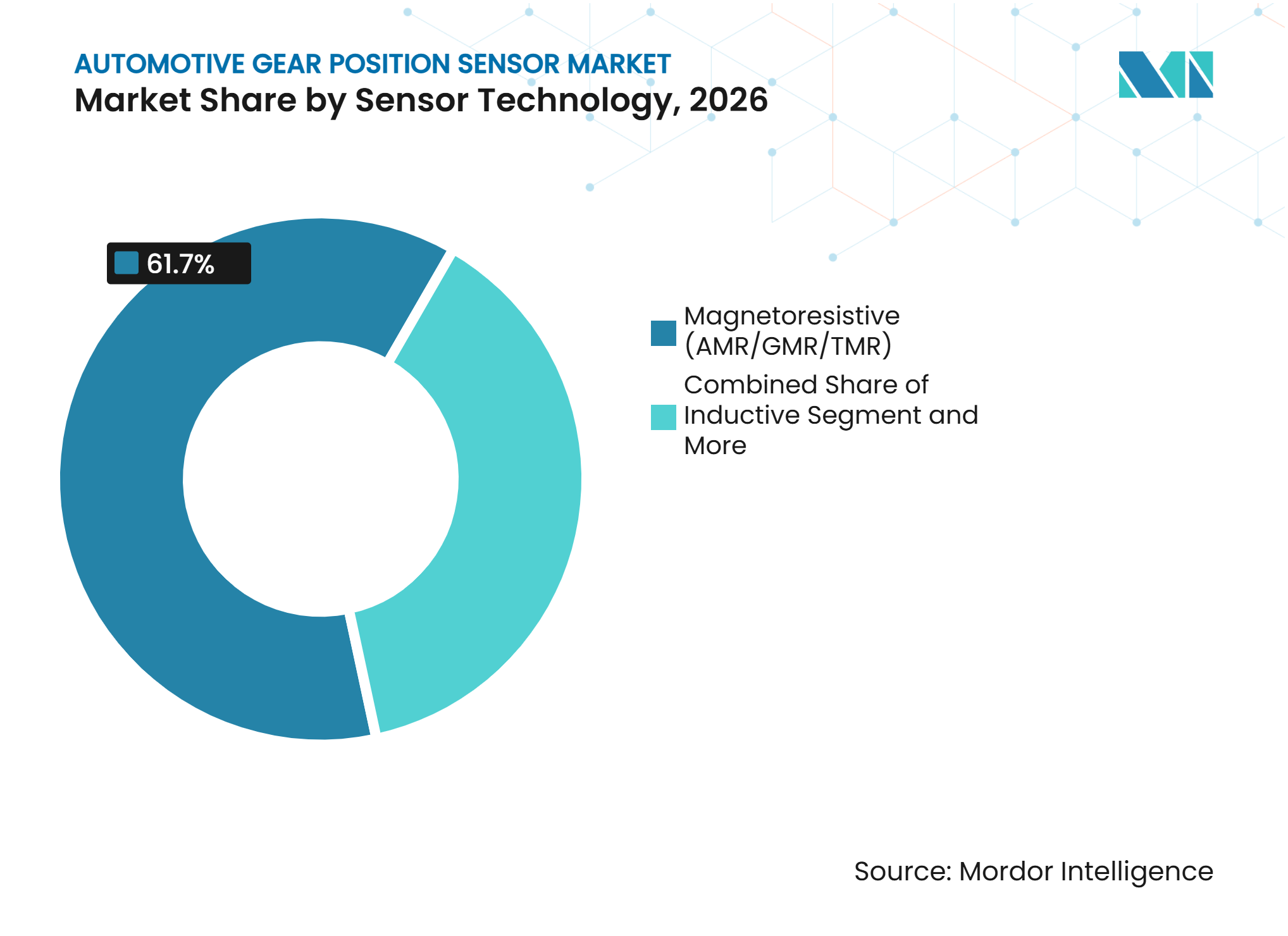
- • By sensor technology, magnetoresistive sensors held 61.74% of the automotive gear position sensor market share in 2026, while inductive sensors are forecast to grow at a 5.88% CAGR through 2032.
- • By transmission type, automatic transmissions accounted for 57.16% of the automotive gear position sensor market share in 2026 and recorded the highest projected CAGR at 6.05% through 2032.
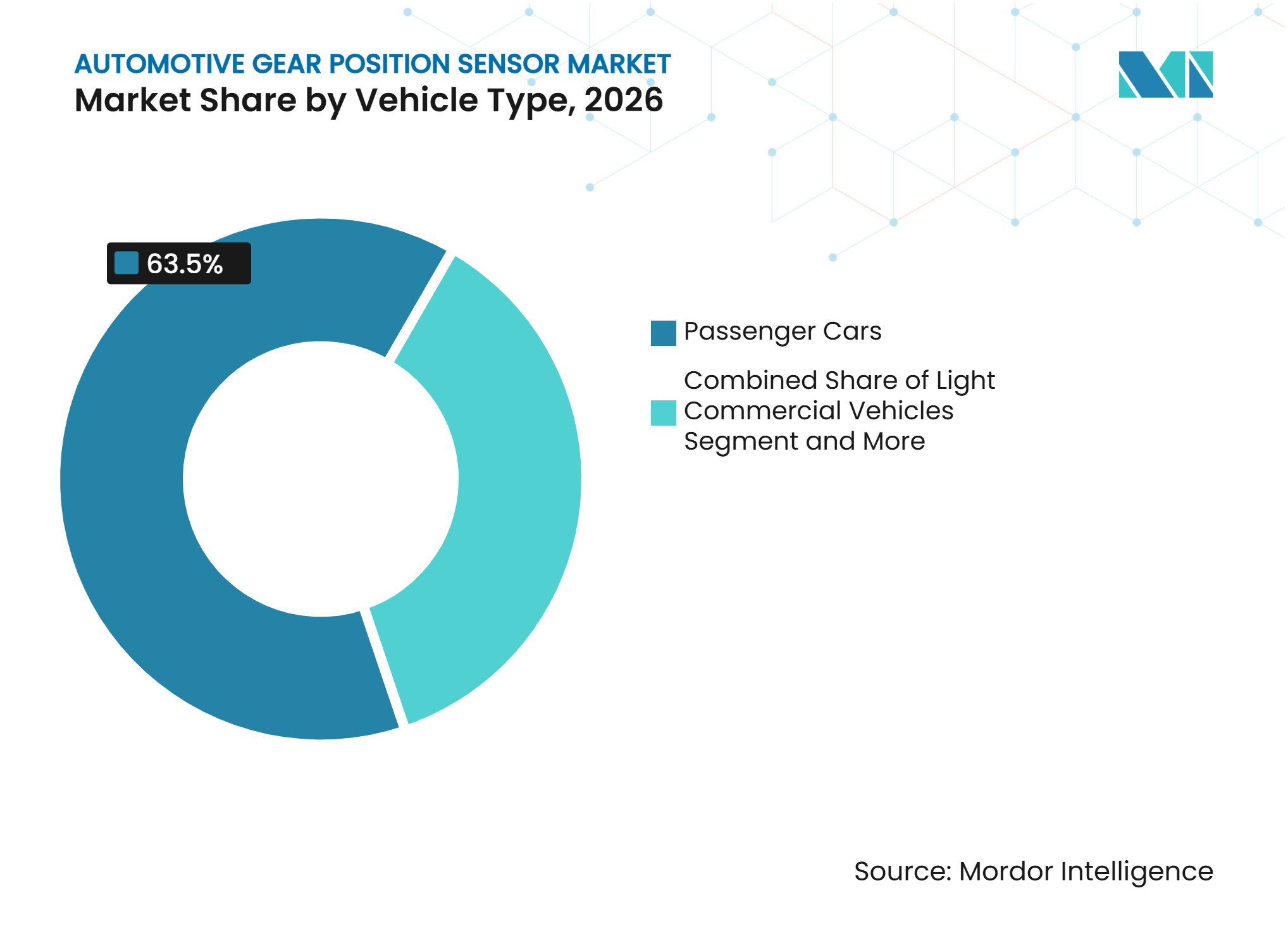
- • By vehicle type, passenger cars represented 63.47% of demand in 2026, while light commercial vehicles are forecast to grow at a 6.13% CAGR through 2032.
- • By sales channel, OEM supply channels accounted for 73.71% of revenue in 2026, while the aftermarket is forecast to expand at a 6.21% CAGR through 2032.
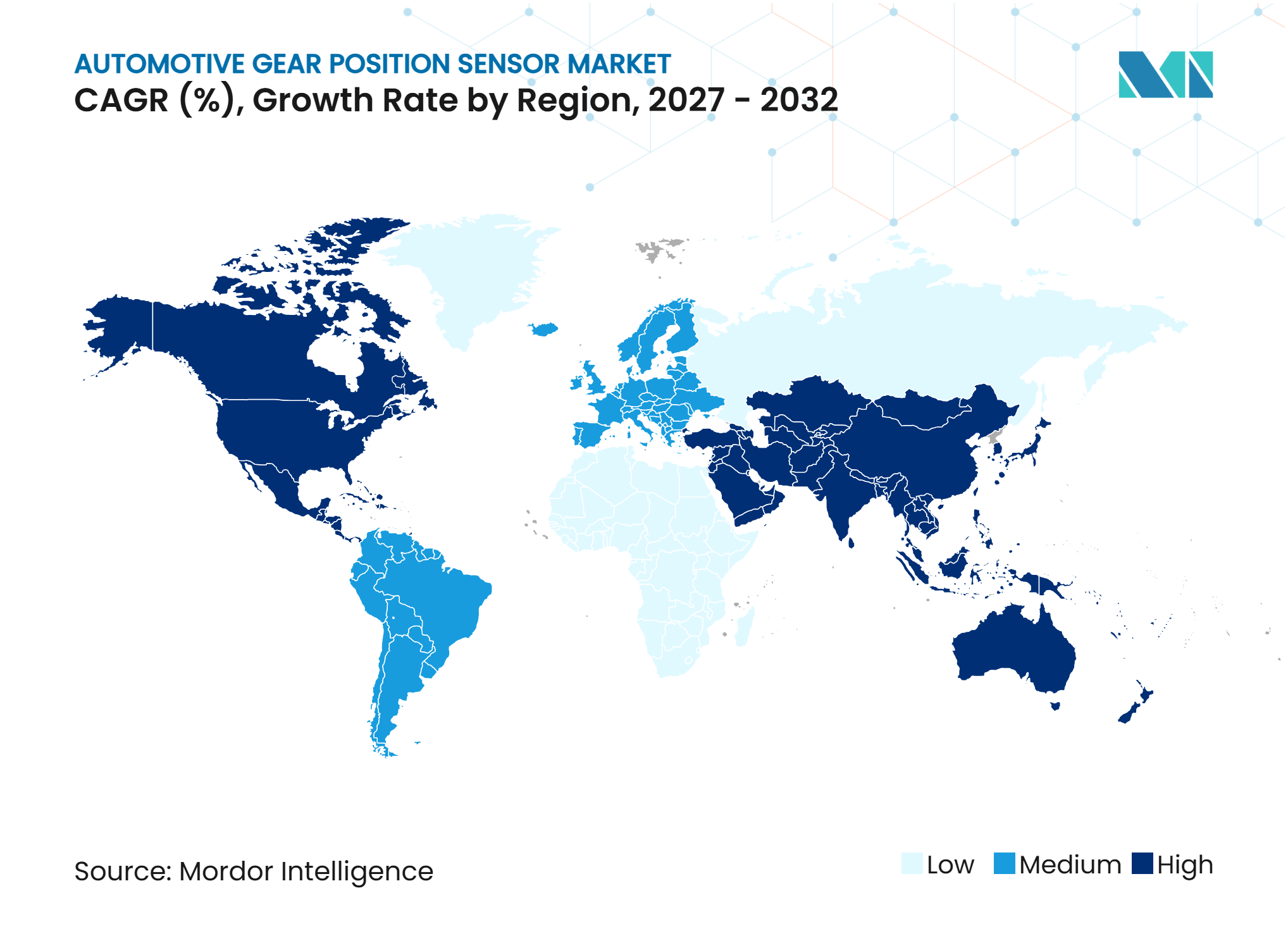
- • By geography, Asia-Pacific held 38.75% of revenue in 2026 and is forecast to grow at a 6.42% CAGR through 2032.
Note: Market numbers in this report are based on Mordor Intelligence's proprietary estimation framework, which combines nine months of actuals with Q4 projections for base year 2026.
Market Trends and Insights
Drivers Impact Analysis of Automotive Gear Position Sensor Market*
| Driver | (~) % Impact on CAGR Forecast | Geographic Relevance | Impact Timeline |
|---|---|---|---|
| Rising Shift-by-Wire Adoption | +1.1% | Global, Asia-Pacific core with spill-over to EU | Medium term (2–4 years) |
| Increasing Automatic, DCT, CVT, and AMT Penetration | +0.9% | Asia-Pacific core, Europe, South America | Medium term (2–4 years) |
| Electrification-Driven Demand for Compact and Contactless Gear-Position Detection | +0.8% | Asia-Pacific core, North America | Medium term (2–4 years) |
| Higher Functional-Safety Requirements for Transmission Position Sensing | +0.7% | Global, regulatory origin in EU and North America | Long term (≥ 4 years) |
| Reduced Calibration Tolerance in Integrated Shift Modules | +0.5% | North America and EU | Long term (≥ 4 years) |
| Growing Demand for Sensor Diagnostics and Redundant Position Signals | +0.5% | Global | Short term (≤ 2 years) |
| Source: Mordor Intelligence | |||
Rising Shift-by-Wire Adoption
Shift-by-wire systems replace the mechanical connection between the selector and transmission with electronic signals. This arrangement needs reliable feedback on the selected gear and the state of the transmission control system. ZF presented the 8HP evo hybrid transmission at IAA Mobility 2025 with software-controlled shift logic, showing the growing role of electronic inputs in established transmission platforms [1]. The automotive gear position sensor market benefits because an electronic selector requires sensing and diagnostic functions that mechanical linkages did not need. Redundant position readout is also becoming more common where safety analysis requires fault detection in the signal path. The shift to integrated modules narrows calibration tolerances and favors suppliers that can support both the sensing hardware and associated software.
Increasing Automatic, DCT, CVT, and AMT Penetration
Automatic, dual-clutch, continuously variable, and automated manual transmissions need more precise gear and clutch state feedback than conventional manual systems. This expands the automotive gear position sensor market as vehicle makers add electronically managed transmissions to lower-priced vehicle lines. India and Southeast Asia are also important because cost-conscious AMT and CVT applications extend electronic transmission controls beyond premium vehicles. Commercial vehicles add a separate requirement because sensors must tolerate vibration, heat, and long duty cycles. These conditions leave room for suppliers that can provide robust units without raising vehicle cost materially.
Electrification-Driven Demand for Compact and Contactless Gear-Position Detection
Battery electric and plug-in hybrid vehicles place sensors near traction inverters, compact e-axles, and park-lock assemblies. These locations increase the value of compact contactless designs that resist electromagnetic interference and avoid mechanical wear. A U.S. patent granted in January 2025 describes an inductive angular sensor for a park-lock assembly that detects gear state and locking-pawl engagement in one compact arrangement. Renesas states that inductive position sensing can tolerate stray fields above 4,000 A/m while offering low latency and high resolution [2]. Such properties support the automotive gear position sensor market where electrified drive units need dependable feedback in constrained spaces. Magnet-free coil designs can also reduce exposure to rare-earth magnet sourcing risks.
Higher Functional-Safety Requirements for Transmission Position Sensing
Functional safety requirements have moved position sensing from a component choice to a vehicle-system requirement. A 2025 IEEE study found that failures in rotor and position sensing can contribute to uncontrolled torque or vehicle immobilization in electric drivetrains. This supports greater use of redundant channels and diagnostic coverage in safety-related gear and shift applications. Infineon introduced its XENSIV TLE4802SC16-S0000 inductive sensor for high-precision measurement with digital outputs suited to demanding automotive applications. The automotive gear position sensor market is therefore rewarding products that support system-level ASIL targets and can be validated within an OEM program. Longer certification and engineering cycles remain a barrier for smaller suppliers without automotive safety resources.
Restraints Impact Analysis of Automotive Gear Position Sensor Market*
| Restraint | (~) % Impact on CAGR Forecast | Geographic Relevance | Impact Timeline |
|---|---|---|---|
| High Qualification and Platform-Validation Costs | -0.7% | Global | Long term (≥ 4 years) |
| Semiconductor, Magnet, and Specialized Packaging Supply Risks | -0.5% | Global, acute in North America and EU | Short term (≤ 2 years) |
| Transmission Architecture Fragmentation Across Vehicle Platforms | -0.4% | Global | Long term (≥ 4 years) |
| Limited Replacement Interchangeability for Integrated Shift Modules | -0.3% | Global | Medium term (2–4 years) |
| Source: Mordor Intelligence | |||
High Qualification and Platform-Validation Costs
Automotive position sensors require testing, calibration, safety analysis, and vehicle-specific environmental validation before production. Sensata reported that sensors are rarely changed during a platform cycle that normally lasts 5 to 7 years, which makes qualification status a major commercial advantage. The same condition can limit adoption of new products because a sensor change can trigger transmission control unit and vehicle-level revalidation. Integrated shift modules make this process harder because the sensing element, actuator, and control logic may be supplied as one package. The automotive gear position sensor market consequently has high entry barriers even when a new sensor has strong technical performance. Smaller suppliers often need a Tier-1 partnership or an aftermarket route to gain scale.
Semiconductor, Magnet, and Specialized Packaging Supply Risks
Sensor suppliers remain exposed to availability risks across analog ICs, magnetic materials, connectors, and overmolded housings. Magnetoresistive designs can depend on rare-earth magnets, while inductive designs need specialized coil and packaging capabilities. Automotive-grade housings must withstand fluid exposure, heat, and vibration, which limits the qualified supplier base. Consolidation can reduce second-source options for some sensor families, as shown by Infineon’s agreement to acquire ams-OSRAM’s non-optical analog and mixed-signal sensor portfolio for EUR 570 million (USD 640.73 million). Platform fragmentation adds another restraint because each transmission architecture has distinct mechanical interfaces and communication requirements. Integrated shift modules also limit replacement interchangeability, which can restrict standalone aftermarket opportunities over time.
*Our forecasts treat driver/restraint impacts as directional, not additive. The impact forecasts reflect baseline growth, mix effects, and variable interactions.
Automotive Gear Position Sensor Market Segment Analysis
By Sensor Technology:
Magnetoresistive Sensors Lead While Inductive Designs Gain GroundMagnetoresistive sensors held 61.74% of the automotive gear position sensor market share in 2026. Their position reflects a long transition away from potentiometric designs that can be affected by wear, contamination, and mechanical contact. AMR, GMR, and TMR devices offer strong resolution and can be used in tight transmission and selector packages. An IEEE review published in 2026 reported that TMR sensors can achieve magnetoresistive ratios above 100%, with materially higher sensitivity than AMR and GMR devices. Littelfuse launched the LF53466 and LF53464 TMR angle sensors in August 2025 with angular error below 0.8° and 0.6%, respectively, for harsh automotive applications. Hall-effect products remain relevant where cost and established platform compatibility outweigh the need for higher resolution.
Inductive sensors are projected to grow at a 5.88% CAGR through 2032. Their automotive gear position sensor market size is expanding, as electric drivetrains create stray fields that can challenge magnetic sensing arrangements. Inductive technology uses coils and a conductive target rather than a permanent magnet, reducing sensitivity to magnet supply conditions. Melexis launched its MLX90514 dual-input inductive device in October 2025, which calculates differential or vernier angles from 2 coil sets and supports ASIL D-capable system design. This architecture is relevant to redundant gear position feedback in electronic selectors and park-lock systems. The technology does not displace magnetic sensors in every application, but it provides a practical option where magnetic immunity and compact packaging are priorities.



By Transmission Type:
Automatic Transmissions Combine Scale and GrowthAutomatic transmissions accounted for 57.16% of automotive gear position sensor market share in 2026. This category includes torque-converter automatic units, dual-clutch transmissions, CVTs, and AMTs. All require electronically managed gear engagement, and many use multiple sensing points for gear, clutch, and selector feedback. Dual-clutch units are particularly sensor-intensive because each clutch path needs position control and validation. The automotive gear position sensor market size tied to automatic transmissions is projected to rise at a 6.05% CAGR through 2032. This combination of scale and growth follows the continuing replacement of manual transmission applications with electronically controlled alternatives.
Digital communication is becoming more relevant in automatic transmission applications. Sensors can provide data directly to adaptive shift control and powertrain management functions. This raises demand for accurate outputs and diagnostics, including SENT and SPC interfaces where specified by the platform. CVT and AMT applications are gaining importance in India and Southeast Asia because they bring automatic operation to lower-cost passenger vehicles. Manual transmission sensors still serve selected commercial and agricultural-adjacent applications where operating preferences and cost considerations maintain their role. Integrated shift module designs can shorten the path between sensing and control, although they also increase the cost of switching suppliers after validation.
By Vehicle Type:
Passenger Cars Provide the Largest Demand BasePassenger cars represented 63.47% of automotive gear position sensor market share in 2026. Their leading position comes from high production volumes and wider use of automatic, hybrid, and shift-by-wire systems. More complex drivetrain software also raises the need for reliable feedback that can support shift quality and torque management. Park-lock applications in battery electric vehicles can combine gear-state and locking-pawl confirmation in one sensor assembly. The January 2025 U.S. patent for an inductive park-lock sensor illustrates this compact dual-function direction. Passenger car demand therefore remains central to the automotive gear position sensor market even as vehicle architectures change.
Light commercial vehicles are forecast to grow at a 6.13% CAGR through 2032. Delivery fleets are adopting automatic transmissions and electrified vehicle platforms for stop-start urban use. These conditions impose repeated thermal and vibration loads, which favor robust contactless sensing approaches. Light commercial vehicles also face connector exposure and frequent gear changes during urban service. Heavy commercial vehicles remain a separate technical case because long-haul operations require higher temperature capability and compatibility with existing AMT architectures. The difference in duty cycle gives suppliers in the Automotive Gear Position Sensor industry an opportunity to tailor designs for fleet applications rather than relying on passenger-car specifications.

By Sales Channel:
OEM Programs Remain the Main Route to RevenueOEM supply channels accounted for 73.71% of automotive gear position sensor market share in 2026. The share reflects the fact that gear sensing is defined during platform engineering and closely linked to transmission calibration and safety validation. Sensata’s 2025 filing notes that qualified sensors are rarely replaced during a 5- to 7-year platform life, reinforcing the importance of design wins. OEM agreements can offer multi-year volumes that support dedicated packaging lines and calibration investments. This favors suppliers that can meet automotive quality requirements, provide validation support, and sustain delivery over the platform life. It also makes price alone insufficient for winning new programs.
The aftermarket is forecast to expand at a 6.21% CAGR through 2032. Growth is linked to the rising installed base of electronically shifted vehicles that will reach repair and replacement intervals. The automotive gear position sensor market has an aftermarket opportunity where independent workshops can diagnose and replace units without full OEM service tools. Robert Bosch expanded its aftermarket catalog by 172 new part numbers for the first quarter of 2026 across drivetrain sensors and related product groups. However, integrated shift modules can limit interchangeability and reduce the scope for a standalone replacement part. Suppliers that pair parts coverage with diagnostics support may be better placed to serve independent repair networks.
Geography Analysis
Asia-Pacific
Asia-Pacific held 38.75% of the automotive gear position sensor market share in 2026 and is projected to grow at a 6.42% CAGR through 2032. China, Japan, South Korea, and India combine large vehicle production bases with growing use of automatic and electrified transmissions. China’s plug-in hybrid policy support is encouraging dedicated hybrid transmission programs that require more complex feedback systems. DENSO co-developed an eAxle for the Toyota bZ4X that combines SiC power semiconductors, cooling functions, and precision gear actuation, illustrating the depth of integration in regional EV programs. JATCO displayed 3-in-1 and 5-in-1 electric powertrain units in 2025, along with a 2-speed in-wheel drive unit, which points to continuing changes in the regional drivetrain design base. Local manufacturing and electronics supply networks support scale, although supplier qualification remains important for safety-critical applications.
Europe
European demand is shaped by safety engineering, vehicle software integration, and strict emissions requirements. The automotive gear position sensor market size in Europe is supported by high-value transmission and selector programs from regional OEMs and Tier-1 suppliers. ZF’s 8HP evo hybrid transmission introduced at IAA Mobility 2025 shows how hybrid systems increasingly combine software-controlled shifting and electronic drivetrain functions. Functional-safety practices under ISO 26262 influence product selection, especially for sensors that serve selector inputs and park-lock confirmation. Digital communication interfaces are becoming more important as vehicle makers connect drivetrain components more directly to software systems. The concentration of OEMs, component makers, and engineering centers in Germany helps suppliers complete co-development and validation work near their customer base. European manufacturers are also increasing hybrid and battery-electric vehicle programs, which supports demand for precise and contactless sensing.
North America, South America, and the Middle East and Africa
North America has a truck and SUV-heavy mix, with high automatic transmission use and growing electronic gear architectures in premium and commercial vehicles. Shift-by-wire adoption in these vehicles increases the requirement for calibrated and redundant position feedback. South America is adopting more automatic transmissions in passenger cars and light commercial vehicles, especially through regional OEM assembly programs. Brazil’s flex-fuel environment can raise calibration requirements for transmission controls because powertrain conditions vary across fuel blends. The Middle East and Africa provide an emerging fleet opportunity as public-sector electrification programs introduce electronic selector systems. High ambient temperatures in these markets require durable packaging and high-temperature sensor designs. The automotive gear position sensor market share across these mixed regions remains smaller than Asia-Pacific, but their vehicle mix creates distinct opportunities for ruggedized automatic transmission and e-axle sensing.
Competitive Landscape
Market Concentration

The automotive gear position sensor market is moderately concentrated at the OEM design-in level. Infineon Technologies, Melexis, Allegro MicroSystems, Robert Bosch, ZF Friedrichshafen, and DENSO hold strong positions through automotive sensing expertise, platform relationships, and functional-safety capabilities. Infineon agreed in February 2026 to acquire ams-OSRAM’s non-optical analog and mixed-signal sensor portfolio for EUR 570 million (USD 640.73 million). The transaction adds positioning and temperature sensor assets and shows the value placed on automotive-qualified sensor intellectual property. Leading suppliers are moving beyond discrete components toward products that integrate diagnostics, redundant functions, and digital communication. This raises switching costs for OEMs and makes software support part of the product offer [3].
Technology competition is focused on inductive, TMR, Hall-effect, and module-level solutions. Melexis launched the MLX90514 in October 2025 to process 2 coil inputs on chip for differential or vernier angle measurement. Robert Bosch received a U.S. patent in April 2025 for an inductive rotor position sensor that places transmitter and receiver coils on a shared PCB. These actions show continued investment in compact contactless architectures for automotive motion sensing. Smaller suppliers can still compete where commercial vehicles need high-temperature units or where emerging-market platforms need affordable redundant designs. Their path is harder when customers require prior qualification, local engineering support, and long-term supply commitments.
The sector also remains affected by acquisitions and the value of standalone sensing portfolios. Allegro MicroSystems rejected onsemi’s USD 6.9 billion all-cash proposal in March 2025, indicating the strategic importance attributed to automotive magnetic sensing capabilities. Cybersecurity and software update requirements add another consideration for sensor data that moves through connected vehicle networks. This favors suppliers that can support secure integration with the wider vehicle electronic architecture. The competitive structure is not dominated by a single supplier because OEM programs are split across vehicle groups, transmission types, and regional sourcing arrangements.
Automotive Gear Position Sensor Industry Leaders
-
AUMOVIO SE
-
Robert Bosch GmbH
-
Infineon Technologies AG
-
ZF Friedrichshafen AG
-
Sensata Technologies Holding plc
- *Disclaimer: Major Players sorted in no particular order
Automotive Gear Position Sensor Market Companies Covered in this Report
- AUMOVIO SE
- Robert Bosch GmbH
- Infineon Technologies AG
- ZF Friedrichshafen AG
- Sensata Technologies Holding plc
- TE Connectivity plc
- Allegro MicroSystems, Inc.
- Melexis NV
- CTS Corporation
- DENSO CORPORATION
- Aptiv PLC
- Methode Electronics, Inc.
- Littelfuse, Inc.
- Standard Motor Products, Inc.
- NXP Semiconductors N.V.
- ams-OSRAM AG
- Kongsberg Automotive ASA
- Elmos Semiconductor SE
- Honeywell International Inc.
- STMicroelectronics N.V.
Recent Industry Developments in Automotive Gear Position Sensor Market
- October 2026: Sensata Technologies announced brake force sensors for next-generation electromechanical braking systems in production EVs. Built on Micro Strain Gauge technology proven over 25 years in safety-critical applications, the sensor directly measures caliper clamping force, enabling closed-loop brake-by-wire control, a platform with direct applicability to electromechanical transmission actuation sensing.
- September 2026: Melexis introduced the MLX90381 5V pico-resolver, expanding Triaxis Hall technology to a wider range of compact motor applications. Supporting rotational speeds above 50,000 rpm in a 2.0 mm × 2.5 mm package with a −40°C to 160°C range and ASIL B SEooC capability, the device targets DC, BLDC, and PMSM motor architectures used in transmission actuators.
- September 2026: Infineon Technologies launched the XENSIV TLx49012 digital angle sensor family, featuring system self-calibration that compensates for changes in magnetic arrangement during operation, a capability for transmission sensors where magnet-to-sensor air gaps drift over vehicle lifetime.
- June 2026: Lumax Auto Technologies said it had secured production agreements for shift-by-wire e-shifters on three vehicle platforms, and expects e-shifters to reach volume parity with mechanical shifters by about 2029, supporting demand for contactless gear-position sensing.
Global Automotive Gear Position Sensor Market Report Scope
The scope of the report includes Sensor Technology (Hall-Effect, Magnetoresistive (AMR/GMR/TMR), Inductive, and Others), Transmission Type (Manual, Automatic, DCT, CVT, and AMT), Vehicle Type (Passenger Cars, LCVs, and HCVs), Sales Channel (OEM and Aftermarket), and Geography (North America, Europe, Asia-Pacific, South America, and the Middle East and Africa). The Market Forecasts are Provided in Terms of Value (USD) and Volume (Units).
Segmentation Overview
| Hall-Effect |
| Magnetoresistive (AMR/GMR/TMR) |
| Inductive |
| Other Sensor Technologies (Potentiometric) |
| Manual |
| Automatic |
| Dual-Clutch Transmission (DCT) |
| Continuously Variable Transmission (CVT) |
| Automated Manual Transmission (AMT) |
| Passenger Cars |
| Light Commercial Vehicles |
| Heavy Commercial Vehicles |
| OEM |
| Aftermarket |
| North America | United States |
| Canada | |
| Mexico | |
| Rest of North America | |
| Europe | Germany |
| United Kingdom | |
| France | |
| Italy | |
| Spain | |
| Russia | |
| Rest of Europe | |
| Asia-Pacific | China |
| Japan | |
| India | |
| South Korea | |
| Southeast Asia | |
| Australia | |
| Rest of Asia-Pacific | |
| South America | Brazil |
| Argentina | |
| Chile | |
| Colombia | |
| Rest of South America | |
| Middle East and Africa | Saudi Arabia |
| United Arab Emirates | |
| Turkey | |
| South Africa | |
| Egypt | |
| Rest of Middle East and Africa |
| By Sensor Technology | Hall-Effect | |
| Magnetoresistive (AMR/GMR/TMR) | ||
| Inductive | ||
| Other Sensor Technologies (Potentiometric) | ||
| By Transmission Type | Manual | |
| Automatic | ||
| Dual-Clutch Transmission (DCT) | ||
| Continuously Variable Transmission (CVT) | ||
| Automated Manual Transmission (AMT) | ||
| By Vehicle Type | Passenger Cars | |
| Light Commercial Vehicles | ||
| Heavy Commercial Vehicles | ||
| By Sales Channel | OEM | |
| Aftermarket | ||
| By Geography | North America | United States |
| Canada | ||
| Mexico | ||
| Rest of North America | ||
| Europe | Germany | |
| United Kingdom | ||
| France | ||
| Italy | ||
| Spain | ||
| Russia | ||
| Rest of Europe | ||
| Asia-Pacific | China | |
| Japan | ||
| India | ||
| South Korea | ||
| Southeast Asia | ||
| Australia | ||
| Rest of Asia-Pacific | ||
| South America | Brazil | |
| Argentina | ||
| Chile | ||
| Colombia | ||
| Rest of South America | ||
| Middle East and Africa | Saudi Arabia | |
| United Arab Emirates | ||
| Turkey | ||
| South Africa | ||
| Egypt | ||
| Rest of Middle East and Africa | ||
Key Questions Answered in the Report
What is driving demand for automotive gear position sensors?
Electronic shift controls, automatic transmissions, electrified drive units, and functional-safety requirements are increasing sensing needs across new vehicle platforms.
How large is the automotive gear position sensor sector?
It is projected to grow from USD 2.81 billion in 2027 to USD 3.56 billion by 2032 at a 4.85% CAGR.
Which sensor technology has the largest share?
Magnetoresistive sensors held 61.74% of revenue in 2026, supported by their resolution and fit with compact transmission modules.
Which transmission type is growing fastest?
Automatic transmissions are projected to grow at a 6.05% CAGR through 2032, while also holding 57.16% of 2026 revenue.
Why are inductive sensors gaining adoption?
They use coils rather than permanent magnets and can tolerate high stray fields in compact electrified powertrain applications.
Which region has the strongest outlook?
Asia-Pacific held 38.75% of 2026 revenue and is expected to expand at a 6.42% CAGR through 2032.