
Automotive Coil Spring Market Size and Share
Market Overview
| Study Period | 2020 - 2032 |
|---|---|
| Market Size (2027) | USD 10.11 Billion |
| Market Size (2032) | USD 12.38 Billion |
| Growth Rate (2027 - 2032) | 4.13 % |
| Fastest Growing Market | Asia-Pacific |
| Largest Market | Asia-Pacific |
| Market Concentration | Medium |
Major Players *Disclaimer: Major Players sorted in no particular order Image © Mordor Intelligence. Reuse requires attribution under CC BY 4.0. | |
Automotive Coil Spring Market Analysis by Mordor Intelligence
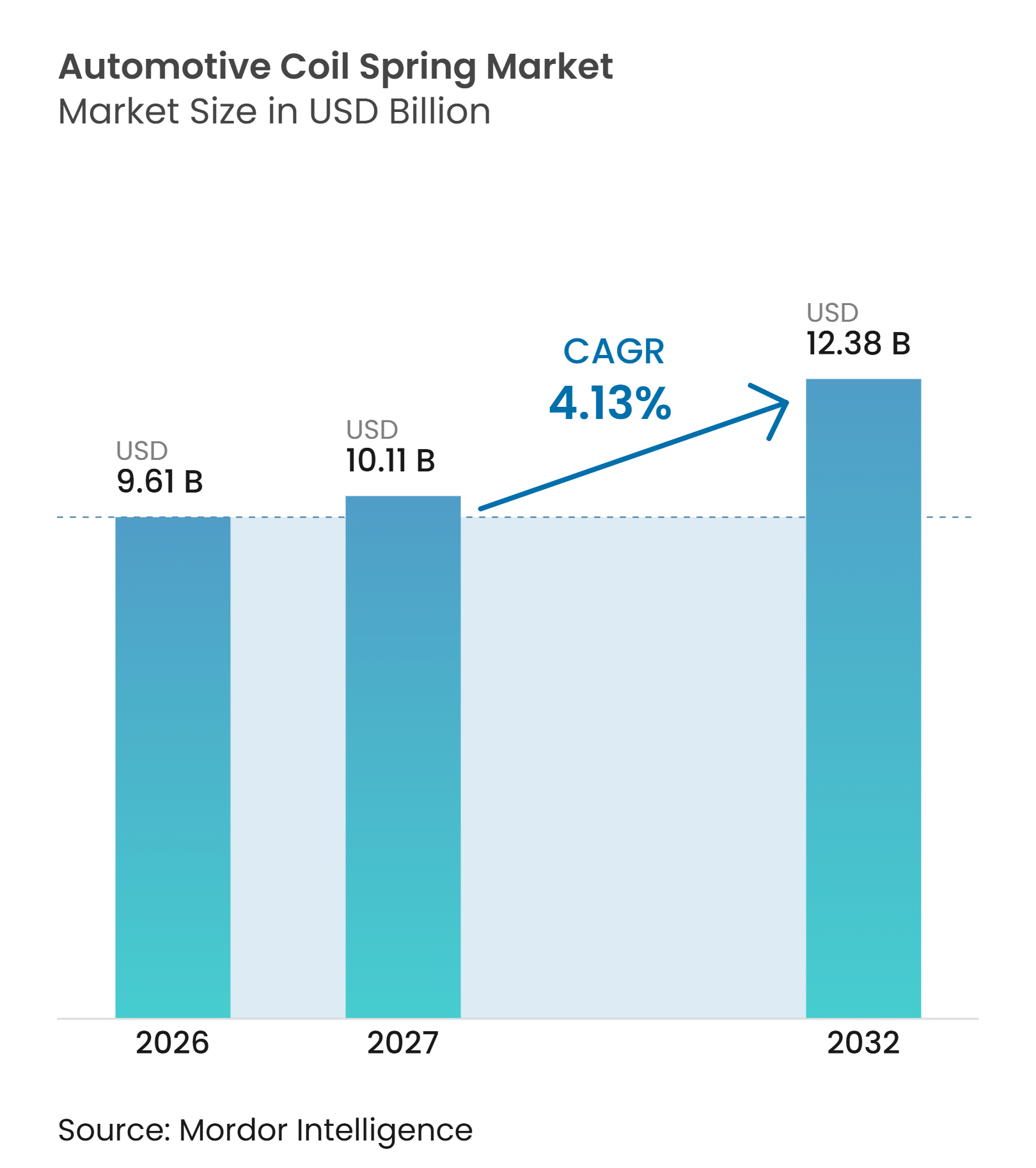
The automotive coil spring market size was valued at USD 9.61 billion in 2026, is estimated at USD 10.11 billion in 2027, and is projected to reach USD 12.38 billion by 2032, growing at a CAGR of 4.13% from 2027 to 2032. The automotive coil spring market is supported by vehicle production, replacement demand from aging fleets, and the heavier load requirements of electrified vehicles. Global vehicle production reached 96.4 million units in 2025, with Asia accounting for more than 61% of output [1]. Electrified vehicles can weigh up to 25% more than comparable internal combustion models, which raises fatigue and packaging demands for suspension components. Suppliers are responding through high-strength steel, vehicle-specific tuning, and local production capacity in major manufacturing regions [2]. These changes place design capability, material qualification, and regional service at the center of supplier selection. The automotive coil spring market also faces substitution by air suspension in select premium and heavy-duty applications, as well as material price volatility and supplier concentration risks.
Key Report Takeaways
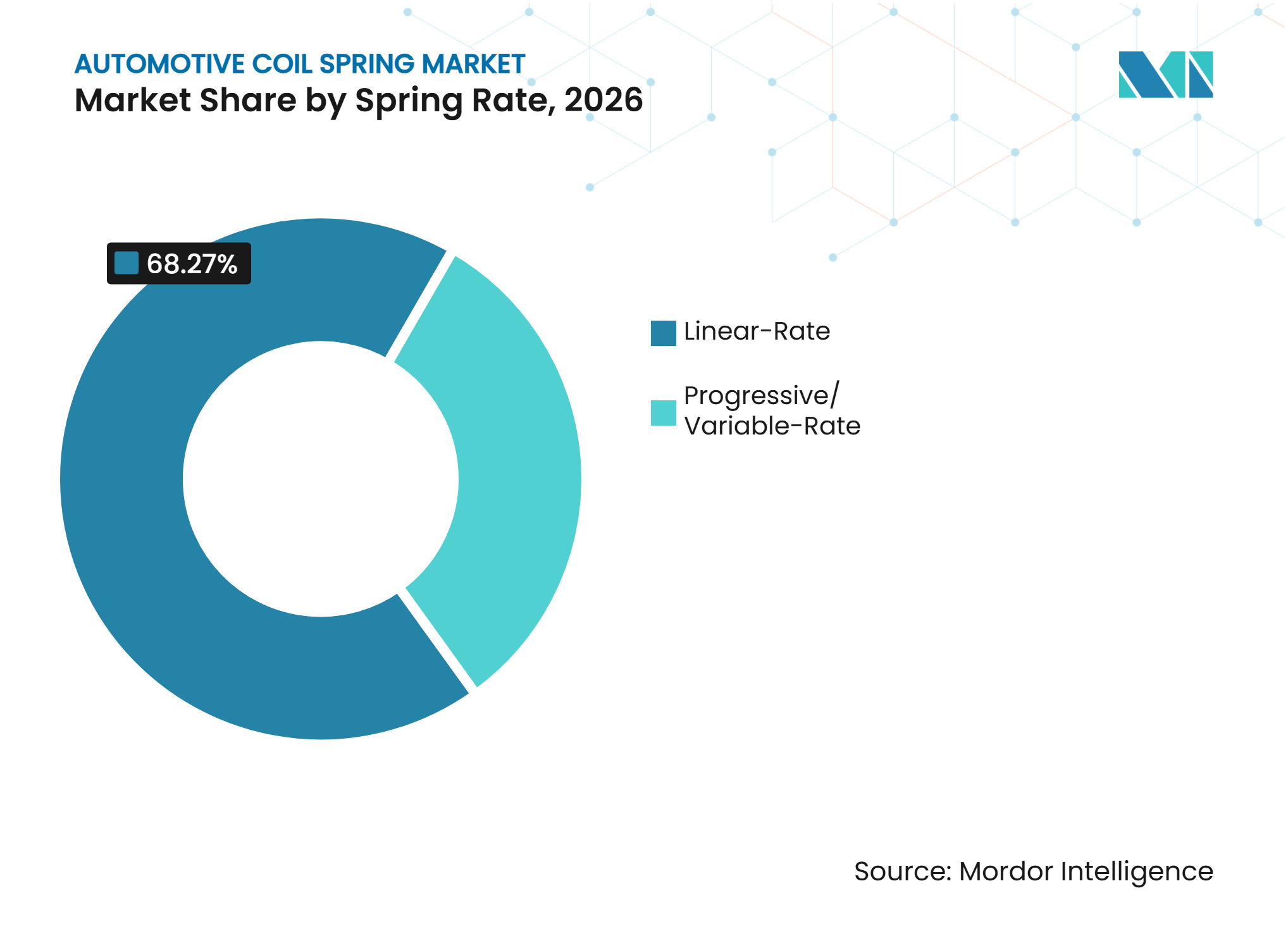
- By spring rate, Linear-Rate springs held 68.27% revenue share in 2026, while Progressive/Variable-Rate springs are forecast to expand at a 4.40% CAGR through 2032.
- By material, Steel held 96.27% revenue share in 2026, while Others, including titanium and composites, are forecast to expand at a 4.93% CAGR through 2032.
- By position, Front Suspension held 52.63% revenue share in 2026 and is forecast to expand at a 4.22% CAGR through 2032.
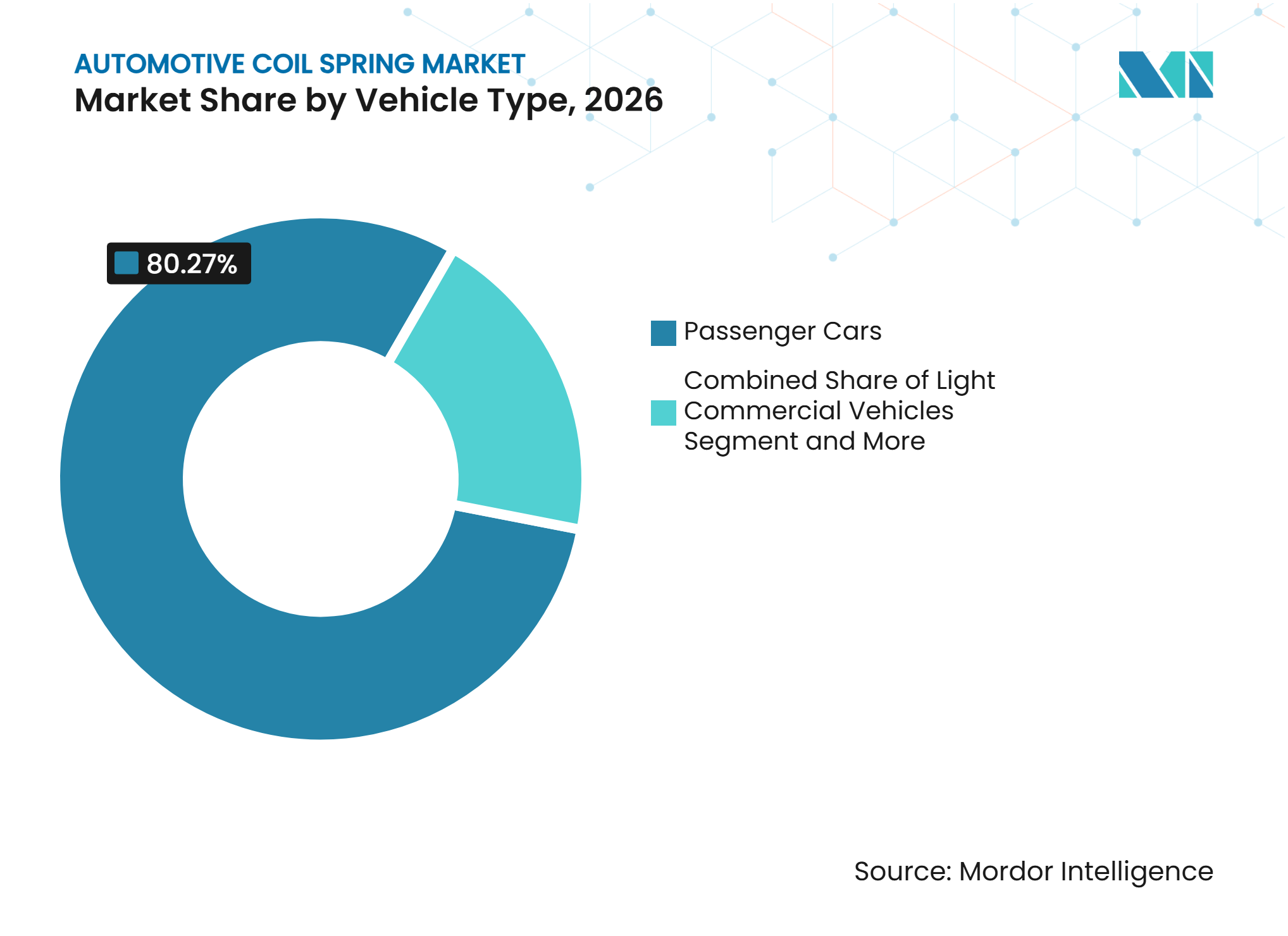
- By vehicle type, Passenger Cars held 80.27% revenue share in 2026 and are forecast to expand at a 4.18% CAGR through 2032.
- By sales channel, OEM held 71.27% revenue share in 2026, while Aftermarket is forecast to expand at a 4.36% CAGR through 2032.
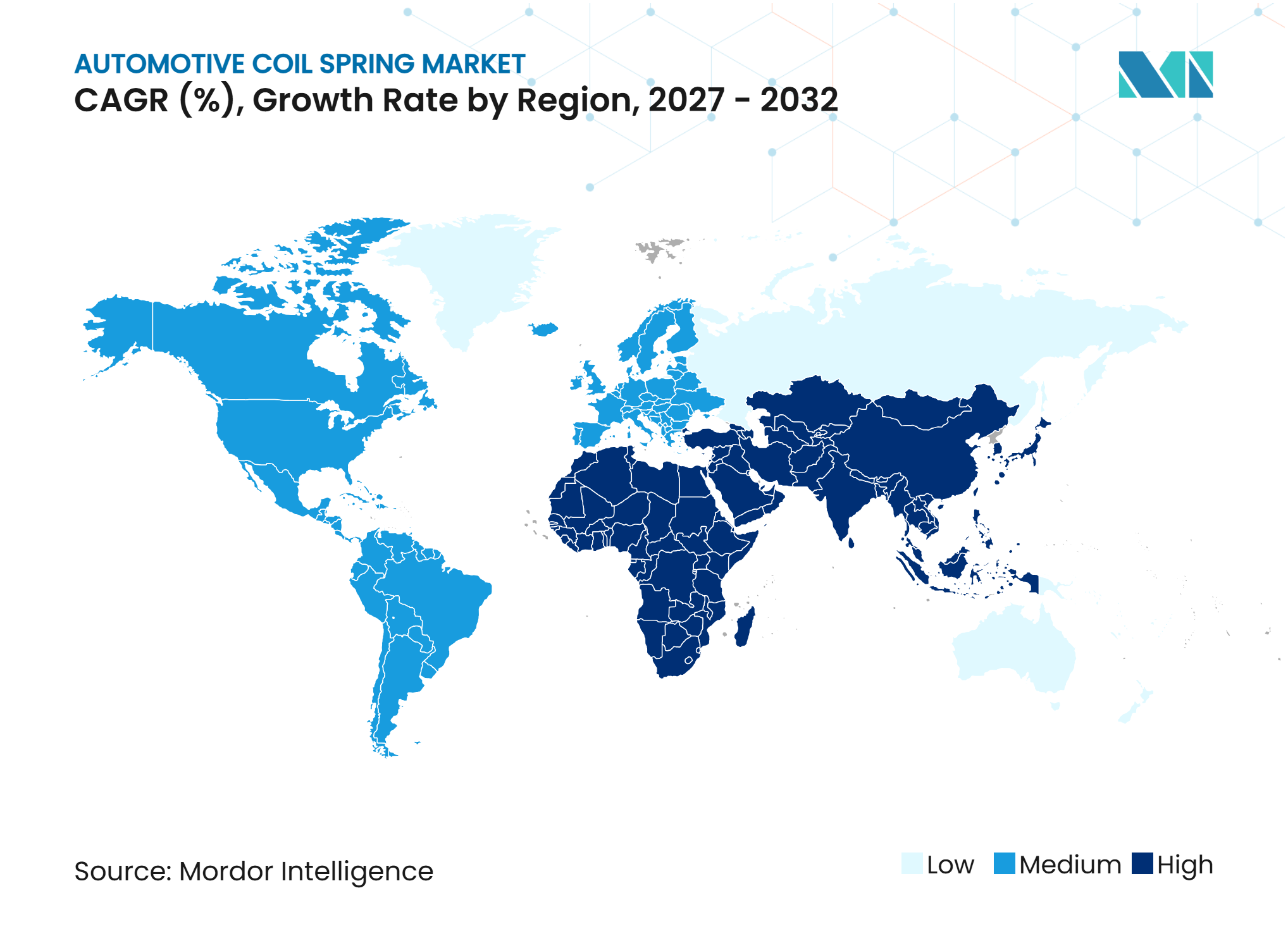
- By geography, Asia-Pacific held a 32.18% revenue share in 2026 and is forecast to expand at a 5.30% CAGR through 2032.
Note: Market numbers in this report are based on Mordor Intelligence's proprietary estimation framework, which combines nine months of actuals with Q4 projections for base year 2026.
Market Trends and Insights
Drivers Impact Analysis of Automotive Coil Spring Market*
| Driver | (~) % Impact on CAGR Forecast | Geographic Relevance | Impact Timeline |
|---|---|---|---|
| Electrification Increasing Spring Load and Rate Requirements | +0.7% | Global, with intensity in Asia-Pacific and Europe | Medium term (2–4 years) |
| Rising Global Vehicle Production and Platform Localization | +0.6% | Asia-Pacific core, spill-over to MEA and South America | Short term (≤ 2 years) |
| Aging Vehicle Parc Supporting Replacement Demand | +0.5% | North America and EU, secondary Asia-Pacific | Long term (≥ 4 years) |
| Adoption of High-Strength Spring Steel for Lightweighting | +0.4% | Global, led by Japan, Germany, South Korea | Medium term (2–4 years) |
| Higher Commercial Vehicle Payload and Axle-Load Requirements | +0.3% | Asia-Pacific core, MEA, South America | Medium term (2–4 years) |
| OEM Demand for Application-Specific Spring Tuning | +0.2% | Global, concentrated at Tier-1 platform level | Long term (≥ 4 years) |
| Source: Mordor Intelligence | |||
Electrification Increasing Spring Load and Rate Requirements
Battery-electric vehicles create a different operating environment for suspension springs. Battery packs add several hundred kilograms, and the vehicle weight penalty can reach 25% against comparable internal combustion models. The automotive coil spring market therefore requires higher wire diameters, revised alloy choices, and tighter fatigue-life targets. Purpose-built electric vehicle platforms also restrict vertical installation space around the battery pack. NHK Spring is preparing to mass-produce in Hungary its Raw Material Forming technology, which combines cold- and hot-coiling characteristics for large-diameter springs in tight packages. This requirement favors suppliers that can integrate load capacity, compact dimensions, ride comfort, and durability into a single component design.
Rising Global Vehicle Production and Platform Localization
Global vehicle production reached 96.4 million units in 2025. Asia-Pacific produced 59.2 million vehicles, which was more than 61% of global output. China added 3.25 million vehicles year over year, reaching 34.53 million units, while India produced a record 6.49 million units. Regional vehicle architectures are diverging through India-focused small cars, China-focused long-wheelbase vehicles, and Southeast Asian pickup trucks. The automotive coil spring market consequently depends on suppliers that can tune spring rates and load-axis behavior for local vehicle applications. NHK Spring and Chuo Spring expanded their presence in India during 2025, showing that capacity decisions are aligned with regional production and engineering needs.
Aging Vehicle Parc Supporting Replacement Demand
Older vehicles support demand that is separate from new-vehicle assembly volumes. The U.S. light-duty fleet reached an average age of 12.8 years in 2025, and vehicles older than 16 years represented 29.3% of the fleet. Coil springs are subject to sustained exposure to fatigue, corrosion, and road-salt conditions. Fracture risk becomes more relevant after 80,000 to 100,000 miles, particularly in corrosive operating environments. This replacement cycle gives the automotive coil spring industry a source of aftermarket demand when new-vehicle production weakens. Electric vehicle spring replacements may also have higher unit values because they use more demanding alloys and dimensional tolerances. The aftermarket is therefore likely to require both broader coverage and closer replication of original equipment specifications.
Adoption of High-Strength Spring Steel for Lightweighting
Suspension springs remain a practical component-level target for weight reduction. ArcelorMittal states that its SOLAM M2050 S-Cor spring-steel grade reaches a tensile strength of 2,050 MPa and can reduce spring weight by up to 20% against conventional 54SiCrV6 steel. NHK Spring also reported an 11% mass reduction from a stress-equalization design method that improves load distribution through the coil geometry. These approaches address the same technical challenge through material selection and design refinement. The automotive coil spring market is moving away from reliance on standard commercial steel grades for applications with higher load, fatigue, and packaging requirements. Material partnerships between spring manufacturers and steel suppliers are becoming more important as these specifications tighten. The benefit is especially relevant when electric vehicle loads and component weight targets must be managed simultaneously.
Restraints Impact Analysis of Automotive Coil Spring Market*
| Restraint | (~) % Impact on CAGR Forecast | Geographic Relevance | Impact Timeline |
|---|---|---|---|
| Air-Suspension Substitution in Premium and Heavy-Duty Applications | -0.5% | Global, led by China and Europe | Long term (≥ 4 years) |
| Spring-Steel Price Volatility and Supply Concentration | -0.4% | Global, most acute in North America post-tariff | Medium term (2–4 years) |
| Fatigue, Corrosion and Noise Warranty Exposure | -0.2% | North America & EU | Long term (≥ 4 years) |
| Vehicle Platform and Suspension Architecture Consolidation | -0.2% | Global | Long term (≥ 4 years) |
| Source: Mordor Intelligence | |||
Air-Suspension Substitution in Premium and Heavy-Duty Applications
Air suspension is becoming more accessible in China as local supplier prices decline. Lower unit prices have reduced the applicable vehicle price threshold, exposing a portion of the mid-premium passenger car segment to substitution. In heavy-duty vehicles, adaptive load-leveling capabilities provide air suspension with an advantage for operators seeking to optimize payload capacity. However, coil springs remain well established in light commercial vehicles, off-road vehicles, and markets with poor road conditions. Concerns regarding the reliability of sealing systems and electronic control units continue to constrain broader air-suspension adoption in high-duty-cycle applications. The automotive coil spring market maintains a large installed base. However, suppliers must defend applications in which fixed-rate systems continue to offer durability and cost advantages.
Spring-Steel Price Volatility and Supply Concentration
Steel costs remained volatile, particularly in regions affected by tariffs and uneven production balances. Tariffs contributed to an increase in domestic steel prices in the United States. The market also experienced a substantial cost gap between spring steel priced in the United States and Asia. These regional differences make it difficult for manufacturers to standardize material costs across production plants.
An explosion at a spring supplier’s production facility resulted in a fatality and prompted several automakers to suspend production at certain facilities. The incident demonstrated how disruptions at a single spring supplier can affect vehicle assembly operations within days. The automotive coil spring market remains vulnerable when material sourcing and qualified production capacity are concentrated in a limited number of locations.
*Our forecasts treat driver/restraint impacts as directional, not additive. The impact forecasts reflect baseline growth, mix effects, and variable interactions.
Automotive Coil Spring Market Segment Analysis
By Spring Rate:
EV Demand Reshaping Rate ArchitectureLinear-Rate springs held 68.27% of the automotive coil spring market share in 2026, while Progressive/Variable-Rate springs are forecast to grow at a 4.40% CAGR through 2032. Linear designs remain widely used because they are cost-effective and fit the large base of internal combustion and early hybrid vehicle platforms. Their simpler tooling supports repeatable dimensions through cold-coiling processes. Existing supplier qualifications also favor continued use of linear designs in established vehicle programs. Progressive designs respond differently as compression increases, which helps vehicles manage changing load conditions. This characteristic is relevant to electric vehicles that carry heavier battery packs and still need acceptable ride comfort.
Progressive/Variable-Rate springs are becoming increasingly relevant as purpose-built electric vehicles enter higher-volume applications. They can provide comfort at lower loads while resisting excessive compression under larger static loads. The automotive coil spring industry is using this capability where battery weight, passenger load, and package space place competing demands on the suspension system. NHK Spring’s XT Coil uses a tapered nonlinear design and changes wire cross-section from round to rectangular in the thinner section. NHK Spring reports that the design reduces mass by 34% compared with conventional designs. This work shows that boundaries between linear and variable-rate designs are narrowing in specialized applications. The automotive coil spring market will still rely on linear springs for scale, while variable-rate products gain relevance in platforms with more complex load requirements.


By Material:
Steel Dominates, Specialty Alloys Drive the Margin StorySteel accounted for 96.27% of the automotive coil spring market in 2026, while the Others category is forecast to expand at a 4.93% CAGR through 2032. Steel remains the standard because it offers a workable balance of cost, strength, fatigue performance, and manufacturing scale. Chrome-silicon grades are gaining use in passenger-car springs that operate under elevated stress. Chrome-vanadium grades remain relevant for mid-heavy commercial vehicles that require impact toughness and fatigue resistance. Titanium and composite products are limited to performance and motorsport applications because their unit costs are 5 to 10 times those of equivalent steel springs. This makes the growth rate for alternative materials less significant than steel’s continuing volume leadership.
The more meaningful change lies within steel specifications rather than in wholesale material replacement. ArcelorMittal’s 2,050 MPa spring steel supports lower component mass and improved post-corrosion fatigue performance. NHK Spring has renewed its material development work with steelmakers because standard grades have limitations in higher-load electric-vehicle applications. IATF 16949 quality requirements require traceable qualification when production-grade alloys change. This compliance requirement slows material switching, yet it also raises the barrier to entry for suppliers without qualified processes. The automotive coil spring market therefore retains steel as its core material while specialized grades support premium applications and tighter engineering targets. The use of advanced steel also reflects the need to combine corrosion resistance, compact packaging, and fatigue resistance in a single product.
By Position:
Front Axle Carries Structural PrimacyFront Suspension held 52.63% of segment revenue in 2026 and is forecast to grow at a 4.22% CAGR through 2032. McPherson struts remain the dominant front-suspension configuration across many passenger-car platforms. These systems require carefully matched coil springs to control caster angle, strut-rod friction, and lateral loads during cornering. The front axle also plays a central role in vehicle dynamics and steering behavior. This makes spring calibration important for comfort, handling, and component durability. The automotive coil spring market benefits from this structural role because front springs are a standard element in a large share of global passenger vehicles.
Rear-axle engineering is also changing as electric vehicle platforms seek more space for underbody battery systems. Some vehicles are moving toward rear coil-spring configurations where earlier designs used torsion beams. Spring specifications in these applications are increasingly focused on load-axis management rather than simple compression rate. Mubea’s transversal blade spring combines functions that are conventionally provided by coil springs, a stabilizer bar, and suspension links in a rear multi-link axle. Mubea reports that the system can reduce weight by 20 kg without a cost premium. Such integrated designs remain platform-specific rather than broadly adopted. They nonetheless show the wider experimentation taking place in rear-axle layouts for purpose-built electric vehicles.
By Vehicle Type:
Passenger Cars Lead Volume, Commercial Vehicles Drive Specification IntensityPassenger Cars held 80.27% of segment revenue in 2026 and are forecast to grow at a 4.18% CAGR through 2032. The passenger-car base gives this segment the largest opportunity for original equipment fitment and later replacement demand. Electric vehicle adoption adds more demanding load and packaging requirements to many new passenger-car programs. These requirements support demand for stronger materials and more precisely tuned coil-spring systems. Passenger cars therefore combine high unit volumes with rising specification complexity.
Light commercial vehicles remain strategically relevant because many use passenger-car platforms and share similar spring specifications. This creates a multiplier effect for suppliers serving common vehicle architectures. Heavy commercial vehicles have lower unit volumes but require more spring mass and more demanding designs. Higher payload and axle-load requirements increase the importance of fatigue strength and impact resistance in commercial applications. Sogefi extended a 5-year supply arrangement for leaf springs and stabilizers with a major heavy commercial vehicle producer and won new work in the defense and railway markets. The company example illustrates how spring manufacturing capabilities can span mobility categories. The automotive coil spring market remains led by passenger cars, while commercial applications retain a meaningful role in technical requirements and supplier capabilities.


By Sales Channel:
Aftermarket Narrows the OEM GapOEM held 71.27% of channel revenue in 2026, while the Aftermarket segment is forecast to grow at a 4.36% CAGR through 2032. Assembly-line fitment gives OEM supply the largest share because every new vehicle requires suspension components. Long-term platform agreements also stabilize original equipment supply relationships. The automotive coil spring market is gradually gaining a stronger aftermarket contribution as vehicle fleets age. Older fleets create replacement needs that do not depend on current-year new-vehicle output. Road salt, corrosion, and long service mileage are important factors in the replacement cycle. These conditions are especially relevant in regions with severe winter road exposure.
Aftermarket suppliers are expanding coverage while moving toward closer replication of original-equipment products. DRiV added more than 500 Monroe Coil Springs SKUs in 2025 and targeted coverage of more than 92% of the European light-vehicle fleet. The added range uses silicon-chrome or chrome-vanadium steel, shot peening, and dual corrosion coatings. KYB reported a substantial expansion in the number of electric and hybrid vehicle parts during 2025. This level of catalog investment makes it harder for suppliers that compete only on price to keep pace. The automotive coil spring market is therefore seeing the OEM and aftermarket channels become more connected through material, tooling, and fitment requirements.
Geography Analysis
Asia-Pacific: The Center of Coil Spring Supply and Demand
Asia-Pacific held 32.2% of automotive coil spring market revenue in 2026 and is forecast to grow at a 5.3% CAGR through 2032. The region produced 59.2 million vehicles in 2025, and China’s new-energy vehicle output reached 16.626 million units, up 29%. India also reached production of 6.49 million vehicles in 2025. These volumes place electric vehicle spring specifications and localized supply capacity at the center of regional demand. NHK Spring announced a third production site in India in Aurangabad in May 2025, with coil spring and solid stabilizer production planned from 2027. The initial investment was JPY 2 billion, equivalent to USD 13 million. Chuo Spring established Chuhatsu India Private Limited in Bangalore to manufacture automotive chassis springs and source materials locally. China’s GB/T 1222-2025 spring-steel standard took effect on May 1, 2026, consolidating 3 earlier standards and creating a clearer compliance basis for suppliers in the Chinese market. The combination of output growth, local investment, and updated material standards supports a larger role for regional engineering and qualified local production.
Europe: Strategic Rationalization Beneath Surface Stability
Europe’s automotive production declined slightly amid high energy costs, tariff pressures, and slower electric vehicle development across several major markets. thyssenkrupp announced the gradual phase-out of its Springs and Stabilizers site in Hagen, Germany, citing underutilization, labor-cost disadvantages, and competition from Asian suppliers. The decision will reduce the workforce over a phased period. In contrast, thyssenkrupp’s facility in Hungary reached a major steel spring production milestone, indicating that production capacity is shifting toward Central Europe rather than exiting the region entirely. Sogefi reported a decline in European Suspensions revenue at constant exchange rates. However, the company continued to secure platform awards for stabilizer bars used in passenger cars and light commercial vehicles. DRiV’s catalog expansion across Europe’s light-vehicle fleet highlights the growing importance of the independent aftermarket as OEM production volumes soften. thyssenkrupp and ArcelorMittal are also collaborating to develop XCarb flat spring bar made from recycled steel and produced using renewable energy. The product is undergoing OEM and aftermarket homologation in Brazil. Europe’s automotive coil spring market is adapting through capacity rationalization, expanded aftermarket coverage, and the development of lower-carbon materials.
South America, North America, and Middle East and Africa: Divergent Trajectories
North American demand is under pressure from declining regional vehicle production and higher costs of imported spring steel due to Section 232 tariffs. However, the aging light-duty vehicle fleet supports durable replacement demand, particularly in road-salt-exposed areas of the United States and Canada. Replacement channels account for a significant share of the automotive coil spring market, supported by the large installed vehicle base and continued corrosion exposure. Mexico remains a key production location within the regional supply chain.
The resolution of a United States-Mexico-Canada Agreement (USMCA) Rapid Response Labor Mechanism matter involving thyssenkrupp Springs and Stabilizers de México followed worker reinstatement, back-pay provisions, and the implementation of freedom-of-association neutrality guidelines. This outcome highlights how labor compliance can affect the risk of nearshore manufacturing. Brazil maintains substantial vehicle production, while Sogefi reported revenue growth in Mercosur at constant exchange rates.
Demand in the Middle East and Africa is supported by aging vehicle fleets and infrastructure activity in markets such as South Africa, Türkiye, and Saudi Arabia. Vehicle production in Türkiye supports regional original equipment supply agreements. Suppliers in these regions must balance local vehicle production opportunities with replacement demand and compliance requirements.
Competitive Landscape
Market Concentration
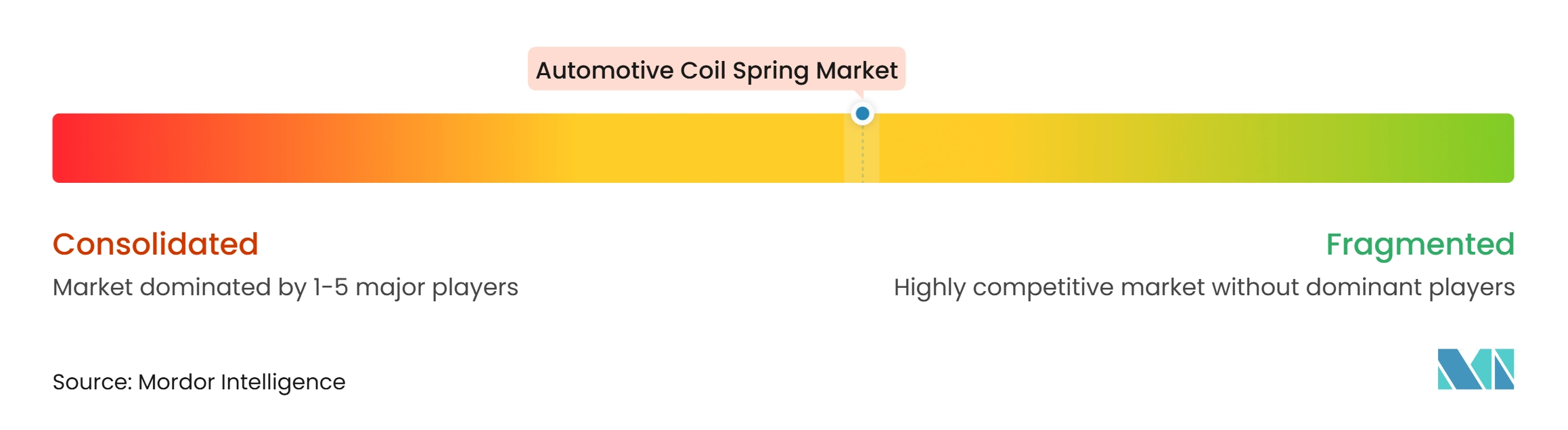
The automotive coil spring market is moderately concentrated, with vertically integrated Tier-1 suppliers such as NHK Spring, Mubea, thyssenkrupp Springs and Stabilizers, and Sogefi holding leading positions. These companies benefit from long-term OEM platform awards and global cold- and hot-coiling manufacturing networks. OEM traceability requirements, IATF 16949-aligned quality processes, and alloy qualification procedures create significant entry barriers for new Tier-1 suppliers. As a result, competition depends on validated manufacturing capabilities as well as price competitiveness. Suppliers that can meet vehicle-specific spring-rate requirements, provide corrosion protection, and achieve demanding fatigue-performance targets are better positioned to retain platform awards. This market structure limits unqualified entrants' ability to secure large OEM programs and increases the value of established engineering, testing, and localized production capabilities.
Technology is becoming an increasingly important differentiator. Mubea’s MLR coil spring system for new-energy vehicles is in series production and delivers up to a 15% weight reduction through selective laser melting, optimized stress design, and NVH-tuned end-coil interfaces. In March 2025, Sapura Industrial signed a five-year Technical Assistance Agreement with Mubea for high-stress coil springs and hollow stabilizer bars in Malaysia. The agreement extends Mubea’s technology into a key regional manufacturing base. NHK Spring’s planned production facility in Hungary for Raw Material Forming provides another example of investment in compact, high-load spring solutions. These developments indicate that electric vehicle requirements are influencing both product development and capacity-expansion decisions. They also demonstrate that premium pricing opportunities depend on technical performance rather than broad product availability alone.
Corrosion-resistant products remain important in markets with road salt exposure or poor road conditions, including Eastern Europe, South Asia, and Sub-Saharan Africa. Standard epoxy-coated products may not meet durability requirements under these operating conditions. In 2025, hybrid and fully electric platforms accounted for 31% of Sogefi’s Suspensions revenue, while 68% of its new business awards carried an e-mobility designation. Aftermarket distributors are increasingly seeking OEM-grade steel and surface treatments as they expand vehicle coverage. Consequently, the automotive coil spring market is experiencing closer alignment between OEM and replacement-part specifications.
Automotive Coil Spring Industry Leaders
-
NHK Spring Co., Ltd.
-
Muhr und Bender KG (Mubea)
-
Sogefi S.p.A.
-
Chuo Spring Co., Ltd.
-
thyssenkrupp AG
- *Disclaimer: Major Players sorted in no particular order
Automotive Coil Spring Market Companies Covered in this Report
- NHK Spring Co., Ltd.
- Muhr und Bender KG (Mubea)
- Sogefi S.p.A.
- Chuo Spring Co., Ltd.
- thyssenkrupp AG
- Beijer Alma AB
- Mitsubishi Steel Mfg. Co., Ltd.
- Daewon Kang Up Co., Ltd.
- Heinrich Eibach GmbH
- H&R Spezialfedern GmbH and Co. KG
- KYB Corporation
- Rassini, S.A.B. de C.V.
- SCHERDEL GmbH
- Betts Spring Manufacturing, Inc.
- Jamna Auto Industries Limited
- Hendrickson USA, L.L.C.
- Fawer Automotive Parts Co., Ltd.
- Zhejiang Meili High Technology Co., Ltd.
- Shanghai China Spring Manufacturing Co., Ltd.
- MW Components, Inc.
Recent Industry Developments in Automotive Coil Spring Market
- April 2026: JAC Motors South Africa launched the T8 2.0L CTi Comfort 4x2 double-cab at ZAR 349,900, positioning it as the lowest-priced double-cab in the market. The vehicle features a 2.0-liter common-rail turbo-diesel engine with an intercooler and an Electric Variable Geometry Turbocharger (EVGT). The engine produces 104 kW at 3,600 rpm and 320 Nm of torque and pairs with a six-speed manual transmission. Its 76-liter fuel tank provides an approximate driving range of 1,100 km. The vehicle also features a double-wishbone front suspension with coil springs.
- March 2026: thyssenkrupp Automotive Technology’s Springs & Stabilizers plant in Debrecen, Hungary, produced its 10 millionth steel spring. Operational since 2018, the facility plays a key role in the company’s production rationalization strategy in Central Europe, alongside the phased closure of its higher-cost site in Hagen, Germany.
- May 2025: NHK Spring announced plans for its third plant in India, in Aurangabad, Maharashtra, to produce coil springs and stabilizer bars, with production scheduled to start in 2027 to serve growing local vehicle output.
- November 2024: Mubea opened a new facility in Ramos Arizpe, Mexico, backed by an investment of MXN 1.1 billion, to produce fiberglass and resin composite springs for vehicle chassis, creating about 200 jobs.
Global Automotive Coil Spring Market Report Scope
The Automotive Coil Spring Market Report is Segmented by Spring Rate (Linear-Rate, Progressive/Variable-Rate), Material (Steel, Others), Position (Front Suspension, Rear Suspension), Vehicle Type (Passenger Cars, LCV, HCV), Sales Channel (OEM, Aftermarket), and Geography (North America (United States, Canada, Mexico), Europe (Germany, France, United Kingdom, Italy, Spain, Rest of Europe), Asia-Pacific (China, India, Japan, South Korea, Rest of Asia-Pacific), South America (Brazil, Rest of South America), Middle East and Africa (Saudi Arabia, United Arab Emirates, South Africa, Rest of Middle East and Africa)). The Market Forecasts are Provided in Terms of Value (USD) and Volume (Units).
Segmentation Overview
| Linear-Rate |
| Progressive/Variable-Rate |
| Steel | Chrome-Silicon |
| Chrome-Vanadium | |
| Others | Titanium |
| Composite |
| Front Suspension |
| Rear Suspension |
| Passenger Cars |
| Light Commercial Vehicles |
| Heavy Commercial Vehicles |
| OEM |
| Aftermarket |
| North America | United States |
| Canada | |
| Rest of North America | |
| Europe | Germany |
| France | |
| United Kingdom | |
| Italy | |
| Spain | |
| Russia | |
| Sweden | |
| Poland | |
| Rest of Europe | |
| Asia-Pacific | China |
| Japan | |
| South Korea | |
| India | |
| Australia | |
| Thailand | |
| Indonesia | |
| Rest of Asia-Pacific | |
| South America | Brazil |
| Argentina | |
| Chile | |
| Colombia | |
| Rest of South America | |
| Middle East and Africa | Turkiye |
| Saudi Arabia | |
| United Arab Emirates | |
| South Africa | |
| Egypt | |
| Israel | |
| Rest of Middle East and Africa |
| By Spring Rate | Linear-Rate | |
| Progressive/Variable-Rate | ||
| By Material | Steel | Chrome-Silicon |
| Chrome-Vanadium | ||
| Others | Titanium | |
| Composite | ||
| By Position | Front Suspension | |
| Rear Suspension | ||
| By Vehicle Type | Passenger Cars | |
| Light Commercial Vehicles | ||
| Heavy Commercial Vehicles | ||
| By Sales Channel | OEM | |
| Aftermarket | ||
| By Geography | North America | United States |
| Canada | ||
| Rest of North America | ||
| Europe | Germany | |
| France | ||
| United Kingdom | ||
| Italy | ||
| Spain | ||
| Russia | ||
| Sweden | ||
| Poland | ||
| Rest of Europe | ||
| Asia-Pacific | China | |
| Japan | ||
| South Korea | ||
| India | ||
| Australia | ||
| Thailand | ||
| Indonesia | ||
| Rest of Asia-Pacific | ||
| South America | Brazil | |
| Argentina | ||
| Chile | ||
| Colombia | ||
| Rest of South America | ||
| Middle East and Africa | Turkiye | |
| Saudi Arabia | ||
| United Arab Emirates | ||
| South Africa | ||
| Egypt | ||
| Israel | ||
| Rest of Middle East and Africa | ||
Key Questions Answered in the Report
What is the projected growth rate for automotive coil springs?
The Automotive Coil Spring Market is forecast to grow at a 4.13% CAGR from 2027 to 2032, increasing from USD 9.61 billion in 2026 to USD 12.38 billion by 2032.
Which material is used most often for automotive coil springs?
Steel held 96.27% of segment revenue in 2026 because it provides a balance of cost, strength, fatigue resistance, and scalable production.
Is the automotive coil-spring aftermarket growing?
Yes. The aftermarket is forecast to grow at a 4.36% CAGR through 2032 as aging vehicle fleets create replacement demand.
Which sales channel is largest for coil springs?
OEM was the largest sales channel with 71.27% revenue share in 2026, reflecting the role of assembly-line fitment and platform supply agreements.