
Automotive Antenna Module Market Size and Share
Market Overview
| Study Period | 2020 - 2032 |
|---|---|
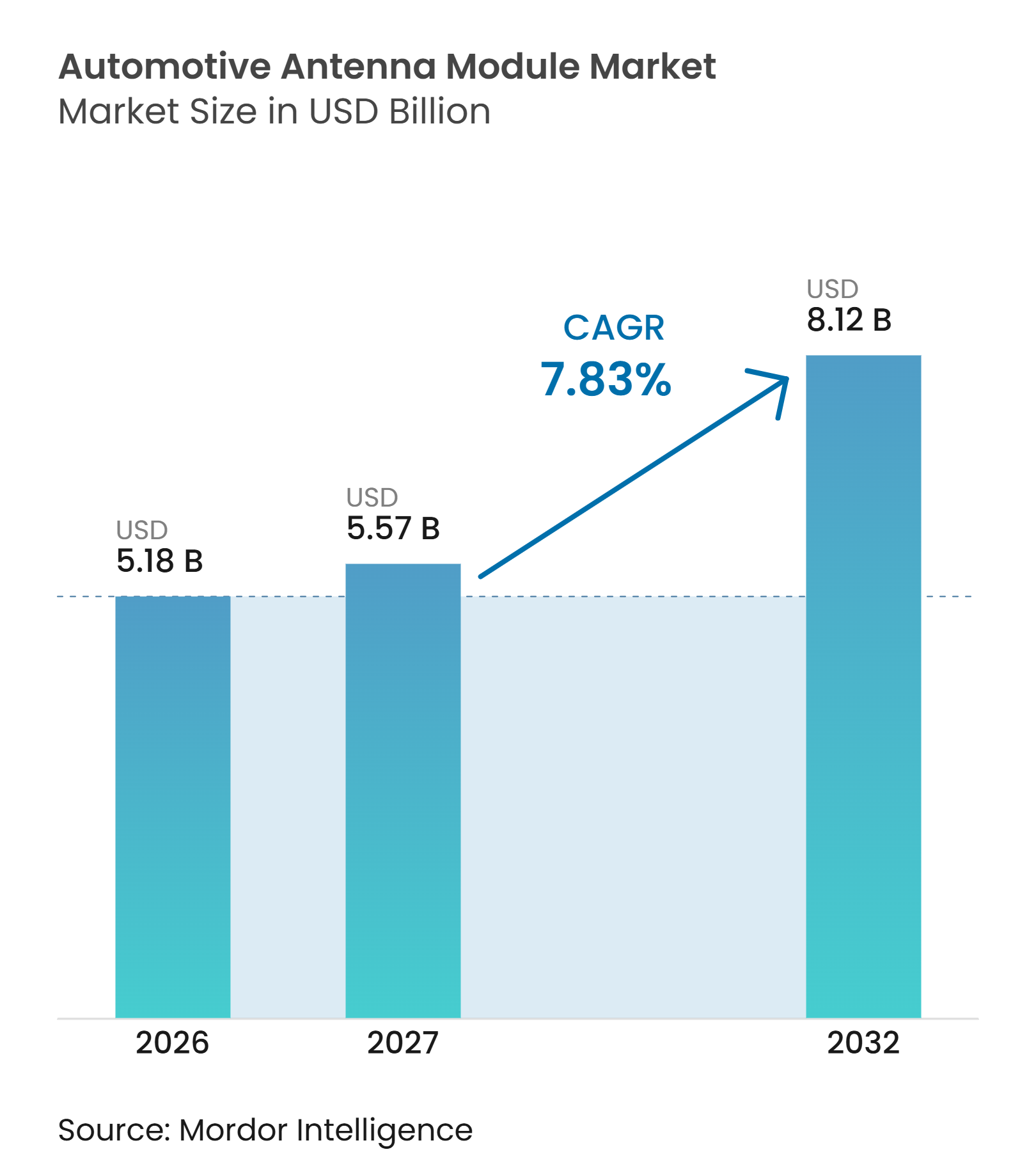
| Market Size (2027) | USD 5.57 Billion |
| Market Size (2032) | USD 8.12 Billion |
| Growth Rate (2027 - 2032) | 7.83 % |
| Fastest Growing Market | Asia-Pacific |
| Largest Market | Asia-Pacific |
| Market Concentration | Medium |
Major Players *Disclaimer: Major Players sorted in no particular order Image © Mordor Intelligence. Reuse requires attribution under CC BY 4.0. | |
Automotive Antenna Module Market Analysis by Mordor Intelligence
The Automotive Antenna Module Market size was valued at USD 5.18 billion in 2026 and is estimated to grow from USD 5.57 billion in 2027 to reach USD 8.12 billion by 2032, at a CAGR of 7.83% during the forecast period (2027-2032). The automotive antenna module market is moving from separate antennas toward multi-band assemblies that combine 5G, GNSS, V2X, Wi-Fi, AM/FM, and digital broadcasting functions. Level 2+ driver-assistance vehicles need 6 to 8 antenna elements, compared with 3 to 4 in conventional internal-combustion vehicles, which raises content value per platform. Software-defined vehicle designs also require remote calibration, diagnostics, and more robust communication links. These requirements favor suppliers that can manage RF design, component integration, certification, and long vehicle development cycles. They also create opportunities in glass-integrated designs, fleet retrofits, and active electronics that support changing network requirements.
Key Report Takeaways
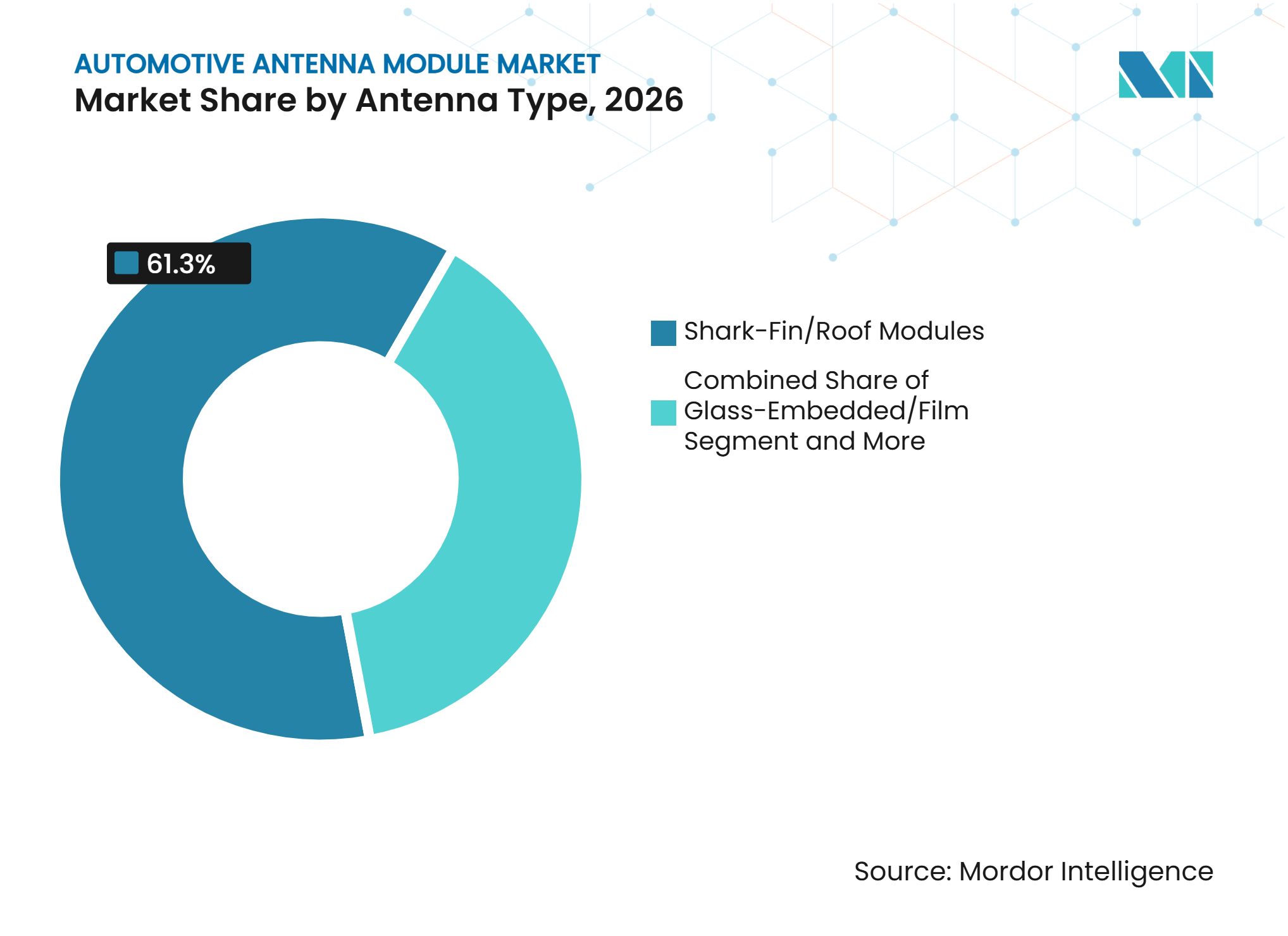
• By antenna type, shark-fin/roof modules held 61.27% of Automotive antenna module market share in 2026, while glass-embedded/film antennas are projected to grow at an 8.81% CAGR through 2032.
• By component, antenna elements accounted for 71.26% of the automotive antenna module market size in 2026, while amplifiers and tuners are projected to expand at an 8.93% CAGR through 2032.
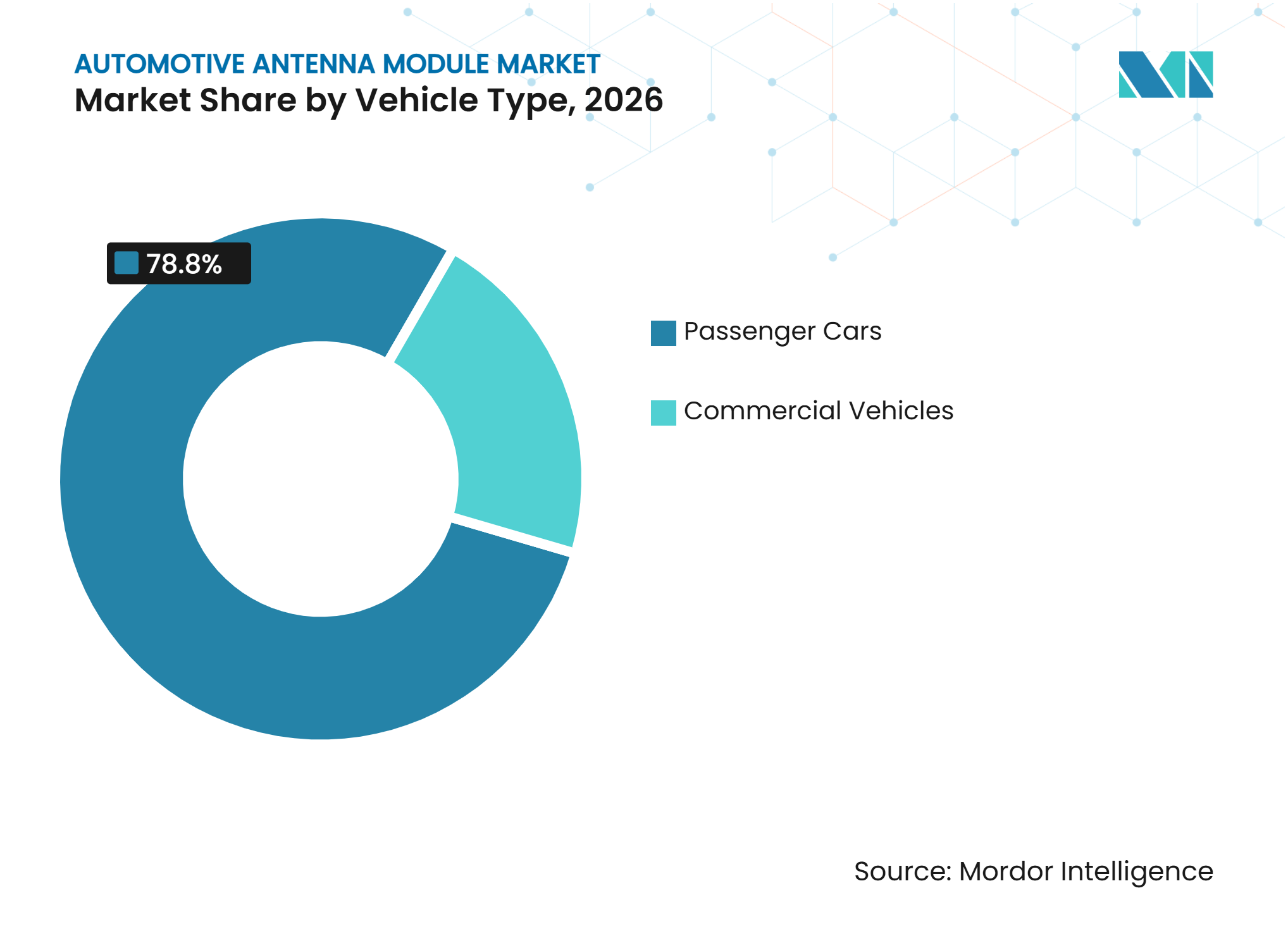
• By vehicle type, passenger cars held 78.83% of market revenue in 2026, while commercial vehicles are forecast to grow at an 8.95% CAGR through 2032.
• By sales channel, OEM held 67.74% of market revenue in 2026, while aftermarket is forecast to grow at a 9.05% CAGR through 2032.
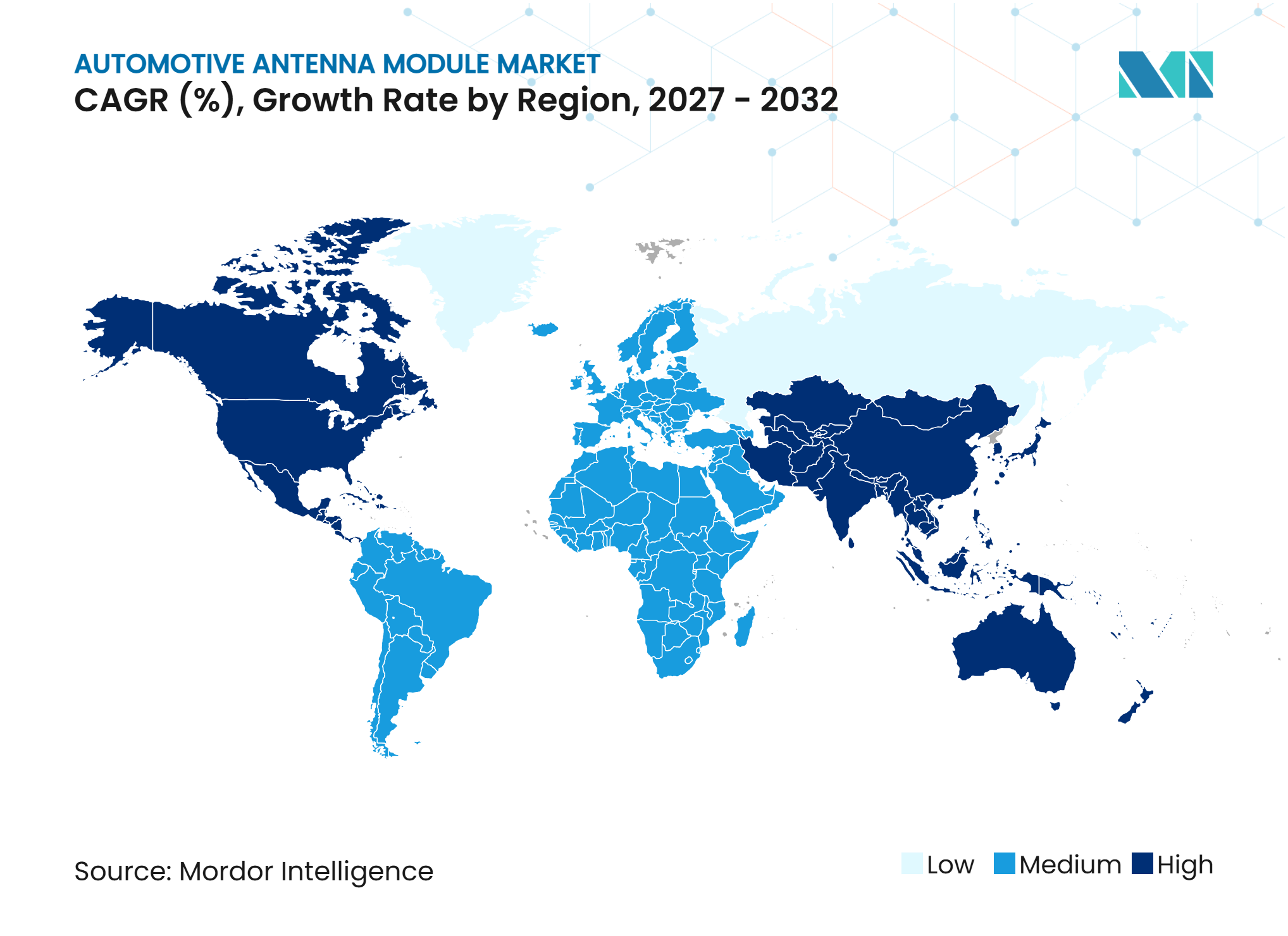
• By geography, Asia-Pacific held 38.91% of market revenue in 2026 and is forecast to grow at a 9.11% CAGR through 2032.
Note: Market numbers in this report are based on Mordor Intelligence's proprietary estimation framework, which combines nine months of actuals with Q4 projections for base year 2026.
Market Trends and Insights
Drivers Impact Analysis of Automotive Antenna Module Market*
| Driver | (~) % Impact on CAGR Forecast | Geographic Relevance | Impact Timeline |
|---|---|---|---|
| Rising Connected-Vehicle and Infotainment Content per Vehicle | +1.8% | Global, led by China, Germany, South Korea | Medium term (2–4 years) |
| Expansion of 5G, V2X and GNSS-Enabled Automotive Functions | +1.5% | Global, early gains in China, US, EU | Medium term (2–4 years) |
| Factory-Fitted Multi-Band Modules Replacing Discrete Antennas | +1.2% | Global, strongest in APAC and Europe | Long term (≥ 4 years) |
| Growing Demand for Low-Profile Roof and Glass Integration | +0.9% | Europe and APAC core, spill-over to North America | Long term (≥ 4 years) |
| Increasing Telematics and Fleet Connectivity in Commercial Vehicles | +0.8% | North America, Europe, Southeast Asia | Short term (≤ 2 years) |
| RF Performance Requirements from Electrification and Software-Defined Vehicles | +0.7% | Global, led by BEV markets (China, Germany, US) | Medium term (2–4 years) |
| Source: Mordor Intelligence | |||
Rising Connected-Vehicle and Infotainment Content per Vehicle
Connected functions are increasing the antenna specification across vehicle price points. OEMs are standardizing digital audio, satellite radio, Wi-Fi hotspots, and vehicle-to-cloud links on models that previously used only AM/FM and cellular equipment. Each added radio function raises isolation requirements and validation work. This supports suppliers with certified multi-band designs rather than suppliers of individual components. Yokowo identifies all-in-one antenna and TCU module development as a core research area for its customers in Japan, ASEAN, the United States, and other regions. Antenna content is also spreading through mid-range and commercial vehicles as fleet telematics and eCall-related connectivity requirements become more common.
Expansion of 5G, V2X and GNSS-Enabled Automotive Functions
5G Release 16, C-V2X, and dual-frequency GNSS are changing module design requirements in the automotive antenna module market. Connected-car platforms increasingly require MIMO configurations with 4 or more cellular elements. C-V2X uses the 5.9 GHz band, which complicates the use of shared apertures with sub-6 GHz cellular arrays. These requirements are contributing to 6-port and 8-port module designs. AUMOVIO received FCC authorizations for roof antennas in June and July 2025, and its TCAM1EU2 module received European homologation in July 2025. LG Innotek also announced an automotive 5G broadband satellite communication module that supports NR-NTN, uses 30 MHz bandwidth, and moved into mass production during Q1 2026 [1].
Factory-Fitted Multi-Band Modules Replacing Discrete Antennas
Factory-fitted multi-band modules replace separate antenna components and cable runs with one integrated assembly. This reduces assembly work and harness weight, which matters for battery-electric platforms. It also increases selling value per module and reduces the number of suppliers that an OEM must qualify. TE Connectivity introduced the TE MINI FAKRA connector system in October 2026 for V2X, ADAS, and compact antenna-module applications, with RF performance up to 9 GHz and data rates up to 24 Gbps [2]. Panoramic glass roofs further support glass-embedded and film antenna designs when conventional roof housings conflict with aerodynamic and styling goals. Japan’s government highlighted AGC’s Pulsaart connected glass roof, which integrates 5G, UWB, and WLAN antennas in glass [3].
Increasing Telematics and Fleet Connectivity in Commercial Vehicles
Commercial fleets are adopting telematics hardware for compliance, dispatching, safety, and transport management. This supports both original equipment installations and retrofit demand in the automotive antenna module market. Passenger and commercial vehicles are also adding electronic systems that require stronger filtering, diagnostics, and gain control. Modules must therefore withstand noise from electrified powertrains while supporting over-the-air parameter updates. Taoglas launched the Patriot series in July 2025 for fleet and emergency-service applications, combining 5G/4G, GNSS, Wi-Fi, SDARS, and LMR/TETRA in one IP69K enclosure [4]. The combination of fleet demand and software-defined vehicle architectures supports active electronics alongside traditional radiating elements.
Restraints Impact Analysis of Automotive Antenna Module Market*
| Restraint | (~) % Impact on CAGR Forecast | Geographic Relevance | Impact Timeline |
|---|---|---|---|
| High RF Integration and Validation Costs for Multifunction Modules | -1.2% | Global, most acute in North America and Europe | Long term (≥ 4 years) |
| Electromagnetic Interference from Dense Vehicle Electronics | -0.9% | Global, most severe in BEV-heavy markets | Medium term (2–4 years) |
| Long Automotive Qualification Cycles and OEM Design-Lock Requirements | -0.8% | Global, particularly North America and Japan | Long term (≥ 4 years) |
| Limited Aftermarket Compatibility Across Vehicle Platforms | -0.5% | North America, Europe, and mature APAC markets | Short term (≤ 2 years) |
| Source: Mordor Intelligence | |||
High RF Integration and Validation Costs for Multifunction Modules
Multi-function modules must meet requirements for 5G MIMO isolation, GNSS carrier-phase accuracy, V2X spectral masks, and legacy broadcast reception. The design process requires electromagnetic simulation, chamber testing, and repeated hardware revisions. Costs increase when OEMs require different variants for separate regions. FCC, MIIT, or CCC approvals, and UNECE approvals can require parallel validation work for each generation. UNECE Regulation No. 10 Amendment 4 updated electromagnetic compatibility requirements for vehicles and electronic subassemblies from June 2025. These requirements extend entry timelines and strengthen the position of suppliers that already hold qualified designs and established OEM relationships.
Electromagnetic Interference from Dense Vehicle Electronics
High-voltage inverters, DC-DC converters, and electric motors can create RF noise in bands used by cellular, GNSS, and Wi-Fi systems. The issue is more demanding in 400-volt and 800-volt architectures, where switching transients can couple into feed lines through shared ground planes. Software updates can also alter vehicle noise patterns after delivery, expanding the electromagnetic environment that a module must tolerate. ISO 11452 and CISPR 25 provide baseline automotive EMC practices, but OEM-specific requirements often add platform-level validation work. These conditions add shielding, filtering, and active gain-control requirements, while glass-integration customers also seek smaller packages. Aftermarket suppliers must additionally manage varying vehicle interfaces, mounting locations, and platform-specific connector arrangements, which limits cross-platform module interoperability.
*Our forecasts treat driver/restraint impacts as directional, not additive. The impact forecasts reflect baseline growth, mix effects, and variable interactions.
Automotive Antenna Module Market Segment Analysis
By Antenna Type:
Shark-Fin Modules Retain Scale While Embedded Designs Gain GroundShark-fin/roof modules held 61.27% of the automotive antenna module market share in 2026. Their position reflects long use as the standard multi-function design on passenger vehicles. Their housings provide established performance across cellular, GNSS, and broadcast bands. They also offer a familiar installation approach for OEM engineering teams. Fixed mast and whip antennas remain relevant in working commercial vehicles, low-cost platforms, and off-highway applications. In these uses, roof integration may add cost without a proportional connectivity benefit. Shark-fin designs therefore remain central to platform programs that favor proven RF performance and simple service procedures. Their large installed base also supports continuing replacement demand.
Glass-embedded and film antennas are forecast to grow at an 8.81% CAGR through 2032. Panoramic roof adoption and exterior-design requirements are changing the physical location of antennas in newer vehicles. Battery-electric vehicles also place greater value on lower-profile structures and integrated surfaces. Transparent and embedded antenna designs shift part of the RF integration role toward vehicle-glass suppliers. AUO Mobility Solutions and YTTEK Technology showed SatGlass at CES 2026, placing transparent phased-array satellite antennas in glass panels for V2X, remote updates, and in-car services. Hidden and conformal arrays in bumpers, spoilers, and mirror housings are also gaining use in premium EV designs. The automotive antenna module industry is therefore shifting toward more complex embedded architectures while shark-fin modules remain the volume base. IEEE research notes that isolation and substrate-permittivity management remain important technical issues for roof-glass antennas. Vehicle makers must therefore coordinate antenna placement with glazing, body structure, and the electronic control systems that use the signal. That wider coordination increases development work, but it can also reduce external components and simplify the vehicle exterior.



By Component:
Antenna Elements Hold the Largest Base While Active Electronics ExpandAntenna elements accounted for 71.26% of the automotive antenna module market size in 2026. Multi-band RF systems remain hardware-intensive because conductive materials, substrates, and element geometry determine key performance results. OEMs also prefer fully characterized radiating elements from certified Tier-1 integrators. This supports the established role of antenna elements in module cost and value. Element performance must be considered with housing materials, cable routing, connector selection, and nearby vehicle electronics. These interdependencies raise the importance of integrated design validation. The category also benefits from the growing number of links that vehicle platforms support. Antenna elements consequently remain the largest component base even as active functions expand.
Amplifiers and tuners are projected to grow at an 8.93% CAGR through 2032. Software-defined vehicle requirements are increasing demand for modules that can diagnose performance, adjust gain, and accept updated parameters. Active tuning can help a physical aperture support regional frequency plans across North America, Europe, and China. This reduces platform-specific SKUs while placing more semiconductor content in each module. TE Connectivity’s FP40 antenna, available from July 2025, combines LTE/5G, Wi-Fi 6E/7, GNSS L1/L5, and Bluetooth across up to 8 ports in an IP67/IP69K housing. Printed circuit boards, connectors, and cable assemblies also benefit from higher port counts. FAKRA and Mini FAKRA standardization supports this higher interconnect density across new platform generations. The automotive antenna module market consequently requires component suppliers to align RF performance with environmental protection, diagnostics, and service needs. The resulting design work makes component integration more important than supplying a larger number of separate parts.
By Vehicle Type:
Passenger Car Programs Provide Scale While Commercial Fleets Grow FasterPassenger cars held 78.83% of the automotive antenna module market size in 2026. Global passenger vehicle volumes and multi-year platform programs support this position. Premium and mid-range passenger vehicles are the main volume base for shark-fin modules. They are also an early adoption base for glass-embedded modules. Connected functions are becoming standard across more model ranges. This moves antenna content from optional equipment toward common platform hardware. Passenger vehicle modules are normally specified years before production starts. That process supports stable volumes for qualified suppliers once a design win is secured.
Commercial vehicles are expected to grow at an 8.95% CAGR through 2032. Growth reflects OEM-fitted telematics for fleet management and compliance needs. It also reflects aftermarket installations for transport-management software and vehicle connectivity. European tachograph requirements and U.S. electronic logging device mandates support the use of connected fleet equipment. Commercial vehicle modules can be refreshed more frequently than passenger-car programs. Taoglas designed its Patriot series for fleet vehicles, emergency services, and commercial transport, highlighting the need for compact multi-network hardware in these uses. Suppliers must still meet IATF 16949 expectations and applicable FCC or UNECE type approvals. Flexible form factors and pre-certified modules are therefore important for fleet-focused suppliers. The automotive antenna module market also benefits when fleet managers can add connectivity without redesigning a vehicle platform. This places practical installation and consistent performance alongside the radio specifications required by each fleet application.

By Sales Channel:
OEM Programs Hold Revenue While Retrofits Support Aftermarket GrowthThe OEM channel held 67.74% of market revenue in 2026. Antenna modules are designed into vehicle platforms and then supplied under multi-year production agreements. This gives OEM suppliers volume visibility and stable program demand. It also creates long lead times between a design win and recognized sales. Development and validation can take 48 to 72 months. That requirement limits direct participation by suppliers without substantial engineering and financial capacity. OEM relationships also require continuity in quality systems, manufacturing, and regional supply support. These conditions explain the channel’s leading position in the automotive antenna module market.
The aftermarket is forecast to grow at a 9.05% CAGR through 2032. Fleet retrofits, insurance telematics, and connectivity upgrades can proceed outside the original vehicle design cycle. Logistics, utility, and emergency-service operators often procure multi-band modules to support operational systems. This channel can become an early deployment route for 5G and V2X capabilities in fleets that lack factory-fitted alternatives. It also has lower qualification barriers than OEM programs. Ficosa states that it is the only automotive company authorized to use Fractal Antenna technology in automotive applications, supporting compact multi-band elements for restricted installation spaces. The channel remains constrained by differences in vehicle interfaces and mounting positions. Suppliers that offer adaptable, pre-certified installations are better placed to address these compatibility limits. The automotive antenna module market gains a separate source of demand when operators update legacy fleets outside new-vehicle purchasing cycles. However, retrofit providers still need to match the module, connector, mounting method, and software requirements of each vehicle group.
Geography Analysis
Asia-Pacific: Vehicle Production and Electrification Support Both Volume and Growth
Asia-Pacific held 38.91% of market revenue in 2026 and is forecast to grow at a 9.11% CAGR through 2032. China supports regional demand through its large passenger-vehicle production base and rapid new-energy vehicle adoption. Electric platforms use more communication interfaces than comparable internal-combustion vehicles. That increases the antenna content required on each connected platform. Japan adds established OEM supply relationships and technology development capabilities. Yokowo identifies Japanese, ASEAN, U.S., and global vehicle customers as target markets for its VCCS antenna and TCU development work. China’s GB/T 32960 framework and MIIT or CCC requirements shape local vehicle communication specifications and supplier qualification. The automotive antenna module market in the region therefore combines production scale, electrification, and compliance requirements that support more integrated hardware. India is emerging as a future demand location as domestic new-energy vehicle activity and connected-vehicle requirements develop. Yokowo identifies India as a market with future antenna-module demand in its annual reporting.
Europe: Compliance Requirements and Premium OEM Programs Support Advanced Designs
Europe remains an important testing ground for advanced antenna integration in Germany, France, the United Kingdom, and Italy. Premium OEM programs in these countries have supported multi-band shark-fin modules and are moving toward glass-embedded systems. The eCall framework helped normalize factory-fitted connectivity across vehicle price points. UNECE R155 Supplement 3 took effect on January 10, 2025, extending cybersecurity management requirements to vehicle supply chains with over-the-air interfaces. This regulatory influence requires suppliers to incorporate relevant communication components into certified cybersecurity management processes. LG Electronics began mass production and deliveries of a 5G Release 16 smart telematics solution to a premium European automaker in August 2026. The integrated unit houses up to 12 antennas and removes the conventional shark-fin arrangement. LG Innotek also received orders for an automotive Wi-Fi 7 module intended for European automotive use, with mass production planned for 2027.
North America, South America, and the Middle East and Africa: Different Channel and Platform Needs
North America relies heavily on light trucks and SUVs, where roof designs can accommodate larger shark-fin housings. FCC and ISED requirements create a separate radio approval environment from Europe’s UNECE system. These compliance factors sustain regional product variants and favor suppliers with existing North American approvals. South America, led by Brazil and Argentina, is more price-sensitive and has a larger retrofit emphasis for stolen-vehicle recovery and fleet management. The Middle East and Africa remain earlier-stage markets, with connected-vehicle demand concentrated in GCC premium imports and fleet telematics projects. These mixed geographies require different approaches to factory supply, aftermarket installation, price, and type approval. The automotive antenna module market therefore has distinct regional requirements even when underlying connectivity functions are similar.
Competitive Landscape
Market Concentration

The automotive antenna module market is moderately concentrated among specialized antenna integrators and diversified Tier-1 suppliers. Harada Industry, AUMOVIO, and Yokowo benefit from established OEM co-development relationships and RF design capabilities. TE Connectivity, Amphenol, and Molex use their connector and interconnect positions to expand into module-level integration. Korean electronics companies, including LG Innotek and LG Electronics, are using communications integration experience to offer combined antenna and modem solutions. AUMOVIO and Continental Automotive Technologies received a U.S. patent in January 2026 for an antenna device with adaptive voltage regulation for LTE compensators. This illustrates continuing development of RF intellectual property for European OEM programs. Supplier selection depends on multi-standard certification, vehicle-platform engineering support, RF design depth, and regional manufacturing capability.
Competition for OEM programs centers on design wins that can be decided 3 to 5 years before production. Once a module is integrated into a platform, qualification requirements make supplier replacement difficult. This favors businesses that can support long design cycles, prove performance, and maintain automotive quality systems. LG Electronics’ August 2026 telematics launch is a clear example of integrated architecture, consolidating up to 12 antennas for a European premium automaker. TE Connectivity’s October 2026 MINI FAKRA launch provides another example, as the system targets compact V2X and antenna-module layouts. These moves show how connectivity hardware, connector systems, and vehicle packaging are becoming more closely linked. IATF 16949 and regional type approval portfolios remain important competitive requirements in both OEM and fleet applications.
The aftermarket has a more fragmented supplier base than OEM platform programs. Taoglas and MTA can compete through application-specific, pre-certified multi-band assemblies that reduce installation work for fleet operators. This channel provides opportunities in entry-level vehicle platforms, commercial fleets, and constrained installation spaces. It also supports regionally adapted modules for C-V2X frequency allocations that differ across China, Europe, and North America. Ficosa’s automotive authorization for Fractal Antenna technology illustrates the value of differentiated antenna solutions for compact applications. Suppliers still face interoperability limits across vehicle platforms and different connector systems. The competitive balance therefore differs by channel, with OEM supply shaped by long qualification cycles and aftermarket demand shaped by compliance speed and installation practicality. The automotive antenna module market remains concentrated around suppliers that can combine RF expertise, automotive certification, and platform-level support.
Automotive Antenna Module Industry Leaders
-
Harada Industry Co., Ltd.
-
AUMOVIO SE
-
TE Connectivity Ltd.
-
Amphenol Corporation
-
Molex, LLC
- *Disclaimer: Major Players sorted in no particular order
Automotive Antenna Module Market Companies Covered in this Report
- Harada Industry Co., Ltd.
- AUMOVIO SE
- TE Connectivity Ltd.
- Amphenol Corporation
- Molex, LLC
- Yokowo Co., Ltd.
- Taoglas Group Holdings Limited
- MTA S.p.A.
- Guangdong Shenglu Telecommunication Technology Co., Ltd.
- MinebeaMitsumi Inc.
- DENSO Corporation
- LG Innotek Co., Ltd.
- INPAQ Technology Co., Ltd.
- Sunway Communication Co., Ltd.
- Ficosa International, S.A.
- Samsung Electronics Co., Ltd.
- Robert Bosch GmbH
- Forvia SE
- Valeo SE
- Ezurio
Recent Industry Developments in Automotive Antenna Module Market
- October 2026: TE Connectivity launched the TE MINI FAKRA connector system, supporting RF performance up to 9 GHz and data rates up to 24 Gbps, designed for V2X, ADAS, and antenna module applications in space-constrained software-defined vehicle architectures; the system is globally available.
- September 2026: Valeo received a development order from Gapwaves for next-generation waveguide antennas for ADAS radar sensors, worth approximately SEK 2.8 million, with prototype delivery planned for H2 2026 and production start targeted for 2030.
- August 2026: LG Electronics began mass production and commenced deliveries of its next-generation 5G R16-based smart telematics solution to a premium European automaker, housing up to 12 antennas in a single integrated unit and eliminating the conventional shark-fin antenna; the solution targets SDV OTA updates, V2X, and autonomous-driving data transmission.
- August 2026: LG Electronics began mass production of its next-generation 5G smart telematics solution for a premium European automaker, integrating a communications module and up to 12 antennas into a single unit to reduce wiring complexity, weight, and cost.
Global Automotive Antenna Module Market Report Scope
The scope of the report includes Antenna Type (Shark-Fin/Roof Modules, Fixed Mast/Whip, Glass-Embedded/Film, Others), Component (Antenna Elements, Amplifiers and Tuners, Others), Vehicle Type (Passenger Cars, Commercial Vehicles), Sales Channel (OEM, Aftermarket), and Geography (North America, South America, Europe, Asia-Pacific, MEA). The Market Forecasts are Provided in Terms of Value (USD) and Volume (Units).
Segmentation Overview
| Shark-Fin/Roof Modules |
| Fixed Mast/Whip |
| Glass-Embedded/Film |
| Others (Hidden/Conformal) |
| Antenna Elements |
| Amplifiers and Tuners |
| Others |
| Passenger Cars |
| Commercial Vehicles |
| OEM |
| Aftermarket |
| North America | United States |
| Canada | |
| Rest of North America | |
| South America | Brazil |
| Argentina | |
| Rest of South America | |
| Europe | Germany |
| United Kingdom | |
| France | |
| Italy | |
| Spain | |
| Russia | |
| Rest of Europe | |
| Asia-Pacific | China |
| Japan | |
| South Korea | |
| India | |
| Southeast Asia | |
| Australia and New Zealand | |
| Rest of Asia-Pacific | |
| Middle East and Africa | Turkey |
| Saudi Arabia | |
| United Arab Emirates | |
| South Africa | |
| Rest of Middle East | |
| Rest of Africa |
| By Antenna Type | Shark-Fin/Roof Modules | |
| Fixed Mast/Whip | ||
| Glass-Embedded/Film | ||
| Others (Hidden/Conformal) | ||
| By Component | Antenna Elements | |
| Amplifiers and Tuners | ||
| Others | ||
| By Vehicle Type | Passenger Cars | |
| Commercial Vehicles | ||
| By Sales Channel | OEM | |
| Aftermarket | ||
| By Geography | North America | United States |
| Canada | ||
| Rest of North America | ||
| South America | Brazil | |
| Argentina | ||
| Rest of South America | ||
| Europe | Germany | |
| United Kingdom | ||
| France | ||
| Italy | ||
| Spain | ||
| Russia | ||
| Rest of Europe | ||
| Asia-Pacific | China | |
| Japan | ||
| South Korea | ||
| India | ||
| Southeast Asia | ||
| Australia and New Zealand | ||
| Rest of Asia-Pacific | ||
| Middle East and Africa | Turkey | |
| Saudi Arabia | ||
| United Arab Emirates | ||
| South Africa | ||
| Rest of Middle East | ||
| Rest of Africa | ||
Key Questions Answered in the Report
What is the forecast growth rate for automotive antenna modules?
The category is forecast to grow at a 7.83% CAGR from 2027 to 2032, rising from USD 5.59 billion in 2027 to USD 8.12 billion by 2032.
Which antenna design leads automotive applications?
Shark-fin/roof modules led with 61.27% revenue share in 2026 because OEMs continue to use their proven multi-band performance and established installation approach.
Why are glass-embedded vehicle antennas gaining adoption?
Glass-embedded and film designs are forecast to grow at an 8.81% CAGR through 2032 as panoramic roofs, aerodynamic needs, and integrated exterior styling become more common.
Which vehicle group has the fastest growth in antenna demand?
Commercial vehicles are forecast to expand at an 8.95% CAGR through 2032, supported by telematics, fleet compliance, transport management, and retrofit demand.
How do 5G and V2X affect antenna design?
These functions increase the number of ports, frequency bands, filtering needs, and validation requirements, supporting multi-band integrated modules.
Which region has the largest demand base?
Asia-Pacific held 38.91% of revenue in 2026 and is forecast to grow at a 9.11% CAGR through 2032, supported by vehicle production, electrification, and connected-platform adoption.