
Automatic Lubrication System Market Size and Share
Market Overview
| Study Period | 2020 - 2032 |
|---|---|
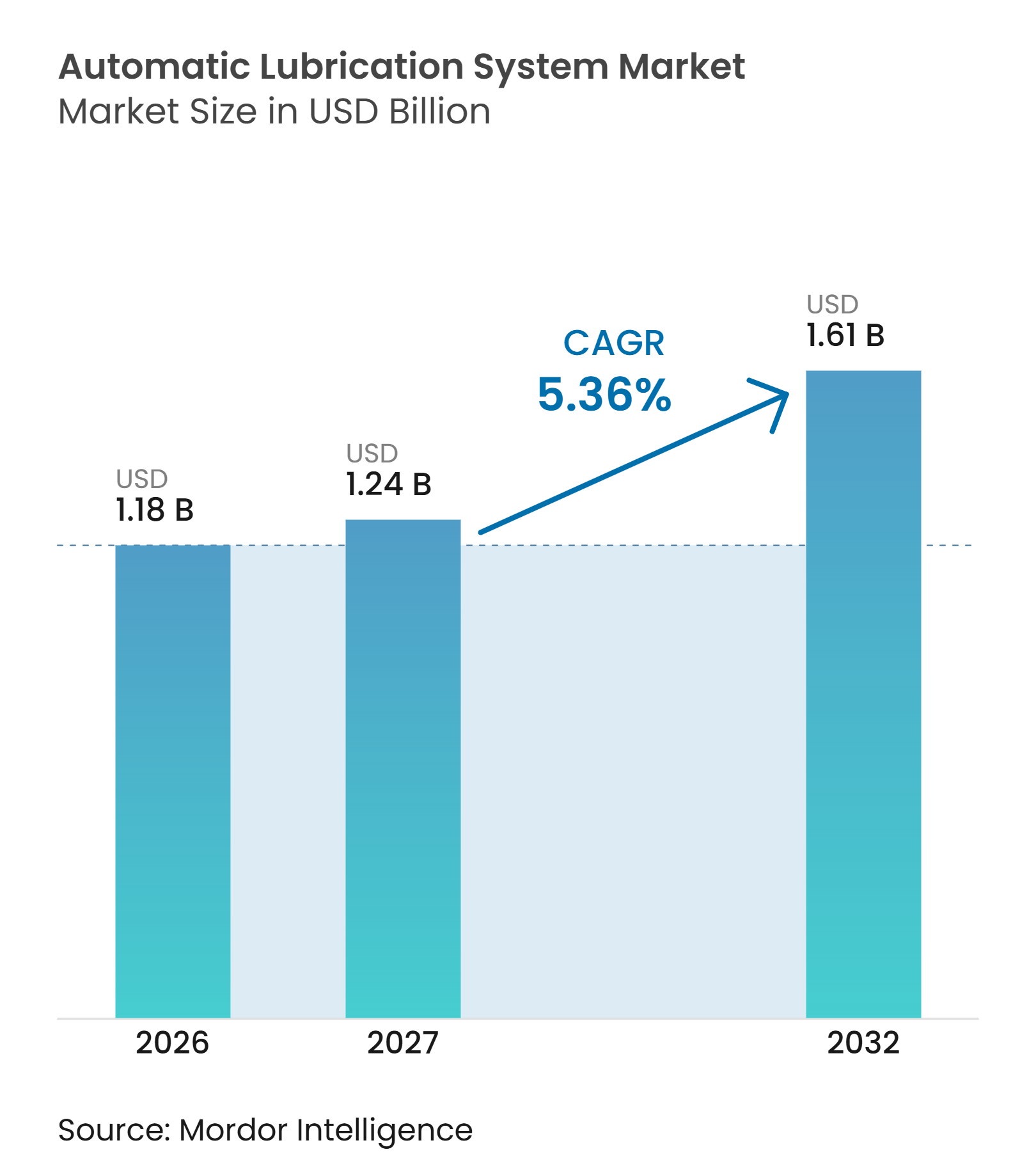
| Market Size (2027) | USD 1.24 Billion |
| Market Size (2032) | USD 1.61 Billion |
| Growth Rate (2027 - 2032) | 5.36 % |
| Fastest Growing Market | Asia-Pacific |
| Largest Market | Asia-Pacific |
| Market Concentration | Medium |
Major Players *Disclaimer: Major Players sorted in no particular order Image © Mordor Intelligence. Reuse requires attribution under CC BY 4.0. | |
Automatic Lubrication System Market Analysis by Mordor Intelligence
The automatic lubrication systems market size was valued at USD 1.18 billion in 2026, is estimated at USD 1.24 billion in 2027, and is projected to reach USD 1.61 billion by 2032, growing at a CAGR of 5.36% from 2027 to 2032. The automatic lubrication systems market is benefiting from wider use of automated equipment in mining, construction, transportation, and energy. Operators increasingly assess lubrication in terms of equipment availability, repair exposure, and asset life, rather than treating it solely as a maintenance supply. Connected controllers and sensors are integrating lubrication systems into broader equipment monitoring programs. This creates room for suppliers that combine durable hardware with practical data tools and maintenance support. The automatic lubrication systems market also faces adoption limits where legacy machines require custom engineering and where operators cannot support specialized installation work.
Key Report Takeaways
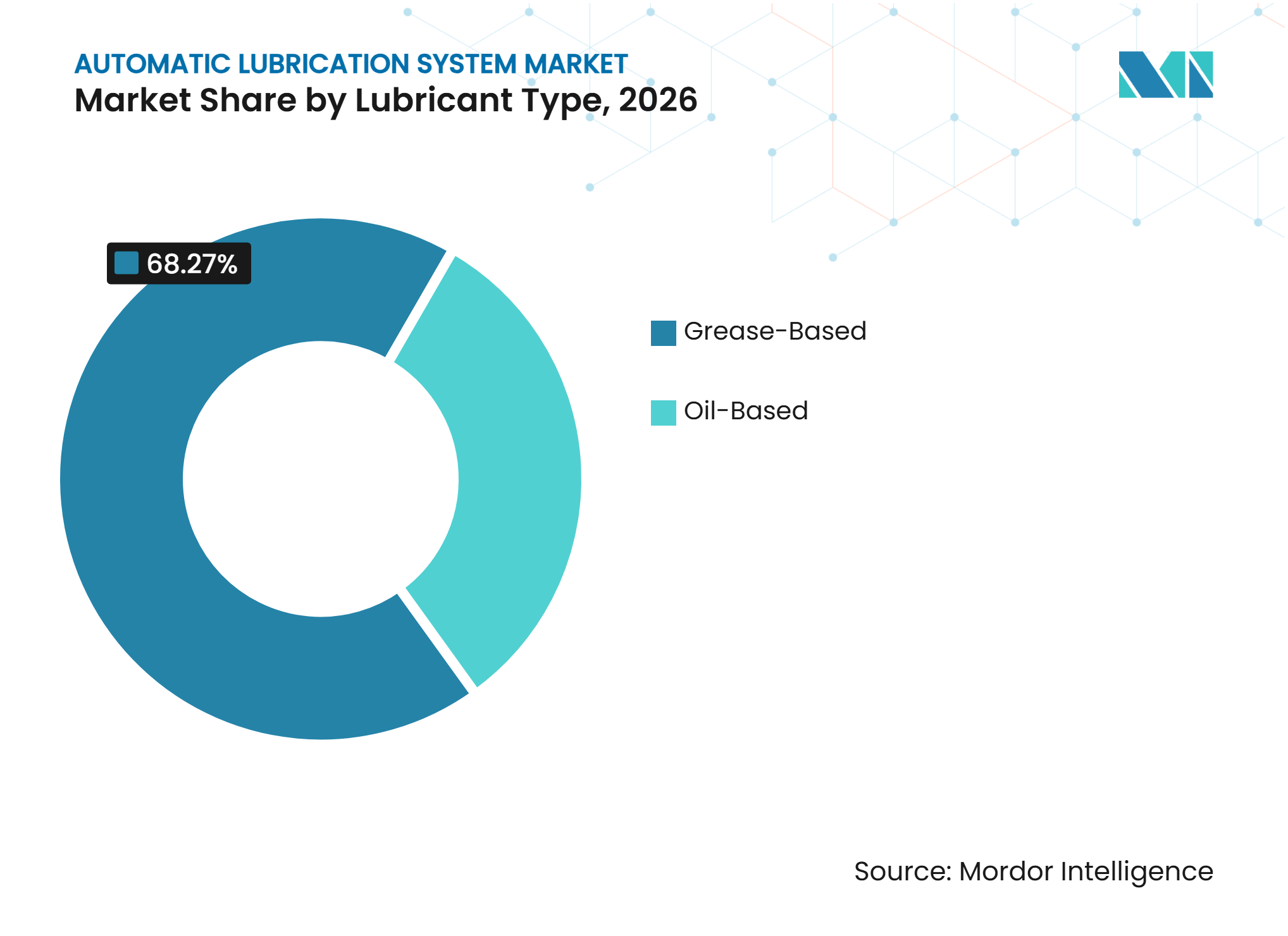
- By lubricant type, Grease-Based systems held 68.27% of the automatic lubrication systems market share in 2026, while Oil-Based systems are forecast to grow at a 5.65% CAGR through 2032.
- By system type, Series Progressive systems accounted for 20.18% of the automatic lubrication systems market size in 2026, while Minimum Quantity Lubrication is projected to expand at a 6.13% CAGR through 2032.
- By component, Pumps held 36.27% of automatic lubrication systems market share in 2026, while Controllers are forecast to grow at a 5.86% CAGR through 2032.
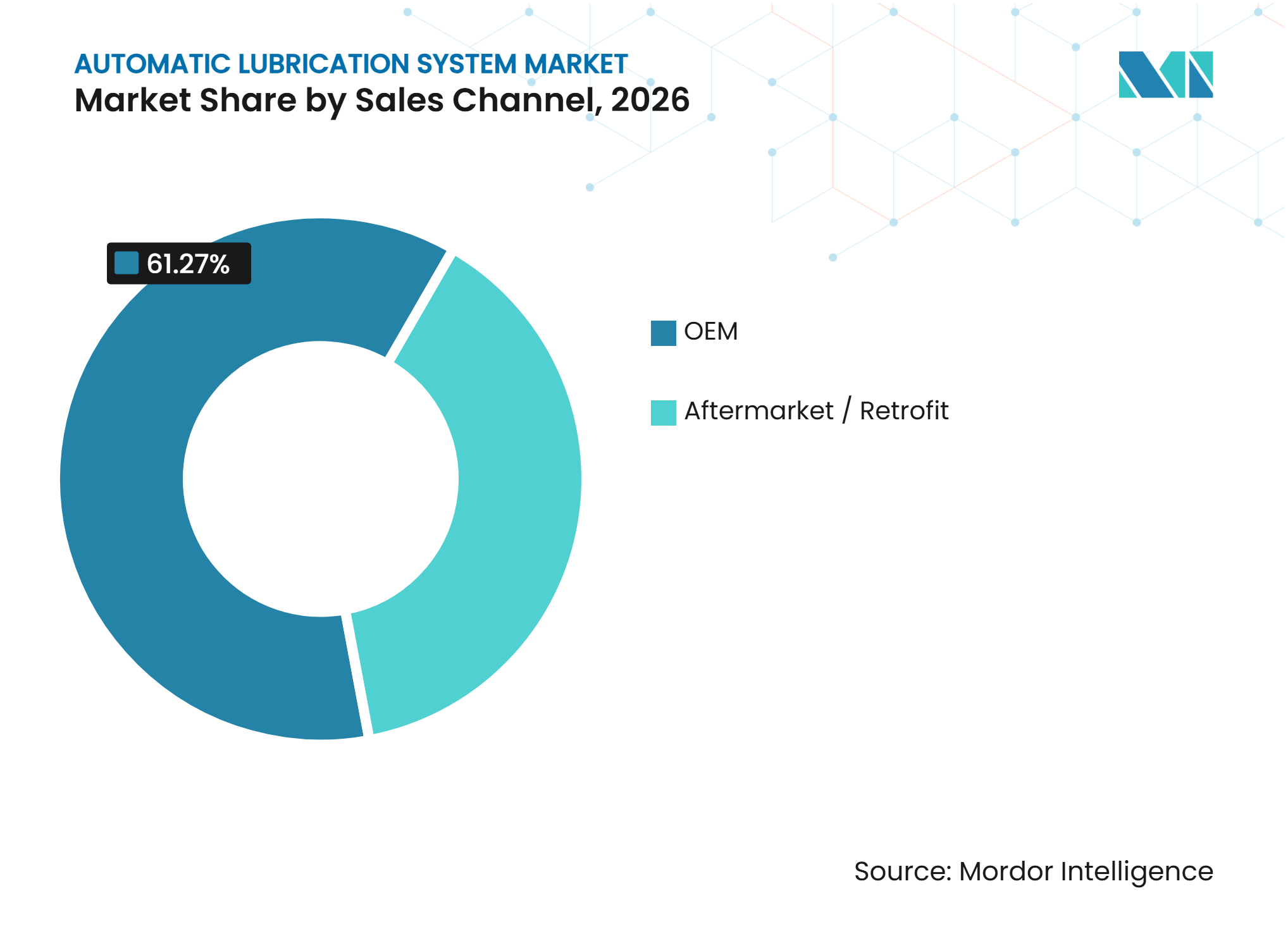
- By sales channel, OEM held 61.27% of the automatic lubrication systems market size in 2026, while Aftermarket and Retrofit is projected to expand at a 5.82% CAGR through 2032.
- By end-use industry, Automotive and Transportation held a 16.27% share in 2026, while Power Generation, including wind, is forecast to grow at a 6.11% CAGR through 2032.
- By geography, Asia-Pacific held a 32.18% share in 2026 and is forecast to grow at a 6.51% CAGR through 2032.
Note: Market numbers in this report are based on Mordor Intelligence's proprietary estimation framework, which combines nine months of actuals with Q4 projections for base year 2026.
Market Trends and Insights
Drivers Impact Analysis of Automatic Lubrication System Market*
| Driver | (~) % Impact on CAGR Forecast | Geographic Relevance | Impact Timeline |
|---|---|---|---|
| Rising Equipment Uptime and Maintenance-Cost Priorities | +1.4% | Global | Medium term (2-4 years) |
| Industrial Automation and Preventive Maintenance Expansion | +1.1% | Asia-Pacific core, spillover to North America and Europe | Medium term (2-4 years) |
| Heavy Equipment Fleet Growth Across Key Industries | +1.0% | Asia-Pacific, North America, Australia | Long term (≥ 4 years) |
| Factory-Integrated OEM Lubrication Packages | +0.8% | Global | Medium term (2-4 years) |
| Sensor-Enabled Lubrication and Predictive Maintenance Adoption | +0.7% | North America and Europe, expanding to Asia-Pacific | Long term (≥ 4 years) |
| Retrofit Demand From Aging Equipment Fleets | +0.6% | North America, Europe, Asia-Pacific | Short term (≤ 2 years) |
| Source: Mordor Intelligence | |||
Rising Equipment Uptime and Maintenance-Cost Priorities
Asset owners in mining, cement, steel, transport, and construction are placing greater weight on the cost of downtime. The automatic lubrication systems industry benefits when failures on large machines have high repair costs and disrupt production commitments. GreaseBoss reported that monitoring Komatsu excavators identified a pump fault that could have caused significant equipment damage if it remained undetected [1]. Automatic systems also reduce the need for technicians to access many lubrication points during routine service work. Construction equipment operators documented annual labor savings per machine after automating lubrication. Larger fleets are therefore more likely to treat lubrication as a reliability control that supports availability targets and service commitments. This need also supports retrofit demand for older mobile equipment where manual servicing is difficult or unsafe.
Industrial Automation and Preventive Maintenance Expansion
Preventive maintenance programs are integrating automatic lubrication systems into connected asset management practices. Connected lubricant monitoring can detect water ingress and prevent potential damage. Controllers integrated with maintenance systems can record grease cycles, low-level alerts, and flow issues alongside other equipment health data. Consequently, the automatic lubrication systems market is shifting toward solutions that communicate with plant maintenance platforms. These data records can help maintenance teams identify bearing or seal issues earlier than inspection-only programs. Suppliers with reliable integration tools can support customers seeking remote oversight without replacing their entire maintenance processes. Lower sensor costs are also making connected functionalities more accessible to mid-sized facilities.
Heavy Equipment Fleet Growth Across Key Industries
Mining, construction, agriculture, and transportation equipment operate in environments where manual lubrication is challenging. Dust, vibration, weather exposure, and extended service intervals increase the need for consistent, metered lubricant delivery. Graco has become available as a factory option on Komatsu North America equipment, indicating that automatic lubrication is becoming increasingly integrated into original equipment specifications. SKF offers quarry lubrication systems with pumps that service lubrication points, meeting the demanding maintenance requirements of aggregate equipment. Agricultural machinery also requires consistent lubrication during short, intensive harvest periods. SKF introduced its CLP Touch compact pump and OCL-M chain lubrication system for agricultural machinery at Agritechnica [2]. These applications favor modular systems that suppliers can configure for different machine sizes.
Factory-Integrated OEM Lubrication Packages
Factory integration enables suppliers to access equipment before it enters service. OEM sales are projected to account for a significant share of revenue, reflecting long-term supply relationships between equipment manufacturers and lubrication system suppliers. The automatic lubrication systems market benefits from this channel, as installed systems generate subsequent demand for replacement parts, lubricants, servicing, and digital upgrades. Changes to a specified lubrication system may require engineering reviews, certification activities, and distributor training, increasing switching costs. Timken stated that Groeneveld-BEKA expanded its product portfolio with oil-based solutions and a GPO oil pump featuring smartphone-enabled monitoring. Factory-fitted systems can also reduce workers’ exposure to moving machine components during routine maintenance. Equipment safety requirements and manufacturers’ service commitments further support lubrication system integration during the equipment design stage.
Restraints Impact Analysis of Automatic Lubrication System Market*
| Restraint | (~) % Impact on CAGR Forecast | Geographic Relevance | Impact Timeline |
|---|---|---|---|
| High Installed Cost and Retrofit Engineering Complexity | -0.5% | Global, most acute in Middle East and Africa and South America | Short term (≤ 2 years) |
| Lubricant Compatibility and Incorrect System Sizing Risk | -0.3% | Global | Medium term (2-4 years) |
| Limited Skilled Installation and Maintenance Capability | -0.2% | Middle East and Africa, South America, parts of Southeast Asia | Short term (≤ 2 years) |
| Harsh-Environment Reliability and Sensor-Fouling Risk | -0.2% | Mining, offshore, cold-climate sites | Long term (≥ 4 years) |
| Source: Mordor Intelligence | |||
High Installed Cost and Retrofit Engineering Complexity
Retrofitting presents a significant constraint for the automatic lubrication systems market, particularly for smaller fleet operators. A complete retrofit for a large mining excavator can require a substantial investment before installation labor, including custom lines, a pump, reservoir, controller, and multiple lubrication points. Consequently, fleets may face substantial upfront investment requirements. Older equipment may lack suitable mounting locations, electrical connections, hydraulic access, or adequate clearance for systems designed after the original equipment build. These limitations increase commissioning time and require skilled installers, who are not uniformly available across all markets. Harsh operating environments create additional challenges, as contamination, remote site conditions, extreme temperatures, and sensor fouling can reduce equipment reliability. Model-specific modular kits can help reduce these challenges; however, standardized solutions remain limited beyond widely used equipment platforms.
Lubricant Compatibility and Incorrect System Sizing Risk
Centralized lubrication systems require the appropriate grease or oil specification, line design, pump capacity, and reservoir size. Unsuitable lubricant viscosity or thickener composition can restrict flow and result in insufficient lubrication at distant lubrication points. This risk is particularly high for mixed fleets, where operators may use different lubricants and incorrectly fill reservoirs. Food and beverage applications require lubricants suitable for incidental food contact and may require relevant certifications. Improper system sizing can cause over-lubrication, which may damage seals or attract contaminants, while undersized reservoirs can interrupt extended operating cycles. Application engineering, commissioning inspections, and installer training can help mitigate these risks. However, smaller distributors may have limited capacity to provide this technical support, potentially reducing customer confidence in new installations.
*Our forecasts treat driver/restraint impacts as directional, not additive. The impact forecasts reflect baseline growth, mix effects, and variable interactions.
Automatic Lubrication System Market Segment Analysis
By Lubricant Type:
Grease Maintains the Broadest Equipment CompatibilityGrease-based systems account for a 68.27% share of the automatic lubrication systems market in 2026. Their strong position reflects reliable performance in mobile and off-road equipment exposed to shock, vibration, dust, and water. Mining excavators, construction dozers, and heavy transport equipment commonly use these systems. The large installed base of such equipment supports demand for multi-point grease systems. High-performance extreme-pressure greases support reliable lubricant delivery under demanding conditions. Grease-based solutions also appeal to customers who prefer proven maintenance methods. Progressive systems provide control across multiple lubrication points and support diagnostics when a divider block stops operating. Selection requires consideration of temperature range, grease consistency, and compatibility with seals and lines. Suppliers can align systems with equipment duty cycles, particularly for fleets operating in cold, wet, or contaminated environments. The installed base also creates opportunities for replacement of injectors, pumps, and lines, as well as monitoring upgrades.
Oil-based systems are forecast to grow at a CAGR of 5.65% through 2032, driven by precision machining, paper machinery, industrial gearboxes, and steel rolling operations, in which lubrication and thermal management are critical. These systems help dissipate heat and maintain a controlled lubricant film, while minimum quantity lubrication uses small volumes of lubricant in machining applications. Eco-friendly solutions can reduce lubricant consumption and improve energy efficiency. Compatibility with biodegradable oils is increasingly important as purchasers seek to meet environmental procurement requirements. Suppliers that validate pumps, seals, and lines for these fluids can reduce uncertainty for OEMs and industrial end users. Oil-based systems require careful management of fluid quality, reservoirs, and delivery paths, and their adoption depends more on equipment design than grease-based systems used in mobile machinery. Integrating oil-condition data with maintenance dashboards supports machine health programs. This creates opportunities for suppliers that combine fluid management with actionable maintenance data, although customers require technical support for fluid selection, contamination control, and system sizing. The automatic lubrication systems industry is likely to adopt oil-based offerings more widely where precision and energy management justify the added complexity.


By System Type:
Series Progressive Systems Lead, While MQL Expands in MachiningSeries progressive systems account for 20.18% of the automatic lubrication systems market size in 2026. These systems support small and medium-sized fixed and mobile machines that require measured lubricant delivery to multiple points. Their design enables effective blockage detection because a stalled divider valve interrupts the lubrication sequence. Series progressive systems are widely used in construction, agricultural, and general industrial equipment, and their established installed base supports their strong market position. Suppliers can differentiate their offerings through pump durability, injector performance, controller features, and service support. Single-line and dual-line systems support equipment with varying line distances, operating temperatures, and numbers of lubrication points. Single-line systems can operate across a broad temperature range and support longer distribution routes, while dual-line systems are commonly used in large mobile equipment and port machinery. Specialist engineering and equipment-specific configurations remain important for complex mobile platforms and large industrial assets.
Minimum Quantity Lubrication (MQL) is projected to grow at a CAGR of 6.13% through 2032. Manufacturers use MQL in machining applications to reduce cutting fluid consumption relative to flood lubrication, lowering purchasing, disposal, and compliance costs. Adaptive MQL systems can also improve machining performance by adjusting lubricant delivery according to operating conditions, supporting their use in high-precision production environments. Single-point lubricators are gaining relevance as plants seek monitoring capabilities without deploying large centralized systems. Wireless units managed through dashboards can make condition-based lubrication more accessible for dispersed factory equipment with fewer lubrication points. Product portfolios that include centralized and single-point options can address the requirements of small plant equipment and heavy machinery.
By Component:
Pumps Anchor Revenue as Controllers Gain RelevancePumps accounted for 36.27% of the automatic lubrication systems market in 2026. They are required for new installations and many retrofits, and must match the lubricant type, the line network, and the operating cycle. Pump design determines pressure capability, reservoir capacity, service intervals, and system reliability. SKF introduced the FlowMaster III at CONEXPO-CON/AGG in March 2026, featuring a modular design, ultrasonic level sensing, and overflow prevention. Direct-drive designs can reduce maintenance by eliminating certain gearbox-related components. Suppliers therefore compete on serviceability and machine uptime as well as pumping performance. Pumps must operate reliably in contamination-prone environments, particularly in mining, construction, and agriculture. Users assess whether pumps can support the required number of lubrication points without pressure instability or insufficient lubricant delivery. Modular designs enable field replacement of individual components, reducing downtime for customers unable to transport equipment to service facilities. Reservoir capacity and level sensing are also critical, as systems cannot protect equipment without lubricant. These requirements favor suppliers with application expertise and field-service capabilities. The automatic lubrication systems market provides pump suppliers with recurring opportunities through replacements, modernization, and electronic-control integration.
Controllers are forecast to grow at a CAGR of 5.86% through 2032. Growth reflects increasing demand for alerts, cycle records, remote monitoring, and maintenance-system integration. Graco states that its GLC Series controllers can transmit lubrication event data to the Graco Trace platform for remote system health monitoring. Connected controllers can alert users to low lubricant levels, blocked lines, and abnormal flow conditions before equipment failures occur. These capabilities support maintenance teams managing large fleets or dispersed equipment. Consequently, the automatic lubrication systems market is shifting part of its value proposition toward actionable equipment data. Controller suppliers will need reliable connectivity and intuitive interfaces to meet this demand. Metering valves, injectors, reservoirs, lines, and fittings remain essential to system performance. Customers select these components based on material quality, pressure ratings, seal compatibility, and temperature tolerance. Flow sensors and pressure switches help verify that lubricant reaches intended lubrication points. Suppliers can gain an advantage by ensuring reliable performance across greases, oils, and operating environments. Easy field replacement, compatibility assessments, and access to spare parts can also strengthen customer relationships, despite price competition.
By Sales Channel:
OEM Sales Account for the Larger Share While Retrofits Drive Digital Service AdoptionOEM held 61.27% of the automatic lubrication systems market in 2026. This channel benefits from the ability to integrate lubrication as part of a machine's original design and delivery package, which reduces installation work for end users and supports OEM equipment uptime claims. Lubrication suppliers with approved positions on major equipment platforms gain access to recurring demand as new machines are sold. Once a supplier is specified, any change typically requires design review, certification, and dealer training, making OEM relationships durable when suppliers meet performance and service expectations. OEM customers increasingly seek systems that combine hardware with monitoring capability, and the supplier relationship can extend beyond the original system through consumables, replacement parts, service kits, and connected features. Suppliers offering a range of grease, oil, and controller options can serve more machine types, and this channel remains particularly relevant for construction, agricultural, commercial vehicle, and industrial equipment manufacturers.
The aftermarket and retrofit segment is forecast to grow at a 5.82% CAGR through 2032, driven by the large installed base of equipment that still relies on manual lubrication. Retrofit customers may seek to reduce routine service time, improve maintenance records, and protect critical equipment intended to remain in operation for many years. Digital controllers can make a retrofit more attractive when users require remote alerts and service history, while suppliers can improve adoption by offering equipment-specific kits that reduce custom fabrication and commissioning work. The cost barrier remains significant for smaller operators, particularly where payback periods exceed internal investment thresholds. Dealers and distributors play a central role by assessing equipment needs, installing systems, and providing ongoing support, and expanding retrofit adoption in the automatic lubrication systems market will depend on their technical capability.

By End-Use Industry:
Transportation Leads While Wind Power Raises DemandAutomotive and Transportation held a 16.27% share in 2026. Commercial trucks, buses, rail equipment, production lines, and transfer systems all require controlled lubrication across different operating environments. Large commercial vehicles can benefit from chassis lubrication systems that reduce manual service requirements. In manufacturing, conveyor and transfer equipment can use automatic systems to support consistent operation. Rail equipment uses specialized wheel-flange and bogie lubrication practices that may require compliance with EN 15427 and UIC guidance. These technical requirements favor suppliers that can demonstrate appropriate performance and support capabilities. Transportation remains an important demand base for the automatic lubrication systems market, as equipment uptime directly affects operating schedules.
Power Generation, including wind, is forecast to grow at a 6.11% CAGR through 2032. Wind turbine gearboxes, pitch bearings, and yaw systems require lubricant delivery in locations where manual maintenance can be hazardous and costly. The IEC 61400-4:2025 standard includes requirements related to wind turbine gearbox design and lubrication system performance. These requirements encourage attention to monitoring, filtration, and system reliability. The automatic lubrication systems market can benefit when wind operators modernize systems to improve equipment availability. Remote monitoring is particularly valuable because turbines are elevated, dispersed, and often exposed to severe weather conditions. The need to reduce unplanned maintenance visits supports the adoption of dependable automatic lubrication solutions.
Geography Analysis
Asia-Pacific
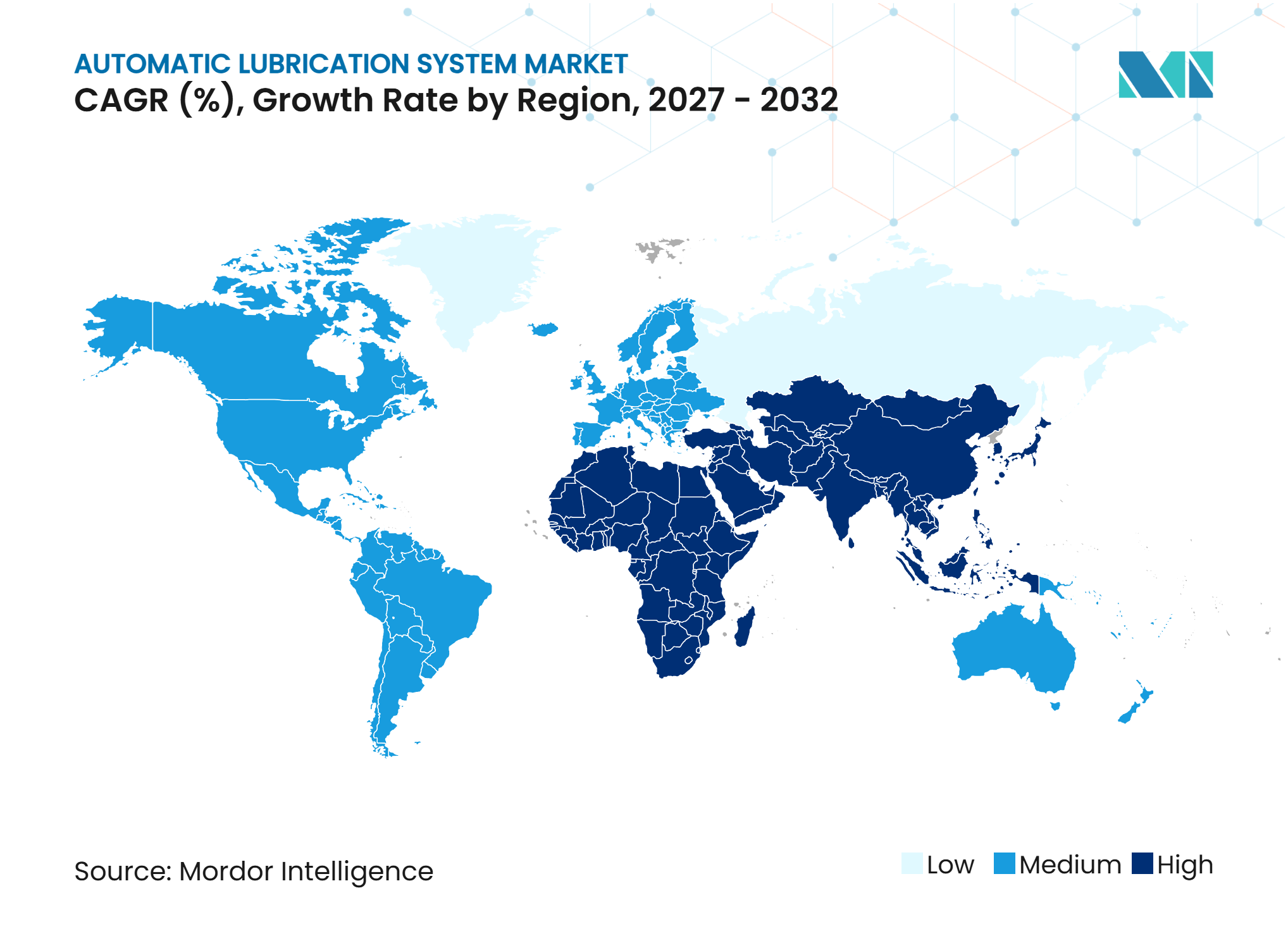
Asia-Pacific accounted for 32.18% of the automatic lubrication systems market share in 2026 and is forecast to grow at a CAGR of 6.51% through 2032. Manufacturing expansion, wind energy infrastructure development, and investments in intelligent factories support demand across industrial and mobile equipment applications. India and Southeast Asian countries are expanding capacity in electronics, automotive components, and food processing. New facilities can integrate automatic lubrication systems during the equipment design phase, avoiding some of the retrofit constraints associated with older sites. Suppliers must offer cost-effective, modular systems and local integration support to address the region’s diverse requirements.
Europe
Precision engineering, reliability-focused maintenance practices, and environmental compliance requirements shape demand in Europe. Machine builders and rail operators require accessible maintenance, documented performance, and compatibility with applicable equipment safety regulations. Wind energy applications, including offshore turbines, require long service intervals under saline and difficult-to-access operating conditions. Suppliers can differentiate through serviceable system designs, controlled lubricant consumption, and remote monitoring capabilities.
North America, South America, and the Middle East and Africa
North American demand is supported by aging commercial vehicle fleets and by applications in mining, agriculture, and construction. South America generates demand primarily from copper and lithium mining operations. Demand in the Middle East and Africa stems from oil and gas equipment, port machinery, construction, and mining operations. Durable systems, local distributor support, and simple installation are critical in these regions, where heat, dust, remote operations, and limited availability of skilled maintenance personnel influence adoption.
Competitive Landscape
Market Concentration
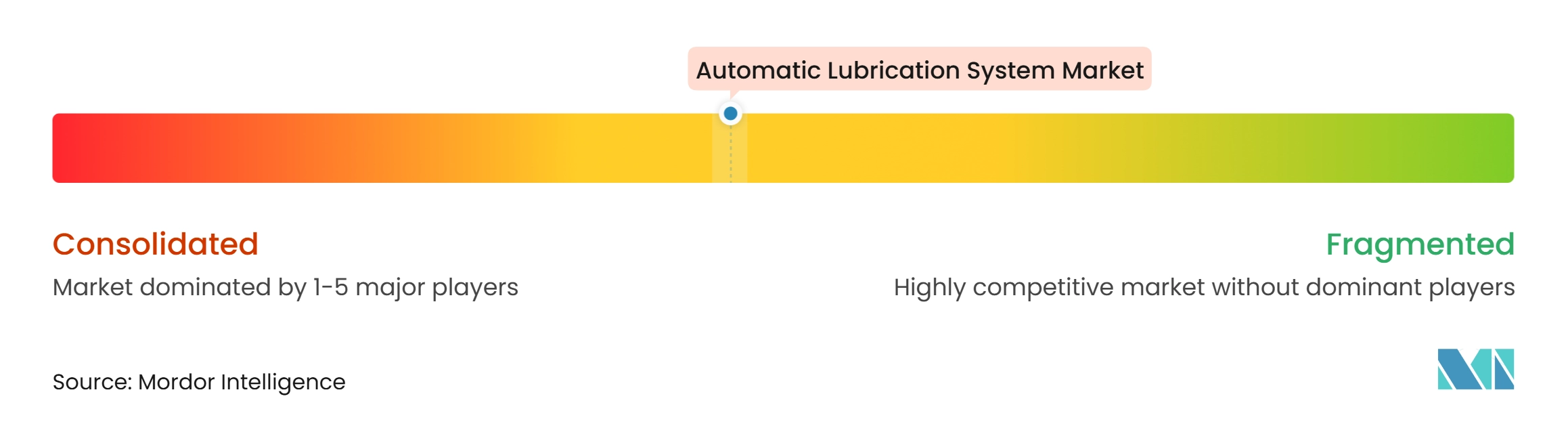
The automatic lubrication systems market is moderately concentrated, with activity spread across applications. SKF, Graco, and Timken are prominent in OEM and heavy mobile-equipment channels, while Dropsa, perma-tec, Memolub, simatec, and regional suppliers serve focused applications. Larger suppliers benefit from global service coverage, broad portfolios, and OEM relationships. In March 2026, Timken acquired Bijur Delimon International for USD 124.3 million, strengthening its coverage in rail, power generation, and mining. The acquisition added specialized lubrication capabilities to Timken's industrial motion business [3].
In March 2026, Graco introduced Pulse Mobile to automate fluid-management records for lube and service truck fleets. This move reflects a broader trend of equipment suppliers linking physical products with service data. Suppliers compete across grease and oil systems, OEM and retrofit channels, and fixed and mobile equipment. Connected alerts and service records can strengthen the value of an installed system. Product development remains focused on uptime, serviceability, and compatibility with maintenance programs.
Specialists use focused technologies and partnerships to compete with larger companies. In 2025, Memolub introduced the CONNECT Series with LoRaWAN and Bluetooth connectivity, cloud access, and support for up to 8 lubrication points. Affordable equipment-specific retrofit kits remain an open opportunity for smaller fleets in developing markets. Competitive performance will depend on installation simplicity, field support, reliability, and the usefulness of connected data.
Automatic Lubrication System Industry Leaders
-
SKF AB
-
Graco Inc.
-
The Timken Company
-
Dropsa S.p.A.
-
perma-tec GmbH and Co. KG
- *Disclaimer: Major Players sorted in no particular order
Automatic Lubrication System Market Companies Covered in this Report
- SKF AB
- Graco Inc.
- The Timken Company
- Dropsa S.p.A.
- perma-tec GmbH and Co. KG
- Oil-Rite Corporation
- Cenlub Systems
- Lubecore International Inc.
- Eugen Woerner GmbH and Co. KG
- simatec ag
- Pulsarlube Inc.
- Memolub International S.A.
- A.T.S. Electro-Lube International Inc.
- Trico Corporation
- Assalub AB
- LUBE Corporation
- Schaeffler AG
Recent Industry Developments in Automatic Lubrication System Market
- March 2026: The Timken Company acquired Bijur Delimon International for USD 124.3 million, net of cash. Bijur Delimon International is a global manufacturer of automated lubrication systems with manufacturing operations in the United States, Europe, and Asia-Pacific. The acquisition strengthens Timken's position in the rail, power generation, and mining markets.
- March 2026: SKF unveiled the FlowMaster III lubrication pump at CONEXPO-CON/AGG 2026, built for heavy construction and mining equipment, with higher output pressure and integrated monitoring to support longer service intervals and reduced manual greasing.
- November 2025: SKF showcased its automatic lubrication systems for tractors, combines and other agricultural machinery at Agritechnica 2025, positioning centralized lubrication as a way to cut downtime during peak harvesting seasons.
- March 2026: Graco introduced Pulse Mobile at CONEXPO 2026, a wirelessly connected and automated fluid management system for lube and service truck fleets. The system links dispensing records to assets, work orders, and technicians through the Pulse Cloud dashboard.
Global Automatic Lubrication System Market Report Scope
The Automatic Lubrication Systems Market Report is Segmented by Lubricant Type (Grease-Based and Oil-Based), System Type (Single-Line (Parallel), Dual-Line, Multi-Line, Series Progressive, Circulating Oil, Oil and Air, Minimum Quantity Lubrication (MQL), and Single-Point Lubricators), Component (Pumps, Controllers, Reservoirs, Metering Valves/Injectors, Lines and Fittings, and Other Components (Filters, Sensors)), Sales Channel (OEM and Aftermarket/Retrofit), End-Use Industry (Automotive and Transportation (Trucks, Buses, Rail), Construction, Mining, Agriculture, Steel and Metals, Cement, Manufacturing, Paper and Printing, Food and Beverage, and Power Generation (Including Wind), Other End-Use Industries), and Geography (North America, South America, Europe, Asia-Pacific, and Middle East and Africa). The Market Forecasts are Provided in Terms of Value (USD) and Volume (Units).
Segmentation Overview
| Grease-Based |
| Oil-Based |
| Single-Line (Parallel) |
| Dual-Line |
| Multi-Line |
| Series Progressive |
| Circulating Oil |
| Oil and Air |
| Minimum Quantity Lubrication (MQL) |
| Single-Point Lubricators |
| Pumps |
| Controllers |
| Reservoirs |
| Metering Valves / Injectors |
| Lines and Fittings |
| Other Components (Filters, Sensors) |
| OEM |
| Aftermarket / Retrofit |
| Automotive and Transportation (Trucks, Buses, Rail) |
| Construction |
| Mining |
| Agriculture |
| Steel and Metals |
| Cement |
| Manufacturing |
| Paper and Printing |
| Food and Beverage |
| Power Generation (Including Wind) |
| Other End-Use Industries |
| North America | United States |
| Canada | |
| Rest of North America | |
| South America | Brazil |
| Argentina | |
| Chile | |
| Rest of South America | |
| Europe | Germany |
| United Kingdom | |
| France | |
| Italy | |
| Russia | |
| Rest of Europe | |
| Asia-Pacific | China |
| Japan | |
| India | |
| South Korea | |
| Australia | |
| Rest of Asia-Pacific | |
| Brazil | |
| Argentina | |
| Chile | |
| Rest of South America | |
| Middle East and Africa | Saudi Arabia |
| United Arab Emirates | |
| Turkey | |
| South Africa | |
| Egypt | |
| Rest of Middle East and Africa |
| By Lubricant Type | Grease-Based | |
| Oil-Based | ||
| By System Type | Single-Line (Parallel) | |
| Dual-Line | ||
| Multi-Line | ||
| Series Progressive | ||
| Circulating Oil | ||
| Oil and Air | ||
| Minimum Quantity Lubrication (MQL) | ||
| Single-Point Lubricators | ||
| By Component | Pumps | |
| Controllers | ||
| Reservoirs | ||
| Metering Valves / Injectors | ||
| Lines and Fittings | ||
| Other Components (Filters, Sensors) | ||
| By Sales Channel | OEM | |
| Aftermarket / Retrofit | ||
| By End-Use Industry | Automotive and Transportation (Trucks, Buses, Rail) | |
| Construction | ||
| Mining | ||
| Agriculture | ||
| Steel and Metals | ||
| Cement | ||
| Manufacturing | ||
| Paper and Printing | ||
| Food and Beverage | ||
| Power Generation (Including Wind) | ||
| Other End-Use Industries | ||
| By Geography | North America | United States |
| Canada | ||
| Rest of North America | ||
| South America | Brazil | |
| Argentina | ||
| Chile | ||
| Rest of South America | ||
| Europe | Germany | |
| United Kingdom | ||
| France | ||
| Italy | ||
| Russia | ||
| Rest of Europe | ||
| Asia-Pacific | China | |
| Japan | ||
| India | ||
| South Korea | ||
| Australia | ||
| Rest of Asia-Pacific | ||
| Brazil | ||
| Argentina | ||
| Chile | ||
| Rest of South America | ||
| Middle East and Africa | Saudi Arabia | |
| United Arab Emirates | ||
| Turkey | ||
| South Africa | ||
| Egypt | ||
| Rest of Middle East and Africa | ||
Key Questions Answered in the Report
What is the projected size of the automatic lubrication systems market by 2032?
The automatic lubrication systems market is forecast to reach USD 1.61 billion by 2032, growing at a 5.36% CAGR from 2027. The growth outlook is supported by wider automation and the need to reduce manual service work on equipment with many lubrication points.
Which lubricant type has the largest share in automatic lubrication systems?
Grease-Based systems lead with 68.27% share in 2026 because they are well suited to mobile, off-road, and contamination-prone equipment. Their broad installed base across mining, construction, and transport sustains replacement and upgrade demand.
Which system type is growing fastest in automatic lubrication?
Minimum Quantity Lubrication is forecast to grow at a 6.13% CAGR through 2032, supported by machining applications that reduce cutting fluid use. It can help manufacturers manage fluid purchasing, disposal, and related compliance needs.
Why are controllers becoming more important in lubrication systems?
Controllers are forecast to grow at a 5.86% CAGR because they support alerts, cycle records, remote monitoring, and maintenance-system integration. They help operators identify low lubricant levels or abnormal flow before equipment problems become more serious.
Which region leads automatic lubrication system demand and growth?
Asia-Pacific held 32.18% share in 2026 and is forecast to grow at a 6.51% CAGR through 2032. Manufacturing expansion, renewable energy equipment, and new facility construction support demand in the region.