
Automated Industrial Quality Control Market Size and Share
Market Overview
| Study Period | 2022 - 2032 |
|---|---|
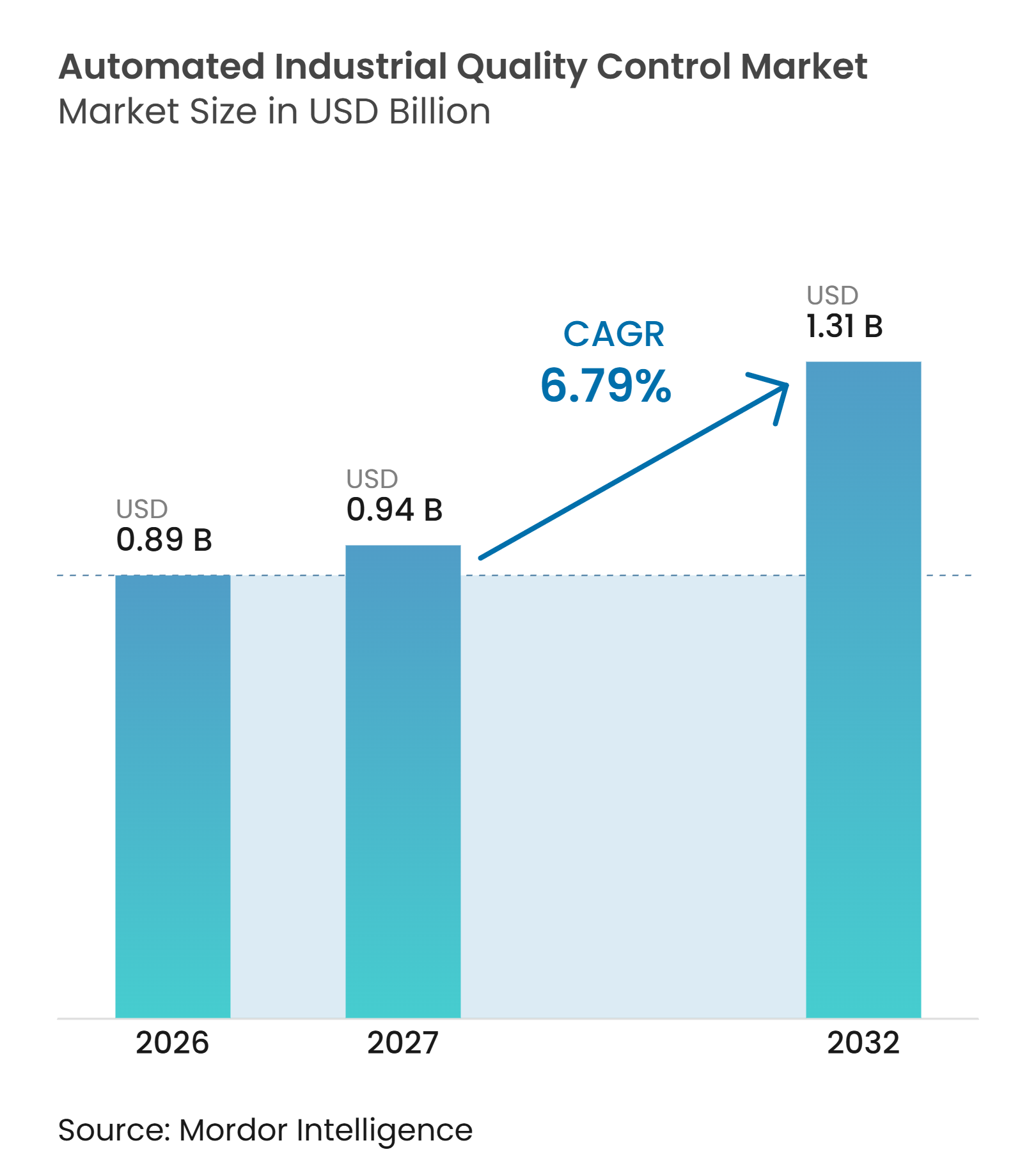
| Market Size (2027) | USD 0.94 Billion |
| Market Size (2032) | USD 1.31 Billion |
| Growth Rate (2027 - 2032) | 6.79 % |
| Fastest Growing Market | Asia-Pacific |
| Largest Market | Asia-Pacific |
| Market Concentration | Medium |
Major Players *Disclaimer: Major Players sorted in no particular order Image © Mordor Intelligence. Reuse requires attribution under CC BY 4.0. | |
Automated Industrial Quality Control Market Analysis by Mordor Intelligence
The Automated Industrial Quality Control Market size is projected to expand from USD 0.89 billion in 2026 and USD 0.95 billion in 2027 to USD 1.31 billion by 2032, at a CAGR of 6.79% between 2027 and 2032. The Automated industrial quality control market is anchored in hardware because cameras, sensors, lighting, and edge computing remain essential on production lines. Demand is moving toward continuous inspection as factories connect robotics, industrial sensors, and production data. Electronics, semiconductor, and electric vehicle manufacturing require detection methods that can identify smaller and more variable defects. Edge processing lets manufacturers improve existing lines without relying on a cloud connection for each inspection decision. Competition now spans established metrology suppliers, vision specialists, and software providers, which is shifting more value toward integrated inspection platforms.
Key Report Takeaways
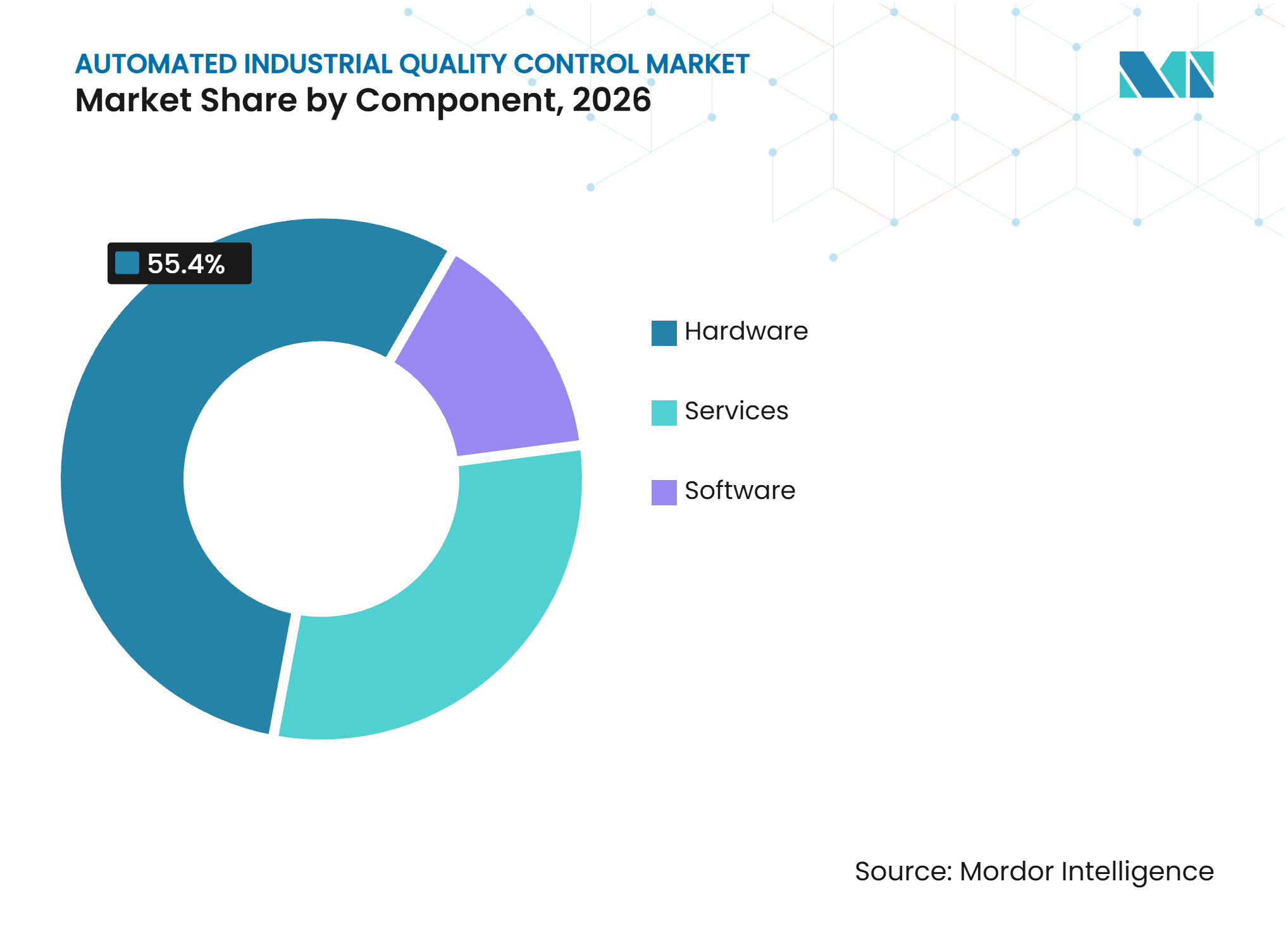
- By component, hardware held 55.4% of the Automated industrial quality control market share in 2026, while software is forecast to grow at a CAGR of 7.8% through 2032.
- By deployment, on-premises deployment held 62.3% of revenue in 2026, while cloud-based deployment is forecast to grow at a CAGR of 8.2% through 2032.
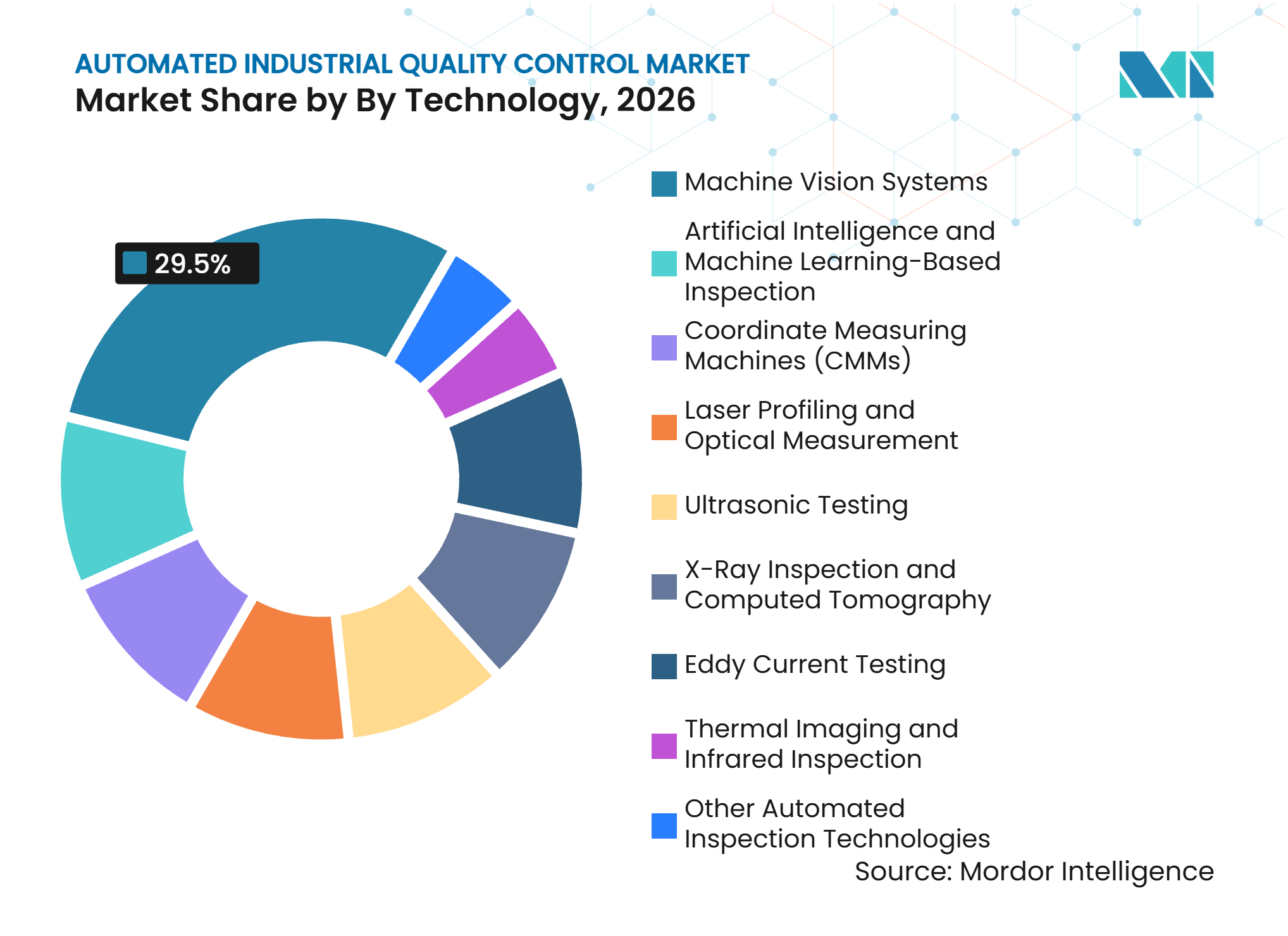
- By technology, machine vision systems held 29.5% of revenue in 2026, while AI and machine-learning-based inspection is forecast to grow at a CAGR of 8.7% through 2032.
- By end-use industry, automotive and transportation held 23.7% of revenue in 2026, while electronics and semiconductors are forecast to grow at a CAGR of 7.5% through 2032.
- By geography, Asia-Pacific held 33.6% of revenue in 2026 and is forecast to grow at a CAGR of 7.4% through 2032.
Note: Market numbers in this report are based on Mordor Intelligence's proprietary estimation framework, which combines nine months of actuals with Q4 projections for base year 2026.
Market Trends and Insights
Drivers Impact Analysis of Automated Industrial Quality Control Market*
| Driver | (~) % Impact on CAGR Forecast | Geographic Relevance | Impact Timeline |
|---|---|---|---|
| Demand for Zero-Defect, High-Throughput Production | +2.1% | Global, concentrated in APAC and North America | Medium term (2-4 years) |
| Stricter Product Safety and Traceability Requirements | +1.3% | Global, with strong compliance pressure in EU and North America | Short term (≤ 2 years) |
| Industry 4.0, Robotics, and Smart-Factory Investment | +1.5% | APAC core, with rapid expansion into EMEA | Medium term (2-4 years) |
| Rising Micro-Precision Requirements in Electronics, Semiconductors, and EV Components | +1.2% | APAC core, North America and EU growing rapidly | Medium term (2-4 years) |
| Edge AI Enables Low-Latency Inspection on Legacy Lines | +0.9% | Global, with early commercial gains in APAC and Germany | Short term (≤ 2 years) |
| Digital Quality Provenance Across Multi-Tier Supply Chains | +0.6% | North America & EU primarily, spill-over to APAC | Long term (≥ 4 years) |
| Source: Mordor Intelligence | |||
Demand for Zero-Defect, High-Throughput Production
The automated industrial quality control market is benefiting from a move away from statistical sampling toward 100% in-line inspection. Manufacturers use machine vision and AI classifiers inside the production flow because inspection must keep pace with line output. A 2025 IEEE Access study reported a 98.2% F1 score and 34-millisecond end-to-end latency for an edge-deployed multimodal inspection framework. The study also reported a 98.2% reduction in false alarms against lightweight baselines.[1] This evidence supports the use of local processing where manufacturers need both speed and dependable defect identification. Automotive and consumer electronics buyers increasingly request defined inspection coverage from suppliers, making automated verification part of supplier qualification.
Stricter Product Safety and Traceability Requirements
Product safety and traceability requirements are making inspection data useful beyond the local quality team. In December 2025, China issued an AI and manufacturing action plan that calls for machine vision, non-destructive testing, and intelligent inspection agents in priority manufacturing sectors.[2] The plan targets 500 scaled application scenarios and 1,000 exemplary enterprises by 2027.[3] This policy can shorten procurement decisions for manufacturers that are building AI-enabled production systems. It also increases the value of systems that retain structured records of inspection results. Quality platforms can then link detected defects to production history, supplier records, and later audit activity.
Industry 4.0, Robotics, and Smart-Factory Investment
Smart-factory programs are placing inspection in the original design of new production systems. Collaborative robots can move cameras around complex parts, which improves inspection flexibility in high-mix settings. A 2025 systematic review identified dynamic part tracking and robot-guided image acquisition as important tools for factory inspection. This approach is useful when a component cannot be fixed in one repeatable position. German manufacturers are also testing retrofit options that allow AI functions to be added to existing equipment. Fraunhofer IMS began its KIMIPA project in 2026 to develop retrofit edge AI hardware that trains models locally and reduces pseudo-rejects. These patterns support a range of system designs, from full new-line installations to smaller upgrades.
Edge AI Enables Low-Latency Inspection on Legacy Lines
Edge AI reduces the delay and connectivity burden that can limit real-time inspection. In July 2025, TDK SensEI introduced edgeRX Vision, which can inspect up to 2,000 parts per minute with local AI inference. The system is designed to inspect components as small as 1 mm by 0.5 mm. A 2025 case study also found that an edge-deployed YOLOv8 system achieved a mean Average Precision at IoU 0.50 (mAP50) score of 0.972 on an active assembly line. Local inference allows existing cameras, lighting equipment, and programmable logic controllers to remain in use. This supports software growth because facilities can update decision-making functions without replacing every part of the inspection cell.
Restraints Impact Analysis of Automated Industrial Quality Control Market*
| Restraint | (~) % Impact on CAGR Forecast | Geographic Relevance | Impact Timeline |
|---|---|---|---|
| High Initial Investment and Long Payback Periods | -1.4% | Global; most acute in South America and MEA | Medium term (2-4 years) |
| Integration and Calibration Complexity Across Legacy Lines | -0.8% | Global; concentrated in SME-heavy manufacturing sectors in EU and APAC | Medium term (2-4 years) |
| Shortage of Skilled Vision, Metrology, and NDT Specialists | -0.6% | Global; most severe in India, SEA, and parts of MEA | Long term (≥ 4 years) |
| Model Drift, False Rejects, and Limited Defect Data in High-Mix Production | -0.5% | Global; particularly acute in electronics and general manufacturing | Short term (≤ 2 years) |
| Source: Mordor Intelligence | |||
High Initial Investment and Long Payback Periods
High upfront spending remains a constraint for smaller manufacturers considering automated inspection. A complete inspection cell may require industrial cameras, lighting, edge computing, software, integration work, and calibration. The resulting payback period can extend from 24 to 36 months, especially in lower-margin metals and food processing operations. Cloud subscriptions can lower initial spending, but they may require data volumes and connectivity conditions that older facilities do not have. Large producers of safety-critical components can often absorb this cost more readily than the suppliers that serve them. Public digitization support and financing programs can reduce the gap, although their availability varies across countries.
Integration and Calibration Complexity Across Legacy Lines
Legacy production lines can require considerable mechanical, electrical, and software work before they can host modern inspection systems. Many were not built with camera mounts, controlled lighting, or inspection bypass arrangements. A 2026 systematic review noted that scaled machine vision deployments must address inconsistent data formats and domain transfer limits across edge, digital twin, and industrial internet environments.[4] These issues can extend commissioning and raise the total cost of deployment. Periodic calibration also remains necessary for coordinate measuring machines and laser profiling systems. Facilities using multiple inspection methods must manage separate calibration schedules, which increases demand on metrology staff.
*Our forecasts treat driver/restraint impacts as directional, not additive. The impact forecasts reflect baseline growth, mix effects, and variable interactions.
Automated Industrial Quality Control Market Segment Analysis
By Component:
Software Growth Signals a Shift in Value CaptureHardware held 55.4% of Automated industrial quality control market revenue in 2026 because cameras, sensors, illumination modules, and edge computing form the physical base of inspection cells. The component mix is changing as fixed cameras give way to multispectral arrays, 3D time-of-flight sensors, and higher-resolution systems. These systems can identify smaller surface anomalies and support more demanding dimensional checks. Software is the fastest-growing component at a CAGR of 7.8% through 2032. This growth reflects demand for model development, site-level deployment tools, and real-time quality dashboards. Cognex introduced the In-Sight 3900 in May 2026 with the Qualcomm Dragonwing platform, speeds up to 4 times faster than earlier embedded systems, and resolutions up to 25 megapixels. The release shows how hardware suppliers are pairing equipment with their own AI software environments.
Services remain important because integrated cells need calibration, model retraining, and remote support. Cloud delivery is also putting formal service agreements around work that was once handled as informal maintenance. The Automated industrial quality control industry is therefore capturing more value from software and recurring support than from stand-alone cameras. Centralized model training can create switching costs when one set of models is deployed across several factories. Cognex describes OneVision as a platform for developing models centrally and deploying them to In-Sight edge devices. Model governance is also becoming relevant in procurement because buyers want documented control over AI-supported decisions. This raises the importance of suppliers that can manage models, devices, and quality records together.



By Deployment:
On-Premises Holds Dominance While Cloud Redefines the EdgeOn-premises deployment accounted for 62.3% of revenue in 2026, reflecting the need for low latency, data control, and dependable operation on factory lines. High-speed inspection cannot always rely on a remote computing round trip. Local computing is particularly important where thousands of parts move through a line each minute. Cloud-based deployment is forecast to grow at a CAGR of 8.2% through 2032. Manufacturers are using hybrid designs that keep defect decisions at the edge while sending training, analysis, and multi-site reporting to cloud platforms. This gives plants a way to compare defects across locations without slowing local inspection. The Automated Industrial Quality Control Market is likely to use both deployment approaches rather than move entirely to one model.
The operating role of the cloud is therefore different from the operating role of the edge. The edge manages the immediate inspection decision, while cloud systems support learning, reporting, and supply-chain integration. Suppliers without software and data capabilities face more pressure as customers seek central quality dashboards. Multi-plant benchmarking and predictive maintenance functions are becoming part of vendor assessments. Manufacturers handling sensitive product designs must also consider data governance requirements. These concerns can favor on-premises systems or sovereign cloud designs in some settings. The result is a market in which deployment choices depend on the process, data policy, and factory connectivity.
By Technology:
AI/ML Inspection Disrupts an Established Technology StackMachine vision systems held 29.5% of Automated industrial quality control market revenue in 2026, supported by their established use in barcode verification, presence checks, and dimensional gauging. Rule-based 2D systems remain practical for repeatable, high-throughput tasks. AI and machine learning-based inspection is forecast to grow at a CAGR of 8.7% through 2032. Deep-learning models are useful where defects are too variable for fixed thresholds. A 2026 review of industrial ML vision applications found that production-calibrated systems can exceed 95% defect detection accuracy. The same review reported that 77% of implementations remained at pilot scale, indicating that deployment execution remains an important barrier. This leaves room for suppliers that can make model development and plant integration easier.
Coordinate measuring machines are also moving toward digital architectures that connect measurement results with design and production systems. Hexagon introduced the MAESTRO Coordinate Measuring Machine (CMM) in May 2025 with digital sensors, a single-cable design, and connectivity to the Nexus ecosystem. Laser profiling, optical measurement, ultrasound, and X-ray or computed tomography address internal and subsurface requirements that basic vision cannot cover. Thermal inspection can identify electrical anomalies in electric vehicle battery modules that are not visible through conventional optics. Eddy current testing continues to support crack detection in metallic components. The Automated industrial quality control industry relies on this range of technologies because no single method can assess every material or defect type. Technology selection is therefore tied closely to the part, production speed, and acceptable defect risk.

By End-Use Industry:
Automotive Anchors Volumes, Electronics Drives PaceAutomotive and transportation held 23.7% of revenue in 2026, supported by inspection requirements for braking, steering, powertrain, and electric vehicle battery components. These systems require extensive verification because defects can affect safety or vehicle performance. Electronics and semiconductors are forecast to grow at a CAGR of 7.5% through 2032. Smaller process nodes and advanced packaging make wafer and assembly inspection more demanding. The National Institute of Advanced Industrial Science and Technology (AIST) published a 2025 study on multi-channel inspection for next-generation power semiconductor wafers that combined AI analysis with faster assessment. The work showed how multiple inspection methods can retain high accuracy while reducing analysis time against single-method approaches. This matters when precision and throughput must improve together.
Aerospace and defense require rigorous inspection for turbine blades, composite structures, and other critical parts. Coordinate measurement, X-ray computed tomography, and ultrasonic testing are relevant where the internal condition matters. Pharmaceuticals and medical devices also require documented inspection because electronic records and audit trails are part of their operating requirements. Food and beverage production is an adoption area where operators are applying computer vision to identify deviations in processing lines. Metals, chemicals, machinery, and oil and gas use automated systems for dimensional measurement, surface inspection, and non-destructive examination. The Automated Industrial Quality Control Market serves these different end uses through a mix of general-purpose platforms and specialized equipment. Their requirements vary by defect type, production speed, regulatory obligation, and tolerance level.
Geography Analysis
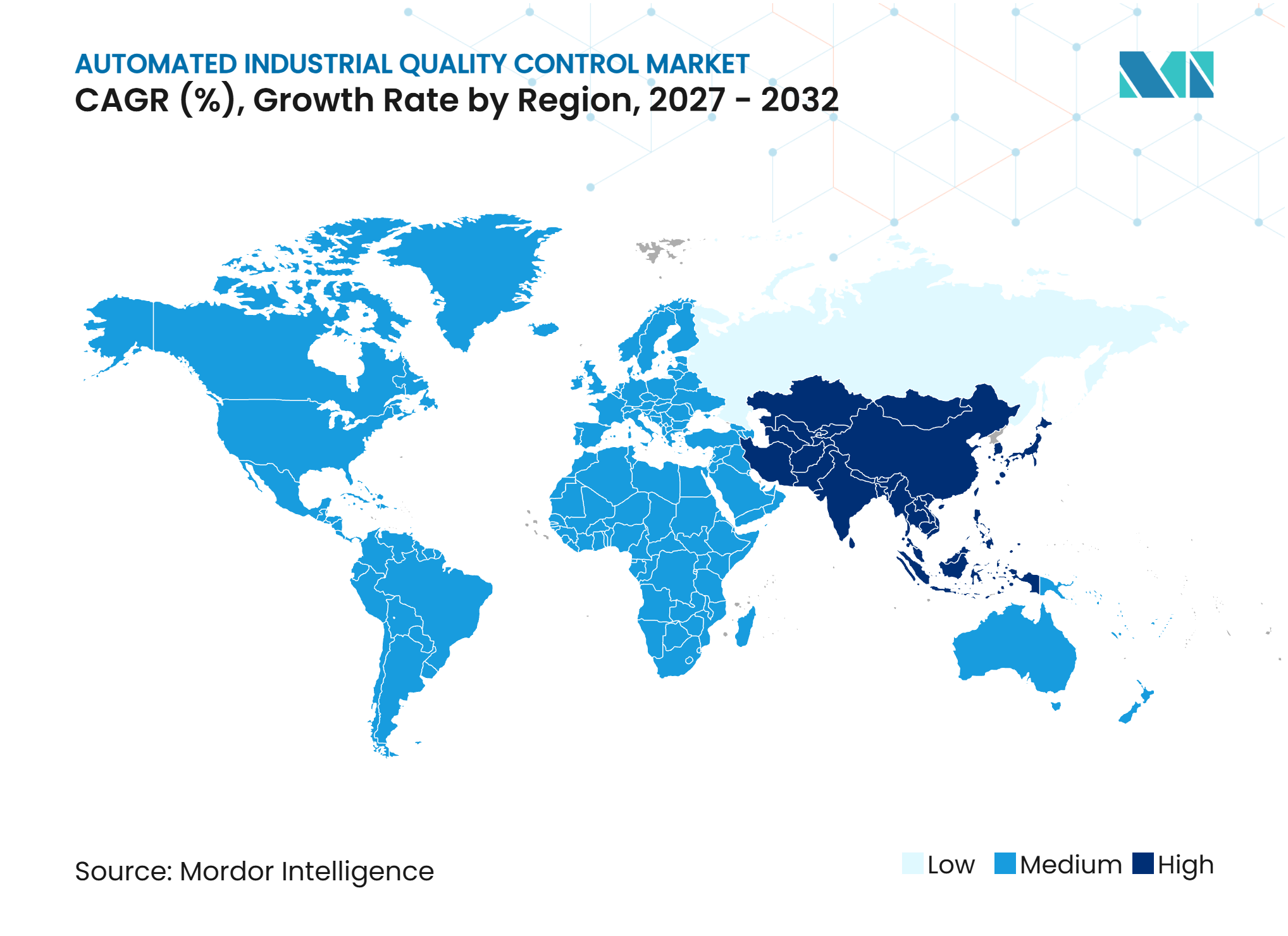
Global Automated Industrial Quality Control Market CAGR (%), Growth Rate by Region
Asia-Pacific held 33.6% of revenue in 2026 and is forecast to grow at a CAGR of 7.4% through 2032. The region combines large electronics assembly, semiconductor fabrication, and electric vehicle battery manufacturing clusters. China has issued an AI and manufacturing action plan that supports machine vision and intelligent inspection in electronics, automotive, steel, and consumer goods production. The policy calls for 500 scaled application scenarios and 100 high-quality industrial datasets by 2027. South Korea, Japan, and Taiwan add demanding semiconductor and automotive supply chains that support advanced inspection adoption.
Japan provides a clear case of automated inspection used to improve production continuity. In November 2025, Fukushima Shibaura Electronics and IBM Japan completed a deep-learning visual inspection system for thermistor components. The companies reported labor reduction of at least 83% and continuous 24-hour line operation. Malaysia, Vietnam, and Indonesia are also receiving manufacturing capacity as global electronics companies diversify production locations. Their inspection requirements are likely to rise as product complexity and export quality expectations increase. The Automated Industrial Quality Control Market benefits in the region from both new plant investment and upgrades to operating lines.
North America and Europe account for much of the remaining revenue and tend to use complex, metrology-grade systems. North American demand is supported by semiconductor investment and sustained aerospace and defense requirements. Europe has a strong industrial automation base, with Germany acting as a major center for precision metrology and edge AI development. Fraunhofer IPA is developing AI-based quality inspection methods for plastics and metals manufacturing, which can feed into commercial machine-builder programs. South America and Middle East and Africa remain earlier-stage markets, where automotive, agri-processing, petrochemicals, metals, and food production create localized demand. Brazil, Saudi Arabia, the UAE, Nigeria, and Egypt each have distinct industrial drivers, while regional growth depends on investment and workforce capability.
Competitive Landscape
Market Concentration
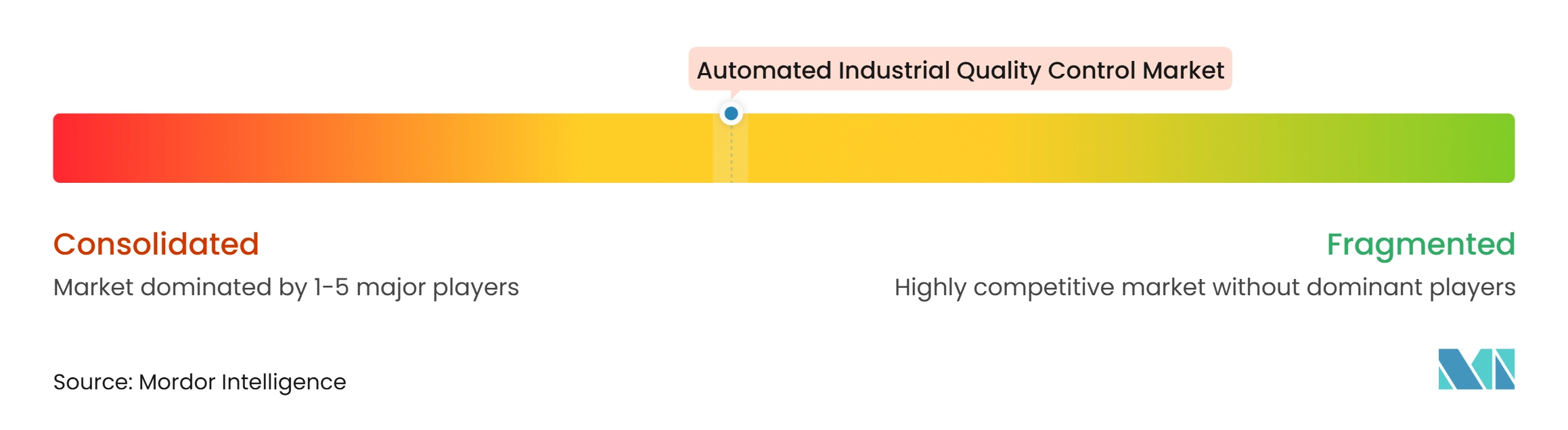
The Automated Industrial Quality Control Market is moderately concentrated in premium metrology and machine vision, but it remains fragmented in AI software and integration services. Hexagon, Cognex, KEYENCE, Carl Zeiss, Renishaw, and SICK compete through accuracy, throughput, and software capability. Their established positions rest on installed equipment and expertise in demanding production environments. Hexagon launched the MAESTRO CMM in May 2025 with digital sensors, a redesigned controller, and industrial internet connectivity to its Nexus ecosystem. Cognex introduced the In-Sight 3900 in May 2026 to combine embedded AI capability with higher speed and resolution. These actions show how leading suppliers are combining inspection hardware with connected software.
Product strategies increasingly emphasize proprietary AI training tools, device deployment systems, and analytics dashboards. These functions can increase customer switching costs because a factory may rely on one supplier across several sites. Hexagon also released two PRESTO Quality Station configurations in May 2025 for automated inspection of large components. The company stated that the stations can be deployed in hours rather than days. This approach addresses manufacturers that need automated inspection but face budget and skills constraints. Suppliers are also using patents around defect classification, multisensor fusion, and edge inference to differentiate their systems.
Open opportunities remain in AI-focused services for smaller manufacturers, combined inspection methods, and systems that consolidate quality records across supply-chain tiers. TDK entered this area through its SensEI business with the edgeRX Vision platform, which uses local AI inference for high-speed inspection. Connected inspection platforms also need strong cybersecurity controls when they are used in defense or critical infrastructure production. The Automated industrial quality control market will therefore reward suppliers that pair technical accuracy with simple deployment, secure connectivity, and reliable ongoing support. Competition is likely to remain active because established equipment vendors and AI-focused firms address different parts of the same customer need.
Automated Industrial Quality Control Industry Leaders
-
KEYENCE Corporation
-
Cognex Corporation
-
Hexagon AB
-
Carl Zeiss AG (ZEISS)
-
Teledyne Technologies Incorporated
- *Disclaimer: Major Players sorted in no particular order
Automated Industrial Quality Control Market Companies Covered in this Report
- Atlas Copco AB
- Boart Longyear Group Ltd.
- Brunner & Lay, Inc.
- Bulroc (UK) Ltd.
- Caterpillar Inc.
- Center Rock Inc.
- Drill King International, L.P.
- Epiroc AB
- Halco Rock Tools Ltd.
- MICON Drilling GmbH
- Mincon Group plc
- Mitsubishi Materials Corporation
- Numa Tool Company
- Robit Plc
- Rockmore International, Inc.
- Sandvik AB
- Ulterra Drilling Technologies, L.P.
- Varel International Energy Services, Inc.
- Western Drilling Tools Inc.
- Xiamen Prodrill Equipment Co., Ltd.
Recent Industry Developments in Automated Industrial Quality Control Market
- May 2026: Cognex Corporation launched the In-Sight 3900 Vision System, described as its highest-performance embedded AI vision system. Built on Qualcomm Dragonwing platforms, it delivers inspection speeds up to 4× faster than prior-generation Cognex embedded systems, supports resolutions up to 25 megapixels, and operates without an external PC, targeting demanding factory inspection in packaging, automotive, and electronics.
- May 2026: Cognex launched the In-Sight 6900 Vision Controller powered by NVIDIA, offering modular AI inference compute for high-complexity, multi-camera inspection cells in industrial environments, addressing compute-intensive applications that exceed the capability of embedded vision systems.
- January 2026: Hexagon released the next-generation OPTIV S 4.4.3 optical coordinate measuring machine at the International Manufacturing Technology Show (IMTS), delivering significant improvements in speed, accuracy, and usability in a redesigned platform for optical dimensional inspection.
- May 2025: Hexagon Manufacturing Intelligence launched the MAESTRO CMM, a next-generation coordinate measuring machine with digital sensors, single-cable architecture, a redesigned controller, and Industrial Internet of Things (IIoT)-native connectivity to Hexagon Nexus. Available for order from June 30, 2025, it targets aerospace, automotive, and high-precision manufacturing.
Global Automated Industrial Quality Control Market Report Scope
Automated industrial quality control refers to the use of hardware, software, and inspection technologies to automatically detect defects, measure product dimensions, verify manufacturing specifications, and assess product quality across industrial production processes. These systems integrate technologies such as machine vision, artificial intelligence (AI), machine learning (ML), coordinate measuring machines (CMMs), laser profiling, ultrasonic testing, X-ray inspection, computed tomography, eddy current testing, and thermal imaging to identify deviations from established quality standards. Automated quality control solutions are deployed across manufacturing facilities, production lines, and inspection stations to support real-time defect detection, dimensional verification, material integrity assessment, and process monitoring. By reducing dependence on manual inspection, these systems help improve inspection consistency, production efficiency, traceability, and product reliability while minimizing quality-related production losses. They are increasingly used in industries where precision, safety, regulatory compliance, and high-volume production are critical, including automotive, electronics, aerospace, pharmaceuticals, food processing, and industrial machinery manufacturing.
The Global Automated Industrial Quality Control Market is segmented by component, deployment, technology, and end-use industry. By component, the market is segmented into hardware, software, and services. By deployment, the market is segmented into on-premises deployment and cloud-based deployment. By technology, the market is segmented into machine vision systems, artificial intelligence and machine learning-based inspection, coordinate measuring machines (CMMs), laser profiling and optical measurement, ultrasonic testing, X-ray inspection and computed tomography, eddy current testing, thermal imaging and infrared inspection, and other automated inspection technologies. By end-use industry, the market is segmented into automotive and transportation, electronics and semiconductors, aerospace and defense, metals and heavy engineering, food and beverage, pharmaceuticals and medical devices, chemicals and materials, industrial machinery and equipment, oil and gas, and other manufacturing industries. The report also covers the market size and forecasts for the global automated industrial quality control market across 26 countries in key regions. For each segment, market sizing and forecasts are provided on the basis of value (USD).
Segmentation Overview
| Rotary Drill Bits |
| Down-the-Hole (DTH) Hammer Bits |
| Other Mining Drill Bit Types |
| Tungsten Carbide |
| Polycrystalline Diamond Compact (PDC) |
| Synthetic and Industrial Diamond |
| Steel |
| Thermally Stable Diamond |
| Other Materials |
| Surface Mining |
| Underground Mining |
| North America | United States |
| Canada | |
| Mexico | |
| Europe | Germany |
| France | |
| Italy | |
| Spain | |
| United Kingdom | |
| Poland | |
| Russia | |
| Rest of Europe | |
| Asia-Pacific | China |
| India | |
| Japan | |
| South Korea | |
| Australia | |
| Indonesia | |
| Vietnam | |
| Thailand | |
| Rest of Asia-Pacific | |
| South America | Brazil |
| Argentina | |
| Chile | |
| Rest of South America | |
| Middle East and Africa | Saudi Arabia |
| United Arab Emirates | |
| Egypt | |
| South Africa | |
| Morocco | |
| Rest of Middle East and Africa |
| By Type | Rotary Drill Bits | |
| Down-the-Hole (DTH) Hammer Bits | ||
| Other Mining Drill Bit Types | ||
| By Material | Tungsten Carbide | |
| Polycrystalline Diamond Compact (PDC) | ||
| Synthetic and Industrial Diamond | ||
| Steel | ||
| Thermally Stable Diamond | ||
| Other Materials | ||
| By Mining Method | Surface Mining | |
| Underground Mining | ||
| By Geography | North America | United States |
| Canada | ||
| Mexico | ||
| Europe | Germany | |
| France | ||
| Italy | ||
| Spain | ||
| United Kingdom | ||
| Poland | ||
| Russia | ||
| Rest of Europe | ||
| Asia-Pacific | China | |
| India | ||
| Japan | ||
| South Korea | ||
| Australia | ||
| Indonesia | ||
| Vietnam | ||
| Thailand | ||
| Rest of Asia-Pacific | ||
| South America | Brazil | |
| Argentina | ||
| Chile | ||
| Rest of South America | ||
| Middle East and Africa | Saudi Arabia | |
| United Arab Emirates | ||
| Egypt | ||
| South Africa | ||
| Morocco | ||
| Rest of Middle East and Africa | ||
Key Questions Answered in the Report
What is the value of the automated industrial quality control market?
The Automated Industrial Quality Control Market size is projected to expand from USD 0.89 billion in 2026 and USD 0.94 billion in 2027 to USD 1.31 billion by 2032, at a CAGR of 6.79% between 2027 and 2032.
Which component has the largest revenue position?
Hardware held 55.4% of revenue in 2026 because cameras, sensors, lighting, and edge computing are required in inspection cells.
Which deployment model is growing fastest?
Cloud-based deployment is forecast to grow at a CAGR of 8.2% through 2032, while on-premises systems retained 62.3% of 2026 revenue.
Which technology is expected to grow fastest?
AI- and machine learning-based inspection is projected to grow at a CAGR of 8.7% through 2032, while machine vision systems held 29.5% of 2026 revenue.
Which region leads automated industrial quality control?
Asia-Pacific led with 33.6% of 2026 revenue and is forecast to grow at a CAGR of 7.4% through 2032.