
Australia Outdoor Lighting Market Size and Share
Market Overview
| Study Period | 2020 - 2031 |
|---|---|
| Forecast Data Period | 2026 - 2031 |
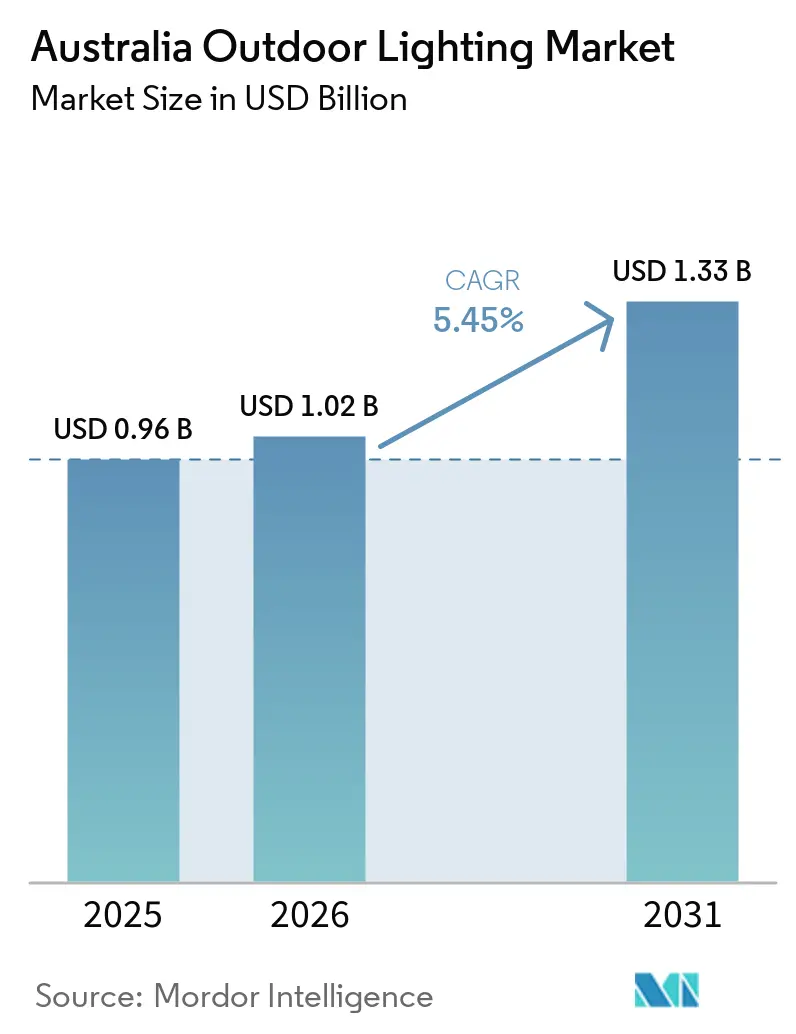
| Base Year Market Size (2025) | USD 0.96 Billion |
| Market Size (2026) | USD 1.02 Billion |
| Market Size (2031) | USD 1.33 Billion |
| Growth Rate (2026 - 2031) | 5.45 % |
| Market Concentration | Low |
Major Players *Disclaimer: Major Players sorted in no particular order Image © Mordor Intelligence. Reuse requires attribution under CC BY 4.0. | |
Australia Outdoor Lighting Market Analysis by Mordor Intelligence
The Australia outdoor lighting market size was valued at USD 0.96 billion in 2025 and estimated to grow from USD 1.02 billion in 2026 to reach USD 1.33 billion by 2031, at a CAGR of 5.45% during the forecast period (2026-2031). The regulatory shift toward efficient LED lamps is moving purchases from discretionary upgrades toward planned compliance and replacement programs. New construction rules also connect exterior lighting specifications with control requirements, which raises the value of products that can support sensors and automated operation[1]. Renovation spending and public infrastructure work are supporting demand from households, councils, and commercial sites. Suppliers can benefit when they combine certified products, local technical support, and systems that reduce installation or operating costs. Competition is becoming more active in connected lighting, while remote projects create a separate opportunity for solar products that avoid grid connection work.
Key Report Takeaways
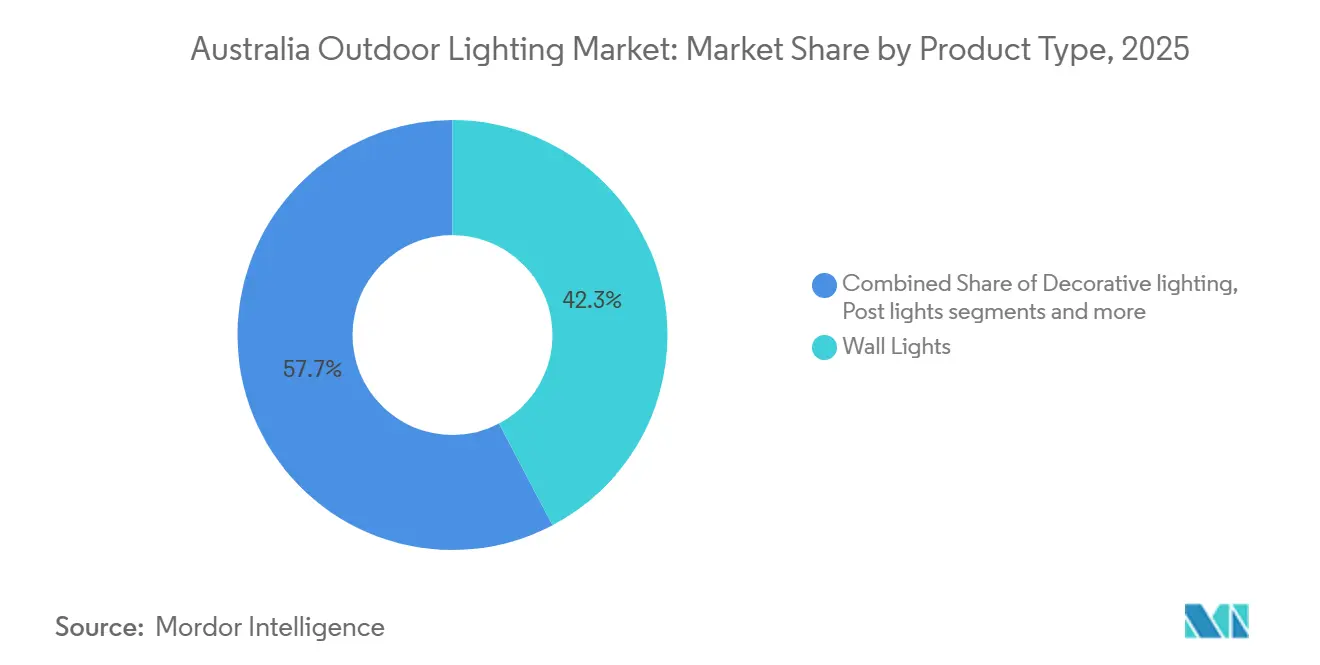
- By product type, wall lights held 42.3% of revenue in 2025 and recorded the highest projected CAGR of 7.00% through 2031.
- By light source, LED accounted for 54.2% of revenue in 2025 and is forecast to grow at a 7.50% CAGR through 2031.
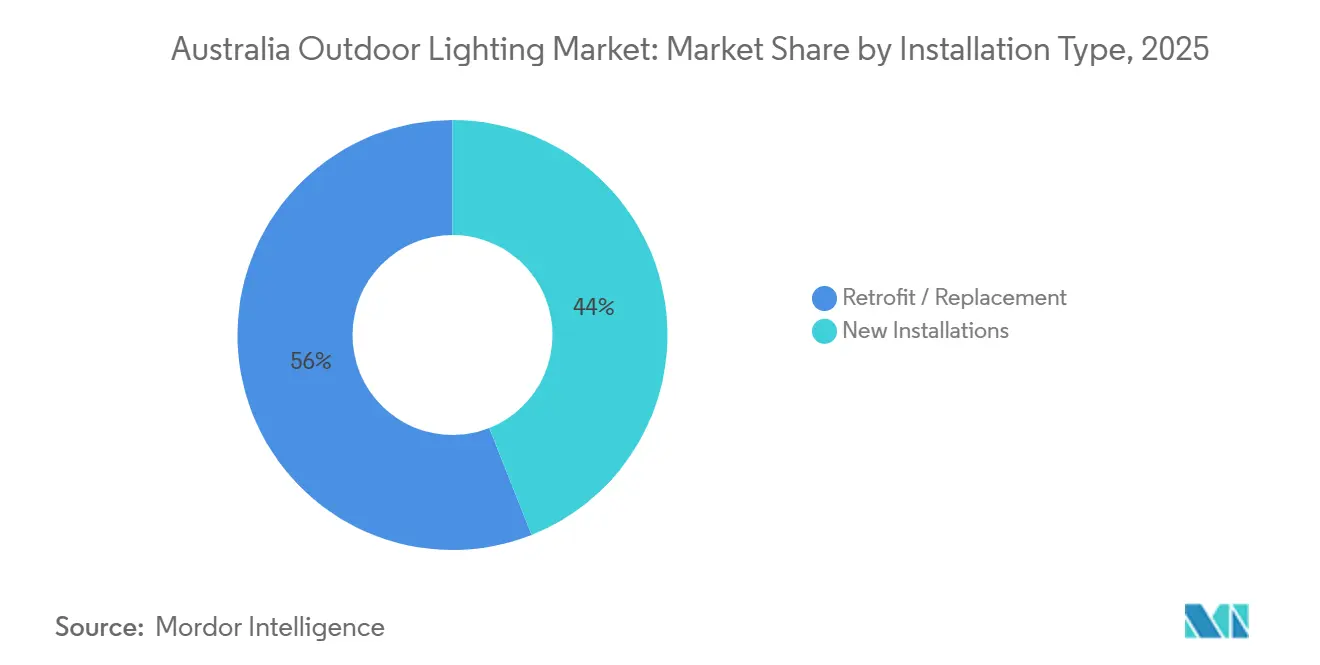
- By installation type, retrofit and replacement held 56.0% of the Australian outdoor lighting market size in 2025 and is forecast to expand at a 7.00% CAGR through 2031.
- By application, commercial accounted for 54.80% of the market in 2025 and is projected to grow at the fastest CAGR of 6.70% during 2026–2031
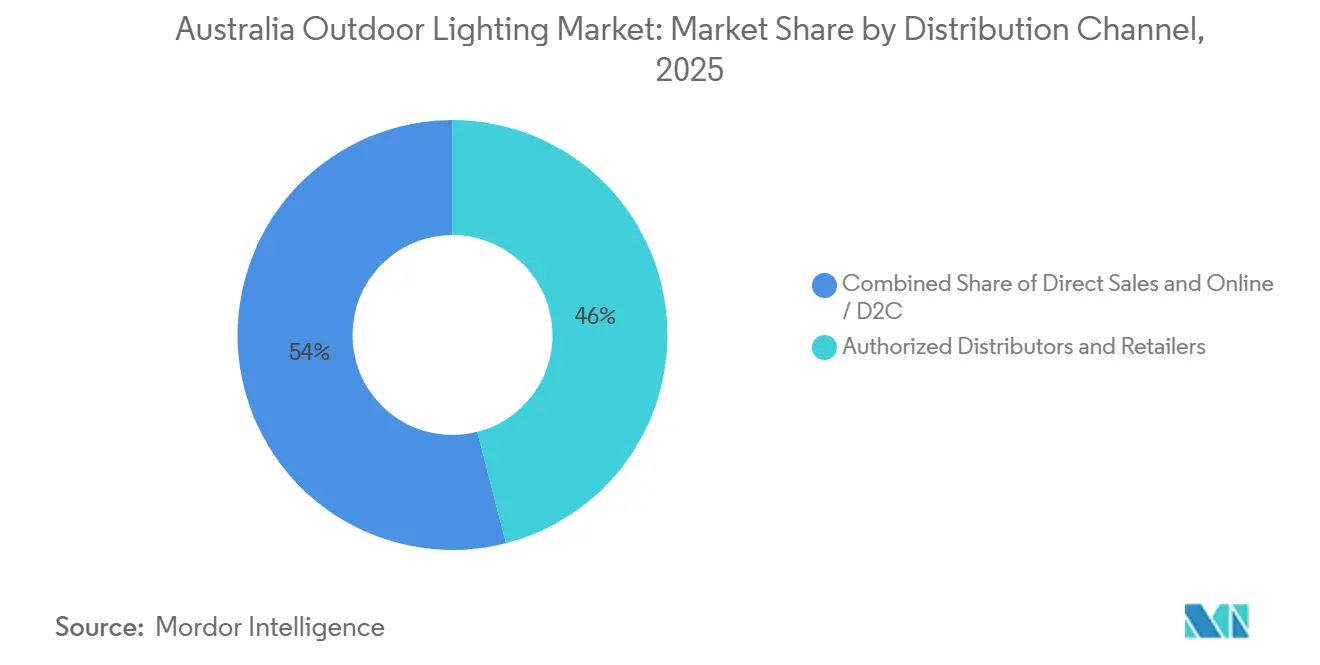
- By distribution channel, authorized distributors and retailers held 46.0% of revenue in 2025, while online and direct-to-consumer sales are projected to grow at the fastest CAGR of 8.50% through 2031.
- By geography, New South Wales led the outdoor lighting market with 31.0% share in 2025, and Queensland is is projected to grow at the fastest CAGR of 7.00% through 2031.
Note: Market size and forecast figures in this report are generated using Mordor Intelligence’s proprietary estimation framework, updated with the latest available data and insights as of January 2026.
Australia Outdoor Lighting Market Trends and Insights
Drivers Impact Analysis*
| Driver | (~) % Impact on CAGR Forecast | Geographic Relevance | Impact Timeline |
|---|---|---|---|
| LED Replacement and Energy Efficiency Adoption | +2.0% | National | Short term (≤ 2 years) |
| Smart City and Connected Outdoor Lighting Deployment | +1.2% | Major metros: Sydney, Melbourne, Brisbane | Medium term (2-4 years) |
| Residential Renovation and Outdoor Living Expansion | +0.8% | National, NSW, and Queensland leading | Medium term (2-4 years) |
| Public Space Safety and Infrastructure Modernization | +0.6% | National, concentrated in metropolitan councils | Medium term (2-4 years) |
| Australian Standard Compliant Local Product Development | +0.3% | National | Short term (≤ 2 years) |
| Solar Lighting for Grid-Constrained and Remote Locations | +0.5% | Remote and regional Australia, Western Australia, Northern Territory, Queensland | Long term (≥ 4 years) |
| Source: Mordor Intelligence | |||
LED Replacement and Energy Efficiency Adoption
Australia’s LED Lamps Determination 2025 commenced on March 3, 2026, and established minimum requirements for covered LED lamp products. Outdoor and industrial LED lamps must meet the stated color rendering requirement, while packaging must disclose power, efficacy, lifetime, beam angle, and correlated color temperature. These disclosures make comparisons more consistent for procurement teams replacing older fixtures. NCC 2025 Specification 40 also requires daylight sensors and demand-operated controls for most exterior artificial lighting in commercial buildings. Greater Geelong replaced more than 22,000 mercury-vapor street lights with smart LED fittings, reporting 82% higher energy efficiency, AUD 2.2 million in annual savings, and a reduction exceeding 3,300 tonnes of CO2-e each year[2]. Earlier LED installations from 2012 to 2016 are also nearing stated design lives, which can sustain replacement demand even without another regulatory change.
Smart City and Connected Outdoor Lighting Deployment
Outdoor lighting is increasingly used as a platform for monitoring, controls, and municipal service management. In November 2025, Itron named Connected Lighting Solutions, a Beacon Lighting Group subsidiary, as an Australian sales channel partner for its networked lighting controller and CityEdge software. The arrangement supports remote monitoring, adaptive dimming, and outage detection for councils and utilities. Open Zhaga-D4i and DALI 2 interfaces let councils update sensors or controls without replacing the physical luminaire. This approach can reduce the cost of phased smart-city programs and encourages multi-vendor specifications. It also increases pressure on vendors that supply only base fixtures because buyers can compare the physical fitting and the control layer separately.
Residential Renovation and Outdoor Living Expansion
Residential renovation remains a durable source of demand for outdoor fixtures across Australia. Housing Industry Association reporting indicated that renovation activity would remain central to residential construction during 2026, especially where households upgrade existing homes rather than relocate. HIA also projected that New South Wales renovation investment would exceed Victoria’s by 50% in 2026. Outdoor upgrades often place lighting alongside decking, paving, landscaping, security, and dining areas. This makes fixture selection part of a broader renovation decision rather than an isolated lighting purchase. Buyers in alfresco projects often seek IP-rated wall lights and decorative garden products, which support suppliers with a broad finish range and compliant specifications.
Public Space Safety and Infrastructure Modernization
Safety requirements support lighting projects even when council capital budgets are constrained. Queensland’s MRTS94 requires LED luminaires for new Rate 3 road lighting projects and specifies a minimum efficacy of 110 lumens per watt. The specification also requires DALI 2-compatible controllers that communicate with the department’s central management system. Brisbane City Council is installing 13 permanent LED luminaires in the Ivory Street Precinct during 2026 to improve nighttime safety and visibility. For councils, compliance documentation reduces the scope for substituting uncertified products on projects carrying public liability exposure. Suppliers with current approvals can therefore compete on reliability and technical assurance rather than price alone.
Restraints Impact Analysis*
| Restraint | (~) % Impact on CAGR Forecast | Geographic Relevance | Impact Timeline |
|---|---|---|---|
| High Upfront Cost of Smart and Retrofit Systems | -1.8% | National, acute in smaller regional councils | Short term (≤ 2 years) |
| Skilled Electrician and Compliance Requirements | -0.9% | National, acute in regional areas | Medium term (2-4 years) |
| Coastal Corrosion, Extreme Weather, and Vandalism Exposure | -0.6% | Coastal Queensland, Western Australia, New South Wales, and South Australia | Long term (≥ 4 years) |
| Solar Battery Performance Variability During Low Sunlight Periods | -0.4% | Victoria, Tasmania, and South Australia | Medium term (2-4 years) |
| Source: Mordor Intelligence | |||
High Upfront Cost of Smart and Retrofit Systems
Capital cost is a key barrier to faster upgrades across the Australia outdoor lighting market. Leadsun stated in May 2026 that a grid-connected pedestrian crossing lighting upgrade can require AUD 45,000 to AUD 75,000 and take 12 to 18 months, including approvals and civil trenching work[3]. Smart LED systems add the cost of controllers, sockets, and cloud platforms to the cost of a basic fixture replacement. Smaller councils may find it difficult to absorb a multi-year project within one annual budget cycle. The energy savings can be compelling, but operating budgets cannot always fund the initial capital requirement. Managed services and energy service agreements can spread costs across supply, installation, monitoring, and maintenance, although their use remains more limited outside major metropolitan councils.
Skilled Electrician and Compliance Requirements
Licensed electricians must install and certify grid-connected outdoor lighting under state safety legislation and relevant standards. This creates scheduling and cost pressure where projects compete with residential solar, electric vehicle charging, data center construction, and other electrical work. A council can have funding and approved equipment, but still face a slower rollout when qualified labor is unavailable. Off-grid solar lighting can avoid some grid-connection work and reduce trenching needs. Leadsun reported that solar alternatives can be delivered more quickly than comparable grid-connected crossing light projects. The benefit is therefore tied to delivery time as well as operating energy use, especially for regional sites and dispersed asset networks.
*Our forecasts treat driver/restraint impacts as directional, not additive. The impact forecasts reflect baseline growth, mix effects, and variable interactions.
Segment Analysis
By Product Type: Wall Lights Lead Across Residential and Commercial Demand
Wall lights held 42.3% of the Australia outdoor lighting market share in 2025 and are forecast to record a 7.00% CAGR through 2031. The category combines security and decorative uses across homes, commercial entrances, hospitality settings, and outdoor dining areas. Its broad application base reduces reliance on a single construction or customer cycle. Wall lights also fit renovation projects where owners want visible upgrades without extensive site work. Path, step, and garden lights are often selected with paving, decking, landscaping, and alfresco improvements. Decorative fixtures can therefore benefit when renovation expenditure moves toward outdoor areas. Signify introduced SunStay Pro gen2 modular solar street lighting and GreenVision Xceed Pro in Australia in September 2025, extending its professional outdoor range[4]. The product activity reflects the importance of serving decorative, road, and solar applications within the Australia outdoor lighting market.
Security lighting and floodlights are gaining use in commercial and industrial premises as motion-activated LED models replace older high-intensity discharge products. IP66-rated fixtures are relevant where exposure, security, and operating hours create stricter performance needs. Bollard lighting is receiving more specification interest in urban precincts, health care campuses, and masterplanned communities. It is suited to pedestrian-focused designs where conventional pole-top lighting is less appropriate. Rope and string lighting remains seasonal, but online sales make smaller orders more practical to fulfill. Deck, patio, and post lights remain closely connected with the pace of housing renovations and new residential construction.

By Light Source: LED Transition Accelerates Under Regulatory Mandate
LED accounted for 54.2% of the Australia outdoor lighting market size in 2025 and is forecast to grow at a 7.50% CAGR through 2031. The share indicates that LED already leads the light-source mix, while non-LED products continue to face replacement pressure. The 2025 LED Lamps Determination took effect in March 2026 and set performance and labeling requirements for covered products. It refers to AS/NZS 5341:2021 for energy and functional performance testing. AS/NZS 62471:2011 governs photobiological safety for LED lamps placed on the Australian market. These requirements make lighting performance, safety, and product information more visible at the point of purchase. Fluorescent products remain in some older industrial and commercial outdoor applications.
Halogen products remain visible in older residential installations but are nearing the end of their installed-base replacement cycle. Incandescent lamps had already been largely phased out through earlier E3 program rounds, leaving limited residual replacement activity. HID products still serve high-mast floodlighting and some large sports venues. New sports projects can increasingly choose high-output LED arrays where they offer comparable output and a lower system cost. The change from HID to LED often creates an opening for connected controls, sensors, and central management systems. This supports vendors that can provide the hardware and control layer together.
By Installation Type: Retrofit Cycle Sustains Majority Position
Retrofit and replacement installations held 56.0% of the Australia outdoor lighting market size in 2025 and are projected to expand at a 7.00% CAGR through 2031. The majority position reflects the large base of halogen, mercury-vapor, and fluorescent fixtures installed before 2016. Replacement demand does not depend only on new buildings or new subdivisions. It also follows maintenance needs, regulatory compliance, and the end of life of older equipment. Victoria’s Energy Upgrades program allows accredited persons to create Victorian Energy Efficiency Certificates through eligible public-lighting replacements. The work must meet AS/NZS 1158 performance and installation requirements. This gives the segment a direct policy mechanism that channels investment into upgrades.
New installations represent the remaining 44% of 2025 demand. They are supported by residential subdivisions in South-East Queensland and Greater Western Sydney. New logistics, industrial, and health care campuses also require external lighting during construction. New-build projects can include controls, sensors, and solar products at the design stage. Retrofit projects instead must work around existing poles, wiring, access, and civil constraints. This difference affects product choice, installation timing, and supplier support needs. The Australia outdoor lighting market gives retrofit suppliers an advantage where products can work with existing infrastructure and documented standards.
By Application: Residential Anchors Volume While Commercial Drives Growth
Residential users accounted for 45.2% of Australia outdoor lighting revenue in 2025. Households support fixture demand through security upgrades, decorative improvements, garden projects, outdoor dining areas, and property renovations. Outdoor-living preferences make lighting visible in home improvement decisions. HIA expected renovation activity to remain central to residential construction in 2026. This demand is spread across wall lights, path lights, garden products, floodlights, and deck lighting. Residential buyers also use online discovery before purchasing through a store, trade account, or installer. That sequence makes product imagery, specifications, and availability important for retailers.
Commercial applications are forecast to expand at a 6.70% CAGR through 2031, the highest rate among application types. The category covers hospitality venues, sports facilities, health care campuses, retail precincts, institutions, and mixed-use sites. These users often need weather resistance, safe illumination, controls, and documented standards compliance. Hospitality operators are selecting IP-rated warm-white fittings for outdoor dining spaces. Sports upgrades can require high-output lighting with glare management and operating controls. Health care campuses also need outdoor luminaires that support safe circulation and appropriate illumination. Brisbane’s Olympic-related venue activity can create concentrated demand for commercial lighting projects.
By Distribution Channel: Digital Platforms Accelerate Trade and Consumer Access
Authorized distributors and retailers held 46.0% of the distribution mix in 2025. Their position reflects the importance of product certification, credit terms, technical support, and local availability. These services are particularly relevant in commercial and council procurement. Direct sales continue to serve large LED renewal contracts where prices, warranties, and AS/NZS documentation are negotiated at the project level. Online and direct-to-consumer channels are forecast to grow at an 8.50% CAGR through 2031. Beacon Lighting Group reported that online trade sales grew 16.5% in FY2026. Its online sales represented 13.1% of company-store revenue during FY2026.
Outdoor lighting is well-suited to online discovery because many products have clear specifications and visual design features. Standardized products can also be shipped efficiently in smaller quantities. However, customers may still need an installer or store consultation before final purchase. The customer path can begin with brand or retailer research online and end with a trade-account or store transaction. This hybrid behavior makes pure online positioning less effective than coordinated digital and physical service. Direct channels remain important where buyers require tender support, technical review, and negotiated warranty terms. Distributors remain important where contractors need immediate stock and advice on compatible accessories.
Geography Analysis
New South Wales held 31.0% of national revenue in 2025, giving it the largest Australia outdoor lighting market share among the states. The state benefits from public infrastructure work and higher-value residential renovation activity, while HIA projected that New South Wales renovation investment would exceed Victoria’s by 50% in 2026. Sydney’s constrained land supply encourages households to improve existing homes, supporting security, decorative, garden, and outdoor-living fixtures. Victoria has a more mature LED conversion profile, and Greater Geelong’s program replaced more than 22,000 lights and reported annual savings of AUD 2.2 million. Powercor reported that more than 80% of its public lighting network had transitioned to LED, while AusNet’s November 2025 Phillip Island trial uses warm-white LEDs, smart controllers, and proximity sensors with wildlife-sensitive dimming profiles.
Queensland is forecast to be the fastest-growing state segment, with a 7.00% CAGR through 2031. Population growth in South-East Queensland, tourism venues, and council infrastructure activity support this outlook, while MRTS94 shapes state and local procurement through LED and DALI 2 controller requirements. Brisbane’s 2026 Ivory Street project shows continuing local investment in permanent LED lighting. Western Australia provides stable demand from mining, resources, and remote support infrastructure, while Western Australia and South Australia requires durable coastal-grade fixtures along populated coastlines. Leadsun delivered 36 SMART solar lighting systems to a BHP mining operation in South Australia in March 2026, illustrating the value of systems that illuminate roads, pathways, and worker accommodation without grid connection or trenching.
Tasmania, the Australian Capital Territory, and the Northern Territory form the smallest geographic segments by value. Tasmania’s demand is linked with tourism, hospitality, council residential lighting programs, and AS/NZS 4282:2023 requirements for controlling obtrusive outdoor lighting effects. The Australian Capital Territory follows the National Capital Authority’s policy, which requires AS/NZS 1158 illuminance compliance for public lighting. The Northern Territory has an outsized solar opportunity relative to its population because remote communities may lack reliable grid access, although system design must account for maintenance, battery performance, and local conditions.
Competitive Landscape
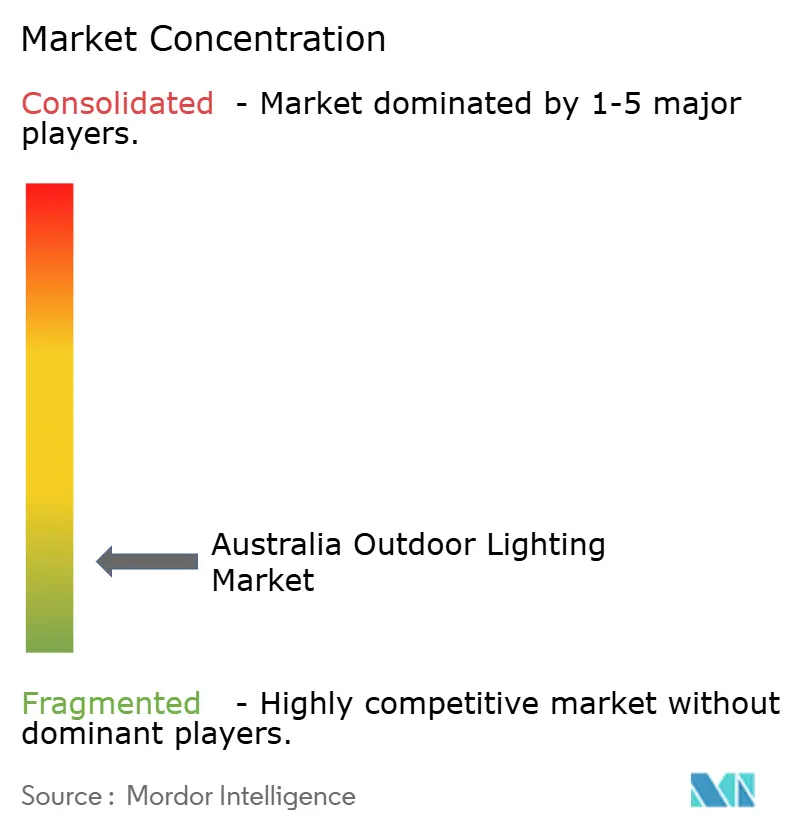
The Australia outdoor lighting market is fragmented, with domestic specialists and global companies competing across compliance, channel reach, product range, and connected systems. Beacon Lighting Group reported FY2026 underlying sales of AUD 340.3 million, an increase of 3.5% from the previous year, and it is extending from lighting distribution into managed smart-infrastructure services through Connected Lighting Solutions. Itron's partnership supports the rollout of networked controllers and CityEdge software for council and utility customers. Leadsun focuses on solar off-grid lighting, reporting more than 300,000 global installations and more than 30 patents, with platforms presented as compliant with AS/NZS 1158.4:2024 requirements.
Signify launched SunStay Pro gen2 modular connected solar street lighting, GreenVision Xceed Pro, and ActiStar sports-venue lighting in Australia on September 15, 2025, indicating active global competition across solar, road, venue, and connected applications. Schréder launched STREETLED MK4 in Australia during May 2026 with IP66 sealing, IK08 impact resistance, a 20-year design life, and D4i compatibility for road operators and councils. Open Zhaga-D4i and DALI 2 interfaces can reduce vendor lock-in and support multi-vendor systems. Domestic suppliers, including SAL National, Pierlite, Brightgreen, enLighten Australia, and Gardens at Night, can compete through response times, local support, and compliance documentation. Product approvals remain a practical barrier for new suppliers because municipal buyers need a defensible compliance record.
Coastal residential and hospitality lighting requires products that can withstand salt spray, cyclone winds, ultraviolet degradation, and vandalism. Verified IP66 and IK08 products can address these demanding uses more directly. AS/NZS 4282:2023 and the LED Lamps Determination 2025 support a premium for vendors able to provide current product records and practical project support.
Australia Outdoor Lighting Industry Leaders
-
Beacon Lighting Group Limited
-
Pierlite
-
SAL National
-
Leadsun Australia Pty Ltd
-
Bondilights
- *Disclaimer: Major Players sorted in no particular order
Recent Industry Developments
- June 2026: Leadsun partnered with Bass Coast Shire Council to install 6 PX2-compliant solar LED street lights across 3 new wombat crossings in Cowes, Phillip Island. The TAC-funded road-safety package required no grid trenching and met AS/NZS 1158.4:2024 pedestrian-lighting requirements.
- May 2026: Schréder launched the STREETLED MK4 road luminaire in Australia. The product is compliant with AS/NZS 60598.2.3 and AS/NZS TS 1158.6, with IP66 sealing, IK08 impact resistance, a 20-year design life, and D4i compatibility.
- March 2026: Leadsun delivered 36 SMART solar lighting systems to a BHP mining operation in South Australia. The systems illuminated roads, pathways, and worker accommodation using portable poles without grid connection or trenching.
Australia Outdoor Lighting Market Report Scope
| Decorative lighting | |
| Post lights | |
| Wall lights | Hanging lights |
| Chandeliers | |
| Others (flush mounts, etc.) | |
| Path & step lights | |
| Deck & patio lights | |
| Garden lights | |
| Security lighting | |
| Flood & spotlights | |
| Bollard | |
| Others (rope lights, string lights, etc.) |
| LED |
| Fluorescent |
| Incandescent |
| Halogen |
| Other Light Sources (HID, OLED, laser, etc.) |
| New Installations |
| Retrofit / Replacement |
| Residential |
| Commercial (HoReCa, Sports centers, Healthcare, Retail, Institutional, and Others (galleries/museums, corporates, etc.)) |
| Direct Sales (B2B / Tenders) |
| Online / D2C |
| Authorized Distributors & Retailers |
| New South Wales |
| Victoria |
| Queensland |
| Western Australia |
| South Australia |
| Tasmania |
| Australian Capital Territory & Northern Territory |
| By Product Type | Decorative lighting | |
| Post lights | ||
| Wall lights | Hanging lights | |
| Chandeliers | ||
| Others (flush mounts, etc.) | ||
| Path & step lights | ||
| Deck & patio lights | ||
| Garden lights | ||
| Security lighting | ||
| Flood & spotlights | ||
| Bollard | ||
| Others (rope lights, string lights, etc.) | ||
| By Light Source | LED | |
| Fluorescent | ||
| Incandescent | ||
| Halogen | ||
| Other Light Sources (HID, OLED, laser, etc.) | ||
| By Installation Type | New Installations | |
| Retrofit / Replacement | ||
| By Application | Residential | |
| Commercial (HoReCa, Sports centers, Healthcare, Retail, Institutional, and Others (galleries/museums, corporates, etc.)) | ||
| By Distribution Channel | Direct Sales (B2B / Tenders) | |
| Online / D2C | ||
| Authorized Distributors & Retailers | ||
| By Geography | New South Wales | |
| Victoria | ||
| Queensland | ||
| Western Australia | ||
| South Australia | ||
| Tasmania | ||
| Australian Capital Territory & Northern Territory | ||
Key Questions Answered in the Report
What is driving demand for outdoor lighting in Australia?
LED compliance requirements, renovation activity, public-space safety programs, and connected lighting upgrades are supporting demand through 2031.
What is the forecast growth rate through 2031?
The category is forecast to grow at a 5.40% CAGR from 2026 to 2031 and reach USD 1.3 billion in 2031.
Which outdoor lighting product type leads demand?
Wall lights led product demand with a 42.3% share in 2025 and are projected to grow at a 7.00% CAGR through 2031.
Why is LED lighting expanding faster than other sources?
LED held 54.2% of 2025 revenue and is projected to grow at a 7.50% CAGR, supported by replacement cycles and the 2026 LED Lamps Determination.