
Australia Microgreens Market Size and Share
Market Overview
| Study Period | 2021 - 2031 |
|---|---|
| Forecast Data Period | 2026 - 2031 |
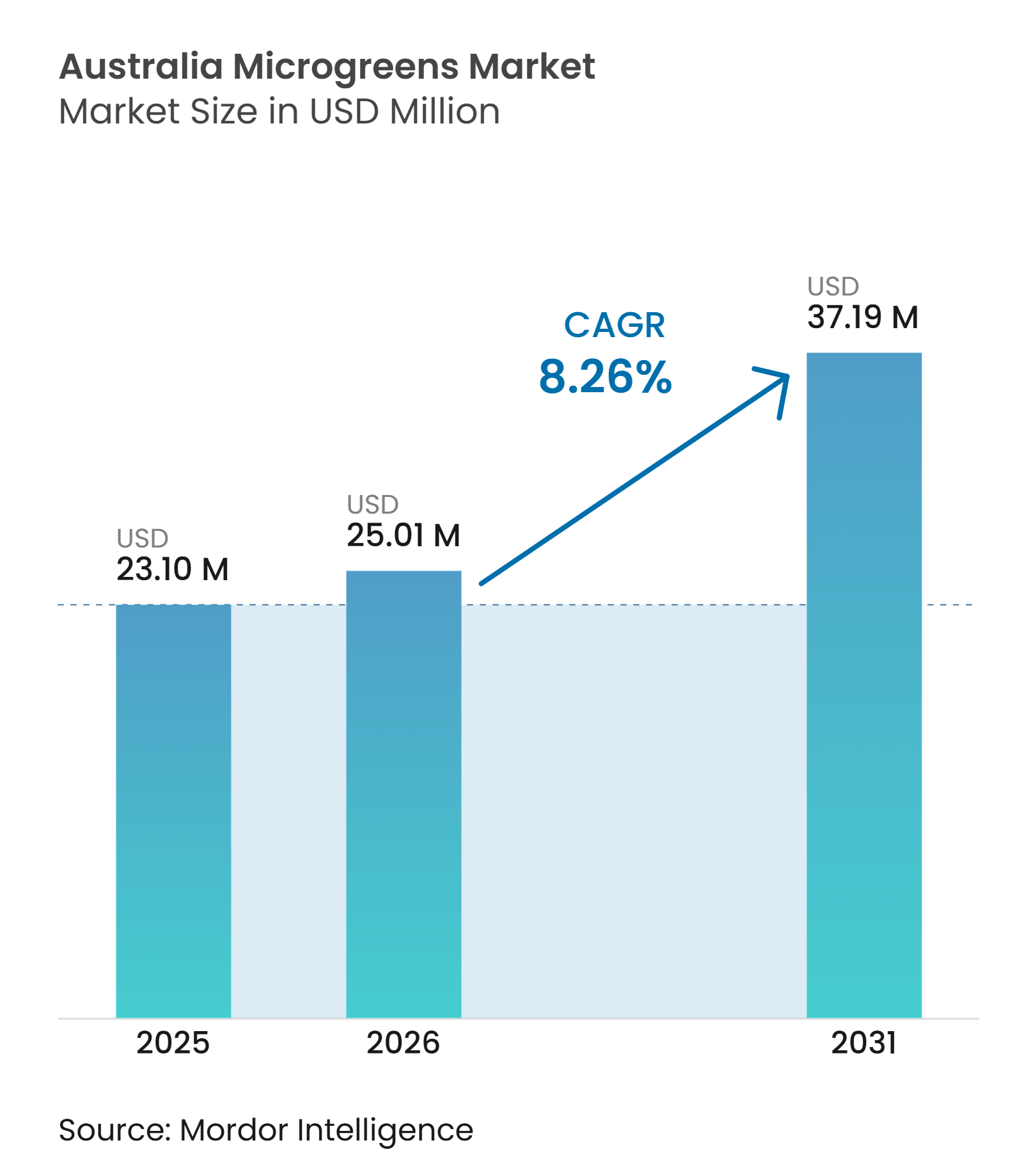
| Base Year Market Size (2025) | USD 23.10 Million |
| Market Size (2026) | USD 25.01 Million |
| Market Size (2031) | USD 37.19 Million |
| Growth Rate (2026 - 2031) | 8.26 % |
| Market Concentration | Low |
Major Players *Disclaimer: Major Players sorted in no particular order Image © Mordor Intelligence. Reuse requires attribution under CC BY 4.0. | |
Australia Microgreens Market Analysis by Mordor Intelligence
The Australia microgreens market size was valued at USD 23.10 million in 2025 and estimated to grow from USD 25.01 million in 2026 to reach USD 37.19 million by 2031, at a CAGR of 8.26% during the forecast period (2026-2031). Demand is supported by consumer interest in locally grown, nutrient-dense produce and by the wider use of microgreens in restaurants and specialty retail. Short growing cycles give growers flexibility, while controlled indoor production can reduce exposure to weather-related supply disruption. The market also benefits from production sites located close to major cities, where fast delivery helps maintain product quality. Larger automated farms are widening the operating gap with small growers, although direct sales and specialized varieties continue to provide opportunities for smaller suppliers.
Key Report Takeaways
- By type, radish held 18% of the Australia microgreens market share in 2025, while basil is forecast to grow at a CAGR of 12% from 2026 to 2031.
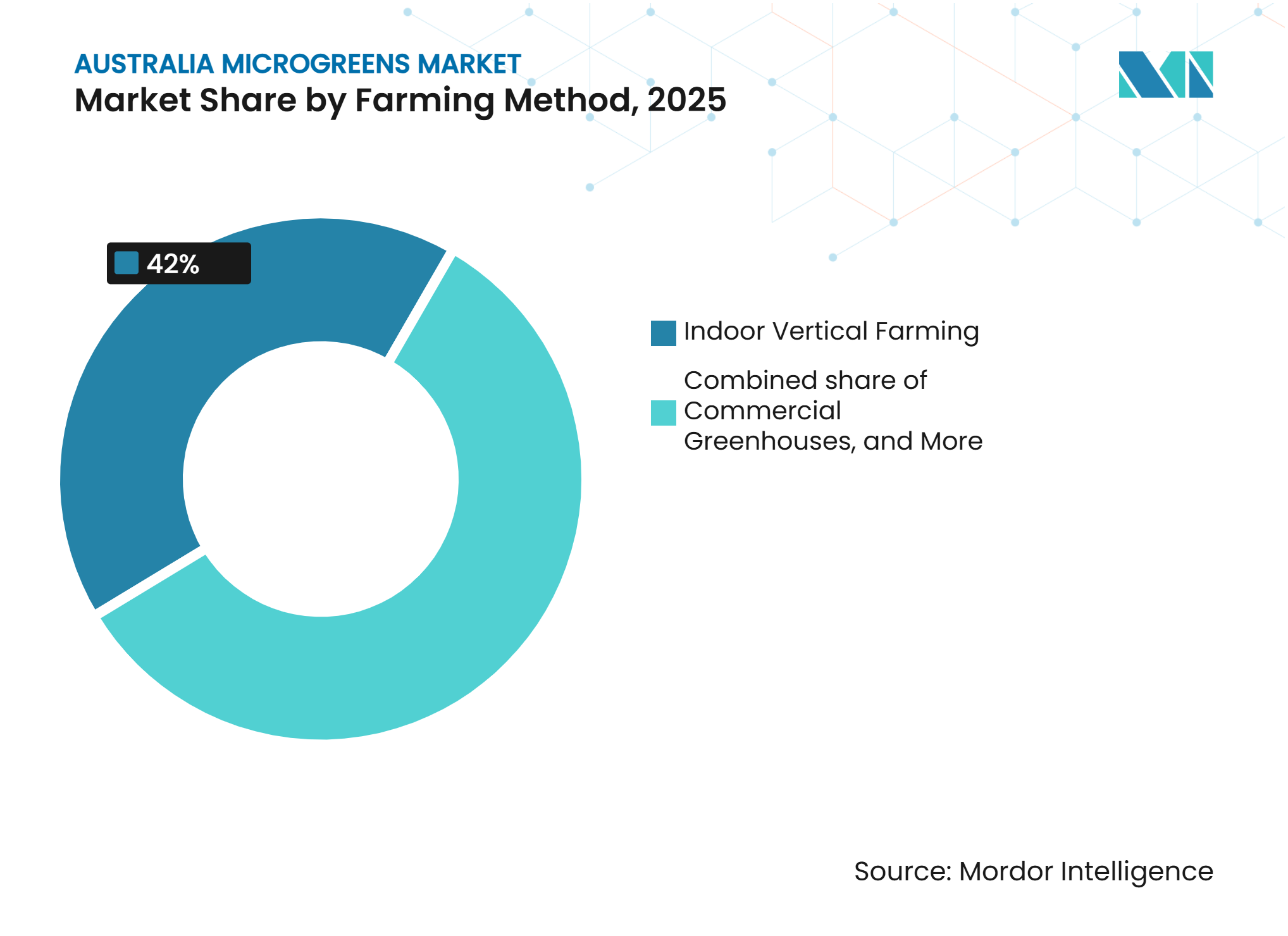
- By farming method, indoor vertical farming held 42% of the Australia microgreens market share in 2025 and is the fastest-growing farming method, with a CAGR of 10.85% through 2031.
- By growth medium, soil held 38% of revenue in 2025, while coconut coir is forecast to grow at a CAGR of 13% from 2026 to 2031.
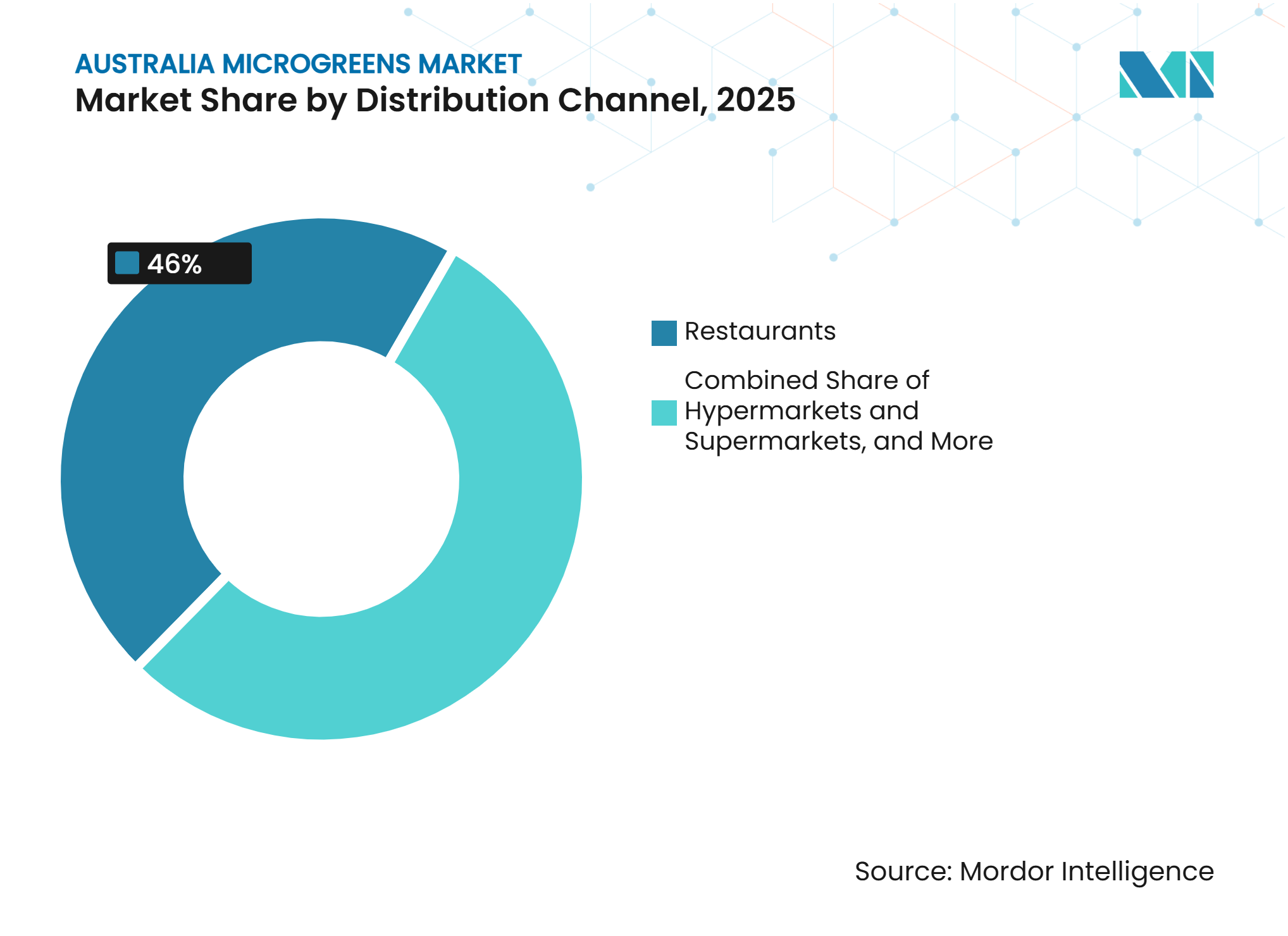
- By distribution channel, restaurants accounted for 46% of revenue in 2025, while other channels are forecast to grow at a CAGR of 15% from 2026 to 2031.
Note: Market size and forecast figures in this report are generated using Mordor Intelligence’s proprietary estimation framework, updated with the latest available data and insights as of January 2026.
Market Trends and Insights
Drivers Impact Analysis of Australia Microgreens Market*
| Driver | (~) % Impact on CAGR Forecast | Geographic Relevance | Impact Timeline |
|---|---|---|---|
| Health-conscious demand for nutrient-dense foods | +1.8% | Australia-wide, concentrated in Sydney, Melbourne, and Brisbane | Short term (≤ 2 years) |
| Restaurant and premium culinary adoption | +1.5% | Sydney, Melbourne, Brisbane, Hobart, and other food-destination cities | Short term (≤ 2 years) |
| Retail, subscription, and direct-to-consumer availability | +1.2% | Urban and peri-urban metropolitan corridors nationally | Medium term (2-4 years) |
| Year-round production through controlled-environment agriculture | +1.6% | Australia-wide, with early gains in Melbourne, Gold Coast, Brisbane, and Sydney | Medium term (2-4 years) |
| Peri-urban production to reduce fresh produce logistics exposure | +0.9% | Major city fringe zones and regional capitals | Long term (≥ 4 years) |
| Solar-powered and water-efficient farm models | +0.7% | Queensland, Western Australia, South Australia, and Victoria | Long term (≥ 4 years) |
| Source: Mordor Intelligence | |||
Health-Conscious Demand for Nutrient-Dense Foods
Health-focused demand supports the Australia microgreens market as consumers seek plant-based, locally sourced, and nutrient-dense food. An aging population and a growing flexitarian consumer base have reinforced this preference. Research on broccoli, kale, and red cabbage microgreens has identified higher concentrations of glucosinolates and pigments than in their mature counterparts. This evidence gives growers a sound basis for variety-specific product information at retail and foodservice outlets. In mid-2026, major retailers listed 15- to 30-gram punnets for AUD 3-5 (USD 1.9-3.1), indicating that consumers were already paying a premium for these products. Scientific evidence can also support a more informative variety-specific product communication at retail and foodservice outlets.
Restaurant and Premium Culinary Adoption
Restaurants remain an important route to volume and visibility for the Australia microgreens market. Chefs use microgreens for color, texture, flavor, and presentation, which supports regular purchases of consistent specialty varieties. Aurea Greens in Sydney harvests daily and supplies restaurants, wholesalers, and retailers, demonstrating how a single farm can serve multiple customer groups [1]. Direct feedback from chefs can help growers assess flavor strength, stem quality, and post-plating appearance before a variety enters broader distribution. Smaller restaurant formats also create demand for rare and visually distinctive varieties that may not suit large retail programs. These relationships can also help growers identify demand for new varieties and adjust product offerings to customer preferences.
Retail, Subscription, and Direct-to-Consumer Availability
Retail listings and subscription models are extending access to the Australia microgreens market beyond restaurant customers. Holy Greens, Farmwall Run, Groovy Greens, and Fresh Microgreens offered recurring delivery options in 2026. Subscription models allow farms to harvest on the delivery day, reducing quality loss that can occur during extended cold chain storage. Woolworths and Coles listings priced at AUD 3-5 (USD 1.9-3.1) per 15- to 30-gram punnet indicate broader grocery availability. Direct sales also allow growers to track buying frequency, preferred varieties, and customer response to pricing. These customer records can support more targeted production planning as the Australia microgreens market develops.
Year-Round Production Through Controlled-Environment Agriculture
Controlled-environment agriculture supports year-round supply for the Australia microgreens market despite drought, flooding, and temperature extremes. Stacked Farm's Melbourne facility demonstrates the expansion of large-scale automated indoor farming infrastructure in Australia. The facility uses controlled growing conditions and automated systems to support the predictable production of fresh greens [2]. Such infrastructure is relevant to the microgreens market because controlled environments can support year-round production and standardized growing conditions. Automation shifts labor costs from manual handling to equipment and operating systems. This model favors large sites with sufficient capital, which may increase consolidation pressure within the Australia microgreens market.
Restraints Impact Analysis of Australia Microgreens Market*
| Restraint | (~) % Impact on CAGR Forecast | Geographic Relevance | Impact Timeline |
|---|---|---|---|
| Short Post-Harvest Shelf Life and Cold-Chain Gaps | -1.2% | Australia-wide, especially interstate and regional delivery routes | Short term (≤ 2 years) |
| High Unit Production Costs in Controlled-Environment Farms | -1.5% | Australia-wide, with pressure in states with higher electricity tariffs | Medium term (2-4 years) |
| Food Safety Risk From Sanitation and Handling Failures | -0.8% | National, especially peri-urban and small-farm operations | Medium term (2-4 years) |
| Electricity, Labor, and Input-Cost Volatility | -1.1% | National, with sensitivity in energy-intensive Queensland and South Australia operations | Long term (≥ 4 years) |
| Source: Mordor Intelligence | |||
Short Post-Harvest Shelf Life and Cold-Chain Gaps
The short commercial shelf life of microgreens limits the market, particularly outside dense metropolitan delivery routes. Harvest timing, refrigeration, packing, and delivery scheduling must work in coordination. A warm vehicle, delayed dispatch, or packing delay can render a batch unsellable even when food safety requirements are still met. This creates an advantage for growers located near city customers and reduces the commercial reach of rural areas. Growth is therefore likely to remain concentrated in coastal cities with stronger chilled logistics and delivery density. Small growers that cannot build sufficient orders within a defined catchment may find their operating model difficult to sustain.
High Unit Production Cost in Controlled-Environment Farms
Commercial controlled-environment farming requires significant investment in racks, LED lighting, climate-control systems, automation, and food-grade facilities. Stacked Farm's USD 150 million funding for its Melbourne facility illustrates the capital intensity associated with large-scale automated indoor farming. These investments can increase the fixed cost base for growers and raise the minimum scale required to achieve efficient production. Food safety requirements also add operational costs, as commercial growers must maintain appropriate hygiene, traceability, and food safety management practices. The combined capital, energy, labor, and compliance costs can increase unit production costs and create challenges for smaller growers in the Australia microgreens market.
*Our forecasts treat driver/restraint impacts as directional, not additive. The impact forecasts reflect baseline growth, mix effects, and variable interactions.
Australia Microgreens Market Segment Analysis
By Type:
Radish Holds the Largest Revenue Position While Basil Grows FastestRadish held 18% of the Australia microgreens market by crop type in 2025. Its 7-10-day growing cycle supports frequent harvests and consistent availability for restaurant customers. Its magenta color, peppery flavor, and reliable indoor performance make it useful as both a garnish and a flavor component throughout the year. Broccoli and arugula represent important secondary demand segments, as consumers recognize broccoli for its nutritional qualities and chefs use arugula across a wide range of dishes. Cabbage, cauliflower, and peas fill mid-tier demand with varying seasonal and menu-related patterns.
Basil is forecast to grow at a 12% CAGR during 2026-2031, making it the fastest-growing type in the Australia microgreens market. Basil microgreens provide a strong aroma in a small serving, which is useful in premium dishes where ingredient yield is important. A 2026 study published in Plant Science Archives reported that substrate composition and biodegradable growing media can influence the agronomic performance and environmental footprint of specialty microgreens [3]. This makes growing-medium selection relevant to basil and other premium varieties. Other specialty varieties, including sunflower, amaranth, and wheatgrass, support niche retail and home-delivery demand, helping growers balance stable restaurant orders with smaller specialty opportunities.
By Farming Method:
Indoor Vertical Farming Leads Through Scale and AutomationIndoor vertical farming accounted for 42% of the Australia microgreens market by farming method in 2025. It leads because controlled facilities can deliver consistent output, documented production conditions, and year-round scheduling. Commercial greenhouses form the next largest method, offering temperature control without the full cost of a purpose-built vertical farm. Smaller rack systems, home kits, and mixed operations serve direct sales, local delivery, and farmers' market channels. These formats offer flexibility but have fewer resources for automation and formal compliance systems.
Indoor vertical farming is also the fastest-growing farming method, with a global benchmark CAGR of 10.85% through 2031. Stacked Farm's Melbourne site demonstrates automated seed-to-pack production at scale, with a capacity of 3.4 million kilograms annually. Controlled sites make it easier to document traceability and hygiene procedures under food safety requirements. Larger facilities can spread fixed equipment and compliance costs over greater output, widening the per-kilogram cost gap relative to manual operations. This dynamic may place increasing pressure on smaller farms in the Australia microgreens market that cannot achieve comparable operating scale.


By Growth Medium:
Soil Remains Established While Coconut Coir Gains MomentumSoil held 38% of segment revenue by growth medium in 2025. It remains familiar to commercial growers and to businesses transitioning from hobby production into regular sales, making it a lower-barrier starting point for small operations. Peat moss held the second-largest position due to its moisture retention, particularly in cooler growing environments. Tissue paper remains a smaller option for varieties that form limited root mass, and each medium has different handling, cost, moisture, and waste characteristics.
Coconut coir is forecast to grow at a 13% CAGR from 2026 to 2031. A peer-reviewed 2025 study published in Horticulturae found that coconut coir can support floating-tray hydroponic microgreens when water level and electrical conductivity are managed correctly. Coir is derived from coconut industry waste and can serve as an alternative to peat. The 2026 review published in the Plant Science Archives also assessed biodegradable mats made from hemp, jute, and coconut coir for microgreen production. Corporate buyer sustainability requirements may increase the relevance of these options, while matching the medium to crop requirements can improve product quality and environmental positioning.
By Distribution Channel:
Restaurants Provide the Base While Other Channels ExpandRestaurants held 46% of segment revenue by distribution channel in 2025. Repeat foodservice orders provide a stable base for growers that can supply consistent quality and delivery schedules, which explains the importance of locating farms close to restaurant clusters in major cities. Hypermarkets and supermarkets form the second tier of distribution.
Other channels are forecast to grow at a 15% CAGR through 2031, the fastest rate among distribution channels. These include online delivery and subscription services, where growers can harvest on the day of delivery. Farmwall Run sells living microgreens in reusable brown glass jars that are collected, washed, and reused. This reusable packaging model reduces reliance on single-use plastic containers and differentiates the direct-delivery offering. Direct channels also give growers access to buyer behavior data, which can be used to plan varieties, harvest timing, and recurring deliveries more effectively.

Geography Analysis
The Australia microgreens market is concentrated around Sydney, Melbourne, Brisbane, Perth, and Adelaide, where population density and restaurant demand support consumption. Melbourne and Sydney have strong restaurant supply relationships, while Brisbane and the Gold Coast have also attracted controlled-environment farming activity, supported by access to metropolitan consumer markets and suitable infrastructure.
Peri-urban areas near the major cities are becoming important production locations because they allow fresh product to reach customers quickly. The Australia microgreens supply base is likely to remain concentrated in these high-density corridors, as delivery reliability is critical. City-fringe farms can serve restaurants, retailers, and subscribers without relying heavily on interstate cold chains. Tasmania has a smaller production base but may offer opportunities for premium positioning linked to its agricultural and farm-to-table food sector. Little Roots Farm is among the producers associated with this local offering, while regional production hubs could expand as foodservice demand develops beyond Sydney and Melbourne.
Domestic demand is expected to remain the primary source of growth for the Australia microgreens market, with production concentrated near major consumption centers. The short shelf life and temperature sensitivity of microgreens reinforce the importance of proximity between growers and end consumers, supporting localized production and efficient domestic distribution.
Competitive Landscape
Market Concentration
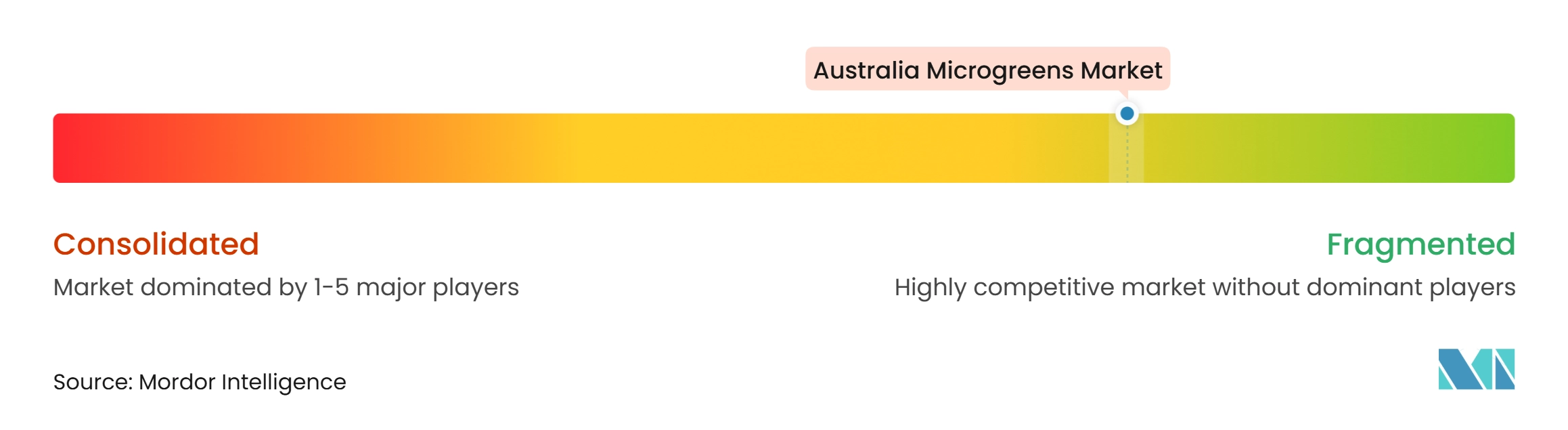
The Australia microgreens market is fragmented, with competition spanning larger automated farms and smaller local growers. Larger operators compete for restaurant groups and retail supply contracts, while smaller growers differentiate through local provenance, broader variety ranges, organic positioning, and subscription relationships. This structure allows both models to coexist as customer requirements vary by location and distribution channel. Larger operators have greater capacity to invest in automation, specialized lighting, and formal food safety systems, while smaller farms can respond quickly to chef requirements and neighborhood delivery needs. Growth opportunities include expanding reliable supply beyond Sydney and Melbourne, improving shelf-life packaging, and adopting cost-efficient automation.
Technology is becoming a clearer point of difference within the Australia microgreens market. April Sun Farms uses custom-spectrum lights developed in-house and has worked with Darebin Council on planned 100-kilowatt solar panels at its warehouse facility. The planned solar installation could reduce reliance on grid electricity and support the company's sustainability positioning. Stacked Farm is advancing a large automated facility in Melbourne with Melbourne Airport and Total Construction. The site has 47% more energy-efficient lighting capacity than conventional designs and a zero-waste-water recirculation system, demonstrating how energy systems, automation, and controlled production can support operational efficiency.
Food safety is also shaping competition as buyer qualification processes place greater emphasis on documented practices. FSANZ Standard 4.2.8 has made formal food safety management, traceability, and hygiene controls more important for commercial leafy vegetable growers. Micro Harvest Pty Ltd uses Freshcare certification as a differentiator in wholesale supply. Farms that build reliable compliance records can be better placed to serve corporate foodservice accounts. Larger farms can strengthen their position in wholesale and foodservice channels, while smaller growers can continue to compete through proximity, specialization, and direct relationships.
Australia Microgreens Industry Leaders
-
April Sun Farms
-
Pocket Herbs Microgreens and Produce
-
Natural Yield
-
Aurea Greens
-
Yarra Valley Herbs
- *Disclaimer: Major Players sorted in no particular order
Australia Microgreens Market Companies Covered in this Report
- Sprout House Farms
- Pocket Herbs Microgreens and Produce
- Natural Yield
- Aurea Greens
- Yarra Valley Herbs
- Little Roots Farm
- Woodford Microgreens
- Micro Harvest Pty Ltd
- Fresh Microgreens
- Tiny Greens
- Groovy Greens
- Mussett Holdings
- JoJo's Greens
- Petal & Sprout Farm
- April Sun Farms
Recent Industry Developments in Australia Microgreens Market
- May 2026: Greenspace launched a Macrofarm and Microfarm at the Amora Hotel Brisbane, growing microgreens, herbs, and leafy greens for on-site hospitality use. The development expands the company's urban vertical-farming model into Brisbane.
- March 2026: Total Construction formalized a partnership with Stacked Farm and Melbourne Airport to complete the base build of a 10,000-square-meter automated indoor vertical farm in northwest Melbourne. The facility incorporates 47% more energy-efficient lighting capacity than conventional designs and a zero-waste-water recirculation system. The facility is designed to produce approximately 3.4 million kilograms of fresh greens annually, demonstrating the expansion of automated indoor farming capacity in Australia.
Australia Microgreens Market Report Scope
Microgreens are young, edible vegetable and herb seedlings harvested between the cotyledon and first true-leaf stages. They are cultivated in controlled and conventional growing systems and are primarily used as fresh ingredients for their flavor, visual appeal, and nutritional value.
The Australia Microgreens Market is Segmented by Type (Broccoli, Cabbage, Cauliflower, Arugula, Peas, Basil, Radish, and Other Types), by Farming Method (Indoor Vertical Farming, Commercial Greenhouses, and Other Farming Methods), by Growth Medium (Soil, Peat Moss, Coconut Coir, Tissue Paper, and Other Growth Media), and by Distribution Channel (Restaurants, Hypermarkets/Supermarkets, and Other Channels). The Market Forecasts are Provided in Terms of Value (USD).
Segmentation Overview
| Broccoli |
| Cabbage |
| Cauliflower |
| Arugula |
| Peas |
| Basil |
| Radish |
| Other Types |
| Indoor Vertical Farming |
| Commercial Greenhouses |
| Other Farming Methods |
| Soil |
| Peat Moss |
| Coconut Coir |
| Tissue Paper |
| Other Growth Media |
| Restaurants |
| Hypermarkets and Supermarkets |
| Other Channels |
| By Type | Broccoli |
| Cabbage | |
| Cauliflower | |
| Arugula | |
| Peas | |
| Basil | |
| Radish | |
| Other Types | |
| By Farming Method | Indoor Vertical Farming |
| Commercial Greenhouses | |
| Other Farming Methods | |
| By Growth Medium | Soil |
| Peat Moss | |
| Coconut Coir | |
| Tissue Paper | |
| Other Growth Media | |
| By Distribution Channel | Restaurants |
| Hypermarkets and Supermarkets | |
| Other Channels |
Key Questions Answered in the Report
What is the size of Australia's microgreens sector?
The Australia microgreens market size was valued at USD 23.10 million in 2025 and estimated to grow from USD 25.01 million in 2026 to reach USD 37.19 million by 2031, at a CAGR of 8.26% during the forecast period (2026-2031).
What is driving demand for microgreens in Australia?
Demand is supported by health-focused food choices, restaurant use, direct delivery subscriptions, and controlled-environment production.
Which crop type leads sales in Australia?
Radish led the crop types with 18% revenue share in 2025, while basil is forecast to grow fastest at a CAGR of 12% from 2026 to 2031.
Which distribution channel has the largest role?
Restaurants held 46% of revenue in 2025, while other channels are forecast to grow at a CAGR of 15% from 2026 to 2031.
What issues affect Australian microgreens growers?
Short shelf life, cold-chain gaps, high facility costs, food safety requirements, and electricity and labor costs are among the key challenges affecting growers.