
Australia Grass Fed Beef Market Size and Share
Market Overview
| Study Period | 2021 - 2031 |
|---|---|
| Forecast Data Period | 2026 - 2031 |
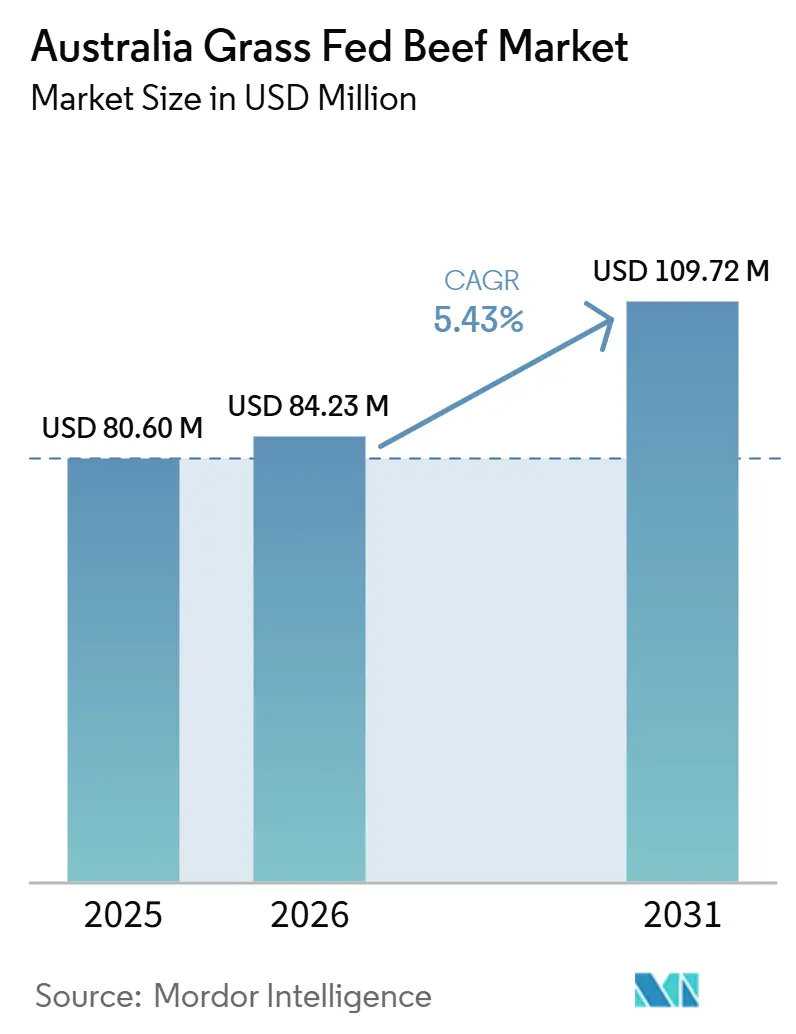
| Base Year Market Size (2025) | USD 80.60 Million |
| Market Size (2026) | USD 84.23 Million |
| Market Size (2031) | USD 109.72 Million |
| Growth Rate (2026 - 2031) | 5.43 % |
| Market Concentration | Medium |
Major Players
*Disclaimer: Major Players sorted in no particular order Image © Mordor Intelligence. Reuse requires attribution under CC BY 4.0. |
|
Australia Grass Fed Beef Market Analysis by Mordor Intelligence
The Australia grass-fed beef market was valued at USD 80.60 million in 2025 and is projected to grow from USD 84.23 million in 2026 to USD 109.72 million by 2031, registering a CAGR of 5.43% during the forecast period. Market growth is driven by rising consumer preference for naturally raised, minimally processed, hormone-free, and antibiotic-free beef, alongside increasing demand for premium protein with strong traceability and sustainability credentials. Australia's extensive pasture-based production systems, robust livestock identification framework, and internationally recognized food safety standards continue to strengthen the competitiveness of its grass-fed beef industry. Ongoing investments in regenerative grazing, low-carbon production practices, digital livestock monitoring, and advanced cold-chain infrastructure are further improving product quality, operational efficiency, and supply chain transparency.
Key Report Takeaways
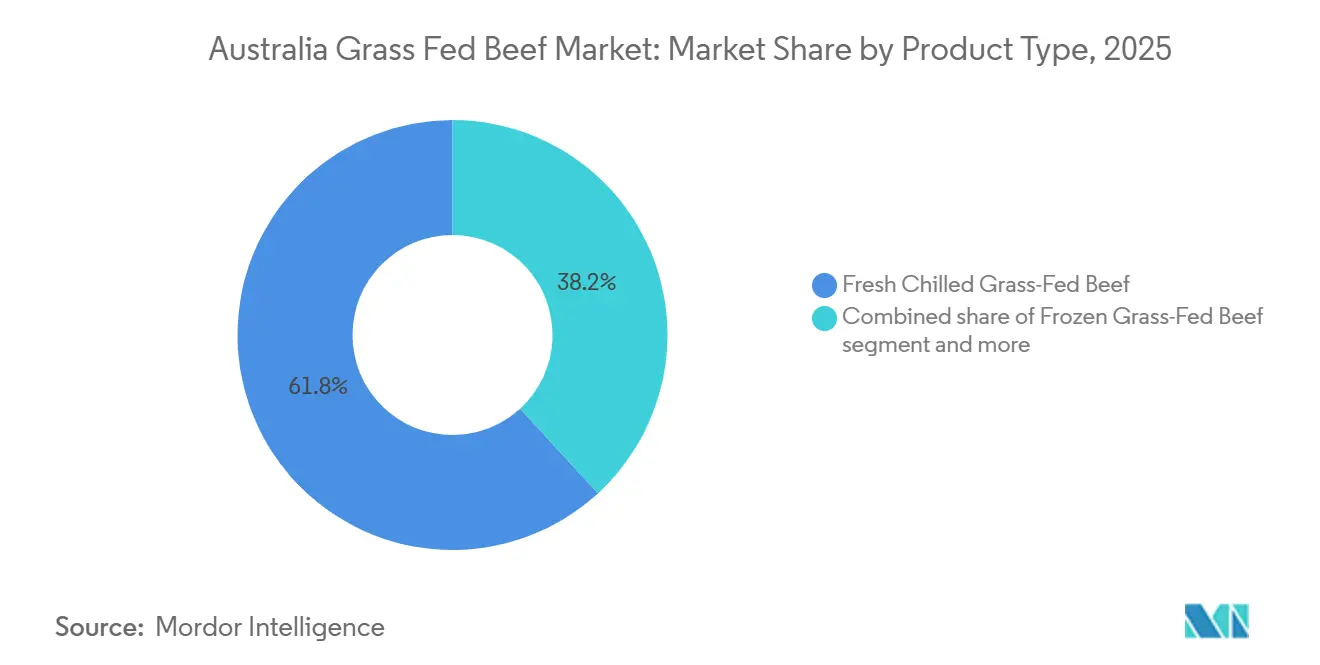
- By product type, fresh chilled grass-fed beef held 61.82% of Australia grass-fed beef market share in 2025, while processed grass-fed beef is forecast to expand at a 7.44% CAGR through 2031.
- By cut type, rib cuts held 29.37% of Australia grass-fed beef market share in 2025, while brisket cuts are forecast to expand at a 6.55% CAGR through 2031.
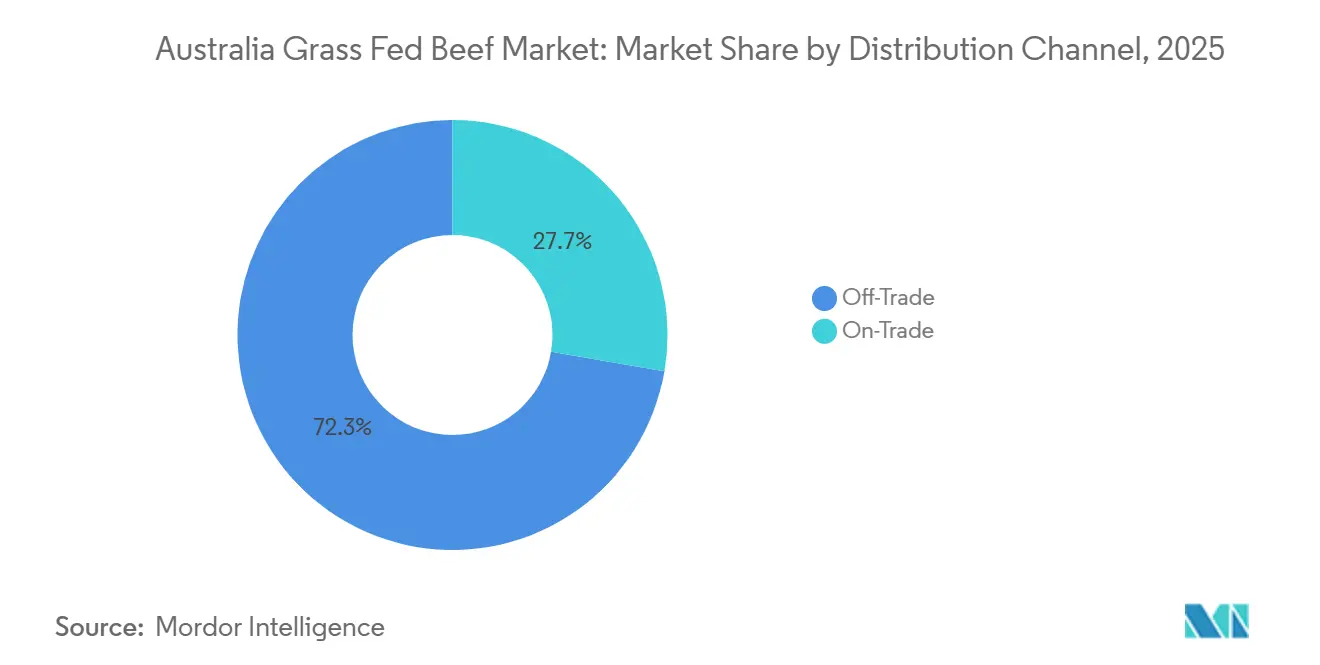
- By distribution channel, off-trade held 72.31% of Australia grass-fed beef market share in 2025, while on-trade is forecast to expand at a 6.21% CAGR through 2031.
Note: Market size and forecast figures in this report are generated using Mordor Intelligence’s proprietary estimation framework, updated with the latest available data and insights as of January 2026.
Australia Grass Fed Beef Market Trends and Insights
Drivers Impact Analysis*
| Driver | (~) % Impact on CAGR Forecast | Geographic Relevance | Impact Timeline |
|---|---|---|---|
| Preference for natural and minimally processed meat products | +1.5% | National, with strongest retail pull in Victoria, New South Wales, and Queensland | Short term (≤ 2 years) |
| Demand for hormone-free and antibiotic-free beef | +1.2% | National; amplified in United States, Japan, and Korea export corridors | Medium term (2–4 years) |
| Sustainable and low-carbon beef production practices | +0.8% | Global, particularly Europe-bound and North American-bound supply chains | Long term (≥ 4 years) |
| Adoption of livestock traceability and digital farm technologies | +0.6% | Asia-Pacific core (Queensland), spill-over to Western Australia and South Australia | Medium term (2–4 years) |
| Advancements in cattle genetics and pasture management | +0.5% | Northern and Central Queensland, Northern Territory | Long term (≥ 4 years) |
| Consumer focus on animal welfare and ethical farming | +0.3% | National, with export concentration in premium Europe and United States markets | Medium term (2–4 years) |
| Source: Mordor Intelligence | |||
Preference for natural and minimally processed meat products
Growing consumer preference for natural and minimally processed meat products is a major driver of the Australia grass-fed beef market. Purchasing decisions increasingly prioritize food authenticity, ingredient transparency, and production methods over conventional meat attributes. Grass-fed beef is perceived as a naturally raised protein produced through pasture-based grazing systems with minimal intervention, aligning with the broader clean-label movement and rising demand for foods that retain their original nutritional and sensory characteristics. Consumers are placing greater importance on production transparency, traceability, and naturally sourced proteins, prompting retailers, foodservice operators, and meat processors to expand premium grass-fed product portfolios and strengthen labeling initiatives. This trend is also encouraging investment in branded grass-fed beef programs, quality assurance systems, and certified production practices that reinforce consumer confidence.
Demand for hormone-free and antibiotic-free beef
Growing consumer demand for hormone-free and antibiotic-free beef is driving the Australia grass-fed beef market, as buyers increasingly prioritize food safety, natural production methods, and transparency in livestock management. Consumers are becoming more conscious of how cattle are raised, favoring beef produced without added growth hormones and routine antibiotic use, particularly in premium retail and foodservice channels. This shift is encouraging producers to adopt Never Ever production systems, strengthen animal health management through pasture-based practices, and obtain certifications that verify natural production standards. In response, companies are expanding dedicated hormone-free and antibiotic-free product lines to differentiate themselves in both domestic and export markets. For instance, Ironbark Beef offers hormone-free beef raised entirely on pasture, emphasizing natural grazing, animal welfare, and full traceability from farm to consumer.
Sustainable and low-carbon beef production practices
The expansion of sustainable and low-carbon beef production practices is emerging as a key driver of the Australia grass-fed beef market, as producers increasingly align their operations with environmental goals and evolving buyer expectations. Grass-fed beef producers are investing in regenerative grazing, improved pasture management, rotational grazing systems, soil carbon enhancement, biodiversity conservation, and more efficient livestock management to reduce the environmental footprint of beef production while maintaining productivity. Sustainability initiatives are also strengthening Australia's competitiveness in premium export markets, where retailers and foodservice operators increasingly favor suppliers with verified environmental credentials and transparent carbon reporting. These efforts are encouraging wider adoption of carbon measurement tools, emissions monitoring, and sustainability certification programs across the value chain. According to the Australian Beef Sustainability Framework (ABSF), processors reduced their emissions intensity by 137 kg per ton of beef over the two years leading to 2024, reaching 339 kg CO₂-e per ton of beef in 2024 [1]Source: Australian Beef Sustainability Framework (ABSF), "ANNUAL UPDATE", sustainableaustralianbeef.com.au.
Adoption of livestock traceability and digital farm technologies
The growing adoption of livestock traceability and digital farm technologies is a key driver of the Australia grass-fed beef market. Producers are increasingly using digital solutions to improve herd management, product integrity, and supply chain transparency. Technologies such as electronic identification (EID), GPS-enabled livestock monitoring, smart ear tags, remote sensing, precision pasture management, automated weighing systems, and cloud-based herd management platforms allow producers to monitor animal health, grazing patterns, productivity, and welfare in real time. These technologies improve decision-making, optimize pasture utilization, reduce production losses, and support compliance with domestic and international traceability requirements. Digital traceability also provides buyers with verified information on cattle origin, production practices, and movement throughout the supply chain, reinforcing consumer confidence in premium grass-fed beef.
Restraints Impact Analysis*
| Restraint | (~) % Impact on CAGR Forecast | Geographic Relevance | Impact Timeline |
|---|---|---|---|
| Limited geographical cultivation and supply concentration | −1.5% | Global supply chain; North American and European buyers most exposed | Long term (≥ 4 years) |
| Seasonal variability affecting raw material availability | −0.8% | Australia (primary production zone), with global procurement knock-on effects | Short term (≤ 2 years) |
| High production and processing costs | −0.7% | Australia-origin supply; affects price-sensitive food and beverage buyers | Medium term (2-4 years) |
| Competition from alternative natural citrus ingredients | −0.6% | Global; most acute in commodity-grade food and beverage applications | Medium term (2-4 years) |
| Source: Mordor Intelligence | |||
Climate variability and prolonged drought affecting pasture availability
Climate variability and prolonged drought are major restraints on the Australia grass-fed beef market. Grass-fed production depends heavily on the availability and quality of natural pasture throughout the year. Extended periods of below-average rainfall, higher temperatures, and changing seasonal weather patterns reduce pasture growth, lower forage quality, and limit grazing capacity, directly affecting cattle weight gain and production efficiency. During drought conditions, producers are often forced to reduce stocking rates, purchase supplementary feed, or delay herd rebuilding, which increases production costs while reducing the availability of certified grass-fed cattle. Water scarcity and pasture degradation can also lengthen finishing periods and create inconsistencies in beef quality and supply.
Competition from grain-fed and Wagyu beef products
Growing competition from grain-fed and Wagyu beef products is a significant restraint on the Australia grass-fed beef market, as these alternatives compete for premium retail shelf space, foodservice menus, and export demand. Grain-fed beef is valued for its consistent marbling, tenderness, and predictable eating quality, while Wagyu commands a strong premium position due to its exceptional intramuscular fat and luxury market appeal. These products attract consumers seeking rich flavor profiles and high-end dining experiences, reducing the addressable market for grass-fed beef in certain premium segments. Additionally, many processors and exporters maintain diversified beef portfolios that include both grass-fed and grain-fed products, intensifying competition for production resources, marketing investments, and distribution channels.
*Our forecasts treat driver/restraint impacts as directional, not additive. The impact forecasts reflect baseline growth, mix effects, and variable interactions.
Segment Analysis
By Product Type: Fresh Chilled Dominance Anchored by Cold-Chain Depth
Fresh Chilled Grass-Fed Beef held a 61.82% share of the Australia Grass-Fed Beef Market in 2025. The segment maintains its dominant position due to its ability to deliver superior eating quality and preserve the authentic characteristics of pasture-raised beef, including natural flavor, juiciness, and texture. Premium retailers, specialty butchers, and hospitality operators prioritize chilled products for their merchandising flexibility, consumer confidence in freshness, and visual appeal at the point of sale. Australia's well-developed refrigerated logistics network supports rapid distribution while maintaining product integrity, enabling producers to consistently supply high-quality chilled beef to domestic and export markets. The premium perception associated with freshly processed beef continues to reinforce its market position.
Processed Grass-Fed Beef is projected to register the fastest CAGR of 7.44% during 2026–2031. The segment is expanding as manufacturers increasingly transform grass-fed beef into diversified value-added formats that improve convenience, usability, and product accessibility across multiple consumption occasions. Continuous investment in processing techniques, packaging technologies, and product formulation is extending shelf life while maintaining the quality attributes expected from grass-fed beef. Growing demand for versatile protein options suited to modern lifestyles is encouraging processors to broaden their premium processed portfolios, creating new consumption opportunities beyond traditional fresh meat purchases. This product diversification is expected to drive sustained growth throughout the forecast period.



By Cut Type: Rib Cuts Lead, Brisket Cuts Redefine Secondary Value
Rib cuts held a 29.37% share of the Australia grass-fed beef market in 2025. Rib cuts dominated the market as they represent the highest-value portion of the carcass and are widely recognized for their tenderness, rich flavor profile, and consistent eating quality. The natural intramuscular fat and fine muscle structure of grass-fed rib cuts enhance their premium appeal while preserving the distinctive characteristics associated with pasture-raised cattle. Their ability to deliver consistent quality across various cooking methods strengthens demand among consumers seeking premium beef. Meat processors and branded beef programs prioritize rib cuts as flagship offerings because they enhance brand positioning, maximize carcass value, and generate higher profit margins. The strong preference for premium-quality beef, combined with Australia's reputation for producing high-grade grass-fed cattle, continues to reinforce the segment's dominant market position.
Brisket cuts are projected to expand at a CAGR of 6.55% during 2026–2031. The brisket segment is gaining momentum as evolving culinary preferences increase appreciation for cuts that deliver rich flavor and perform well in extended cooking techniques. The cut's abundant connective tissue and collagen create a tender, succulent texture after slow cooking, making it increasingly attractive for premium barbecue, smoked, braised, and gourmet preparations. Meat processors are also improving brisket utilization through enhanced trimming standards, standardized portioning, vacuum packaging, and value-added product development, allowing the cut to reach a broader consumer base. Growing product innovation, wider availability through modern retail channels, and increasing recognition of brisket as a premium specialty cut are creating new consumption opportunities, enabling the segment to outpace other cut categories over the forecast period.
By Distribution Channel: Off-Trade Scale Gives Way to On-Trade Premiumisation
Off-trade channels accounted for a 72.31% share of the Australia Grass-Fed Beef Market in 2025. The segment maintained its dominant position due to its extensive retail presence, reliable product availability, and ability to offer consumers a broad selection of premium grass-fed beef throughout the year. Supermarkets and hypermarkets continue to strengthen sales through dedicated premium meat sections, branded grass-fed product ranges, transparent labeling, and advanced refrigerated merchandising that preserves freshness and product quality. Online retail has also become an important part of the off-trade ecosystem, offering consumers greater convenience through home delivery, click-and-collect services, and direct access to premium grass-fed beef brands. According to the International Telecommunication Union (ITU), 96.1% of Australia's population were internet users in 2024, supporting the rapid adoption of digital grocery shopping [2]Source: International Telecommunication Union (ITU), "Australia", itu.int.
The on-trade channel is projected to be the fastest-growing distribution channel, registering a CAGR of 6.21% during 2026–2031. The segment is expanding as consumers increasingly seek premium dining experiences centered on high-quality, naturally raised beef with distinctive flavor and provenance. Foodservice establishments are adding premium grass-fed beef to their menus to differentiate their offerings and meet growing demand for high-quality protein options. Chefs value grass-fed beef for its distinct taste profile, consistency, and suitability for premium culinary preparations, encouraging wider adoption across fine dining, casual dining, and hospitality venues. The recovery and expansion of Australia's hospitality sector, along with rising culinary tourism and greater consumer interest in restaurant-quality meat experiences, are also supporting higher procurement of premium grass-fed beef.
Geography Analysis
The Australia grass-fed beef market is geographically unique because domestic production is closely integrated with export demand, making international trade a key determinant of industry performance. Australia is one of the world's largest exporters of grass-fed beef, with overseas demand strongly influencing production strategies, processing volumes, and supply chain investments. According to Meat & Livestock Australia (MLA), Australia's total beef exports exceeded 1.5 million tons in 2025, while grass-fed beef exports reached approximately 1.09 million tons, highlighting the market's export-oriented nature [3]Source: Meat & Livestock Australia (MLA), "Beef exports break new ground in 2025", mla.com.au. Strong demand from premium international markets encourages producers to maintain strict quality, traceability, and food safety standards while expanding processing capacity and strengthening cold-chain infrastructure.
Queensland and the Northern Territory form the production heartland of Australia's grass-fed beef industry due to their vast grazing landscapes, extensive pastoral systems, and large cattle inventories. These regions possess expansive natural grasslands that support year-round pasture-based cattle production on a commercial scale, allowing producers to raise cattle predominantly on natural forage. Large station operations, favorable grazing conditions, and established livestock transport networks enable efficient movement of cattle to major processing facilities and export terminals. Ongoing improvements in pasture management, herd genetics, water infrastructure, and digital livestock monitoring are further enhancing productivity and supply reliability, reinforcing the northern regions as the primary source of Australia's grass-fed cattle.
Victoria and Tasmania serve as Australia's premium grass-fed beef processing corridor, supported by advanced meat processing infrastructure, temperate grazing conditions, and a strong focus on value-added production. These regions are recognized for producing consistently high-quality grass-fed beef through intensive pasture management, rigorous quality assurance systems, and internationally recognized branded beef programs. Their proximity to major refrigerated processing facilities, container ports, and integrated cold-chain logistics enables efficient distribution to both domestic retailers and export markets while preserving product quality. A strong emphasis on premium branding, product differentiation, traceability, sustainability, and high-value export specifications continues to strengthen the competitive position of Victoria and Tasmania as Australia's primary regions for premium grass-fed beef processing and export.
Competitive Landscape
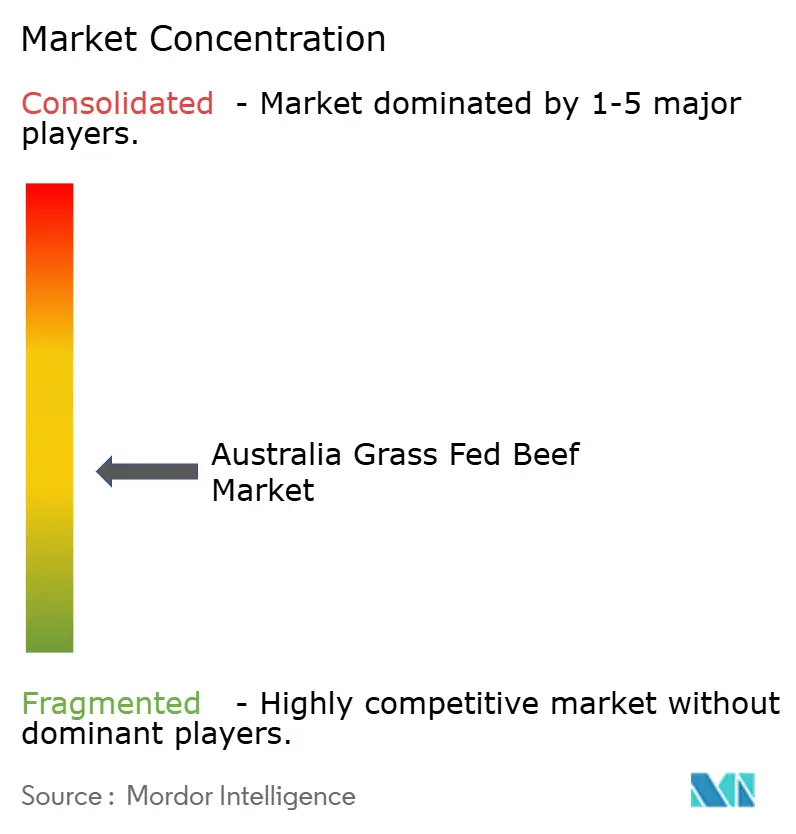
The Australia grass-fed beef market is moderately fragmented, with competition driven by large integrated processors, export-focused suppliers, and premium branded beef producers. Key participants, including JBS Foods Australia, Greenham Tasmania, Australian Country Choice (ACC), John Dee Warwick Pty Ltd, and Cape Grim Beef, compete primarily on product quality, traceability, processing capability, and access to premium domestic and international markets rather than price alone. Market participants continue to strengthen their positions through vertically integrated supply chains, long-term producer partnerships, branded premium beef programs, and investments in export-ready processing facilities.
Competition is increasingly shifting toward sustainability, technological advancement, and supply chain optimization as key differentiators. Companies are investing in digital livestock identification, electronic traceability systems, precision pasture management, data-driven herd monitoring, and automated meat processing technologies to improve productivity, consistency, and operational efficiency. Investments in advanced cold-chain logistics, refrigerated transportation, automated packaging systems, and export infrastructure are also enhancing product quality while reducing supply chain losses. These technological improvements strengthen producers' ability to consistently deliver premium grass-fed beef while meeting increasingly stringent quality and traceability requirements.
Future competitive opportunities are expected to center on verified low-carbon and environmentally sustainable grass-fed beef programs. As global buyers increasingly prioritize products with measurable environmental credentials, companies are expanding regenerative grazing practices, carbon footprint measurement, methane reduction initiatives, biodiversity management, and verified sustainability certification programs to strengthen market differentiation. Investments in transparent carbon accounting, digital product passports, blockchain-enabled provenance systems, and ESG-focused supply chain reporting are expected to create new premium market opportunities.
Australia Grass Fed Beef Industry Leaders
-
JBS Foods
-
Greenham Tasmania
-
Australian Country Choice (ACC)
-
John Dee Warwick Pty Ltd
-
Cape Grim Beef
- *Disclaimer: Major Players sorted in no particular order

Recent Industry Developments
- January 2026: Woolworths Group, Sea Forest, DIT AgTech, and Teys Australia have joined forces in a multi-year collaboration to trial Sea Forest's SeaFeed supplement in Australian grass-fed cattle. The initiative aims to reduce methane emissions and improve productivity across the beef value chain.
- January 2026: Angus Australia launched Angus GenetiQ, a next-generation genetic evaluation platform that delivers more frequent evaluation cycles and greater accuracy. The platform allows members to view Angus GenetiQ Estimated Breeding Values (EBVs) alongside TACE EBVs across their entire database.


Australia Grass Fed Beef Market Report Scope
Grass-fed beef comes from cattle that eat a natural, forage-based diet of grass and pasture their entire lives. The Australia grass-fed beef market is segmented by product type, cut type, distribution channel, and market concentration. Based on product type, the market is segmented into fresh chilled grass-fed beef, frozen grass-fed beef, and processed grass-fed beef. Based on cut type, the market is segmented into rib cuts, round cuts, chuck cuts, brisket cuts, and others. Based on distribution channel, the market is segmented into on-trade and off-trade. The off-trade segment is further categorized into supermarkets and hypermarkets, speciality stores, online retail stores, and others. The report provides market size and forecasts in both value (USD) and volume (tons) for all the mentioned segments.
| Fresh Chilled Grass-Fed Beef |
| Frozen Grass-Fed Beef |
| Processed Grass-Fed Beef |
| Rib Cuts |
| Round Cuts |
| Chuck Cuts |
| Brisket Cuts |
| Others |
| On-Trade | |
| Off-Trade | Supermarkets and Hypermarkets |
| Speciality Stores | |
| Online Retail Stores | |
| Others |
| By Product Type | Fresh Chilled Grass-Fed Beef | |
| Frozen Grass-Fed Beef | ||
| Processed Grass-Fed Beef | ||
| By Cut Type | Rib Cuts | |
| Round Cuts | ||
| Chuck Cuts | ||
| Brisket Cuts | ||
| Others | ||
| By Distribution Channel | On-Trade | |
| Off-Trade | Supermarkets and Hypermarkets | |
| Speciality Stores | ||
| Online Retail Stores | ||
| Others | ||


Key Questions Answered in the Report
What is the forecast for the Australia grass-fed beef market?
The Australia grass-fed beef market is forecast to reach USD 109.72 million by 2031 from USD 84.23 million in 2026, with a 5.43% CAGR. Export demand and premium certified products support the outlook.
Which product category has the largest share?
Fresh chilled grass-fed beef led with 61.82% in 2025, supported by refrigerated processing and supermarket distribution. Its position reflects established cold-chain capacity and retail supply relationships.
Which cut category is growing fastest?
Brisket cuts are forecast to grow at a 6.55% CAGR through 2031, supported by slow-cook and barbecue uses. Their wider use can improve returns from secondary cuts.
What is the leading distribution route?
Off-trade held 72.31% in 2025, while on-trade is forecast to grow at a 6.21% CAGR through 2031. Restaurants use provenance claims to distinguish premium menus.
Page last updated on:





