
Australia Bonsai Market Size and Share
Market Overview
| Study Period | 2021 - 2031 |
|---|---|
| Forecast Data Period | 2026 - 2031 |
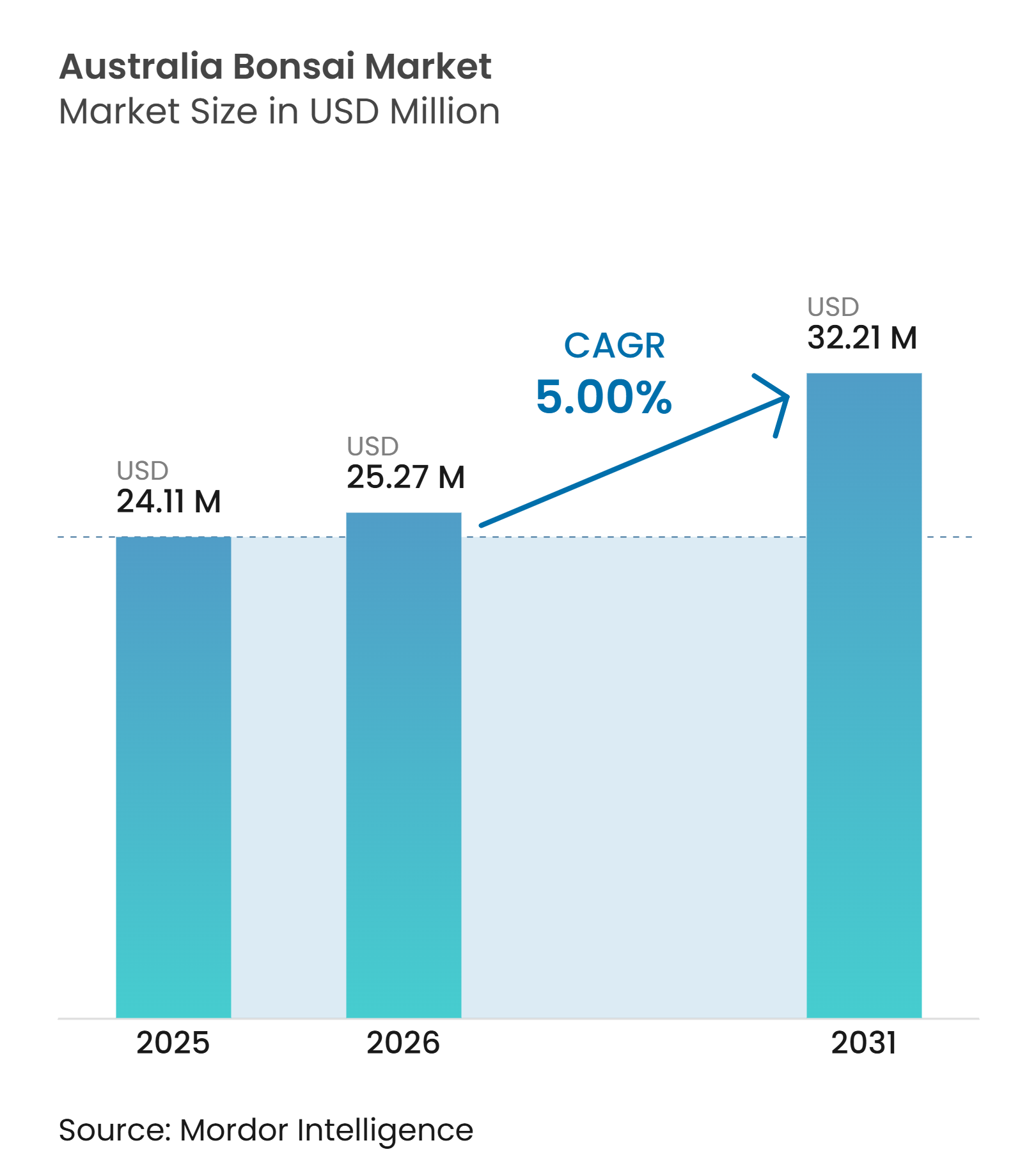
| Base Year Market Size (2025) | USD 24.11 Million |
| Market Size (2026) | USD 25.27 Million |
| Market Size (2031) | USD 32.21 Million |
| Growth Rate (2026 - 2031) | 5.00 % |
| Market Concentration | Medium |
Major Players *Disclaimer: Major Players sorted in no particular order Image © Mordor Intelligence. Reuse requires attribution under CC BY 4.0. | |
Australia Bonsai Market Analysis by Mordor Intelligence
The Australia bonsai market size was valued at USD 24.11 million in 2025 and is estimated to grow from USD 25.27 million in 2026 to USD 32.21 million by 2031. The market is expected to grow at a 5% CAGR during 2026–2031. Demand rests on a deeper domestic hobby base, broader retail access, and purchases for gifting and professional interiors. Organized clubs give new buyers regular access to training, demonstrations, and specialist communities. Local growers hold an advantage in outdoor species and Australian natives that suit domestic conditions, while import rules restrict the flow of mature overseas stock. Competitive activity centers on range depth, nursery expertise, direct delivery, and practical access to specialist stock, while single-owner business exits have tightened supply in some locations.
Key Report Takeaways
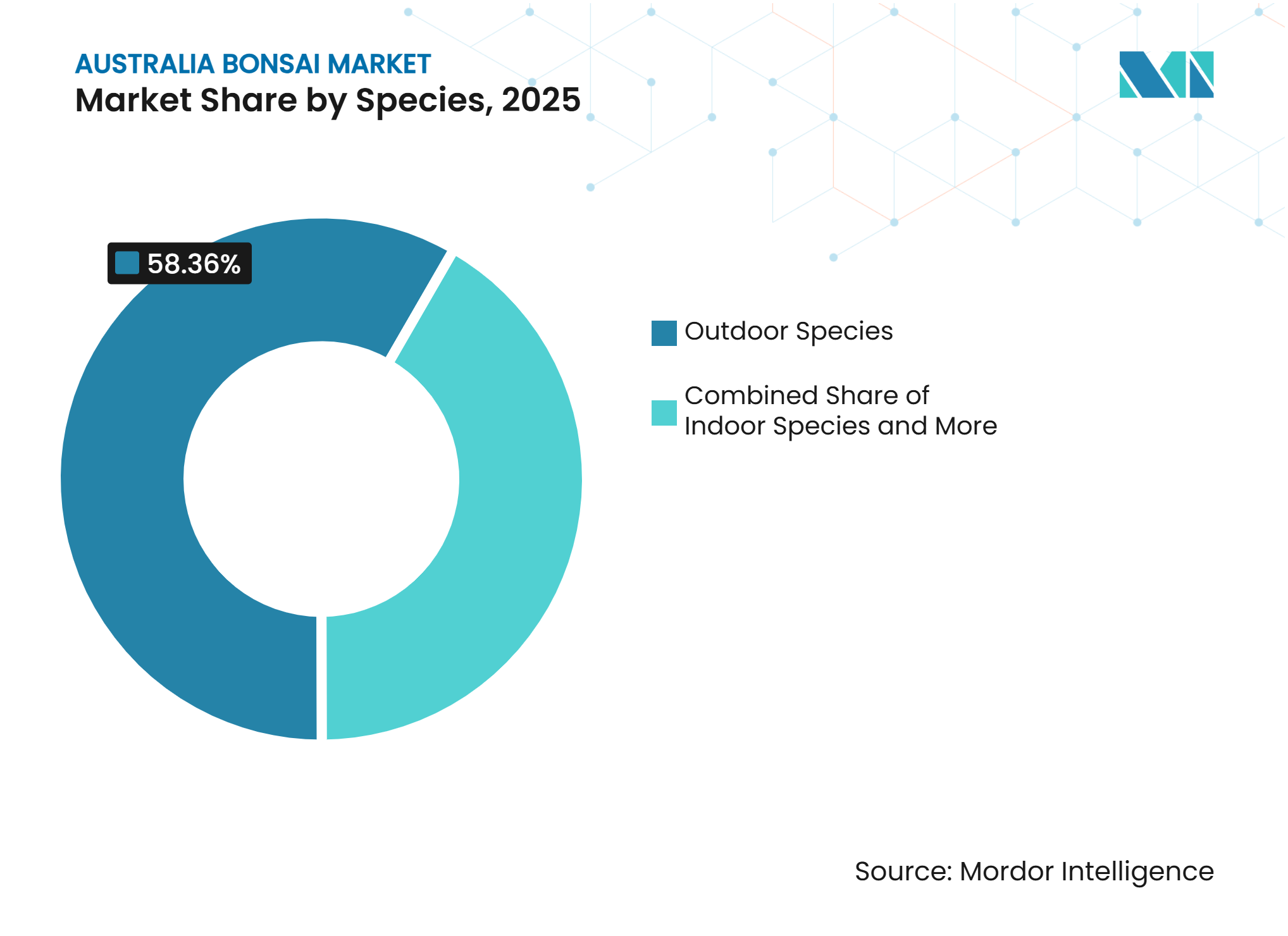
- By species, outdoor species held 58.36% of the Australia bonsai market size in 2025, and it is anticipated to grow at a 7.6% CAGR during 2026–2031.
- By distribution channel, offline held 60.43% of the Australia bonsai market share in 2025, and it is projected to grow at a 6.4% CAGR during 2026–2031.
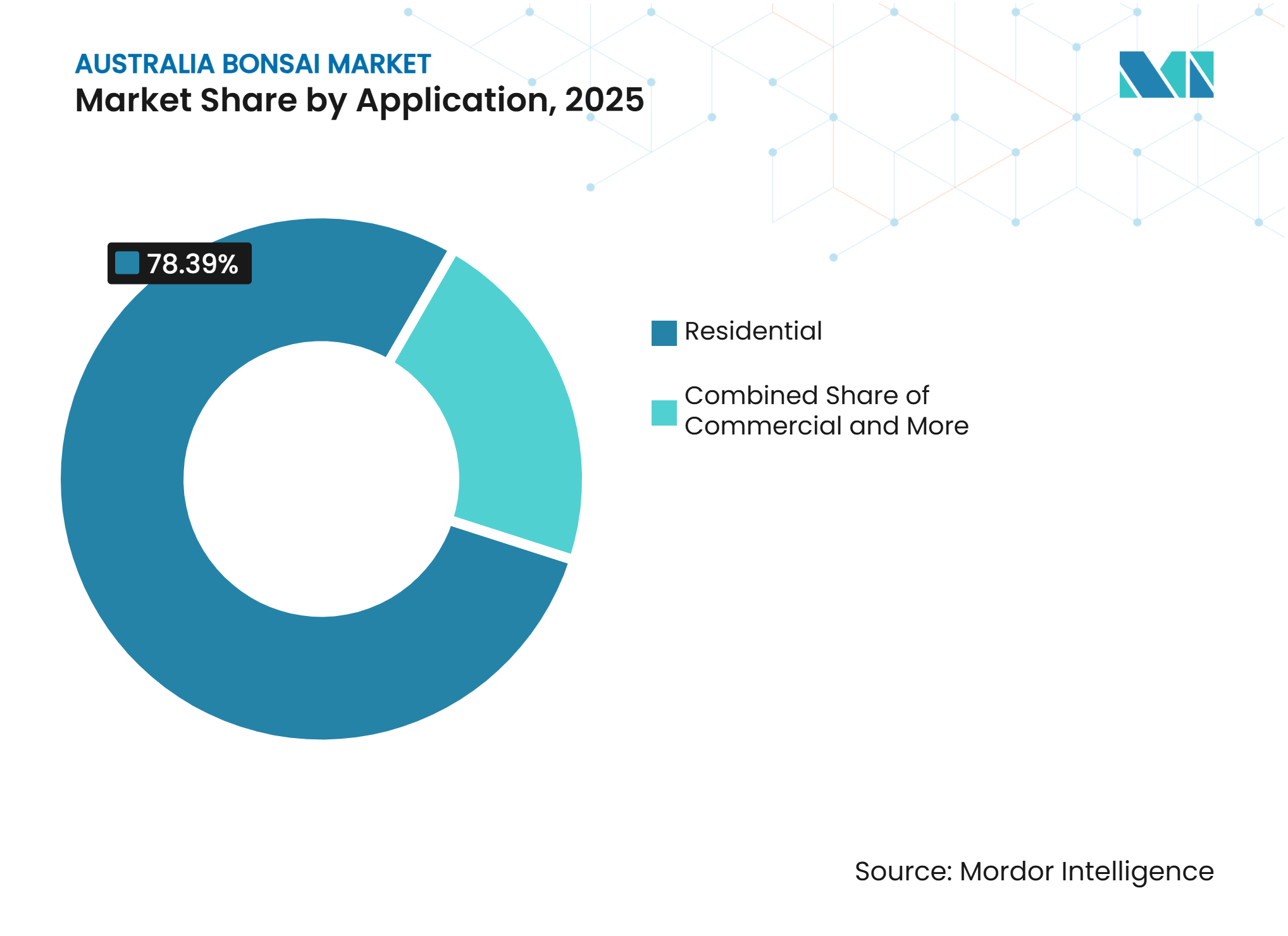
- By application, Residential accounted for 78.39% of sales in 2025. Commercial is anticipated to grow at a 5.5% CAGR during 2026–2031.
Note: Market size and forecast figures in this report are generated using Mordor Intelligence’s proprietary estimation framework, updated with the latest available data and insights as of January 2026.
Market Trends and Insights
Drivers Impact Analysis of Australia Bonsai Market*
| Driver | (~) % Impact on CAGR Forecast | Geographic Relevance | Impact Timeline |
|---|---|---|---|
| Expanding Bonsai Participation and Specialist Education | +1.1% | National, with strong activity in New South Wales, Victoria, Queensland, and the Australian Capital Territory where clubs and events provide regular buyer education. | Medium term (2-4 years) |
| Wider Online and Multi-Channel Availability | +0.8% | National, strongest in metropolitan and regional areas served by specialist delivery networks. | Short term (≤ 2 years) |
| Affordable Starter-to-Specimen Product Ladder | +0.7% | National, as entry products support first purchases across city and regional buyer groups. | Short term (≤ 2 years) |
| Gifting and Living-Art Positioning | +0.5% | National, with visible relevance in Brisbane, Gold Coast, Melbourne, and Sydney. | Medium term (2-4 years) |
| Rising Interest in Australian Native Bonsai | +0.6% | National, particularly the Australian Capital Territory, Victoria, New South Wales, and Queensland where native-bonsai clubs and shows are active. | Long term (≥ 4 years) |
| Local Climate-Specific Bonsai Expertise and Production | +0.4% | National, with the strongest relevance near specialist growing regions in Victoria, New South Wales, and Queensland. | Long term (≥ 4 years) |
| Source: Mordor Intelligence | |||
Expanding Bonsai Participation and Specialist Education
Club activity supports repeat demand because buyers gain the care skills needed to retain their first trees and later purchase more developed material. The Association of Australian Bonsai Clubs (AABC) has 58 member clubs and subsidizes tutor travel costs for member clubs through its Visiting Tutor Program[1]. The 2025 national convention in Canberra brought together more than 210 delegates from 42 clubs, along with 12 vendors, which linked education with direct buying opportunities. The Canberra Bonsai Society reported nearly 300 members in 2025. This organized participation gives the Australia bonsai market a broader base of informed buyers than a retailer-led hobby alone would provide.
Wider Online and Multi-Channel Availability
Online selling has connected specialist suppliers with customers outside the areas served by dedicated physical nurseries. Bonsai Gifts Nursery, based in Belivah, Queensland, offers local delivery to Brisbane and the Gold Coast and ships orders Australia-wide, while Bonsai-En uses Australia Post and Aramex for national deliveries. Digital catalogs allow customers to identify specific trees before seasonal availability becomes limited. Catalog reservation also supports the selection of individual trees before a physical visit. The Australia bonsai market gains reach from these formats, but state plant-health controls still prevent a fully national delivery model. This access extends the Australia bonsai market beyond specialist-nursery catchments.
Gifting and Living-Art Positioning
Bonsai combines a durable gift format with an object that develops through ongoing care. Digital certificates allow recipients to choose species and size after receiving the gift, which reduces the risk of unsuitable selections. Bonsai-En supports this approach through digital gift certificates that can be redeemed online or in-store. Bonsai Shop Australia also offers flexible gift-card denominations, which broadens the entry path for non-hobbyist purchasers. In commercial settings, living trees provide a considered alternative to short-lived floral gifts and decorative objects, with Bonsai Shop Australia supplying bonsai as corporate gifts for staff, clients, and business partners, often in bulk. These purchase occasions bring new customers into the Australia bonsai market without requiring prior technical knowledge.
Rising Interest in Australian Native Bonsai
Australian native trees have become more visible in club exhibitions and specialist nursery assortments. ABC News reported in May 2025 that native species such as banksia were increasingly being used as bonsai, with a native bonsai artist noting that shows once featured only one or two native trees, and the Canberra Bonsai Society saying its focus had shifted from exotics toward natives. The Victorian Native Bonsai Club held its 10th Symposium on Australian Natives as Bonsai in Melbourne in 2024, showing the depth of accumulated cultivation knowledge. Local species distinguish domestic nursery offers from imported Japanese material. This gives the Australia bonsai market a species base that imported ranges do not match. Their suitability for outdoor growing also gives growers a route to expand production around conditions familiar to Australian customers.
Restraints Impact Analysis of Australia Bonsai Market*
| Restraint | (~) % Impact on CAGR Forecast | Geographic Relevance | Impact Timeline |
|---|---|---|---|
| Strict Live-Plant Import and Biosecurity Compliance | -0.80% | National, directly affecting importers and retailers that source overseas plant material. | Medium term (2-4 years) |
| State Quarantine and Inter-State Shipping Restrictions | -0.50% | Western Australia, Tasmania, and the Northern territory face the strongest effect because live-tree deliveries from mainland suppliers are restricted. | Short term (≤ 2 years) |
| Long Production Cycles and Scarcity Of Advanced Stock | -0.60% | National, especially in specialist production regions in Victoria, New South Wales, and Queensland. | Long term (≥ 4 years) |
| Fragile and Fragmented Specialist Supply Base | -0.30% | National, with more pronounced effects outside large metropolitan areas where fewer specialist suppliers operate. | Long term (≥ 4 years) |
| Source: Mordor Intelligence | |||
Strict Live-Plant Import and Biosecurity Compliance
Australia requires an import permit, a phytosanitary certificate, and arrival inspection for live plant imports, and most non-tissue-cultured plants must also be treated on arrival, with some requiring post-entry quarantine growth and testing before release[2]. The Department of Agriculture, Fisheries and Forestry (DAFF) states that post-entry growing periods vary, with some plants released within a few months and others grown for a couple of years. In 2025, the department moved its Xylella fastidiosa emergency measures from plant family to genus level, starting with China in January 2025 and extending to all other countries in April 2025, with regulated genera including Olea. Importers face longer lead times and added compliance work before specialist trees become available for sale. These requirements make locally grown stock more important but limit the diversity and immediate availability of imported material.
Long Production Cycles and Scarcity Of Advanced Stock
Advanced bonsai require sustained work on trunk development, root structure, branching, and container refinement. Sugoi Bonsai released its 2025 field-grown stock in September 2025, and the nursery's growing notes describe about 30 months of in-ground growth to produce a reasonable trunk and root base, followed by root pruning and another year of growth. Shibui Bonsai's catalog, updated in December 2025, listed Japanese red pine and mugho pine as out of stock among species it offers only in limited numbers from time to time, and noted that buyers who wait until mid-year miss the best of each season's crop. Growers cannot rapidly increase supply of finished specimens without losing the aged form buyers value. This production cycle supports premium pricing for advanced trees but limits sales volume when demand rises.
*Our forecasts treat driver/restraint impacts as directional, not additive. The impact forecasts reflect baseline growth, mix effects, and variable interactions.
Australia Bonsai Market Segment Analysis
By Species:
Outdoor Species Lead Demand Through Local ProductionOutdoor Species held 58.36% of the Australia bonsai market share in 2025. The segment is projected to grow at a 7.6% CAGR during 2026–2031. Temperate deciduous trees such as trident maple, Japanese maple, Chinese elm, Chinese quince, and crab apple fit many open-air growing conditions. Specialist nurseries maintain listings across these species and invest in field-grown stock that is prepared for later refinement[3]. The species group gives local producers a practical production base because trees develop outdoors before refinement.
Australian native trees strengthen the outdoor offer by adding material with a distinct local identity. ABC News reported in May 2025 that native species such as banksia were increasingly being used as bonsai, with the Canberra Bonsai Society noting a shift in emphasis from exotics toward natives. Indoor Species serve apartment buyers who lack reliable outdoor space, especially in Sydney and Melbourne. Needle Tree Species such as Japanese black pine and Shimpaku juniper retain their appeal for experienced collectors seeking traditional forms. Deciduous Tree Species also support higher-value purchases because established specimens demonstrate their value across multiple seasons.



By Distribution Channel:
Offline Nurseries Retain Buyer PreferenceOffline held 60.43% of the Australia bonsai market size in 2025. The segment is anticipated to grow at a 6.4% CAGR during 2026–2031. Physical viewing matters because buyers assess trunk movement, root spread, branch structure, and foliage condition before purchasing. Large specialist nurseries give customers access to a wider selection of living material than most general retailers. Specialist events also place growers and buyers together and encourage hands-on product assessment, as seen at the 2025 national convention in Canberra, which featured a marketplace with 12 vendors.
Online channels provide a practical route for starter trees, smaller specimens, gift certificates, and repeat purchases by informed hobbyists. Digital catalog releases help customers locate specific species before a physical visit or seasonal selling period. National parcel delivery broadens supplier reach, but online sales still cannot fully serve quarantine-restricted jurisdictions, with some nurseries unable to ship trees to Western Australia, Tasmania, or the Northern Territory. Channel growth therefore depends not only on website access but also on compliant transport systems for living material.
By Application:
Residential Demand Anchors Sales While Commercial Use GrowsResidential buyers accounted for 78.39% of the Australia bonsai market share in 2025. Residential purchases draw support from club participation, accessible starter stock, and gift-based buying. The Bimer Bonsai Club's 2025 program included a free introductory session, a Fundamentals 1 course, and a Fundamentals 2 course (formerly the Advanced course), with Fundamentals 1 supplying three plants, soil, and wire across five monthly sessions, which supports equipment and tree purchases as skills develop. Household buyers also have access to a wide range of species, from simple starter plants to developed specimens. This broad base provides ongoing demand across nursery, online, and event channels.
The Commercial segment is projected to grow at a 5.5% CAGR during 2026–2031. Hospitality venues, corporate offices, and premium retail interiors use living plants as part of interior design specifications. Bonsai gives professional buyers a long-lived botanical element suited to a defined space. The Others segment includes institutional gifts and art fairs, where exhibition trees and demonstration auctions introduce premium examples to public audiences, as at the 2025 national convention in Canberra, where demonstration trees were auctioned. Commercial and institutional purchases are smaller than residential demand, but they support higher-value orders and greater visibility for skilled growers.

Geography Analysis
New South Wales holds the largest concentration of specialist bonsai suppliers and buyers in Australia. The Dural and Hills District area northwest of Sydney includes established physical nurseries that serve collectors and first-time buyers. The School of Bonsai scheduled its annual show for October 17–18, 2026, at Ray Nesci Bonsai Nursery in Dural, supporting the area's role as an event and sales venue. On the South Coast, Bonsai at the Bay offers pick-up and doorstep delivery from its nursery in Woollamia, near Jervis Bay.
Victoria is the second major commercial hub, with suppliers around Melbourne and the Mornington Peninsula. These businesses serve metropolitan and peri-urban buyers through different nursery, production, and delivery models. Queensland's Brisbane and Gold Coast corridor benefits from specialist nursery delivery capacity. The Australian Capital Territory has a smaller buyer population, but the National Bonsai and Penjing Collection of Australia at the National Arboretum provides national visibility for the practice. Canberra also serves as a meeting point for clubs and specialist audiences from across Australia.
Western Australia, Tasmania, and the Northern Territory face the strongest access limits because state controls restrict interstate live-plant shipments. This constraint narrows the local Australia bonsai market size served through mainland online suppliers, even where customer interest is present. The 38th national convention, held at Hobart's Wrest Point Conference Centre from May 1 to 4, 2026, created an in-state point of access for Tasmanian buyers through its public exhibition and traders area. The National Arboretum hosted South Australian Bonsai Society president Matt Sharp as its 2025 Bonsai Artist in Residence in April 2025, which supported the exchange of native-species cultivation knowledge.
Competitive Landscape
Market Concentration
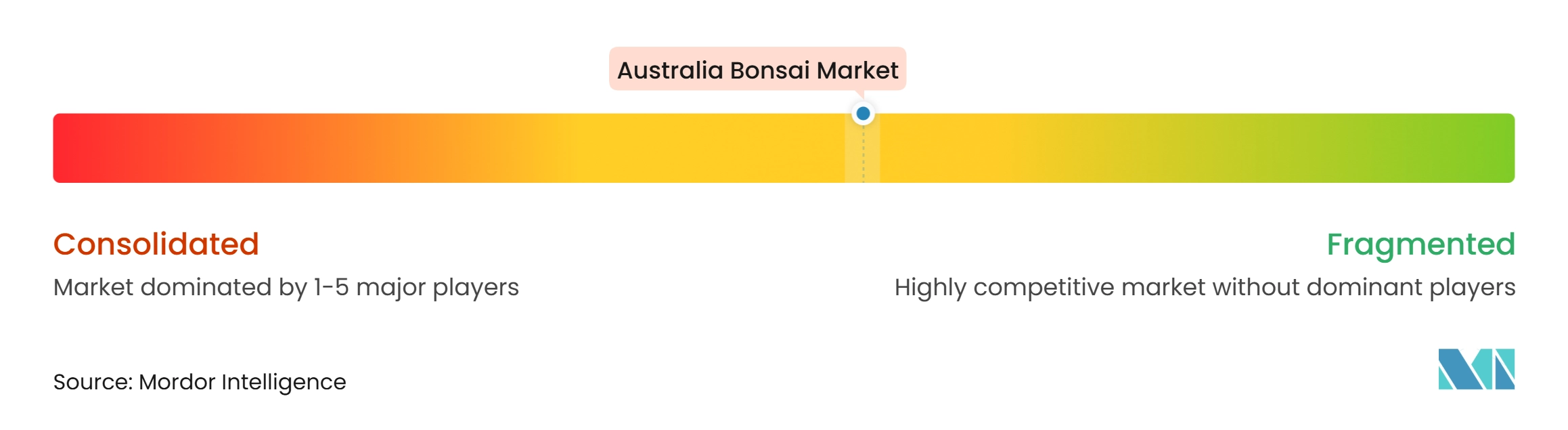
The Australia bonsai market has a moderately concentrated structure, with specialist nurseries competing alongside smaller owner-operated businesses. Bonsai Sensation, based in Narre Warren South, Victoria, differentiates through large inventory and nationwide shipping, with more than 20,000 trees in stock, while Ray Nesci Bonsai Nursery differentiates through nursery experience dating back to 1979 and named cultivars. Ray Nesci Bonsai Nursery lists new cultivars it has produced and cultivated for sale, including the trident maples Acer buergerianum 'Sparky,' 'Nescii,' and 'Nesci's Gold.' Other specialists compete through online ordering, gift formats, and delivery choices. These differences make product quality, service model, and buyer access more relevant than price alone.
Supply changes have increased the importance of established surviving operators. Orient Bonsai Nursery, a Thomastown-based specialist importer, wholesaler, and retailer operating since 1999, has announced its closure and is running a clearance sale, removing a specialist supplier from Victoria's metropolitan supply base. Such exits place more value on operators with production depth, replacement stock, and clear succession arrangements. They also create scope for remaining suppliers to acquire customer relationships, stock, or brand recognition without building them from the beginning.
Shibui Bonsai used 2025 events to present its offer directly to specialist audiences, taking a trade space at the national convention in Canberra in May and selling stock alongside its demonstrations at Bonsai by the Harbour in Sydney in June. The company also began making handcrafted display stands in 2024, using timbers that include native blackwood, red gum, and ash, and now sells them alongside a custom-made service, adding a bonsai-specific adjacent product line. Sugoi Bonsai's field-grown stock program reflects a different strategy centered on long production cycles and mature material. Market is fragmented field of smaller owner-operated suppliers.
Australia Bonsai Industry Leaders
-
Bonsai Sensation
-
AUSTRALIAN BONSAI GROWER
-
Bonsai Gifts Nursery
-
Ray Nesci Bonsai Nursery
-
Orient Bonsai Nursery
- *Disclaimer: Major Players sorted in no particular order
Australia Bonsai Market Companies Covered in this Report
- Bonsai Sensation
- AUSTRALIAN BONSAI GROWER
- Bonsai Gifts Nursery
- Ray Nesci Bonsai Nursery
- Orient Bonsai Nursery
- Bonsai-En
- Bonsai Shop Australia
- Shibui Bonsai
- Sugoi Bonsai
- Padre Pio Bonsai Nurseries Annangrove
- Bonsai at the Bay
- Bonsai Boy
- Chojo Feature Trees Gallery and Nursery
- The Bonsai Man
- Bonsai Bliss
Recent Industry Developments in Australia Bonsai Market
- April 2025: The Department of Agriculture, Fisheries and Forestry (DAFF) extended genus-level regulation under its Xylella fastidiosa emergency measures to all countries other than China, following its earlier application to China in January 2025, with regulated genera including Olea. The update increased phytosanitary scrutiny for relevant live-plant imports. The update increased phytosanitary scrutiny for relevant live-plant imports.
- December 2025: Shibui Bonsai released updated 2026 catalogs covering trident maples, Prunus species, root-over-rock specimens, Japanese maples, and crab apples. The release refreshed seasonal access to both starter and developed material.
- April 2025: The National Arboretum hosted South Australian Bonsai Society president Matt Sharp as its 2025 Bonsai Artist in Residence, with a focus on unconventional and native Australian species. The residency connected public collection work with club-level cultivation knowledge.
Australia Bonsai Market Report Scope
Australia's bonsai market has an annual value of miniature, living woody plants intentionally trained to mimic mature trees, plus the pots, soils, and pruning inputs sold with them. Values represent consumer-level spending through both specialty nurseries and general retail, expressed in USD.
The Australia Bonsai Market Report is Segmented by Species (Indoor Species, Outdoor Species, Needle Tree Species, and Deciduous Tree Species), by Distribution Channel (Online and Offline), and by Application (Residential, Commercial, and Others).
Segmentation Overview
| Indoor Species |
| Outdoor Species |
| Needle Tree Species |
| Deciduous Tree Species |
| Online |
| Offline |
| Residential |
| Commercial |
| Others (institutional gifts, art fairs) |
| By Species | Indoor Species |
| Outdoor Species | |
| Needle Tree Species | |
| Deciduous Tree Species | |
| By Distribution Channel | Online |
| Offline | |
| By Application | Residential |
| Commercial | |
| Others (institutional gifts, art fairs) |
Key Questions Answered in the Report
What is the 2026 value of Australia's bonsai sector?
The Australia bonsai market is valued at USD 25.27 million in 2026.
What growth rate is forecast for bonsai sales in Australia?
The market is projected to grow at a 5% CAGR during 2026–2031.
Which bonsai species category leads sales in Australia?
Outdoor Species is the leading category, holding 58.36% of the Australia bonsai market share in 2025.
Do buyers prefer online or offline bonsai purchases in Australia?
Buyers prefer offline bonsai purchases in Australia.