
Athletic Socks Market Size and Share
Market Overview
| Study Period | 2022 - 2032 |
|---|---|
| Market Size (2027) | USD 7.25 Billion |
| Market Size (2032) | USD 9.28 Billion |
| Growth Rate (2027 - 2032) | 5.04 % |
| Fastest Growing Market | Asia-Pacific |
| Largest Market | North America |
| Market Concentration | Low |
Major Players *Disclaimer: Major Players sorted in no particular order Image © Mordor Intelligence. Reuse requires attribution under CC BY 4.0. | |
Athletic Socks Market Analysis by Mordor Intelligence
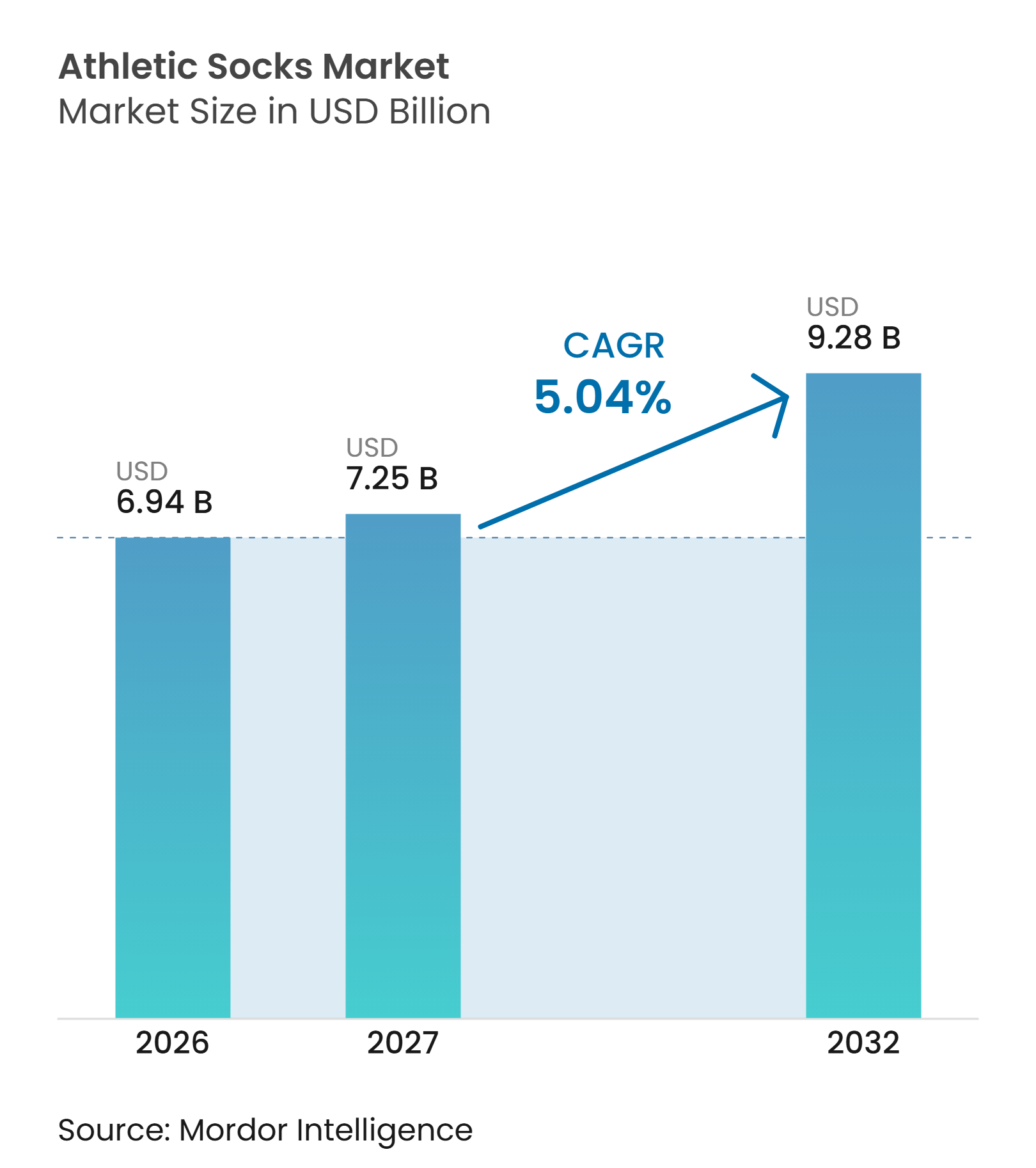
The athletic socks market size was valued at USD 6.94 billion in 2026 and is estimated to grow from USD 7.25 billion in 2027 to reach USD 9.28 billion by 2032, at a CAGR of 5.04% during the forecast period (2027-2032). Demand is shifting from plain cotton products toward engineered constructions featuring terry cushion zones, asymmetric knit panels, and performance-fiber blends. These features address moisture management, blister prevention, slippage, and arch fatigue, supporting repeat purchases and higher price points. Brands are also making more specific claims regarding moisture management, cushioning, compression, and fit, increasing the importance of construction expertise and material sourcing. The athletic socks market remains exposed to material cost volatility and lower-priced online alternatives; however, technical differentiation and broader access to fitness activities continue to support demand.
Key Report Takeaways
-
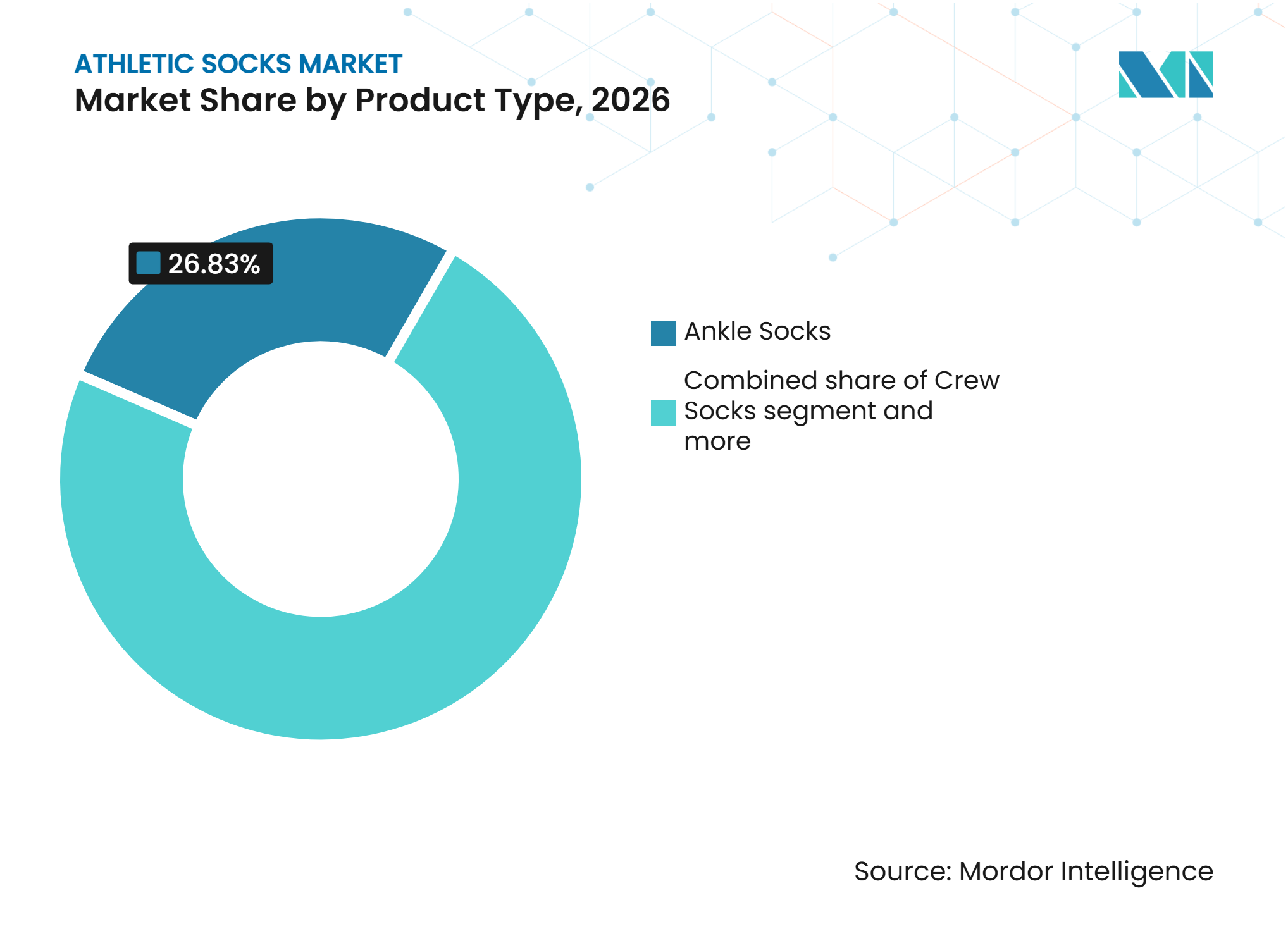
By product type, ankle socks dominated the athletic socks market with a share of 26.83% in 2026, while crew socks are anticipated to register the fastest CAGR of 6.25% during 2027-2032.
-
By material, cotton dominated the market with a share of 43.56% in 2026, while polyester is anticipated to register the fastest CAGR of 6.42% during 2027-2032.
-
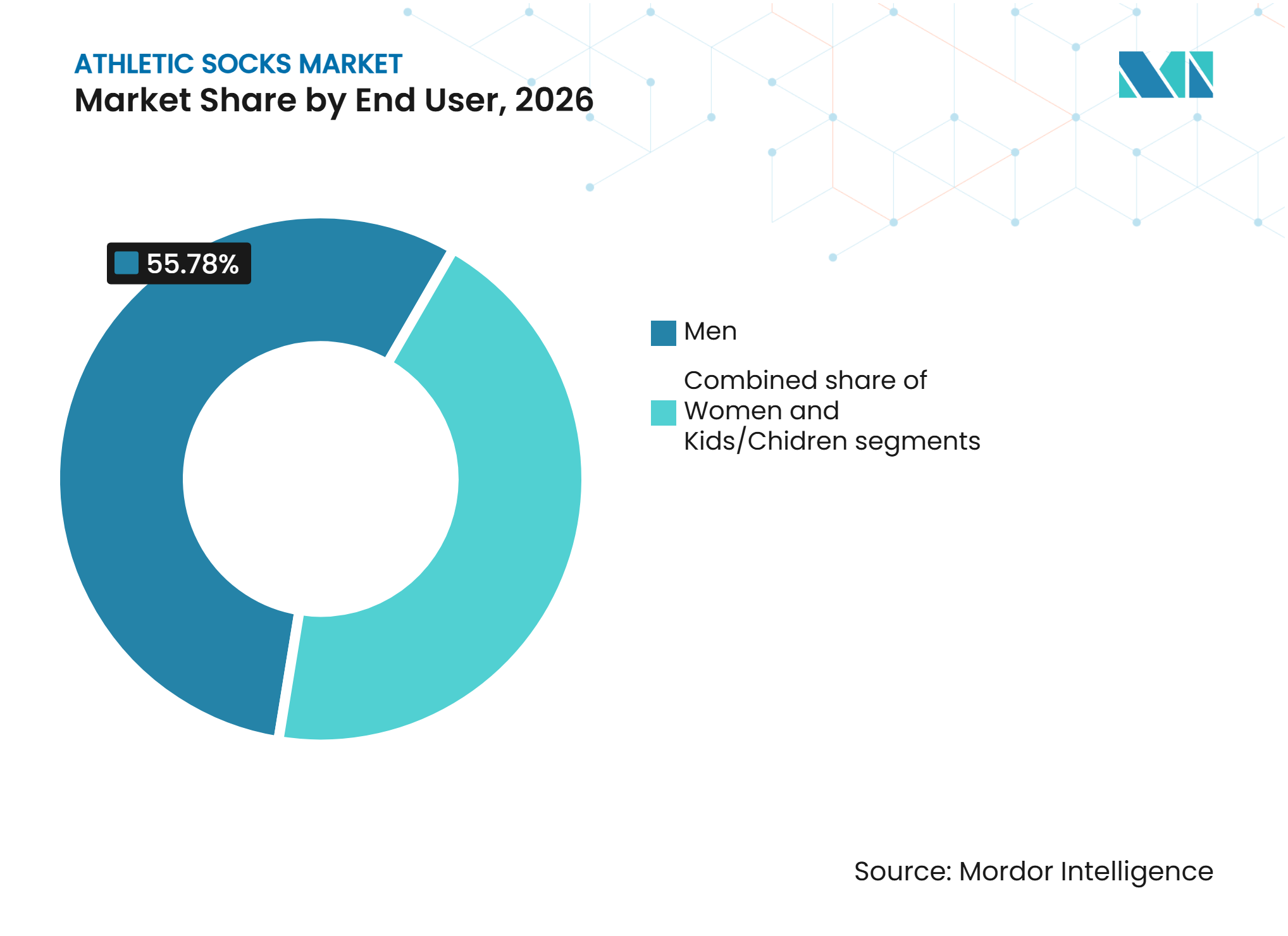
By end user, men dominated the market with a share of 55.78% in 2026, while women are anticipated to register the fastest CAGR of 6.63% during 2027-2032.
-
By distribution channel, supermarkets/hypermarkets dominated the market with a share of 34.45% in 2026, while online retail stores are anticipated to register the fastest CAGR of 6.92% during 2027-2032.
-
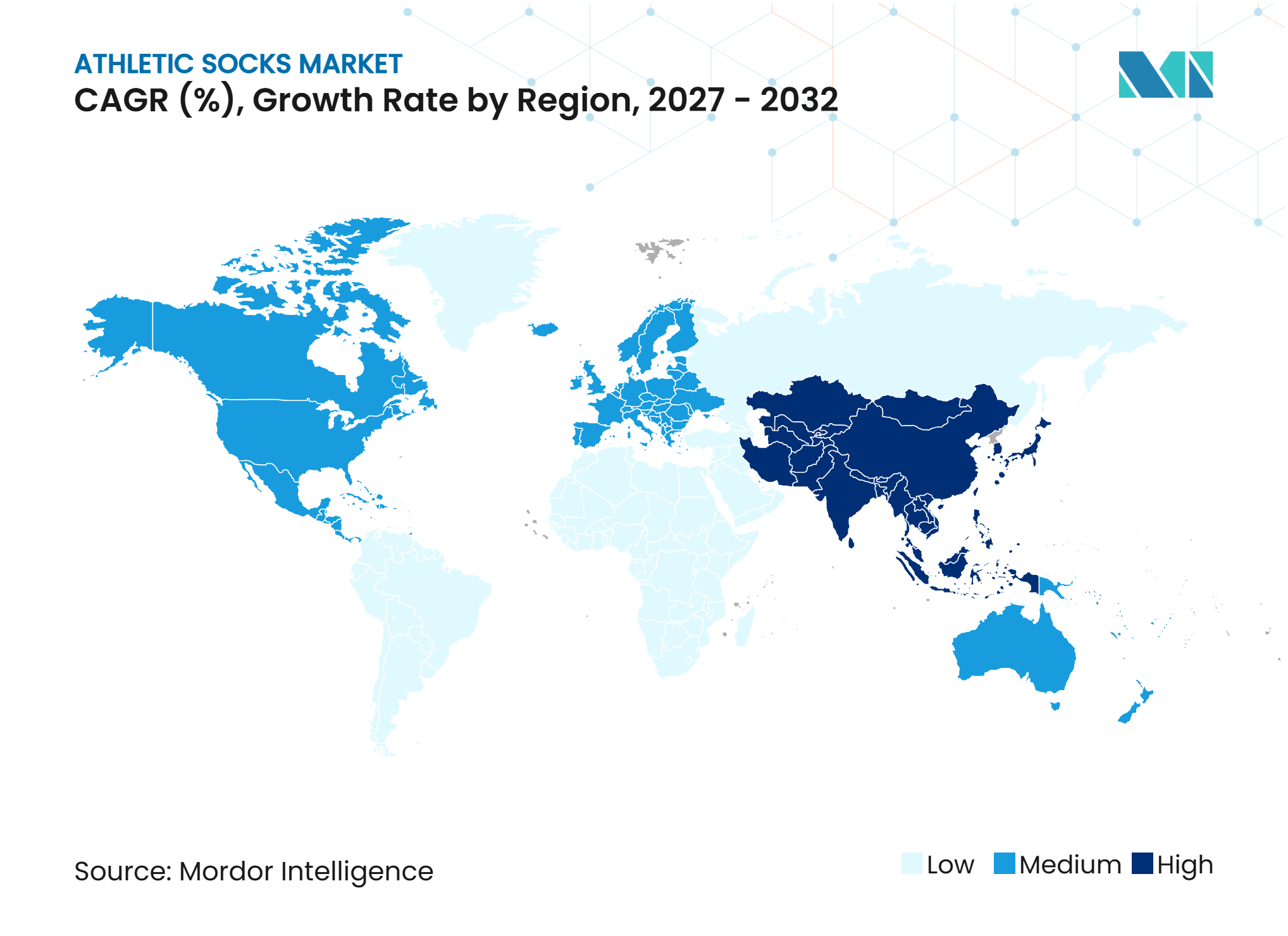
By geography, North America dominated the athletic socks market with a share of 39.42% in 2026, while Asia-Pacific is anticipated to register the fastest CAGR of 6.75% during 2027-2032.
Note: Market numbers in this report are based on Mordor Intelligence's proprietary estimation framework, which combines nine months of actuals with Q4 projections for base year 2026.
Market Trends and Insights
Drivers Impact Analysis of Athletic Socks Market*
| Driver | (~) % Impact on CAGR Forecast | Geographic Relevance | Impact Timeline |
|---|---|---|---|
| Rising participation in sports and physical activities | +1.2% | Global | Long term (≥ 4 years) |
| Expansion of gym memberships and fitness centres | +0.9% | North America, Europe, Asia-Pacific core | Long term (≥ 4 years) |
| Increasing demand for moisture-wicking and breathable socks | +0.8% | Global | Medium term (2-4 years) |
| Demand for cushioned athletic socks | +0.6% | North America, Europe | Medium term (2-4 years) |
| Foot health and blister prevention awareness | +0.7% | North America, Europe, Asia-Pacific | Long term (≥ 4 years) |
| Adoption of compression and arch-support technologies | +0.6% | Global, with early gains in North America and Europe | Medium term (2-4 years) |
| Source: Mordor Intelligence | |||
Rising Participation in Sports and Physical Activities
The athletic socks market benefits from rising participation in sports, fitness, and leisure activities. In March 2026, the Sports and Fitness Industry Association reported that 250 million Americans participated in at least one such activity in 2025, representing the highest figure in its tracking history[1]. Participation in team sports also exceeded 90 million people for the first time. Youth participation supports longer-term demand, as children require replacement products as they progress through different size ranges. The athletic socks market can benefit when brands engage these consumers early through sport-specific products and multipack offerings. Additionally, greater involvement in running, gym workouts, and recreational sports encourages consumers to purchase specialised socks offering cushioning, moisture management, and improved foot comfort.
Expansion of Gym Memberships and Fitness Centers
Growth in gym participation provides the athletic socks market with a consistent setting for product use and replenishment. In August 2025, the Health and Fitness Association reported that gym memberships increased by 6% in 2024, while the number of facilities rose by nearly 4%[2]. Strength training is particularly relevant, as it supports demand for cushioned low-cut and crew socks that consumers can purchase separately from outdoor running products. At its 2025 Investor Day, Planet Fitness reported having more than 2,800 clubs and nearly 21 million members, illustrating the broad reach of lower-cost membership models. Fitness facilities also provide retailers and brands with a practical opportunity to link functional apparel purchases to regular training habits. As gym attendance becomes a consistent part of consumers’ weekly routines, frequent use and replacement needs support demand for multiple pairs of durable, breathable, and comfortable athletic socks.
Increasing Demand for Moisture-Wicking and Breathable Socks
Consumer preference for improved foot comfort during running, gym workouts, cycling, and other physical activities supports demand for moisture-wicking and breathable athletic socks. Prolonged exercise causes perspiration, making moisture management and ventilation critical product attributes. Athletic socks made from polyester, nylon, and specialized blended fibers wick sweat away from the skin, dry quickly, and maintain comfort during extended use. Additionally, breathable fabric structures help regulate the temperature inside sports footwear, reducing excessive moisture buildup and discomfort during prolonged physical activity. These functional benefits drive consumer preference for performance-oriented athletic socks over conventional cotton alternatives, supporting demand for technically advanced sock materials and designs.
Demand for Cushioned Athletic Socks
Cushioning is becoming increasingly activity-specific in the athletic socks market. Consumers now expect padding in key impact areas rather than evenly distributed throughout the sock. Revitalign launched Performance Socks in March 2026, featuring a 360-degree cushioned heel zone, additional forefoot padding, and a PWR-BRIDGE compression band. This design incorporated orthotic principles into athletic sock construction and supports a higher-value product proposition. The growing adoption of high-stack running shoes also increases demand for socks that stabilize the foot and protect the ankle. Consequently, the athletic socks market can benefit from product designs that integrate cushioning, fit, and movement control for specific activities, rather than positioning comfort as a generic feature.
Restraints Impact Analysis of Athletic Socks Market*
| Restraint | (~) % Impact on CAGR Forecast | Geographic Relevance | Impact Timeline |
|---|---|---|---|
| Fluctuations in raw material prices | -0.6% | Global, particularly Asia-Pacific manufacturing hubs | Short term (≤ 2 years) |
| Intense price competition and product commoditisation | -0.5% | Global | Long term (≥ 4 years) |
| High manufacturing costs of advanced performance socks | -0.4% | North America, Europe | Medium term (2-4 years) |
| Counterfeit products and low-quality alternatives | -0.3% | Asia-Pacific, Middle East and Africa | Long term (≥ 4 years) |
| Source: Mordor Intelligence | |||
Fluctuations in Raw Material Prices
Fluctuations in raw material prices create cost pressures for athletic sock manufacturers, as production depends on cotton, polyester, nylon, elastane, and other synthetic fibers. Weather conditions, crop yields, and global supply availability influence cotton prices, while crude oil and petrochemical prices closely affect polyester and nylon costs. In May 2026, the World Bank reported that global cotton prices rose by 12% in April 2026, reflecting tighter supply conditions, and global cotton production would decline by 5% during the 2026-27 season[3]. As these fibers are essential inputs in athletic sock manufacturing, price volatility can increase procurement and production costs, complicate inventory planning, and compress manufacturers’ profit margins. Smaller manufacturers may find it particularly difficult to absorb these cost increases when competitive pricing constrains their ability to pass additional expenses on to consumers.
Intense Price Competition and Product Commoditization
The athletic socks market faces intense price competition, as basic styles are visually similar and easy to compare online. Lower-priced alternatives can make price the primary purchase criterion when brands do not clearly communicate differences in materials, fit, or cushioning. This pressure is most pronounced among mid-priced offerings positioned between commodity multipacks and premium technical products. It can also constrain smaller brands’ ability to recover the higher manufacturing costs associated with advanced construction. Direct-to-consumer brands use subscriptions, personalized recommendations, purpose-led positioning, and activity-specific product ranges to reduce direct price comparisons. However, sustainable differentiation depends on performance claims that consumers can easily understand and trust, rather than brand messaging alone.
*Our forecasts treat driver/restraint impacts as directional, not additive. The impact forecasts reflect baseline growth, mix effects, and variable interactions.
Athletic Socks Market Segment Analysis
By Product Type:
Ankle Socks Lead Broad Use While Crew Socks Gain MomentumAnkle Socks holds 26.83% share of the Athletic Socks Market in 2026, making them the largest product category. Their low-profile design suits court sports, running, gym activities, and athleisure applications. This format provides a practical option for consumers who prefer socks that remain less visible with low-top footwear. This versatility supports demand across both casual and performance-oriented purchases. Quarter Socks hold a more specialized position in court sports and activities where ankle coverage helps protect against abrasion. Each format, therefore, serves a distinct role within the broader performance and lifestyle product assortment. Retailers in the Athletic Socks Market can use this distinction to organize product selections by footwear type, activity, and preferred coverage level.
Crew Socks are projected to expand at a CAGR of 6.25% through 2032, the highest growth rate among product categories. Wider athleisure adoption and consumer preference for greater ankle coverage during trail and outdoor running support this growth. The additional height can reduce debris entry and provide abrasion protection in demanding conditions. It also creates space for targeted compression features and visual branding. The Athletic Socks industry benefits when brands differentiate crew socks designed for high-impact activities from styles primarily intended for fashion. This distinction can simplify product selection across retail and digital channels while helping brands explain how products with similar heights and appearances address different performance needs.



By Material:
Cotton Retains Its Base While Polyester Expands in Performance UseCotton accounted for 43.56% of the athletic socks market size in 2026. Its softness, hypoallergenic properties, and familiar feel continue to support its use in lower-intensity activities and everyday athletic applications. Cotton-rich styles remain relevant in applications where comfort is more important than high-intensity moisture management. Blended constructions enable manufacturers to enhance performance while maintaining the familiar feel of cotton. Merino wool, nylon, spandex blends, and recycled fibers continue to address premium requirements, supporting higher price points through tactile benefits or sustainability-related differentiation. These materials allow suppliers to tailor fiber choices to varying activity levels and price points while developing product lines that transition consumers from familiar cotton styles to more technical blends.
Polyester is forecast to grow at a CAGR of 6.42% through 2032. Its moisture-management properties, durability, and color retention make it suitable for performance-oriented constructions and frequent washing. Polyester also supports lightweight products that retain less moisture during high-intensity activities. The athletic socks industry can use polyester blends to improve product performance while managing price points across different product ranges. These properties support products designed for regular exercise and repeated laundering. Material selection will remain important, as it determines how brands balance comfort, drying performance, durability, and consumer expectations. Producers must also carefully manage fiber choices to preserve familiar comfort while incorporating performance benefits.
By End User:
Men Lead Current Demand While Women Add New Activity-Specific NeedsMen accounted for 55.78% of athletic socks market demand in 2026. Organized sports participation and established replacement patterns in team and endurance activities support this position. Men also represent a core customer group for multipacks and sport-specific styles sold through mass retailers and specialty stores. The kids and children segment contributes additional volume, as products require replacement when foot sizes change. A household strategy that combines adult and youth products can help brands generate repeat demand across multiple life stages. It also enables retailers to merchandise products around family shopping occasions rather than individual sports alone.
The women’s segment is projected to grow at a CAGR of 6.63% through 2032. Activity-specific product development can enable clearer use-case-based merchandising and reduce reliance on a single generic women’s range for varied movement needs. This approach creates opportunities to provide more relevant product guidance on grip, support, cushioning, and coverage. Offering different pack sizes and price points can help convert recurring household purchases into repeat demand.

By Distribution Channel:
Mass Retail Retains Reach While Online Retail Gains SpeedSupermarkets and hypermarkets accounted for 34.45% of demand in 2026. Their scale, high customer traffic, multipack positioning, and add-on purchasing behavior support this leading position. These outlets are particularly important for value-oriented products and household replenishment purchases. Specialist stores offer a distinct advantage, as staff can explain sock construction and recommend products for specific activities. This capability supports premium pricing for running, outdoor, and compression products. The channel mix enables brands to balance broad household reach with targeted technical selling while reducing reliance on a single retail environment as consumer shopping patterns evolve.
Online retail stores are forecast to grow at a CAGR of 6.92% through 2032. Digital channels support subscription-based replenishment, product comparisons, personalized recommendations, and direct customer feedback. They also enable brands to communicate technical features through detailed product pages and fit guides. The athletic socks market is likely to reward brands that combine digital discovery with reliable retail availability and clear product education. This approach is relevant for both premium technical styles and repeat-purchase basics. The online channel is particularly valuable for brands seeking to maintain a direct customer relationship after the initial purchase.
Geography Analysis
North America
North America accounted for 39.42% of regional demand in 2026. The region benefits from a large base of active consumers and strong access to premium, mass-market, and specialist products. Consumers increasingly purchase basic multipacks for daily use and higher-value running, compression, or merino styles for specific activities. Fiber-content requirements make material selection a key compliance consideration, while established retail networks support consumer education and in-store trials for technical product launches.
Asia-Pacific
Asia-Pacific is projected to grow at a 6.75% CAGR through 2032. E-commerce distribution and growing participation in organised and casual fitness activities expand access to athletic products across the region. The expansion of sports clubs, fitness centres, and recreational running communities across major regional economies is also creating additional purchasing opportunities. Manufacturers are balancing price points, supply flexibility, and product features as digital discovery expands beyond traditional specialist retail. Additionally, rising disposable incomes, expanding sportswear retail networks, and increasing consumer interest in performance-oriented footwear accessories are expected to support regional demand for athletic socks.
Europe, South America, and the Middle East and Africa
Europe remains an established market for athletic socks, supported by strong sportswear brands, organized sporting activities, and consumer demand for technically advanced products. However, high manufacturing costs, sustainability requirements, and competition from lower-cost Asian manufacturers challenge regional producers. Investments in recycled fibers, moisture-management technologies, and specialized product development can help European manufacturers maintain competitiveness. In South America, rising fitness participation, a strong football culture, and the expansion of sportswear retail networks support demand for athletic socks. However, price sensitivity drives demand for affordable products and multipack offerings.
Competitive Landscape
Market Concentration
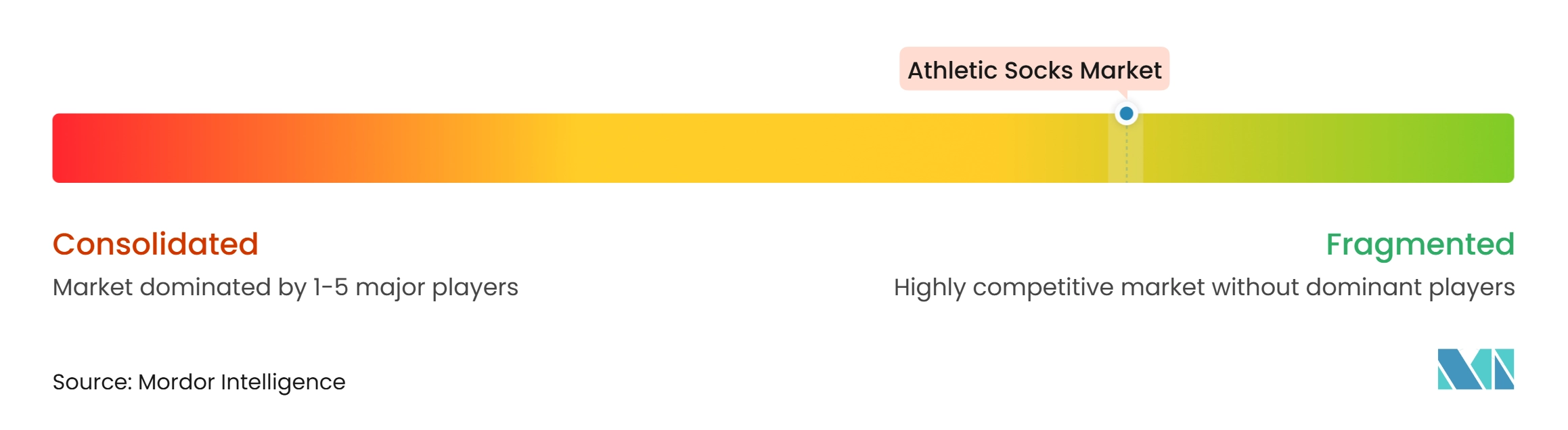
The athletic socks market is fragmented, with Nike, Adidas, Under Armour, New Balance, and Stance projected to collectively hold major market in 2025. Nike leads this group, supported by strong demand, while specialist brands, direct-to-consumer companies, and basic apparel manufacturers compete across distinct price points and usage segments. Larger sportswear brands benefit from broad retail reach, athlete endorsements, and established footwear ecosystems. Competition extends from technical-performance products to value-oriented multipack offerings. Brand strength depends on aligning product claims, material selection, and distribution channels with the needs of specific customer groups.
Gildan completed its acquisition of HanesBrands on December 1, 2025, integrating sock manufacturing and supply chain operations into a larger combined organization. Marquee Brands acquired Stance in November 2025 and placed the brand within a licensing model, with United Legwear & Apparel Co. serving as the global licensee. This approach emphasizes brand positioning and distribution while relying on a partner for manufacturing and global product execution.This consolidation also enables companies to optimise sourcing, strengthen manufacturing capabilities, and improve operational efficiency across international markets.
Technical innovation is also shaping competition. Balega’s UltraGlide redesign incorporates LYCRA Dry yarn to combine friction reduction with moisture management. This development makes targeted compression, comfort, and moisture control more tangible product differentiators. The athletic socks market is likely to favor companies that can clearly communicate these technical benefits, as customers cannot always assess the value of internal construction before using the product. Such innovations also help brands justify premium pricing, strengthen customer loyalty, and differentiate their offerings in an increasingly competitive athletic socks market.
Athletic Socks Industry Leaders
-
Nike, Inc.
-
Adidas AG
-
Gildan Activewear Inc.
-
PUMA SE
-
Under Armour, Inc.
- *Disclaimer: Major Players sorted in no particular order
Athletic Socks Market Companies Covered in this Report
- Nike, Inc.
- Adidas AG
- Gildan Activewear Inc.
- Bombas
- Under Armour, Inc.
- PUMA SE
- ASICS Corporation
- New Balance Athletics, Inc.
- Reebok International Limited
- Hanesbrands Inc.
- VF Corporation
- Stance Inc.
- Balega International
- Feetures, LLC
- Swiftwick LLC
- Thorlos, Inc.
- Darn Tough Vermont
- Wigwam Mills Inc.
- Injinji Inc.
- SockGuy, Inc.
Recent Industry Developments in Athletic Socks Market
- June 2026: FIGS and ArchTek launched the first patented medical-grade compression socks. Developed in collaboration with podiatrist and foot surgeon Dr. Bob Baravarian, the collection combines ArchTek’s five-layer arch support and stabilization system with FIGS’ distribution network for healthcare professionals.
- March 2026: Revitalign launched Performance Socks featuring biomechanical PWR-BRIDGE technology. The Waco Shoe Company brand introduced the socks with a Y-shaped heel design and a 360-degree cushioned heel zone.
- September 2025: PUMA collaborated with Louis Gabriel Nouchi and launched the Mostro Sock. This laceless, ankle-high sock-shoe hybrid combines running- and football-inspired design elements with an accessibility-focused slip-on construction for para-athletes.
Global Athletic Socks Market Report Scope
Athletic socks are specially designed socks worn during sports, exercise, and physical activities to provide comfort, cushioning, moisture management, and foot support.
The athletic socks market is segmented by product type, material, end user, distribution channel, and geography. By product type, the market is segmented into ankle socks, crew socks, quarter socks, and other types. By material, the market is segmented into cotton, polyester, and other materials. By end user, the market is classified into men, women, and kids/children. By distribution channel, the market is segmented into supermarkets/hypermarkets, specialist stores, online retail stores, and other distribution channels. Based on geography, the market is classified into North America, Europe, South America, Asia-Pacific, and the Middle East and Africa. The market forecasts are provided in terms of value (USD).
Segmentation Overview
| Ankle Socks |
| Crew Socks |
| Quarter Socks |
| Other Types |
| Cotton |
| Polyester |
| Other Materials |
| Men |
| Women |
| Kids/Children |
| Supermarkets/Hypermarkets |
| Specialist Stores |
| Online Retail Stores |
| Other Distribution Channels |
| North America | United States |
| Canada | |
| Mexico | |
| Rest of North America | |
| Europe | Germany |
| United Kingdom | |
| Italy | |
| France | |
| Spain | |
| Poland | |
| Belgium | |
| Netherlands | |
| Rest of Europe | |
| Asia-Pacific | China |
| India | |
| Japan | |
| Australia | |
| Indonesia | |
| Thailand | |
| Singapore | |
| Rest of Asia-Pacific | |
| South America | Brazil |
| Argentina | |
| Peru | |
| Colombia | |
| Rest of South America | |
| Middle East and Africa | South Africa |
| Saudi Arabia | |
| United Arab Emirates | |
| Egypt | |
| Turkey | |
| Rest of Middle East and Africa |
| By Product Type | Ankle Socks | |
| Crew Socks | ||
| Quarter Socks | ||
| Other Types | ||
| By Material | Cotton | |
| Polyester | ||
| Other Materials | ||
| By End User | Men | |
| Women | ||
| Kids/Children | ||
| By Distribution Channel | Supermarkets/Hypermarkets | |
| Specialist Stores | ||
| Online Retail Stores | ||
| Other Distribution Channels | ||
| By Geography | North America | United States |
| Canada | ||
| Mexico | ||
| Rest of North America | ||
| Europe | Germany | |
| United Kingdom | ||
| Italy | ||
| France | ||
| Spain | ||
| Poland | ||
| Belgium | ||
| Netherlands | ||
| Rest of Europe | ||
| Asia-Pacific | China | |
| India | ||
| Japan | ||
| Australia | ||
| Indonesia | ||
| Thailand | ||
| Singapore | ||
| Rest of Asia-Pacific | ||
| South America | Brazil | |
| Argentina | ||
| Peru | ||
| Colombia | ||
| Rest of South America | ||
| Middle East and Africa | South Africa | |
| Saudi Arabia | ||
| United Arab Emirates | ||
| Egypt | ||
| Turkey | ||
| Rest of Middle East and Africa | ||
Key Questions Answered in the Report
What is the current size and future growth outlook of the athletic socks market?
The athletic socks market was valued at USD 6.94 billion in 2026 and is estimated to reach USD 7.25 billion in 2027. The market is projected to grow to USD 9.28 billion by 2032, registering a CAGR of 5.04% during 2027–2032.
Which product type held the largest share of the athletic socks market in 2026?
Ankle socks was the largest product type segment in 2026, accounting for 26.83% of athletic socks market.
Which material held the largest share of the athletic socks market in 2026?
Cotton was the largest material segment in 2026, accounting for 43.56% of athletic socks market.
Which end-user segment held the largest share of the athletic socks market in 2026?
Men was the largest end-user segment in 2026, accounting for 55.78% of athletic socks market.
Which distribution channel held the largest share of the athletic socks market in 2026?
Supermarkets/hypermarkets was the largest distribution channel segment in 2026, accounting for 34.45% of athletic socks market.