
Assistive Listening Devices Market Size and Share
Market Overview
| Study Period | 2020 - 2031 |
|---|---|
| Market Size (2026) | USD 17.20 Billion |
| Market Size (2031) | USD 25.05 Billion |
| Growth Rate (2026 - 2031) | 7.80 % |
| Fastest Growing Market | Asia-Pacific |
| Largest Market | North America |
| Market Concentration | Medium |
Major Players *Disclaimer: Major Players sorted in no particular order Image © Mordor Intelligence. Reuse requires attribution under CC BY 4.0. | |
Assistive Listening Devices Market Analysis by Mordor Intelligence
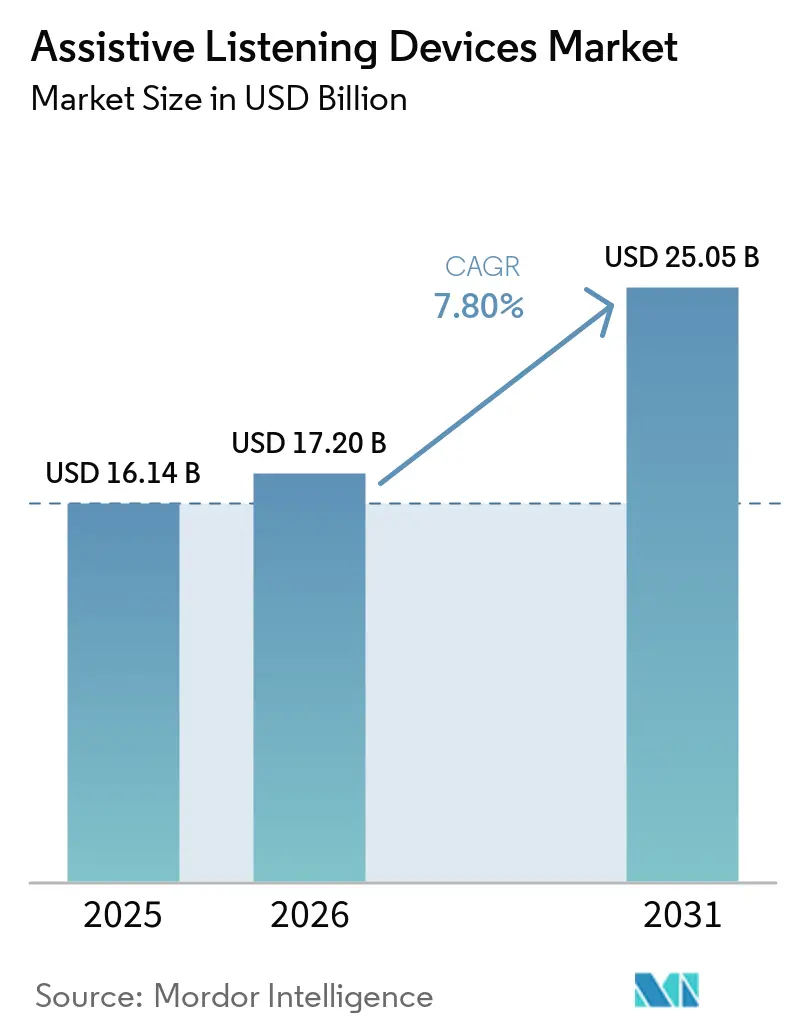
The Assistive Listening Devices Market size is projected to expand from USD 16.14 billion in 2025 and USD 17.20 billion in 2026 to USD 25.05 billion by 2031, registering a CAGR of 7.80% between 2026 to 2031.
Hearing loss prevalence, aging populations, and a large untreated population support demand across consumer and institutional settings. The assistive listening devices market is also changing as over-the-counter access and consumer electronics distribution reduce barriers for adults with perceived mild-to-moderate hearing loss. Premium manufacturers are responding with artificial intelligence, remote support, and Bluetooth capabilities that support better performance in difficult listening conditions. Venue owners face a separate replacement cycle as Auracast systems become an accepted option for accessible audio delivery. These changes create opportunities for companies that can serve both clinical care and lower-barrier consumer channels while managing affordability and interoperability constraints.
Key Report Takeaways
By product type, hearing aids held 69.5% of product-type revenue in 2025, while connectivity and alert devices are forecast to grow at an 8.1% CAGR through 2031.
By technology, digital devices held 63.8% of technology revenue in 2025, while AI-enabled devices are forecast to grow at an 8.4% CAGR through 2031.
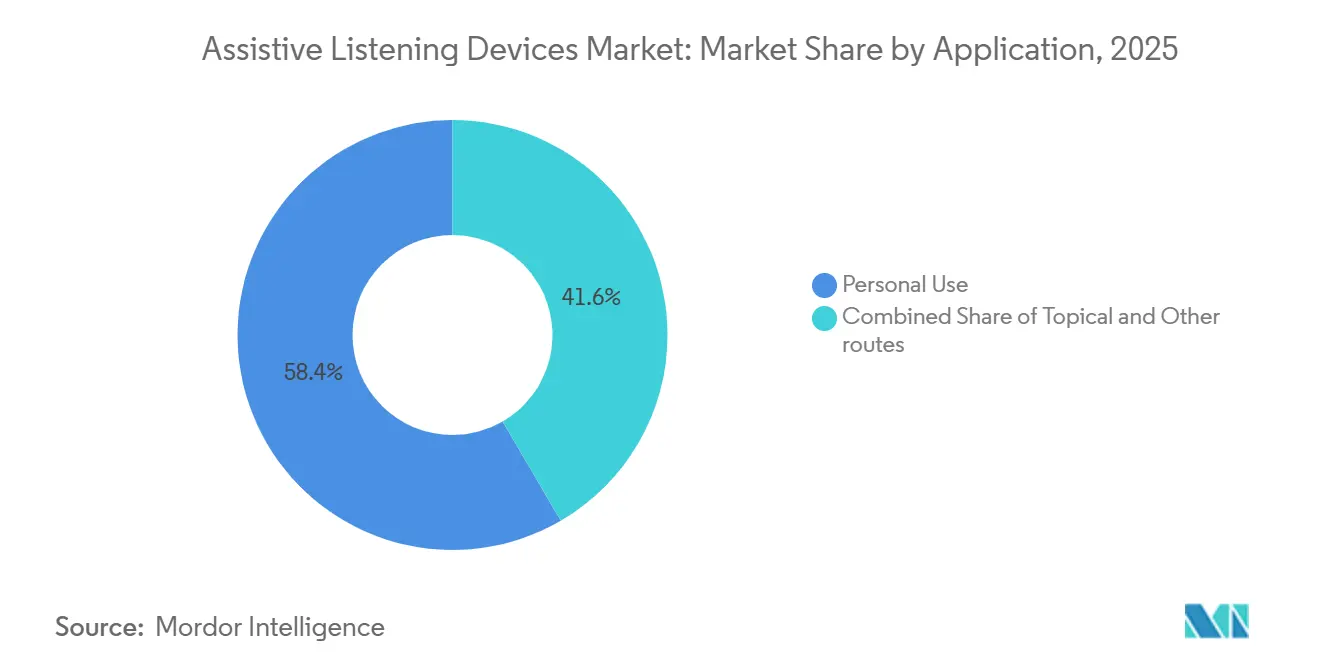
By application, personal use held 58.4% of 2025 revenue, while healthcare facilities are forecast to grow at an 8.3% CAGR through 2031.
By distribution channel, audiology clinics held 42.7% of 2025 revenue, while online stores are forecast to grow at an 8.2% CAGR through 2031.
By geography, North America held 41.5% of 2025 revenue, while Asia-Pacific is forecast to grow at an 8.5% CAGR through 2031.
Note: Market size and forecast figures in this report are generated using Mordor Intelligence’s proprietary estimation framework, updated with the latest available data and insights as of January 2026.
Market Trends and Insights
Drivers Impact Analysis of Assistive Listening Devices Market*
| Driver | (~) % Impact on CAGR Forecast | Geographic Relevance | Impact Timeline |
|---|---|---|---|
| Aging Population and Rising Hearing Impairment | +2.3% | Global, concentrated in Asia-Pacific, North America, and Western Europe | Long term (≥ 4 years) |
| Accessibility Requirements in Public and Commercial Venues | +1.0% | North America and Europe, with spillover to Asia-Pacific | Medium term (2-4 years) |
| Digital Signal Processing, Wireless Connectivity, and Bluetooth Integration | +1.5% | Global, with premium adoption in North America, Europe, and Japan | Medium term (2-4 years) |
| OTC, Direct-to-Consumer, and Lower-Barrier Hearing Solutions | +1.2% | North America, with e-commerce expansion into Europe and Asia-Pacific | Short term (≤ 2 years) |
| Auracast-Enabled Venue Modernization | +0.7% | North America and Europe initially, then Asia-Pacific technology hubs | Medium term (2-4 years) |
| Remote-Microphone Speech Enhancement in Noisy Environments | +0.5% | Global, with early adoption in the United States, Germany, and Australia | Short term (≤ 2 years) |
| Source: Mordor Intelligence | |||
Aging Demographics Build a Structural, Multi-Decade Demand Floor
The assistive listening devices market draws sustained demand from a growing population with age-related hearing loss. A 2025 Global Burden of Disease[1] analysis reported that hearing loss cases rose from 741 million in 1990 to 1.55 billion in 2021. Adults aged 65 to 74 had a 22% prevalence of hearing loss, while prevalence reached 55% among those aged 75 and older. A 2025 study projected years lived with disability from age-related hearing loss among adults aged 60 and older to rise from 27.5 million in 2022 to 46.9 million in 2040. This demographic pattern extends beyond individual device refresh cycles and supports long-term demand for assessment, fitting, and ongoing hearing care. It also increases the importance of products that can address both daily communication needs and age-related comorbidities.
OTC and Direct-to-Consumer Models Expand Access Beyond Clinic Distribution
The assistive listening devices market is expanding beyond traditional clinic distribution as over-the-counter products become more available. The FDA’s over-the-counter hearing aid rule removed prescription requirements for adults with perceived mild-to-moderate hearing loss. A 2024 study found subjective real-world benefits from self-fitting over-the-counter hearing aids. The reported nine-year average gap between diagnosis and first device purchase indicates that reduced cost and purchasing friction can influence adoption. Consumer-led purchase paths can bring milder-loss users into the category earlier than a clinic-only model. Prescription providers can retain complex cases by emphasizing fitting expertise, clinical follow-up, and performance needs that are less suited to self-directed purchasing.
AI, Wireless Connectivity, and Remote Microphones Strengthen Premium Performance
Artificial intelligence and wireless features are raising the performance expectations of the assistive listening devices market. GN introduced ReSound Vivia in 2025 with an artificial intelligence hearing platform, Bluetooth LE Audio, and Auracast connectivity. Phonak later introduced Infinio Ultra with extended deep neural network capabilities and firmware-based wax management improvements. A 2026 study[2] reported that spatial artificial intelligence hearing devices were preferred in 99 of 100 randomized multitalker noise trials. Remote microphone systems also support speech recognition in noisy environments, especially in education and other structured settings. In the assistive listening devices market, these capabilities allow prescription-tier suppliers to support a premium position when consumer electronics products focus on lower-barrier access.
Auracast-Enabled Venue Modernization Supports Institutional Purchases
Auracast-enabled venue upgrades introduce an institutional demand stream for the assistive listening devices market. Listen Technologies and Ampetronic began shipping Auri in February 2025 as a commercial-grade Auracast assistive listening solution. The Bluetooth SIG reported deployments at venues including the Sydney Opera House, Oslo Central Theater, and St. Paul’s Cathedral during 2025. Auracast can comply with ADA requirements when it is deployed within the relevant system design requirements. U.S. accessibility requirements also require assistive listening systems in covered assembly areas with integral audible communication. Existing FM, infrared, and induction loop systems will not disappear immediately because venue replacement cycles can last 8 to 12 years. The resulting transition creates procurement demand in the assistive listening devices market but requires operators to assess compatibility, receiver availability, and installation needs.
Restraints Impact Analysis of Assistive Listening Devices Market*
| Restraint | (~) % Impact on CAGR Forecast | Geographic Relevance | Impact Timeline |
|---|---|---|---|
| Device Cost and Limited Affordability in Low-Income Markets | -1.8% | Asia-Pacific excluding Japan, Africa, South America, and the Middle East, with secondary U.S. pressure | Long term (≥ 4 years) |
| Limited Awareness, Stigma, and Inconsistent Hearing-Care Access | -1.3% | Global, with high impact in South Asia, Southeast Asia, and Sub-Saharan Africa | Long term (≥ 4 years) |
| Radio-Frequency Privacy, Interference, and Compatibility Constraints | -0.8% | Global, concentrated in dense urban settings and multi-system venues | Medium term (2-4 years) |
| Venue Retrofit Complexity, Charging Burden, and IT Integration Requirements | -0.5% | North America and Europe for venue installations, and Asia-Pacific healthcare settings | Medium term (2-4 years) |
| Source: Mordor Intelligence | |||
Device Cost Limits Access in High-Burden Countries
Affordability remains a central limit on the assistive listening devices market, particularly where hearing loss is most prevalent. The World Health Organization has reported that nearly 80% of people with disabling hearing loss live in low- and middle-income countries. The supplied evidence placed developed-market prescription hearing aid prices between USD 1,000 and USD 7,000 per pair. It also placed competitive over-the-counter products between USD 200 and USD 1,500. A 2024 review noted that people can find it difficult to assess their own hearing loss, limiting uptake despite easier product access. Reimbursement design in large emerging economies will therefore influence whether lower-cost devices reach a broader share of the population. Without wider coverage or lower delivered prices, growth is likely to remain concentrated in higher-income users.
Stigma and Fragmented Care Infrastructure Limit Clinical Adoption
Stigma and uneven care access reduce the number of people who move from hearing difficulty to device use. NIDCD information shows that fewer than 1 in 3 adults aged 70 and older who could benefit from hearing aids used them. The reported nine-year interval between diagnosis and first purchase reinforces the persistence of this delay. Research on the 2021 Global Burden of Disease data found that middle socio-demographic index regions had large hearing loss populations but insufficient audiology capacity. Awareness programs can improve attitudes in higher-income countries, but messaging alone cannot overcome device cost or limited professional access. The assistive listening devices market therefore depends on coordinated progress in public awareness, clinical capacity, and affordable product availability.
*Our forecasts treat driver/restraint impacts as directional, not additive. The impact forecasts reflect baseline growth, mix effects, and variable interactions.
Assistive Listening Devices Market Segment Analysis
By Product Type:
Hearing Aids Provide the Revenue Base While Connectivity Devices Grow FasterHearing aids held 69.5% of assistive listening devices market share in 2025. Their position reflects established prescription channels and the clinical value offered by fitted devices. GN ReSound Vivia and Phonak Infinio Ultra[3] illustrate how artificial intelligence features are being used to support premium device propositions. Personal sound amplification products provide a lower-commitment entry point for first-time users. Self-fitting over-the-counter devices have shown reported subjective benefit in daily use
Connectivity and alert devices are forecast to grow at an 8.1% CAGR through 2031. Bluetooth streamers, television listeners, and visual or vibration alerts address users who prioritize access and connectivity. GN positioned ReSound Savi with Bluetooth LE Audio and Auracast at a more accessible price tier. This category faces direct pressure from consumer electronics brands with broad retail distribution. Companies can protect value by positioning accessories as complementary parts of clinical hearing solutions. Installed FM, infrared, and induction loop systems also retain relevance in the assistive listening devices market while venue owners plan future upgrades.


By Technology:
Digital Devices Lead While AI-Enabled Products Set the Premium PaceDigital devices held 63.8% of the assistive listening devices market share in 2025. This position reflects the replacement of analog processing across prescription and over-the-counter products. Analog products remain concentrated in the lowest-priced tiers of cost-sensitive emerging markets. Falling component costs can make digital products more accessible in those markets. Bluetooth LE Audio and Auracast features are appearing across flagship product ranges and can support accessible venue audio systems.
AI-enabled devices are forecast to grow at an 8.4% CAGR through 2031. Deep neural network processing is widening the performance difference between premium and mid-tier products. A 2025 study measured lower cognitive load from deep learning-based noise management in experienced hearing aid users. Sonova identified a new AI-enabled platform expected in the second half of 2026 as part of its product development program. Clinical evidence can support reimbursement discussions that rely on more than basic sound amplification. This supports continued investment in software, signal processing, and remote updates across the assistive listening devices market.
By Application:
Personal Use Leads While Healthcare Facilities Grow FastestPersonal use held 58.4% of the assistive listening devices market size in 2025. This segment remains the main source of consumer demand for hearing assistance. Over-the-counter access is changing how adults with milder loss obtain products. A 2025 study documented changes in audiology visit patterns after the FDA over-the-counter hearing aid ruling. Educational institutions are also a proven application for remote microphone systems that improve speech recognition in noise.
Healthcare facilities are forecast to grow at an 8.3% CAGR through 2031. Their demand is supported by wireless system procurement and the inclusion of hearing care in treatment for older patients. A 2025 analysis found a parallel rise in hearing loss and cardiovascular years lived with disability. Hospitals and senior care facilities can procure rechargeable digital hearing systems as equipment for resident and patient needs. This creates purchasing cycles in the assistive listening devices market that are less dependent on individual consumer decisions. Public venues and commercial facilities also add demand as accessibility requirements encourage system modernization.
By Distribution Channel:
Audiology Clinics Retain Leadership While Online Stores ExpandAudiology clinics held 42.7% of 2025 distribution revenue. Their role remains important for prescription hearing aids that require complex fitting and ongoing clinical support. Specialty hearing-care stores provide broader access while maintaining service capability. Institutional and direct sales address educational systems, healthcare facilities, and public bodies. These buyers often purchase in response to accessibility requirements or organized care needs.
Online stores are forecast to grow at an 8.2% CAGR through 2031. The channel benefits from reduced prescription friction for adults with perceived mild-to-moderate hearing loss. As lower-complexity users purchase directly, clinics can focus more on complex fittings and higher-tier products. Demant reported organic revenue growth in its hearing care network during 2025. Manufacturers that operate across clinic, specialty, online, and institutional channels can serve different purchasing preferences. This approach also reduces dependence on a single route to the customer in the assistive listening devices market.
Geography Analysis
North America and Europe Assistive Listening Devices Market
North America held 41.5% of global revenue in 2025. The region combines high healthcare spending, established audiology infrastructure, and the FDA’s over-the-counter framework. U.S. accessibility requirements[4] create institutional demand for assistive listening systems in covered assembly areas. Auracast compliance recognition is encouraging reviews of venue audio infrastructure. Europe follows as the second-largest regional part of the assistive listening devices market, supported by reimbursement systems in Germany, the United Kingdom, France, Italy, and Spain.
APAC Assistive Listening Devices Market
Asia-Pacific is forecast to grow at an 8.5% CAGR through 2031. Japan’s aging population, China’s urban middle-income growth, and India’s healthcare infrastructure investment support this expansion. Japan and Australia have expanded procurement of rechargeable digital devices in senior care settings. China concentrates premium direct-pay demand in tier-1 cities while demand is spreading across tier-2 and tier-3 cities. India’s National Programme for Prevention and Control of Deafness and expanding private hospital networks create opportunities for mid-tier devices. South Korea and Australia are smaller but technologically progressive settings for public-venue Auracast adoption.
MEA and South America Assistive Listening Devices Market
Middle East and Africa and South America remain early-stage regions where device penetration is below the underlying hearing loss burden. Government healthcare investment in Gulf Cooperation Council countries is bringing Western accessibility standards into new public buildings and entertainment venues. South Africa anchors a private hearing-care base with partial audiology reimbursement. Brazil leads South American demand through private hospital expansion and online access to compatible products. The assistive listening devices market in these regions depends on infrastructure, reimbursement design, and local manufacturing incentives. Lower pricing that reaches broader populations would make the large long-term opportunity more accessible.
Competitive Landscape
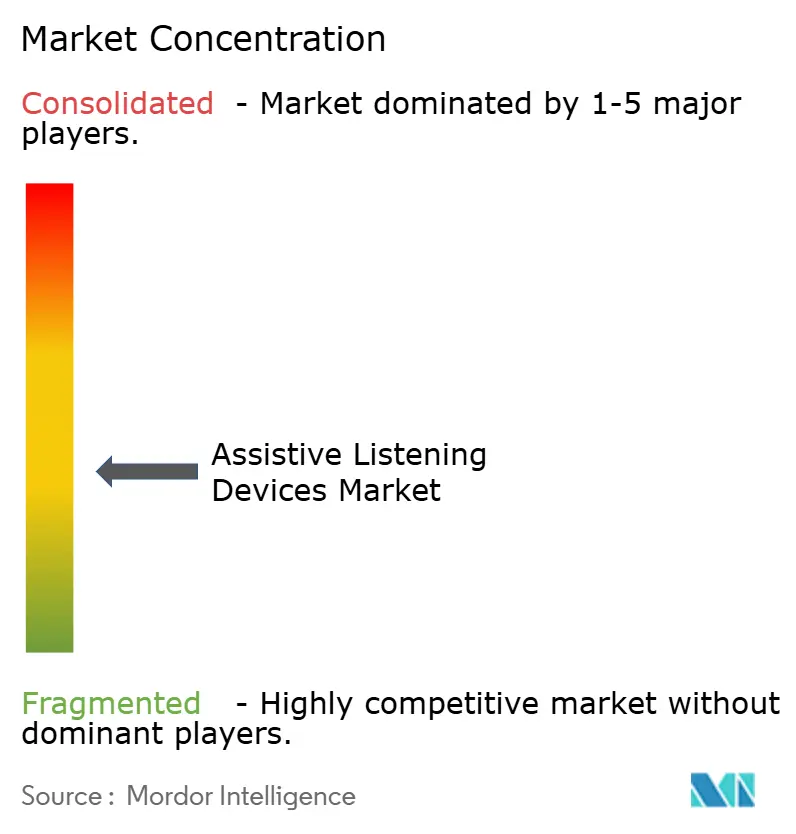
The assistive listening devices market has a moderately consolidated premium hearing aid tier and a more fragmented assistive listening systems tier. Sonova, Demant, GN Store Nord, and WS Audiology account for most global prescription hearing aid revenue in the supplied research. Williams AV, Listen Technologies, Ampetronic, and Contacta Systems operate in FM, loop, infrared, and venue audio systems. GN reported 5% organic growth in 2025 after 10% growth in 2024 and 13% growth in 2023. Its ReSound Vivia gains show the commercial importance of early artificial intelligence product positioning.
Product strategy is moving beyond the device itself toward software, remote fitting, and connectivity ecosystems. Phonak’s Infinio Ultra delivered additional deep neural network and maintenance capabilities through a firmware update. This approach can extend product value without requiring immediate hardware replacement. Starkey and MED-EL introduced the DualSync partnership in July 2025 for simultaneous streaming to compatible hearing aids and cochlear implants. Cochlear introduced the Osia 3 Sound Processor in July 2026 for conductive, mixed hearing loss, and single-sided deafness.
The supplied research also identified an agreement for Amplifon to acquire GN’s Hearing business for USD 2.6 billion, subject to regulatory approvals and expected to close by the end of 2026. This would combine hearing aid manufacturing with Amplifon’s retail network and increase vertical integration in the premium tier. Sonova announced the divestment of its Consumer Hearing business and a strategy focused on hearing instruments and cochlear implants. These actions indicate that distribution reach, clinical credibility, and software capability are becoming central competitive factors. The assistive listening devices market faces additional competition from consumer electronics companies at the connectivity layer, especially where products do not require clinical fitting.
Assistive Listening Devices Industry Leaders
-
Sonova Holding AG
-
Demant A/S
-
GN Store Nord A/S
-
WS Audiology
-
Cochlear Limited
- *Disclaimer: Major Players sorted in no particular order
Assistive Listening Devices Market Companies Covered in this Report
- Sonova
- Demant
- Amplifon S.p.A.
- GN Store Nord
- WS Audiology
- Starkey Hearing Technologies
- Cochlear
- MED-EL
- RION
- Williams AV LLC
- Listen Technologies Corporation
- Ampetronic Ltd
- Bellman & Symfon AB
- Sennheiser electronic SE & Co. KG
- Clarity Products
- Panasonic Corporation
- Contacta Systems Ltd
- Geemarc Telecom
- Audina Hearing Instruments
- Serene Group, Inc.
Recent Industry Developments in Assistive Listening Devices Market
- July 2026: Cochlear Limited received FDA clearance for the Osia 3 Sound Processor, the first fully rechargeable active bone conduction device with up to 30 hours of battery life, expanded fitting range, and multi-platform wireless streaming for patients with conductive or mixed hearing loss and single-sided deafness; US availability is expected in early fall 2026
- March 2026: Sonova announced the divestment of its Consumer Hearing business, Sennheiser brand, and a renewed strategy targeting CHF 6 billion, USD 6.7 billion, in revenue by FY2030/31, concentrating investment on Phonak and Unitron hearing instruments and Advanced Bionics cochlear implants
- October 2025: Phonak launched Infinio Ultra and Infinio Ultra Sphere, extending deep neural network capabilities and introducing EasyGuard wax management through a firmware update, enabling existing Infinio users to receive major artificial intelligence improvements without hardware replacement
- July 2025: Starkey and MED-EL launched DualSync, a bimodal streaming partnership enabling simultaneous Apple device audio streaming to compatible Starkey hearing aids and MED-EL cochlear implants, creating a unified wireless ecosystem for bimodal users
Global Assistive Listening Devices Market Report Scope
Segmentation Overview
| Hearing Aids |
| Personal Sound Amplifiers (PSAPs) |
| Assistive Listening Systems (FM, Infrared, Induction Loop) |
| Connectivity & Alert Devices (Bluetooth Streamers, TV Listeners, Telephone Amplifiers, Visual/Vibration Alerts) |
| Analog Devices |
| Digital Devices |
| Bluetooth LE Audio & Auracast Devices |
| AI-Enabled Devices |
| Personal Use |
| Healthcare Facilities |
| Educational Institutions |
| Public Venues & Commercial Facilities |
| Audiology Clinics |
| Specialty Hearing-Care Stores |
| Online Stores |
| Institutional & Direct Sales |
| North America | United States |
| Canada | |
| Mexico | |
| Europe | Germany |
| United Kingdom | |
| France | |
| Italy | |
| Spain | |
| Rest of Europe | |
| Asia-Pacific | China |
| India | |
| Japan | |
| South Korea | |
| Australia | |
| Rest of Asia-Pacific | |
| Middle East & Africa | GCC |
| South Africa | |
| Rest of Middle East and Africa | |
| South America | Brazil |
| Argentina | |
| Rest of South America |
| By Product Type | Hearing Aids | |
| Personal Sound Amplifiers (PSAPs) | ||
| Assistive Listening Systems (FM, Infrared, Induction Loop) | ||
| Connectivity & Alert Devices (Bluetooth Streamers, TV Listeners, Telephone Amplifiers, Visual/Vibration Alerts) | ||
| By Technology | Analog Devices | |
| Digital Devices | ||
| Bluetooth LE Audio & Auracast Devices | ||
| AI-Enabled Devices | ||
| By Application | Personal Use | |
| Healthcare Facilities | ||
| Educational Institutions | ||
| Public Venues & Commercial Facilities | ||
| By Distribution Channel | Audiology Clinics | |
| Specialty Hearing-Care Stores | ||
| Online Stores | ||
| Institutional & Direct Sales | ||
| By Geography | North America | United States |
| Canada | ||
| Mexico | ||
| Europe | Germany | |
| United Kingdom | ||
| France | ||
| Italy | ||
| Spain | ||
| Rest of Europe | ||
| Asia-Pacific | China | |
| India | ||
| Japan | ||
| South Korea | ||
| Australia | ||
| Rest of Asia-Pacific | ||
| Middle East & Africa | GCC | |
| South Africa | ||
| Rest of Middle East and Africa | ||
| South America | Brazil | |
| Argentina | ||
| Rest of South America | ||
Key Questions Answered in the Report
What is the projected value of the assistive listening devices market by 2031?
The assistive listening devices market is forecast to reach USD 25.05 billion by 2031, growing at a 7.8% CAGR from 2026.
Which product category has the largest revenue position?
Hearing aids held 69.5% of product-type revenue in 2025, supported by established prescription channels and fitted-device demand.
Which technology is growing fastest in hearing devices?
AI-enabled devices are forecast to grow at an 8.4% CAGR through 2031, supported by deep neural network processing and clinical performance evidence.
Why are online stores gaining importance for hearing products?
Online stores are forecast to grow at an 8.2% CAGR through 2031 because over-the-counter access reduces prescription friction for eligible adults.
Which region is expanding fastest for assistive listening devices?
Asia-Pacific is forecast to grow at an 8.5% CAGR through 2031, supported by aging populations and healthcare infrastructure investment.
What limits wider adoption of hearing assistance products?
Cost, stigma, uneven audiology access, and difficulty with self-assessment continue to limit use, particularly in lower-income settings.