
Asia-Pacific Smart Faucets Market Size and Share
Market Overview
| Study Period | 2021 - 2032 |
|---|---|
| Forecast Data Period | 2027 - 2032 |
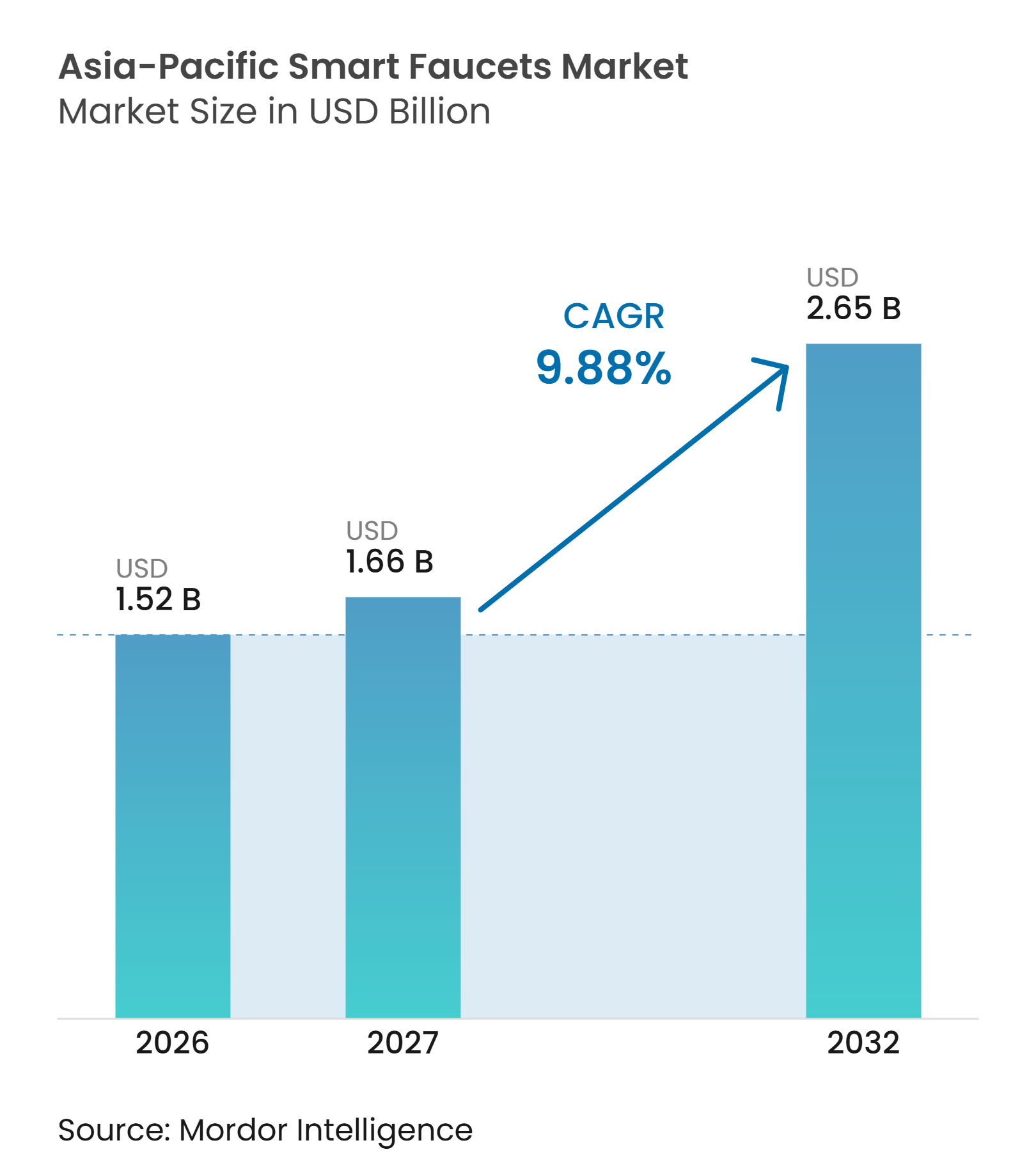
| Base Year Market Size (2026) | USD 1.52 Billion |
| Market Size (2027) | USD 1.66 Billion |
| Market Size (2032) | USD 2.65 Billion |
| Growth Rate (2027 - 2032) | 9.88 % |
| Market Concentration | Medium |
Major Players *Disclaimer: Major Players sorted in no particular order Image © Mordor Intelligence. Reuse requires attribution under CC BY 4.0. | |
Asia-Pacific Smart Faucets Market Analysis by Mordor Intelligence
The Asia-Pacific smart faucets market size was valued at USD 1.52 billion in 2026 and is estimated to grow from USD 1.66 billion in 2027 to reach USD 2.65 billion by 2032, at a CAGR of 9.88% during the forecast period (2027-2032). The Asia-Pacific smart faucets market is moving beyond its earlier institutional focus as water-efficiency rules, hotel renovations, and connected-home upgrades increase demand for touchless fixtures. Water scarcity policies are making automatic shutoff and flow control more relevant in residential, commercial, and public buildings. Renovation activity is likely to remain more important than greenfield construction because much of the region’s urban housing stock is reaching the stage for kitchen and bathroom upgrades. Manufacturers are balancing premium sensor features with products suited to humid, saline, and hard-water conditions. Competition is shaped by global bathroom brands, regional manufacturers, and consumer electronics companies that are bringing filtration, applications, and connected controls into the category.
Key Report Takeaways
-
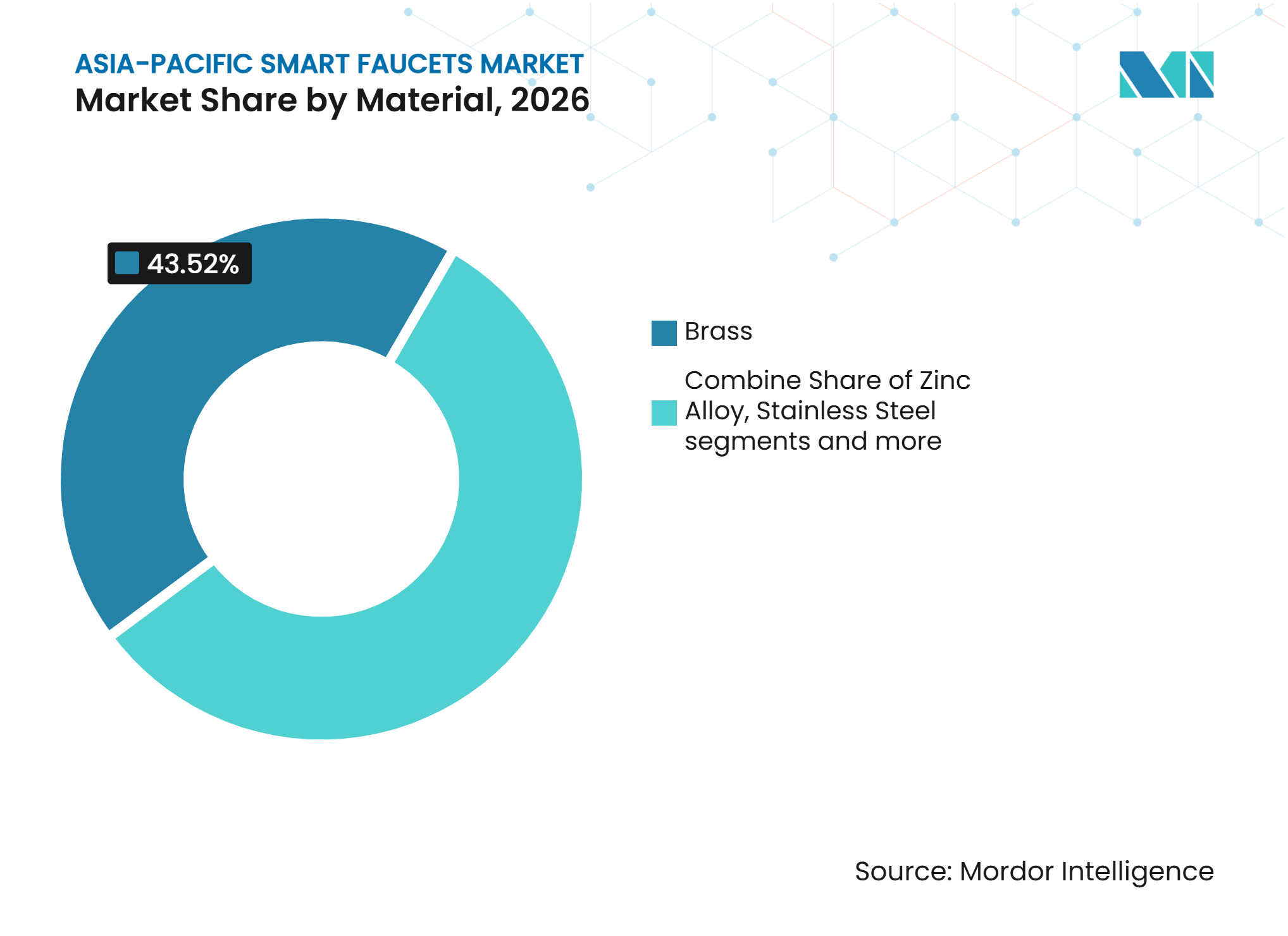
By material, brass held 43.52% of the Asia-Pacific smart faucets market share in 2026, while engineering plastics/polymer composites are projected to grow at the fastest CAGR of 11.22% during 2027–2032.
-
By installation type, deck-mount faucets accounted for 58.46% of revenue share in 2026, while wall-mount faucets are projected to grow at the fastest CAGR of 11.07% during 2027–2032.
-
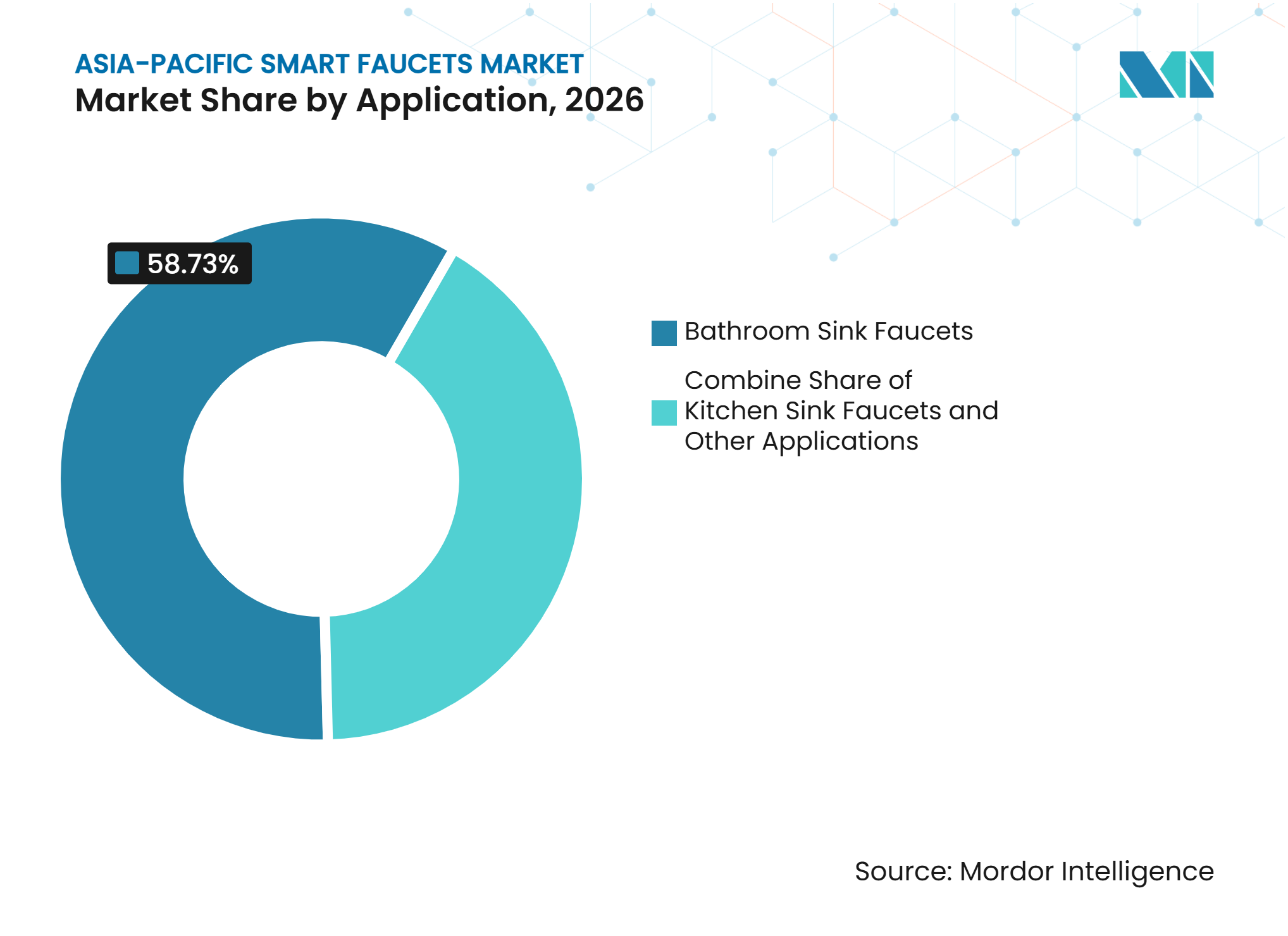
By application, bathroom sink faucets accounted for 58.73% of the Asia-Pacific smart faucets market size in 2026, while kitchen sink faucets are projected to grow at the fastest CAGR of 10.57% during 2027–2032.
-
By construction/project type, replacement/renovation/retrofit held 56.81% of revenue share in 2026 and are projected to grow at the fastest CAGR of 10.88% during 2027–2032.
-
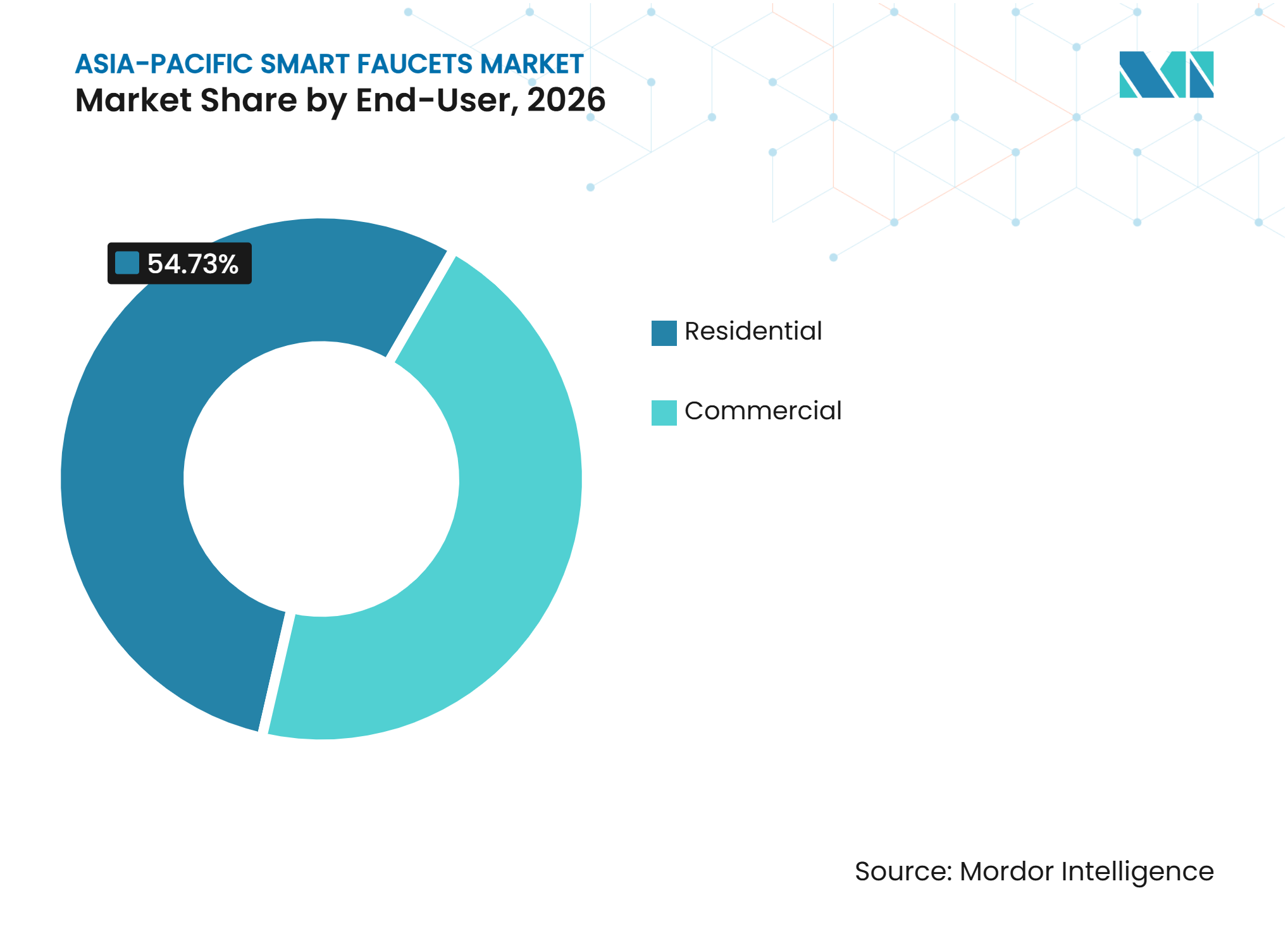
By end user, residential users held 54.73% of revenue share in 2026, while commercial users are projected to grow at the fastest CAGR of 11.48% during 2027–2032.
-
By distribution channel, business-to-consumer/retail channels held 66.05% of revenue share in 2026, while business-to-business/direct-sales channels are projected to grow at the fastest CAGR of 11.34% during 2027–2032.
-
By geography, China held 33.64% of the Asia-Pacific smart faucets market share in 2026, while India is projected to grow at the fastest CAGR of 11.50% during 2027–2032.
Note: Market numbers in this report are based on Mordor Intelligence's proprietary estimation framework, which combines nine months of actuals with Q4 projections for base year 2026.
Market Trends and Insights
Drivers Impact Analysis of Asia-Pacific Smart Faucets Market of Asia-Pacific Smart Faucets Market*
| Driver | (~) % Impact on CAGR Forecast | Geographic Relevance | Impact Timeline |
|---|---|---|---|
| Water Scarcity and Water-Efficiency Requirements | +2.40% | China, India, and Southeast Asia | Short term (≤ 2 years) |
| Luxury Hospitality, Airports, Malls, and Mixed-Use Development | +1.80% | Asia-Pacific, Vietnam, Indonesia, and Thailand | Medium term (2-4 years) |
| Smart-City and Sustainable-Building Programs | +1.50% | China, India, Singapore, and Japan | Medium term (2-4 years) |
| IoT Monitoring, Leak Detection, and Flow Optimization | +1.30% | Singapore, Tokyo, Sydney, and other Asia-Pacific cities | Long term (≥ 4 years) |
| High-End Residential Automation and Connected Bathrooms | +1.20% | China, South Korea, Australia, and Japan | Long term (≥ 4 years) |
| Developer and Contractor Specification in Large Projects | +0.90% | India, Vietnam, Indonesia, and Southeast Asia | Medium term (2-4 years) |
| Source: Mordor Intelligence | |||
Water Scarcity and Water-Efficiency Requirements
In 2025, the Asian Development Bank stated that Asia and the Pacific required USD 4 trillion in water infrastructure investment from 2025 to 2040, while current budgets met less than 40% of that requirement[1]. This funding gap is increasing attention to fixtures that can reduce water use at the point of consumption. In November 2025, China’s Ministry of Water Resources identified sensing, automatic shutoff, and flow-control smart faucets as priority water-saving terminal equipment in its 2025-2030 development plan. In December 2025, China updated its water-efficiency labeling directory and tightened the criteria applied to water taps. These requirements are making water-performance documentation more important in hospitality, health care, food service, and other high-traffic facilities. The Asia-Pacific smart faucets market therefore benefits when purchasers choose higher-efficiency equipment before regulations become more stringent.
Luxury Hospitality, Airports, Malls, and Mixed-Use Development
In 2025, Hilton said it planned to exceed 250 luxury and lifestyle hotels in Asia-Pacific, with its portfolio in the region expected to grow by at least 50%. Large hotel, airport, mall, and mixed-use projects create demand for products that combine hygiene, durability, and water management. Touchless fixtures fit premium washroom specifications because they reduce direct contact and can support a consistent design across many rooms. Hotel renovations can also create replacement demand because brand conversions often require bathroom upgrades. Framework agreements with hotel groups can give manufacturers better order visibility than individual retail sales. The Asia-Pacific smart faucets market gains from this concentration of fixture decisions among developers, contractors, and branded property operators.
Smart-City and Sustainable-Building Programs
In 2025, India’s National Institute of Urban Affairs reported that 63 of 94 responding Smart Cities had deployed Internet of Things-based water monitoring. The same publication reported more than 965,000 smart meters under supervisory control and data acquisition integration[2]. Smart faucets can extend this monitoring closer to the end point by recording consumption, identifying abnormal flow, and supporting automatic shutoff. This functionality is particularly relevant where commercial property owners track water consumption for environmental, social, and governance reporting. In May 2025, LIXIL described its work to create an integrated bathroom ecosystem across its INAX, American Standard, and GROHE brands, including support for Matter interoperability. The Asia-Pacific smart faucets market can benefit as compatibility reduces the effort required to connect fixtures with wider building systems.
Internet of Things Monitoring, Leak Detection, and Flow Optimization
In 2025, India’s National Institute of Urban Affairs reported that 63 of 94 responding Smart Cities had deployed Internet of Things-based water monitoring. The same publication reported more than 965,000 smart meters under supervisory control and data acquisition integration[3]. Smart faucets can extend this monitoring closer to the end point by recording consumption, identifying abnormal flow, and supporting automatic shutoff. This functionality is particularly relevant where commercial property owners track water consumption for environmental, social, and governance reporting. In May 2025, LIXIL described its work to create an integrated bathroom ecosystem across its INAX, American Standard, and GROHE brands, including support for Matter interoperability. The Asia-Pacific smart faucets market can benefit as compatibility reduces the effort required to connect fixtures with wider building systems.
Restraints Impact Analysis of Asia-Pacific Smart Faucets Market*
| Restraint | (~) % Impact on CAGR Forecast | Geographic Relevance | Impact Timeline |
|---|---|---|---|
| Higher Premium Over Manual Fixtures | -1.2% | Global; strongest in price-sensitive India, Southeast Asia | Short term (≤ 2 years) |
| Project-Cycle Dependence and Contractor Concentration | -0.7% | India, Vietnam, Indonesia | Medium term (2–4 years) |
| Hard-Water, Salinity, Humidity, and Sensor-Service Conditions | -0.8% | Coastal Southeast Asia, parts of India, Pacific Islands | Long term (≥ 4 years) |
| Imported Electronics, Battery Replacement, and After-Sales Constraints | -0.6% | Southeast Asia and smaller Asia-Pacific markets | Medium term (2–4 years) |
| Source: Mordor Intelligence | |||
Higher Premium Over Manual Fixtures and Project-Cycle Dependence
Sensor faucets retain a meaningful price premium over manual fixtures, which limits their reach in price-sensitive cities and projects. This premium is most relevant in India, Vietnam, and Indonesia, where lower-cost mechanical fixtures remain familiar to contractors and homeowners. In January 2025, Chongqing introduced a kitchen and bathroom renovation subsidy that offered a 15% rebate on eligible faucet purchases, subject to a CNY 2,000 (USD 279.2) consumer limit. Subsidies can reduce the initial cost of an upgrade but may not fully address maintenance concerns or low familiarity with sensor products. Without sustained price reductions or subsidies, the premium can limit adoption beyond upper-income and institutional users.
Hard-Water, Salinity, Humidity, and After-Sales Conditions
Hard water, salt exposure, and high humidity can reduce sensor reliability and increase maintenance needs in coastal and tropical installations. Mineral deposits can affect aerators and sensor lenses, while humid conditions can increase corrosion risks for electronic control modules close to splash zones. These conditions are relevant in parts of India, Indonesia, Malaysia, and the Philippines. IEC 60529 defines ingress-protection requirements for electronic equipment, but it does not establish a single regional durability threshold for sensor faucets under hard-water or humid field conditions. Manufacturers must demonstrate resilience through design, local testing, service coverage, and clear maintenance requirements.
*Our forecasts treat driver/restraint impacts as directional, not additive. The impact forecasts reflect baseline growth, mix effects, and variable interactions.
Asia-Pacific Smart Faucets Market Segment Analysis
By Material:
Brass Remains the Leading Material While Polymer Composites Gain GroundBrass held 43.52% of the Asia-Pacific smart faucets market share in 2026, supported by its established role in mid-range and premium bathroom and kitchen fixtures. Buyers commonly associate brass with durability, while suppliers in China have established production networks for the material. Brass remains relevant for residential products where finish quality and perceived value influence product selection. It also supports a wide range of conventional and sensor-faucet designs. China’s water-efficiency rules and Singapore’s Green Mark requirements are increasing attention to water-contact materials and water performance. This creates an additional reason for manufacturers to develop lead-free brass options and to document material compliance.
Engineering plastics and polymer composites are forecast to grow at an 11.22% CAGR during 2027–2032. These materials are suited to hard-water and high-salinity settings because they can resist corrosion that affects metal components. In July 2025, LIXIL opened its International Competence Center in Guangzhou to support product development, testing, materials analysis, and technical validation for international products[4]. Localized development can help manufacturers adjust component choices for water quality, humidity, and supply conditions across Asia-Pacific. Zinc alloy continues to serve value-oriented products, while stainless steel remains relevant in airport, hospital, and premium institutional washrooms. Copper and specialty alloy finishes retain a narrower role in architectural and luxury projects.



By Installation Type:
Deck-Mount Faucets Retain Scale While Wall-Mount Products Grow FasterDeck-mount faucets accounted for 58.46% of installation-type revenue in 2026. Their position reflects compatibility with the large installed base of conventional basins in homes and mid-range commercial properties. A deck-mount sensor faucet can often replace a manual fixture without extensive changes to plumbing. This reduces installation complexity for a homeowner, contractor, or building manager. The configuration is therefore well suited to a replacement-led Asia-Pacific smart faucets market. Other installation formats, including freestanding and outdoor surface-mounted fixtures, remain specialized products for architectural or public-space uses.
Wall-mount faucets are forecast to grow at an 11.07% CAGR during 2027–2032. The format supports concealed plumbing and can free counter space in premium bathrooms, hospitality projects, and renovation schemes. It can also provide a clear position for the sensor above the basin. Japanese manufacturers such as KVK Corporation and SANEI Ltd. have refined wall-mount arrangements for compact urban bathrooms. These products can use sensor layouts that reduce unintended activation in confined spaces. Wall-mount demand is likely to remain stronger in projects that can accommodate plumbing changes and higher installation costs.
By Application:
Bathroom Faucets Lead Demand While Kitchen Faucets Expand FasterBathroom sink faucets accounted for 58.73% of application revenue in 2026. Frequent handwashing and grooming make touchless operation especially visible in this setting. The products can support hygiene expectations while helping users control water consumption. In August 2025, TOTO launched the ESCUA sensing system in Japan, placing microwave sensors in the vanity cabinet rather than in the faucet body. This arrangement allows several faucet designs to operate touchlessly and gives designers greater freedom over fixture appearance. The Asia-Pacific smart faucets market size for bathroom applications is supported by these design-led product changes in premium residential and hospitality projects.
Kitchen sink faucets are forecast to grow at a 10.57% CAGR during 2027–2032. Growth is linked to greater interest in connected kitchens, cooking hygiene, filtration, and premium home upgrades in China, South Korea, and Australia. In August 2025, KVK launched the KM6092SCEC dual-sensor built-in purifier kitchen faucet in Japan, combining touchless operation for purified and standard water. The product shows how water purification and touchless controls are being combined in a single kitchen fixture. Kitchen products can compete less on basic plumbing function and more on convenience, health-related features, and connection with home systems. This category will depend on consumers accepting higher prices for integrated functions.

By Construction or Project Type:
Renovation and Retrofit Work Drives DemandReplacement, renovation, and retrofit projects held 56.81% of revenue share in 2026 and are forecast to grow at a 10.88% CAGR during 2027–2032. This makes the segment both the largest and the fastest-growing construction category in the Asia-Pacific smart faucets market. Many urban homes in Japan, South Korea, Australia, China, and other regional markets are entering a stage when bathroom and kitchen upgrades become practical. Sensor faucets can be installed as part of a wider renovation without requiring a new building. In January 2025, Chongqing’s renovation subsidy program supported eligible kitchen and bathroom upgrades, including faucet purchases. Such programs can help close the price gap between manual and smart fixtures.
New construction and first installation accounted for 43.19% of revenue share in 2026. In July 2025, India’s Ministry of Housing and Urban Affairs reported 3,571 approved water-supply projects and 18.9 million new and serviced tap-water connections under AMRUT 2.0. These projects expand the upstream base of properties that may later adopt higher-value bathroom and kitchen fittings. However, basic infrastructure delivery does not guarantee that sensor fixtures will be installed. In lower-cost projects, unorganized contractors can still choose manual products unless developers define sensor requirements. Renovation demand may therefore remain more dependable than new construction in the medium term.
By End User:
Residential Demand Leads While Commercial Demand Grows FasterResidential users held 54.73% of revenue share in 2026. This reflects the region’s large urban housing base and growing interest in connected fixtures among consumers in China, Japan, and South Korea. Residential buyers often value a mix of touch-free operation, appearance, water savings, and compatibility with home automation. Premium apartment developments can introduce these products to homeowners at the point of purchase. In May 2025, Jaquar Group announced a partnership with Trinity for the Sky Palazzo Residences project in India. Developer specifications can help establish smart bathroom fixtures in higher-value housing projects.
Commercial users are forecast to grow at an 11.48% CAGR during 2027–2032. Hotels, airports, malls, offices, hospitals, and public facilities provide settings where hygiene, water measurement, and maintenance are important. Property owners may also prefer products that support environmental, social, and governance reporting and measured water use. Large developers and hotel operators can use standardized product lists across many sites. This makes commercial demand more concentrated but also more dependent on project decisions and approval cycles.
By Distribution Channel:
Retail Retains Volume While Direct Sales ExpandBusiness-to-consumer and retail channels held 66.05% of distribution revenue in 2026. These channels include home-improvement retailers, specialist kitchen and bath showrooms, branded stores, online platforms, and local hardware outlets. Retail allows consumers to compare finish, price, installation needs, and sensor features before purchase. It is important for renovation projects in which the homeowner controls product selection. The channel also supports local installation services and after-sales contact. The Asia-Pacific smart faucets market depends on retail education because many consumers remain unfamiliar with battery, sensor, and maintenance requirements.
Business-to-business and direct-sales channels are forecast to grow at an 11.34% CAGR during 2027–2032. These channels serve hospitality groups, health care networks, public projects, developers, and major contractors. Direct specification can give manufacturers multiyear project orders and recurring maintenance opportunities. In January 2025, GROHE Asia B2B announced the opening of LIXIL Experience Centre Central Jakarta and plans for further expansion in Indonesia. Showrooms can support contractor and developer engagement by allowing professional buyers to review products in person. The channel’s growth depends on manufacturers building local service capacity alongside product sales.
Geography Analysis
China
China held 33.64% of the Asia-Pacific smart faucets market share in 2026. Its scale reflects a large base of residential, commercial, and institutional buildings, together with deep manufacturing capacity for fixtures and electronic components. In November 2025, China’s Ministry of Industry and Information Technology and Ministry of Water Resources jointly issued the Implementation Plan for High-Quality Development of Water-Saving Equipment 2025-2030. In December 2025, the National Development and Reform Commission updated the water-efficiency labeling directory for regulated products, including water taps. These measures make efficiency documentation more important in high-traffic buildings. In July 2025, LIXIL opened its International Competence Center in Guangzhou to support localized development, product testing, and material analysis. The center shows that China is both a demand center and a product-development base for the region.
India
India is forecast to expand at an 11.50% CAGR during 2027–2032. Its growth is connected with city infrastructure programs, premium housing development, domestic manufacturing investment, and growing demand from hospitality projects. In August 2025, the Ministry of Jal Shakti reported that 81.02% of Indian households had functional tap-water connections. In June 2025, the World Bank approved a USD 426 million program for water security and resilience in Bengaluru, including smart water meters and private-sector innovation for aging pipe systems. Adoption remains uneven because premium projects in Bengaluru and Mumbai are more advanced than many Tier-2 and Tier-3 city projects.
Japan, South Korea, Australia, New Zealand, and Southeast Asia
In Japan, TOTO and LIXIL compete through sensor precision, product design, and bathroom-system integration. In August 2025, TOTO launched ESCUA, which uses microwave sensing within a vanity cabinet and supports multiple touchless faucet designs. South Korea’s demand is linked to smart-apartment ecosystems and compatibility with connected-home platforms. Australia and New Zealand place greater emphasis on water-efficient fixtures through plumbing requirements and the Water Efficiency Labelling and Standards system. In July 2025, Singapore’s Building and Construction Authority stated that Green Mark had certified 2,590 buildings in Singapore and more than 340 projects in 18 countries. The regional spread of Green Mark supports demand for fixtures that can show water-efficiency performance. Southeast Asia also presents an opportunity for localized designs that can withstand humidity, salinity, and varied water quality.
Competitive Landscape
Market Concentration
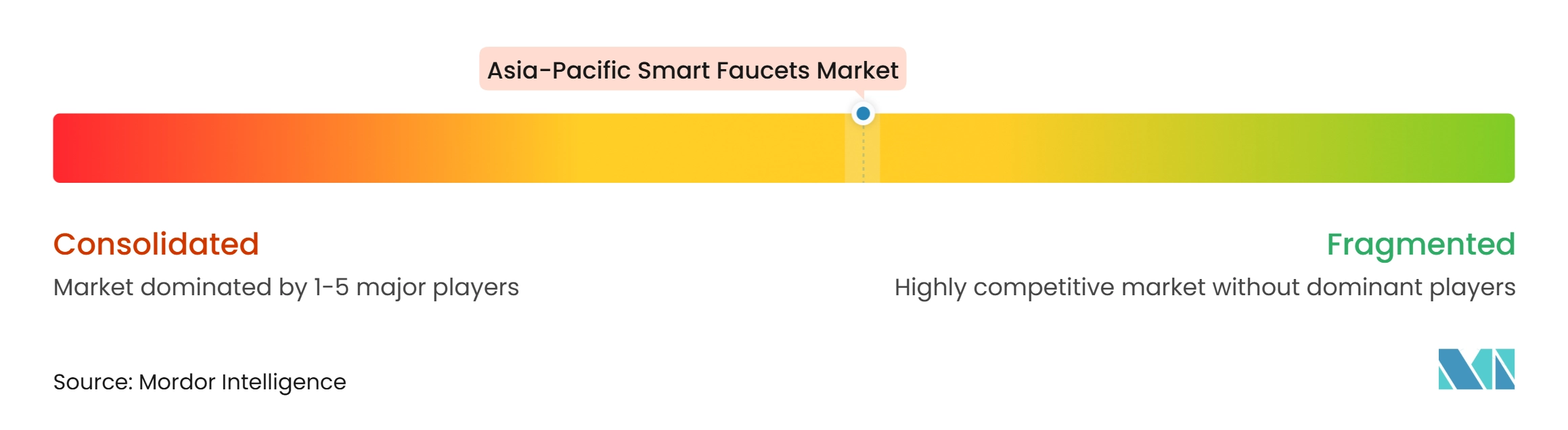
The Asia-Pacific smart faucets market has moderate concentration in premium commercial applications and greater fragmentation in residential retail. LIXIL, TOTO, Kohler, Hansgrohe, and Moen compete for specifications in luxury hotels, commercial facilities, and institutional buildings. Their positions are supported by product testing, compliance documentation, established distributor networks, and broad bathroom portfolios. Chinese brands such as JOMOO and HUIDA compete strongly in domestic and value-led segments. Indian brands including Jaquar Group, CERA Sanitaryware, and Hindware Home Innovation use domestic manufacturing and regional distribution to address local demand. Japanese companies KVK, SANEI, and KAKUDAI retain relevance in specialized and compact bathroom applications.
In July 2025, LIXIL opened its Guangzhou competence center to shorten localized development cycles and use regional supplier capabilities. In August 2025, TOTO introduced ESCUA, which shifts the touchless sensor from the faucet body to the vanity cabinet. In August 2025, KVK introduced a dual-sensor kitchen faucet that supports touchless access to purified and standard water. These moves show that leading companies are competing through design integration, water treatment, and system compatibility rather than sensor activation alone. China’s efficiency-label requirements and Singapore’s Green Mark rules also favor firms that can provide certified water-performance evidence. Smaller firms can remain competitive where they offer simpler products, local servicing, and lower upfront prices.
Affordable sensor products for price-sensitive cities remain an important competitive opening. Products designed for hard water, high humidity, and intermittent power conditions can also help manufacturers address regional service concerns. Consumer electronics brands add pressure by combining water purification, applications, displays, and connected controls in kitchen products. Suppliers must therefore combine reliable hardware with clear maintenance support and easy integration.
Asia-Pacific Smart Faucets Industry Leaders
-
LIXIL Corporation
-
TOTO Ltd.
-
Kohler Co.
-
JOMOO Kitchen & Bath Co., Ltd.
-
Jaquar Group
- *Disclaimer: Major Players sorted in no particular order
Asia-Pacific Smart Faucets Market Companies Covered in this Report
- LIXIL Corporation
- TOTO Ltd.
- Kohler Co.
- Jaquar Group
- CERA Sanitaryware Limited
- JOMOO Kitchen & Bath Co., Ltd.
- HUIDA Sanitary Ware Co., Ltd.
- Moen Incorporated
- Delta Faucet Company
- Hansgrohe SE
- Geberit International AG
- Sloan Valve Company
- Oras Ltd.
- PRESTO Group
- KVK Corporation
- SANEI Ltd.
- KAKUDAI MFG. Co., Ltd.
- Roca Parryware
- Hindware Home Innovation Limited
- Franke Group
Recent Industry Developments in Asia-Pacific Smart Faucets Market
- April 2026: Takagi introduced its LC Touchless Battery-powered faucet-integrated water purifier, enabling users to activate and stop water flow through hand gestures.
- August 2025: TOTO Corporation (Japan) launched its ESCUA touchless “Sensing System” , embedding microwave sensors within the vanity cabinet body, rather than the faucet, to enable six distinct faucet design variants to operate touchlessly. The system also integrates automatic lighting, three-mode dimming and color adjustment, and auto-dispensing of TOTO's proprietary Kirei antibacterial water after use, materially advancing Japan's premium vanity segment.
- August 2025: KVK Corporation (Japan) launched the KM6092SCEC dual-sensor kitchen built-in purifier faucet, combining simultaneous touchless activation for both purified and standard water outputs. The product demonstrates Japan's convergence of water purification and sensor faucet functionalities and targets premium kitchen renovation projects.
- July 2025: LIXIL Corporation opened its 1,654 sq m International Competence Center in Guangzhou, China. The cross-functional research and development hub features advanced labs for product testing, material analysis, and technical validation, supporting GROHE and American Standard brands for international markets, and complements LIXIL's existing Asia research and development hub in Shanghai.
Asia-Pacific Smart Faucets Market Report Scope
Segmentation Overview
| Zinc Alloy |
| Stainless Steel |
| Brass |
| Engineering plastics / polymer composites |
| Other Materials |
| Deck-Mount |
| Wall-Mount |
| Other Installations |
| Kitchen Sink Faucets |
| Bathroom Sink Faucets |
| Other Applications |
| New construction / first installation |
| Replacement / renovation / retrofit |
| Residential |
| Commercial |
| B2C / Retail | Multi-Brand Stores/Home-improvement retailers |
| Specialist plumbing and kitchen/bath showrooms (including Exclusive Brand Outlets (EBOs)) | |
| Online / E-Commerce | |
| Local Hardware Stores / Unorganized Retail | |
| B2B / Direct Sales |
| China |
| India |
| Japan |
| South Korea |
| Australia and New Zealand |
| Southeast Asia |
| Rest of Asia-Pacific |
| By Material | Zinc Alloy | |
| Stainless Steel | ||
| Brass | ||
| Engineering plastics / polymer composites | ||
| Other Materials | ||
| By installation Type | Deck-Mount | |
| Wall-Mount | ||
| Other Installations | ||
| By Application | Kitchen Sink Faucets | |
| Bathroom Sink Faucets | ||
| Other Applications | ||
| By Construction/Project Type | New construction / first installation | |
| Replacement / renovation / retrofit | ||
| By End-User | Residential | |
| Commercial | ||
| By Distribution Channel | B2C / Retail | Multi-Brand Stores/Home-improvement retailers |
| Specialist plumbing and kitchen/bath showrooms (including Exclusive Brand Outlets (EBOs)) | ||
| Online / E-Commerce | ||
| Local Hardware Stores / Unorganized Retail | ||
| B2B / Direct Sales | ||
| By Geography | China | |
| India | ||
| Japan | ||
| South Korea | ||
| Australia and New Zealand | ||
| Southeast Asia | ||
| Rest of Asia-Pacific | ||
Key Questions Answered in the Report
What is the projected value of Asia-Pacific smart faucets by 2032?
The category is projected to reach USD 2.65 billion by 2032, growing at a 9.7% CAGR during 2027–2032. Demand is supported by water-efficiency policies, upgrades in homes and commercial properties, and wider use of connected fixtures.
Which material leads smart faucet demand in Asia-Pacific?
Brass leads with a 43.52% share in 2026, while engineering plastics and polymer composites have the fastest projected growth at 11.22% CAGR. Brass remains established in higher-value fixtures, while polymers are increasingly relevant in corrosive water conditions.
Why are commercial buyers adopting touchless faucets?
Hotels, airports, offices, health care facilities, and public buildings value hygiene, controlled water use, and support for building water-management systems. Direct procurement also lets owners standardize products, servicing, and compliance documents across multiple locations.
Which application is growing fastest for smart faucets?
Kitchen sink faucets are forecast to grow at a 10.57% CAGR during 2027–2032 as filtration, connected controls, and premium kitchen upgrades gain attention. Products that combine purified and standard water access show how the category is extending beyond basic plumbing hardware.
Which country is the largest regional demand base?
China held 33.64% of 2026 regional revenue share, supported by manufacturing depth and water-efficiency requirements. Its local supplier ecosystem and rules on water-saving equipment also make it important for product development and component sourcing.