
Asia-Pacific Prefabricated Bathroom Modules Market Size and Share
Market Overview
| Study Period | 2019 - 2031 |
|---|---|
| Forecast Data Period | 2026 - 2031 |
| Base Year Market Size (2025) | USD 0.66 Billion |
| Market Size (2026) | USD 0.73 Billion |
| Market Size (2031) | USD 1.16 Billion |
| Growth Rate (2026 - 2031) | 9.71 % |
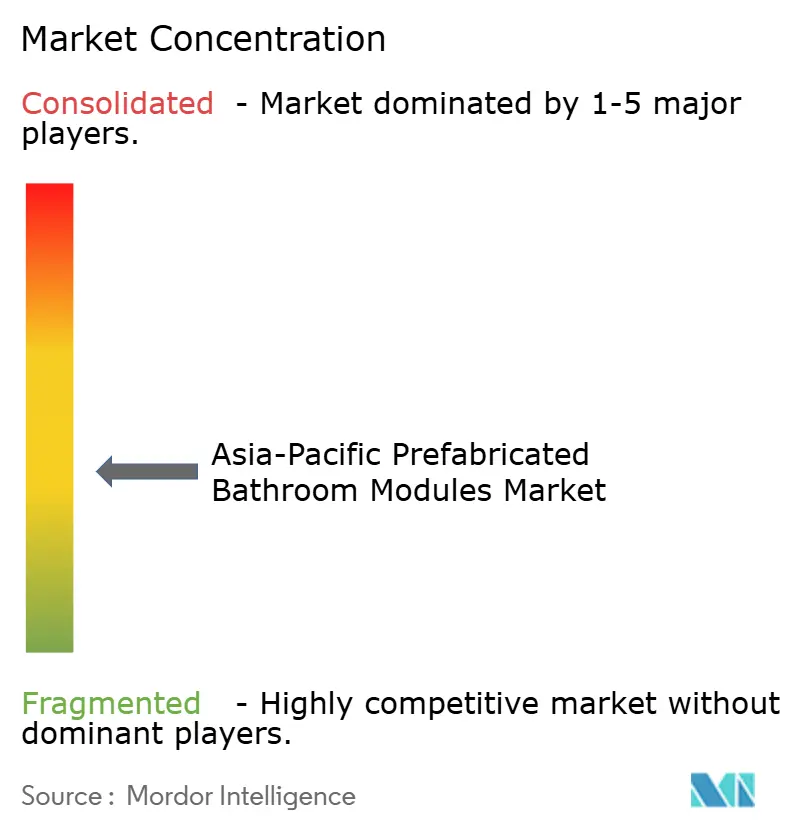
| Market Concentration | Medium |
Major Players *Disclaimer: Major Players sorted in no particular order Image © Mordor Intelligence. Reuse requires attribution under CC BY 4.0. | |
Asia-Pacific Prefabricated Bathroom Modules Market Analysis by Mordor Intelligence
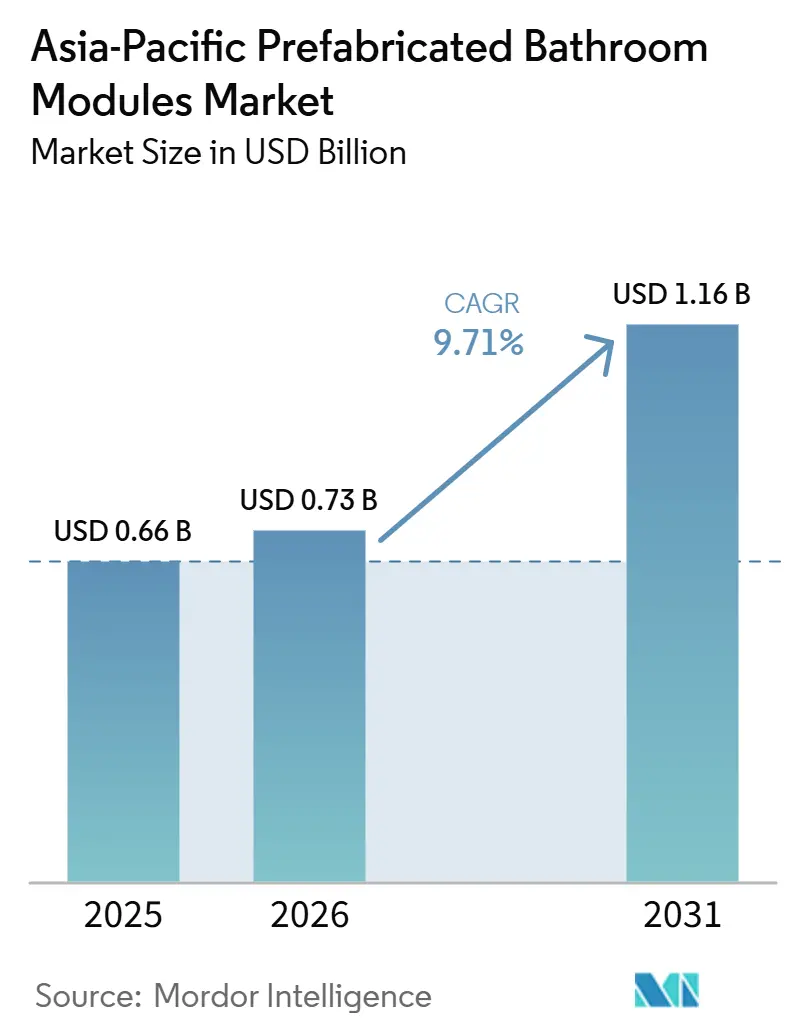
The Asia-Pacific Prefabricated Bathroom Modules Market size is expected to increase from USD 0.66 billion in 2025 to USD 0.73 billion in 2026 and reach USD 1.16 billion by 2031, growing at a CAGR of 9.71% over 2026-2031.
Persistent housing shortages, a rising hotel project pipeline, and the ongoing shift away from labor-intensive wet-trade installation continue to support demand for prefabricated bathroom modules across the Asia-Pacific market. Government-backed construction programs are also changing procurement behavior, especially in China and India, where scale, delivery deadlines, and standardization needs are pushing developers toward factory-built solutions. Demand is also being reinforced by the need to reduce defects, leakage risks, and on-site coordination burdens in bathrooms, which remain one of the most execution-sensitive parts of a building. At the same time, fragmented building rules in several Association of Southeast Asian Nations (ASEAN) markets and the high upfront cost of dedicated factory tooling continue to restrict supplier depth in lower-income sub-markets of the Asia-Pacific prefabricated bathroom modules market. Competition remains moderate but is becoming more active as Chinese manufacturers expand, leveraging scale and price advantages. At the same time, Japanese and Australian suppliers continue to defend their positions through certification depth, product quality, and credibility in project execution.[1] Xinhua News Agency, “Faster, Greener, More Affordable: China's Modular Building Solution Goes Global,” Xinhua News Agency, english.news.cn
Key Report Takeaways
- By product type, steel-framed modules led with 36.40% of the Asia-Pacific prefabricated bathroom modules market share in 2025, while hybrid modules recorded the highest projected CAGR at 11.20% through 2031.
- By installation type, new build held 73.20% of the Asia-Pacific prefabricated bathroom modules market share in 2025, while retrofit and renovation are forecast to expand at a 10.60% CAGR through 2031.
- By end user, residential accounted for 33.80% share in 2025, while healthcare is advancing at a 10.90% CAGR through 2031.
- By geography, China accounted for 41.30% of the Asia-Pacific prefabricated bathroom modules market size in 2025, while India recorded the highest projected CAGR at 12.10% through 2031.
Note: Market size and forecast figures in this report are generated using Mordor Intelligence’s proprietary estimation framework, updated with the latest available data and insights as of January 2026.
Asia-Pacific Prefabricated Bathroom Modules Market Trends and Insights
Drivers Impact Analysis*
| Drivers | (~) % Impact on CAGR Forecast | Geographic Relevance | Impact Timeline |
|---|---|---|---|
| Rapid Urban Housing Programs Drive Bathroom Module Demand | +2.4% | China, India, Southeast Asia | Medium term (2-4 years) |
| Labor Shortages in Wet Trades Accelerate Prefabricated Module Adoption | +2.1% | Asia-Pacific-wide, strongest in Australia, Japan, India | Long term (≥ 4 years) |
| Fast-Track Hospitality and Healthcare Projects Increase Bathroom Pod Usage | +1.5% | China, India, Southeast Asia, Australia | Medium term (2-4 years) |
| Factory Quality Standards Reduce Defects and Leakage Risks | +1.2% | China, Japan, South Korea | Medium term (2-4 years) |
| Prefabrication-Ready Design and Procurement Improve Project Efficiency | +0.9% | Asia-Pacific-wide | Short term (≤ 2 years) |
| High Seismic and Quality Standards Support Bathroom Module Adoption | +0.7% | Japan, Australia, New Zealand | Long term (≥ 4 years) |
| Source: Mordor Intelligence | |||
Rapid Urban Housing Programs Drive Bathroom Module Demand
Urban housing programs in China and India are creating multi-year procurement pipelines for the Asia-Pacific prefabricated bathroom modules market. Large public housing volumes are difficult to execute through conventional wet-trade methods because site labor, sequencing, and finishing capacity do not scale evenly across projects. China is reinforcing this shift through policy support for prefabricated and intelligent construction, which is moving modular products from an optional solution to a more standard project requirement. India is adding another layer of volume through Pradhan Mantri Awas Yojana - Urban (PMAY-U) 2.0. At the same time, the broader PMAY-U pipeline had already sanctioned 122.06 lakh homes and completed 96.02 lakh by November 2025. As a result, developers are increasingly treating bathroom pods as a schedule control tool within the Asia-Pacific prefabricated bathroom modules market, especially where repeatable layouts and tight handover deadlines matter most.
Labor Shortages in Wet Trades Accelerate Prefabricated Module Adoption
The labor shortage affecting wet trades across regional construction is proving structural rather than short-lived, strengthening the case for factory-built modules in the Asia-Pacific prefabricated bathroom modules market. A 2025 study in Buildings found that modular bathroom systems can cut construction periods by 65%, reduce the installation sequence from 11 tasks and 22 processes to 3 tasks and 15 processes, and lower embodied carbon by 15% across the A1-A3 stages. In India, construction labor costs rose at an annualized rate of 15% between 2022 and 2025, further strengthening the economic logic of shifting repeatable bathroom work into factories. Japan continues to demonstrate that labor-led prefabrication can become a mainstream approach when quality, consistency, and installation speed are valued over site-based customization. The productivity gap also becomes more significant as project scale increases, so the labor case strengthens further as housing or hospitality pipelines grow.
Fast-Track Hospitality and Healthcare Projects Increase Bathroom Pod Usage
Hospitality and healthcare projects favor speed, repeatability, and reduced installation risk, making them a natural fit for the Asia-Pacific prefabricated bathroom modules market. Hotel developers in several Southeast Asian corridors are increasingly drawn to pods because they shorten critical path activities and help standardize room delivery across large properties. Healthcare buyers value factory-built bathrooms for reasons beyond speed, including zero-gap waterproofing, easier hygiene control, and materials that perform better under rigorous cleaning routines. In China, Hubei Third People's Hospital specified SMC integrated bathrooms for corrosion resistance to hospital-grade disinfectants and for a claimed 30-year service life. Institutional confidence is also improving, as shown by CIMC Modular Building Systems receiving top recognition in April 2026 for the Gibraltar Elderly Care Home project, which used 226 factory-finished modules with integrated bathroom pods.
Factory Quality Standards Reduce Defects and Leakage Risks
Factory production reduces installation variability in one of the most defect-prone areas of a building, which is an important support factor for the Asia-Pacific prefabricated bathroom modules market. The shift is becoming more durable, where authorities are codifying prefabricated interior and bathroom practices through formal standards, because those rules give developers a clearer compliance path. China has continued to move in that direction through provincial and technical standards that govern design, production, installation, and quality acceptance of integrated kitchen and bathroom systems. Japan reinforces the same preference from a different angle by requiring certified seismic performance for factory-built bathroom units in regulated building projects. Once a certified product line is accepted within a jurisdiction, developers are more likely to specify it again across multiple projects, which supports recurring access for established suppliers in the Asia-Pacific prefabricated bathroom modules market.
Restraints Impact Analysis*
| Restraints | (~) % Impact on CAGR Forecast | Geographic Relevance | Impact Timeline |
|---|---|---|---|
| High Upfront Factory Setup and Tooling Costs Limit Market Entry | -1.5% | APAC-wide, most acute in Southeast Asia | Long term (≥ 4 years) |
| Transport, Crane, and Site Access Constraints Increase Installation Complexity | -1.2% | India tier-2 and tier-3 cities, Southeast Asian islands, mountainous APAC sub-markets | Medium term (2-4 years) |
| Fragmented Building Codes Delay Cross-Market Adoption | -0.9% | Southeast Asia, South Asia | Long term (≥ 4 years) |
| Customization Limitations Restrict Non-Standard Building Designs | -0.6% | Australia, Japan high-end residential | Short term (≤ 2 years) |
| Source: Mordor Intelligence | |||
High Upfront Factory Setup and Tooling Costs Limit Market Entry
Dedicated bathroom module production requires substantial capital spending on moulds, jigs, waterproofing lines, and precision quality systems, which remains a major barrier across the Asia-Pacific prefabricated bathroom modules market. Producers also need dimensional control, process discipline, and trained technical staff, so entry is not limited only by equipment cost. This matters most in Southeast Asia, where project pipelines can be uneven, and local contractor bases are often fragmented. That structure favors imported or cross-border supply from better-capitalized manufacturers in China, Taiwan, or Japan rather than broad local manufacturing depth. Large multi-project agreements can reduce this pressure by giving suppliers better production visibility, but that requires earlier supply chain engagement than many regional delivery models still practice.
Transport, Crane, and Site Access Constraints Increase Installation Complexity
Volumetric bathroom modules need crane access, transport clearance, and structural planning that must be locked in early, which can slow adoption in parts of the Asia-Pacific prefabricated bathroom modules market. These constraints are evident in India's tier-2 and tier-3 cities, where public housing demand is growing, but infrastructure conditions are not always aligned with large-scale module delivery. Similar problems affect island and mountainous sub-markets across Asia-Pacific, where freight distances, road limits, or port constraints raise landed costs and installation risk. Retrofit work is even more difficult because the existing shell limits how modules can be brought into the building without major disruption. Panel-based or flat-pack systems can reduce some of this pressure by allowing more assembly at floor level, but that also shifts a greater share of execution quality back to site teams.
*Our forecasts treat driver/restraint impacts as directional, not additive. The impact forecasts reflect baseline growth, mix effects, and variable interactions.
Segment Analysis
By Product Type: Steel Framed Modules Lead While Hybrid Modules Accelerate Growth
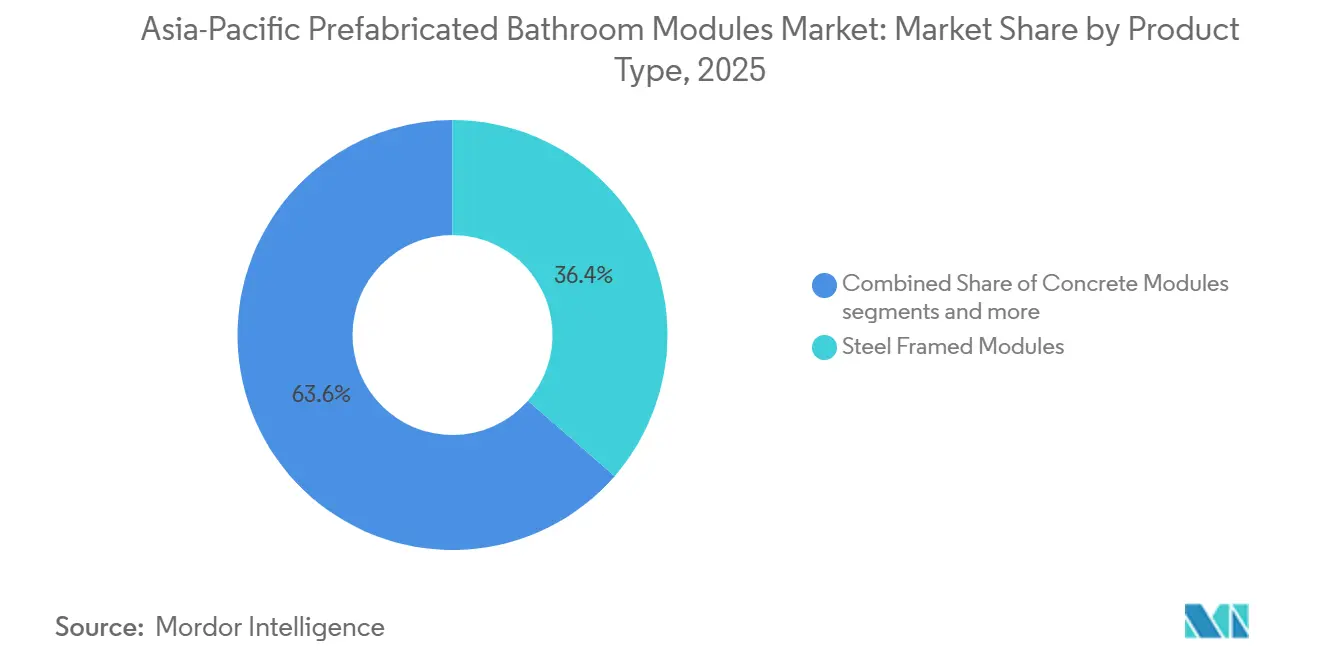
Steel framed modules held 36.40% of the Asia-Pacific prefabricated bathroom modules market share in 2025, making them the largest product type in the region. They remain the default choice for multi-story residential projects, premium hotels, and institutional buildings where structural rigidity, fire performance, and tile finish quality are important. Their position is also supported by the fact that many large projects still prefer a familiar structural base when shifting only selected building components into factory production. That makes steel a practical bridge between conventional construction habits and the broader adoption path of the Asia-Pacific prefabricated bathroom modules market.
Hybrid modules are projected to expand at 11.20% CAGR through 2031, giving them the fastest growth rate within the product mix. Their appeal lies in combining the acoustic and waterproofing strengths of concrete or sheet-molding compound (SMC) bases with the lighter logistics profile of steel-framed walls. The 2025 Buildings study identified SMC composite waterproof pans as a preferred modular bathroom floor substrate, with productivity nearing 100 press cycles per day and low operator dependence[2]Beomseok Kim et al., “Carbon Reduction Potential of Modular Bathroom Systems in the A1-A3 Life-Cycle Stages,” Buildings, doi.org. That production profile favors hybrid architecture because it balances factory efficiency with performance requirements more effectively than all-concrete alternatives. It also positions hybrid products strongly as the Asia-Pacific prefabricated bathroom modules industry responds to demand for better acoustics, lower defect rates, and easier installation and handling. Concrete modules still serve higher-specification projects that need strong acoustic insulation and fire resistance. Their use is more concentrated in markets where performance expectations justify the weight and handling burden. Glass-reinforced plastic (GRP) modules continue to hold space in budget hotels and student accommodation. However, their pricing position is under pressure as low-cost supply consolidates in parts of Greater China. Timber-based modules remain niche, but they are gaining notice in Australia and New Zealand, where sustainability-driven developers are combining bathroom pods with mass timber or cross-laminated timber (CLT)-led building concepts. This keeps product competition varied across the Asia-Pacific prefabricated bathroom modules market, even though scale continues to favor steel and fast-growing hybrid systems.


By Installation Type: New Build Anchors Volume While Retrofit and Renovation Accelerates Growth
New build installations accounted for 73.20% of the Asia-Pacific prefabricated bathroom modules market in 2025, making it the dominant installation format. That lead reflects the scale of greenfield housing delivery in China and India, as well as the large hotel construction pipeline across Southeast Asia. New build projects can integrate pod dimensions, access routes, crane planning, and structural openings from the design stage, which lowers coordination risk compared with later adoption. This design advantage should keep new build as the main revenue base of the Asia-Pacific prefabricated bathroom modules market throughout the forecast period.
Temporary and relocatable applications remain a smaller segment, but they have a clear use case in transitional housing, worker accommodation, and fast-response buildings. CIMC Modular Building Systems demonstrated this capability through its Kai Tak transitional housing project in Hong Kong, where an integrated bathroom pod design was paired with building information modeling (BIM)-led coordination of design, production, and installation. These applications do not match new build volume, but they help validate speed-driven procurement models that later influence broader project categories. They also show how delivery certainty remains a core selling point in the Asia-Pacific prefabricated bathroom modules market. Retrofit and renovation are forecast to grow at 10.60% CAGR through 2031, making it the fastest-expanding installation type. Japan offers the clearest example, where LIXIL expanded its Renobio Fit 2026 Spring range with additional unit sizes and configurations for apartment-renovation use. Australia is also improving the path to renovation adoption through consultation on a voluntary certification scheme for modern methods of construction, which can reduce friction in project-by-project compliance. Growth in this segment is closely linked to urban renewal and aging building stock in China, Japan, and South Korea, where replacement bathrooms can be installed with less disruption than traditional wet-trade rework.
By End User: Residential Remains the Largest Segment, Healthcare Expands the Fastest
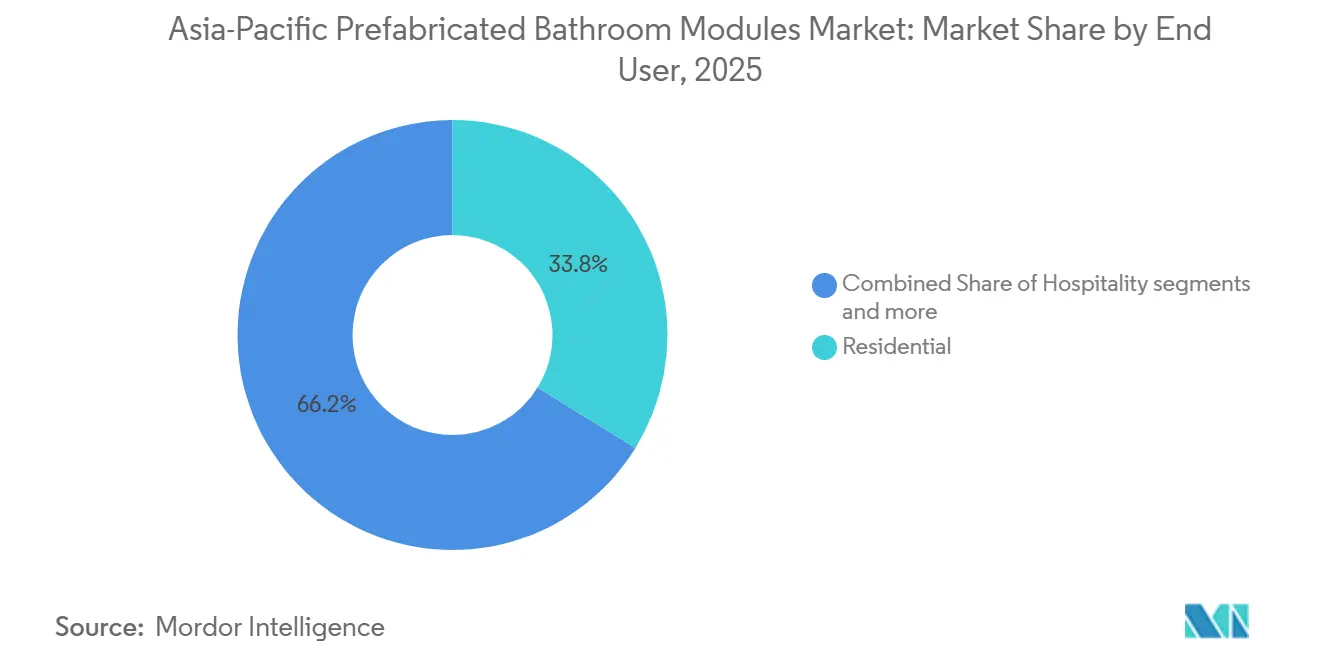
Residential held 33.80% of the Asia-Pacific prefabricated bathroom modules market in 2025, which made it the largest end-user segment by value. The main support comes from large housing pipelines in China and from PMAY-U-linked demand in India, where repeated layouts allow tooling investment to be spread over long production runs. Residential procurement also benefits from the fact that schedule delays in bathroom finishing can delay whole-unit handover, making standardized off-site production more attractive at scale. This keeps housing as the main volume anchor for the Asia-Pacific prefabricated bathroom modules market.
Hospitality remains the second major end-user category because room repetition, branded finish expectations, and launch timelines all favor pod-based delivery. Commercial offices form a smaller but steady pocket of demand, especially where modular bathrooms are bundled into wider interior fit-out programs. Other applications also continue to exist, but they do not match the scale or urgency seen in residential and hospitality. Still, the breadth of end users gives suppliers more than one route to volume in the Asia-Pacific prefabricated bathroom modules market. Healthcare is projected to rise at 10.90% CAGR through 2031, making it the fastest-growing end-user segment. Hospitals value antimicrobial wall surfaces, zero-gap waterproofing, chemical-resistant floor systems, and more consistent infection control, all of which favor factory-built products over site-built bathrooms. PUDA Industrial states that it supplies 80% of the hospital bathroom segment in Taiwan and has delivered more than 100,000 bathroom pods to date, which shows the commercial strength of focused healthcare specialization. The Hubei Third People's Hospital procurement case also shows that material durability under hospital disinfectants is becoming a direct buying factor. Vakio's 2025 agreement with Gaurs Group for 40,000 bathroom pods adds another sign that large-scale institutional procurement is becoming more accepted in the Asia-Pacific prefabricated bathroom modules market.
Geography Analysis
China accounted for 41.30% of the Asia-Pacific prefabricated bathroom modules market share in 2025, making it the largest regional demand center. Its position is tied to domestic housing volume, strong factory capacity, and a policy environment that is becoming increasingly supportive rather than less so. National and subnational efforts in prefabricated and intelligent construction are making bathroom modules easier to specify in formal procurement settings. China also has sufficient manufacturing depth to support both exports and domestic projects, and Xinhua reported that prefabricated building exports in Q1 2026 rose 45% year over year. Japan remains a mature market where established unit-bath adoption, certification discipline, and quality expectations continue to support demand even if volumetric growth is lower than in India or Southeast Asia.
India is the fastest-growing country in the Asia-Pacific prefabricated bathroom modules market, with the market size in India projected to expand at a 12.10% CAGR through 2031. The country has a strong housing pipeline, as PMAY-U had sanctioned 122.06 lakh homes across both phases and completed 96.02 lakh by November 2025, while PMAY-U 2.0 adds 10 million more homes and USD 27.1 billion in subsidies. Rising labor costs are also improving the economics of factory-made bathroom production for high-volume developers. Vakio's 2025 agreement with Gaurs Group for 40,000 bathroom pods set a visible benchmark for bulk procurement in India. Australia is moving forward through both demand and policy channels, with the National Construction Code 2025 released on May 1, 2026, and consultation on a voluntary certification pathway for modern methods of construction already in motion[3]Australian Building Codes Board, “Modern Methods of Construction,” Australian Building Codes Board, ncc.abcb.gov.au .
The rest of Asia-Pacific spans markets at different maturity levels, which gives the region both opportunity and uneven adoption speed. Vietnam, Malaysia, and Thailand are seeing continued hospitality and residential construction activity, which supports future demand for standardized bathroom systems. Indonesia and several other Southeast Asian markets still face fragmented local code structures, which slow the easy cross-market deployment of products. South Korea is becoming more relevant because building-sector emissions targets are giving greater weight to solutions that can lower embodied carbon and improve execution efficiency. That makes the broader Asia-Pacific prefabricated bathroom modules market attractive beyond the current core countries, even though certification complexity and logistics still shape how quickly suppliers can scale.
Competitive Landscape
The Asia-Pacific prefabricated bathroom modules market is moderately fragmented, with no single company controlling a dominant position across all countries, end users, and product formats. Japanese manufacturers such as LIXIL Housing Technology, Sekisui House, Daiwa House Industry, BSL Bath System, and Nakao Co. hold strong positions in quality-led domestic demand, supported by long-standing developer relationships and certified product ranges. Chinese suppliers, including CIMC Modular Building Systems, Broad Homes Industrial Group, CSCEC Modular Building, SALLY Technology, Hunan Xinling Housing Equipment, and Lesso Modular Building, compete from different bases, leveraging scale, export reach, and price competitiveness to serve both housing and hospitality projects. Taiwan-based PUDA Industrial specializes in institutional projects. It claims to supply 80% of Taiwan's hospital bathroom segment, highlighting how end-user specialization can still create strong local leadership even within a fragmented regional structure.
Competitive differentiation is increasingly centered on certification depth, factory process control, and end-user focus. LIXIL's Renobio Fit expansion in 2026 shows how established Japanese players are targeting retrofit demand with more tailored unit configurations rather than relying only on standard new-build volume. CIMC is using integrated project execution as a strategic lever, as seen in its BIM-driven Kai Tak transitional housing model and the award-winning Gibraltar Elderly Care Home project. Vakio's memorandum of understanding (MoU) with Gaurs Group for 40,000 bathroom pods also shows that scale partnerships are becoming a practical route to market entry and expansion in India. These moves show that the Asia-Pacific prefabricated bathroom modules market is not being driven solely by price.
Smaller regional players still have room to compete where local compliance support, design adaptation, or installation service matters more than pure volume. This is especially relevant in markets where imported products need to be adjusted to meet local code requirements or project-specific access constraints. Healthcare and aged-care bathrooms remain one of the clearest white spaces because buyers in those segments want hygiene-ready materials, traceable quality documentation, and reliable installation sequencing. That demand profile favors suppliers that can offer more than a standard catalog and can instead prove sector-specific credibility. Overall, the Asia-Pacific prefabricated bathroom modules market remains open enough for specialist growth. However, the strongest regional advantage still sits with manufacturers that combine production scale, certification credibility, and repeat-project execution.
Asia-Pacific Prefabricated Bathroom Modules Industry Leaders
Interpod Pty Ltd.
PIVOTek
PUDA Industrial
Erawet Sdn. Bhd.
SALLY Technology Co., Ltd.
- *Disclaimer: Major Players sorted in no particular order

Recent Industry Developments
- April 2026: CIMC Modular Building Systems received 2 honors at the Modular Building Institute's 2026 Awards of Distinction for the Gibraltar Elderly Care Home, an 11-story, 12,000-square-meter facility built from 226 precision-engineered, factory-finished modules with integrated bathroom pods, delivering 189 purpose-built resident suites.
- January 2026: CIMC Modular Building Systems completed the shipment of 63 precision-engineered modules for a high-end senior living facility in central England, with full on-site installation scheduled for completion within 2 weeks of delivery.
- July 2025: Australian Building Codes Board released an issues paper initiating a National Voluntary Certification Scheme for Manufacturers of Modern Methods of Construction, opening formal consultation on nationally consistent definitions and accreditation pathways for prefabricated building products, including bathroom modules.


Asia-Pacific Prefabricated Bathroom Modules Market Report Scope
The Asia-Pacific Prefabricated Bathroom Modules Market Report is Segmented by Product Type (Steel Framed Modules, Concrete Modules, Hybrid Modules, and More), Installation Type (New Build, and More), End User (Hospitality, Healthcare, Residential, Commercial Offices, and Others), and Country (China, Japan, India, Australia, and Rest of Asia-Pacific). The Market Forecasts are Provided in Terms of Value (USD).
| Steel Framed Modules |
| Concrete Modules |
| Hybrid Modules |
| Glass Reinforced Plastic Modules |
| Timber-Based Modules |
| New Build |
| Retrofit and Renovation |
| Temporary and Relocatable Units |
| Hospitality |
| Healthcare |
| Residential |
| Commercial Offices |
| Others |
| China |
| Japan |
| India |
| Australia |
| Rest of Asia-Pacific |
| By Product Type | Steel Framed Modules |
| Concrete Modules | |
| Hybrid Modules | |
| Glass Reinforced Plastic Modules | |
| Timber-Based Modules | |
| By Installation Type | New Build |
| Retrofit and Renovation | |
| Temporary and Relocatable Units | |
| By End User | Hospitality |
| Healthcare | |
| Residential | |
| Commercial Offices | |
| Others | |
| By Country | China |
| Japan | |
| India | |
| Australia | |
| Rest of Asia-Pacific |


Key Questions Answered in the Report
What is the 2026 value of Asia-Pacific prefabricated bathroom modules?
The Asia-Pacific prefabricated bathroom modules market is valued at USD 0.73 billion in 2026 and is forecast to reach USD 1.16 billion by 2031 at a 9.71% CAGR.
Which country leads demand in this space across Asia-Pacific?
China leads the region with 41.30% share in 2025, supported by strong manufacturing depth, large domestic demand, and expanding policy support for prefabrication
Which country is expanding the fastest through 2031?
India is the fastest-growing country at 12.10% CAGR through 2031, helped by PMAY-U 2.0, large housing demand, and rising labor cost pressure
Which product type currently holds the largest share?
Steel framed modules led the product mix with 36.40% share in 2025, while hybrid modules are growing the fastest at 11.20% CAGR through 2031.
Page last updated on:





