
Asia-Pacific Gold Analyzer Testing Solutions Market Size and Share
Market Overview
| Study Period | 2021 - 2032 |
|---|---|
| Forecast Data Period | 2027 - 2032 |
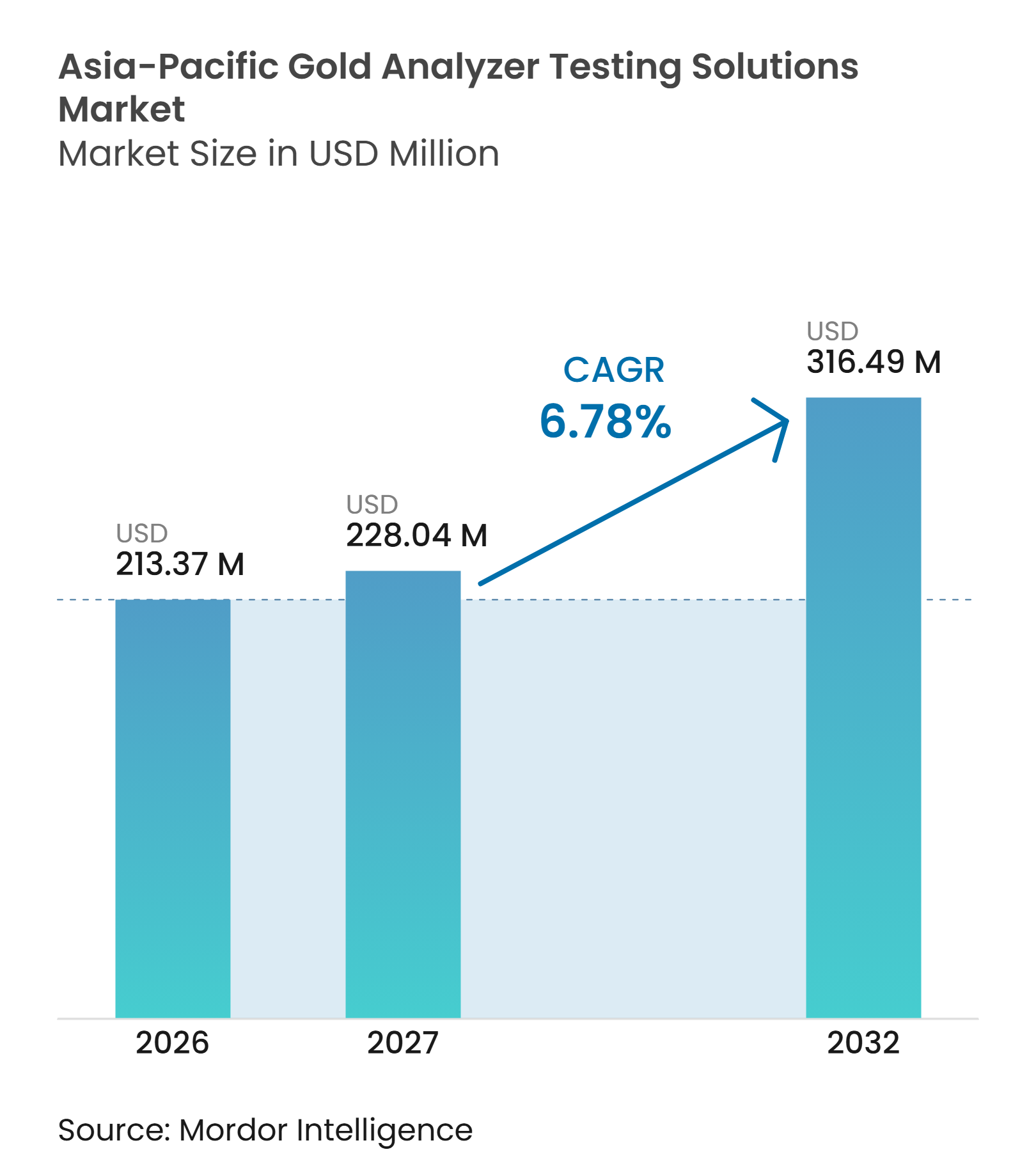
| Base Year Market Size (2026) | USD 213.37 Million |
| Market Size (2027) | USD 228.04 Million |
| Market Size (2032) | USD 316.49 Million |
| Growth Rate (2027 - 2032) | 6.78 % |
| Market Concentration | Medium |
Major Players *Disclaimer: Major Players sorted in no particular order Image © Mordor Intelligence. Reuse requires attribution under CC BY 4.0. | |
Asia-Pacific Gold Analyzer Testing Solutions Market Analysis by Mordor Intelligence
The Asia-Pacific gold analyzer testing solutions market size is expected to expand from USD 213.37 million in 2026 to USD 228.04 million in 2027 and is forecast to reach USD 316.49 million by 2032 at 6.78% CAGR over 2027-2032. Government requirements for purity certification are extending the use of professional testing equipment across major gold-consuming economies. Gold-backed lending rules are also making assay equipment a branch-level requirement for regulated lenders, rather than an optional quality-control tool. Higher gold values raise the financial consequences of errors, which supports spending on faster and more reliable verification. Secondary gold processing is becoming more formal, and refiners increasingly need digital records that connect testing with traceability. These conditions create openings for portable systems at retail and lending locations, as well as automated systems in laboratories and refineries.
Key Report Takeaways
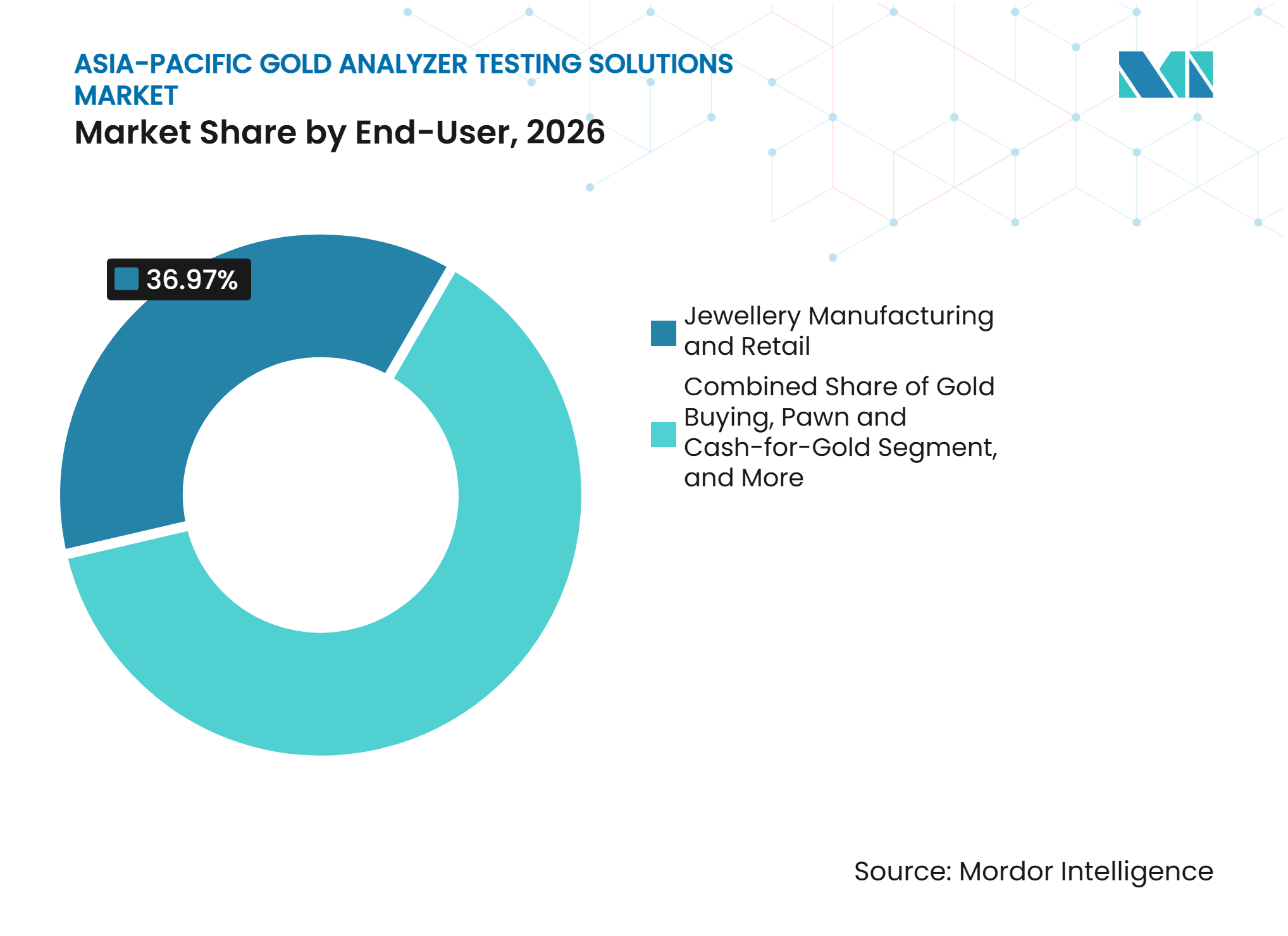
- By end-user, Jewellery Manufacturing and Retail held 36.97% of the Asia-Pacific gold analyzer testing solutions market share in 2026, while Assaying, Hallmarking and Testing is projected to expand at an 8.28% CAGR through 2032.
- By technology, X-Ray Fluorescence held 73.46% of the Asia-Pacific gold analyzer testing solutions market share in 2026 and is expected to expand at a 7.17% CAGR through 2032.
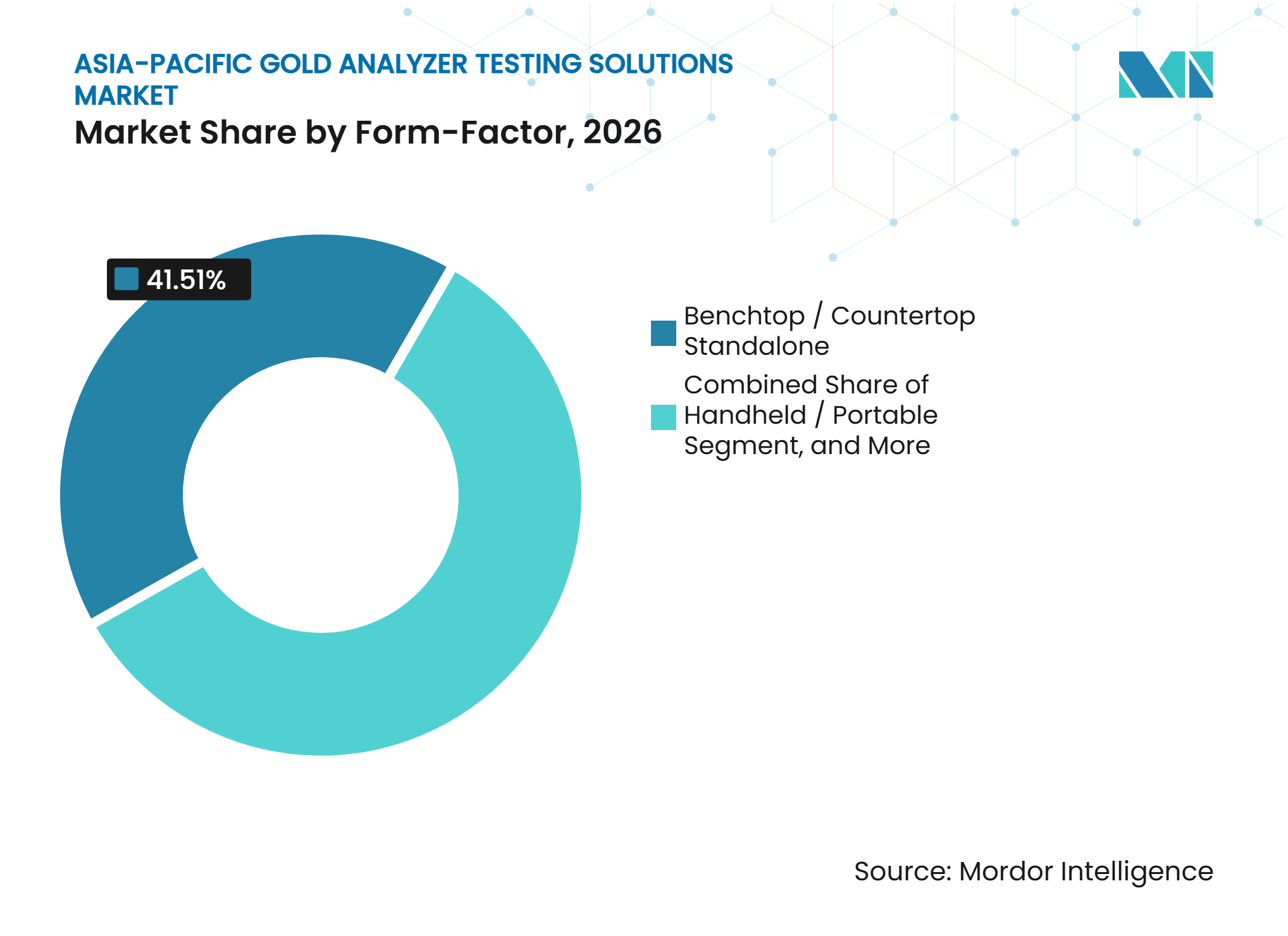
- By form factor, Benchtop and Countertop Standalone instruments accounted for 41.51% of the regional market in 2026, while Automated and Integrated Laboratory or Inline Systems are projected to expand at a 7.46% CAGR through 2032.
- By geography, China held 38.47% of the regional market in 2026, while India is projected to expand at a 7.69% CAGR through 2032.
Note: Market numbers in this report are based on Mordor Intelligence's proprietary estimation framework, which combines nine months of actuals with Q4 projections for base year 2026.
Market Trends and Insights
Drivers Impact Analysis of Asia-Pacific Gold Analyzer Testing Solutions Market*
| Driver | (~) % Impact on CAGR Forecast | Geographic Relevance | Impact Timeline |
|---|---|---|---|
| Gold Hallmarking and Purity Certification Regulations | +2.1% | India, China, Vietnam, Asia-Pacific-wide | Medium term (2-4 years) |
| Growth in Gold-Backed Lending and Bullion Trading | +1.4% | India, Singapore, Indonesia | Medium term (2-4 years) |
| Demand for Rapid and Non-Destructive Gold Purity Testing | +1.2% | Asia-Pacific core, with spillover to Southeast Asia | Short term (≤ 2 years) |
| Expansion of Gold Recycling and Refining Activities | +0.9% | China, Japan, India | Long term (≥ 4 years) |
| Gold Supply Chain Formalization and Traceability Requirements | +0.6% | China, ASEAN | Medium term (2-4 years) |
| Adoption of Portable XRF and Digital Assay Systems | +0.5% | India, Southeast Asia | Short term (≤ 2 years) |
| Source: Mordor Intelligence | |||
Gold Hallmarking and Purity Certification Regulations
Mandatory hallmarking creates demand for analytical equipment by establishing accredited testing centers and a recurring need to test each article. The Bureau of Indian Standards reported that mandatory hallmarking covered 392 districts, 236,624 registered jewelers, and 1,565 hallmarking centers as of August 2026.[1] The June 2026 operating guidelines also require that integrated weighing-balance and microbalance data be captured within the inward testing workflow. This requirement favors digital instruments over manual touchstone methods and raises demand for systems that can preserve complete test records. Smaller cities are likely to require compact equipment with low maintenance needs, while larger centers can justify high-throughput benchtop systems. Vietnam's 2025 gold business decree and China's 2025-2027 gold plan reinforce the move toward more formal certification and traceability across the Asia-Pacific gold analyzer testing solutions market.
Growth in Gold-Backed Lending and Bullion Trading
Gold-backed lending is creating a distinct institutional buying channel for assay equipment in the Asia-Pacific gold analyzer testing solutions market. The Reserve Bank of India issued its Master Directions on Lending against Gold and Silver Collateral in 2025, requiring regulated lenders to assess the purity of collateral before loan sanction and to provide an assay certificate.[2] The direction moves testing closer to the lending branch, which broadens the buyer base beyond jewelers, refiners, and hallmarking centers. It also makes standardized operating procedures important, as branch networks require consistent documentation and customer-facing verification. Indonesia introduced bullion banking services through Pegadaian and Bank Syariah Indonesia in February 2025, extending formal precious-metals infrastructure into Southeast Asia. Singapore's bullion market association has also identified collateral mobilization and verification as necessary parts of a deeper gold financing ecosystem.
Demand for Rapid and Non-Destructive Gold Purity Testing
The Asia-Pacific gold analyzer testing solutions market benefits from a shift away from acid and touchstone testing, which can damage valuable articles and slow customer service. The World Gold Council reported an LBMA PM gold price average of USD 4,262.2 per ounce in the third quarter of 2026, making avoidable material loss more costly for testing operators.[3] AMETEK SPECTRO introduced the SPECTROSCOUT kt in August 2026 with 30-90-second measurement cycles, 25-element alloy coverage, and silicon drift detector technology. Thermo Fisher Scientific introduced the Niton XL5e in January 2026, including a quick-sort mode that can reduce some scan times to 2 seconds. Evident's Vanta Element series adds cloud-based result management and rapid alloy identification for user settings such as jewelry counters and scrap sorting. Faster throughput can reduce queue times for pawnshops and cash-for-gold operators, even in the absence of a testing mandate.
Expansion of Gold Recycling and Refining Activities
The recycling and refining base supports demand for higher-specification laboratory and inline equipment in the Asia-Pacific gold analyzer testing solutions market. The World Gold Council stated that India's collateralized gold and China's old-gold-for-new exchanges reduce outright recycling flows, making formal channels especially important for the availability of recycled material. China's gold development plan requires recovery ledgers and transaction reporting, which brings recyclers and refiners into more traceable operating models. Global recycled gold supply declined year over year, and the World Gold Council described supply as broadly unresponsive to elevated prices. This creates a measured volume outlook; however, formal processing still requires dependable purity measurement. Inline verification can limit batch reclassification losses when refiners process high-carat material. TANAKA Precious Metals identifies trusted local relationships and technical development as central to its overseas precious-metal recycling activities.
Restraints Impact Analysis of Asia-Pacific Gold Analyzer Testing Solutions Market*
| Restraint | (~) % Impact on CAGR Forecast | Geographic Relevance | Impact Timeline |
|---|---|---|---|
| High Equipment Costs and Maintenance Requirements | -1.5% | Southeast Asia, tier-2 cities in India | Medium term (2-4 years) |
| XRF Surface-Bias and Sample-Heterogeneity Limitations | -0.8% | Asia-Pacific-wide | Long term (≥ 4 years) |
| Prevalence of Informal Gold Testing Practices | -0.6% | India, non-covered districts, Southeast Asia | Short term (≤ 2 years) |
| Fragmented Hallmarking Standards and Low-Cost Equipment Competition | -0.4% | China, ASEAN sub-markets | Long term (≥ 4 years) |
| Source: Mordor Intelligence | |||
High Equipment Costs and Maintenance Requirements
Acquisition cost remains a barrier for small hallmarking centers, rural jewelry retailers, and dispersed lending networks. Silicon drift detector-based benchtop systems offer higher capability than acid test kits, but their upfront cost is accompanied by calibration, detector, software, and servicing expenses. This can concentrate purchases among larger hallmarking chains and well-capitalized retailers. Smaller operators may choose outsourced testing or minimum-compliance equipment, which limits direct adoption in underpenetrated areas. The Bureau of Indian Standards' revised 2026 guidelines increase the need for digital workflow integration, which may require existing centers to upgrade rather than retain older systems. Suppliers that combine local service coverage, clear maintenance plans, and practical financing options may be better positioned in the cost-sensitive portion of the Asia-Pacific gold analyzer testing solutions market.
XRF Surface-Bias and Sample-Heterogeneity Limitations
XRF principally examines the upper surface of an item, so plating, oxidation, surface enrichment, and uneven composition can affect the result in the Asia-Pacific gold analyzer testing solutions market. A surface reading that matches a hallmarked caratage does not confirm bulk composition in every case. This limitation keeps fire assay relevant in accredited settings, despite the speed and convenience of XRF. ISO 15093 and ISO 18214 specify bulk measurement methods using ICP-OES and spark-OES for high-purity precious metals. Manufacturers are responding with deeper-penetration settings, multi-layer analysis software, and plating-detection functions, but these features require stronger calibration and may not be available in entry-level equipment. The parallel use of XRF and reference methods supports a broader testing ecosystem, while reducing the likelihood that XRF alone meets every regulatory need.
*Our forecasts treat driver/restraint impacts as directional, not additive. The impact forecasts reflect baseline growth, mix effects, and variable interactions.
Asia-Pacific Gold Analyzer Testing Solutions Market Segment Analysis
By End-User:
Hallmarking Centers Increase Demand for Specialized EquipmentJewellery Manufacturing and Retail held 36.97% of the regional market in 2026. The segment benefits from dense jewelry trading networks in China and India, where countertop XRF has increasingly replaced acid and touchstone methods for customer-facing checks. Retailers value an immediate result because it can support consumer confidence at the point of sale. Gold Refining, Recycling and Processing remains a high-value equipment segment, because laboratory and inline systems can command greater unit values than retail instruments. China's traceability rules are directing secondary processors toward certified analytical workflows. Gold Buying, Pawn and Cash-for-Gold operations maintain demand through high transaction volumes, particularly in India and Southeast Asia. Bullion Trading and Financial Institutions form a smaller segment, but lending requirements introduce a new institutional route for standardized equipment purchases.
Assaying, Hallmarking and Testing is projected to expand at an 8.28% CAGR through 2032. The Asia-Pacific gold analyzer testing solutions market size for this segment is supported by the expansion of accredited testing infrastructure in India, China, and Vietnam. BIS reported 1,561 gold hallmarking centers in October 2026, alongside HUID reporting and integrated weighing data requirements that require equipment upgrades across the installed base. Once a center adopts regulatory-grade equipment, it also requires calibration, software support, and periodic replacement services. This creates a more recurring relationship for suppliers than a single retail countertop sale. The SPECTROSCOUT kt was introduced for settings including hallmarking centers, showrooms, assay offices, and pawnshops. Suppliers therefore need both robust measurement performance and simple daily workflows for staff handling a large number of articles.



By Technology:
XRF Holds the Broadest Role Across Testing SettingsX-Ray Fluorescence accounted for 73.46% of the total regional market in 2026. It combines speed, non-destructive measurement, and cost efficiency across retail, hallmarking, refining, and lending applications. The share also understates its practical role because density, specific gravity, and conductivity methods commonly function as complementary checks rather than standalone substitutes. Portable systems are narrowing the historical gap between field-based and laboratory analysis. AMETEK SPECTRO's portable system uses silicon drift detector technology, while Thermo Fisher's Niton XL5e offers a faster scan mode for selected applications. These product features strengthen the role of XRF where customer wait time and operator simplicity matter.
XRF is also projected to expand at a 7.17% CAGR through 2032. Lower-cost portable energy-dispersive XRF forms can widen access among smaller hallmarking centers and cash-for-gold operators. Density and specific gravity methods remain useful for finding hollow or filled articles, where a surface reading alone cannot confirm total mass composition. Electrical and conductivity testing has a narrower role in screening plated items and some tungsten-cored counterfeits. The Asia-Pacific gold analyzer testing solutions market size is therefore not defined by a complete replacement of other techniques. Multi-method platforms that combine XRF with density measurement can serve customers that need a faster initial screen and an additional physical check. This configuration is especially relevant for accredited centers and refiners that must document their testing process. The lasting limitation of surface measurement helps preserve demand for reference methods and combined verification workflows.
By Form Factor:
Automation Supports High-Throughput VerificationBenchtop and Countertop Standalone instruments held 41.51% of the regional market in 2026. Their installed base reflects consistent calibration, larger sample chambers, and stable operating conditions in jewelry stores and hallmarking centers. The equipment suits settings where testing takes place at a fixed work counter and operators need repeatable workflows. Handheld units occupy the middle tier and give lending branches, growing hallmarking networks, and mobile buyers a more flexible option. The SPECTROSCOUT kt was designed for portable counter use in showrooms, hallmarking centers, and pawnshops. Thermo Fisher also stated that the Niton XL5e includes IP54-rated protection and wireless connectivity. These characteristics make portable equipment more suitable for demanding field conditions.
Automated and Integrated Laboratory or Inline Systems are projected to expand at a 7.46% CAGR through 2032. Refiners and recyclers are shifting from periodic batch sampling to continuous verification, which can lower per-item measurement costs and support a digital audit trail. China's traceability initiatives make recorded process data more relevant for downstream verification. High gold values strengthen the case for regular measurement because a small classification error on refined material can have a significant financial effect. The World Gold Council reported that the quarterly average gold price reached USD 4,262.2 per ounce in the third quarter of 2026. South Korea and Japan are relevant markets for advanced inline systems due to electronics recovery and precision manufacturing activity. Compact countertop systems with software-generated reports are also becoming a practical middle ground for centers that need traceable records without a full laboratory footprint.

Geography Analysis
China
China held 38.47% of the regional market in 2026. Its position reflects an integrated supply chain that reaches from mine output and refining to investment products, jewelry retail, and recycling. The Shanghai Hongkou Green Gold Traceability Center opened in January 2026 as a government-industry platform for supply-chain digitization and traceable sourcing. This infrastructure increases the importance of test records that can accompany material through later stages of the supply chain. The national 2025-2027 plan also requires recovery ledgers, transaction reporting, and assay center capability upgrades, with a target to increase gold and silver production by more than 5% by 2027. Domestic suppliers benefit from local distribution and service coverage in price-sensitive channels, while global companies retain an advantage where formal laboratory capability and documentation are required.
India
India is projected to expand at a 7.69% CAGR through 2032 in the Asia-Pacific gold analyzer testing solutions market. BIS hallmarking requirements and Reserve Bank of India lending rules create two related sources of demand for purity testing. BIS coverage reached 392 districts, and its scheme covers 7 gold caratages from 9K to 24KS. The Reserve Bank's 2025 directions require regulated lenders to assess gold and silver collateral before approving a loan. This extends equipment demand into branches located outside established jewelry and refining centers. India's silver HUID framework under IS 2112:2025 adds a further case for multi-metal equipment. Local manufacturers can compete through service proximity and familiarity with BIS workflows, while global suppliers are positioned for higher-value financial and accredited testing applications.
Japan, South Korea, Singapore, Vietnam, and Malaysia
Japan's organized urban mining activity creates demand for high-specification instruments used in precious-metal recovery from electronics. TANAKA Precious Metals identifies overseas partnerships and technical development as part of its approach to precious-metal recycling. South Korea's electronics and precision manufacturing base also supports benchtop and inline systems that can handle complex recovered materials. Singapore is developing bullion financing infrastructure, including MetaComp's May 2026 partnership with Matrixdock for tokenized gold collateral tied to LBMA-accredited physical bars and audited holdings. Vietnam's 2025 decree tightens the operating framework for licensed gold enterprises. Malaysia's Gold Industry Principles specify ISO-compliant fineness testing through ICP-OES or spark-OES under its assaying and hallmarking code. These compliance factors support laboratory-grade measurement in markets where bullion trading and formal gold business operations are becoming more structured.
Competitive Landscape
Market Concentration
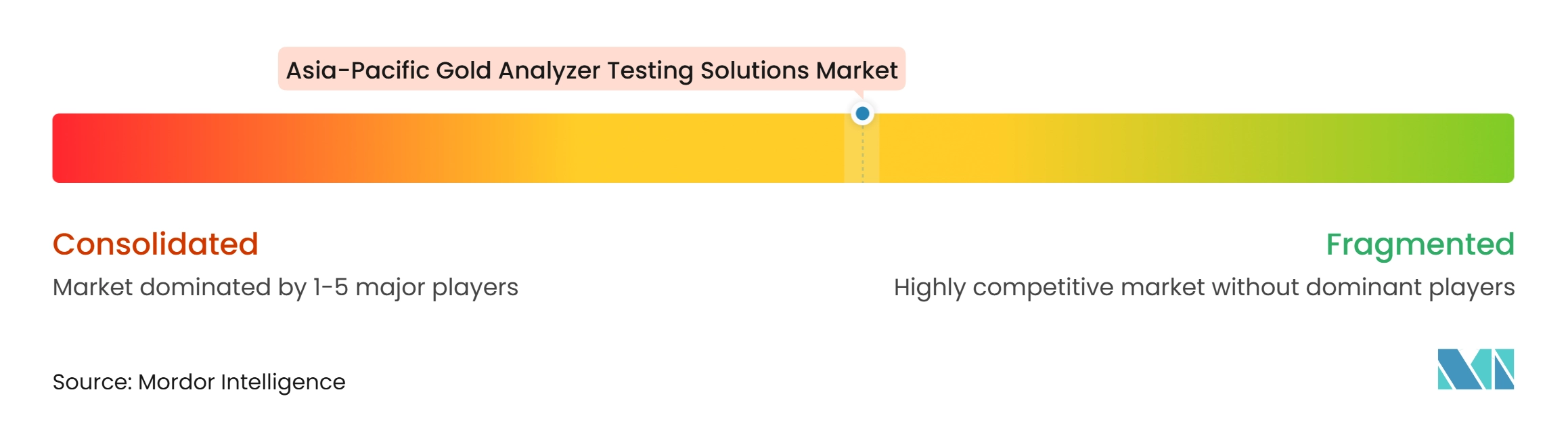
The Asia-Pacific gold analyzer testing solutions market is moderately fragmented. Global analytical instrument manufacturers occupy premium positions in accredited testing centers, refineries, and financial institutions. Their competitive strengths include analytical precision, silicon drift detector performance, software, service support, and the ability to meet formal documentation needs. Regional suppliers in India and China compete at more cost-sensitive price points for smaller hallmarking centers, cash-for-gold operators, and jewelry retailers. Their local service networks and familiarity with domestic workflows can reduce response time and ownership costs. This division keeps automated and laboratory-grade formats differentiated while basic countertop systems face more direct price competition.
Software and connectivity are becoming more important areas of competition in the Asia-Pacific gold analyzer testing solutions market. Evident introduced the Vanta Element series in January 2025 with Evident Connect cloud storage and browser-based result management. AMETEK SPECTRO introduced the SPECTROSCOUT kt in August 2026 for precious-metals analysis in hallmarking centers, showrooms, assay offices, and pawnshops. Thermo Fisher introduced the Niton XL5e in January 2026 with faster processing, enhanced light-metal sensitivity, and connectivity features.These launches show that suppliers are seeking to simplify operation, shorten testing cycles, and link results to digital records. China's traceability requirements and India's digital capture requirements favor companies that can provide an end-to-end documentation workflow.
Suppliers also have opportunities in automated inline systems for mid-sized recyclers, dual-metal analyzers for Indian gold and silver verification, and portable systems for emerging bullion finance networks. ISO 15093 and ISO 18214 remain relevant technical references for high-purity precious-metal determination. Manufacturers that can support conformance in certified testing settings may be better placed in higher-value procurement decisions. The Asia-Pacific gold analyzer testing solutions market still requires different product positions because a high-volume refinery, a jewelry counter, and a lending branch have different throughput, reporting, and budget needs. Global manufacturers are less exposed where they offer specialized applications, service programs, and integrated software. Regional manufacturers are likely to remain important where buyers prioritize affordability, local maintenance, and straightforward operation. This balance supports a moderately fragmented competitive structure rather than a market controlled by a small group of suppliers.
Asia-Pacific Gold Analyzer Testing Solutions Industry Leaders
-
Thermo Fisher Scientific Inc.
-
Bruker Corporation
-
Hitachi High-Tech Corporation
-
Evident Corporation
-
Helmut Fischer GmbH
- *Disclaimer: Major Players sorted in no particular order
Asia-Pacific Gold Analyzer Testing Solutions Market Companies Covered in this Report
- Thermo Fisher Scientific / Niton
- Hitachi High-Tech Analytical Science
- Helmut Fischer GmbH (Fischer India)
- Bruker Corporation
- Evident Scientific (formerly Olympus)
- AMETEK / SPECTRO (Nucleus XRF - authorized distributor)
- Arihant Maxsell Technologies / Maxsell (Indian)
- Microanalytik Instruments (Indian)
- Omio Technologies (Indian)
- Neo Instrument Co. (Indian)
- Jiangsu Skyray Instrument (Chinese - multiple India distribution channels)
- Guangdong Hongtuo Instrument Technology Co., Ltd. (Chinese)
Recent Industry Developments in Asia-Pacific Gold Analyzer Testing Solutions Market
- August 2026: AMETEK SPECTRO launched the SPECTROSCOUT kt portable ED-XRF analyzer for precious metals on its Japanese platform, offering 30-90-second measurement cycles, 25-element alloy coverage, 1 mm spot testing via integrated video system, and silicon drift detector technology previously confined to benchtop units. The instrument targets hallmarking centers, showrooms, assay offices, and pawnshops across Asia-Pacific.
- August 2026: India's Bureau of Indian Standards expanded mandatory gold hallmarking to 392 districts under the Third Amendment Order, 2026, adding 12 new districts and legally prohibiting non-hallmarked gold jewelry sales across the expanded network, requiring certified XRF and fire assay workflows at over 236,624 registered jewelers.
- May 2026: MetaComp Group, licensed by the Monetary Authority of Singapore, partnered with Matrixdock to offer tokenized gold collateral lending backed by LBMA-accredited physical bars stored in Singapore and Hong Kong vaults, with semiannual physical audits by Bureau Veritas, expanding institutional gold purity verification requirements in Southeast Asia's leading financial center.
- January 2026: Thermo Fisher Scientific launched the Niton XL5e Handheld XRF Analyzer, extending the Niton portfolio with IP54-rated field protection, faster processing, enhanced light-metal sensitivity, Light Metal Quick Sort mode reducing scan time to 2 seconds per sample, and Wi-Fi and Bluetooth connectivity. The company highlighted the product in its first-quarter 2026 filing as a high-impact innovation.
Asia-Pacific Gold Analyzer Testing Solutions Market Report Scope
The Asia-Pacific Gold Analyzer Testing Solutions Market comprises instruments, analytical systems, and related services for verifying the purity, composition, and authenticity of gold and other precious metals. These solutions support accurate testing, valuation, quality assurance, certification, and fraud detection across the gold ecosystem. Market growth is driven by increasing demand for reliable precious metal verification, rising gold trading and recycling activities, stricter quality standards, and technological advancements that enhance testing accuracy, speed, and operational efficiency.
The Gold Analyzer Testing Solutions Market is Segmented by End-User (Jewellery Manufacturing and Retail, Assaying, Hallmarking and Testing, Gold Refining, Recycling and Processing, Gold Buying, Pawn and Cash-for-Gold, and Bullion Trading and Financial Institutions (NBFCs and Banks)), Technology (X-Ray Fluorescence (XRF), Density / Specific Gravity Testing, Electrical / Conductivity / Resistivity Testing, and Other Technologies), Form Factor (Benchtop/Countertop Standalone, Handheld/Portable, and Automated / Integrated Laboratory or Inline Systems), and Country (China, India, Japan, South Korea, and Rest of Asia-Pacific). The Market Forecasts are Provided in Terms of Value (USD).
Segmentation Overview
| Jewellery Manufacturing and Retail |
| Assaying, Hallmarking and Testing (AHC Segment) |
| Gold Refining, Recycling and Processing |
| Gold Buying, and Pawn Cash-for-Gold |
| Bullion Trading and Financial Institutions (NBFCs and Banks) |
| X-Ray Fluorescence (XRF) |
| Density / Specific Gravity Testing |
| Electrical / Conductivity / Resistivity Testing |
| Other Technologies |
| Benchtop / Countertop Standalone |
| Handheld / Portable |
| Automated / Integrated Laboratory or Inline Systems |
| China |
| India |
| Japan |
| South Korea |
| Rest of Asia-Pacific |
| By End-User Segment | Jewellery Manufacturing and Retail |
| Assaying, Hallmarking and Testing (AHC Segment) | |
| Gold Refining, Recycling and Processing | |
| Gold Buying, and Pawn Cash-for-Gold | |
| Bullion Trading and Financial Institutions (NBFCs and Banks) | |
| By Technology | X-Ray Fluorescence (XRF) |
| Density / Specific Gravity Testing | |
| Electrical / Conductivity / Resistivity Testing | |
| Other Technologies | |
| By Form Factor | Benchtop / Countertop Standalone |
| Handheld / Portable | |
| Automated / Integrated Laboratory or Inline Systems | |
| By Country | China |
| India | |
| Japan | |
| South Korea | |
| Rest of Asia-Pacific |
Key Questions Answered in the Report
What is the Asia-Pacific gold analyzer testing solutions market size?
It is expected to increase from USD 213.37 million in 2026 to USD 228.04 million in 2027 and reach USD 316.49 million by 2032, at a 6.78% CAGR.
Which technology leads gold analyzer testing solutions in Asia-Pacific?
X-Ray Fluorescence leads with a 73.46% share in 2026 and is projected to expand at a 7.17% CAGR through 2032.
What is driving adoption of gold purity testing equipment in India?
Mandatory hallmarking and rules for lending against gold and silver collateral are widening demand from hallmarking centers to regulated lender branches.
Which end-user segment is expanding fastest through 2032?
Assaying, Hallmarking and Testing is projected to expand at an 8.28% CAGR, supported by accredited testing infrastructure and digital record requirements.
Why are automated gold analyzer systems being adopted?
Refiners and recyclers use automated systems for continuous verification, lower sampling-related risk, and digital audit records.
Which Asia-Pacific country holds the largest share of gold analyzer testing solutions?
China holds 38.47% of the regional share in 2026, supported by its integrated gold supply chain and traceability initiatives.