
Asia-Pacific Decorated Apparel Market Size and Share
Market Overview
| Study Period | 2021 - 2031 |
|---|---|
| Base Year Market Size (2025) | USD 11.76 Billion |
| Market Size (2026) | USD 13.10 Billion |
| Market Size (2031) | USD 22.77 Billion |
| Growth Rate (2026 - 2031) | 11.69 % |
| Fastest Growing Market | Asia-Pacific |
| Largest Market | North America |
Major Players *Disclaimer: Major Players sorted in no particular order Image © Mordor Intelligence. Reuse requires attribution under CC BY 4.0. | |
Asia-Pacific Decorated Apparel Market Analysis by Mordor Intelligence
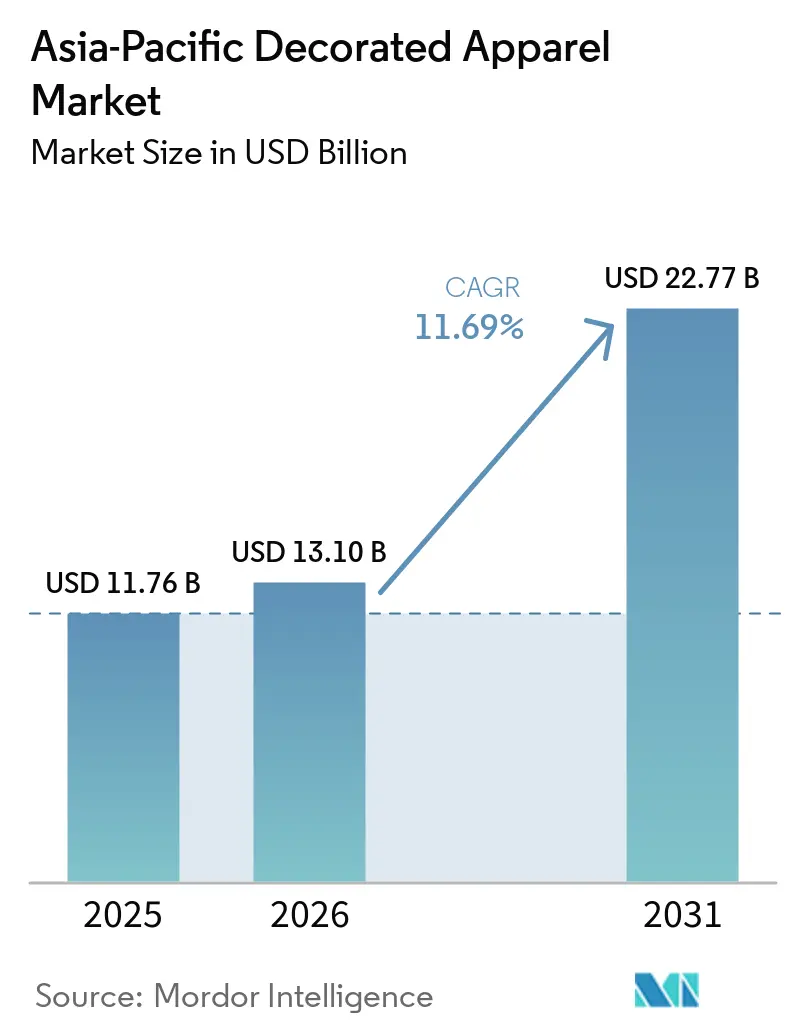
The Asia-Pacific Decorated Apparel Market size grow from USD 11.76 million in 2025 to USD 13.10 million in 2026, and is forecast to reach USD 22.77 million by 2031 at a 11.69% CAGR over 2026-2031. The Asia-Pacific decorated apparel market is driven by demand for personalized garments, faster digital ordering, and the region’s extensive textile manufacturing base. Embroidery remains a key decoration method, as corporate uniforms, ceremonial apparel, and gifting products require durable designs and a tactile finish. Online tools shorten the path from design selection to purchase, while offline suppliers remain relevant for institutional buyers that require physical quality inspections. The market remains fragmented, with sportswear brands, regional decorators, and direct-to-consumer platforms serving different countries, distribution channels, and customer segments.
Key Report Takeaways
- By decoration type, embroidery led the Asia-Pacific decorated apparel market with a share of 43.24% in 2025, while screen printing is anticipated to register the fastest CAGR of 12.93% during 2026-2031.
- By apparel type, sportswear retained a 38.43% share in 2025, and is forecast to expand at an 11.95% CAGR through 2031.
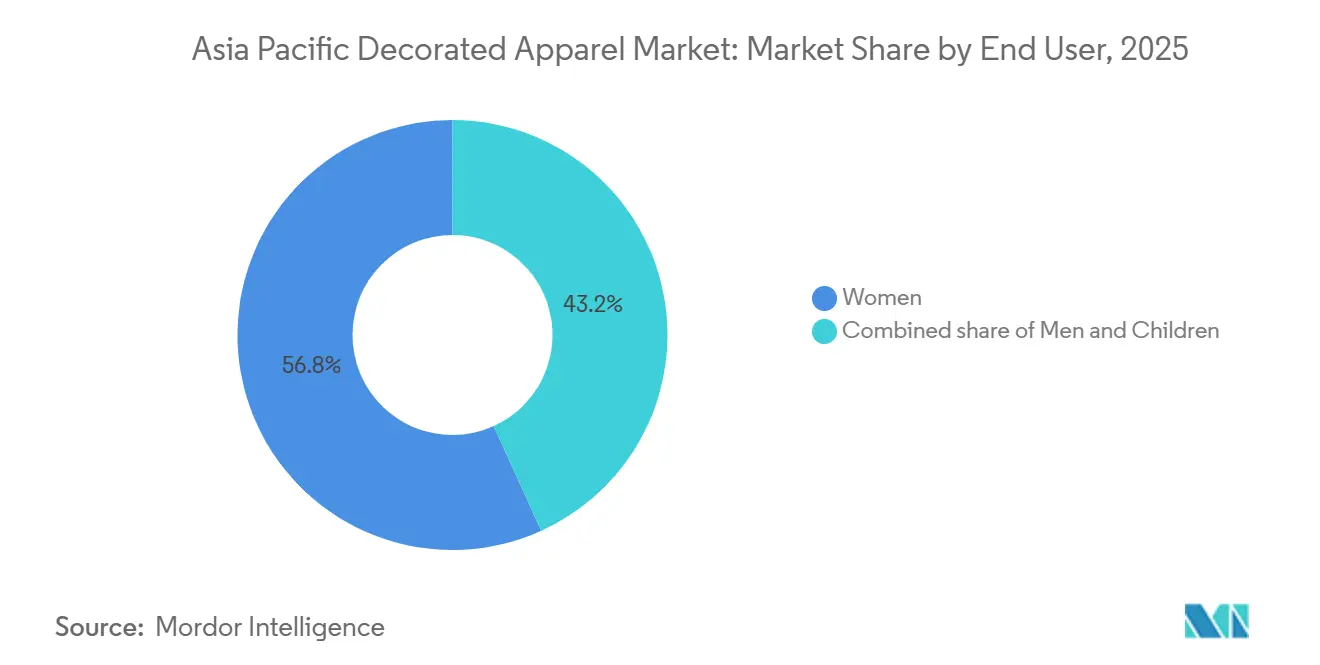
- By end user, women led the market with a share of 56.78% in 2025, whereas men is anticipated to register the fastest CAGR of 12.99% during 2026-2031.
- By distribution channel, offline led the market with a share of 45.45% in 2025, while online retail is anticipated to register the fastest CAGR of 14.29% during 2026-2031.
- By geography, China led the Asia-Pacific decorated apparel market in 2025 with a 34.12% share, while India is projected to advance at a 13.14% CAGR through 2031.
Note: Market size and forecast figures in this report are generated using Mordor Intelligence’s proprietary estimation framework, updated with the latest available data and insights as of January 2026.
Asia-Pacific Decorated Apparel Market Trends and Insights
Drivers Impact Analysis*
| Drivers | (~) % Impact on CAGR Forecast | Geographic Relevance | Impact Timeline |
|---|---|---|---|
| Rising demand for personalized and customized apparel | +2.3% | China, India, South Korea | Medium term (2-4 years) |
| Expansion of e-commerce and online customization | +2.0% | India, Indonesia, Vietnam | Short term (≤ 2 years) |
| Increasing demand for corporate, promotional, and event apparel | +1.2% | China, Japan, India, Singapore, Australia | Medium term (2-4 years) |
| Technological advancements in apparel decoration | +1.5% | China, Vietnam | Long term (≥ 4 years) |
| Cultural preference for embellished and traditional apparel | +0.8% | South Asia, Southeast Asia, Japan | Long term (≥ 4 years) |
| Strong textile and apparel manufacturing ecosystem in Asia-Pacific | +1.3% | China, India, Vietnam, Bangladesh | Medium term (2-4 years) |
| Source: Mordor Intelligence | |||
Rising demand for personalized and customized apparel
Demand for personalized apparel has become a key driver of the Asia-Pacific decorated apparel market, particularly among consumers seeking garments that reflect their personal interests, social groups, and local cultural preferences. Social media has shortened fashion cycles and expanded consumers’ ability to choose graphics, colors, and garment details. In India, China, and South Korea, small customized orders increasingly compete with standardized, high-volume production. Online shopping platforms convert interest in personalized designs into purchases by integrating customization options into the buying process. As a result, personalization has expanded decorated apparel beyond premium occasions to support more frequent purchases across emerging Asian economies. These purchases include everyday graphic apparel, team-related garments, and small gifts that consumers can order without lengthy production cycles.
Expansion of E-commerce and online customization
Online stores grow from 2026 to 2031 in the Asia-Pacific decorated apparel market, supported by accessible mobile shopping, platform-based product discovery, and simplified design-selection features. Digital storefronts enable buyers to review designs, place small orders, and reorder approved artwork more easily. Xtep reported cross-border e-commerce growth of more than 220% in 2025 through Shopee, TikTok, and Lazada in Southeast Asia. This performance demonstrates how platform sales can connect sports communities with repeat purchases of performance apparel. Online fulfillment also increases pressure on suppliers to minimize errors, manage lead times, and optimize material use. The channel is likely to become increasingly relevant as design tools and delivery services improve across Southeast Asia. Cross-border platforms can also help smaller brands test demand in neighboring countries before making broader retail commitments.
Increasing demand for corporate, promotional, and event apparel
Corporate uniforms, branded merchandise, and event apparel generate recurring order volumes in the Asia-Pacific decorated apparel market, as organizations require a consistent visual identity across employees, attendees, and promotional campaigns. These orders often favor screen printing and embroidery, as buyers need consistent logos across multiple garments. Conferences, corporate off-sites, and promotional campaigns further drive demand for standardized designs in larger production runs. Buyers in Japan, Singapore, India, China, and Australia also prioritize supplier reliability and sample approval before placing repeat orders. This demand pattern benefits decorators that can manage artwork, garment sourcing, and delivery through an integrated service model. It also supports the retention of offline relationships, particularly where institutional procurement requires physical inspection before committing to volume orders. Buyers seek assurance regarding fabric quality, logo placement, wash performance, and delivery consistency.
Technological advancements in apparel decoration
New printing and embroidery workflows are reshaping cost structures, production speed, and design flexibility in the Asia-Pacific decorated apparel market. These technologies enable suppliers to manage a greater variety of artwork while maintaining control over repeatable production processes. In 2025, Gildan introduced Plasma Print Technology to reduce or eliminate certain direct-to-garment pre-treatment requirements while improving ink coverage, vibrancy, and softness. These tools can shorten product launch cycles for suppliers that integrate them effectively. As a result, workflow design and software capabilities are becoming as important as printing equipment ownership. Digitally agile mid-sized operators can improve response times without matching the full asset base of larger manufacturers, provided they can integrate artwork approval, production scheduling, color management, and fulfillment into a reliable customer process.
Restraints Impact Analysis*
| Restraint | (~) % Impact on CAGR Forecast | Geographic Relevance | Impact Timeline |
|---|---|---|---|
| High production and decoration costs | -1.1% | Japan, Australia, South Korea | Short term (≤ 2 years) |
| High initial investment in advanced decoration equipment | -0.8% | India, Vietnam, Malaysia, Thailand | Medium term (2-4 years) |
| Volatility in raw material and decoration input prices | -0.6% | China, India, Vietnam | Short term (≤ 2 years) |
| Environmental regulations and sustainability compliance | -0.5% | China, India, Indonesia, Australia | Long term (≥ 4 years) |
| Source: Mordor Intelligence | |||
High production and decoration costs
High production and decoration costs limit operational flexibility for many suppliers in the Asia-Pacific decorated apparel market. Margins may remain constrained until companies invest in additional capacity, staff training, and more efficient operating processes. Labor, utilities, inks, garment blanks, and shipping increase the total cost of decorated apparel orders. This challenge is particularly significant in Japan, Australia, and South Korea, where customers maintain high quality expectations. Suppliers cannot always pass incremental costs on to buyers without affecting order volumes. This pressure is most evident in price-sensitive promotional and small-batch orders. Businesses with strong purchasing arrangements and repeat institutional customers are better positioned to manage these costs, as consistent order volumes improve visibility into material requirements and production scheduling while strengthening their ability to negotiate with suppliers.
High initial investment in advanced decoration equipment
Advanced direct-to-garment, dye-sublimation, and computerized embroidery equipment often require capital investments that smaller decorators cannot readily make, particularly when financing remains limited and order volumes are too inconsistent to support rapid payback. In February 2025, Printing United Alliance reported that decorated apparel businesses faced operating-cost inflation of 6.8%, while only 50.4% of respondents had raised prices proportionately [1]. This margin pressure can delay investment in higher-throughput or automated equipment. Larger operators can distribute equipment costs across higher order volumes and multiple locations. As a result, independent firms in India, Vietnam, Malaysia, and Thailand may retain older equipment for longer. This disparity can widen the capability gap between well-funded operators and single-location decoration shops, affecting print quality, turnaround times, product variety, and the ability to serve larger customers with complex order requirements.
*Our forecasts treat driver/restraint impacts as directional, not additive. The impact forecasts reflect baseline growth, mix effects, and variable interactions.
Segment Analysis
By Decoration Type: Embroidery Holds Ground While Screen Printing Surges
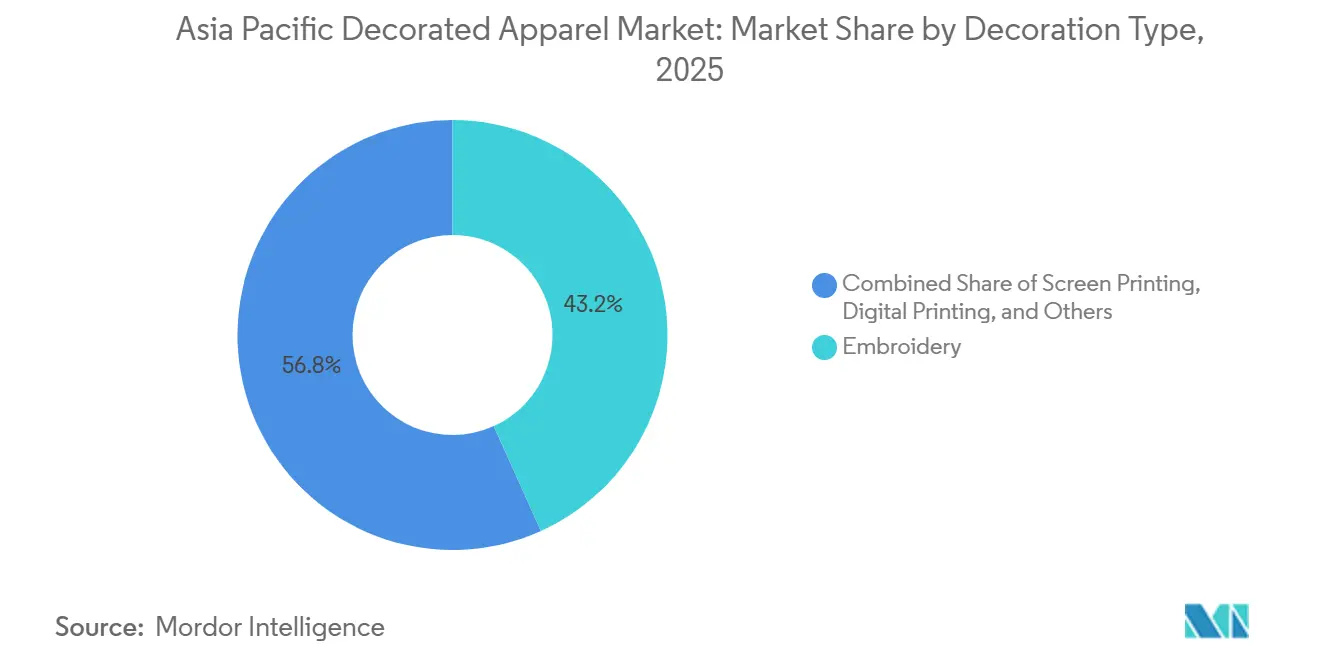
Embroidery account for a 43.24% share in 2025, while screen printing is forecast to grow at a CAGR of 12.93% through 2031. Embroidery maintains its leading position in corporate logo apparel, ceremonial textiles, and gifting apparel, where durability remains a key requirement. Multi-head computerized systems enable manufacturers to manage complex thread-color sequences efficiently at scale. This method suits institutional buyers that prioritize consistent branding and a distinctive visual finish. Screen printing benefits from demand for corporate gifts, team apparel, event merchandise, and other high-volume orders. Its cost per garment remains competitive when buyers standardize artwork and order volumes. The Asia-Pacific decorated apparel market will continue to require both methods, as they serve different order volumes and fabric requirements.
Screen-printing facilities also face evolving requirements for ink formulations and exhaust treatment. Digital printing and dye sublimation are gaining relevance for short production runs and on-demand orders. Dye sublimation enables vivid, all-over graphics on performance fabrics that conventional embroidery cannot replicate. This capability is particularly relevant for sportswear and other garments, where comfort influences decoration choices. Therefore, the Asia-Pacific decorated apparel industry uses a portfolio of decoration processes rather than relying on a single universal technology.

By Apparel Type: Sportswear Consolidates Dual Dominance
Sportswear accounts for a 38.43% share in 2025 and is expected to expand at an 11.95% CAGR through 2031. This leading position reflects demand for team kits, branded activewear, licensed club merchandise, and event apparel. Running, training, and outdoor products are expected to serve as the primary growth drivers across the region. Decorated performance garments function as brand-identity products rather than standard apparel, while their higher decoration intensity contributes to their prominence in the regional category mix. The Asia-Pacific decorated apparel market benefits from the intersection of sporting participation, fan culture, and digital retail.
Formal wear continues to support institutional programs in Japan, Singapore, and South Korea. Corporate dress codes and uniform procurement generate recurring orders for embroidered and printed business garments. Casual wear and nightwear or loungewear cater to athleisure and lifestyle demand but face more direct competition from standard fast-fashion alternatives. In contrast, sportswear has stronger links to community events, teams, and brand licensing. Xtep International Holdings report in 2025 that overseas Running Club membership has increased 34-fold to more than 7,000 members [2]. Such community programs can generate repeat demand without relying solely on discount promotions, supporting sportswear’s larger role in the Asia-Pacific decorated apparel market.
By End User: Women Anchor Volume, Men Drive Acceleration
Women accounted for 56.78% of end users in 2025, while the men’s segment is forecast to grow at a CAGR of 12.99% through 2031. Women’s purchasing patterns are driven by fashion embellishments, gifting occasions, and seasonal collections, particularly in the large urban markets of Japan, South Korea, and China. Weddings, festivals, and corporate gifting support repeat purchases across decorated apparel categories. Children also represent a stable end-user group, supported by demand for school uniforms and licensed character merchandise.
Growth in the men’s segment is concentrated in corporate, sportswear, and promotional orders. Increasing brand awareness in India and Southeast Asia supports demand for activewear and branded casual garments. Workplace apparel across the technology, logistics, and financial services industries can generate recurring institutional demand. Bulk orders reduce unit costs for buyers and create more predictable revenue streams for suppliers. Consequently, product development is likely to become more balanced across men’s and women’s ranges. The Asia-Pacific decorated apparel market offers opportunities for suppliers that cater to both personal and organizational use cases.
By Distribution Channel: Offline Holds Volume, Online Resets Economics
Offline stores hold a 45.45% share in 2025, while online stores are forecast to grow at a 14.29% CAGR through 2031. Physical locations remain valuable for corporate and institutional buyers that need to assess fabric, color, decoration quality, and garment fit. Specialty stores and local print and embroidery outlets also maintain repeat business-to-business relationships. This role is particularly important in Japan, South Korea, and Australia, where quality verification may form part of the procurement process. The expansion of online channels indicates that physical retail can continue to support product discovery and trials for brands that initially operate online. Offline sales volumes are expected to remain significant, even as the channel's share changes over the forecast period.
Online ordering is reshaping the economics of small-batch decorated apparel through design tools, platform integration, and print-on-demand fulfillment. VistaPrint launched AI Logomaker in March 2026, providing print-ready logos that integrate with its product-ordering workflow. Direct-to-consumer websites enable companies to retain customer data and simplify design reordering. Third-party platforms remain important for discovery-driven and price-sensitive purchases in Southeast Asia. Online channels will continue to gain importance as fulfillment reliability and customization interfaces improve. Therefore, the Asia-Pacific decorated apparel market is likely to maintain a mixed distribution channel structure.
Geography Analysis
China account for a 34.12% share in 2025, making it the largest country in the Asia-Pacific decorated apparel market. Manufacturing clusters in Guangdong and Zhejiang integrate apparel finishing with decoration capabilities. Domestic demand in China is shifting toward branded and premium sportswear products. Japan and South Korea form a premium cluster for corporate embroidery, gift-oriented products, and custom sportswear. Adidas record 14% currency-neutral growth in Japan and South Korea in 2025. Quality standards and procurement expectations will remain important competitive factors in these markets.
India is projected to grow at a CAGR of 13.14% from 2026 to 2031, the fastest growth rate among countries in the Asia-Pacific decorated apparel market. The PM MITRA initiative includes seven integrated parks that connect textile production with garment manufacturing. These developments can support closer coordination between fabric supply and decoration finishing. Vietnam and Malaysia are emerging as both production and demand centers. Southeast Asian sportswear brands are also expanding their distribution presence across the region.
Australia has a premium customer base for corporate branding, conferences, and sporting events. Singapore’s event activity supports demand for high-value custom apparel associated with business gatherings. Thailand and Malaysia are expanding domestic consumption alongside manufacturing activity and improved e-commerce logistics. Indonesia, the Philippines, and Bangladesh offer a significant future volume base for the Asia-Pacific decorated apparel market. Indonesia’s urban workforce and corporate activity can support demand for branded workplace and promotional garments. Regulatory requirements related to water use, emissions, and product processes will remain important across the regional production base.
Competitive Landscape
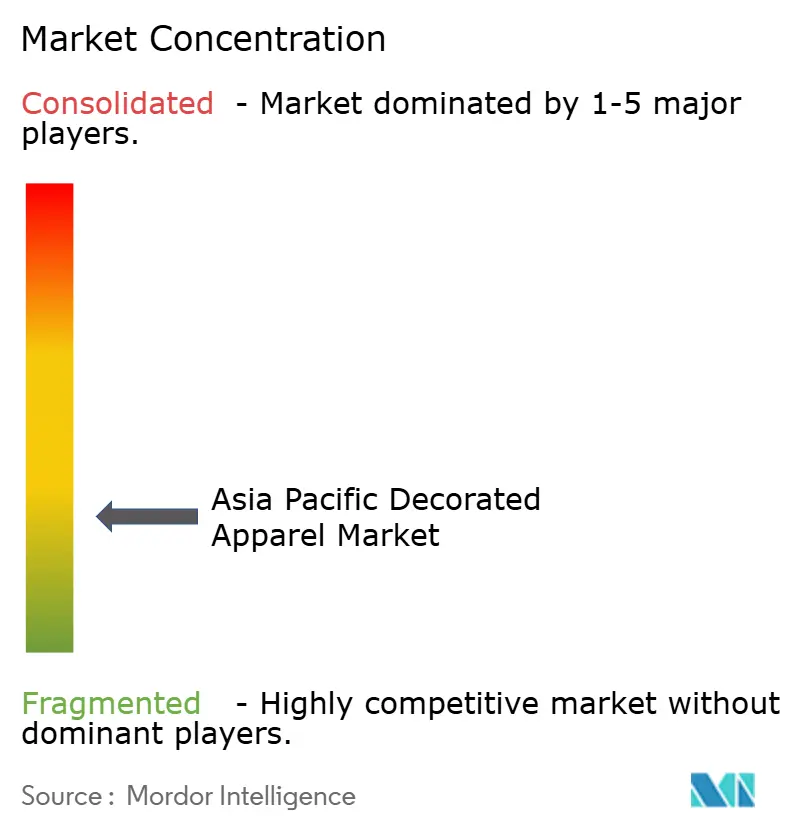
The Asia-Pacific decorated apparel market remains fragmented across countries and product formats. No single participant has a decisive presence across the regional supply chain and customer base. Global sportswear brands, regional decorators, and domestic direct-to-consumer platforms hold distinct competitive positions. Global brands emphasize retail experiences, licensing, and brand communities, while regional specialists compete through manufacturing scale, event participation, and local distribution.
361 Degrees is the official supplier for the Aichi-Nagoya 2026 Asian Games and provides outfits for more than 32,000 volunteers. This association provides the brand with a visible platform to showcase its sportswear and decoration capabilities. VistaPrint also uses digital design tools to reduce the time between a small business concept and an apparel order. These approaches demonstrate that community access, event visibility, and digital ordering represent relevant differentiation strategies. They also create opportunities for local suppliers that can combine service, quality control, and efficient fulfillment.
Compliance is emerging as another competitive factor in the Asia-Pacific decorated apparel market. China issue an updated textile water-pollutant discharge standard in June 2026, which will affect dyeing, printing, and finishing operations [3]. Suppliers with documented controls for inks, dyes, wastewater, and production processes may be better positioned to serve export and institutional channels. Fragmentation is likely to persist because these capabilities remain unevenly distributed across countries and companies. The market concentration score remains consistent with a competitive landscape in which specialized and local participants retain meaningful roles.
Asia-Pacific Decorated Apparel Industry Leaders
-
VistaPrint
-
Lynka
-
Gildan Activewear Inc.
-
Bewakoof
-
VF Corporation
- *Disclaimer: Major Players sorted in no particular order
Recent Industry Developments
- April 2026: 61 Degrees launched the outfits for the Aichi-Nagoya 2026 Asian Games in Nagoya, Japan. Marking its fifth consecutive involvement with the Asian Games, the company will provide branded sportswear and accessories for torchbearers, escort runners, and more than 32,000 volunteers at the Games.
- March 2026: VistaPrint launched AI Logomaker by VistaPrint, a generative AI design tool that enables small businesses to create professional, print-ready logos and integrates directly with VistaPrint’s decorated apparel ordering workflow.
- April 2025: The Souled Store completed the acquisition of Redwolf, a pop culture merchandise brand specializing in indie-licensed graphic-decorated apparel. The acquisition expanded The Souled Store’s licensing portfolio and consolidated two licensed decorated apparel operators under a single omnichannel brand.
Asia-Pacific Decorated Apparel Market Report Scope
Decorated apparel includes clothing enhanced with designs, logos, graphics, patterns, or embellishments through techniques such as embroidery, screen printing, digital printing, heat transfer, and dye sublimation.
The Asia-Pacific decorated apparel market is segmented by decoration type, apparel type, end user, distribution channel, and country. By decoration type, the market is segmented into embroidery, screen printing, digital printing, dye sublimation, and others. By apparel type, the market is segmented into formal wear, casual wear, sportswear, nightwear/loungewear, and others. By end user, the market is segmented into men, women, and children. By distribution channel, the market is segmented into offline Stores (specialty stores, custom print/embroidery stores, and other offline distribution channels) and online stores (third party retailers and direct-to-consumer websites). Based on country, the market is classified into China, Japan, India, Australia, South Korea, Vietnam, Malaysia, Thailand, Singapore, and Rest of Asia-Pacific. The Market Forecasts are Provided in Terms of Value (USD).
| Embroidery |
| Screen Printing |
| Digital Printing |
| Dye Sublimation |
| Others |
| Formal Wear |
| Casual Wear |
| Sportswear |
| Nightwear/Loungewear |
| Others |
| Men |
| Women |
| Children |
| Offline Stores | Specialty Stores |
| Custom Print/Embroidery Stores | |
| Others Offline Distribution Channels | |
| Online Stores | Third Party Retailers |
| Direct-To-Consumers Websites |
| China |
| Japan |
| India |
| Australia |
| South Korea |
| Vietnam |
| Malaysia |
| Thailand |
| Singapore |
| Rest of Asia-Pacific |
| By Decoration Type | Embroidery | |
| Screen Printing | ||
| Digital Printing | ||
| Dye Sublimation | ||
| Others | ||
| By Apparel Type | Formal Wear | |
| Casual Wear | ||
| Sportswear | ||
| Nightwear/Loungewear | ||
| Others | ||
| By End User | Men | |
| Women | ||
| Children | ||
| By Distribution Channel | Offline Stores | Specialty Stores |
| Custom Print/Embroidery Stores | ||
| Others Offline Distribution Channels | ||
| Online Stores | Third Party Retailers | |
| Direct-To-Consumers Websites | ||
| By Country | China | |
| Japan | ||
| India | ||
| Australia | ||
| South Korea | ||
| Vietnam | ||
| Malaysia | ||
| Thailand | ||
| Singapore | ||
| Rest of Asia-Pacific | ||
Key Questions Answered in the Report
What is the current and projected size of the Asia-Pacific Decorated Apparel Market?
The Asia-Pacific Decorated Apparel Market was valued at USD 11.76 billion in 2025 and is expected to grow to USD 13.10 billion in 2026 and further reach USD 22.77 billion by 2031, registering a CAGR of 11.69% during 2026-2031.
Which decoration type held the largest market share in 2025?
Embroidery was the leading decoration type in 2025, accounting for 43.24% of the Asia-Pacific Decorated Apparel Market.
What is the fastest-growing decoration type segment through 2031?
Screen Printing is expected to be the fastest-growing decoration type segment, with a CAGR of 12.93% from 2026 to 2031.
Which apparel type dominated the market in 2025?
Sportswear held the largest share of the market in 2025, representing 38.43% of total revenue.
Which end-user segment accounted for the largest market share in 2025?
The Women segment led the market in 2025, capturing 56.78% of the total market share.
Which distribution channel was the largest in 2025?
The Offline distribution channel dominated the market in 2025 with a 45.45% market share.
Which country held the largest share of the Asia-Pacific Decorated Apparel Market in 2025?
China was the largest country-level market in 2025, accounting for 34.12% of the regional market.