
Asia-Pacific Data Center UPS and Battery Supply Chain Market Size and Share
Market Overview
| Study Period | 2021 - 2032 |
|---|---|
| Forecast Data Period | 2027 - 2032 |
| Base Year Market Size (2026) | USD 3.60 Billion |
| Market Size (2027) | USD 4 Billion |
| Market Size (2032) | USD 6.91 Billion |
| Growth Rate (2027 - 2032) | 11.57 % |
| Market Concentration | Medium |
Major Players *Disclaimer: Major Players sorted in no particular order Image © Mordor Intelligence. Reuse requires attribution under CC BY 4.0. | |
Asia-Pacific Data Center UPS and Battery Supply Chain Market Analysis by Mordor Intelligence
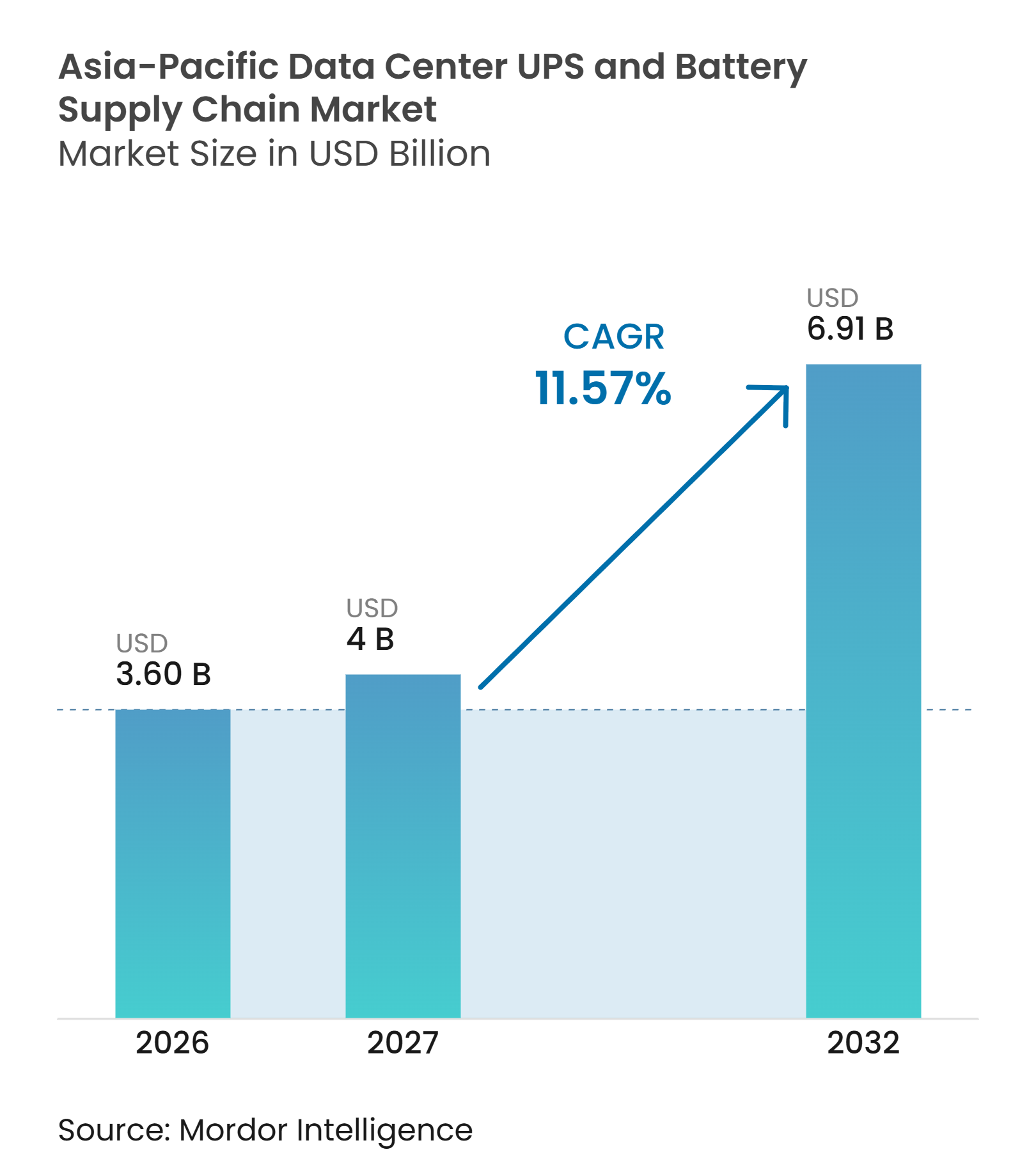
The Asia-Pacific data center UPS and battery supply chain market size is projected to expand from USD 3.60 billion in 2026 and USD 4 billion in 2027 to USD 6.91 billion by 2032, registering a CAGR of 11.57% during the forecast period (2027-2032). The regional development pipeline reached 26,455 MW in the first half of 2026, including 7,103 MW of added capacity, which increases demand for dependable backup power across new facilities. AI racks are being specified from 20 kW to more than 100 kW per rack, placing conventional UPS designs under greater pressure and raising requirements for power quality, controls, and battery performance. This shift shortens replacement cycles for systems designed for traditional IT loads and supports refresh activity across capacity classes. Data center operators are also facing higher efficiency requirements in Singapore, China, and India, which lifts the minimum specification for new power infrastructure. These conditions support sustained demand in the Asia-Pacific data center UPS and battery supply chain market as hyperscale construction, AI deployment, and efficiency requirements occur at the same time.
Key Report Takeaways
-
By UPS type, online (double-conversion) UPS systems held 92.33% revenue share in the Asia-Pacific data center UPS and battery supply chain market in 2026 and are projected to expand at a 12.55% CAGR through 2032.
-
By UPS capacity, systems above 500 kVA accounted for 59.87% of the Asia-Pacific data center UPS and battery supply chain market size in 2026 and are projected to expand at a 12.98% CAGR through 2032.
-
By battery chemistry, lithium-ion batteries held 65.43% revenue share in 2026 and are projected to expand at a 14.96% CAGR through 2032.
-
By battery application, UPS backup batteries held 88.51% revenue share in 2026, while other batteries are projected to expand at a 14.32% CAGR through 2032.
-
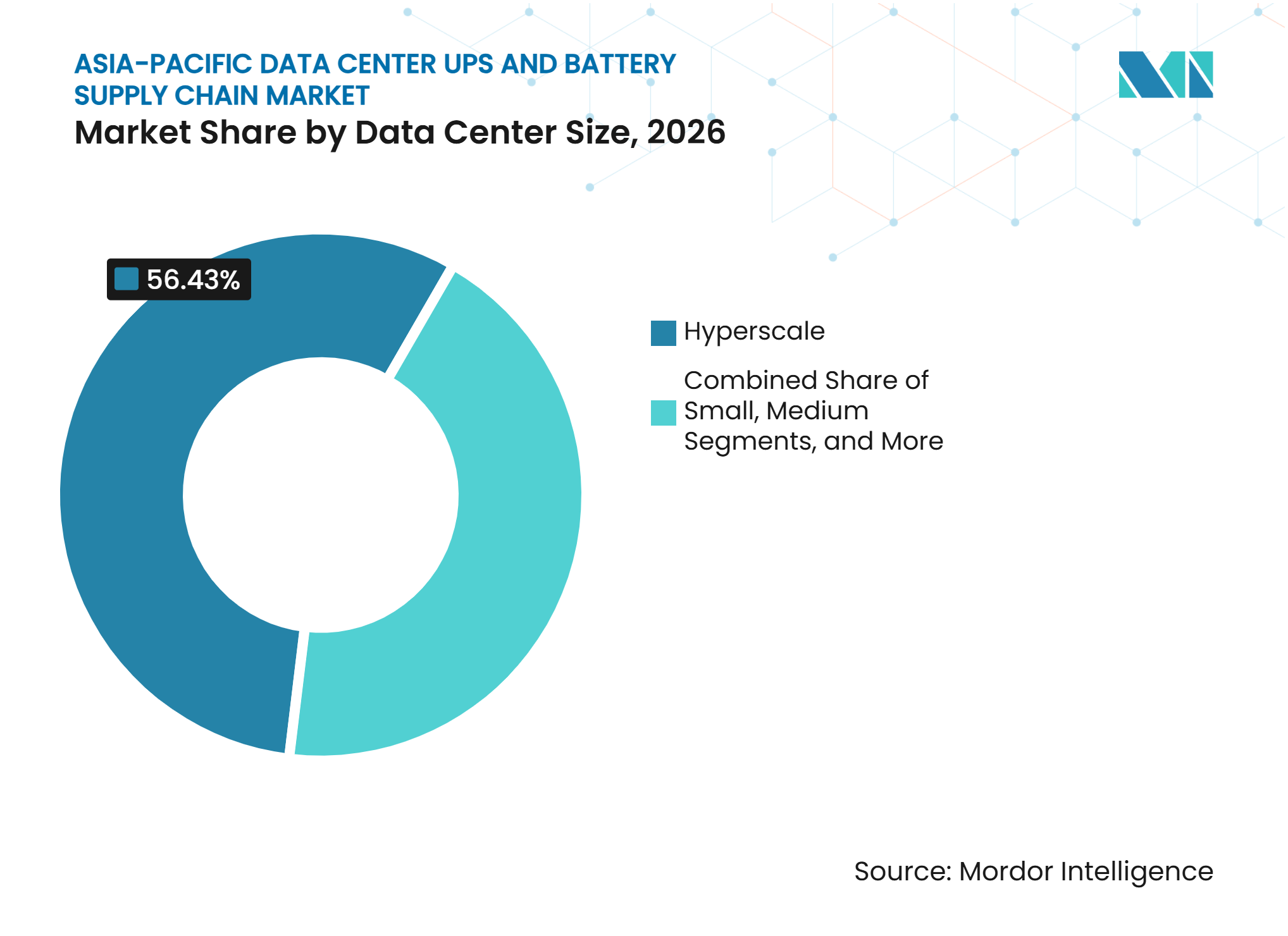
By data center size, hyperscale facilities held 56.43% revenue share in 2026 and are projected to expand at a 12.73% CAGR through 2032.
-
By data center type, cloud service providers held 41.78% revenue share in 2026 and are projected to expand at a 13.43% CAGR through 2032.
-
By country, China held 29.66% revenue share in 2026, while India is projected to expand at a 15.51% CAGR through 2032.
Note: Market numbers in this report are based on Mordor Intelligence's proprietary estimation framework, which combines nine months of actuals with Q4 projections for base year 2026.
Market Trends and Insights
Drivers Impact Analysis of Asia-Pacific Data Center UPS and Battery Supply Chain Market*
| Driver | (~) % Impact on CAGR Forecast | Geographic Relevance | Impact Timeline |
|---|---|---|---|
| Hyperscale and AI Data Center Campus Construction | +3.8% | China, India, Southeast Asia | Short term (≤ 2 years) |
| Cloud, 5G, and Rising Rack Power Density | +3.1% | China, Japan, South Korea, India | Short term (≤ 2 years) |
| Digital-Economy and Data-Sovereignty Incentives | +1.9% | India, China, Vietnam, Southeast Asia | Medium term (2-4 years) |
| Edge Micro-Data-Center Proliferation | +1.2% | Asia-Pacific tier-2 and tier-3 cities | Medium term (2-4 years) |
| Grid-Connection Delays Driving Onsite Microgrids | +0.7% | Singapore, Japan, Australia | Medium term (2-4 years) |
| Factory-Prefabricated UPS and Battery Integration | +0.5% | China, India, Southeast Asia | Short term (≤ 2 years) |
| Source: Mordor Intelligence | |||
Hyperscale and AI Data Center Campus Construction
Hyperscale campus construction raises both the number of UPS systems required and the standard expected from each system. India had investment commitments exceeding USD 180 billion by September 2026, while operating data center capacity was nearing 2.0 GW by year-end. This construction activity creates larger equipment orders and favors suppliers able to support consistent delivery across a full campus. Operators are specifying AI-ready UPS controls during design, rather than adding them after commissioning. That approach raises the role of power controls, battery monitoring, and integration support in the Asia-Pacific data center UPS and battery supply chain market. It also makes product qualification and local service capacity more important for major project awards.
Cloud, 5G, and Rising Rack Power Density
Cloud migration and 5G deployment increase power demand across both large data centers and distributed computing sites. AI racks specified from 20 kW to more than 100 kW require backup systems that can manage faster and larger load changes. This requirement reduces the suitability of static UPS designs intended for conventional server loads. Higher-density installations also shorten replacement cycles because earlier systems may not support newer power profiles. Suppliers with validated systems for GPU-heavy workloads can address a distinct requirement among cloud providers and newer computing platforms. The Asia-Pacific data center UPS and battery supply chain market therefore benefits from both new construction and replacement demand.
Digital-Economy and Data-Sovereignty Incentives
Digital-economy programs and data-sovereignty rules encourage more processing capacity to be built within national borders. India notified its Digital Personal Data Protection Rules in November 2025, providing a policy setting that supports local data handling and related infrastructure investment.[1] Local capacity requirements can strengthen demand for backup power equipment because data centers need uninterrupted operations regardless of location. These policies can also favor suppliers with regional manufacturing, assembly, and service capabilities. In China, India, Vietnam, and Southeast Asia, procurement can become less uniform as operators respond to domestic rules and project incentives. The resulting variation gives the Asia-Pacific data center UPS and battery supply chain market a wider set of local design and supply requirements.
Edge Micro-Data-Center Proliferation
Edge facilities in tier-2 and tier-3 cities require a different purchasing model from hyperscale campuses. Their smaller footprints favor modular equipment that can be delivered, tested, and installed with limited on-site work. This supports demand for factory-prefabricated UPS pods and catalog-based power solutions. South Korea advanced a KRW 27.3 billion initiative, equivalent to USD 20 million, to develop micro-data-centers with domestic AI semiconductors in non-metropolitan locations. These installations can move purchasing decisions toward vendors with readily available modular systems and field support beyond capital cities. The Asia-Pacific data center UPS and battery supply chain market can therefore gain from a broader geographic spread of digital infrastructure.
Restraints Impact Analysis of Asia-Pacific Data Center UPS and Battery Supply Chain Market*
| Restraint | (~) % Impact on CAGR Forecast | Geographic Relevance | Impact Timeline |
|---|---|---|---|
| High Upfront Capex for High-Efficiency Power Systems | -2.1% | India, Southeast Asia | Short term (≤ 2 years) |
| Power-Electronic Component Supply-Chain Volatility | -1.6% | Taiwan, Japan, South Korea | Short term (≤ 2 years) |
| Grid and Land Constraints in Tier-1 Asia-Pacific Hubs | -1.0% | Singapore, Japan, Australia | Long term (≥ 4 years) |
| Skilled-Labor Gap for Liquid-Cooling Power Installations | -0.6% | India, Southeast Asia | Medium term (2-4 years) |
| Source: Mordor Intelligence | |||
High Upfront Capex for High-Efficiency Power Systems
High-efficiency power systems require more capital at the start of a project, especially when operators replace VRLA batteries with lithium-ion systems or modular UPS platforms. The stated premium of 30-50% over conventional systems can be difficult for mid-tier colocation operators to fund. This challenge is more visible in India and Southeast Asia, where long-term financing can be limited. Singapore requires newly approved data centers to meet a power usage effectiveness level below 1.3, which can require higher-specification equipment. Smaller operators may consider second-life electric-vehicle batteries when budget pressure is high. That decision can introduce uncertainty over battery quality and cycle life within the Asia-Pacific data center UPS and battery supply chain market.
Power-Electronic Component Supply-Chain Volatility
Power-electronic component availability remains a delivery risk for UPS manufacturers serving the region. Capacity additions for IGBTs and silicon carbide modules can take 18-24 months because manufacturing and testing are complex. High demand from AI-related applications can divert component capacity from conventional UPS equipment. Gallium-related trade measures can also affect the pricing of gallium nitride components used in high-efficiency power designs. Variable lead times can delay projects that are already working to energize AI-ready capacity on fixed schedules. Manufacturers with diversified component sourcing and better inventory planning have a practical advantage under these conditions.
*Our forecasts treat driver/restraint impacts as directional, not additive. The impact forecasts reflect baseline growth, mix effects, and variable interactions.
Asia-Pacific Data Center UPS and Battery Supply Chain Market Segment Analysis
By UPS Type:
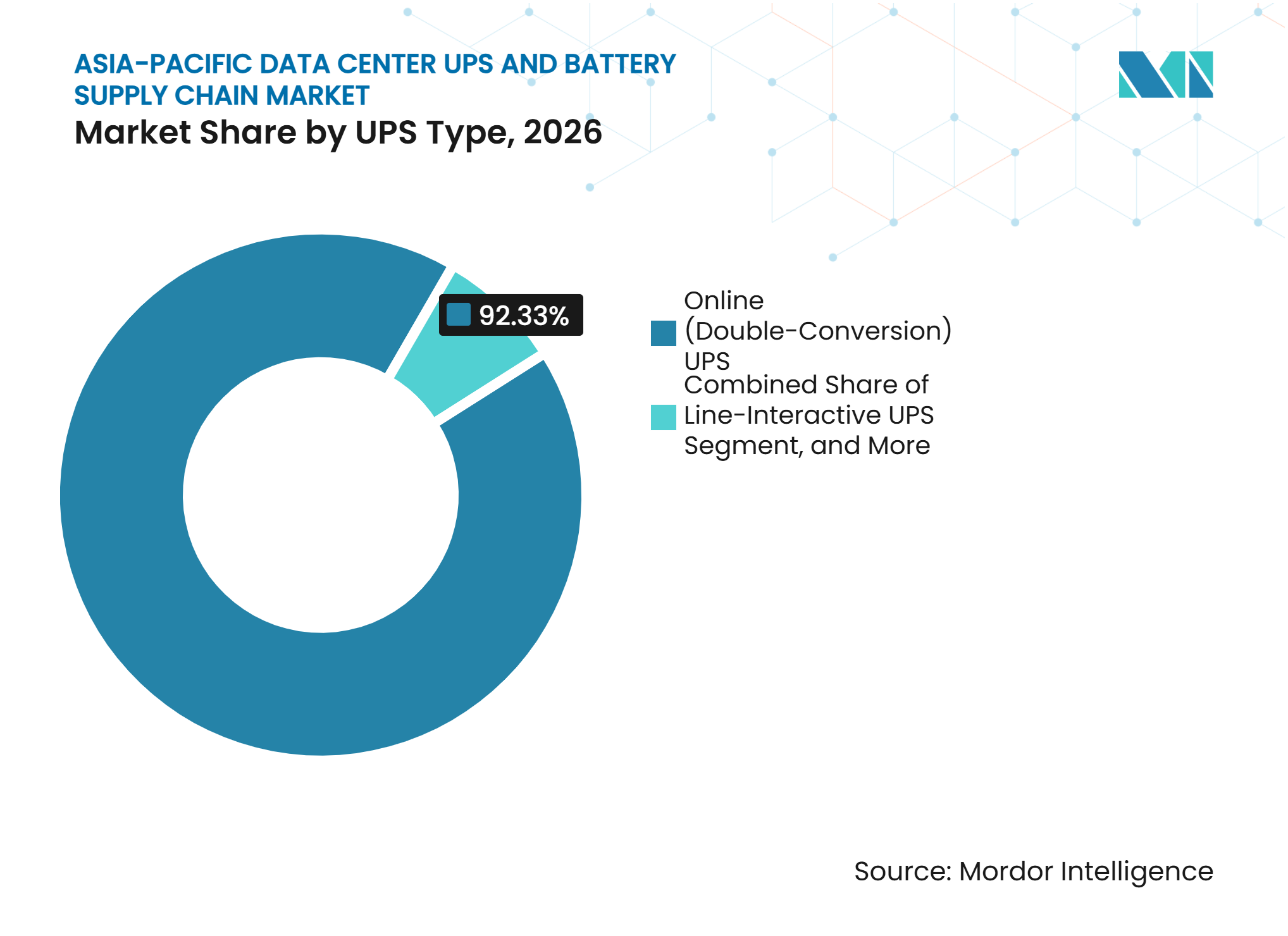
Online Double-Conversion Systems Retain Leadership Under AI Power RequirementsOnline (double-conversion) UPS systems held 92.33% of the Asia-Pacific data center UPS and battery supply chain market in 2026 and are projected to expand at a 12.55% CAGR through 2032. Their share reflects the need for reliable power quality in data centers that cannot tolerate interruptions or unstable voltage. The architecture provides continuous power conditioning for sensitive IT equipment and can respond to voltage events that affect GPU clusters. AI workloads have reinforced this choice because higher-density racks require more stable power delivery. The same segment is both the largest and fastest-expanding UPS topology, which indicates that operators are standardizing rather than shifting toward lower-cost alternatives. This pattern keeps online systems central to new builds and major refresh projects, especially where operators need predictable maintenance planning, continuous conditioning, and common power standards across several data halls. It also limits the role of lower-cost topologies in the highest-value projects. Within the Asia-Pacific data center UPS and battery supply chain market, this selection supports common operating practices across large campuses.
Online UPS platforms can cycle batteries more frequently than standby systems under demanding workloads. That can reduce VRLA replacement intervals to 2-3 years and sustain near-term battery demand in existing sites. Standby and line-interactive systems remain relevant for enterprise edge deployments, where load requirements and capital budgets differ from those of hyperscale projects. Their role is narrower because new large facilities generally select double-conversion configurations. Vertiv introduced the PowerUPS 9000 1.8 MW in Southeast Asia in August 2026, with Battery Shield and Input Power Smoothing controls tested with STT Singapore for AI operating conditions.[2] The launch reflects the emphasis on large systems that manage rapid load changes and protect battery performance.



By UPS Capacity:
Systems Above 500 kVA Support Campus-Scale DeploymentSystems above 500 kVA held 59.87% of the Asia-Pacific data center UPS and battery supply chain market size in 2026 and are projected to expand at a 12.98% CAGR through 2032. Hyperscale campuses in China and India can specify centralized UPS frames from 1 MW to 2 MW in a single footprint. Larger systems can reduce distribution losses across campuses with IT loads above 100 MW. Their use also matches the procurement practices of operators building capacity in large phases. The 100 kVA to 500 kVA range remains important for colocation and enterprise projects that use redundant modules to achieve N+1 resilience. Up to 100 kVA systems continue to serve edge facilities and branch deployments where rapid installation matters more than centralized capacity.
Large UPS orders are increasingly placed through multi-year framework agreements with a limited set of preferred vendors. This approach creates high switching costs and makes early qualification important for equipment suppliers. Prefabricated infrastructure also reduces the time needed to deploy power, thermal, and IT systems together. Vertiv launched OneCore in August 2025 as a factory-assembled solution for blocks from 5 MW to 50 MW and from 96 to 944 racks. Delta Electronics introduced a prefabricated AI modular data center solution in 2026 and stated that it can reduce deployment time by up to 60%.[3] These products move competition beyond UPS ratings toward manufacturing capacity, system integration, and delivery speed. They also reduce the coordination burden between civil, electrical, cooling, and IT teams during construction. This matters when operators need capacity available on a fixed schedule. The Asia-Pacific data center UPS and battery supply chain market therefore places added value on repeatable factory testing and coordinated delivery.
By Battery Chemistry:
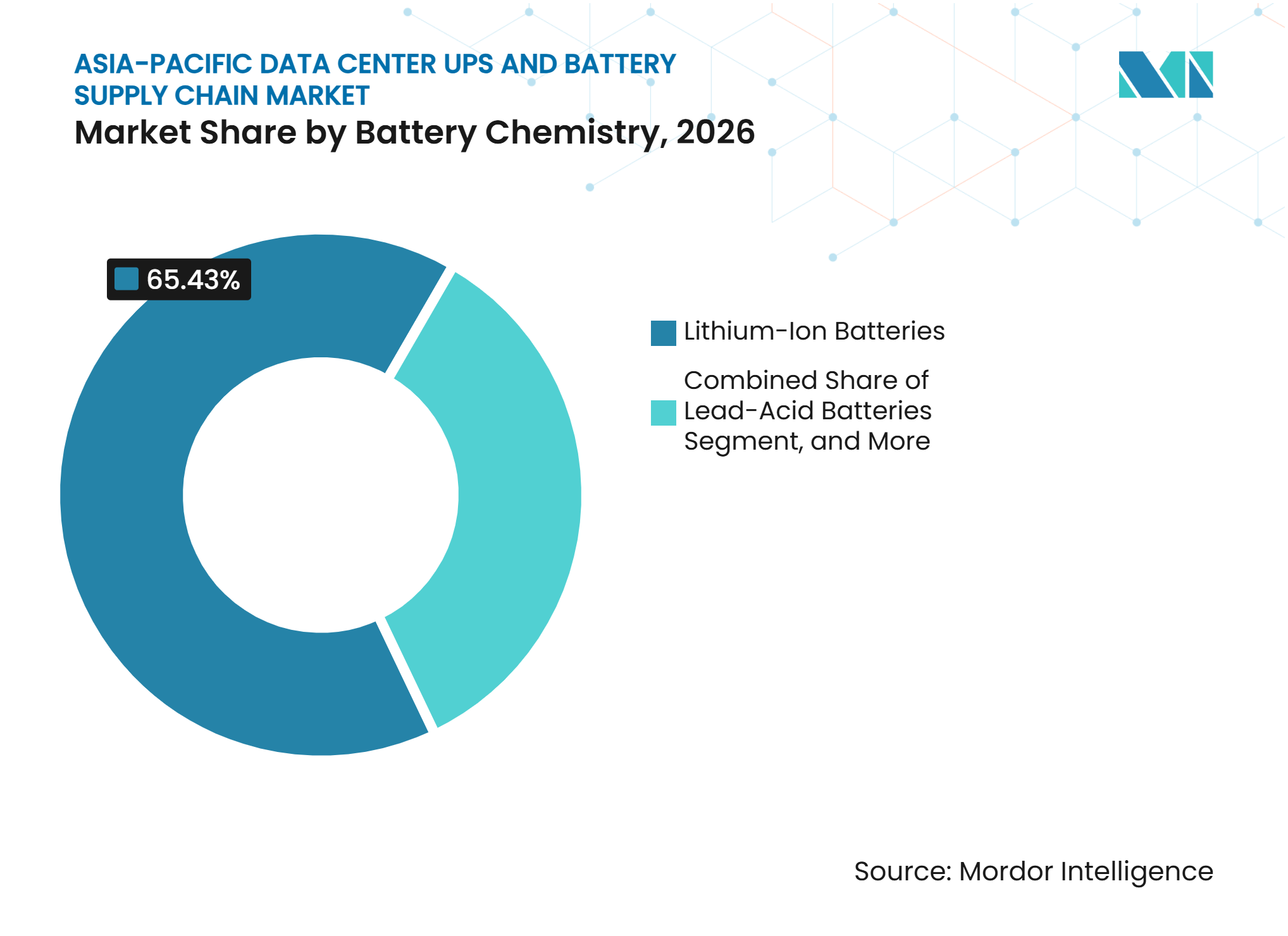
Lithium-Ion Becomes the Preferred Choice for New FacilitiesLithium-ion batteries held 65.43% of the Asia-Pacific data center UPS and battery supply chain market in 2026 and are projected to expand at a 14.96% CAGR through 2032. Greenfield hyperscale and colocation projects increasingly specify lithium-ion batteries during the design phase. LFP and NMC chemistries offer a cycle life that is 2-3 times that of VRLA batteries. This can remove one battery replacement within the first 10 years of a facility's operation. The performance case is particularly relevant where operators expect higher cycle rates from AI workloads and grid-support applications. Lithium-ion capacity also supports a smaller footprint than many conventional battery configurations.
Lead-acid batteries retain a role in retrofit and brownfield projects, especially where facilities were engineered around VRLA strings. Nickel-cadmium batteries serve a narrow group of applications that need broad operating temperature capability. Other battery technologies face a tighter path to adoption after Natron Energy ceased operations in September 2025. Nickel-zinc systems still have a role where data centers need support for rapid power changes from AI loads. EnerSys introduced the DataSafe Noir lithium-based system in June 2026 for data centers with AI-driven load conditions.[4] IEC 62133 certification is also relevant to insurance, financing, and data center qualification decisions for battery systems. Operators also assess thermal management, monitoring coverage, warranty terms, and replacement support before approving a battery platform. Those factors can outweigh the initial purchase price over a facility life cycle.

By Battery Application:
Backup Batteries Remain Essential While Grid Services ExpandUPS backup batteries held 88.51% of the Asia-Pacific data center UPS and battery supply chain market share in 2026. Their leading position reflects the need to bridge power between a utility disruption and generator startup at tier-III and tier-IV facilities. Other battery applications are projected to expand at a 14.32% CAGR through 2032 as operators evaluate peak shaving and grid frequency support. Japan, Singapore, and Australia provide settings where battery assets can serve backup and grid-related roles. These uses require higher cycle life and faster charging than a battery designed only for standby service. Lithium-ion and advanced nickel-zinc options are better aligned with those technical requirements.
Grid-service participation can make a battery asset partly revenue-generating instead of only a cost of reliability. This strengthens the business case for premium battery specifications where permitted by local rules. Singapore's Energy Market Authority launched a virtual power plant regulatory sandbox in October 2025, creating a possible route for distributed energy participation. Australia's grid framework for data centers is also developing as electricity demand from facilities increases. The Asia-Pacific data center UPS and battery supply chain market gains a new specification path when operators plan batteries for both reliability and controlled grid interaction. System providers need battery management, monitoring, and controls that can support these uses without weakening backup readiness. Clear operating limits are required to preserve enough stored energy for an outage. This makes system software and operational procedures part of the equipment selection process.
By Data Center Size:
Hyperscale Facilities Shape the Largest Equipment OrdersHyperscale data centers held 56.43% of the Asia-Pacific data center UPS and battery supply chain market in 2026 and are projected to expand at a 12.73% CAGR through 2032. Their scale drives demand for online double-conversion UPS systems, lithium-ion batteries, and capacity above 500 kVA. Large facilities also set procurement standards that influence colocation projects and regional cloud deployments. Average new facilities are exceeding 100 MW of IT load, requiring more structured planning for power delivery and backup systems. Large data centers continue to support established colocation operators and regional cloud providers. Medium and small sites serve enterprise and edge needs but face pressure as workloads consolidate into larger facilities.
Hyperscale buyers can make multi-year agreements directly with battery cell manufacturers. This gives them stronger access to lithium-ion allocations than smaller colocation and enterprise operators. The resulting two-tier procurement structure can raise secondary-market battery costs for buyers without large volume commitments. Specialist integrators can address part of this gap by pooling demand and providing system-level support. Edge construction in tier-2 cities still creates small-site opportunities for prefabricated systems. The Asia-Pacific data center UPS and battery supply chain industry therefore combines a concentrated hyperscale purchasing base with a broader, smaller-scale edge opportunity. Suppliers need different delivery models for each group, including direct account support for campuses and readily configured products for distributed sites. These operating models influence inventory and service planning.
By Data Center Type:
Cloud Service Providers Lead High-Density DemandCloud service providers (CSPs) held 41.78% of the Asia-Pacific data center UPS and battery supply chain market in 2026 and are projected to expand at a 13.43% CAGR through 2032. Their demand is closely linked to large-scale AI deployment and the rising use of wholesale colocation contracts. In China, major cloud and hyperscale companies are increasingly using wholesale capacity rather than retail colocation. This approach favors large, standardized power orders and long-term vendor relationships. Colocation providers remain important because they connect hyperscale campuses with enterprise customers and support expansion into secondary locations. Enterprise and edge data centers have smaller orders and retain a higher share of VRLA battery specifications.
The IEC 62040 series is becoming more relevant in procurement, with major colocation operators requiring IEC 62040-3 Class 1 performance. Neocloud providers are also emerging as a distinct cloud category designed for GPU-intensive workloads. Their higher rack density and frequent power changes can accelerate battery degradation and UPS refresh needs. Suppliers with performance references for neocloud operations may be better placed to win these projects. Enterprise and edge operators are gradually adopting lithium-ion as the price premium narrows. Their replacement cycles remain longer than those at hyperscale sites because equipment utilization is lower. Even so, these buyers need systems that are simple to maintain and compatible with incremental expansion. This sustains demand for scalable designs and structured support services.
Geography Analysis
China: Regional Scale Sustains Equipment Demand
China held 29.66% of the Asia-Pacific data center UPS and battery supply chain market share in 2026. Its installed capacity stood at 32 GW at the end of 2025, and national capacity is expected to exceed 60 GW by 2030. The East Data West Computing strategy shifts some demand toward interior provinces and extends the need for power infrastructure beyond established coastal hubs. National computing hub projects face a power usage effectiveness requirement below 1.2 under the 15th Five-Year Plan, which raises the expected efficiency of supporting power equipment. The country also benefits from domestic LFP cell production, which can reduce delivered battery costs for local integrators. This combination of capacity growth, policy direction, and battery manufacturing supports demand for higher-efficiency UPS and battery systems. Local cell availability can also strengthen the position of regional integrators that package batteries with controls, monitoring, and UPS equipment. Procurement choices will depend on lifecycle performance as well as delivered cost.
India: Strong Capital Commitments and Local Data Requirements
India is projected to expand at a 15.51% CAGR through 2032, the highest country-level rate in the Asia-Pacific data center UPS and battery supply chain market. Investment commitments exceeded USD 180 billion by September 2026, and operating capacity was nearing 2.0 GW by the end of the year. The country's grid reliability profile can require larger battery strings per unit of installed IT capacity than comparable facilities in Japan or Australia. This gives backup batteries a larger role in equipment design and project budgets. The Digital Personal Data Protection Rules notified in November 2025 add support for onshore data handling and local data center construction. Suppliers with local service teams and designs suited to demanding power conditions can be better positioned as projects move from commitments into deployment. They must also support commissioning, spares availability, and battery maintenance through the operating life of each facility. These requirements favor established local delivery capabilities.
Japan, Australia, Singapore, and Southeast Asia: Diverse Demand Conditions
Japan is testing dual-use battery models through planned data center UPS programs intended to provide grid-adjustment capacity. A 400 MW-class AI data center in Chiba Prefecture was announced in October 2026 by JERA, Dell Technologies, and RHAELM. Australia's data center electricity consumption is projected to triple to 12 TWh by 2029-30, which increases the importance of energy-efficient power systems. Singapore faces grid connection lead times of 26-28 months, encouraging operators to prioritize efficient UPS architectures and careful capacity planning. Malaysia's Johor region, Indonesia, Vietnam, and Thailand are receiving hyperscale activity that is moving beyond capacity-constrained Singapore. These locations offer suppliers an opportunity to combine modular delivery, regional inventory, and local compliance support as their projects mature. Their varied grid conditions and development stages make a uniform regional product strategy less effective. Suppliers can gain by matching equipment configuration and service coverage to each location.
Competitive Landscape
Market Concentration
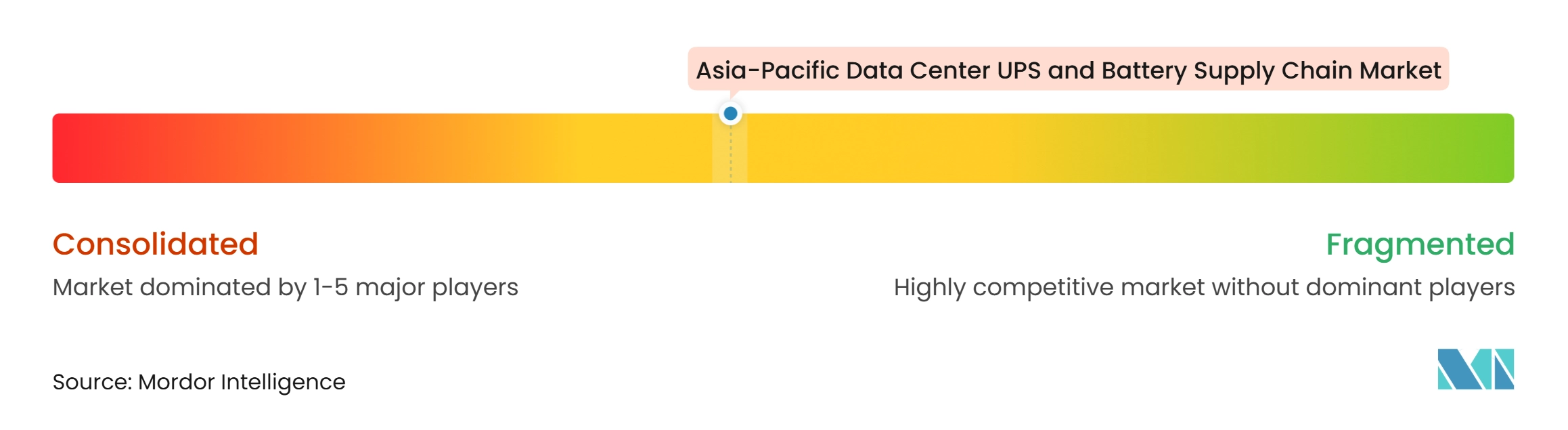
The Asia-Pacific data center UPS and battery supply chain market is moderately consolidated among tier-1 UPS original equipment manufacturers, while battery supply remains more fragmented between lead-acid specialists and lithium-ion integrators. Large suppliers compete through system performance, service coverage, and their ability to support long project schedules. Vertiv has used AI-focused product development to protect relationships with large data center accounts. Its PowerUPS 9000 1.8 MW system targets large AI facilities, while OneCore integrates power, thermal, and IT infrastructure in factory-assembled blocks. This approach addresses operators that want equipment and infrastructure to arrive as an integrated deployment package. EnerSys has also broadened its offer toward lithium-based systems for data centers that face high-cycle demand. Such product moves give buyers a wider choice between established battery suppliers and integrated UPS providers. They also raise the importance of demonstrated performance under actual data center duty cycles.
Regional battery integrators using domestically sourced Chinese LFP cells can compete with Western UPS manufacturers on delivered cost in China and India. That cost position expands the supplier field, particularly where projects value local assembly and timely delivery. International incumbents respond through AI-optimized product features and broader channel coverage. Vertiv announced a South Asia distribution partnership with Inflow Technologies in November 2026, extending access to UPS, cooling, and rack products across Bangladesh, Bhutan, the Maldives, Nepal, and Sri Lanka. Delta Electronics has also positioned prefabricated data center infrastructure as a route to reduce installation time in AI projects. These actions show that regional presence and execution are becoming as important as individual equipment specifications. A supplier must be able to deliver factory-tested equipment, coordinate installation, and maintain systems after commissioning. This requirement creates an advantage for companies that combine regional channels with technical service resources.
Neocloud and sovereign cloud projects create room for suppliers that can validate performance under GPU-dense workloads and local data requirements. Battery management systems are becoming a stronger point of differentiation because operators need clear information on battery health, cycle capability, and backup readiness. ZincFive introduced the BC 2 AI battery cabinet in October 2026, focused on handling large GPU power surges alongside backup duty. The Asia-Pacific data center UPS and battery supply chain market also rewards vendors that can coordinate cells, UPS controls, cooling interfaces, and on-site commissioning. Buyers are likely to favor qualified suppliers with a proven regional service base because failures can delay capacity activation. Product reliability and supply assurance remain more important than short-term price advantages in the largest deployments. The Asia-Pacific data center UPS and battery supply chain market gives a clear advantage to suppliers that can document performance, maintain inventory, and resolve issues locally during critical commissioning periods.
Asia-Pacific Data Center UPS and Battery Supply Chain Industry Leaders
-
Vertiv Holdings Co.
-
EnerSys
-
Exide Technologies, Inc.
-
C&D Technologies, Inc.
-
ZincFive, Inc.
- *Disclaimer: Major Players sorted in no particular order
Asia-Pacific Data Center UPS and Battery Supply Chain Market Companies Covered in this Report
- Vertiv Holdings Co.
- EnerSys
- Exide Technologies, Inc.
- C&D Technologies, Inc.
- ZincFive, Inc.
- SENS
- Power Innovations International, LLC
- AMETEK Powervar
- Cyber Power Systems (USA), Inc.
- Exponential Power, Inc.
- East Penn Manufacturing Company, Inc.
- Contemporary Amperex Technology Co., Ltd. (CATL)
- Huawei Digital Power Technologies Co., Ltd.
- Delta Electronics, Inc.
- Marathon Power, Inc.
- Piller Power Systems, Inc.
- Riello Power Systems USA, Inc.
- SOCOMEC, Inc.
- AEG Power Solutions USA, Inc.
- HBL America, Inc.
Recent Industry Developments in Asia-Pacific Data Center UPS and Battery Supply Chain Market
- November 2026: Vertiv India announced a distribution partnership with Inflow Technologies, a Singapore-based ICT distributor, expanding Vertiv's UPS, precision cooling, and IT rack product reach across Bangladesh, Bhutan, the Maldives, Nepal, and Sri Lanka, per Vertiv's official announcement.
- October 2026: ZincFive launched the BC 2 AI UPS Battery Cabinet, the industry's first AI-optimized nickel-zinc battery system for dual-mode operation, absorbing GPU cluster power surges of up to 15 times idle power and providing traditional backup power during utility outages. The system delivers 280 kWh to 325 kWh with a maximum discharge current of 800 A, produces 25-50% lower lifecycle greenhouse gas emissions, and uses more than 90% recyclable base materials, per ZincFive's disclosure.
- August 2026: Vertiv expanded the Vertiv PowerUPS 9000 UPS family in Asia with a new 1.8 MW model for large-scale AI data centers, now available across Southeast Asia, Australia, and New Zealand, with Battery Shield and Input Power Smoothing controls co-tested with STT Singapore, per Vertiv's official release.
- August 2026: Vertiv opened a Singapore experience center for AI infrastructure systems, featuring live demonstrations of Vertiv SmartRun overhead infrastructure, SmartAisle 3 modular data center infrastructure, and high-density thermal and power management solutions, per Vertiv's official announcement.
Asia-Pacific Data Center UPS and Battery Supply Chain Market Report Scope
The Asia-Pacific data center UPS and battery supply chain market comprises uninterruptible power supply (UPS) systems, backup batteries, battery cabinets and modules, and related power conversion, monitoring, and replacement solutions supplied to data centers. It covers both new installations and the refresh of existing UPS systems and batteries. These systems provide instantaneous ride-through power during utility outages and voltage disturbances, bridge the transfer to standby generation, protect critical IT loads from power quality events, and support high-density AI and cloud computing workloads. They help data center operators maintain uptime, meet Tier III/IV redundancy requirements, and lower total cost of ownership through longer-life battery chemistries across colocation, cloud, enterprise, edge, and hyperscale facilities.
The Asia-Pacific Data Center UPS and Battery Supply Chain Market Report is Segmented by UPS Type (Standby (Offline) UPS, Line-Interactive UPS, and Online (Double-Conversion) UPS), UPS Capacity (Up to 100 kVA, Above 100 kVA to 500 kVA, and Above 500 kVA), Battery Chemistry (Lead-Acid Batteries, Lithium-Ion Batteries, Nickel-Cadmium Batteries, and Other Battery Technologies), Battery Application (UPS Backup Batteries and Other Batteries Used in Data Center Backup Power Systems), Data Center Size (Small, Medium, Large, and Hyperscale), Data Center Type (Colocation, Cloud Service Providers (CSPs), and Enterprise / Edge), and Country (China, India, Japan, Australia, Singapore, and Rest of Asia-Pacific). The Market Forecasts are Provided in Terms of Value (USD).
Segmentation Overview
| Standby (Offline) UPS |
| Line-Interactive UPS |
| Online (Double-Conversion) UPS |
| Up to 100 kVA |
| Above 100 kVA to 500 kVA |
| Above 500 kVA |
| Lead-Acid Batteries |
| Lithium-Ion Batteries |
| Nickel-Cadmium Batteries |
| Other Battery Technologies |
| UPS Backup Batteries |
| Other Batteries Used in Data Center Backup Power Systems |
| Small |
| Medium |
| Large |
| Hyperscale |
| Colocation |
| Cloud Service Providers (CSPs) |
| Enterprise / Edge |
| China |
| India |
| Japan |
| Australia |
| Singapore |
| Rest of Asia-Pacific |
| By UPS Type | Standby (Offline) UPS |
| Line-Interactive UPS | |
| Online (Double-Conversion) UPS | |
| By UPS Capacity | Up to 100 kVA |
| Above 100 kVA to 500 kVA | |
| Above 500 kVA | |
| By Battery Chemistry | Lead-Acid Batteries |
| Lithium-Ion Batteries | |
| Nickel-Cadmium Batteries | |
| Other Battery Technologies | |
| By Battery Application | UPS Backup Batteries |
| Other Batteries Used in Data Center Backup Power Systems | |
| By Data Center Size | Small |
| Medium | |
| Large | |
| Hyperscale | |
| By Data Center Type | Colocation |
| Cloud Service Providers (CSPs) | |
| Enterprise / Edge | |
| By Country | China |
| India | |
| Japan | |
| Australia | |
| Singapore | |
| Rest of Asia-Pacific |
Key Questions Answered in the Report
What is the Asia-Pacific data center UPS and battery supply chain market size?
The market is valued at USD 3.60 billion in 2026 and is forecast to reach USD 6.91 billion by 2032 at an 11.57% CAGR from 2027 to 2032.
Which UPS type leads data center backup power demand in Asia-Pacific?
Online double-conversion UPS systems lead with a 92.33% share in 2026 and are projected to expand at a 12.55% CAGR through 2032.
Why are lithium-ion batteries becoming more common in regional data centers?
Lithium-ion batteries lead the battery chemistry category with a 65.43% share and offer 2-3 times the cycle life of VRLA batteries.
Which data center capacity range is expanding fastest?
Systems above 500 kVA are projected to expand at a 12.98% CAGR through 2032, supported by large hyperscale campus construction.
Which country has the fastest outlook for backup power equipment?
India is projected to expand at a 15.51% CAGR through 2032, supported by investment commitments and local data infrastructure requirements.
How are AI workloads changing UPS purchasing decisions?
AI racks can require 20 kW to more than 100 kW per rack, increasing the need for high-density UPS systems, advanced controls, and batteries with stronger cycling capability.