
Asia-Pacific Data Center Transformer Market Size and Share
Market Overview
| Study Period | 2021 - 2032 |
|---|---|
| Forecast Data Period | 2027 - 2032 |
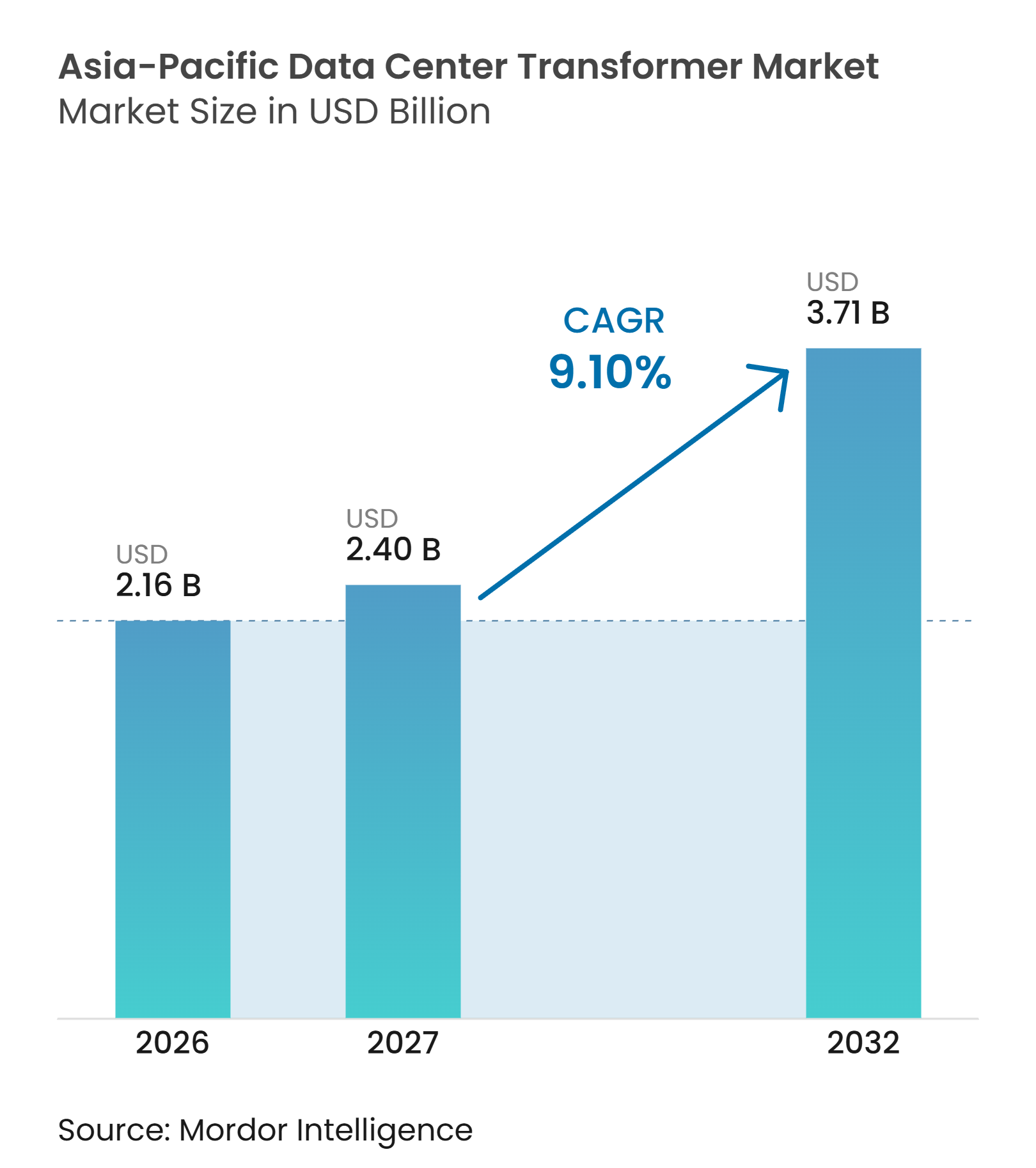
| Base Year Market Size (2026) | USD 2.16 Billion |
| Market Size (2027) | USD 2.40 Billion |
| Market Size (2032) | USD 3.71 Billion |
| Growth Rate (2027 - 2032) | 9.10 % |
| Market Concentration | Medium |
Major Players *Disclaimer: Major Players sorted in no particular order Image © Mordor Intelligence. Reuse requires attribution under CC BY 4.0. | |
Asia-Pacific Data Center Transformer Market Analysis by Mordor Intelligence
The Asia-Pacific data center transformer market size is projected to expand from USD 2.16 billion in 2026 and USD 2.40 billion in 2027 to USD 3.71 billion by 2032, registering a CAGR of 9.10% between 2027 to 2032. The Asia-Pacific data center transformer market is being shaped by larger computing campuses, where transformer procurement is planned well before a site begins operating. AI workloads are increasing peak power requirements and placing greater emphasis on thermal performance, harmonic tolerance, and remote condition monitoring. Developers are also placing greater weight on grid access when selecting locations, which favors suppliers that can manage long project schedules and multi-site orders. The Asia-Pacific data center transformer market is therefore moving toward larger ratings, more advanced monitoring, and equipment that can work within changing grid and fire-safety requirements. Competition is centered on technical qualification, dependable delivery, and local supply capacity rather than equipment price alone.
Key Report Takeaways
- By transformer type, liquid-immersed transformers held 68.19% of the Asia-Pacific data center transformer market share in 2026, while dry-type transformers are projected to expand at a 9.93% CAGR through 2032.
- By power rating, the above-10 MVA to 30 MVA segment held 45.11% of revenue in 2026, while the above-30 MVA segment is projected to expand at a 12.26% CAGR through 2032.
- By voltage level, medium voltage held 46.53% f the Asia-Pacific data center transformer market share in 2026, while high voltage is projected to expand at a 10.19% CAGR through 2032.
- By installation, outdoor installations held 59.80% of revenue in 2026, while indoor installations are projected to expand at a 10.39% CAGR through 2032.
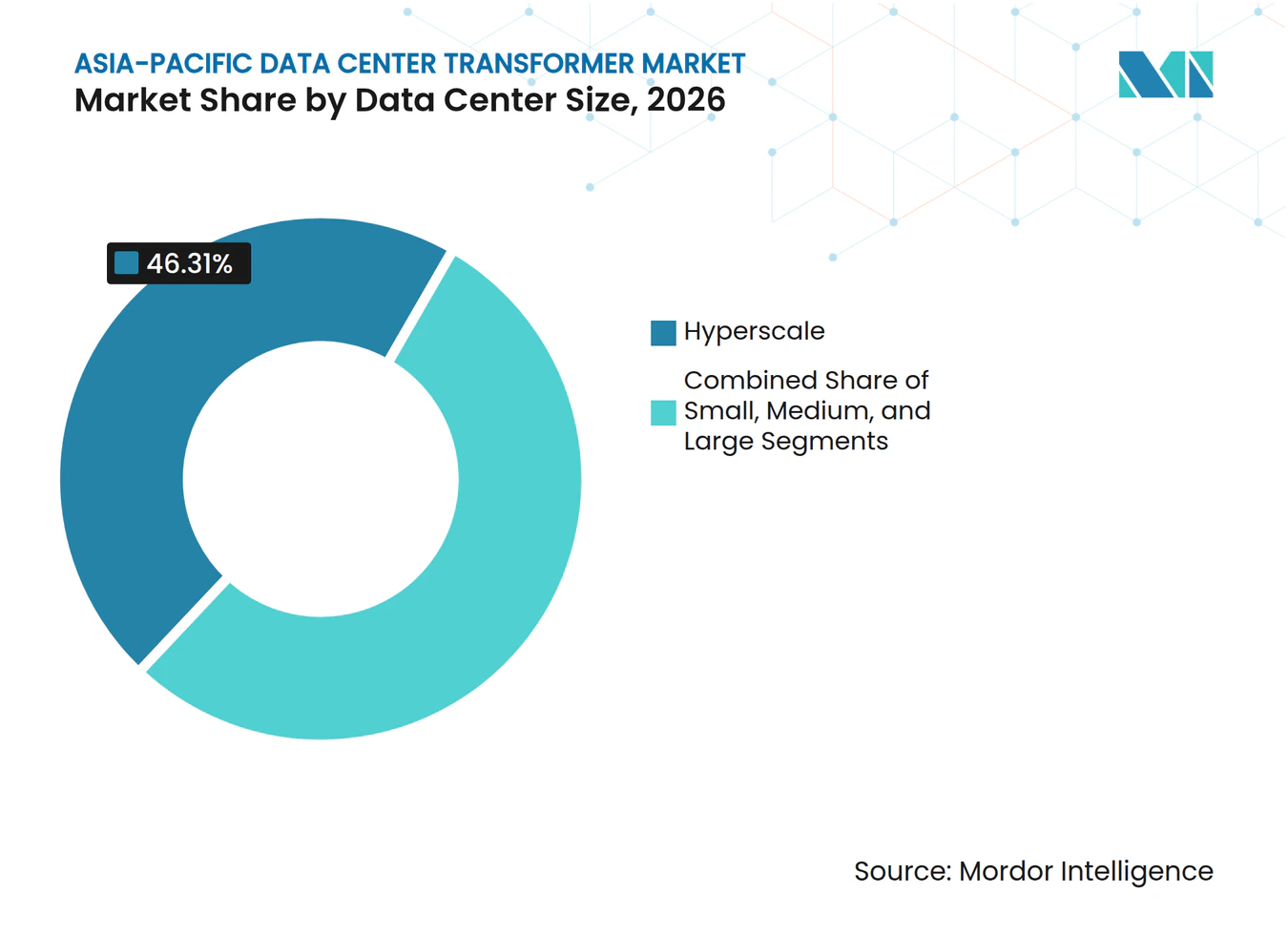
- By data center size, hyperscale facilities held 46.31% of the Asia-Pacific data center transformer market share in 2026 and are projected to expand at an 11.27% CAGR through 2032.
- By data center type, cloud service providers held 44.39% of revenue in 2026 and are projected to expand at a 10.17% CAGR through 2032.
- By geography, China held 34.21% of revenue in 2026, while India is projected to expand at an 11.69% CAGR through 2032.
Note: Market numbers in this report are based on Mordor Intelligence's proprietary estimation framework, which combines nine months of actuals with Q4 projections for base year 2026.
Market Trends and Insights
Drivers Impact Analysis of Asia-Pacific Data Center Transformer Market*
| Driver | (~) % Impact on CAGR Forecast | Geographic Relevance | Impact Timeline |
|---|---|---|---|
| AI-Ready Hyperscale Capacity Expansion | +3.2% | Global, led by China, India, Japan, Singapore, and Australia | Short term (≤ 2 years) |
| Cloud, Colocation, and Digitalization Buildout | +2.0% | Global, with strongest demand in India and Southeast Asia | Medium term (2-4 years) |
| Regional Grid Modernization and Smart Monitoring | +1.3% | China, Japan, India, and Australia | Medium term (2-4 years) |
| High-Density Computing and High-MVA Substation Demand | +1.0% | China, Singapore, Japan, and South Korea | Short term (≤ 2 years) |
| Power-Secure Southeast Asia and India Site Migration | +0.8% | India, Malaysia, Indonesia, and Thailand | Medium term (2-4 years) |
| Modular and Prefabricated Data Center Deployment | +0.6% | Southeast Asia, India, and Australia | Long term (≥ 4 years) |
| Source: Mordor Intelligence | |||
AI-Ready Hyperscale Capacity Expansion
The Asia-Pacific data center transformer market benefits as AI facilities require much more power at the same site than conventional enterprise data centers. GPU clusters create high and changing loads, so operators need transformers with stronger thermal margins and better tolerance for harmonics. These requirements make a standard utility design less suitable when it has not been adapted for the data center duty cycle. Hitachi and Hitachi Energy announced support for NVIDIA's 800-volt direct-current architecture in October 2026, which points to changing power interfaces between grid equipment and AI servers. The Asia-Pacific data center transformer market is likely to see more demand for above-30 MVA units as operators develop campuses that exceed 100 MW. Compliance with IEC 60076 and China's GB/T 1094 continues to shape the specifications used for high-performance transformer procurement. These standards give developers a common basis for assessing insulation, loading, testing, losses, and reliability before equipment is accepted for a critical facility. Their role is especially important when one operator is qualifying equipment for several countries with different local grid practices.
Cloud, Colocation, and Digitalization Buildout
Cloud providers and colocation operators are shortening the interval between construction decisions and transformer orders. Power agreements and construction schedules limit the ability of developers to absorb a late delivery of primary equipment. This creates a premium for suppliers that can support both repeat cloud orders and varied colocation projects. Larger facilities in Johor, Mumbai, and Bangkok are being designed for workloads that were previously associated with only the largest cloud campuses. Cloud service providers held 44.39% of the Asia-Pacific data center transformer market in 2026, which supports their importance in equipment demand. Suppliers that combine standardized designs with project-specific engineering are better positioned to address both buyer groups. They can repeat proven equipment across a cloud portfolio while adjusting voltage, cooling, protection, and physical arrangement for the local site. This flexibility can reduce avoidable redesign work while preserving the qualification discipline expected by large operators.
Regional Grid Modernization and Smart Monitoring
Grid modernization supports transformer demand because utilities must adapt networks to serve new, large electricity loads. Data center projects can require upgraded substations, digital protection systems, and monitoring equipment at the point of grid connection. The APEC Energy Research Center expects data center load to place growing pressure on electricity systems across the APEC region through 2035. On-site generation and battery-backed microgrids can also require transformers that synchronize private power systems with utility networks. Japan's OCCTO requirements and India's CERC framework increase the value of equipment that can support monitored, compliant grid connections. The Asia-Pacific data center transformer market benefits when operators treat power quality and asset visibility as part of site reliability rather than as optional features. This approach links transformer selection to the wider substation design, including protection settings, maintenance access, event recording, and the information required to make operating decisions. It also gives utilities and data center owners a clearer view of how growing loads affect local network performance.
High-Density Computing and High-MVA Substation Demand
Data center designs are shifting from campuses that used several smaller transformers to sites that require fewer and larger units. AI clusters can raise a facility's power requirement above 100 MW, which changes the primary substation specification. A large liquid-immersed transformer can replace several distribution-level units where site design and utility rules permit. Higher ratings also increase the importance of on-load tap changers, dissolved-gas analysis sensors, and redundant windings. These features raise the value of each order and make qualification more demanding for suppliers. The Asia-Pacific data center transformer market is therefore moving toward equipment that can meet utility-grade reliability needs inside a commercial data center project, including designs that sustain elevated loading, provide continuous condition data, and support operating teams that cannot tolerate an unplanned interruption to critical computing capacity. The equipment decision also affects protection coordination, future capacity additions, spare-unit planning, and the operator's ability to meet demanding service commitments. It must fit the full electrical path from the utility connection through the primary substation, distribution system, backup equipment, and the power systems serving computing loads. This creates a broader engineering role for manufacturers that can provide tested designs, responsive technical support, complete operating records and clear maintenance guidance throughout the operating life, and documentation suited to a complex commissioning process.
Restraints Impact Analysis of Asia-Pacific Data Center Transformer Market*
| Restraint | (~) % Impact on CAGR Forecast | Geographic Relevance | Impact Timeline |
|---|---|---|---|
| Grid-Connection Queues and Power Availability Constraints | -1.2% | Japan, South Korea, Singapore, and Australia | Short term (≤ 2 years) |
| Extended Transformer Lead Times and Allocation Risk | -0.9% | Global, with acute pressure in India and Southeast Asia | Short term (≤ 2 years) |
| High Project Costs and Raw-Material Volatility | -0.6% | Global, with significant exposure in India and Australia | Medium term (2-4 years) |
| Land, Fire-Safety, and Sustainability Compliance Constraints | -0.4% | Singapore, Japan, Australia, and South Korea | Long term (≥ 4 years) |
| Source: Mordor Intelligence | |||
Grid-Connection Queues and Power Availability Constraints
Grid access can delay a project even when the developer has financing and equipment suppliers in place. A transformer may be available before a final connection is approved, leaving the developer to carry equipment and financing costs without operating revenue. Singapore uses a Data Center Call for Application process to manage access to constrained power capacity. Australia is also updating large-load access arrangements as new demand creates planning pressure on transmission and distribution networks.[1] These conditions shift buying from speculative orders toward confirmed sites, but they also favor suppliers with available production capacity. The Asia-Pacific data center transformer market must operate within power planning timelines that often extend well beyond the normal equipment purchase cycle.
Extended Transformer Lead Times and Allocation Risk
Long lead times for large power transformers can disrupt data center construction schedules. The risk is greater in locations that have limited domestic manufacturing capacity for large or specialized units. New designs also need qualification before they can enter a hyperscale supply chain, which reduces the time available for sourcing. Grain-oriented electrical steel availability can affect both cost and production timing because it is an essential transformer material. These pressures encourage long-term framework agreements between large operators and selected original equipment manufacturers. For smaller buyers, the Asia-Pacific data center transformer market can therefore remain difficult to access during periods of strong demand. These buyers may have less ability to reserve production slots, hold strategic inventory, or offer the long-term volume commitments that large cloud platforms can provide. Their project schedules can become more sensitive to a delayed design approval, a material shortage, or a change in available factory capacity.
*Our forecasts treat driver/restraint impacts as directional, not additive. The impact forecasts reflect baseline growth, mix effects, and variable interactions.
Asia-Pacific Data Center Transformer Market Segment Analysis
By Transformer Type:
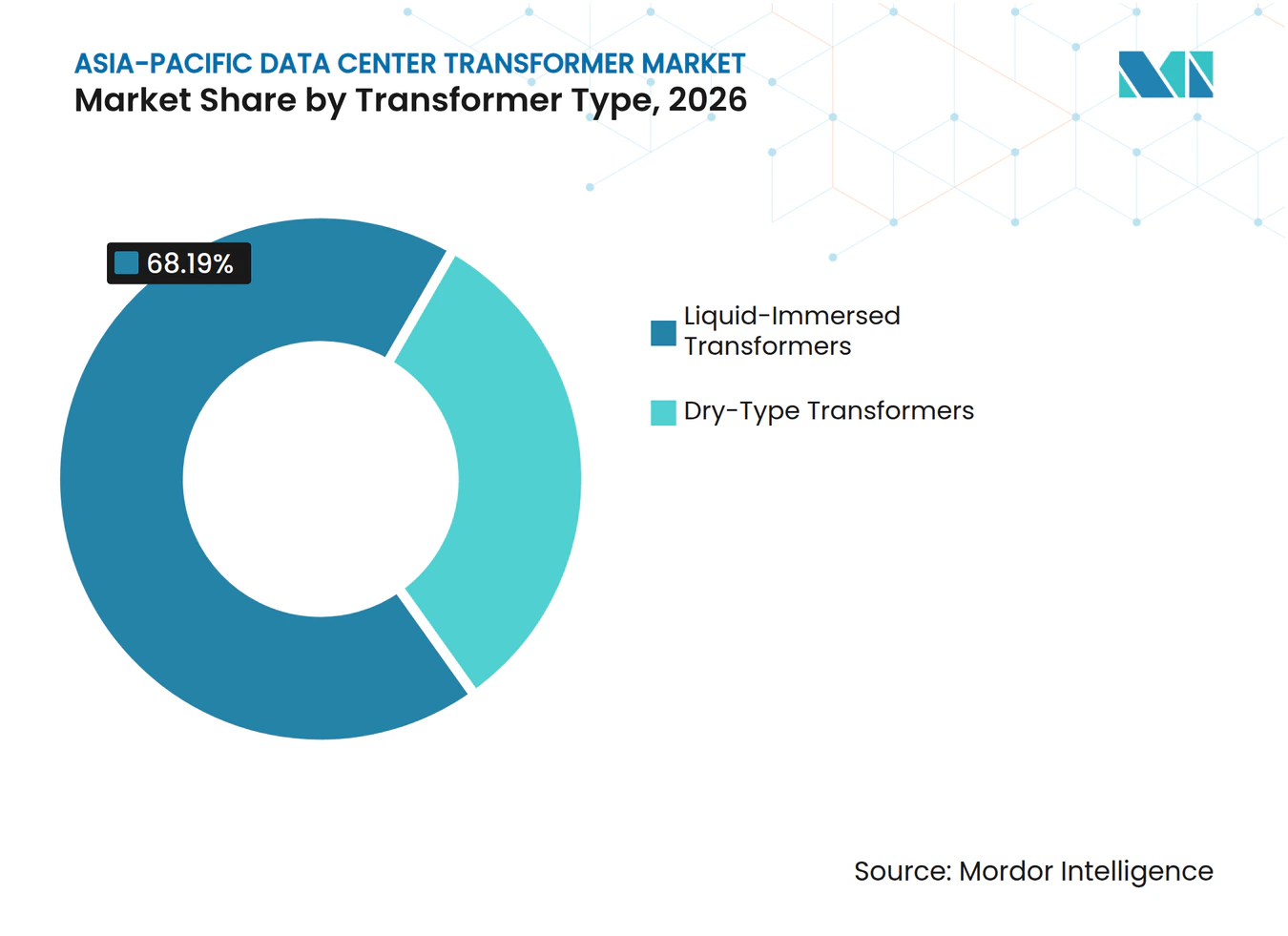
Liquid-Immersed Equipment Leads While Dry-Type Demand AdvancesLiquid-immersed transformers held 68.19% of revenue in 2026, reflecting their established position at outdoor primary substations for large data center campuses. Their thermal performance supports high-load operation, and their familiar maintenance requirements give operators confidence when planning large transformer yards. These systems are well-suited to greenfield projects where developers can provide appropriate safety distances and install the higher ratings required by AI clusters. Their service base also helps buyers plan inspections, oil management, and long-term replacement programs. This position remains relevant for large developments in land-abundant parts of China, India, and Malaysia.
Dry-type transformers are projected to expand at a 9.93% CAGR through 2032, supported by fire-safety needs at enclosed and multistory facilities. The Asia-Pacific data center transformer market size for dry-type equipment benefits, where dense urban sites make outdoor oil-filled systems difficult to install or operate. Japan, Singapore, and Australia increasingly favor nonflammable insulation in buildings where fire safety and usable floor area are important constraints. IEC 60076-11 and Japan's JIS C 4306 provide reference standards for vacuum-pressure-impregnated and cast-resin units used in these projects. Suppliers are responding with dual portfolios that can serve both outdoor campus substations and indoor urban facilities.


By Power Rating:
Above-30 MVA Units Gain Value From AI Campus DesignsThe above-10 MVA to 30 MVA category held 45.11% of revenue in 2026 and remains the workhorse rating for campus substations. It serves data centers with 20 MW to 60 MW of IT load, including many colocation and cloud projects in established metropolitan locations. The band offers a practical balance among capacity, siting, redundancy, and the ability to expand a site in planned stages. It also reflects the scale of many current facilities that have not yet moved to the largest AI campus model. The installed project base supports ongoing demand for familiar medium-to-large power configurations. Buyers in this band can use established engineering practices, available service knowledge, and staged capacity plans without immediately redesigning the complete electrical architecture around a very large primary transformer. This makes the category relevant for operators that want to increase capacity while retaining proven site layouts. Buyers in this band can use established engineering practices, available service knowledge, and staged capacity plans without immediately redesigning the complete electrical architecture around a very large primary transformer. This makes the category relevant for operators that want to increase capacity while retaining proven site layouts.
Above-30 MVA equipment is projected to expand at a 12.26% CAGR through 2032 as high-density GPU clusters push total facility demand above 100 MW. Operators are specifying larger transformers with utility-grade monitoring, redundant windings, and controls that support demanding primary substation duties. Hitachi's support for an 800-volt direct-current AI architecture illustrates how new power designs can affect future transformer interfaces.[2] The up-to-10 MVA category remains important for edge nodes, telecom colocation, and enterprise facilities in secondary cities. Large units can generate more revenue per order because their technical requirements and delivered value are higher. Their procurement can involve specialized testing, additional sensors, detailed interface work, and more extensive coordination with the utility and civil works teams. These requirements increase the importance of early engineering engagement between the operator and the selected equipment supplier.
By Voltage Level:
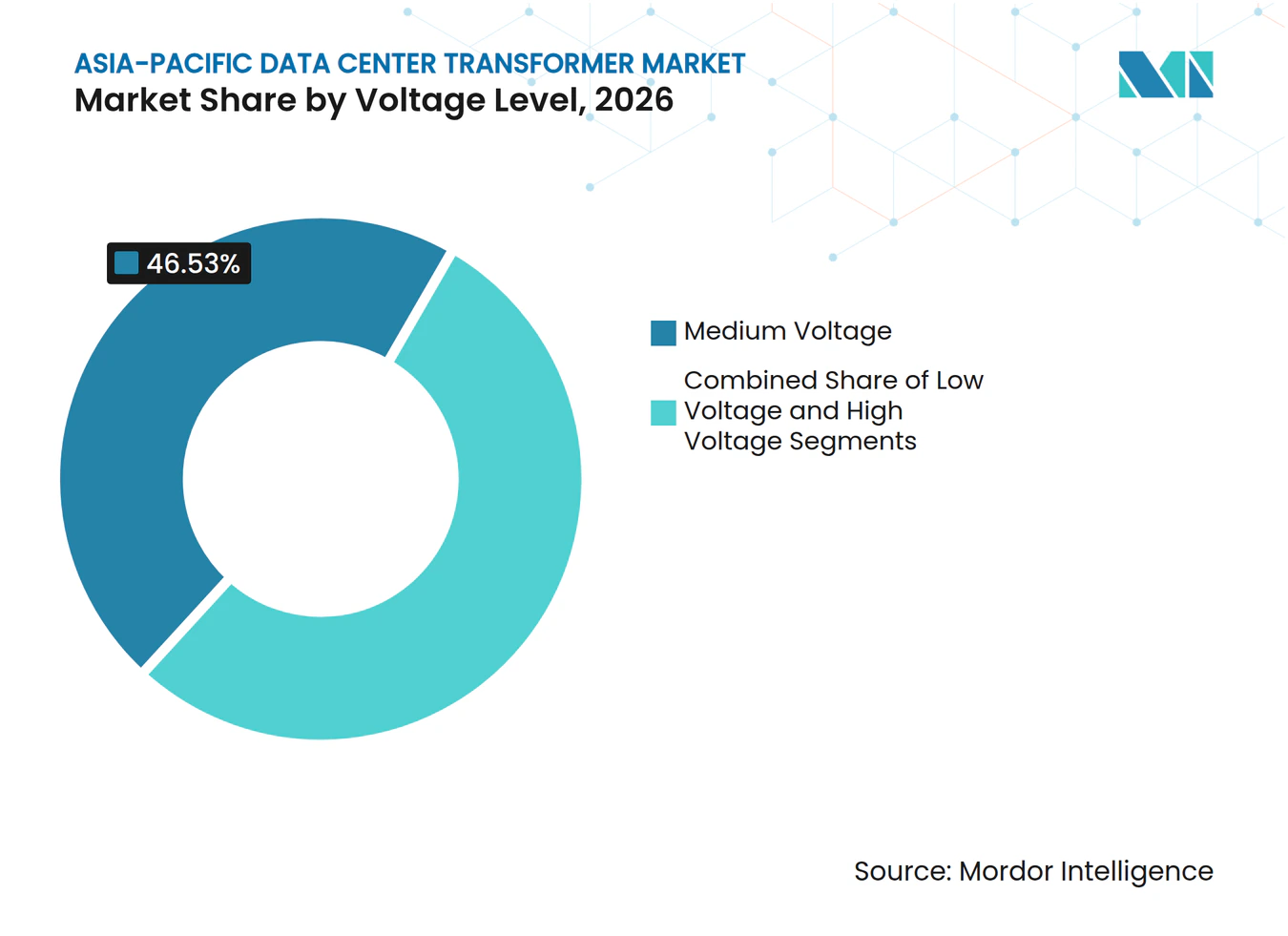
High Voltage Connects the Largest New CampusesMedium voltage accounted for 46.53% of revenue in 2026 and remains central to internal distribution systems at colocation and enterprise data centers. It links incoming power, switchgear, backup systems, and IT hall distribution within facilities that do not need a direct transmission-level connection. The segment remains relevant as operators add modular capacity in stages and require reliable equipment across several distribution points. Its broad installed base also supports replacement demand and incremental expansion at operating sites. These requirements keep medium voltage important even as larger campuses move toward direct high-voltage access.
High voltage is projected to expand at a 10.19% CAGR through 2032 because the largest hyperscale campuses increasingly need 115 kV-and-above connections. Direct access can help where distribution voltage cannot accommodate the total load, although it requires closer coordination with utilities and network operators. China's digital infrastructure policies support major campuses that need high-capacity power connections. Australia's large-load access work also indicates the need to consider high-voltage connections for major new demand centers.[3] High-voltage units carry higher average selling prices, allowing their revenue contribution to rise faster than unit volumes.


By Installation:
Outdoor Systems Remain Established as Indoor Demand RisesOutdoor installations held 59.80% of revenue in 2026 because greenfield hyperscale campuses commonly include dedicated transformer yards. This layout suits land-abundant locations in India, Malaysia, and China's interior provinces, where developers can place large equipment away from occupied buildings. Outdoor yards can accommodate liquid-immersed units, support suitable separation distances, and offer room for planned capacity additions. They also allow maintenance teams to access primary equipment without entering a data hall or enclosed electrical room. These practical advantages keep outdoor systems important for large new campus projects. The layout can separate high-energy equipment from occupied areas, simplify delivery of heavy units, and allow operators to plan future bays without disturbing live computing space. It remains a useful option where land availability and local planning rules permit a purpose-built electrical yard.
Indoor installations are projected to expand at a 10.39% CAGR through 2032 as dense urban and peri-urban locations limit the use of outdoor liquid-immersed equipment. Building and fire-safety rules in Singapore and Japan support enclosed designs using dry-type transformers and compact electrical rooms. Prefabricated facilities also integrate medium-voltage switchgear, dry-type transformers, and UPS equipment within factory-tested modules. This model is relevant in Malaysia, Thailand, and India's tier-2 cities where schedules favor repeatable construction methods. Indoor buyers place particular value on remote monitoring and continuous reliability because access for maintenance can be more limited. They also need designs that work within building footprints, ventilation arrangements, fire compartments, and installation sequences that are often more constrained than an outdoor transformer yard. These factors can make physical design and serviceability as important as rated capacity.
By Data Center Size:
Hyperscale Facilities Set the Demand PatternHyperscale facilities held 46.31% of the Asia-Pacific data center transformer market size in 2026 and are projected to expand at an 11.27% CAGR through 2032. This alignment of current scale and future demand concentrates transformer spending in the largest projects, which require large primary substations and complex site-level power systems. Hyperscale operators consolidate cloud and AI workloads into campuses that favor suppliers with proven qualification, manufacturing depth, and field-service capability. Their procurement programs can extend across several facilities, making these buyers central to regional production planning. The focus on very large sites also increases the importance of reliable delivery and standardized technical performance. A delay in a primary transformer can affect the timing of energization, commissioning, and revenue generation across a substantial part of a campus. Operators, therefore, value suppliers that can align factory testing, logistics, site installation, and documentation with a tightly managed construction program.
Small data centers continue to serve enterprise and edge workloads in secondary cities, while medium-sized sites remain relevant to colocation operators serving regional finance and health care customers. Large facilities in the 50 MW to 100 MW range are a transition category because many are being adapted for more power-dense AI workloads. These upgrades can replace several smaller transformers with fewer high-MVA units and can occur before a fully new campus is constructed. The Asia-Pacific data center transformer market benefits from this retrofit work because it creates demand across operating assets as well as new-build projects. The resulting mix requires suppliers to support both large greenfield contracts and carefully planned replacement programs. Retrofit work can require precise planning because equipment must be removed, installed, tested, and energized without creating an avoidable risk to active computing operations. This favors suppliers that can coordinate engineering, field service, and customer operating teams across a long sequence of project activities.
By Data Center Type:
Cloud Providers Lead and Colocation Operators FollowCloud service providers held 44.39% of revenue in 2026 and are projected to expand at a 10.17% CAGR through 2032. Their investment programs support large, repeatable orders for primary transformer equipment across multiple sites. Cloud operators often need consistent equipment specifications, but local grid requirements still require site-specific engineering and documentation. This procurement model rewards manufacturers that can offer a common product platform while adapting to local connection standards. It also gives qualified suppliers better visibility into capacity additions and production needs. A repeat purchasing relationship can enable earlier discussions on factory slots, design approvals, spare equipment, and long-lead components. For operators, this can reduce uncertainty when new capacity depends on a coordinated delivery of substations, switchgear, backup systems, and transformer equipment.
Colocation operators remain significant buyers because cloud providers often lease capacity instead of building every site themselves. In this arrangement, the colocation company purchases transformers and may do so at a scale comparable to a self-built hyperscale campus. Enterprise sites and edge facilities are also moving toward hybrid cloud structures for workloads that require low latency or local data handling. These facilities often use medium-voltage dry-type transformers for on-premises power distribution. Suppliers need to support both standardized cloud orders and varied colocation requirements, which strengthens the value of flexible engineering capability. Colocation sites can differ in available land, building form, utility connection arrangements, and tenant power density, even when the operator uses a common development model. Suppliers that manage these differences without losing control of quality and delivery can serve a broader set of projects.
Geography Analysis
China held 34.21% of revenue in 2026. Its large data center base and domestic transformer manufacturing capacity support its role as the region's main demand center and supply anchor. National Development and Reform Commission guidance on power usage effectiveness below 1.3 for new hyperscale facilities supports demand for efficient power equipment. Delta Electronics deployed a solid-state transformer system at Chindata Group's North China hyperscale site in February 2026, achieving 98.5% conversion efficiency and reducing energy losses by more than 30% compared with conventional solutions.[4] The deployment shows that Chinese hyperscale projects are testing new power-conversion designs alongside conventional transformer procurement.
India is projected to expand at an 11.69% CAGR through 2032, with data center capacity expected to reach 3.4 GW by 2030 and support a multi-year equipment pipeline. Data localization requirements and expanding digital services support this development. The country combines domestic manufacturing activity with a need for specialized equipment that may be sourced through broader regional supply chains. Australia requires additional grid-connection capacity as data center electricity demand rises, and the Australian Energy Market Operator's 2025 report describes strong growth under its Step Change scenario. Japan remains important, although connection constraints can require developers to commit to equipment well before commissioning.
Malaysia's Johor region is emerging as a major data center location because of its proximity to Singapore and available development space, while Thailand, Indonesia, and Vietnam are attracting operators seeking capacity beyond tier-1 hubs. These countries need reliable grid connections and compliant electrical equipment as they develop new sites. Thailand's projected data center electricity demand highlights the need for system planning as facilities scale. Vietnam and Indonesia are developing data center rules that include reliability requirements for power infrastructure, while Southeast Asia needs to balance site availability, grid readiness, and equipment lead times.
Competitive Landscape
Market Concentration
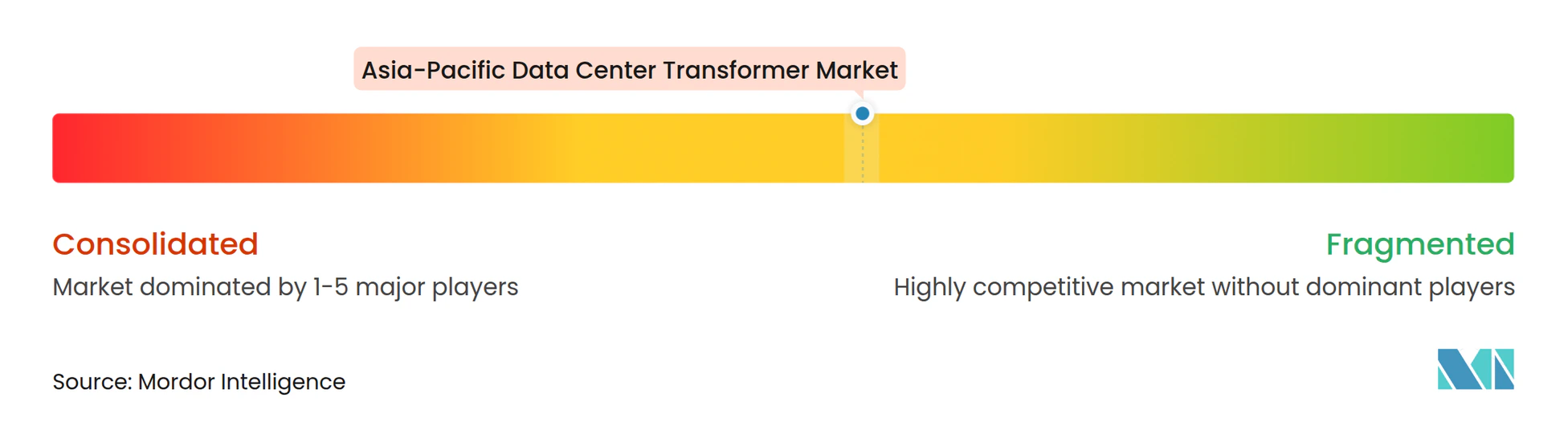
The Asia-Pacific data center transformer market is moderately fragmented among global tier-1 original equipment manufacturers and capable regional suppliers. ABB Ltd., Hitachi Energy Ltd., Siemens Energy AG, and Eaton Corporation plc compete with manufacturers in China, India, Japan, and South Korea. Competition is strongest at the high-MVA end, where AI projects need thermal capability, harmonic tolerance, and embedded monitoring, while regional suppliers compete through local manufacturing, shorter delivery routes, and price. Global suppliers remain important when buyers require complex engineering, certified designs, and broad service support. IEC 60076 and IEC 62271 standards help qualified suppliers demonstrate performance and maintain a premium position in specification-led projects.
Smart transformer integration is an important area of differentiation because dissolved-gas analysis, thermal sensors, and condition-monitoring software can improve asset visibility at continuously operating sites. Suppliers that provide these features as standard can be more attractive than producers selling equipment without integrated instrumentation. GE Vernova and Amazon Web Services signed a strategic framework agreement in March 2025 covering turnkey substation solutions, including primary transformer infrastructure, across data center sites in several regions. The agreement also covered grid security and renewable integration. This illustrates how equipment suppliers are seeking broader roles in the power systems serving data center operators.
Siemens Energy and Eaton announced a collaboration in June 2025 to support modular data centers with integrated on-site generation, medium-voltage equipment, low-voltage switchgear, and UPS systems. The companies stated that the approach could reduce time to market by up to 2 years compared with conventional grid-connected construction. Hitachi Energy's support for NVIDIA's 800-volt direct-current architecture is another strategic move toward AI-specific power designs. These initiatives show that suppliers are competing through project integration and technical design, while long qualification cycles and advanced monitoring needs create barriers in premium projects.
Asia-Pacific Data Center Transformer Industry Leaders
-
ABB Ltd.
-
Siemens Energy AG
-
Hitachi Energy Ltd.
-
Toshiba Energy Systems and Solutions Corporation
-
Hyosung Heavy Industries Corporation
- *Disclaimer: Major Players sorted in no particular order
Asia-Pacific Data Center Transformer Market Companies Covered in this Report
- ABB Ltd.
- Schneider Electric SE
- Siemens Energy AG
- Eaton Corporation plc
- Hitachi Energy Ltd.
- Mitsubishi Electric Corporation
- Toshiba Energy Systems and Solutions Corporation
- General Electric Company, GE Vernova
- Hyosung Heavy Industries Corporation
- WEG S.A.
- Amorphous Metal Technology Transformers
- Delta Electronics, Inc.
- SGB-SMIT Group
- TBEA Co., Ltd.
- CG Power and Industrial Solutions Limited
- Bharat Heavy Electricals Limited
- LS Electric Co., Ltd.
- Fuji Electric Co., Ltd.
- Hyundai Electric and Energy Systems Co., Ltd.
- JiangSu HuaPeng Transformer Co., Ltd.
- Baoding Tianwei Baobian Electric Co., Ltd.
Recent Industry Developments in Asia-Pacific Data Center Transformer Market
- October 2026: Hitachi Energy and Hitachi, Ltd. announced support for NVIDIA's 800-volt direct-current power architecture, developing a grid-to-rack design that streamlines electricity flow from the grid through transformers into AI servers. The shift in primary power delivery standards will require OEMs to re-engineer transformer interfaces and step-down ratios for next-generation AI infrastructure across the region.
- October 2026: TBEA has launched its "Roy Sync" solid-state transformer series at its Tianjin production base, achieving concurrent mass production capability and initial on-site commissioning. Supported by an annual capacity of 200 units, the debut model features a 2.5 MW rating, 10kV AC medium-voltage direct input, 800V DC output, and a peak conversion efficiency exceeding 98.5%. Designed with a scalable architecture from 1 to 5 MW, the technology is optimized for both indoor and outdoor applications
- June 2026: Chinese power equipment manufacturer Kerun Intelligent Control has launched an integrated transformer and substation solution targeting AI data centers. The company claims the package is designed to address the electrical challenges common to high-density facilities, including harmonic interference from server loads, continuous high-temperature operation, and rising power density.
- February 2026: Delta Electronics formally deployed its solid-state transformer system at Chindata Group's North China hyperscale data center, serving a computing center commissioned long-term by Meituan. The system achieved 98.5% conversion efficiency, reduced energy losses by more than 30% versus conventional solutions, and delivered up to 1 MW per square meter, described by Delta and Meituan as the first global implementation of SST technology at a commercial computing center.
Asia-Pacific Data Center Transformer Market Report Scope
The Asia-Pacific data center transformer market refers to the regional industry dedicated to supplying high-capacity power transformers optimized for the rapidly expanding digital infrastructure across the Asia-Pacific economies. The market is propelled by explosive data consumption, government-led digitalization initiatives, and massive investments in hyper-scale facilities across major hubs like China, India, Japan, and Southeast Asia.
The Asia-Pacific Data Center Transformer Market Report is Segmented by Transformer Type (Liquid-Immersed Transformers and Dry-Type Transformers), Power Rating (Up to 10 MVA, Above 10 MVA to 30 MVA, and Above 30 MVA), Voltage Level (Low Voltage, Medium Voltage, and High Voltage), Installation (Indoor Installation and Outdoor Installation), Data Center Size (Small, Medium, Large, and Hyperscale), Data Center Type (Colocation, Cloud Service Provider, and Enterprise Data Centers/Edge), and Country (China, India, Japan, Australia, Singapore, and Rest of Asia-Pacific). The Market Forecasts are Provided in Terms of Value (USD).
Segmentation Overview
| Liquid-Immersed Transformers |
| Dry-Type Transformers |
| Up to 10 MVA |
| Above 10 MVA to 30 MVA |
| Above 30 MVA |
| Low Voltage |
| Medium Voltage |
| High Voltage |
| Indoor Installation |
| Outdoor Installation |
| Small |
| Medium |
| Large |
| Hyperscale |
| Colocation |
| Cloud Service Provider |
| Enterprise Data Centers/Edge |
| China |
| India |
| Japan |
| Australia |
| Singapore |
| Rest of Asia-Pacific |
| By Transformer Type | Liquid-Immersed Transformers |
| Dry-Type Transformers | |
| By Power Rating | Up to 10 MVA |
| Above 10 MVA to 30 MVA | |
| Above 30 MVA | |
| By Voltage Level | Low Voltage |
| Medium Voltage | |
| High Voltage | |
| By Installation | Indoor Installation |
| Outdoor Installation | |
| By Data Center Size | Small |
| Medium | |
| Large | |
| Hyperscale | |
| By Data Center Type | Colocation |
| Cloud Service Provider | |
| Enterprise Data Centers/Edge | |
| By Country | China |
| India | |
| Japan | |
| Australia | |
| Singapore | |
| Rest of Asia-Pacific |
Key Questions Answered in the Report
What is the size of the Asia-Pacific data center transformer market?
The Asia-Pacific data center transformer market size is USD 2.16 billion in 2026 and is projected to reach USD 3.71 billion by 2032 at a 9.10% CAGR. Demand is tied to larger power connections, AI-ready campuses, and equipment ordered well before a site begins operating. The forecast reflects a need for grid-interface and distribution equipment across both new developments and upgrades to existing sites.
What is driving demand for data center transformers in Asia-Pacific?
AI-ready hyperscale facilities, cloud expansion, grid modernization, and larger primary substations are increasing demand for specialized transformer equipment. Operators also need better thermal performance, harmonic tolerance, and condition monitoring as computing loads become more concentrated. These requirements make transformer design a core part of site reliability planning rather than a routine electrical purchase.
Which transformer type leads data center installations in Asia-Pacific?
Liquid-immersed transformers led with 68.19% share in 2026, while dry-type products are projected to expand at a 9.93% CAGR through 2032. Liquid-immersed designs suit outdoor primary substations, whereas dry-type units address indoor and fire-safety requirements at dense urban sites. The equipment choice depends on building design, available land, capacity requirements, and the local rules governing installation.
Why are above-30 MVA transformers becoming more important?
AI campuses with power needs above 100 MW require larger primary transformers, and the above-30 MVA segment is projected to expand at a 12.26% CAGR through 2032. These units commonly require utility-grade monitoring, controls, and engineering coordination before installation. Their higher order value also makes early factory-slot planning important for developers working to fixed commissioning dates.
Which country has the strongest outlook for data center transformer demand?
India is projected to expand at an 11.69% CAGR through 2032, supported by data localization requirements and an expected 3.4 GW of data center capacity by 2030. China remains the largest country by revenue share, supported by domestic demand and manufacturing capacity. Its project activity also creates a testing ground for more efficient power-conversion equipment at hyperscale locations.
How do grid constraints affect data center transformer procurement?
Grid queues can delay site commissioning, encourage earlier equipment planning, and favor suppliers that can manage long lead times and provide reliable delivery. Developers may need to align transformer orders with connection approvals, protection requirements, and a wider sequence of substation construction work. This can increase the value of early coordination among utilities, site owners, engineering teams, and equipment suppliers. It also makes dependable manufacturing schedules and clear testing documentation important, because equipment delivery must align with physical construction, protection commissioning, and the final approval to energize the connection.