
Asia-Pacific Data Center Technical Workforce Market Size and Share
Market Overview
| Study Period | 2021 - 2032 |
|---|---|
| Forecast Data Period | 2027 - 2032 |
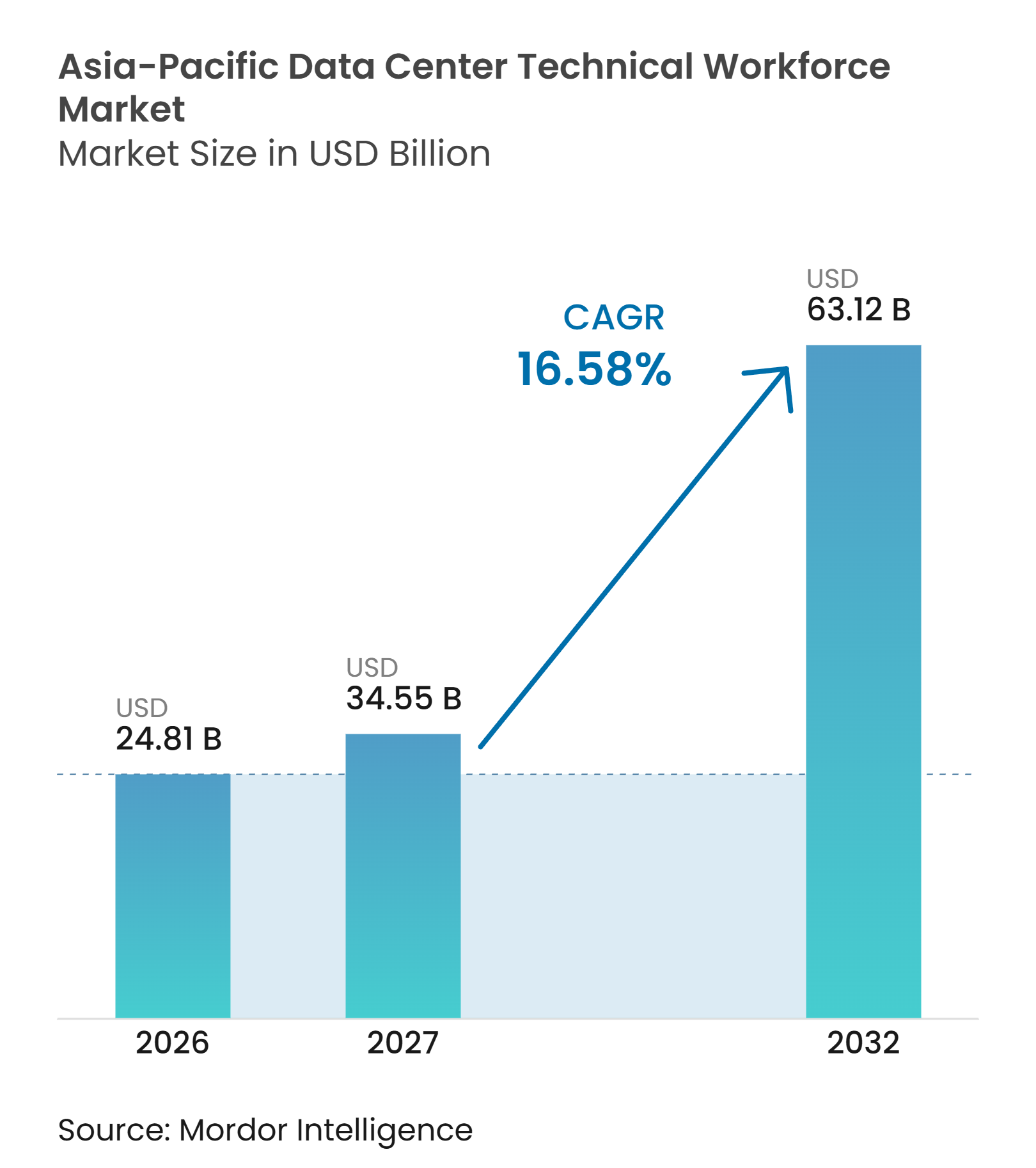
| Base Year Market Size (2026) | USD 24.81 Billion |
| Market Size (2027) | USD 34.55 Billion |
| Market Size (2032) | USD 63.12 Billion |
| Growth Rate (2027 - 2032) | 16.58 % |
| Market Concentration | Medium |
Major Players *Disclaimer: Major Players sorted in no particular order Image © Mordor Intelligence. Reuse requires attribution under CC BY 4.0. | |
Asia-Pacific Data Center Technical Workforce Market Analysis by Mordor Intelligence
The Asia-Pacific data center technical workforce market size is expected to increase from USD 24.81 billion in 2026 to USD 28.94 billion in 2027 and reach USD 63.12 billion by 2032, expanding at a CAGR of 16.58% over 2027-2032. The Asia-Pacific data center technical workforce market is being shaped by a large pipeline of new facilities and the shift toward AI-ready campuses. These facilities need more specialized skills in thermal management, GPU commissioning, electrical systems, and live-site operations. Operators are therefore competing for workers from power generation, semiconductor manufacturing, and industrial automation. The Asia-Pacific data center technical workforce market also has an opportunity to expand structured training and staffing services because existing education pipelines do not meet the need for specialized roles. This need is especially important in countries where development is moving beyond established data center hubs.
Key Report Takeaways
- By workforce function, Project Development Workforce held 38.39% of the Asia-Pacific data center technical workforce market share in 2026, while Facility Operations and Maintenance Workforce is projected to expand at a 17.88% CAGR through 2032.
- By employment model, In-house Workforce held 58.42% of the market in 2026, while External Workforce Services is projected to expand at a 17.72% CAGR through 2032.
- By data center type, Hyperscale Data Centers accounted for 46.15% of the Asia-Pacific data center technical workforce market share in 2026 and are projected to expand at a 17.92% CAGR through 2032.
- By geography, China held 32.76% of the market in 2026, while India is projected to expand at a 17.85% CAGR through 2032.
Note: Market numbers in this report are based on Mordor Intelligence's proprietary estimation framework, which combines nine months of actuals with Q4 projections for base year 2026.
Market Trends and Insights
Drivers Impact Analysis of Asia-Pacific Data Center Technical Workforce Market*
| Driver | (~) % Impact on CAGR Forecast | Geographic Relevance | Impact Timeline |
|---|---|---|---|
| AI-Ready Data Center Build-Out and Technical Labor Demand | +4.8% | Global, with emphasis on China, India, Malaysia, and Indonesia | Short term (≤ 2 years) |
| Cloud Migration and Digital-Service Expansion | +3.2% | Global, with highest relevance in India, Southeast Asia, and Australia | Medium term (2–4 years) |
| Hyperscaler and Colocation Capacity Commitments | +2.8% | China, India, Singapore, Japan, and Malaysia | Short term (≤ 2 years) |
| 5G, Edge Computing, and Data-Localization Requirements | +1.7% | Asia-Pacific, especially Japan, South Korea, India, and Indonesia | Medium term (2–4 years) |
| Government-Backed Digital Infrastructure and Workforce Programs | +1.3% | Malaysia, Indonesia, India, and Japan | Medium term (2–4 years) |
| Cross-Border Capacity Migration and Specialist Talent Demand | +0.8% | Singapore-Johor corridor and Australia-Southeast Asia | Long term (≥ 4 years) |
| Source: Mordor Intelligence | |||
AI-Ready Data Center Build-Out Increasing Technical Labor Demand
The conversion of regional facilities into AI-ready, high-density campuses is changing the skills required across the Asia-Pacific data center technical workforce market. These sites need liquid-cooling configurations, direct-to-chip thermal management, GPU array commissioning, and optical interconnect integration. Conventional MEP and IT experience does not fully cover these requirements. ST Telemedia Global Data Centers surveyed more than 600 companies in 9 Asia-Pacific economies and found that 90% had begun AI deployment.[1] It also found that 71% remained at the building stage, with talent and infrastructure constraints limiting progress. Larger operators are hiring from power generation, semiconductor fabrication, and industrial automation, widening supply but raising compensation expectations for specialist roles.
Cloud Migration and Digital-Service Expansion
Enterprise and public-sector cloud adoption creates a continuing need for infrastructure, network, and facility professionals. New cloud capacity requires engineers who can design, build, commission, and operate reliable facilities. The Asia-Pacific data center technical workforce market, therefore, needs both construction-stage and operating-stage talent. Large operators increasingly connect workforce planning to campus development schedules. They can identify candidates before a facility is ready to hire at scale, reducing the risk of vacancies at critical project stages. This practice makes spot hiring harder for smaller providers and strengthens the need for regional training partnerships.
Hyperscaler and Colocation Capacity Commitments
Hyperscaler and colocation capacity plans are converting infrastructure investment into longer-term technical staffing requirements. Amazon announced plans to invest USD 48 billion in India from 2026 to 2030.[2] Such commitments require engineers, project managers, commissioning specialists, and operations staff over several years. AI-capable facilities require more power, cooling, systems, and security knowledge than conventional hosting environments. Colocation providers pre-qualify specialist labor before peak construction to avoid commissioning delays. This helps larger operators secure critical talent but can leave fewer candidates for smaller providers without comparable planning capacity.
5G, Edge Computing, and Data-Localization Requirements
Data-localization requirements and 5G deployments are expanding demand beyond the largest data center hubs. Edge and in-country sites need technical teams even when they are smaller than hyperscale campuses. The International Finance Corporation noted that countries with weak transmission systems and slower digital infrastructure reforms risk being left behind in AI development.[3] This matters to markets attracting new capacity while facing power and skills constraints. India’s Ministry of Electronics and Information Technology supports data center development in Tier-2 and Tier-3 cities outside Mumbai. These sites need local partnerships, training pathways, and mobile specialist teams because local experience and certification infrastructure can be limited.
Restraints Impact Analysis of Asia-Pacific Data Center Technical Workforce Market*
| Restraint | (~) % Impact on CAGR Forecast | Geographic Relevance | Impact Timeline |
|---|---|---|---|
| Persistent Shortage of Mission-Critical Technical Talent | -3.2% | Asia-Pacific, with the greatest pressure in Malaysia, Indonesia, Vietnam, and the Philippines | Short term (≤ 2 years) |
| High Attrition and Cross-Operator Poaching | -2.1% | Singapore, Japan, Australia, and emerging Asia-Pacific hubs | Short term (≤ 2 years) |
| Uneven Certification and Training Capacity Across Countries | -1.0% | Philippines, Indonesia, Vietnam, and Thailand | Medium term (2–4 years) |
| Power, Land, and Permitting Delays Disrupting Workforce Utilization | -0.7% | Japan, Australia, and India, with state-level variation | Medium term (2–4 years) |
| Source: Mordor Intelligence | |||
Persistent Shortage of Mission-Critical Technical Talent
A shortage of specialized workers is a central constraint on the Asia-Pacific data center technical workforce market. The problem affects project schedules as well as the operation of completed facilities. Malaysia needs 50,000 skilled engineers to meet current data center demand, while universities produce 5,000 engineering graduates each year. This gap means general engineering output cannot immediately meet the need for critical infrastructure skills. Employers must compete for a small group of candidates who understand power, cooling, commissioning, and continuous operations. Singapore’s Infocomm Media Development Authority has included workforce-readiness expectations with infrastructure licensing through its Data Center Call for Application process.
High Attrition and Cross-Operator Poaching
Attrition compounds the shortage of qualified technical workers in the Asia-Pacific data center technical workforce market. When experienced staff move between operators, the receiving company gains practical site knowledge while the former employer loses it. Mature hubs such as Singapore and Hong Kong can attract experienced engineers through higher compensation. This can reduce the available pool in newer construction markets such as Vietnam, Indonesia, and Malaysia. Retention strategies are therefore as important as recruitment strategies for operators with live facilities. Larger companies can engage candidates early and offer formal development programs, while smaller providers may depend more on contract labor and external service partners.
*Our forecasts treat driver/restraint impacts as directional, not additive. The impact forecasts reflect baseline growth, mix effects, and variable interactions.
Asia-Pacific Data Center Technical Workforce Market Segment Analysis
By Workforce Function:
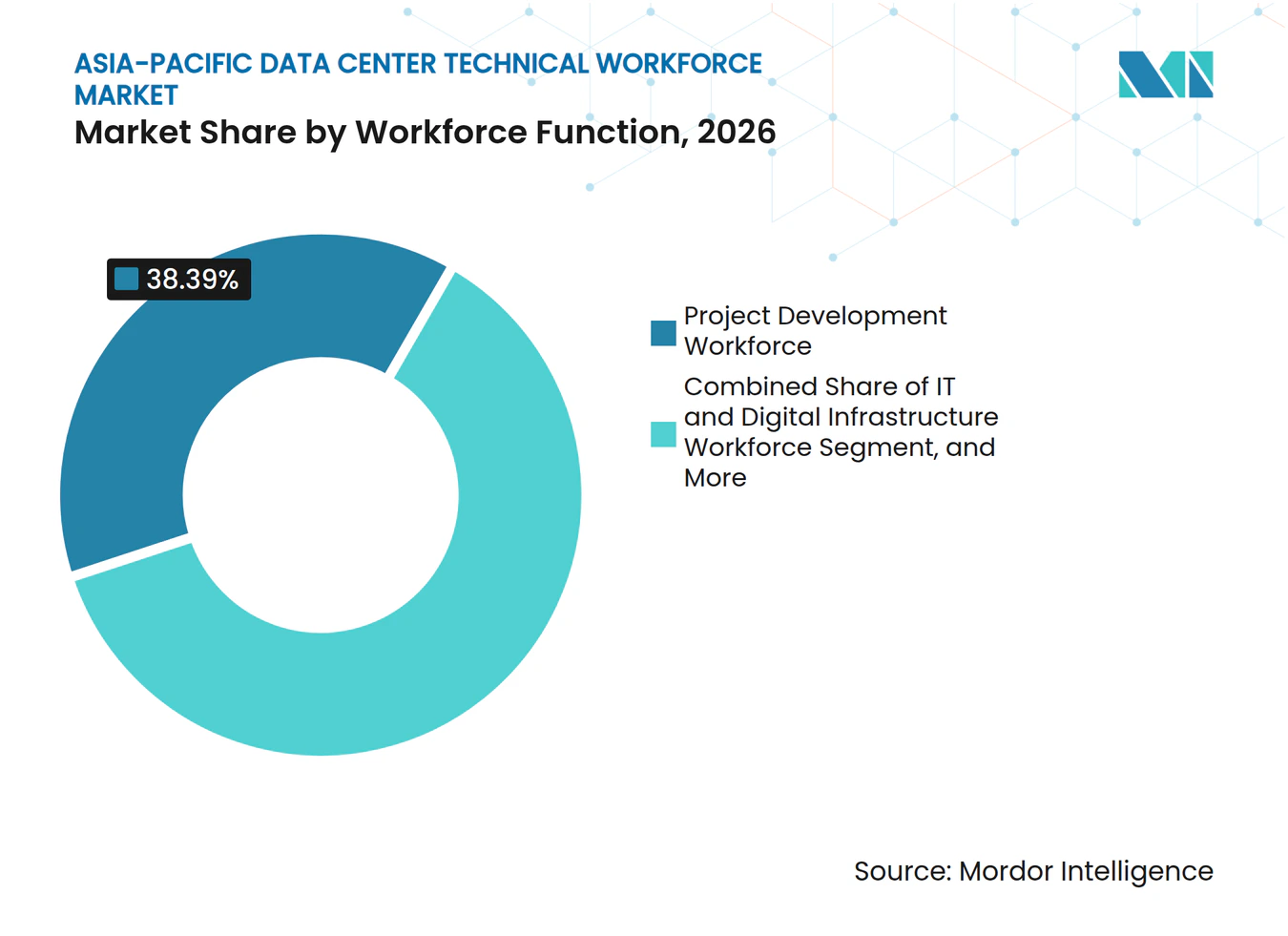
Project Phase Labor Leads, Operations Demand BuildsProject Development Workforce held 38.39% of the Asia-Pacific data center technical workforce market share in 2026. Its leading position reflects a regional pipeline heavily weighted toward facilities under construction. Project teams need high-voltage electrical engineers, MEP commissioning specialists, civil engineers, and structural project managers. These roles are particularly important for AI-ready campuses with demanding power and cooling designs. The Asia-Pacific data center technical workforce market size for this function is supported by projects moving through design, construction, and commissioning.
Chinese operators, including Alibaba Cloud and ByteDance, require personnel with MEP, civil, HVAC, and AI systems knowledge for infrastructure delivery. This shows how digital infrastructure projects draw on established engineering disciplines. The Facility Operations and Maintenance Workforce is projected to expand at a 17.88% CAGR through 2032. Completed facilities need multi-year teams to maintain reliability, manage change, and respond to equipment issues. The IT and Digital Infrastructure Workforce is also evolving as facilities move from CPU-dense designs to GPU-optimized configurations. AI infrastructure roles require stronger knowledge of accelerated computing, networks, security, and platform operations.



By Employment Model:
In-House Control Remains Important as External Services ExpandIn-house Workforce accounted for 58.42% of the market in 2026. Operators favor direct employment when they need close control over mission-critical responsibilities. Permanent engineers preserve institutional knowledge and continuity across shifts, maintenance cycles, and equipment upgrades. The Asia-Pacific data center technical workforce market share held by in-house teams reflects the need for clear accountability at high-uptime facilities. Direct employment remains especially relevant for live sites where downtime can have major financial and operational consequences.
External Workforce Services is projected to expand at a 17.72% CAGR through 2032. Operators that cannot build full teams quickly use managed staffing, employer-of-record arrangements, and contract labor pools. These models provide access to specialists during concentrated construction and commissioning periods. Smaller operators can use these services to reach GPU commissioning engineers and high-voltage power specialists within fixed project schedules. Providers with regional mobility can transfer practical experience between locations with small candidate pools. Operators still need to manage quality, safety, and site knowledge carefully.
By Data Center Type:
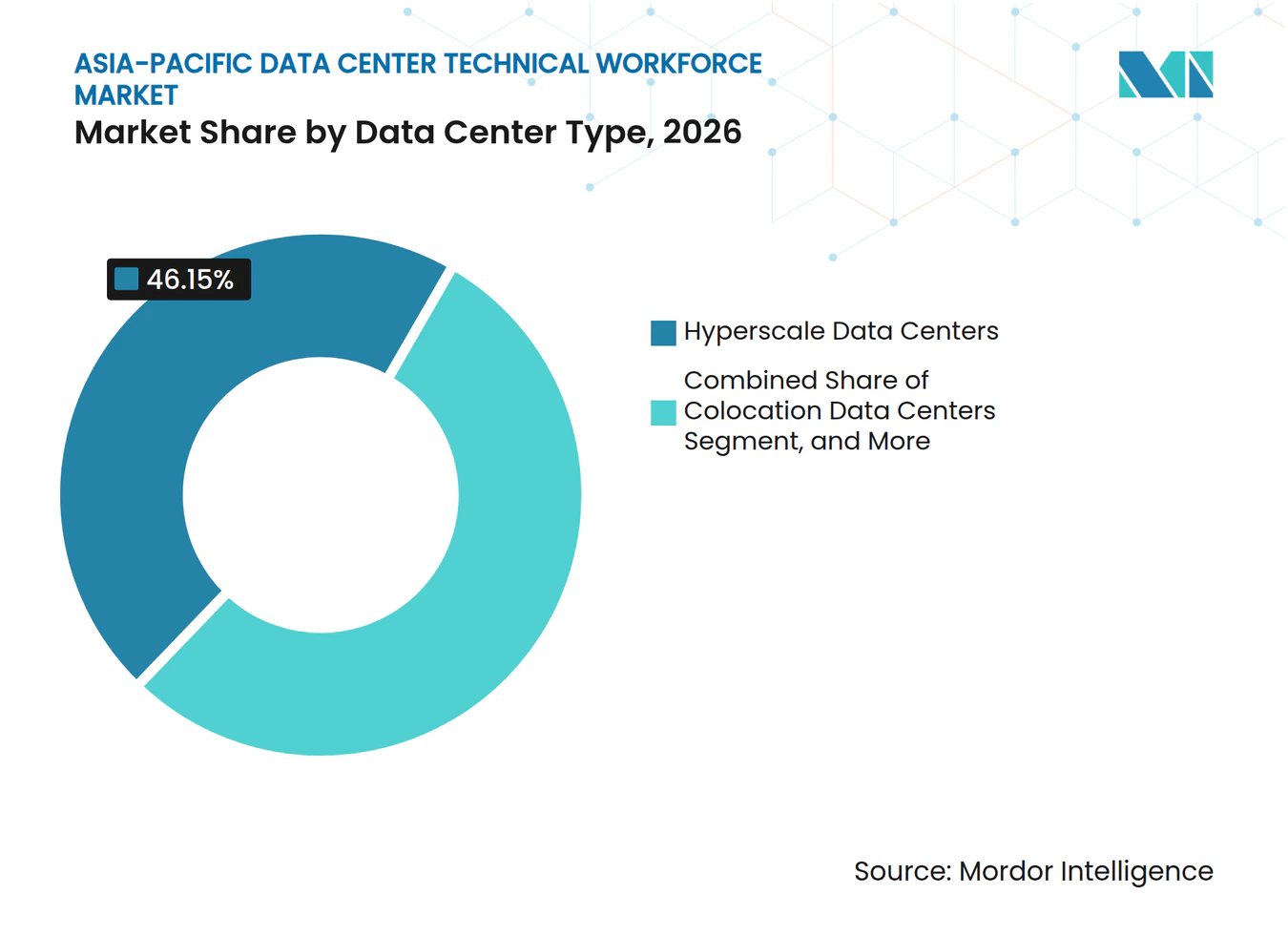
Hyperscale Facilities Lead Demand and ExpansionHyperscale Data Centers held 46.15% of the market in 2026 and are projected to expand at a 17.92% CAGR through 2032. This segment combines the largest Asia-Pacific data center technical workforce market share with the highest forecast rate among facility types. New regional hyperscale facilities can exceed 100 MW of planned IT capacity. Their construction requires large groups of engineers, project specialists, and commissioning staff. Their operations also require continuing technical teams after the initial build phase.
AI-ready hyperscale sites need direct-to-chip thermal engineers, GPU commissioning leads, AI operations specialists, and cloud-native cybersecurity professionals. These skills are not yet covered consistently by formal regional training programs. Operators are consequently competing for people with relevant experience in adjacent technical sectors. The Asia-Pacific data center technical workforce market size linked to hyperscale development will depend on how quickly broader engineering skills become site-ready capabilities. Colocation operators such as Equinix, NEXTDC, and Keppel also need similar staff across Hong Kong, Singapore, Malaysia, India, and Japan. Enterprise, Edge, and Modular Data Centers extend demand to in-country and non-metropolitan sites with thinner candidate pools.

Geography Analysis
China and Japan Data Center Technical Workforce Market
China held 32.76% of the Asia-Pacific data center technical workforce market share in 2026. Its position reflects the scale of domestic hyperscale development and the expansion of technology operators that need infrastructure delivery and operations teams. Alibaba Cloud and ByteDance have sought talent with civil, MEP, HVAC, and AI systems knowledge. This hiring profile illustrates the blend of traditional engineering and digital infrastructure skills needed in major Chinese campuses. Japan is also a demanding technical market because operational capacity and planned development are both substantial. The Linux Foundation reported that more than 70% of Japanese organizations faced understaffing in key technical domains in 2025. This shortage can make long-lead engineering pipelines particularly important for Japanese operators.
APAC Data Center Technical Workforce Market
India is projected to expand at a 17.85% CAGR through 2032, the fastest geographic rate in the Asia-Pacific data center technical workforce market. India has a large infrastructure pipeline and a broad base of engineering talent, but its need for specialized data center workers is also increasing. Data center projects require people who can support power systems, cooling, commissioning, operational reliability, and AI infrastructure. Malaysia is another key location because Johor is connected to Singapore through a developing cross-border capacity corridor. Malaysia’s need for 50,000 skilled engineers compared with annual output of 5,000 engineering graduates shows the intensity of local workforce pressure. Indonesia, Vietnam, Thailand, and the Philippines are also building their data center presence, which increases the need for training and certification outside the region’s established hubs.
Australia and Thailand Data Center Technical Workforce Market
Australia is receiving a new wave of hyperscaler investment and needs more technical staff across construction, commissioning, and AI operations. Microsoft pledged USD 18 billion and Amazon pledged USD 13 billion for Australia by 2029, according to company announcements cited in the research material. NEXTDC was selected by OpenAI for the Stargate Australia project, which involves a 550 MW hyperscale AI campus in Western Sydney. Thailand has a substantial construction pipeline relative to its existing operational capacity, creating a near-term need for commissioning teams. South Korea and other Asia-Pacific markets are also receiving more capital for digital infrastructure. Workforce demand will increasingly extend to countries where training capacity and certification systems remain at an earlier stage of development.
Competitive Landscape
Market Concentration
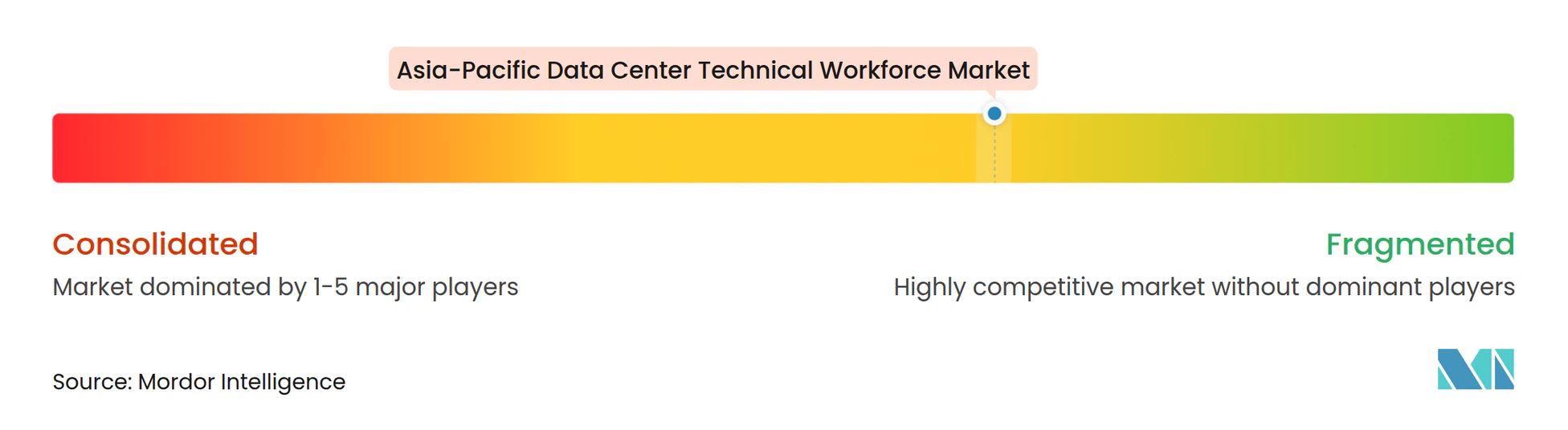
The Asia-Pacific data center technical workforce market is moderately fragmented. A small group of hyperscalers and global colocation providers consumes a large share of scarce specialist talent, while regional and national operators compete in individual country markets. Large organizations can recruit from power generation, semiconductor fabrication, and industrial automation. This broadens their access to workers with electrical controls and commissioning experience. It also allows them to set compensation levels that smaller operators may find difficult to meet. The Asia-Pacific data center technical workforce market is therefore competitive not only for projects and customers but also for practical technical capability.
Keppel received a provisional award of 50 MW under Singapore’s second Data Center Call for Application, DC-CFA2, in June 2026. The award reflects the importance of meeting government requirements for efficiency, resilience, and workforce capability in constrained capacity markets. Princeton Digital Group acquired a 240 MW power site in Greater Jakarta in April 2026, expanding its Indonesia portfolio to 400 MW. These actions show that expansion plans require coordinated decisions on sites, power, delivery teams, and operating talent. Equinix also opened the first phase of its HK6 facility in Hong Kong in June 2026, incorporating direct-to-chip liquid cooling and connectivity to the Hong Kong-Shenzhen Innovation and Technology Park. This type of facility requires technical roles that are still scarce across the region.
Indonesia, the Philippines, Vietnam, and Thailand present opportunities for workforce services that can move qualified personnel across borders. These locations combine emerging data center development with limited local specialist supply. AI infrastructure roles are another area of competition because GPU operations, direct-to-chip cooling, and AI infrastructure engineering remain difficult to source even in established hubs. BDx Data Centers and Singapore’s Institute of Technical Education signed a March 2026 memorandum to develop an AI data center talent pipeline across all 3 ITE colleges. Equinix’s Pathways to Tech initiative is also establishing entry routes into technical careers. Such programs can improve the supply of talent, although training and credential cycles mean that their effects will emerge gradually.
Asia-Pacific Data Center Technical Workforce Industry Leaders
-
NTT Global Data Centers Holding Corporation
-
AirTrunk
-
Equinix, Inc.
-
ST Telemedia Global Data Centres Pte. Ltd.
-
Princeton Digital Group
- *Disclaimer: Major Players sorted in no particular order
Asia-Pacific Data Center Technical Workforce Market Companies Covered in this Report
- AirTrunk
- NTT Global Data Centers Holding Corporation
- Equinix, Inc.
- Digital Realty Trust, Inc.
- ST Telemedia Global Data Centres Pte. Ltd.
- Princeton Digital Group
- GDS Services Limited
- Keppel Data Centres Holding Pte. Ltd.
- Bridge Data Centres Pte. Ltd.
- NEXTDC Limited
- CDC Data Centres Pty Ltd
- SUNeVision Holdings Ltd.
- Vantage Data Centers Management Company, LLC
- AIMS Data Centre Sdn. Bhd.
- YTL Power International Berhad
- Telekom Malaysia Berhad
- Amazon Web Services, Inc.
- Microsoft Corporation
- Google LLC
- Oracle Corporation
Recent Industry Developments in Asia-Pacific Data Center Technical Workforce Market
- September 2026: NEXTDC Limited was selected by OpenAI as the infrastructure partner for the Stargate Australia project, involving a 550 MW hyperscale AI campus and large-scale GPU supercluster in Western Sydney, substantially expanding NEXTDC's technical workforce requirements across construction, commissioning, and AI operations disciplines.
- June 2026: Keppel was provisionally awarded 50 MW of new data center capacity under Singapore's second Data Center Call for Application, DC-CFA2, administered by the Singapore Economic Development Board and the Infocomm Media Development Authority, with a planned investment of more than SGD 1 billion (USD 750 million) for Keppel DC SGP 11 on Jurong Island, funded through Keppel Data Center Fund III.
- June 2026: Equinix opened the first phase of HK6 in Hong Kong with an initial investment of USD 124 million, incorporating direct-to-chip liquid cooling and a direct private connection to the Hong Kong-Shenzhen Innovation and Technology Park, expanding Equinix's AI-ready footprint in the Greater Bay Area.
- May 2026: NEXTDC Limited launched KL1 Kuala Lumpur, its first international data center outside Australia, to support AI, cloud, and digital services growth across Southeast Asia, entering a market where operational capacity more than doubled in 2025.
Asia-Pacific Data Center Technical Workforce Market Report Scope
The Asia-Pacific Data Center Technical Workforce Market refers to the ecosystem of skilled professionals responsible for designing, constructing, operating, maintaining, securing, and optimizing data center infrastructure.
The Asia-Pacific Data Center Technical Workforce Market Report is Segmented by Workforce Function (Project Development Workforce [Design and Engineering Workforce, Construction and Installation Workforce, and Testing and Commissioning Workforce], Facility Operations and Maintenance Workforce [Data Center Operations Workforce, Facility Management Workforce, and Maintenance and Reliability Workforce], and IT and Digital Infrastructure Workforce [IT Hardware and Cloud Infrastructure Workforce, Network Infrastructure Workforce, Cybersecurity and Technical Security Workforce, and AI Infrastructure Workforce]), Employment Model (In-house Workforce and External Workforce Services), Data Center Type (Hyperscale Data Centers, Colocation Data Centers, and Enterprise, Edge and Modular Data Centers), and Geography (China, India, Japan, Indonesia, Australia, Singapore, Malaysia, Vietnam, Thailand, Taiwan, Philippines, and Rest of Asia-Pacific). The Market Forecasts are Provided in Terms of Value (USD).
Segmentation Overview
| Project Development Workforce | Design and Engineering Workforce |
| Construction and Installation Workforce | |
| Testing and Commissioning Workforce | |
| Facility Operations and Maintenance Workforce | Data Center Operations Workforce |
| Facility Management Workforce | |
| Maintenance and Reliability Workforce | |
| IT and Digital Infrastructure Workforce | IT Hardware and Cloud Infrastructure Workforce |
| Network Infrastructure Workforce | |
| Cybersecurity and Technical Security Workforce | |
| AI Infrastructure Workforce |
| In-house Workforce |
| External Workforce Services |
| Hyperscale Data Centers |
| Colocation Data Centers |
| Enterprise, Edge and Modular Data Centers |
| China |
| India |
| Japan |
| Indonesia |
| Australia |
| Singapore |
| Malaysia |
| Vietnam |
| Thailand |
| Taiwan |
| Philippines |
| Rest of Asia-Pacific |
| By Workforce Function | Project Development Workforce | Design and Engineering Workforce |
| Construction and Installation Workforce | ||
| Testing and Commissioning Workforce | ||
| Facility Operations and Maintenance Workforce | Data Center Operations Workforce | |
| Facility Management Workforce | ||
| Maintenance and Reliability Workforce | ||
| IT and Digital Infrastructure Workforce | IT Hardware and Cloud Infrastructure Workforce | |
| Network Infrastructure Workforce | ||
| Cybersecurity and Technical Security Workforce | ||
| AI Infrastructure Workforce | ||
| By Employment Model | In-house Workforce | |
| External Workforce Services | ||
| By Data Center Type | Hyperscale Data Centers | |
| Colocation Data Centers | ||
| Enterprise, Edge and Modular Data Centers | ||
| By Geography | China | |
| India | ||
| Japan | ||
| Indonesia | ||
| Australia | ||
| Singapore | ||
| Malaysia | ||
| Vietnam | ||
| Thailand | ||
| Taiwan | ||
| Philippines | ||
| Rest of Asia-Pacific | ||
Key Questions Answered in the Report
What is the size of the Asia-Pacific data center technical workforce market?
The market is expected to increase from USD 24.81 billion in 2026 to USD 63.12 billion by 2032, at a 16.58% CAGR over 2027-2032. Demand covers project development, facility operations, and IT infrastructure work.
Which workforce function has the largest share in Asia-Pacific data centers?
Project Development Workforce held 38.39% in 2026 because the region has a substantial construction and commissioning pipeline. Demand is concentrated in high-voltage, MEP, civil, structural, and commissioning roles.
Which data center type creates the strongest technical labor demand?
Hyperscale Data Centers held 46.15% in 2026 and are projected to expand at a 17.92% CAGR through 2032. AI-ready campuses need specialist teams during construction and throughout operations.
Why are AI-ready facilities changing workforce needs?
AI-ready sites require specialized capability in liquid cooling, GPU commissioning, thermal management, and AI infrastructure operations. Those skills are not yet supplied consistently through formal regional training programs.
Which country has the fastest workforce demand outlook?
India is projected to expand at a 17.85% CAGR through 2032, supported by a large data center development pipeline. The country needs technical workers for construction, commissioning, and continuous facility operations.
How are operators responding to shortages of specialized workers?
Operators are hiring from adjacent engineering fields, developing training programs, and using external workforce services for scarce specialist roles. Earlier candidate engagement is also becoming more common among larger operators.