
Asia-Pacific Data Center Switchgear Market Size and Share
Market Overview
| Study Period | 2021 - 2032 |
|---|---|
| Forecast Data Period | 2027 - 2032 |
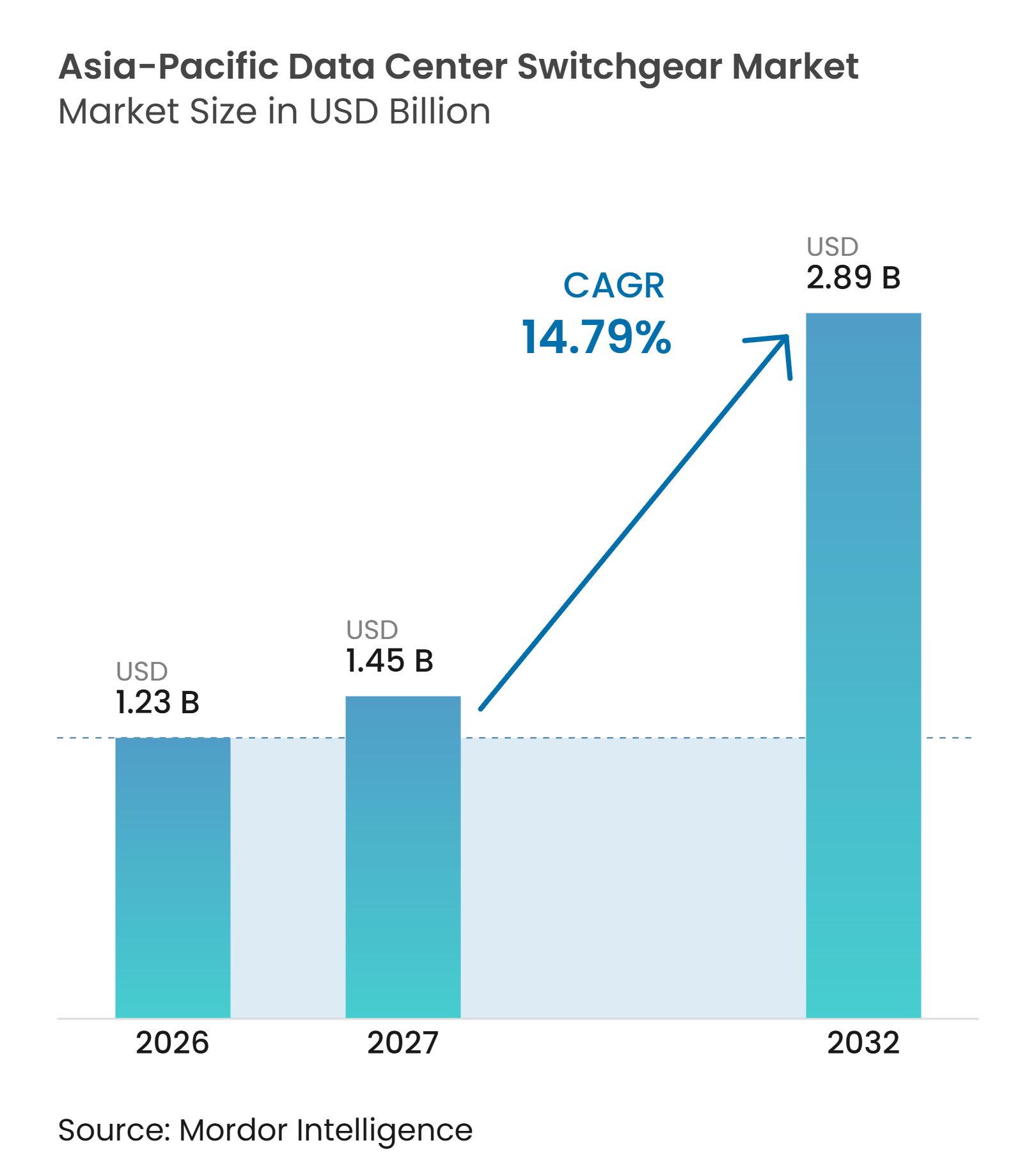
| Base Year Market Size (2026) | USD 1.23 Billion |
| Market Size (2027) | USD 1.45 Billion |
| Market Size (2032) | USD 2.89 Billion |
| Growth Rate (2027 - 2032) | 14.79 % |
| Market Concentration | Medium |
Major Players *Disclaimer: Major Players sorted in no particular order Image © Mordor Intelligence. Reuse requires attribution under CC BY 4.0. | |
Asia-Pacific Data Center Switchgear Market Analysis by Mordor Intelligence
The Asia-Pacific data center switchgear market size was valued at USD 1.23 billion in 2026 and estimated to expand from USD 1.45 billion in 2027 to reach USD 2.89 billion by 2032, at a CAGR of 14.79% during the forecast period (2027-2032). The Asia-Pacific data center switchgear market is being shaped by larger AI-ready campuses that need more resilient electrical distribution from the grid connection through the rack. These projects are increasing demand for medium-voltage equipment, redundant power paths, and digital monitoring tools. Suppliers are responding with factory-built power modules, SF₆-free equipment, and software-based configuration that can shorten on-site work. Grid capacity, equipment lead times, and local approval requirements remain important limits, especially in established hubs. The Asia-Pacific data center switchgear market also creates openings in India, Southeast Asia, and inland China, where new sites can combine available land and power with expanding digital infrastructure.
Key Report Takeaways
- By voltage level, low-voltage switchgear held 51.30% of the Asia-Pacific data center switchgear market share in 2026, while medium-voltage switchgear is projected to expand at a 16.39% CAGR through 2032.
- By insulation type, air-insulated switchgear accounted for 49.51% of the Asia-Pacific data center switchgear market in 2026, while other insulation technologies are projected to expand at a 16.88% CAGR through 2032.
- By installation type, indoor switchgear held 73.20% revenue share in 2026, while outdoor switchgear is projected to expand at a 16.97% CAGR through 2032.
- By configuration, withdrawable switchgear held 47.33% revenue share in 2026, while modular switchgear is projected to expand at a 17.20% CAGR through 2032.
- By data center size, hyperscale facilities accounted for 42.61% of the Asia-Pacific data center switchgear market size in 2026 and are projected to expand at a 17.81% CAGR through 2032.
- By data center type, colocation facilities held 46.20% revenue share in 2026, while cloud service providers are projected to expand at a 17.10% CAGR through 2032.
- By geography, China held 36.45% revenue share in 2026, while India is projected to expand at a 17.53% CAGR through 2032.
Note: Market numbers in this report are based on Mordor Intelligence's proprietary estimation framework, which combines nine months of actuals with Q4 projections for base year 2026.
Market Trends and Insights
Drivers Impact Analysis of Asia-Pacific Data Center Switchgear Market*
| Driver | (~) % Impact on CAGR Forecast | Geographic Relevance | Impact Timeline |
|---|---|---|---|
| Hyperscale and Artificial Intelligence Campus Expansion | +4.5% | China, India, Australia, Japan, Singapore | Short term (≤ 2 years) |
| Cloud, 5G and Edge Workload Growth | +3.2% | Asia-Pacific-wide, with emphasis on Southeast Asia and Japan | Medium term (2-4 years) |
| High Power Density and Redundancy Requirements | +2.5% | Asia-Pacific-wide, with highest intensity in China and India | Short term (≤ 2 years) |
| Government Digitalization and Data-Localization Requirements | +2.0% | India, China, Indonesia, Australia, Southeast Asia | Medium term (2-4 years) |
| SF₆-Free and Digital Monitoring Adoption | +1.5% | Singapore, Japan, Australia, South Korea and China | Long term (≥ 4 years) |
| Grid-Connection Delays Driving Modular and Onsite Power Architectures | +0.8% | Japan, Australia, Asia-Pacific core markets | Medium term (2-4 years) |
| Source: Mordor Intelligence | |||
Hyperscale and Artificial Intelligence Campus Expansion
The Asia-Pacific data center switchgear market is closely tied to hyperscale AI campuses, where individual sites can exceed 100 MW and require campus-level medium-voltage distribution. These facilities need dedicated substations, heavy-duty transformers, protection systems, and multiple distribution paths. The International Energy Agency identifies data centers as a major new source of electricity demand, alongside wider grid modernization and renewable-energy investment, which places pressure on electrical equipment supply chains. The scale of AI clusters shifts procurement toward switchgear that can handle higher fault current and allow planned maintenance without interrupting critical loads. The Asia-Pacific data center switchgear market, therefore, benefits when operators secure sites early and reserve equipment capacity before construction begins.
Cloud, 5G and Edge Workload Growth
Cloud migration, 5G services, and AI inference at the network edge are broadening demand beyond central campuses. Smaller edge sites need standardized switchgear that can be monitored remotely because many operate with limited on-site staff. China’s National Energy Administration reported 170 TWh of data center electricity use in 2025, equal to 1.6% of national electricity consumption, which shows the power-system relevance of this buildout. Distributed capacity does not replace hyperscale capacity, since each serves different latency, workload, and connectivity needs. The Asia-Pacific data center switchgear market gains from this dual pattern because compact modular systems can serve edge sites while larger medium-voltage lineups serve cloud campuses.
High Power Density and Redundancy Requirements
AI and high-performance computing are raising rack power requirements from the 5-7 kW range used in conventional deployments toward 15-30 kW. This change increases the need for medium-voltage primary distribution and more transformers per megawatt of IT load. Redundancy designs such as N+1 and 2N require parallel electrical paths, which increases the number of panels, breakers, and monitoring points installed at each site. ABB reported that a compact medium-voltage switchgear design at a Chengdu data center reduced floor space by more than 25% compared with traditional configurations. The Asia-Pacific data center switchgear market is consequently moving toward smaller-footprint equipment that supports high availability and effective use of technical space.
Government Digitalization and Data-Localization Requirements
Government programs and data-residency requirements provide a baseline for new local capacity even when commercial cloud investment varies. Invest India reported announced data center investment commitments exceeding USD 180 billion as of September 2026, alongside major capacity plans across Indian locations.[1] China’s national computing strategy is directing workloads toward new hubs in western provinces, which links digital policy with power infrastructure expansion. These programs support demand for locally compliant equipment and qualified service support. The Asia-Pacific data center switchgear market also benefits from replacement activity, where efficiency rules make older electrical systems less suitable for modern facilities.
Restraints Impact Analysis of Asia-Pacific Data Center Switchgear Market*
| Restraint | (~) % Impact on CAGR Forecast | Geographic Relevance | Impact Timeline |
|---|---|---|---|
| High Upfront Equipment and Installation Costs | -2.5% | Asia-Pacific-wide, most acute in Japan and Australia | Short term (≤ 2 years) |
| Grid, Land and Permitting Constraints in Tier-1 Hubs | -2.0% | Japan, Singapore, South Korea and Australia | Medium term (2-4 years) |
| Long Lead Times and Local Qualification Requirements | -1.2% | Asia-Pacific-wide | Medium term (2-4 years) |
| Skilled-Labor Shortage for High-Density and Digital Installations | -0.8% | India, Southeast Asia and emerging Asia-Pacific hubs | Long term (≥ 4 years) |
| Source: Mordor Intelligence | |||
High Upfront Equipment and Installation Costs
Higher power density raises the installed cost of electrical infrastructure because operators need more complex distribution, cooling support, and redundancy. SF₆-free and digitally enabled medium-voltage equipment can also carry a price premium against conventional equipment. Smaller enterprises and edge operators may respond by delaying a refresh or reducing the scope of a new build. Singapore’s Green Data Center Roadmap links capacity expansion with standards for resource efficiency, which can add planning and compliance work at the start of a project. The Asia-Pacific data center switchgear market remains exposed to these cost pressures, although factory testing and reusable modular designs can reduce some field labor and schedule risk.
Grid, Land and Permitting Constraints in Tier-1 Hubs
Power access can delay a project even when there is strong customer demand and financing. The International Energy Agency states that grid investment and supply-chain capability must advance with rising electricity needs from data centers and other electrified uses.[2] In constrained urban markets, developers may need to consider on-site generation, storage, or locations outside the core city. These choices alter equipment specifications and can lengthen engineering work. The Asia-Pacific data center switchgear market is shifting part of its new-build opportunity toward locations with more available land and grid capacity, including secondary Indian cities, Malaysia’s Johor corridor, and inland China.
*Our forecasts treat driver/restraint impacts as directional, not additive. The impact forecasts reflect baseline growth, mix effects, and variable interactions.
Asia-Pacific Data Center Switchgear Market Segment Analysis
By Voltage Level:
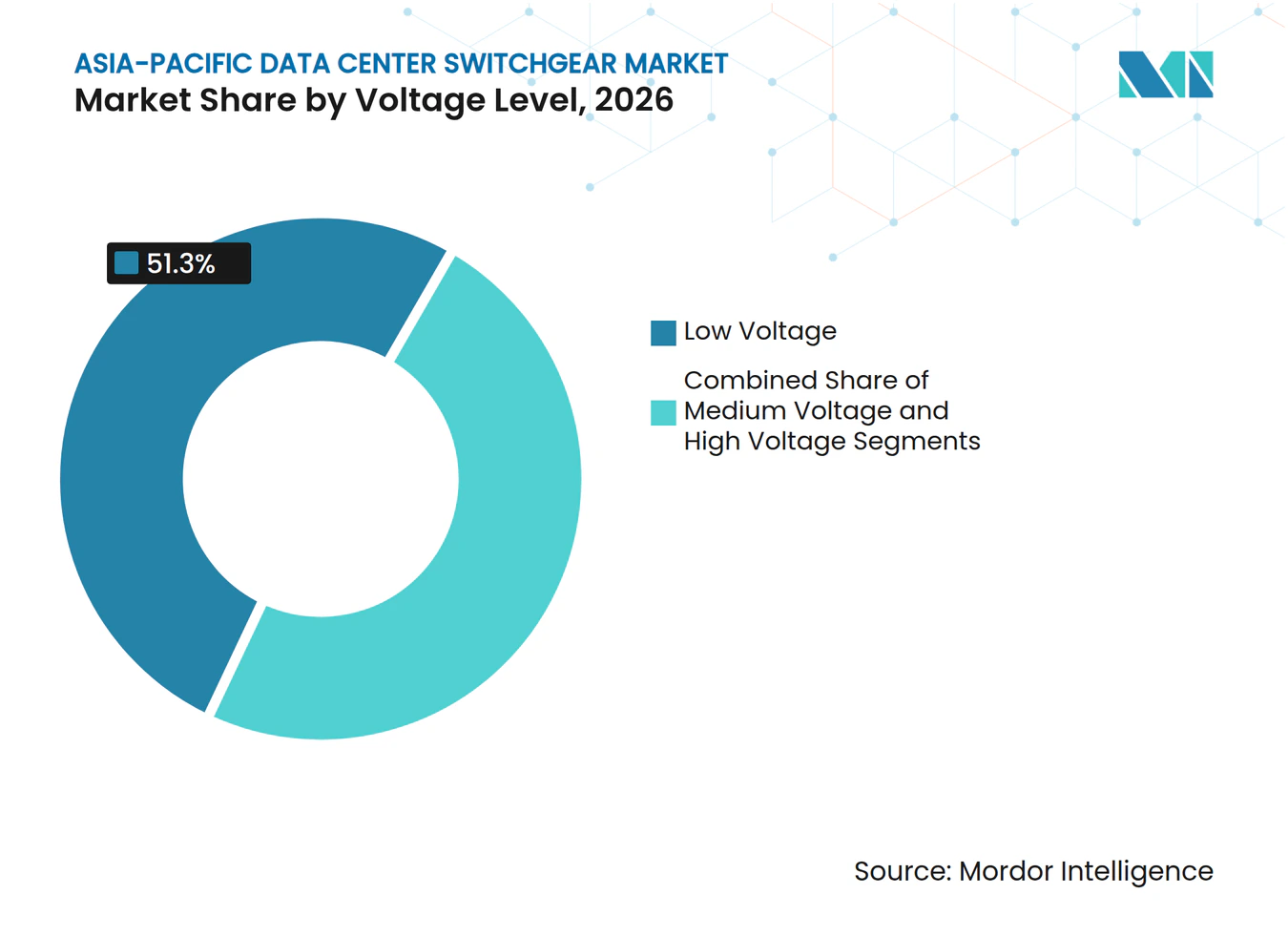
Medium Voltage Gains Ground in High-Density DeploymentsLow-voltage switchgear held 51.30% of the Asia-Pacific data center switchgear market share in 2026 because it remains central to downstream distribution, UPS interfaces, and generator paralleling systems. Its wide adoption reflects established 400/480 V distribution designs and the need for equipment that can be maintained by local teams. Low-voltage lineups continue to serve distribution rooms across colocation, enterprise, and cloud facilities. Medium-voltage switchgear is projected to expand at a 16.39% CAGR through 2032 as operators move more primary power distribution closer to the utility intake. This approach reduces transformer losses and can release valuable floor space inside high-density facilities. High-voltage equipment remains important at the largest campuses because it supports the initial grid connection and primary substation.
Medium-voltage systems operating at 10-35 kV are increasingly suitable for campuses with AI loads and multi-building layouts. The demand outlook for medium-voltage equipment is supported by designs that connect grid intake, switchgear, and UPS arrangements through a coordinated architecture. ABB describes medium-voltage data center solutions that integrate these elements to improve power density and energy efficiency IEC 62271 requirements for internal arc protection and continuity of service are becoming common procurement considerations across voltage tiers. Buyers also consider the availability of qualified local service engineers, spare parts, and testing capability. These requirements favor suppliers that can support both technical design and long-term maintenance.



By Insulation Type:
SF₆-Free Technologies Reshape Procurement StandardsAir-insulated switchgear accounted for 49.51% of the Asia-Pacific data center switchgear market in 2026 because it offers familiar maintenance practices and avoids gas-handling requirements. It is suited to many indoor primary distribution uses where space is available. Operators often value its lower ownership cost and the availability of trained technicians. Other insulation technologies are projected to expand at a 16.88% CAGR through 2032 as environmental reporting and sustainability commitments influence equipment selection. These alternatives include pure-air systems, solid insulation, vacuum interruption, and SF₆-free gas mixtures. Gas-insulated equipment continues to have a role at urban facilities where a compact footprint can justify a higher installed cost.
SF₆ selection has become a governance and operational matter, not only a technical choice. Hitachi Energy delivered a 550 kV SF₆-free gas-insulated switchgear system to Chubu Electric Power Grid in Japan in March 2026 and stated that its insulating gas reduces CO₂-equivalent emissions by 99% against conventional SF₆ equipment.[3] The Asia-Pacific data center switchgear market is therefore seeing procurement criteria that consider gas management, reporting exposure, serviceability, and lifetime emissions. IEC 62271-4 provides a relevant framework for the handling of insulating gases and their mixtures. Suppliers are adapting with pure-air, vacuum-breaker, and alternative-gas configurations. The choice between AIS and GIS remains location-specific because space, maintenance capability, and environmental policies differ across the region.
By Installation Type:
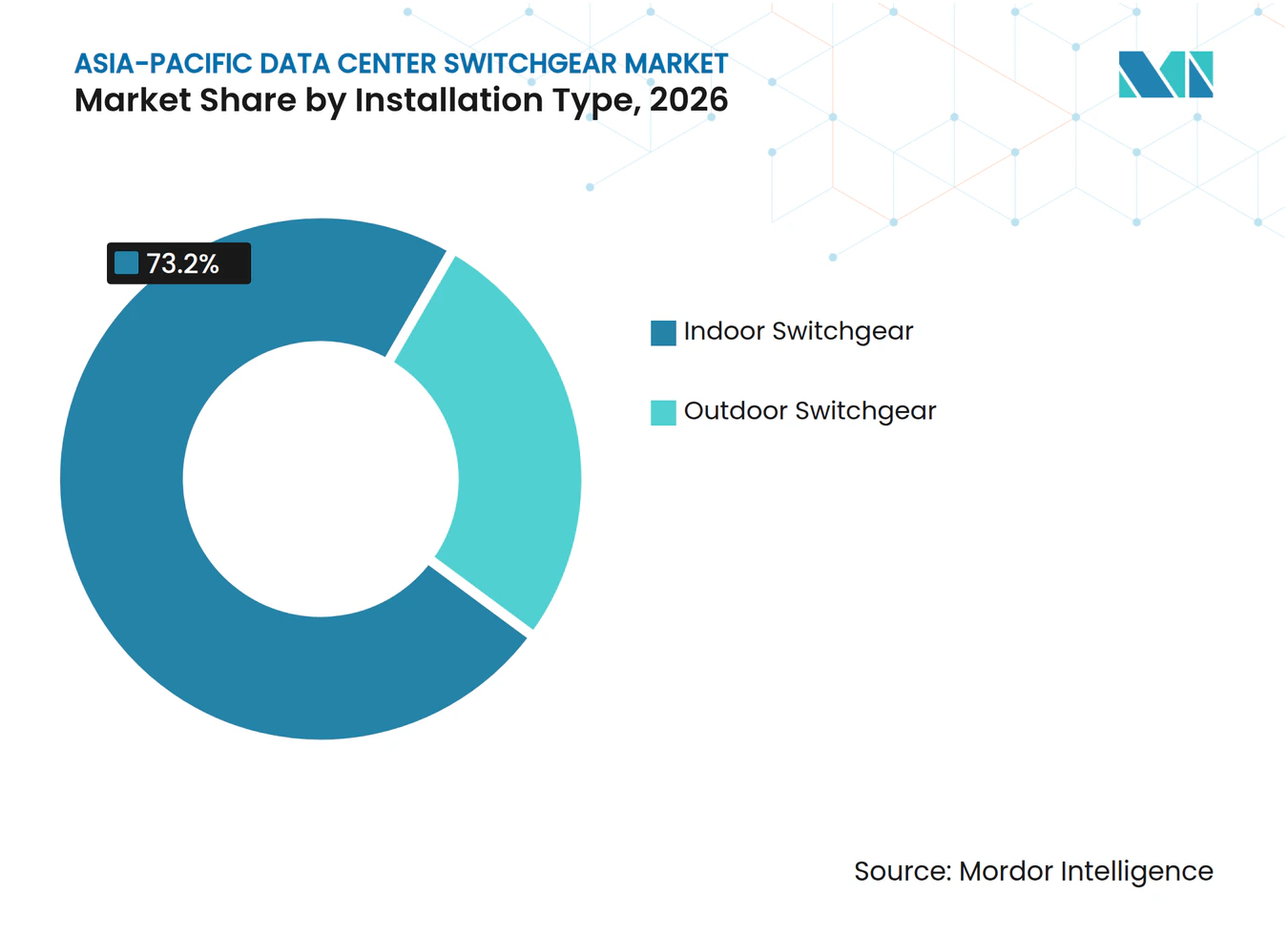
Outdoor Switchgear Scales With Campus FootprintsIndoor switchgear held 73.20% of the revenue share in 2026 because most purpose-built facilities place electrical lineups in protected rooms. Controlled conditions can extend equipment life and make integration with monitoring systems easier. This format is widely used by colocation operators, cloud providers, and enterprise facilities in mature markets. Outdoor switchgear is projected to expand at a 16.97% CAGR through 2032 as campuses adopt external prefabricated power modules and containerized substations. These units can be assembled, tested, and wired before they arrive at the site. The model helps developers reduce work in congested construction locations.
Outdoor solutions also support large campus designs where power infrastructure needs to expand in repeatable blocks. CHINT states that its factory-built Power Pod can reduce on-site installation time by up to 60% for configurations from 500 kW to 4,000 kW. The Asia-Pacific data center switchgear market uses this approach to address labor shortages and uncertain construction schedules. Factory acceptance testing can identify issues earlier than field assembly. Outdoor equipment must still account for local heat, humidity, corrosion, and seismic conditions. Suppliers that offer proven enclosure designs and coordinated protection systems are better placed to meet these site-specific needs.

By Configuration:
Modular Switchgear Compresses Deployment TimelinesWithdrawable switchgear held 47.33% of revenue share in 2026 because it allows circuit breakers to be removed or replaced without de-energizing adjacent circuits. This capability supports the availability commitments common in Tier III and Tier IV facilities. It also helps operators plan maintenance and lower the mean time to repair. Modular switchgear is projected to expand at a 17.20% CAGR through 2032 as buyers favor standardized assemblies that can be installed and expanded with less site rewiring. Fixed-mounted products continue to serve cost-sensitive enterprise and edge facilities with fewer circuits and less demanding maintenance access. Configuration choice, therefore, reflects an operator’s uptime target, project scale, and budget.
The Asia-Pacific data center switchgear market benefits from modular products where developers need predictable quality and shorter delivery cycles. CHINT describes its EnergiX-P40 as a modular switchgear platform with live-swappable outgoing circuits and IEC 61439-2 compliance. Schneider Electric introduced a software-defined medium-voltage architecture that it says can reduce modeled deployment time from 31.5 weeks to 11.5 weeks. Standard hardware with configurable software can also simplify later changes to protection and control logic. The remaining requirement is dependable local commissioning and lifecycle service. That requirement can limit adoption in markets without a qualified support network.
By Data Center Size:
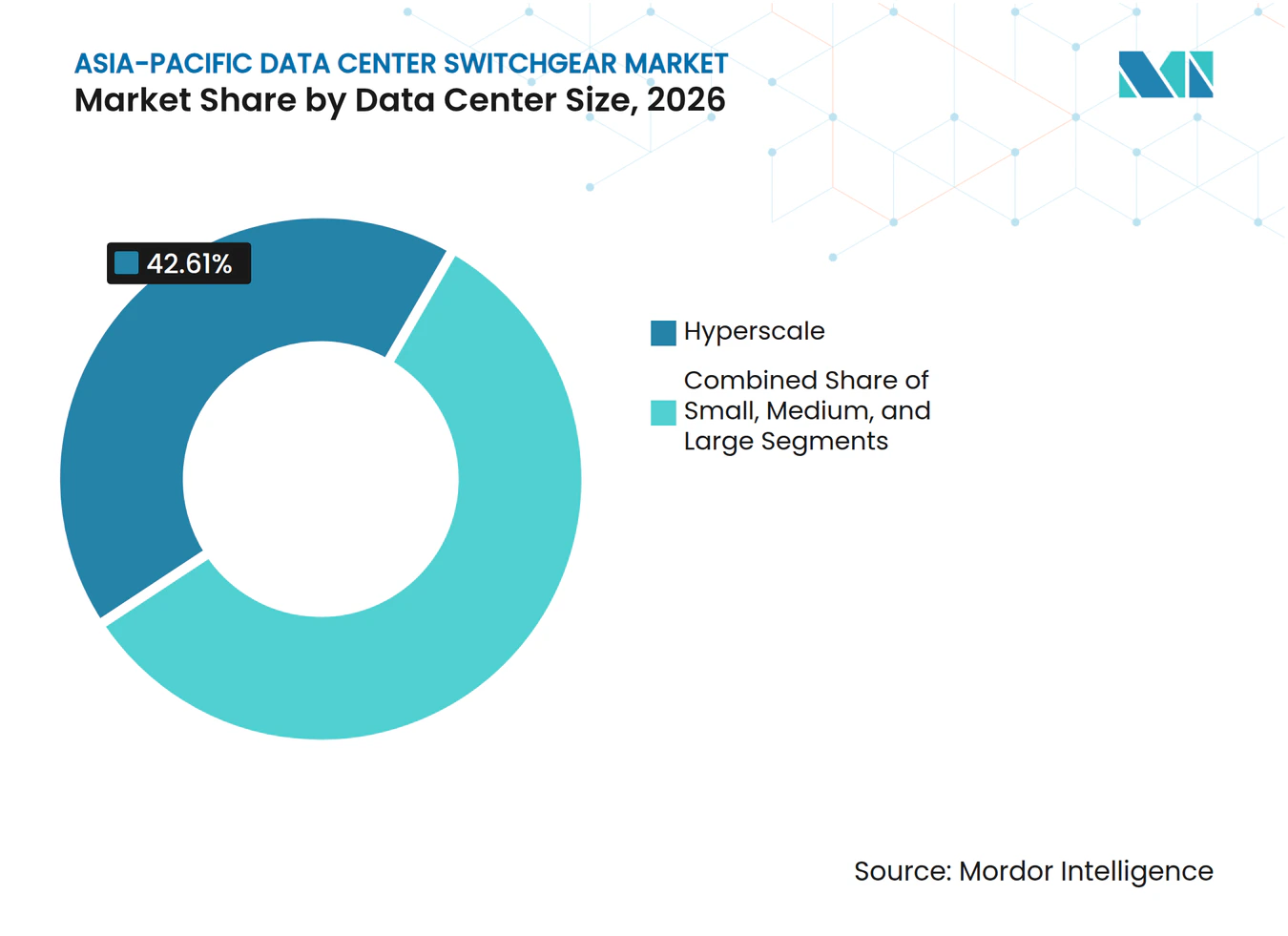
Hyperscale Consolidates Demand LeadershipHyperscale facilities accounted for 42.61% of the Asia-Pacific data center switchgear market in 2026 and are projected to expand at a 17.81% CAGR through 2032. These sites commonly need high-voltage intake, medium-voltage campus distribution, and low-voltage facility distribution in one coordinated system. New campuses in China and India can exceed 100 MW and are increasingly planned at 200-400 MW. This concentration makes a small number of projects important to annual equipment demand. Large and medium facilities remain relevant for enterprise, financial services, and government operators. Small sites are individually modest purchasers but create a distributed base of demand across edge and regional colocation deployments.
Hyperscale buyers often favor digitally monitored equipment and lifecycle agreements because outages carry substantial service consequences. China’s national computing strategy has established eight computing hub clusters, creating a policy framework for major new digital infrastructure projects. The Asia-Pacific data center switchgear market is also supported by factory-built power pods that combine switchgear, transformers, and protection in one outdoor unit. These systems help sites add capacity in phases without redesigning the full electrical system. Enterprise buyers put greater weight on price per panel and local service availability. The contrast means suppliers need distinct product and service models for hyperscale campuses and smaller facilities.
By Data Center Type:
Cloud Service Providers Drive The Highest Growth VelocityColocation facilities held 46.20% revenue share in 2026 because neutral facilities remain important for interconnection and proximity requirements in Singapore, Hong Kong, Tokyo, and Sydney. Their contractual uptime commitments favor withdrawable and modular systems with strong service continuity ratings. Cloud service providers are projected to expand at a 17.10% CAGR through 2032 as they add regional capacity for cloud services and AI workloads. Enterprise and edge data centers remain a diverse group that includes on-premises installations, public-sector sites, and telecom nodes. These operators typically favor standardized and locally supportable configurations. The Asia-Pacific data center switchgear market must therefore address different technical needs across each customer category.
CSP purchases can require customized medium-voltage equipment, power distribution units, and digital models for electrical planning. Schneider Electric reported supplying medium-voltage switchgear, customized SPC-PDUs, and digital modeling software for a ByteDance data center project in China. Colocation providers focus on maintaining service while work is performed, which increases interest in redundant and compartmentalized equipment. Edge sites are more sensitive to installed cost and remote operation because they have fewer on-site personnel. AI inference at the edge may also create replacement demand where existing panels were not designed for denser GPU loads. Product portfolios that combine standardization with local customization are well suited to this varied buyer base.
Geography Analysis
China
China held 36.45% regional revenue share in 2026, supported by large installed capacity and national digital infrastructure programs. The National Energy Administration reported 170 TWh of data center electricity use in 2025, which represented 1.6% of China’s electricity consumption. The national computing strategy moves some workloads from eastern demand centers to western regions with more suitable power resources. This supports new campus construction in provinces such as Inner Mongolia, Guizhou, and Gansu. The National Development and Reform Commission frames the program as an integrated national computing network, which links location planning, connectivity, and computing capacity. Domestic manufacturers can benefit where buyers prioritize local supply, delivery capability, and compliance with Chinese technical requirements. Energy-efficiency targets also support equipment with advanced monitoring and lower electrical losses.
India
India is projected to expand at a 17.53% CAGR through 2032, making it the fastest-growing geography in the Asia-Pacific data center switchgear market. Invest India reported announced data center investments above USD 180 billion as of September 2026, which indicates a substantial pipeline for electrical equipment. Demand is concentrated in Mumbai, Hyderabad, Chennai, and Delhi-NCR, while other cities are attracting interest as land and power constraints increase in core hubs. India’s data protection framework and public digital infrastructure support demand for domestic capacity. Schneider Electric Infrastructure India announced plans in May 2026 to expand panel manufacturing at Vadodara from 8,000 to 14,000 panels a year, reflecting suppliers’ need for local production capability. The availability of regional manufacturing and field support will shape supplier selection as projects move from announcement to construction. Power quality, grid connections, and skilled installation work remain practical factors for delivery.
Japan, Australia, Singapore, And Emerging Asia-Pacific Markets
Japan has strong commercial demand but faces difficult grid access in major metropolitan locations. Singapore manages a limited land and power envelope through controlled capacity allocation and its Green Data Center Roadmap, which emphasizes resource efficiency and low-carbon power.[4] These conditions favor compact, monitoring-capable equipment and high-quality local service. Australia is adding AI-oriented capacity while grid operators consider the reliability obligations of large new loads. Malaysia, Indonesia, Thailand, and Vietnam offer sites that can draw investment away from constrained hubs. Hitachi Energy’s SF₆-free technology and grid-to-rack focus illustrate how suppliers are linking grid modernization with data center development. Across these locations, local grid codes, weather conditions, and available technical labor create different specifications for the same underlying data center demand.
Competitive Landscape
Market Concentration
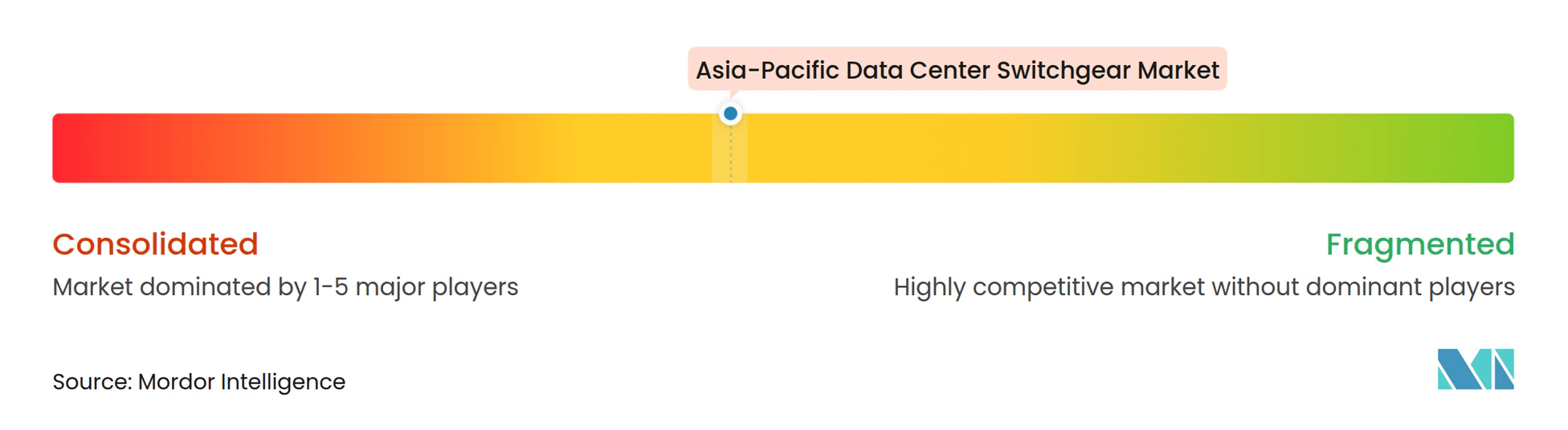
The Asia-Pacific data center switchgear market has a moderately consolidated premium tier led by Schneider Electric, ABB, Siemens, Eaton, Hitachi Energy, and Mitsubishi Electric. These companies combine equipment portfolios with engineering support, service networks, and digital tools. A second layer of regional manufacturers competes on price, domestic production, and tailored designs. China-based producers such as CHINT, Guangzhou Baiyun Electric Equipment, and Guangdong Mingyang Electric are relevant to projects where local sourcing is important. IEC 62271 compliance and internal-arc certification remain important qualification requirements for high-specification projects. These technical and service expectations make it difficult for new suppliers to enter without proven testing and local support.
Technology differentiation is shifting toward SF₆-free insulation, software-defined protection and control, and prefabricated electrical modules. Schneider Electric unveiled its software-defined medium-voltage switchgear architecture in September 2026 and said it uses 87% less control wiring and 91% fewer terminals than conventional configurations. Hitachi delivered its first 550 kV SF₆-free GIS system to Chubu Electric Power Grid in March 2026, supporting the practical deployment of alternative insulation at high voltage. Hyosung introduced a 145 kV dry-air circuit breaker in April 2026, adding another alternative to conventional SF₆ equipment. These moves show that leading suppliers are competing through electrical performance, environmental credentials, and deployment speed. Buyers will continue to judge suppliers on local technical support and the ability to satisfy country-specific grid rules.
Unserved opportunities remain in factory-tested substations for edge facilities in Southeast Asian secondary cities and in digital upgrades for installed switchgear. Retrofitting sensors and communication systems can create a service opportunity where operators want better visibility without replacing complete lineups. India is an important competitive test because CSP demand is increasing faster than some global suppliers’ established local production capacity. Mitsubishi Electric introduced NVIDIA-compatible reference designs in September 2026 that connect power transmission and distribution equipment with next-generation AI data center supply technologies. Emerging solid-state transformer and high-voltage direct-current designs could change some long-term power architectures. The Asia-Pacific data center switchgear market nevertheless remains dependent on proven conventional switchgear for most current campus builds.
Asia-Pacific Data Center Switchgear Industry Leaders
-
Schneider Electric SE
-
Eaton Corporation plc
-
Siemens AG
-
Vertiv Holdings Co.
-
Mitsubishi Electric Corporation
- *Disclaimer: Major Players sorted in no particular order
Asia-Pacific Data Center Switchgear Market Companies Covered in this Report
- Schneider Electric SE
- Eaton Corporation plc
- ABB Ltd.
- Siemens AG
- Mitsubishi Electric Corporation
- Vertiv Holdings Co.
- Legrand SA
- Meidensha Corporation
- Huawei Technologies Co., Ltd.
- Fuji Electric Co., Ltd.
- LS ELECTRIC CO., LTD.
- Hyundai Electric and Energy Systems Co., Ltd.
- Hitachi Energy Ltd.
- CHINT Group
- TAKAOKA TOKO CO., LTD.
- Anord Mardix
- Powell Industries, Inc.
- Guangzhou Baiyun Electric Equipment Co., Ltd.
- Guangdong Mingyang Electric Co., Ltd.
- Hyosung Heavy Industries Corporation
- Toshiba Infrastructure Systems and Solutions Corporation
Recent Industry Developments in Asia-Pacific Data Center Switchgear Market
- October 2026: Hitachi Energy participated in the Singapore International Energy Week, presenting its SF₆-free EconiQ switchgear and a panel discussion on data center grid readiness as power bottlenecks intensify across Asia-Pacific, reinforcing its positioning as a grid-to-rack infrastructure partner for the region’s largest data center markets.
- September 2026: Mitsubishi Electric unveiled NVIDIA AI infrastructure-compatible reference designs for next-generation AI data centers, integrating its power transmission and distribution equipment with next-generation power supply technologies in a chip-to-grid architecture intended to support AI factories.
- March 2026: Hitachi Energy delivered the world’s first 550 kV SF₆-free gas-insulated switchgear using EconiQ technology to Chubu Electric Power Grid in Japan, reducing CO₂-equivalent emissions from the insulating gas by 99% versus conventional SF₆ equipment.
- February 2026: ABB’s switchgear was selected for SK Corporation’s AI Data Center in Ulsan, South Korea, a KRW 7 trillion (USD 5.1 billion) facility serving Amazon Web Services with high-voltage AI server racks.
Asia-Pacific Data Center Switchgear Market Report Scope
The Asia-Pacific data center switchgear market denotes the regional sector dedicated to supplying switchgears designed for data infrastructures. The market is propelled by digital transformation, massive investments in cloud computing hubs, and government mandates for energy efficiency across major economies like China, India, Japan, Australia, Singapore, and more. It encompasses the tracking of market revenue, smart-switchgear integration, and technological adaptations to highly diverse regional utility grids.
The Asia-Pacific Data Center Switchgear Market Report is Segmented by Voltage Level (Low Voltage, Medium Voltage, and High Voltage), Insulation Type (Air-Insulated Switchgear, Gas-Insulated Switchgear, and Other Insulation Technologies), Installation Type (Indoor Switchgear and Outdoor Switchgear), Configuration (Fixed-Mounted Switchgear, Withdrawable Switchgear, and Modular Switchgear), Data Center Size (Small, Medium, Large, and Hyperscale), Data Center Type (Colocation, Cloud Service Providers [CSPs], and Enterprise / Edge), and Country (China, Japan, India, Australia, Singapore, and Rest of Asia-Pacific). The Market Forecasts are Provided in Terms of Value (USD).
Segmentation Overview
| Low Voltage |
| Medium Voltage |
| High Voltage |
| Air-Insulated Switchgear |
| Gas-Insulated Switchgear |
| Other Insulation Technologies |
| Indoor Switchgear |
| Outdoor Switchgear |
| Fixed-Mounted Switchgear |
| Withdrawable Switchgear |
| Modular Switchgear |
| Small |
| Medium |
| Large |
| Hyperscale |
| Colocation |
| Cloud Service Providers (CSPs) |
| Enterprise / Edge |
| China |
| Japan |
| India |
| Australia |
| Singapore |
| Rest of Asia-Pacific |
| By Voltage Level | Low Voltage |
| Medium Voltage | |
| High Voltage | |
| By Insulation Type | Air-Insulated Switchgear |
| Gas-Insulated Switchgear | |
| Other Insulation Technologies | |
| By Installation Type | Indoor Switchgear |
| Outdoor Switchgear | |
| By Configuration | Fixed-Mounted Switchgear |
| Withdrawable Switchgear | |
| Modular Switchgear | |
| By Data Center Size | Small |
| Medium | |
| Large | |
| Hyperscale | |
| By Data Center Type | Colocation |
| Cloud Service Providers (CSPs) | |
| Enterprise / Edge | |
| By Country | China |
| Japan | |
| India | |
| Australia | |
| Singapore | |
| Rest of Asia-Pacific |
Key Questions Answered in the Report
What is the Asia-Pacific data center switchgear market size?
It is USD 1.45 billion in 2027 and is forecast to reach USD 2.89 billion by 2032 at a 14.79% CAGR.
Which voltage level leads data center switchgear demand in Asia-Pacific?
Low-voltage switchgear leads with 51.30% share in 2026, while medium-voltage equipment is forecast to expand faster at a 16.39% CAGR through 2032.
Why are AI data centers increasing switchgear demand?
AI workloads raise rack density and require more resilient electrical distribution, medium-voltage systems, redundancy, and monitoring.
Which data center type is expanding fastest in Asia-Pacific?
Cloud service providers are forecast to expand at a 17.10% CAGR through 2032, supported by regional cloud and AI capacity additions.
Which country offers the fastest expansion in the region?
India is projected to expand at a 17.53% CAGR through 2032, supported by announced digital infrastructure investment and expanding local production.
What technology changes are influencing switchgear purchases?
Buyers are evaluating SF₆-free insulation, software-defined controls, prefabricated power modules, and digital monitoring for availability and environmental management.