
Asia-Pacific Data Center Perimeter Security Market Size and Share
Market Overview
| Study Period | 2021 - 2032 |
|---|---|
| Forecast Data Period | 2027 - 2032 |
| Base Year Market Size (2026) | USD 0.66 Billion |
| Market Size (2027) | USD 0.74 Billion |
| Market Size (2032) | USD 1.33 Billion |
| Growth Rate (2027 - 2032) | 12.29 % |
| Market Concentration | Medium |
Major Players *Disclaimer: Major Players sorted in no particular order Image © Mordor Intelligence. Reuse requires attribution under CC BY 4.0. | |
Asia-Pacific Data Center Perimeter Security Market Analysis by Mordor Intelligence
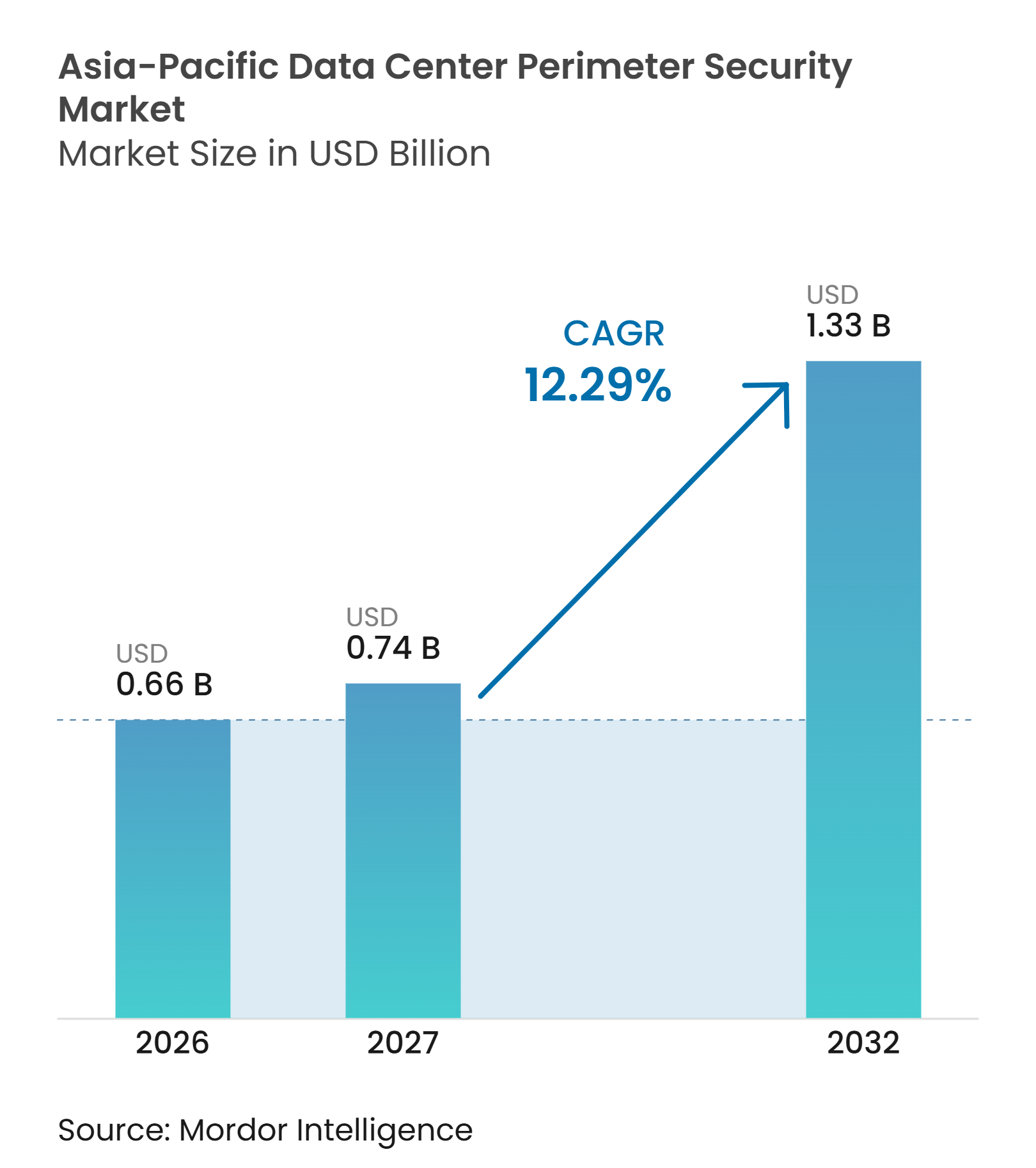
The Asia-Pacific Data Center Perimeter Security Market size is expected to increase from USD 0.66 billion in 2026 to USD 0.74 billion in 2027 and reach USD 1.33 billion by 2032, growing at a CAGR of 12.29% over 2027-2032.
The construction of hyperscale and colocation capacity keeps perimeter protection in the design budget rather than treating it as a later upgrade. Operators increasingly procure connected surveillance, access control, radar, thermal imaging, and environmental monitoring as part of one operational view. Security requirements are also moving toward controls that protect both the physical perimeter and the networked devices installed on it. High upfront costs, long equipment life cycles, and delayed site approvals can shift annual purchasing schedules, particularly for retrofit projects.
Key Report Takeaways
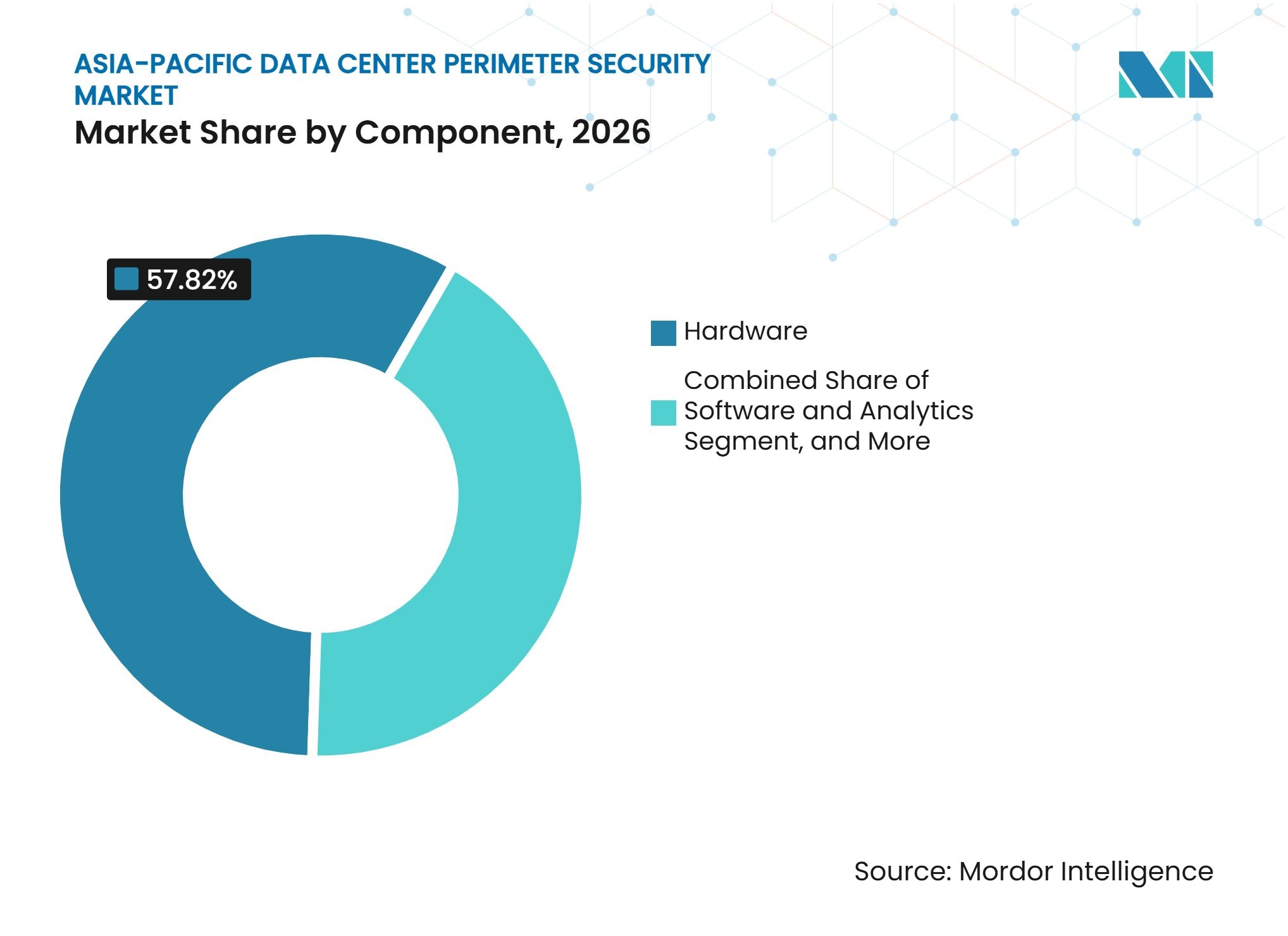
- By component, hardware held 57.82% of the Asia-Pacific data center perimeter security market share in 2026, while software and analytics is projected to expand at a 13.29% CAGR through 2032.
- By solution type, intrusion detection systems accounted for 24.78% of the Asia-Pacific data center perimeter security market share in 2026, while perimeter radar and sensor systems is projected to expand at a 13.51% CAGR through 2032.
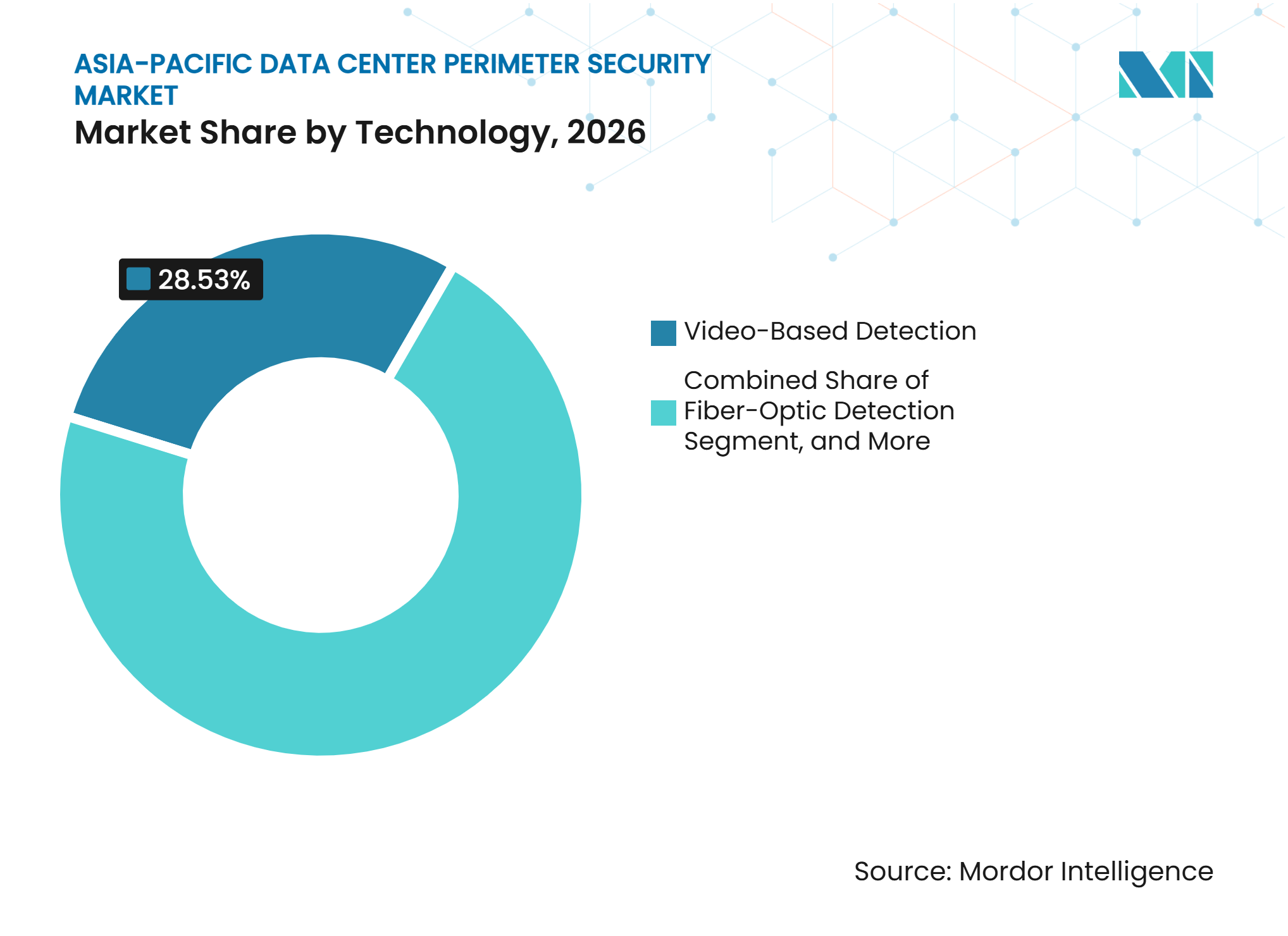
- By technology, video-based detection held 28.53% of the market in 2026, while fiber-optic detection is projected to expand at a 13.82% CAGR through 2032.
- By deployment type, new data center construction accounted for 72.06% of the market in 2026 and is projected to expand at a 13.19% CAGR through 2032.
- By data center size, hyperscale facilities held 33.16% of the market in 2026 and are projected to expand at a 13.62% CAGR through 2032.
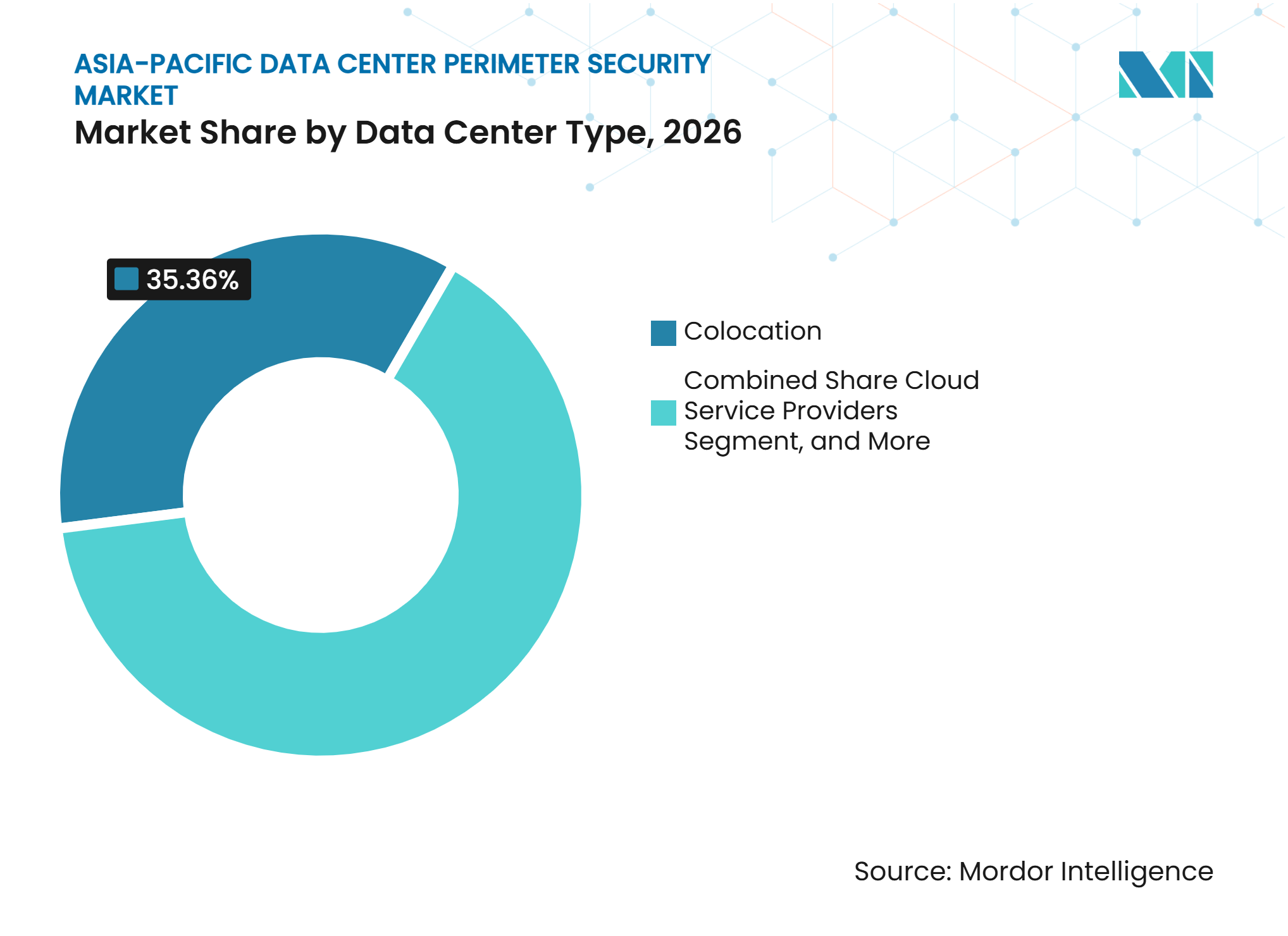
- By data center type, colocation facilities accounted for 35.36% of the market in 2026, while cloud service providers are projected to expand at a 13.68% CAGR through 2032.
- By geography, China held 32.29% of the market in 2026, while India is projected to expand at a 13.71% CAGR through 2032.
Note: Market numbers in this report are based on Mordor Intelligence's proprietary estimation framework, which combines nine months of actuals with Q4 projections for base year 2026.
Market Trends and Insights
Drivers Impact Analysis of Asia-Pacific Data Center Perimeter Security Market*
| Driver | (~) % Impact on CAGR Forecast | Geographic Relevance | Impact Timeline |
|---|---|---|---|
| Expansion of Hyperscale and Colocation Data Center Capacity | +3.1% | Global, with the highest concentration in China, India, and Southeast Asia | Short term (≤ 2 years) |
| Cloud, AI, 5G, and Digital Infrastructure Investment | +2.6% | Global, with Asia-Pacific at the core and spillover to the Middle East and Africa | Short term (≤ 2 years) |
| Stricter Critical Infrastructure and Data Protection Requirements | +1.9% | Singapore, Australia, India, and China | Medium term (2-4 years) |
| Demand for Integrated Physical and Cybersecurity Controls | +1.5% | Global | Medium term (2-4 years) |
| AI-Ready Campuses Requiring Sensor Fusion at Large, Unmanned Perimeters | +1.1% | Global, strongest in Japan, Singapore, and Southeast Asia | Medium term (2-4 years) |
| Security-by-Design Procurement for High-Density and Liquid-Cooled Facilities | +0.8% | Asia-Pacific core, with spillover to the rest of Asia-Pacific | Long term (≥ 4 years) |
| Source: Mordor Intelligence | |||
Expansion of Hyperscale and Colocation Data Center Capacity
The Asia-Pacific data center perimeter security market benefits when security systems are specified during site design and installed before operations begin. The Security Industry Association states that the perimeter should be protected before a data center becomes operational, which makes these systems part of the construction sequence rather than a discretionary post-opening purchase.[1] Large campuses require systems that cover long boundary lines without relying only on patrol staff. Fiber-optic sensing, long-range radar, and surveillance cameras can support continuous detection across these environments. Colocation operators also need to document physical protection for several tenants with separate service-level and audit requirements. This operating model supports recurring demand for perimeter systems that can produce usable alerts and records.
Cloud, AI, 5G, and Digital Infrastructure Investment
Cloud and AI facilities concentrate valuable computing equipment and sensitive workloads in a limited number of locations. That concentration raises the operational consequences of a perimeter breach and supports higher security specifications for new sites. Distributed 5G and edge deployments also create smaller sites where continuous staffing may be difficult. In these locations, automated detection can provide coverage without making guard deployment the only control. The Asia-Pacific data center perimeter security market therefore serves both large campuses and a developing group of distributed facilities. These sites require systems that work across varied climate conditions and can connect with the operator's broader security process.
Stricter Critical Infrastructure and Data Protection Requirements
Data center customers increasingly expect evidence that physical controls are managed as part of wider resilience and information-security practices. The Security of Critical Infrastructure Act and the Australian Government Hosting Certification Framework establish security obligations relevant to critical facilities in Australia.[2] ISO/IEC 27001 has also become a practical customer requirement for many operators that need to demonstrate a managed security framework. These expectations increase the importance of access records, surveillance retention, incident response, and physical security procedures. The Asia-Pacific data center perimeter security market gains from this shift because perimeter systems provide data that operators can use in internal review and customer assurance processes. Multi-country colocation customers can also encourage more consistent controls across facilities in different jurisdictions.
Demand for Integrated Physical and Cybersecurity Controls
A connected camera or sensor is both a physical security device and a network endpoint. Axis Communications noted that unclear ownership of cybersecurity risk can leave known vulnerabilities unresolved throughout the operating life of physical security equipment. Operators increasingly request secure authentication, encrypted communications, secure boot, and logging controls alongside detection performance. Senstar's FiberPatrol FP1500 includes a hardware security module, EAP-TLS authentication, and tamper-resistant logging, while the product aligns with IEC/ISA 62443 and the EU Cyber Resilience Act. This requirement favors suppliers that can satisfy physical detection and device-security needs within the same deployment. It also makes integration capability more important when operators compare vendor proposals.
Restraints Impact Analysis of Asia-Pacific Data Center Perimeter Security Market*
| Restraint | (~) % Impact on CAGR Forecast | Geographic Relevance | Impact Timeline |
|---|---|---|---|
| High Capital and Lifecycle Integration Costs | -2.3% | Global | Short term (≤ 2 years) |
| Power, Land, Water, and Permitting Constraints Delaying New Sites | -1.7% | Singapore, Japan, and India's Tier 1 cities | Medium term (2-4 years) |
| Limited Availability of Skilled Security and Systems-Integration Personnel | -1.1% | Asia-Pacific core | Medium term (2-4 years) |
| False-Alarm Exposure and Interoperability Risk in Multi-Vendor Sensor Environments | -0.7% | Global | Long term (≥ 4 years) |
| Source: Mordor Intelligence | |||
High Capital and Lifecycle Integration Costs
The Security Industry Association identifies physical security as a defined but limited share of the total data center construction budget. This constraint affects the selection of barriers, sensors, cameras, and the density of coverage at commissioning. Perimeter hardware also has a long operating life, so current design choices can create enduring dependencies on software, interfaces, and service providers. A system may need to remain compatible with changing analytics capabilities long before the physical hardware reaches the end of its service life. High-density and liquid-cooled facilities add further integration requirements with power, cooling, and building controls. These conditions can extend procurement cycles and delay projects where design teams need to reconcile separate system requirements.
Power, Land, Water, and Permitting Constraints Delaying New Sites
New perimeter security contracts normally follow the construction timetable for a site. When power connections, water availability, land access, or permitting delay a campus, the related security purchase is often deferred as well. The Reserve Bank of Australia described strong data center investment expectations in Australia while recognizing that power and broader infrastructure conditions shape the pace of development. These constraints are significant in dense urban markets and can be more acute for large, power-intensive facilities. They create a difference between announced capacity plans and the facilities that move into active construction. The Asia-Pacific data center perimeter security market remains linked to actual site commissioning because that is when installed protection becomes necessary.
*Our forecasts treat driver/restraint impacts as directional, not additive. The impact forecasts reflect baseline growth, mix effects, and variable interactions.
Asia-Pacific Data Center Perimeter Security Market Segment Analysis
By Component:
Hardware Provides the Physical Base, While Software Extends Operational ValueHardware accounted for 57.82% of the Asia-Pacific data center perimeter security market share in 2026. The category includes barriers, fiber-optic sensors, radar units, camera infrastructure, and vehicle access equipment. These systems create the physical detection and delay layer that later analytics depend on. New construction keeps hardware demand high because equipment must be installed before a site can be protected. Installation, integration, and maintenance services form another important component category. Their value reflects the need to configure diverse devices, test detection rules, and maintain performance after handover.
Software and analytics is projected to record a 13.29% CAGR through 2032. Operators use these tools for event classification, audit records, and physical security information management integration. The Security Industry Association reports that AI analytics can reduce nuisance alarms by up to 90%, thereby lowering the burden on security teams reviewing routine events.[3] Software also supports camera-footage retention and more consistent event handling across larger estates. The Asia-Pacific data center perimeter security industry is therefore moving toward deployments in which hardware creates signals and software helps staff prioritize the signals that require action. This relationship gives operators a reason to consider lifecycle support, updates, and integration capability when selecting components.



By Solution Type:
Detection Systems Remain the Foundation, While Radar and Sensors Gain UseIntrusion detection systems held 24.78% of the Asia-Pacific data center perimeter security market share in 2026. They provide a basic breach-detection layer for both new construction and retrofit work. The installed base of these systems supports their continued role in campus security design. Security fencing, physical barriers, and vehicle access barriers provide separate layers that can slow or redirect unauthorized entry. These physical measures are increasingly considered with threat assessments for large campuses near public roads. Together, these solutions allow sites to combine delay, detection, and response functions.
Perimeter radar and sensor systems are projected to expand at a 13.51% CAGR through 2032. Radar can monitor wide areas where lighting, weather, or site geometry limits the performance of cameras. Sensor systems can also cover fence lines and buried locations that are difficult to observe continuously. OPTEX describes a perimeter design that combines fiber-optic sensing, LiDAR, and photobeam sensors to reduce blind spots that a single technology can leave behind. Integrated perimeter security platforms are gaining use because they can bring different detection technologies into one management interface. This operating approach helps teams assess alerts in context rather than reviewing each device type separately.
By Technology:
Video Leads Current Use, While Fiber-Optic Detection AdvancesVideo-based detection accounted for 28.53% of the Asia-Pacific data center perimeter security market share in 2026. IP cameras are already embedded in access control, incident response, and general site supervision processes. Video can give operators visual confirmation when another system produces an alarm. Retention requirements for sensitive areas can also support demand for camera and storage infrastructure. Sensor-based and radar-based detection remain relevant where site conditions make visual monitoring less effective. Integrated multi-technology systems are used when a perimeter has varied terrain, weather exposure, or operating zones.
Fiber-optic detection is projected to expand at a 13.82% CAGR through 2032. Distributed acoustic sensing uses fiber to establish continuous sensing along a boundary. Senstar states that its FiberPatrol FP1500 can locate an intrusion within ±3 m, has a typical detection probability of 95%, and produces fewer than 1 false alarm per kilometer each month. The product uses a deep neural network to distinguish intrusion events from wind and rain conditions. Its resistance to electromagnetic interference is relevant where high-voltage equipment operates near the perimeter. These attributes support its use in large facilities that need continuous coverage and reliable event classification.

By Deployment Type:
New Construction Is the Main Route to MarketNew data center construction held 72.06% of the Asia-Pacific data center perimeter security market share in 2026. The segment has a clear procurement advantage because perimeter protection can be designed into the site from the beginning. Project teams can determine cable routes, camera views, barrier locations, and system interfaces before the site enters operation. This method reduces the disruption associated with adding equipment to a live facility. It also enables a broader range of technologies to be integrated across the campus. The Security Industry Association emphasizes security planning during design because perimeter systems should be functioning before a facility goes live.
New data center construction is also projected to expand at a 13.19% CAGR through 2032. Security upgrades and retrofitting represent a different purchase model because operators must work around legacy equipment and continuing operations. These projects can face tighter budgets and limited space for new infrastructure. Older facilities may nonetheless require upgrades as threat models, client requirements, and device-security expectations change. The Asia-Pacific data center perimeter security market gains from retrofit demand when operators seek to modernize existing sites without interrupting customer services. Vendors that support open integration and phased implementation can be better placed to address this category.
By Data Center Size:
Hyperscale Sites Set Requirements for Coverage and AutomationHyperscale facilities held 33.16% of the Asia-Pacific data center perimeter security market share in 2026. These facilities commonly combine large equipment areas, long external boundaries, and multiple access routes. Their scale makes continuous manual patrols difficult to maintain as the only security control. Automated sensing can extend coverage across fence lines, road approaches, and utility areas. Hyperscale operators also need systems that can manage a high volume of alarms without overwhelming staff. This pushes specification toward analytics, long-range radar, and fiber-optic sensing.
Hyperscale facilities are projected to expand at a 13.62% CAGR through 2032. Their projects can influence technical requirements across the broader Asia-Pacific data center perimeter security industry because suppliers design reference architectures for these demanding campuses. Large and medium facilities also present material demand, particularly where operators modernize older infrastructure. Smaller edge and enterprise sites tend to have simpler perimeter needs, although they can require centralized management when widely distributed. 5G deployment supports a larger group of edge locations in secondary cities, creating demand for systems that are practical for limited on-site staffing. Suppliers must therefore balance comprehensive protection for large campuses with manageable deployment options for smaller sites.
By Data Center Type:
Colocation Leads Current Spending, While Cloud Providers AccelerateColocation facilities accounted for 35.36% of the Asia-Pacific data center perimeter security market share in 2026. A colocation operator must meet physical security obligations for several customers inside the same campus. This creates a strong need for clear access management, retained records, and consistently applied perimeter controls. These operators also run facilities continuously and need to uphold service-level commitments for security uptime. ISO/IEC 27001 and SOC 2 requirements can add to the need for documented operational controls. As a result, colocation facilities often set a high standard for integrated security programs.
Cloud service providers are projected to expand at a 13.68% CAGR through 2032. Hyperscalers can use colocation capacity as well as self-built sites, concentrating security delivery within professionally managed programs. This can favor suppliers that provide an integrated platform and local support capability. Enterprise and edge facilities have different needs because their sites may be smaller or located within carrier hotels and industrial properties. TIA-942 continues to influence expectations for physical security design in data center settings. The Asia-Pacific data center perimeter security market therefore serves distinct operating models rather than a uniform class of facilities.
Geography Analysis
China: State-Led Capacity Expansion Supports Large-Campus Security Demand
China held 32.29% of the Asia-Pacific data center perimeter security market share in 2026. The country has a large operational data center base and a concentration of high-capacity sites. GB 50174-2017 and GB/T 51314-2018 shape data center design and security considerations. Internet data center customer-data protection guidance also reinforces the need for controlled access and surveillance processes. The Eastern Data, Western Computing initiative is directing development toward locations such as Ulanqab and Guizhou. These remote, large-perimeter campuses make continuous sensing more practical than relying solely on guard deployment.
India: Investment and Digital Accountability Strengthen New-Build Demand
India is projected to expand at a 13.71% CAGR through 2032. The outlook reflects a large pipeline of new data center activity and greater requirements for demonstrable operational controls. The Digital Personal Data Protection Act creates accountability around data handling and breach notification. These requirements increase the value of access records and reliable surveillance processes within a wider governance approach. New facilities in major state clusters can support repeatable security design across multiple sites. The Asia-Pacific data center perimeter security market size for India is supported by this extended construction opportunity and by the need to protect sites as they enter operation.
Southeast Asia, Japan, and Australia: Regulatory Direction and New Capacity Create Varied Requirements
Japan has secured new campus investment, including AirTrunk's planned USD 8 billion investment through 2030 across four Tokyo and Osaka campuses. AirTrunk's projects require perimeter designs suited to urban planning conditions and high-value infrastructure. In Australia, critical-infrastructure obligations and hosting certification requirements provide a regulatory influence on physical security processes. The Reserve Bank of Australia projected USD 115 billion in real-terms data center investment from mid-2026 to the end of 2028. Southeast Asia is adding capacity in multiple markets, which increases demand for systems adapted to tropical conditions and distributed project delivery. The Asia-Pacific data center perimeter security market share for this mixed group depends on how rapidly sites pass from announced investment to active construction. Cross-border operators can benefit from designs that apply consistent controls while allowing for local requirements.
Competitive Landscape
Market Concentration
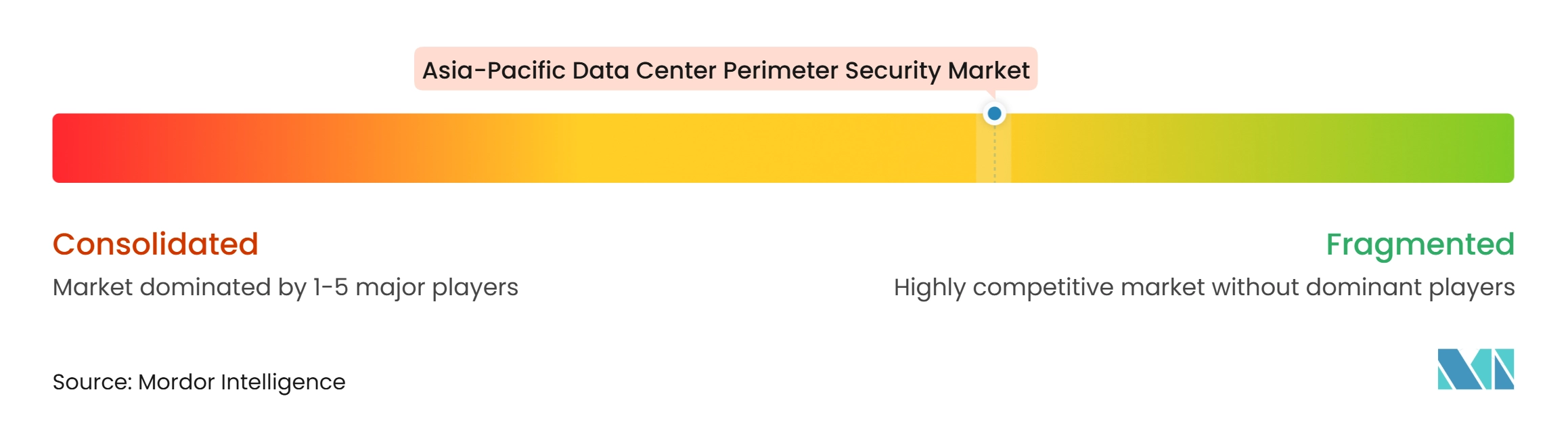
The Asia-Pacific data center perimeter security market is moderately fragmented. Global integrated security providers compete with regional system integrators and specialized hardware suppliers. Integrated platforms have a more concentrated supplier group than fencing and vehicle-barrier products. Regional integrators can compete through local delivery capacity, proximity support, and multi-vendor configuration skills. Technology leadership increasingly depends on analytics and sensor fusion, while delivery performance depends on trained installation and service teams. This combination creates a market in which product capability and execution capacity both matter.
Johnson Controls introduced C-CURE IQ 3.2 in February 2026, adding video functions and standardized incident workflows to its enterprise access control platform. The move supports large facilities that want access, video, and incident procedures connected in one operational process. Gallagher released its PIV-compliant High Security Controller 7000 and Command Centre v9.40 for high-assurance access control settings. These products address the needs of facilities that handle sovereign or defense-related workloads. Senstar launched the FiberPatrol FP1500 with security controls that align with IEC/ISA 62443 and the EU Cyber Resilience Act. These releases show that security suppliers are combining detection performance with device-level cybersecurity and operational workflow capability.
There is room for lower-cost fiber-optic detection for medium-scale and edge facilities. There is also demand for managed perimeter monitoring where operators do not maintain a dedicated security operations center. Genetec reported that 71% of its channel partners expected new cloud system deployments in 2026, with automatic updates and simpler maintenance among the main reasons. Cloud-based management can help operators maintain distributed sites with consistent processes. Specialist sensing vendors and AI-focused analytics providers can enter projects by integrating with open video management systems. Skilled security integration personnel remain limited, which benefits firms with established delivery teams across the region.
Asia-Pacific Data Center Perimeter Security Industry Leaders
-
Axis Communications AB
-
Hangzhou Hikvision Digital Technology Co., Ltd.
-
Zhejiang Dahua Technology Co., Ltd.
-
Johnson Controls International plc
-
Bosch Sicherheitssysteme GmbH
- *Disclaimer: Major Players sorted in no particular order
Asia-Pacific Data Center Perimeter Security Market Companies Covered in this Report
- Axis Communications AB
- Hangzhou Hikvision Digital Technology Co., Ltd.
- Zhejiang Dahua Technology Co., Ltd.
- Johnson Controls International plc
- Bosch Sicherheitssysteme GmbH
- Honeywell International Inc.
- Schneider Electric SE
- Siemens AG
- ASSA ABLOY AB
- ABB Ltd
- Securitas Technology
- Convergint Technologies LLC
- Genetec Inc.
- Senstar Corporation
- Gallagher Security
- Teledyne FLIR LLC
- Magal Security Systems Ltd.
- OPTEX CO., LTD.
- Panasonic Holdings Corporation
- Cisco Systems, Inc.
- Pelco, Inc.
Recent Industry Developments in Asia-Pacific Data Center Perimeter Security Market
- September 2026: Senstar Corporation launched the FiberPatrol FP1500 precision-locating fiber-optic perimeter sensor on September 14, 2026, targeting high-consequence sites including data centers. The system uses coherent Rayleigh scattering to locate intrusions within ±3 m with a typical detection probability of 95% and fewer than 1 false alarm per kilometer per month, complies with IEC/ISA 62443 and the EU Cyber Resilience Act, and is immune to electromagnetic interference, directly addressing the high-voltage environments adjacent to data center power infrastructure.
- September 2026: Hikvision completed one year to its intelligent perimeter protection white paper, for publishing it in collaboration with SourceSecurity.com, documenting how AI-driven video analytics, thermal imaging, radar, and fiber-optic sensing reduce false alarms and improve detection reliability for critical infrastructure sites. The paper reported that intelligent cameras with embedded AI can reduce false alarms by more than 90% and introduced Vision Language Model capability enabling natural-language video archive search for security event investigation.
- August 2026: Ooredoo Group committed USD 800 million as lead investor with a 49% stake in Zankore, an AI neocloud platform developed with Indosat Ooredoo Hutchison, Nokia, and NVIDIA in Indonesia, targeting 1 GW of NVIDIA DSX AI Factory capacity. Zankore is planned to deliver 200 MW of AI capacity in H1 2027, creating large new perimeter security demand across its Southeast Asian campus pipeline at a scale that requires continuous automated detection from day 1.
- February 2026: Johnson Controls unveiled C-CURE IQ 3.2 at ISC West 2026, its updated enterprise access control platform incorporating C-CURE IQ VMS and Incident Management with built-in video functions and standardized incident workflows. The platform is designed to streamline security operations in large, mission-critical facilities including data centers, complementing the company's growing Asia-Pacific data center security and thermal management portfolio.
Asia-Pacific Data Center Perimeter Security Market Report Scope
The Asia-Pacific Data Center Perimeter Security Market refers to the industry focused on solutions and services designed to protect the physical boundaries of data center facilities from unauthorized access, intrusion, vandalism, theft, and security threats.
The Asia-Pacific Data Center Perimeter Security Market Report is Segmented by Component (Hardware; Software and Analytics; Installation, Integration, and Maintenance Services), Solution Type (Intrusion Detection Systems; Security Fencing and Physical Barriers; Vehicle Access Barriers; Perimeter Radar and Sensor Systems; Integrated Perimeter Security Platforms), Technology (Sensor-Based Detection; Video-Based Detection; Fiber-Optic Detection; Radar-Based Detection; Integrated Multi-Technology Systems), Deployment Type (New Data Center Construction; Security Upgrades and Retrofitting), Data Center Size (Small; Medium; Large; Hyperscale), Data Center Type (Colocation; Cloud Service Providers; Enterprise and Edge), and Geography (China; India; Japan; Australia; Singapore; Rest of Asia-Pacific). The Market Forecasts are Provided in Terms of Value (USD).
Segmentation Overview
| Hardware |
| Software and Analytics |
| Installation, Integration, and Maintenance Services |
| Intrusion Detection Systems |
| Security Fencing and Physical Barriers |
| Vehicle Access Barriers |
| Perimeter Radar and Sensor Systems |
| Integrated Perimeter Security Platforms |
| Sensor-Based Detection |
| Video-Based Detection |
| Fiber-Optic Detection |
| Radar-Based Detection |
| Integrated Multi-Technology Systems |
| New Data Center Construction |
| Security Upgrades and Retrofitting |
| Small |
| Medium |
| Large |
| Hyperscale |
| Colocation |
| Cloud Service Providers |
| Enterprise and Edge |
| China |
| India |
| Japan |
| Australia |
| Singapore |
| Rest of Asia-Pacific |
| By Component | Hardware |
| Software and Analytics | |
| Installation, Integration, and Maintenance Services | |
| By Solution Type | Intrusion Detection Systems |
| Security Fencing and Physical Barriers | |
| Vehicle Access Barriers | |
| Perimeter Radar and Sensor Systems | |
| Integrated Perimeter Security Platforms | |
| By Technology | Sensor-Based Detection |
| Video-Based Detection | |
| Fiber-Optic Detection | |
| Radar-Based Detection | |
| Integrated Multi-Technology Systems | |
| By Deployment Type | New Data Center Construction |
| Security Upgrades and Retrofitting | |
| By Data Center Size | Small |
| Medium | |
| Large | |
| Hyperscale | |
| By Data Center Type | Colocation |
| Cloud Service Providers | |
| Enterprise and Edge | |
| By Geography | China |
| India | |
| Japan | |
| Australia | |
| Singapore | |
| Rest of Asia-Pacific |
Key Questions Answered in the Report
What is the Asia-Pacific data center perimeter security market size?
The Asia-Pacific data center perimeter security market size is USD 0.66 billion in 2026 and is expected to reach USD 1.33 billion by 2032 at a 12.29% CAGR. Construction-led security procurement, connected devices, and integrated management systems support this outlook. High upfront integration costs and delays in site approvals can alter the timing of spending. Lifecycle compatibility remains a central consideration for equipment that may operate over many years. Operators also assess how new analytics will connect with installed physical infrastructure.
Which component leads spending on data center perimeter protection in Asia-Pacific?
Hardware leads the component segment with a 57.82% share in 2026 because barriers, sensors, radar, cameras, and access equipment must be installed at the site. Software and analytics then add classification, records, and cross-system management capability. Services are also needed to configure, test, and maintain multi-vendor installations. Skilled integration capacity can shape how quickly complex projects are delivered. This is particularly important for sites with multiple detection technologies.
Which perimeter security technology is advancing fastest in Asia-Pacific data centers?
Fiber-optic detection is projected to expand at a 13.82% CAGR through 2032, supported by continuous sensing and its suitability for large boundaries. It can be particularly relevant where high-voltage infrastructure operates close to perimeter cable routes. Radar, video, and other sensors can complement fiber systems where different zones need different coverage. The combination helps operators reduce blind spots across long and varied boundaries. It also gives teams more information to assess suspicious activity.
Why do colocation facilities require integrated perimeter security?
Colocation facilities held 35.36% of demand in 2026 and must support several tenants, retain security records, and meet continuing service-level commitments. Integrated systems can bring access, detection, video, and incident processes into a more consistent operating model. This can support audit evidence and help security staff review alarms in a common interface. It can also support consistent treatment of physical security events across tenant areas.
What is driving perimeter security adoption at hyperscale facilities?
Hyperscale facilities held 33.16% in 2026 and need automated sensing, analytics, radar, and fiber-optic protection to cover long boundaries and multiple access routes. This reduces dependence on staff patrols as the area requiring protection becomes larger. The category also influences supplier specifications for automated coverage and event handling. These requirements also affect the selection of integration partners and managed services.
Which geography is projected to expand fastest through 2032?
India is projected to expand at a 13.71% CAGR through 2032, supported by new facility development and increased need for demonstrable access and surveillance controls. The Digital Personal Data Protection Act also raises the need for accountable data-handling processes. Security providers must support new construction while enabling records that can be reviewed as part of operational governance. This gives new sites a reason to adopt documented access and surveillance processes from commissioning. These practices can remain in place as the site adds capacity and more customer workloads. They also support a clearer operational record when access events and alarms require investigation.