
Asia-Pacific Data Center Fire Protection and Life Safety Market Size and Share
Market Overview
| Study Period | 2021 - 2032 |
|---|---|
| Forecast Data Period | 2027 - 2032 |
| Base Year Market Size (2026) | USD 1.04 Billion |
| Market Size (2027) | USD 1.16 Billion |
| Market Size (2032) | USD 1.87 Billion |
| Growth Rate (2027 - 2032) | 12.41 % |
| Market Concentration | Medium |
Major Players *Disclaimer: Major Players sorted in no particular order Image © Mordor Intelligence. Reuse requires attribution under CC BY 4.0. | |
Asia-Pacific Data Center Fire Protection and Life Safety Market Analysis by Mordor Intelligence
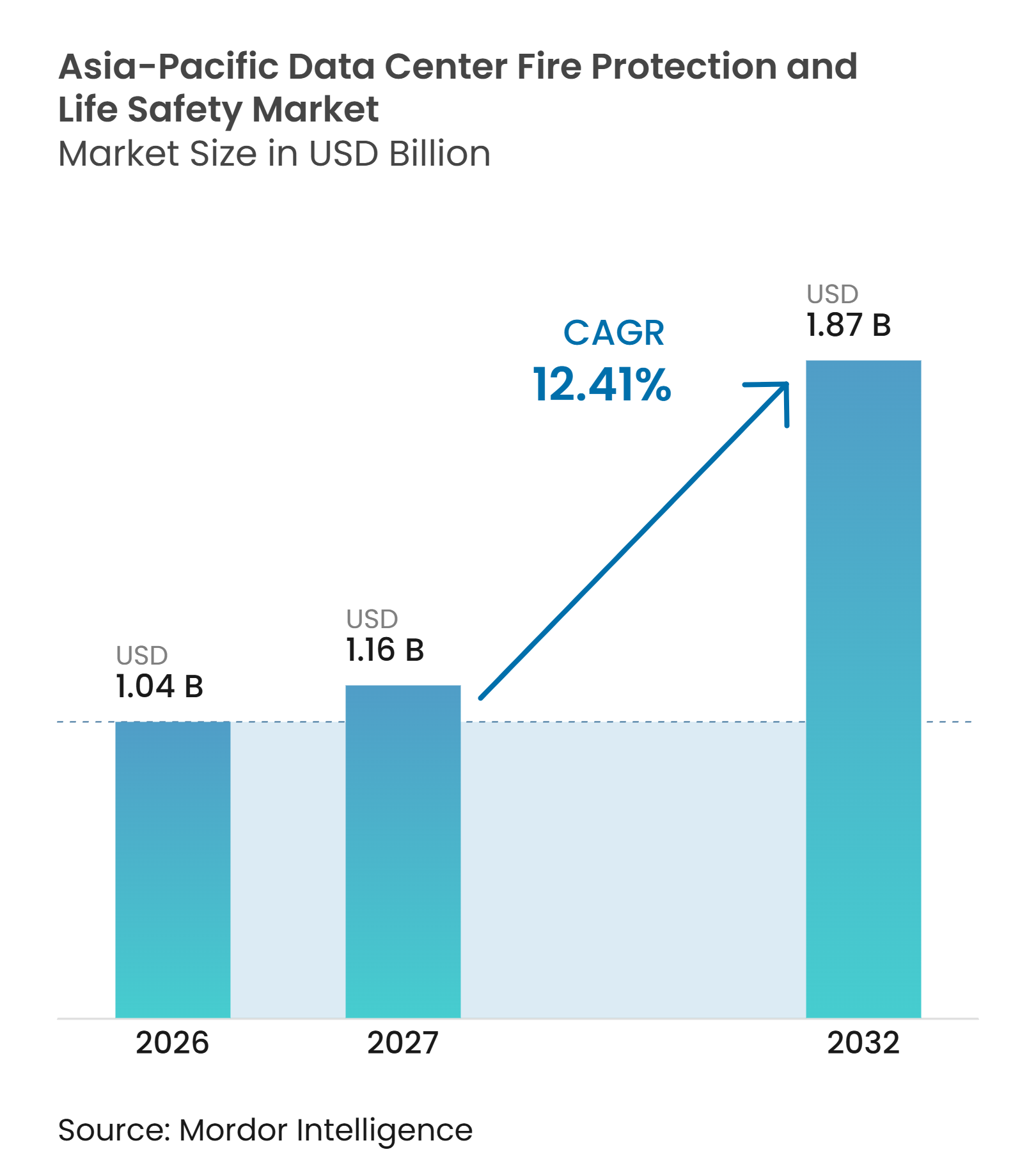
The Asia-Pacific data center fire protection and life safety market size is valued at USD 1.04 billion in 2026 and is projected to reach USD 1.87 billion by 2032, registering a CAGR of 12.41% between 2027 and 2032. Investment in regional data center capacity is increasing the number of facilities that require detection, suppression, monitoring, and evacuation systems. AI deployments are changing the design of these facilities because dense server racks, direct-to-chip cooling, and lithium-ion backup power create different hazards within the same campus. The Asia-Pacific data center fire protection and life safety market therefore benefits when protection is specified during design, rather than added after construction. Compliance requirements and insurance conditions are also making protection systems a necessary part of project approval and risk management. Suppliers that combine certified equipment, engineering support, and maintenance coverage are better placed to serve large regional operators.
Key Report Takeaways
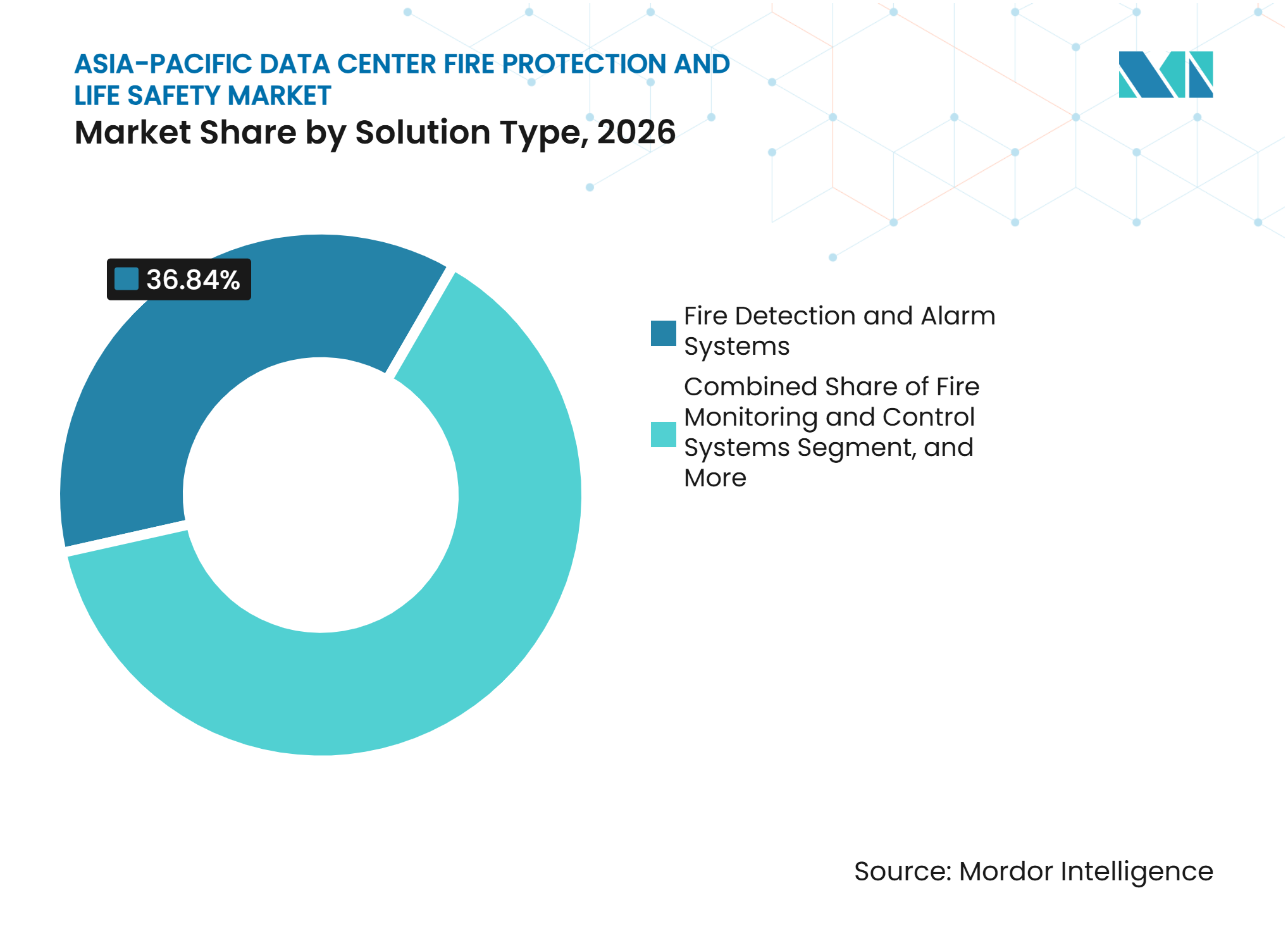
- By solution type, fire detection and alarm systems held 36.84% of the Asia-Pacific data center fire protection and life safety market share in 2026, while fire monitoring and control systems are expected to record the highest expansion through 2032.
- By fire protection technology, smoke and heat detection accounted for 28.71% of revenue in 2026, while aspirating smoke detection is projected to expand at a 13.72% CAGR through 2032.
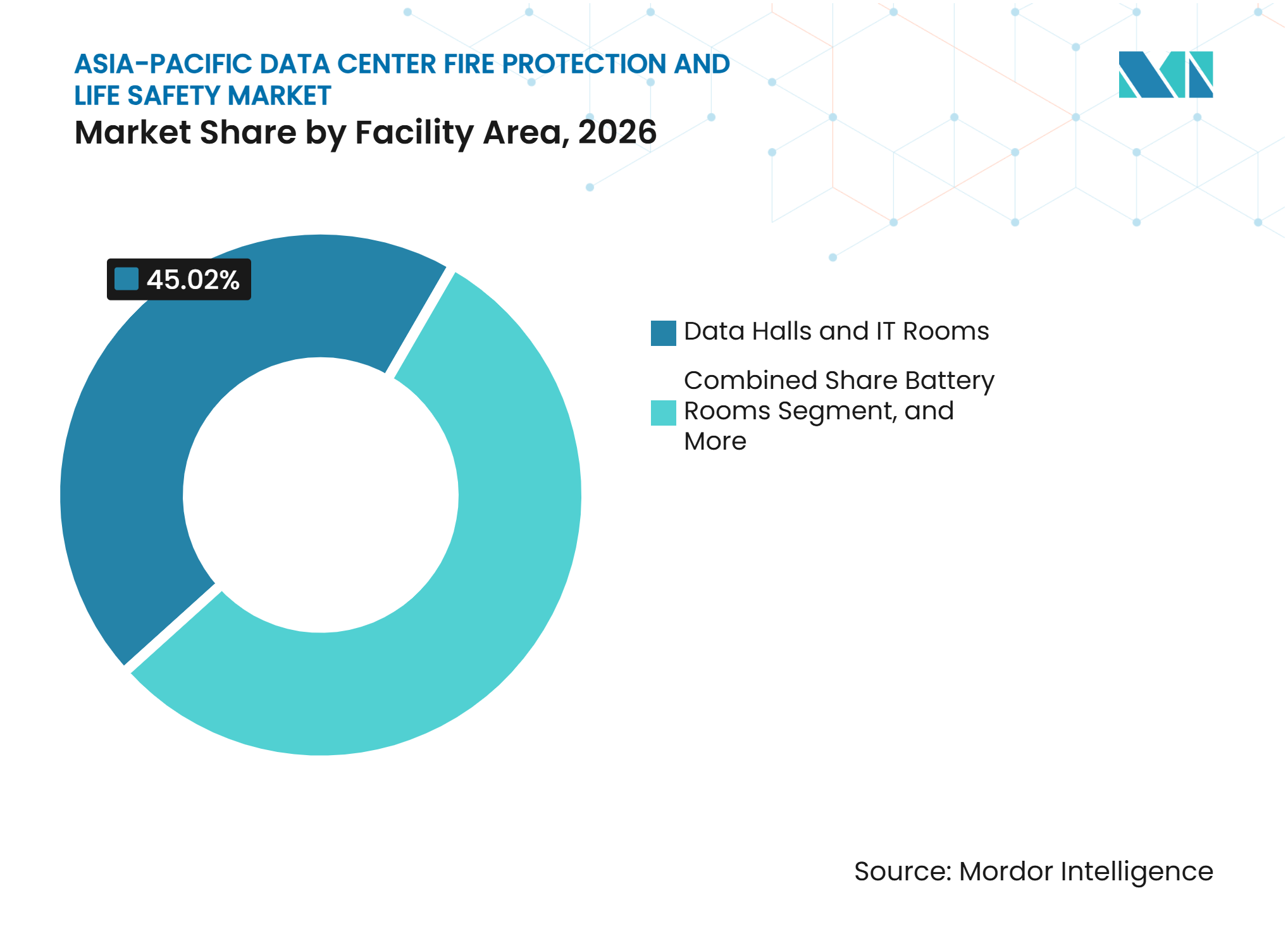
- By facility area, data halls and IT rooms accounted for 45.02% of revenue in 2026, while battery rooms are projected to expand at a 13.81% CAGR through 2032.
- By data center size, hyperscale facilities held 33.49% of revenue in 2026 and are expected to record the highest expansion through 2032.
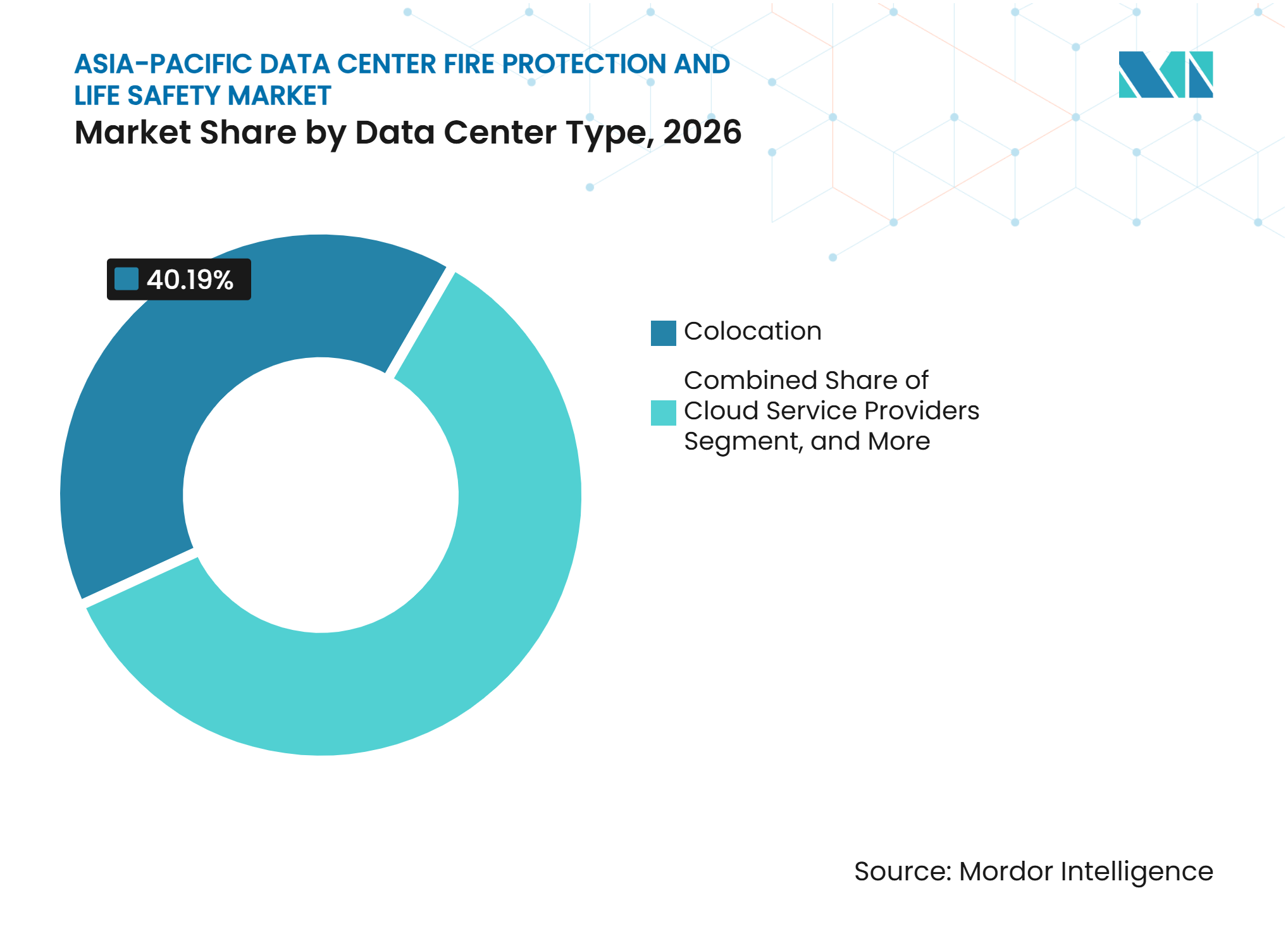
- By data center type, colocation operators accounted for 40.19% of revenue in 2026, while cloud service providers are projected to record the highest expansion through 2032.
- By geography, China held 28.71% of revenue in 2026, while India is projected to expand at a 13.88% CAGR through 2032.
Note: Market numbers in this report are based on Mordor Intelligence's proprietary estimation framework, which combines nine months of actuals with Q4 projections for base year 2026.
Market Trends and Insights
Drivers Impact Analysis of Asia-Pacific Data Center Fire Protection and Life Safety Market*
| Driver | (~) % Impact on CAGR Forecast | Geographic Relevance | Impact Timeline |
|---|---|---|---|
| Hyperscale and AI Data Center Capacity Expansion | +3.8% | Global, primary in China, India, Australia, and Malaysia | Short term (≤ 2 years) |
| Stricter Data Center Fire-Safety Compliance and Insurance Requirements | +3.2% | China, India, Hong Kong SAR, Singapore, Japan, and Southeast Asia | Medium term (2-4 years) |
| Rising Rack Density and Thermal Loads in AI-Optimized Facilities | +2.4% | Global, concentrated in Singapore, Japan, and Australia | Medium term (2-4 years) |
| Expansion of Colocation, Cloud, and Digital Infrastructure Investment | +1.9% | India, Malaysia, Southeast Asia, and Australia | Medium term (2-4 years) |
| Battery Energy Storage and UPS Fire-Risk Management | +1.3% | Global, with high urgency in China, South Korea, and Japan | Medium term (2-4 years) |
| Early-Warning Requirements for High-Airflow Server Environments | +0.9% | Global, concentrated in AI-optimized facilities across Asia-Pacific | Long term (≥ 4 years) |
| Source: Mordor Intelligence | |||
Hyperscale and AI Data Center Capacity Expansion
Asia-Pacific had a data center development pipeline of 26,455 MW in the first half of 2026, including 4,764 MW under construction. The scale of concurrent development requires fire detection, suppression, and life safety systems to be commissioned alongside core power and cooling equipment. Operators are increasingly engaging protection providers during design because later changes can interrupt commissioning schedules. A hyperscale campus also requires separate approaches for server halls, battery rooms, cable areas, and administrative spaces. This increases the scope of each contract compared with a conventional enterprise facility. The Asia-Pacific data center fire protection and life safety market gains from this shift because protection is becoming part of the standard project package rather than an optional retrofit.
The distinction is important at the equipment level. Aspirating smoke detection is suited to server halls where air movement can dilute smoke. Clean agent or inert gas systems are commonly specified for UPS and battery rooms where equipment protection and rapid response are necessary. Pre-action water systems may be used in areas where water-based protection is appropriate. These site-specific requirements raise the need for integrated design and testing. The resulting demand supports suppliers that can coordinate several technologies under one commissioning plan.[1]
Stricter Data Center Fire-Safety Compliance and Insurance Requirements
Asia-Pacific had a data center development pipeline of 26,455 MW in the first half of 2026, including 4,764 MW under construction. The scale of concurrent development requires fire detection, suppression, and life safety systems to be commissioned alongside core power and cooling equipment. Operators are increasingly engaging protection providers during design because later changes can interrupt commissioning schedules. A hyperscale campus also requires separate approaches for server halls, battery rooms, cable areas, and administrative spaces. This increases the scope of each contract compared with a conventional enterprise facility. The Asia-Pacific data center fire protection and life safety market gains from this shift because protection is becoming part of the standard project package rather than an optional retrofit. The Asia-Pacific data center fire protection and life safety market also benefits from earlier engineering engagement across multi-building campuses.
Telangana introduced specialized guidance for data centers through a circular dated October 28, 2026. The guidance specifies clean-agent or water-mist suppression in technical areas, battery and UPS risk assessments, and links with building management platforms. It applies to provisional fire no-objection certificate submissions from November 6, 2026. Insurance expectations reinforce these formal rules because insurers increasingly examine wall ratings, sprinkler arrangements, and risk controls before providing coverage. Swiss Re reported that fire represented 42.3% of data center loss costs while accounting for 10.9% of loss events.[2]
Rising Rack Density and Thermal Loads in AI-Optimized Facilities
GPU-led computing is increasing power density and changing the location of fire risk inside data halls. Modal rack density reached 11 kW in 2026, compared with 9 kW in 2025, and AI training clusters can exceed 100 kW per rack. Higher energy flows in a smaller area can increase the risk of electrical faults, arc flashes, and insulation failures. AI facilities also have rapidly changing power demand. These conditions make early detection and coordinated response more important.[3]
Direct-to-chip cooling places glycol and refrigerant fluids in the white space. This requires engineers to assess whether agents, detection arrangements, and water-based systems are suitable for the local hazard. FM identified liquid-related incidents as a material component of loss costs in its review of data center risks. A design that was acceptable for lower-density racks may not be sufficient for a 100 kW GPU installation. The Asia-Pacific data center fire protection and life safety market consequently favors systems that can integrate environmental monitoring, fire alarm functions, and response controls.
Expansion of Colocation, Cloud, and Digital Infrastructure Investment
India added 387 MW of data center IT capacity in 2025, compared with 191 MW in 2024. The country is expected to have more than 4 GW of capacity by 2030. Much of the increase is associated with leased facilities, including colocation and wholesale developments. Multi-tenant sites must address the fire safety expectations of several customers at the same time. This increases the importance of certified, monitored, and maintainable systems.
Malaysia is also receiving greater investment in large data center campuses. Johor recorded 53% year-over-year growth in live capacity during 2025. BOMBA approval is a central requirement for deployments in Malaysia and affects equipment selection, installation, and handover. These conditions raise the value of vendors that have local approvals and service partners. Expansion in India, Malaysia, and other Southeast Asian markets creates opportunities for firms that can deliver both equipment and long-term inspection support.
Restraints Impact Analysis of Asia-Pacific Data Center Fire Protection and Life Safety Market*
| Restraint | (~) % Impact on CAGR Forecast | Geographic Relevance | Impact Timeline |
|---|---|---|---|
| High Installation, Integration, and Recharge Costs | -2.1% | Global, most pronounced in India, Southeast Asia, and Rest of Asia-Pacific | Short term (≤ 2 years) |
| Fragmented Country-Level Codes and Approval Processes | -1.8% | India, Malaysia, Indonesia, Thailand, and Vietnam | Medium term (2-4 years) |
| Power, Water, and Construction Constraints Delaying Data Center Projects | -1.4% | Singapore, Japan, parts of Australia, urban India, and South Korea | Medium term (2-4 years) |
| Limited Availability of Qualified Fire-Protection Service Personnel | -0.8% | Global, acute in emerging Southeast Asian markets and parts of India | Long term (≥ 4 years) |
| Source: Mordor Intelligence | |||
High Installation, Integration, and Recharge Costs
Replacing legacy HFC-227ea systems with lower-global-warming-potential options such as FK-5-1-12 can require new pipework, different nozzles, and additional cylinder volume. The cost is therefore broader than replacing the extinguishing agent. Greenfield projects also need separate detection and suppression zones for server halls and battery rooms. Centralized monitoring adds another layer of integration work. These requirements can be difficult for smaller colocation operators to fund.
Clean-agent recharge logistics can create further pressure after a system discharge. Replacement agents and cylinder servicing can take weeks where regional distribution networks are limited. Operators may delay testing or inspections when replacement costs and downtime risks are high. Delays can weaken system reliability, particularly where local service chains are thin. Insurers may reflect this risk in coverage terms and premiums. These factors can slow upgrades even when the technical case for replacement is clear.
Fragmented Country-Level Codes and Approval Processes
Asia-Pacific operators must navigate different codes, approval schedules, and technical expectations across each country. Japan requires gas suppression in certain communication equipment rooms, while its authorities are reviewing the role of water-based sprinkler systems in server halls. China applies GB 50174-2017 and GB 50370 to relevant facilities, with the latter under revision. Malaysia, Singapore, Hong Kong, and Indian states also have distinct approval systems. A common regional design cannot always be commissioned without local changes.
This variation creates additional engineering and documentation work for multi-country projects. It can delay the final commissioning of an otherwise complete facility. It can also shorten the time available for suppliers to begin maintenance work after construction. Vendors with established local certification knowledge have an advantage in this environment. The Asia-Pacific data center fire protection and life safety market faces a practical barrier where product approvals and technician credentials do not transfer between jurisdictions.
*Our forecasts treat driver/restraint impacts as directional, not additive. The impact forecasts reflect baseline growth, mix effects, and variable interactions.
Asia-Pacific Data Center Fire Protection and Life Safety Market Segment Analysis
By Solution Type:
Detection Systems Anchor Revenue and Monitoring Platforms Gain GroundFire detection and alarm systems held 36.84% of revenue in 2026. Their leading position reflects the requirement for early warning in every facility class and jurisdiction. Reliable detection must operate before suppression systems can respond effectively. This makes the category difficult to defer even when a project budget is constrained. Nohmi Bosai stated that more than 30,000 units of its PROTECVIEW aspirating detection system had been installed. The company relaunched the system in May 2025 with improved sensitivity for uses that include data centers and semiconductor plants. This history illustrates the need for detection systems that can operate in demanding, high-airflow spaces.
Fire suppression systems form the next major solution group because server halls and battery rooms need equipment-safe response options. Clean agent and inert gas systems are often selected where residue-free discharge is required. Emergency notification and evacuation products are increasingly specified as part of a wider safety platform rather than as separate installations. This can reduce their independent revenue contribution while increasing the overall value of each site package. Fire monitoring and control systems are the fastest-expanding solution category through 2032. Johnson Controls launched its Simplex Incident Manager in August 2026 with support for up to 250,000 devices and 687 fire alarm control units. The Asia-Pacific data center fire protection and life safety market size for integrated control platforms is supported by operators seeking a single view across large campuses.



By Fire Protection Technology:
ASD Adoption Accelerates in AI-Dense EnvironmentsSmoke and heat detection held 28.71% of revenue in 2026, making it the largest technology category. It serves as the foundational detection layer across different building layouts and data center sizes. Conventional point detectors can face limits in high-airflow data halls. Air changes above 60 per hour can dilute smoke and contribute to delayed activation or false alarms. Honeywell identifies this operating environment as a key challenge for conventional detection layouts. The issue becomes more material as AI computing raises cooling airflow requirements. It supports the need for detection designs that sample air at controlled locations.
Aspirating smoke detection is projected to expand at a 13.72% CAGR from 2027 to 2032. Active pipe networks collect samples at consistent volumes and can detect low smoke concentrations. The Fire Industry Association issued a code of practice for ASD systems in February 2026. The guidance supports more consistent design, installation, commissioning, and maintenance practices. Clean agent systems, including IG-541 and IG-55, remain important in server halls because they leave no residue and can protect equipment. Water mist is gaining attention in battery rooms because cooling can help manage thermal runaway propagation.
By Facility Area:
Data Halls Drive Core Demand and Battery Rooms Form the High-Risk FrontierData halls and IT rooms accounted for 45.02% of regional revenue in 2026. Their position reflects their large share of the campus footprint and the density of systems installed per square meter. Tier III and Tier IV designs commonly combine aspirating detection, suppression, and integrated monitoring across raised floors and ceiling areas. FM identifies data center facilities as requiring coordinated property loss prevention measures. The need for continuous operation also makes fault detection and alarm availability critical. Protection designs are now being considered alongside cooling system choices.
Battery rooms are projected to expand at a 13.81% CAGR from 2027 to 2032. Demand is linked to the replacement of lead-acid UPS banks with lithium-ion alternatives. Lithium-ion batteries can sustain chemical combustion after gas suppression has been applied. The ITU and Huawei white paper identifies thermal runaway propagation as a central fire hazard for lithium-ion UPS installations. Water-based cooling can therefore complement gas systems rather than replace them. The September 2026 fire involving lithium-ion UPS batteries at South Korea's National Information Resources Service data center disrupted 709 government information systems. The Asia-Pacific data center fire protection and life safety market size for battery-room protection is supported by requirements for early-warning gas sensors and thermal runaway detection.

By Data Center Size:
Hyperscale Facilities Define the Benchmark for Fire Safety ComplexityHyperscale facilities held 33.49% of revenue in 2026 and are also the fastest-expanding size category through 2032. A large campus can include thousands of individual protection zones over a substantial floor area. These projects require zonal detection and suppression, linear heat detection in cable areas, aspirating detection in server halls, and centralized monitoring. The combined specification creates contracts that are larger than those at enterprise and mid-sized sites. Neocloud providers are adding a new source of demand for high-performance computing capacity. Their expansion broadens the customer base for full-campus safety systems.
Large and medium data centers remain important because they support recurring inspection, testing, and maintenance demand. Small sites and edge deployments in Tier-II cities may not require custom clean-agent systems. These locations can favor factory-built, modular protection systems. EPG received BOMBA certification in December 2025 for containerized data center products. The approval demonstrates demand for pre-certified modules in Malaysia and the wider ASEAN region. Such systems can simplify deployment where local approvals and on-site engineering resources are limited. The Asia-Pacific data center fire protection and life safety industry benefits from solutions that match the needs of both campus-scale and distributed facilities.
By Data Center Type:
Colocation Operators Lead Revenue and Cloud Builds Drive Future DemandColocation operators accounted for 40.19% of revenue in 2026. Their position is supported by the scale of multi-tenant facilities across the region. Each site must address the requirements of several tenants, including organizations in financial services, health care, government, and telecommunications. This can result in higher spending on detection, suppression, monitoring, and documentation than a single-tenant site requires. Singapore's data center resilience guidance recognizes fire detection and suppression as elements of uptime protection. The segment therefore favors certified systems from suppliers with proven maintenance capabilities.
Cloud service providers are the fastest-expanding type from 2027 to 2032. AWS, Google, Microsoft, and Oracle are developing proprietary campuses that are designed for higher power density. These operators set detailed global technical standards and may require site-specific approvals from suppliers. The process creates an advantage for vendors with regional engineering and compliance knowledge. Enterprise and edge facilities continue to provide stable demand from government, financial services, and telecommunications users. The rollout of 5G in India and Southeast Asia also requires locally compliant protection in dispersed and sometimes unmanned edge sites.
Geography Analysis
China
China held 28.71% of regional revenue in 2026. The country benefits from a large data center buildout and a more prescriptive compliance environment. GB 50174-2017 calls for gas suppression in Tier-A server halls. GB 50370 governs gas extinguishing system design and remains under revision. The China Fire Safety Association published its Lithium-Ion Battery Fire Safety White Paper for Data Centers in February 2025. The document addressed ventilation, suppression, thermal runaway detection, and emergency shutdown in battery rooms. Shanghai's DB31/T 1660-2025 standard entered effect in April 2026 and treats fire suppression as a core infrastructure requirement. Alibaba Cloud, Tencent Cloud, and ByteDance are investing in high-density GPU clusters, which supports complex zonal designs. This compliance environment sustains demand in the Asia-Pacific data center fire protection and life safety market.
India
India is projected to expand at a 13.88% CAGR from 2027 to 2032, the fastest rate among regional geographies. The country added 387 MW of data center IT capacity in 2025, and announced investments exceeded USD 180 billion as of September 2026. Its capacity pipeline exceeds 8.3 GW. Global hyperscalers are supporting large developments in Mumbai, Chennai, and Hyderabad. These projects apply standardized safety specifications that move local contractors beyond minimum statutory requirements. Telangana's October 2026 guidance requires clean-agent or water-mist systems in technical areas and dedicated assessments for battery rooms. The Asia-Pacific data center fire protection and life safety market size in India is also supported by a planned 600 MW of new additions in 2026.
Japan, Australia, Singapore, and Emerging Markets
Japan has a high-compliance environment where domestic suppliers have strong positions through Fire Service Act-certified products. The Fire and Disaster Management Agency is examining whether water-based suppression should be formally approved for server halls. Australia recorded 37% year-over-year live capacity expansion in Melbourne during 2025. The OpenAI-NEXTDC plan for an AUD 7 billion campus in western Sydney indicates the scale of projects entering the country. Singapore continues to attract premium facilities despite restricted land supply. Its Civil Defence Force guidelines provide a performance-based path for projects that need flexibility beyond prescriptive rules. In Malaysia, the Johor-Singapore Special Economic Zone is drawing large campus investment and increasing the importance of BOMBA certification. Indonesia, Thailand, and Vietnam remain earlier in the development of data center-specific compliance frameworks, creating opportunities for providers with local approval capabilities.
Competitive Landscape
Market Concentration
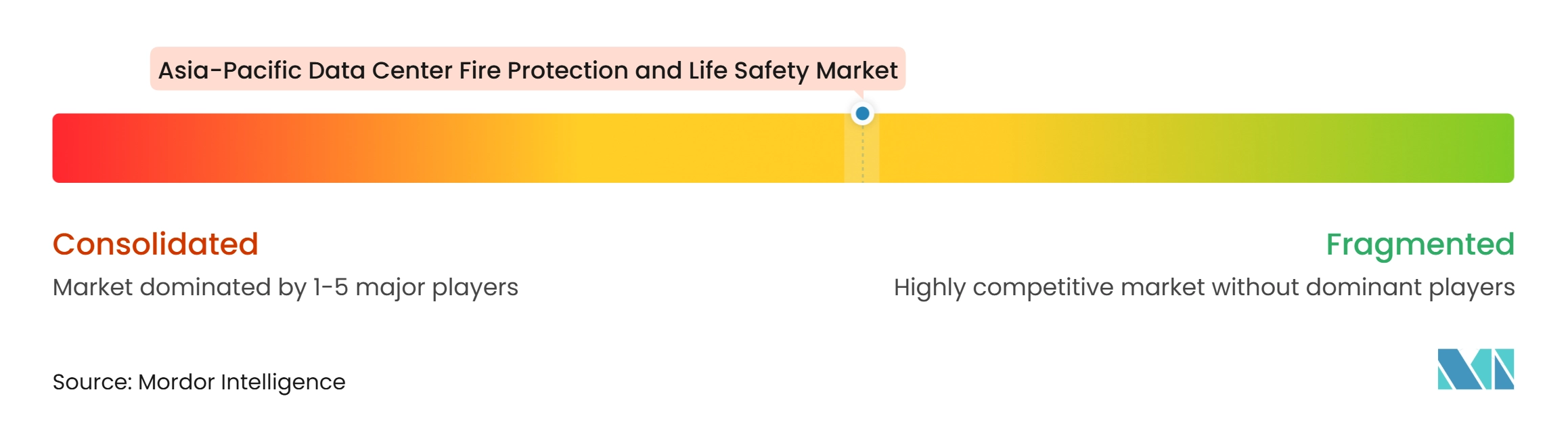
The Asia-Pacific data center fire protection and life safety market is moderately concentrated. Johnson Controls International, Honeywell International, and Siemens AG compete through portfolios that combine detection, suppression, monitoring, and service support. Specialist suppliers compete on technology depth in aspirating smoke detection, water mist, and battery protection. Siemens launched Sinteso Nova and Cerberus Nova in March 2026. The connected detectors include automated self-checks, remote diagnostics, and predictive maintenance functions. These capabilities address operators that want lower manual intervention across 24/7 facilities.
Johnson Controls has developed inert-gas suppression products that address noise during discharge. This is relevant where dense AI racks still use hard disk drives that can be affected by acoustic conditions. Its Hygood IGS-300 positions the company for applications that need both suppression performance and equipment protection. Johnson Controls also released new fire safety workstations in August 2026 for large, multisite installations. The systems support unified monitoring across mixed environments and provide an upgrade path for dispersed legacy panels. These moves illustrate how large suppliers are using integrated digital platforms and tailored suppression designs to differentiate their offers. The Asia-Pacific data center fire protection and life safety market also requires suppliers to combine equipment performance with scalable monitoring.
Southeast Asia still has open space for providers that can navigate country-level approvals and maintain locally certified service teams. Jensen Hughes acquired Singapore-based HiLT Pte. Ltd. in July 2026 to strengthen its expertise in performance-based design, energy storage system protection, water mist, and synthetic fluorine-free foam. SEVO Systems offers oxygen-reduction fire prevention based on inert gas injection, giving hyperscale users an alternative to post-ignition response. FM Global guidance and IEC 62619 expectations are important filters for battery protection solutions. They favor providers that can demonstrate tested performance in lithium-ion environments. The Asia-Pacific data center fire protection and life safety market is likely to reward vendors that combine certified products, local engineering support, and long-term maintenance capacity.
Asia-Pacific Data Center Fire Protection and Life Safety Industry Leaders
-
Johnson Controls International plc
-
Honeywell International Inc.
-
Siemens AG
-
Fike Corporation
-
Minimax Viking GmbH
- *Disclaimer: Major Players sorted in no particular order
Asia-Pacific Data Center Fire Protection and Life Safety Market Companies Covered in this Report
- Johnson Controls International plc
- Honeywell International Inc.
- Siemens AG
- Fike Corporation
- Minimax Viking GmbH
- Robert Bosch GmbH
- Eaton Corporation plc
- Carrier Global Corporation
- Securiton AG
- Hochiki Corporation
- Nohmi Bosai Ltd.
- Halma plc
- Marioff Corporation Oy
- Victaulic Company
- WAGNER Group GmbH
- SEVO Systems
- NAFFCO FZCO
- SFFECO Global FZCO
- ORR Protection Systems
- Firetrace International LLC
- Schneider Electric SE
- Panasonic Holdings Corporation
Recent Industry Developments in Asia-Pacific Data Center Fire Protection and Life Safety Market
- November 2026: The Telangana Fire Department issued a specialized fire and life safety guidance circular dated October 28, 2026, mandating clean-agent or water-mist suppression in data center technical areas, dedicated fire-risk assessments for battery and UPS rooms, and integration of fire systems with building management platforms, effective for all fire no-objection certificate applications from November 6, 2026. The guidelines signal India's transition toward jurisdiction-specific, data center-native fire safety codes rather than adaptations of general industrial standards, accelerating compliance-driven procurement from operators seeking NOC clearance across Telangana's rapidly expanding data center corridor.
- October 2026: Swiss Re published sigma 07/2026, *Insuring AI: Data Centre Value at Risk*, establishing that fire accounts for 42.3% of data center loss costs despite representing only 10.9% of loss events, and that FM's 2026 full revision of its Data Center Data Sheet increased recommended fire-resistance wall ratings to two hours and introduced more stringent sprinkler requirements. The publication is expected to accelerate underwriting-driven fire protection upgrades across Asia-Pacific, particularly in markets where facilities are seeking new or renewed property coverage from global reinsurers applying these revised benchmarks.
- August 2026: Johnson Controls launched its next-generation Simplex Incident Manager and Autocall Fire Site Administrator fire safety workstations, capable of monitoring up to 250,000 devices and connecting 687 fire alarm control units, 2.5 times more than competing platforms, and designed for multi-site, multi-manufacturer environments including data centers, campuses, and hospitals. The platforms include cybersecurity-focused architecture aligned with ISA/IEC 62443 and have received FM, UL, and CSFM approvals, positioning them as a direct upgrade path for hyperscale operators consolidating disparate legacy fire panels into a unified command center.
- July 2026: FM Global published an interim revision to its Property Loss Prevention Data Sheet 5-32, Data Centers, elevating fire-resistance wall rating recommendations and introducing comprehensive liquid cooling guidance, reflecting the industry-wide shift to direct-to-chip and immersion cooling systems that introduce new flammable fluid risks into server halls. The revision establishes a new compliance benchmark that fire protection engineers and operators in Asia-Pacific must reference when designing, upgrading, or insuring AI-optimized data centers.
Asia-Pacific Data Center Fire Protection and Life Safety Market Report Scope
The Asia-Pacific Data Center Fire Protection and Life Safety Market refers to the industry focused on the deployment, integration, monitoring, and maintenance of fire detection, fire suppression, smoke management, emergency communication, evacuation, and life safety solutions designed to protect data center infrastructure, personnel, and critical digital assets across countries in the Asia-Pacific region.
The Asia-Pacific Data Center Fire Protection and Life Safety Market Report is Segmented by Solution Type (Fire Detection and Alarm Systems, Fire Suppression Systems, Emergency Notification and Evacuation Systems, Fire Monitoring and Control Systems, and Inspection, Testing, and Maintenance Services), Fire Protection Technology (Smoke and Heat Detection, Aspirating Smoke Detection, Clean Agent Suppression, Inert Gas Suppression, Water-Based Suppression, and Other Fire Protection Technologies), Facility Area (Data Halls and IT Rooms, Electrical and UPS Rooms, Battery Rooms, Cooling and Mechanical Rooms, and Administrative and Support Areas), Data Center Size (Small, Medium, Large, and Hyperscale), Data Center Type (Colocation, Cloud Service Providers, and Enterprise and Edge), and Geography (China, India, Japan, Australia, Singapore, and Rest of Asia-Pacific). The Market Forecasts are Provided in Terms of Value (USD).
Segmentation Overview
| Fire Detection and Alarm Systems |
| Fire Suppression Systems |
| Emergency Notification and Evacuation Systems |
| Fire Monitoring and Control Systems |
| Inspection, Testing, and Maintenance Services |
| Smoke and Heat Detection |
| Aspirating Smoke Detection |
| Clean Agent Suppression |
| Inert Gas Suppression |
| Water-Based Suppression |
| Other Fire Protection Technologies |
| Data Halls and IT Rooms |
| Electrical and UPS Rooms |
| Battery Rooms |
| Cooling and Mechanical Rooms |
| Administrative and Support Areas |
| Small |
| Medium |
| Large |
| Hyperscale |
| Colocation |
| Cloud Service Providers |
| Enterprise and Edge |
| China |
| India |
| Japan |
| Australia |
| Singapore |
| Rest of Asia-Pacific |
| By Solution Type | Fire Detection and Alarm Systems |
| Fire Suppression Systems | |
| Emergency Notification and Evacuation Systems | |
| Fire Monitoring and Control Systems | |
| Inspection, Testing, and Maintenance Services | |
| By Fire Protection Technology | Smoke and Heat Detection |
| Aspirating Smoke Detection | |
| Clean Agent Suppression | |
| Inert Gas Suppression | |
| Water-Based Suppression | |
| Other Fire Protection Technologies | |
| By Facility Area | Data Halls and IT Rooms |
| Electrical and UPS Rooms | |
| Battery Rooms | |
| Cooling and Mechanical Rooms | |
| Administrative and Support Areas | |
| By Data Center Size | Small |
| Medium | |
| Large | |
| Hyperscale | |
| By Data Center Type | Colocation |
| Cloud Service Providers | |
| Enterprise and Edge | |
| By Geography | China |
| India | |
| Japan | |
| Australia | |
| Singapore | |
| Rest of Asia-Pacific |
Key Questions Answered in the Report
What is the 2026 size of the Asia-Pacific data center fire protection and life safety market?
The market is valued at USD 1.04 billion in 2026 and is projected to reach USD 1.87 billion by 2032 at a 12.41% CAGR from 2027 to 2032.
Which solution type leads regional revenue?
Fire detection and alarm systems lead with 36.84% of revenue in 2026 because early warning is required across facility types.
Why is aspirating smoke detection gaining use in data centers?
ASD actively samples air at controlled locations, which helps address the smoke dilution challenges of high-airflow AI server halls.
Which facility area is expanding fastest for fire protection systems?
Battery rooms are projected to expand at a 13.81% CAGR through 2032 as lithium-ion UPS systems require specialized thermal-runaway detection and response.
Which country is expected to expand fastest through 2032?
India is projected to expand at a 13.88% CAGR as its data center pipeline and institutional fire safety requirements increase.
What does a supplier need to compete in Asia-Pacific data center fire protection?
Suppliers need certified equipment, local approval knowledge, integration skills, and maintenance coverage for complex, high-availability facilities.