
Asia-Pacific Data Center Energy Storage and Microgrids Market Size and Share
Market Overview
| Study Period | 2021 - 2032 |
|---|---|
| Forecast Data Period | 2027 - 2032 |
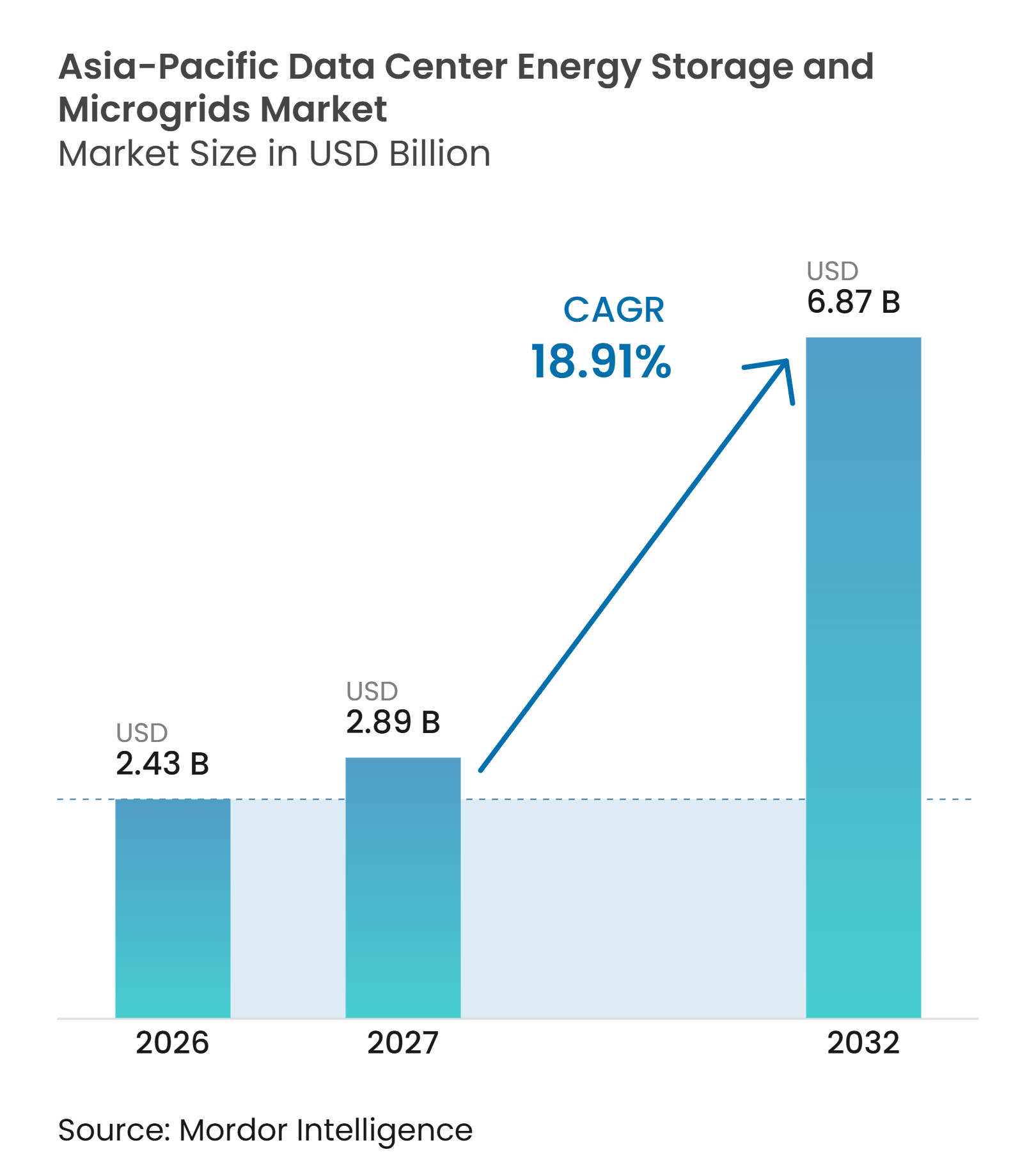
| Base Year Market Size (2026) | USD 2.43 Billion |
| Market Size (2027) | USD 2.89 Billion |
| Market Size (2032) | USD 6.87 Billion |
| Growth Rate (2027 - 2032) | 18.91 % |
| Market Concentration | Medium |
Major Players *Disclaimer: Major Players sorted in no particular order Image © Mordor Intelligence. Reuse requires attribution under CC BY 4.0. | |
Asia-Pacific Data Center Energy Storage and Microgrids Market Analysis by Mordor Intelligence
The Asia-Pacific data center energy storage and microgrids market size is projected to expand from USD 2.43 billion in 2026 to USD 2.89 billion in 2027, and to USD 6.87 billion by 2032, registering a CAGR of 18.91% between 2027 and 2032. The Asia-Pacific data center energy storage and microgrids market is being shaped by rapid data center construction, which is raising the value of dependable on-site power systems. Higher rack densities enabled by artificial intelligence and high-performance computing are also shifting batteries from a backup role to daily power management. Operators are pairing storage with solar, long-term renewable power contracts, and microgrid controls to limit exposure to grid constraints and electricity charges. Suppliers are responding with integrated offerings that combine batteries, conversion equipment, cooling, and monitoring software, while developers increasingly assess energy infrastructure before committing to a new site.
Key Report Takeaways
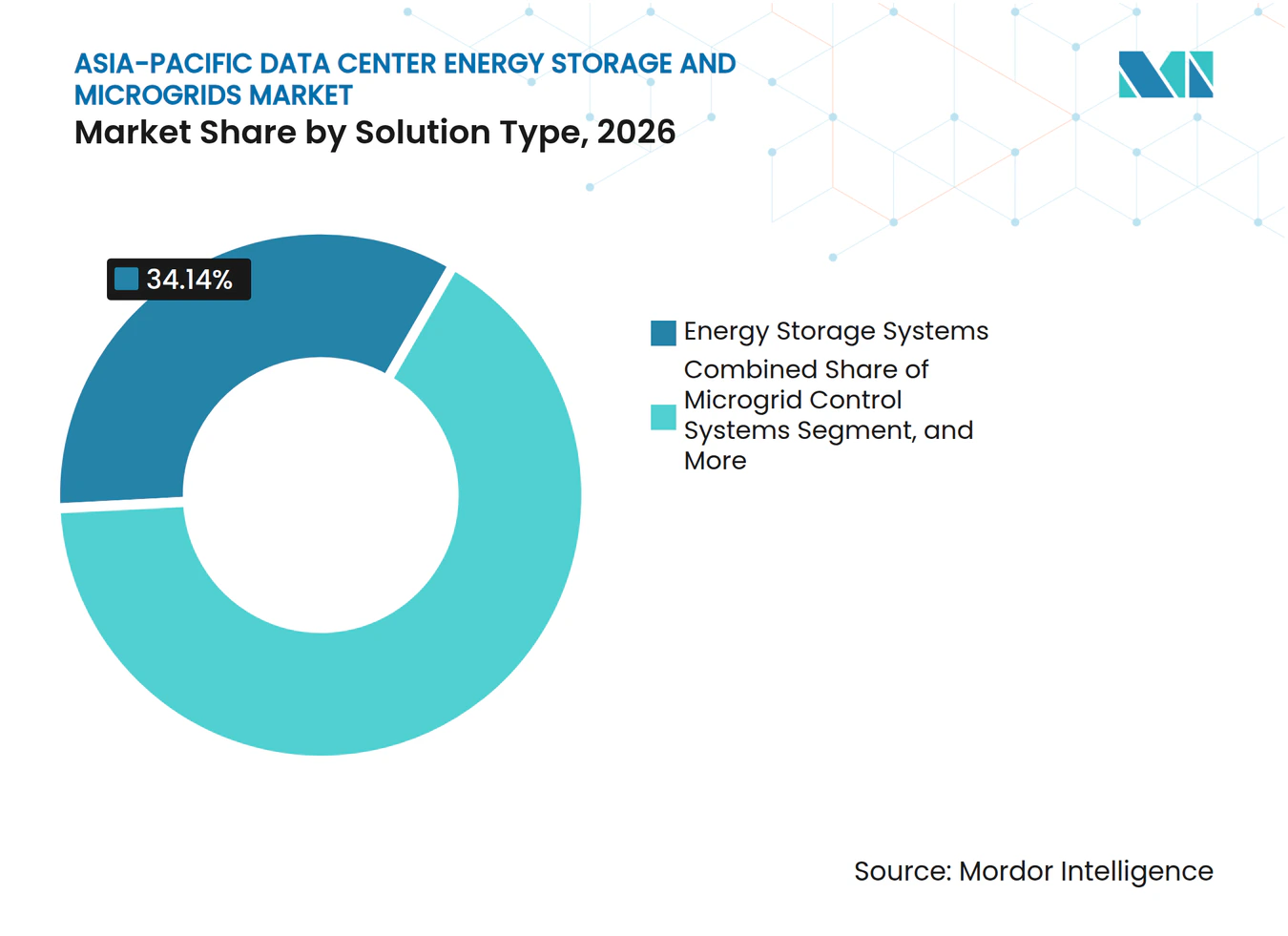
- By solution type, energy storage systems held 34.14% of the Asia-Pacific data center energy storage and microgrids market share in 2026, while microgrid control systems are projected to expand at a 19.89% CAGR through 2032.
- By storage technology, lithium-ion batteries accounted for 71.43% of revenue in 2026 and are expected to expand at a 19.84% CAGR through 2032.
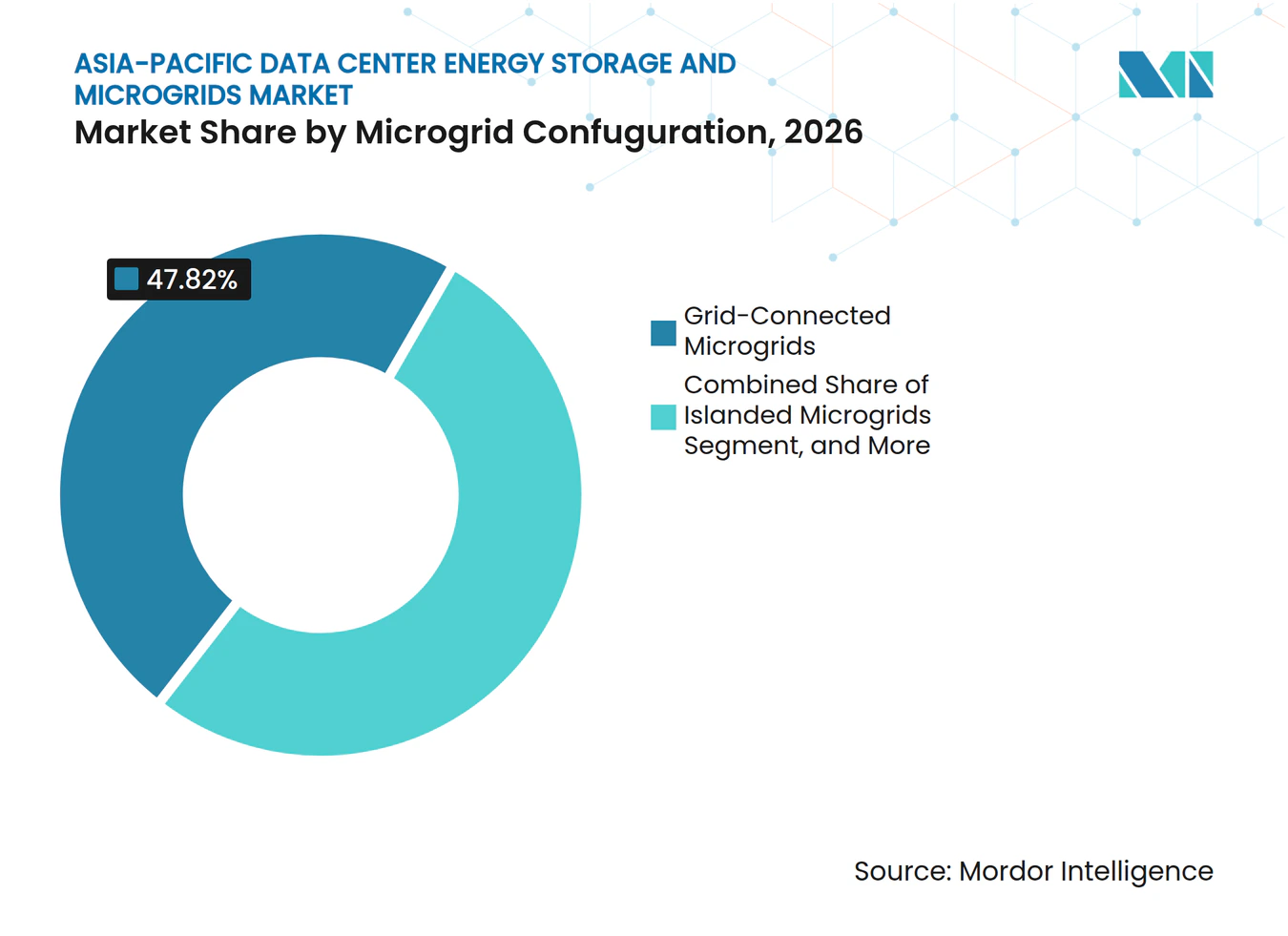
- By microgrid configuration, grid-connected systems accounted for 47.82% of revenue in 2026, while hybrid systems are projected to grow at a 19.34% CAGR through 2032.
- By primary energy source, grid electricity accounted for 37.44% of revenue in 2026, while solar power is expected to expand at a 20.11% CAGR through 2032.
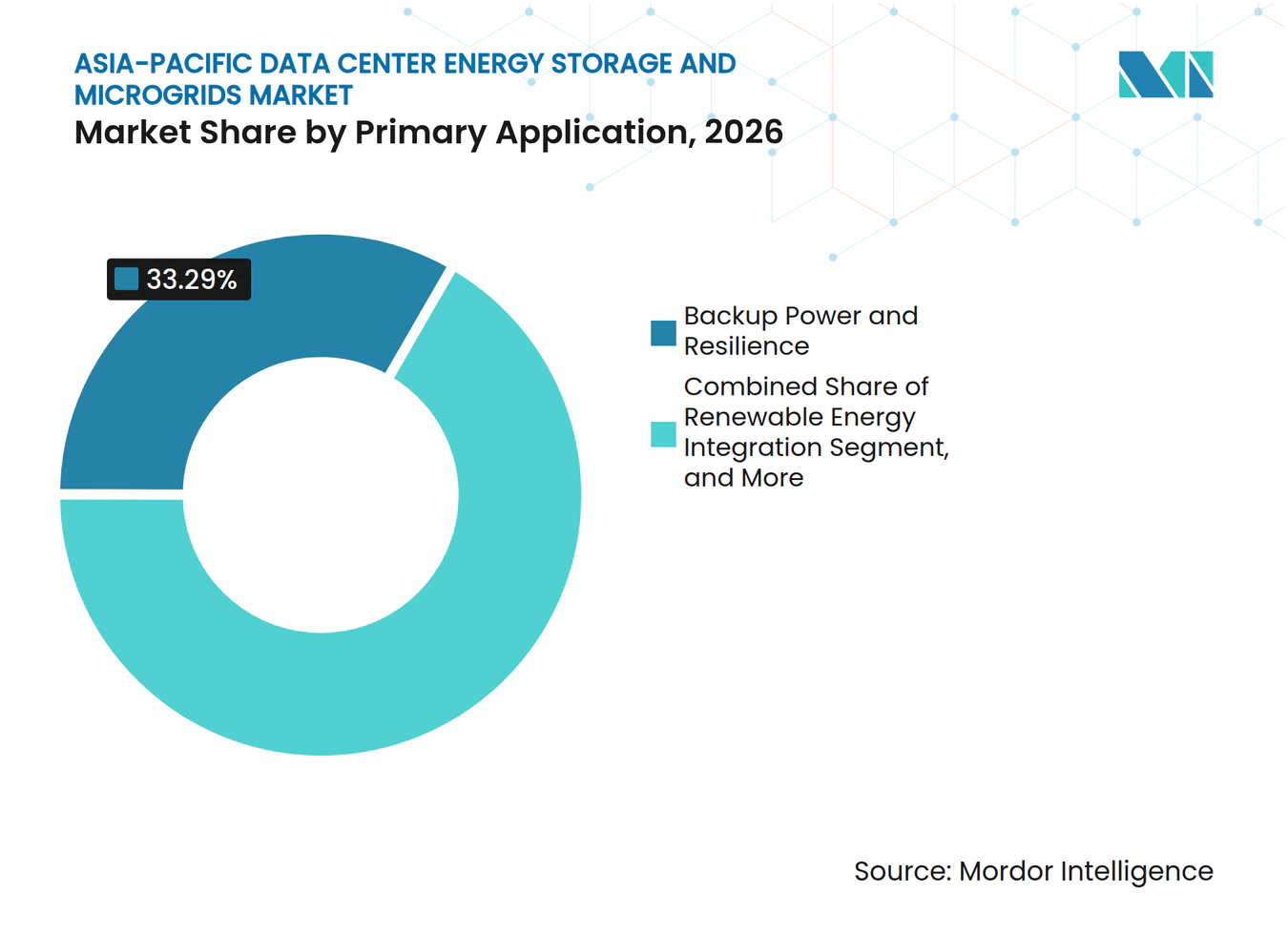
- By primary application, backup power and resilience accounted for 33.29% of revenue in the Asia-Pacific data center energy storage and microgrids market in 2026, while renewable energy integration is projected to expand at a 19.78% CAGR through 2032.
- By data center size, hyperscale facilities accounted for 39.81% of revenue in 2026 and are projected to expand at a 19.66% CAGR through 2032.
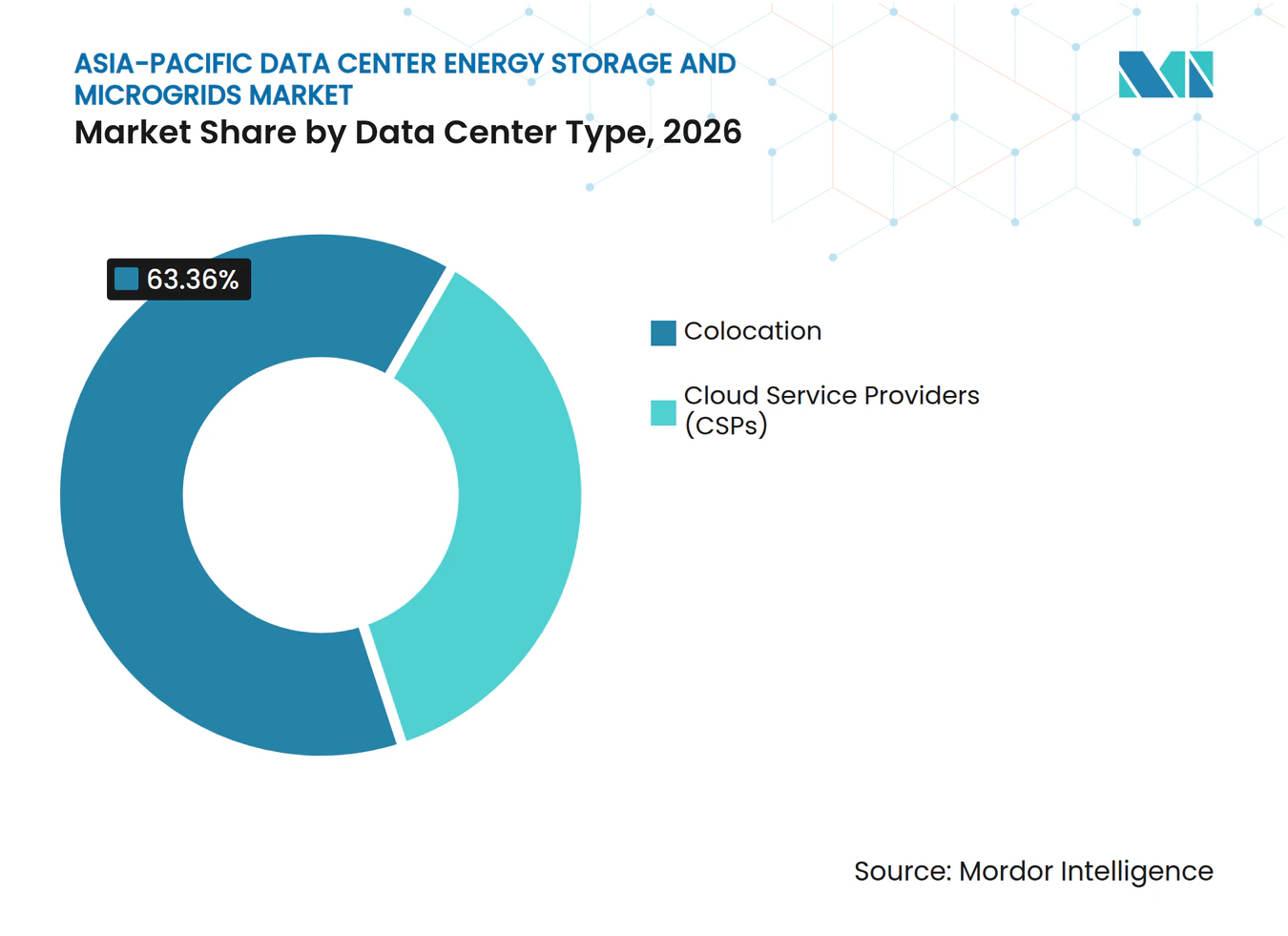
- By data center type, cloud service providers held 36.64% of revenue in 2026, while colocation is expected to expand at a 19.57% CAGR through 2032.
- By geography, China accounted for 34.19% of revenue in 2026, while India is projected to expand at a 20.16% CAGR through 2032.
Note: Market numbers in this report are based on Mordor Intelligence's proprietary estimation framework, which combines nine months of actuals with Q4 projections for base year 2026.
Market Trends and Insights
Drivers Impact Analysis of Asia-Pacific Data Center Energy Storage and Microgrids Market*
| Driver | (~) % Impact on CAGR Forecast | Geographic Relevance | Impact Timeline |
|---|---|---|---|
| AI Data Center Capacity Expansion | +5.0% | China, India, Japan, Singapore, Australia | Short term (≤ 2 years) |
| Grid-Connection Delays Driving On-Site Microgrids | +3.5% | Japan, India, Malaysia, Indonesia | Medium term (2-4 years) |
| Rising Need for Extended Backup and Power Resilience | +3.2% | India, Indonesia, and grid-constrained markets | Short term (≤ 2 years) |
| Renewable Integration and Corporate Carbon Commitments | +2.8% | China, Japan, Singapore, Australia, South Korea | Medium term (2-4 years) |
| High Electricity Tariffs and Demand-Charge Avoidance | +2.1% | Malaysia, Singapore, South Korea, Japan | Medium term (2-4 years) |
| Disaster Resilience Requirements Across Seismic and Typhoon-Prone Markets | +1.5% | Japan, Philippines, Taiwan, Indonesia, coastal Australia | Long term (≥ 4 years) |
| Source: Mordor Intelligence | |||
AI Data Center Capacity Expansion
Asia-Pacific data center power capacity is projected to rise from 16 GW in 2025 to 70 GW by 2030. This expansion makes power availability a central development requirement for the Asia-Pacific data center energy storage and microgrids market. The International Energy Agency reported that global battery-based uninterruptible power supply capacity additions, mainly for data centers, reached 45 GW in 2025, a 30% increase from the prior year.[1] AI inference workloads can change quickly, so operators need systems that manage voltage and frequency without interrupting computing equipment. Alibaba announced a CNY 380 billion (USD 53 billion) investment program for cloud and AI, and linked a 40 MW/160 MWh storage system with 200 MW of wind capacity at its Zhangjiakou campus. Large operators are setting technical specifications that smaller providers may need to follow when seeking anchor tenants.
Grid-Connection Delays Driving On-Site Microgrids
Long utility connection processes are changing the project sequence for new data centers across the Asia-Pacific data center energy storage and microgrids market. In Greater Tokyo, grid access has required 48-60 months, and the Chiba Inzai-Shiroi area has placed 2,500 MW of large-load demand in the interconnection queue. Japan's Ministry of Economy, Trade, and Industry revised grid connection rules in September 2025 to support faster connections for facilities with on-site battery backup. Storage, therefore, plays a role in both access planning and resilience. In India, Indonesia, and Malaysia, developers are using behind-the-meter microgrids to provide dependable power while transmission upgrades remain underway. This approach can shorten exposure to construction delays, although it requires earlier design decisions and larger initial capital commitments.
Rising Need for Extended Backup and Power Resilience
India's data center capacity reached 1,575 MW in 2026, up more than 4 times from 375 MW in 2020. The country's Central Electricity Authority expects data center power demand to reach 17 GW by fiscal 2031-32. This expansion reinforces demand for systems that serve both short-duration power protection and longer outages. Schneider Electric has described microgrid-compatible designs that combine solar, batteries, and diesel inputs for data centers in constrained power environments. A layered design can also support time-based electricity management, rather than leaving batteries unused until an outage. The Asia-Pacific data center energy storage and microgrids market, therefore, encompasses a broader range of users, including mid-sized operators and edge facilities that require higher resilience standards.
Renewable Integration and Corporate Carbon Commitments
China has required new national hub data centers to secure at least 80% of their electricity from renewable sources.[2] That requirement creates a direct need for storage that can balance variable wind and solar generation. China Datang began direct green power supply to the Zhongwei data center hub in February 2026 through its computing power and electricity coordination project. The project combines a 500 MW solar installation with a planned 1.5 GW wind addition, targeting 2.29 billion kWh of annual clean electricity. In Malaysia, Gamuda Energy and Gentari Renewables signed an agreement in August 2025 to develop up to 1.5 GW of solar and battery capacity for hyperscale data centers. Renewable procurement is increasingly linked to storage requirements, which can reduce the value of delaying battery investment.
Restraints Impact Analysis of Asia-Pacific Data Center Energy Storage and Microgrids Market*
| Restraint | (~) % Impact on CAGR Forecast | Geographic Relevance | Impact Timeline |
|---|---|---|---|
| High Upfront Capex and Long Payback Periods | -2.8% | India, Indonesia, Malaysia, and other markets | Medium term (2-4 years) |
| Interconnection, Permitting, and Fire-Safety Complexity | -2.0% | Japan, Singapore, Australia, South Korea, Malaysia | Medium term (2-4 years) |
| Thermal Runaway, Degradation, and Insurance Constraints | -1.5% | Singapore, Japan, Australia | Long term (≥ 4 years) |
| Limited Qualified Integrators and Service Personnel | -0.9% | India, Indonesia, Malaysia, Rest of Asia-Pacific | Medium term (2-4 years) |
| Source: Mordor Intelligence | |||
High Upfront Capex and Long Payback Periods
Integrated microgrids require battery systems, solar generation, power conversion equipment, and digital controls. The combined capital requirement can be difficult for small and mid-sized operators to fund, particularly where financing costs are high. Payback periods also depend on electricity tariffs, battery cycling, and access to grid-services revenue. Gold Peak Technology Group announced a USD 150 million investment in battery manufacturing in Malaysia's Johor-Singapore Special Economic Zone in February 2025, but the facility is designed primarily for large-scale demand. Smaller colocation providers can face less favorable procurement terms and may limit installations to essential uninterruptible power supply capacity. This can delay wider use of storage for peak shaving and renewable balancing in the Asia-Pacific data center energy storage and microgrids market.
Interconnection, Permitting, and Fire-Safety Complexity
Storage projects often need separate studies for grid interconnection, fire safety, and environmental approvals. These processes can add 12-18 months to commissioning schedules when agencies review applications separately. Singapore updated fire safety requirements for large energy storage systems, including ground-floor placement near fire-engine access routes in specified cases. A published risk assessment of a 485.52 kWh lithium-ion battery installation at an Equinix facility in Singapore highlighted hydrogen fluoride exposure as a major hazard during a thermal runaway event. Compliance with standards such as NFPA 855 and IEC 62933 can require additional engineering and testing. These requirements are important safeguards, but they create greater scheduling and cost pressure for operators without committed tenants.
*Our forecasts treat driver/restraint impacts as directional, not additive. The impact forecasts reflect baseline growth, mix effects, and variable interactions.
Asia-Pacific Data Center Energy Storage and Microgrids Market Segment Analysis
By Solution Type:
Energy Storage Systems Support Core Power InfrastructureEnergy storage systems held 34.14% of the Asia-Pacific data center energy storage and microgrids market share in 2026. Their leading position reflects the need to maintain uninterrupted service before operators add more advanced functions. Hyperscale tenants commonly require very fast failover capability under long-term service contracts. Energy storage systems provide the battery capacity needed to meet this performance requirement. They also enable peak management and renewable balancing when a site has the required controls and operating model in place.
Microgrid control systems are projected to expand at a 19.89% CAGR through 2032. These systems coordinate batteries, grid supply, solar generation, and standby assets through a common operational layer. Rebellions and Standard Energy announced plans to develop an artificial intelligence-based power-flow control platform for data center energy storage applications. The platform is intended to manage demand spikes at millisecond intervals and reduce peak-demand charges. Integrated microgrid solutions can lower on-site coordination risk for colocation operators that do not maintain large internal engineering teams.



By Storage Technology:
Lithium-Ion Batteries Retain a Leading RoleLithium-ion batteries accounted for 71.43% of the Asia-Pacific data center energy storage and microgrids market share within the storage technology segment in 2026. They are also projected to expand at a 19.84% CAGR through 2032. The dual position reflects established supply chains, compact equipment designs, and ongoing performance improvements. Lithium iron phosphate chemistry is widely used because it offers strong cycle life and thermal stability. The China National Energy Storage Alliance reported that lithium iron phosphate represented more than 99% of newly commissioned energy storage capacity in China's data center sector.
LG Energy Solution introduced a next-generation uninterruptible power supply battery for AI data centers, delivering up to 527 kW per cabinet for 5 minutes. The product targets the high-power requirements of GPU clusters. Flow batteries continue to serve select long-duration applications, including Alibaba's 50 MWh liquid-flow battery at its Hangzhou data center. Lead-acid batteries remain in older backup installations where replacement cycles are slow. Flywheels still serve short-duration power-quality needs where operators prioritize rapid response and seek to reduce reliance on large lithium-ion battery installations.
By Microgrid Configuration:
Hybrid Designs Increase Operating OptionsGrid-connected microgrids represented 47.82% of the Asia-Pacific data center energy storage and microgrids market size for this configuration segment in 2026. They remain common in established clusters with dependable transmission infrastructure, including coastal China and Singapore. These systems retain grid access while using batteries for resilience, demand management, and selected ancillary services. The configuration is often easier to operate because the grid remains the main source of electricity. It also provides a practical route for adding a renewable supply in stages.
Hybrid grid-connected and islandable systems are projected to expand at a 19.34% CAGR through 2032. Their appeal is strongest in areas exposed to typhoons, seismic activity, or long grid outages. Japan's GX 2040 Vision supports development near low-carbon energy hubs and offshore wind resources, creating a favorable setting for flexible power systems. Islanded systems remain relevant for remote sites in Indonesia and Australia where utility service is limited. A hybrid design can also allow an operator to reduce grid consumption when spot prices are elevated.

By Primary Energy Source:
Solar Gains Relevance Alongside Grid SupplyGrid electricity accounted for 37.44% of the Asia-Pacific data center energy storage and microgrids market share for primary energy sources in 2026. It remains the dominant source because large facilities need a firm, continuous supply. However, tariff reforms in Malaysia, Singapore, and Japan have increased interest in a wider mix of power inputs. Storage can help operators control the timing of grid purchases and support load shifting. The degree of benefit still depends on site-specific tariff structures and the battery dispatch strategy.
Solar power is expected to expand at a 20.11% CAGR through 2032. Microsoft contracted 25 MW of solar power from Shizen Energy in Japan through a 20-year virtual power purchase agreement. Equinix also signed a 30 MW, 20-year renewable power purchase agreement with Trina Solar ISBU Japan in April 2025. India's solar capacity utilization factor of 16-20% shows why solar generation alone cannot meet a data center's continuous demand. Solar and storage systems are therefore increasingly designed together, while diesel, natural gas, and fuel cells continue to provide transition or contingency capacity.
By Primary Application:
Backup Power Remains the Largest Use CaseBackup power and resilience accounted for 33.29% of the Asia-Pacific data center energy storage and microgrids market size for applications in 2026. Cloud providers and enterprise tenants require high uptime, which keeps power continuity at the center of procurement decisions. Batteries can bridge the interval before standby generation becomes available. They also protect sensitive equipment from short power-quality events. This role remains important even when operators add renewable power and microgrid controls.
Renewable energy integration is projected to expand at a 19.78% CAGR through 2032. Tata Power received approval from the Maharashtra Electricity Regulatory Commission for a 100 MW multi-location battery energy storage system in Mumbai. The project is intended to serve critical loads, including data centers, while also supporting black-start and islanding functions. Peak shaving and load shifting are becoming more important where contracted capacity penalties are high. Grid services remain an early-stage application, but Japan and Australia have market structures that can support storage aggregation for wholesale electricity services.
By Data Center Size:
Hyperscale Facilities Influence ProcurementHyperscale facilities held 39.81% of the Asia-Pacific data center energy storage and microgrids market share in 2026. They are also projected to expand at a 19.66% CAGR through 2032. Their scale can lower equipment costs per megawatt-hour and support large renewable procurement commitments. This gives hyperscale operators greater leverage when negotiating with battery suppliers and power developers. The Asia-Pacific data center energy storage and microgrids industry is therefore influenced by the procurement standards set by a relatively small group of large buyers.
JLL expects Asia-Pacific data center capacity to increase from 32 GW to 57 GW by 2030. DayOne signed a 1.5 GW renewable supply agreement with Tenaga Nasional Berhad in Malaysia, including 2.2 GWh of battery energy storage. Medium-sized facilities are more likely to adopt modular systems that can be expanded as tenant commitments are secured. Small facilities commonly focus on replacing uninterruptible power supplies and adding selected rooftop solar. This difference in purchasing capacity creates an advantage for suppliers with modular product lines and service networks.
By Data Center Type:
Cloud Providers Lead While Colocation ExpandsCloud service providers accounted for 36.64% of the Asia-Pacific data center energy storage and microgrids market share in 2026. Their position reflects large regional footprints across China, India, Japan, Australia, and Singapore. Cloud operators tend to require consistent specifications across multiple sites. That requirement favors suppliers that can provide equipment, software, and warranty support at scale. It also increases interest in systems capable of managing highly variable artificial intelligence workloads.
Colocation is expected to expand at a 19.57% CAGR through 2032. Demand is supported by enterprises that want managed capacity without owning a full data center. LG CNS won an Indonesian hyperscale AI data center project in Jakarta with an initial capacity of 30 MW and the potential to expand to 220 MW. The company combined batteries, cooling, and design capabilities through its One LG Solution offering. Enterprise and edge sites also need more resilient power systems as organizations place latency-sensitive or sovereignty-sensitive workloads closer to users.
Geography Analysis
China
China accounted for 34.19% of the Asia-Pacific data center energy storage and microgrids market share in 2026. The East Data, West Computing program directs data center development from constrained coastal locations toward energy-rich western provinces, while new national hub data centers must use at least 80% renewable electricity. China Datang began supplying green electricity to the Zhongwei data center hub in February 2026 through a project that includes 500 MW of solar and a planned 1.5 GW of wind capacity. CATL, BYD, and Sungrow benefit from a strong domestic supply chain for lithium iron phosphate batteries, which supports faster deployment across the country. The National Energy Administration's AI and smart energy pilot policy, launched in November 2025, supports artificial intelligence in grid planning, virtual power plants, and renewable dispatch.
India
India is projected to expand at a 20.16% CAGR through 2032, the fastest rate among the geographies assessed. Installed data center capacity reached 1,575 MW in 2026, and the Central Electricity Authority expects power demand from this sector to reach 17 GW by fiscal 2031-32. The Ministry of New and Renewable Energy has set a battery energy storage target of 236.22 GWh for the same period, while Tata Power's approved 100 MW battery system in Mumbai shows how urban storage can support critical loads and grid services. Lithium-ion batteries made up 77% of new telecom battery installations in India in 2025, providing a base of related skills and supply activity for data center deployments.
Japan, Australia, Singapore, South Korea, Malaysia, and Indonesia
Japan's 48-60 month grid connection timelines make storage a practical option for accessing power sooner, and the Ministry of Economy, Trade and Industry's 2025 rule change gives battery-equipped data centers a faster route to connection. Singapore allocated 20 hectares on Jurong Island in October 2025 for a data center park of up to 700 MW and included shared energy storage and utility infrastructure in the plan. Malaysia's July 2025 tariff reform increased electricity costs for data centers and strengthened the case for peak shaving. South Korea confirmed a KRW 780 billion (USD 565 million) investment in the Pohang AI data center and a KRW 179.8 billion (USD 130 million) investment in an 80 MW/480 MWh battery system in 2026. In Indonesia, a 450 MW capacity agreement for a hyperscale campus in Batam and a planned Jakarta facility with 120 MWh of battery storage show that power infrastructure is being designed at the outset.
Competitive Landscape
Market Concentration
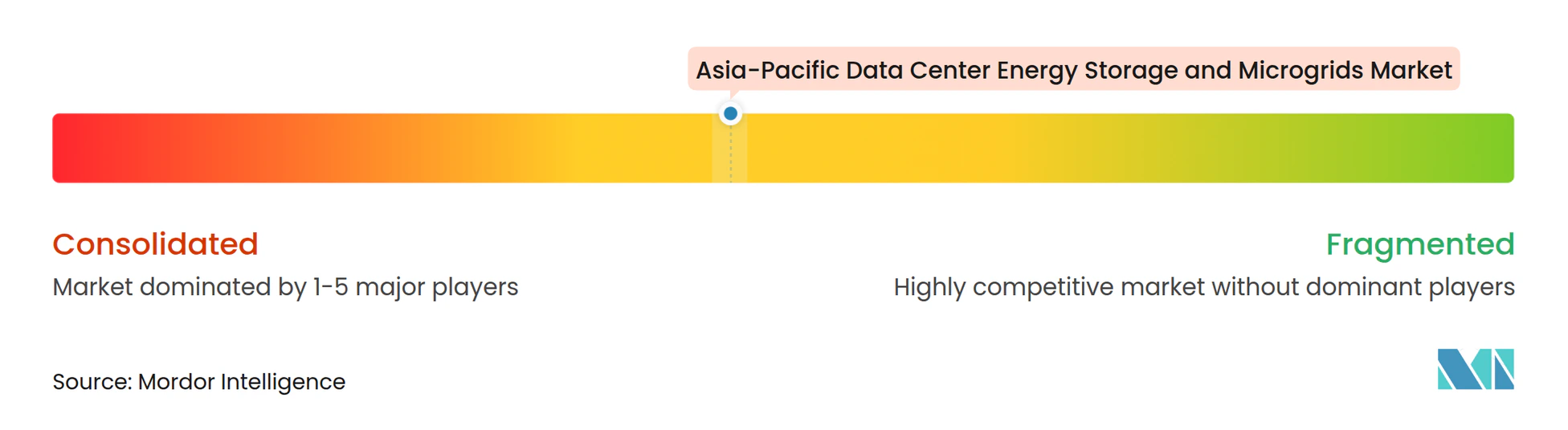
The Asia-Pacific data center energy storage and microgrids market has moderate-to-high concentration among major system integrators and battery suppliers. Schneider Electric, Vertiv, Huawei Digital Power, and ABB compete with CATL, BYD, Sungrow, LG Energy Solution, and Samsung SDI through system design, controls, service coverage, and warranties. Schneider Electric's EcoStruxure platform combines energy management and predictive maintenance tools for power resilience applications. Huawei's SmartLi architecture brings lithium-ion uninterruptible power supply equipment into a broader power and cooling management system. These offerings reduce the number of separate interfaces that a data center operator must manage.
Fluence reported USD 850 million in first data center contract awards in fiscal Q3 2026, including USD 300 million from a data center developer and USD 550 million under a hyperscaler master service agreement, while its battery storage pipeline reached 16 GWh, up 35% quarter-on-quarter. Fluence positioned its Smartstack platform for IEC 62933 certification, which can support procurement in markets where formal technical alignment is important. LG Energy Solution's One LG Solution model combines batteries, cooling, and data center design services in a single offer.[3] This model addresses the integration risk that operators often budget for when working with multiple suppliers.
CATL and BYD retain cost and scale advantages in lithium iron phosphate cells, although trade uncertainty can affect their position outside China. Samsung SDI had orders that represented 90% of its annual energy storage system production capacity, signaling tight supply for non-Chinese projects. Rebellions and Standard Energy are pursuing a more specialized position through software that responds to rapid power changes in artificial intelligence data centers. Long-duration storage and multi-source microgrid control remain areas where there is room for product differentiation. Buyers also continue to favor suppliers that can coordinate hardware, controls, maintenance, and compliance support across multiple locations.
Asia-Pacific Data Center Energy Storage and Microgrids Industry Leaders
-
Schneider Electric SE
-
Vertiv Holdings Co
-
Huawei Technologies Co., Ltd.
-
Delta Electronics, Inc
-
Eaton Corporation plc
- *Disclaimer: Major Players sorted in no particular order
Asia-Pacific Data Center Energy Storage and Microgrids Market Companies Covered in this Report
- Schneider Electric SE
- Vertiv Holdings Co
- Huawei Technologies Co., Ltd.
- Delta Electronics, Inc.
- Eaton Corporation plc
- ABB Ltd.
- Siemens AG
- Hitachi Energy Ltd.
- CATL (Contemporary Amperex Technology Co., Limited)
- BYD Company Limited
- LG Energy Solution
- Samsung SDI Co., Ltd.
- Panasonic Energy Co., Ltd.
- Sungrow Power Supply Co., Ltd.
- Toshiba Corporation
- Mitsubishi Electric Corporation
- Fluence Energy, Inc.
- Honeywell International Inc.
- GE Vernova Inc.
- Johnson Controls International plc
- Generac Holdings Inc.
- Cummins Inc.
- Caterpillar Inc.
- Socomec Group
- Piller Power Systems
Recent Industry Developments in Asia-Pacific Data Center Energy Storage and Microgrids Market
- August 2026: South Korea confirmed the Pohang AI Data Center, KRW 780 billion (USD 565 million), and Yeonggwang Battery Energy Storage System project, KRW 179.8 billion (USD 130 million), 80 MW/480 MWh, 6-hour dispatch capability, as the 9th and 10th Regional Revitalization Investment Fund projects. The projects co-locate computing and storage infrastructure in designated regional energy corridors, and construction on the BESS commenced in the first half of 2026.
- June 2026: Fluence Energy reported USD 850 million in first data center contract awards in fiscal Q3 2026, including a USD 300 million order from a data center developer and USD 550 million in awards under a hyperscaler master service agreement. Its data center BESS pipeline reached 16 GWh, a 35% quarter-on-quarter increase.
- May 2026: China Datang's 500 MW photovoltaic project at Ningxia Zhongwei achieved full grid connection and began direct green electricity supply to the Zhongwei data center hub. The 1.5 GW wind addition was progressing toward September 2026 commissioning and was expected to deliver 2.29 billion kWh of annual clean power.
- April 2026: Indonesia's Batam region advanced as a hyperscale hub through a 450 MW capacity agreement between PT PLN and a hyperscale campus at Kabil Industrial Tech Park. Electricity supply was scheduled in phases through 2026-2027, with energy storage required as part of the power infrastructure.
Asia-Pacific Data Center Energy Storage and Microgrids Market Report Scope
The Asia-Pacific Data Center Energy Storage and Microgrids Market represents the development and adoption of advanced energy management and power infrastructure solutions to address the growing electricity demands of data centers across the region.
The Asia-Pacific Data Center Energy Storage and Microgrids Market Report is Segmented by Solution Type (Energy Storage Systems, Microgrid Control Systems, Distributed Generation Systems, Integrated Microgrid Solutions, and Power Conversion Systems), Storage Technology (Lithium-Ion Batteries, Flow Batteries, Lead-Acid Batteries, Flywheel Energy Storage, and Other Storage Technologies), Microgrid Configuration (Grid-Connected Microgrids, Islanded Microgrids, and Hybrid Grid-Connected and Islandable Microgrids), Primary Energy Source (Grid Electricity, Solar Power, Wind Power, Fuel Cells, and Other Energy Sources), Primary Application (Backup Power and Resilience, Peak Shaving and Loaf Shifting, Renewable Energy Integration, Energy Cost Optimization, and Grid Services), Data Center Size (Hyperscale, Large, Medium, and Small), Data Center Type (Cloud Service Providers, Colocation, and Enterprise and Edge Data Centers), and Geography (China, India, Japan, Australia, Singapore, South Korea, Malaysia, Indonesia, and Rest of Asia-Pacific). The Market Forecasts are Provided in Terms of Value (USD).
Segmentation Overview
| Integrated Microgrid Solutions |
| Energy Storage Systems |
| Microgrid Control Systems |
| Distributed Generation Systems |
| Power Conversion Systems |
| Lithium-Ion Batteries |
| Lead-Acid Batteries |
| Flow Batteries |
| Flywheel Storage |
| Other Storage Technologies |
| Grid-Connected Microgrids |
| Islanded Microgrids |
| Hybrid Grid-Connected and Islandable Microgrids |
| Grid Electricity |
| Diesel and Natural Gas |
| Solar Power |
| Wind Power |
| Fuel Cells |
| Other Energy Sources |
| Backup Power and Resilience |
| Peak Shaving and Load Shifting |
| Renewable Energy Integration |
| Grid Services |
| Energy Cost Optimization |
| Small |
| Medium |
| Large |
| Hyperscale |
| Colocation |
| Cloud Service Providers (CSPs) |
| Enterprise and Edge |
| China |
| India |
| Japan |
| Australia |
| Singapore |
| South Korea |
| Malaysia |
| Indonesia |
| Rest of Asia-Pacific |
| By Solution Type | Integrated Microgrid Solutions |
| Energy Storage Systems | |
| Microgrid Control Systems | |
| Distributed Generation Systems | |
| Power Conversion Systems | |
| By Storage Technology | Lithium-Ion Batteries |
| Lead-Acid Batteries | |
| Flow Batteries | |
| Flywheel Storage | |
| Other Storage Technologies | |
| By Microgrid Configuration | Grid-Connected Microgrids |
| Islanded Microgrids | |
| Hybrid Grid-Connected and Islandable Microgrids | |
| By Primary Energy Source | Grid Electricity |
| Diesel and Natural Gas | |
| Solar Power | |
| Wind Power | |
| Fuel Cells | |
| Other Energy Sources | |
| By Primary Application | Backup Power and Resilience |
| Peak Shaving and Load Shifting | |
| Renewable Energy Integration | |
| Grid Services | |
| Energy Cost Optimization | |
| By Data Center Size | Small |
| Medium | |
| Large | |
| Hyperscale | |
| By Data Center Type | Colocation |
| Cloud Service Providers (CSPs) | |
| Enterprise and Edge | |
| By Geography | China |
| India | |
| Japan | |
| Australia | |
| Singapore | |
| South Korea | |
| Malaysia | |
| Indonesia | |
| Rest of Asia-Pacific |
Key Questions Answered in the Report
What is the size of the Asia-Pacific data center energy storage and microgrids market?
The market is projected to increase from USD 2.43 billion in 2026 and USD 2.89 billion in 2027 to USD 6.87 billion by 2032, at an 18.91% CAGR.
Which solution type has the largest share in the Asia-Pacific data center energy storage and microgrids market?
Energy storage systems lead with a 34.14% share in 2026, reflecting the need for reliable backup power and power-quality protection.
Why are lithium-ion batteries widely used in Asia-Pacific data centers?
Lithium-ion batteries held 71.43% of the storage technology segment in 2026 because of established supply chains, compact designs, and strong cycle-life performance.
Which country is expanding fastest for data center energy storage and microgrids?
India is projected to expand at a 20.16% CAGR through 2032, supported by new data center capacity and battery storage targets.
How do grid connection delays affect data center development in Asia-Pacific?
Delays encourage developers to use on-site microgrids and storage so facilities can secure dependable power while waiting for utility upgrades.
What is driving solar and battery installations at data centers?
Solar is projected to expand at a 20.11% CAGR through 2032 as operators use batteries to manage intermittent generation and meet renewable electricity commitments.