
Asia-Pacific Data Center Emergency Power and Resilience Market Size and Share
Market Overview
| Study Period | 2021 - 2032 |
|---|---|
| Forecast Data Period | 2027 - 2032 |
| Base Year Market Size (2026) | USD 3.71 Billion |
| Market Size (2027) | USD 4.23 Billion |
| Market Size (2032) | USD 8.37 Billion |
| Growth Rate (2027 - 2032) | 14.62 % |
| Market Concentration | Medium |
Major Players *Disclaimer: Major Players sorted in no particular order Image © Mordor Intelligence. Reuse requires attribution under CC BY 4.0. | |
Asia-Pacific Data Center Emergency Power and Resilience Market Analysis by Mordor Intelligence
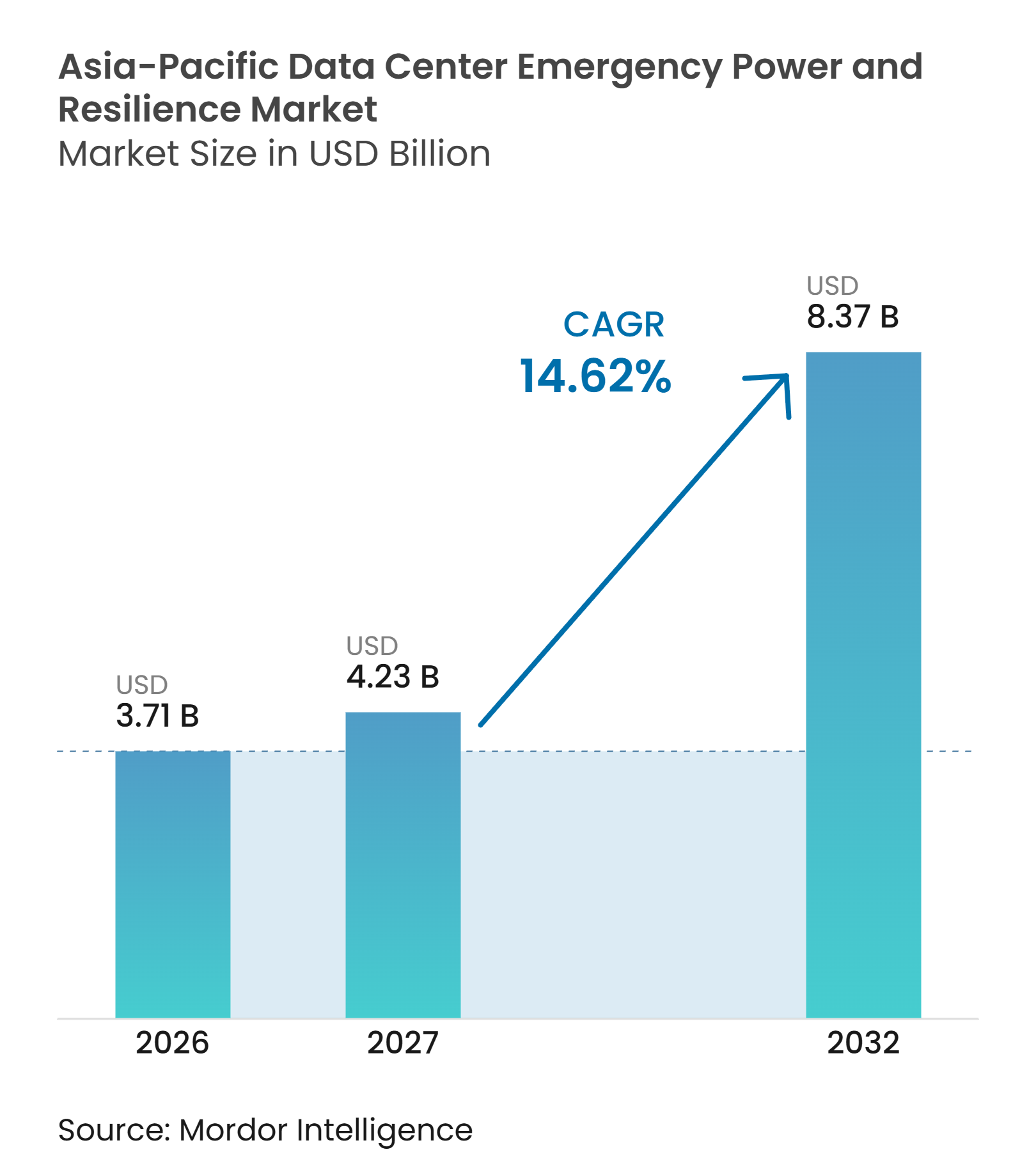
The Asia-Pacific data center emergency power and resilience market size is expected to grow from USD 3.71 billion in 2026 to USD 4.23 billion in 2027 and is forecast to reach USD 8.37 billion by 2032 at a 14.62% CAGR over 2027-2032. Investment in new data centers is increasing the need for equipment that maintains operations during power interruptions. Higher rack densities for AI workloads require larger and more responsive backup systems at each site. Hyperscale campuses are shaping equipment specifications, service arrangements, and supplier selection across the region. Grid connection delays in major hubs increase the need for on-site resilience, while also raising project costs and complicating fuel planning. These conditions support demand for the Asia-Pacific data center emergency power and resilience market through the current construction cycle and into the operating life of new facilities.
Key Report Takeaways
- By equipment type, backup generators held 36.71% of the Asia-Pacific data center emergency power and resilience market share in 2026, while backup batteries are projected to expand at a 16.26% CAGR through 2032.
- By power capacity, the 20 MW and above tier accounted for 43.28% of revenue in 2026 and is expected to expand at a 15.92% CAGR through 2032.
- In backup power technology, diesel-based systems accounted for 59.78% of revenue in 2026, while fuel cell and other emerging systems are projected to expand at a 16.39% CAGR through 2032.
- By service type, preventive and corrective maintenance accounted for 27.59% of revenue in 2026, while power resilience consulting and assessment is projected to expand at a 16.51% CAGR through 2032.
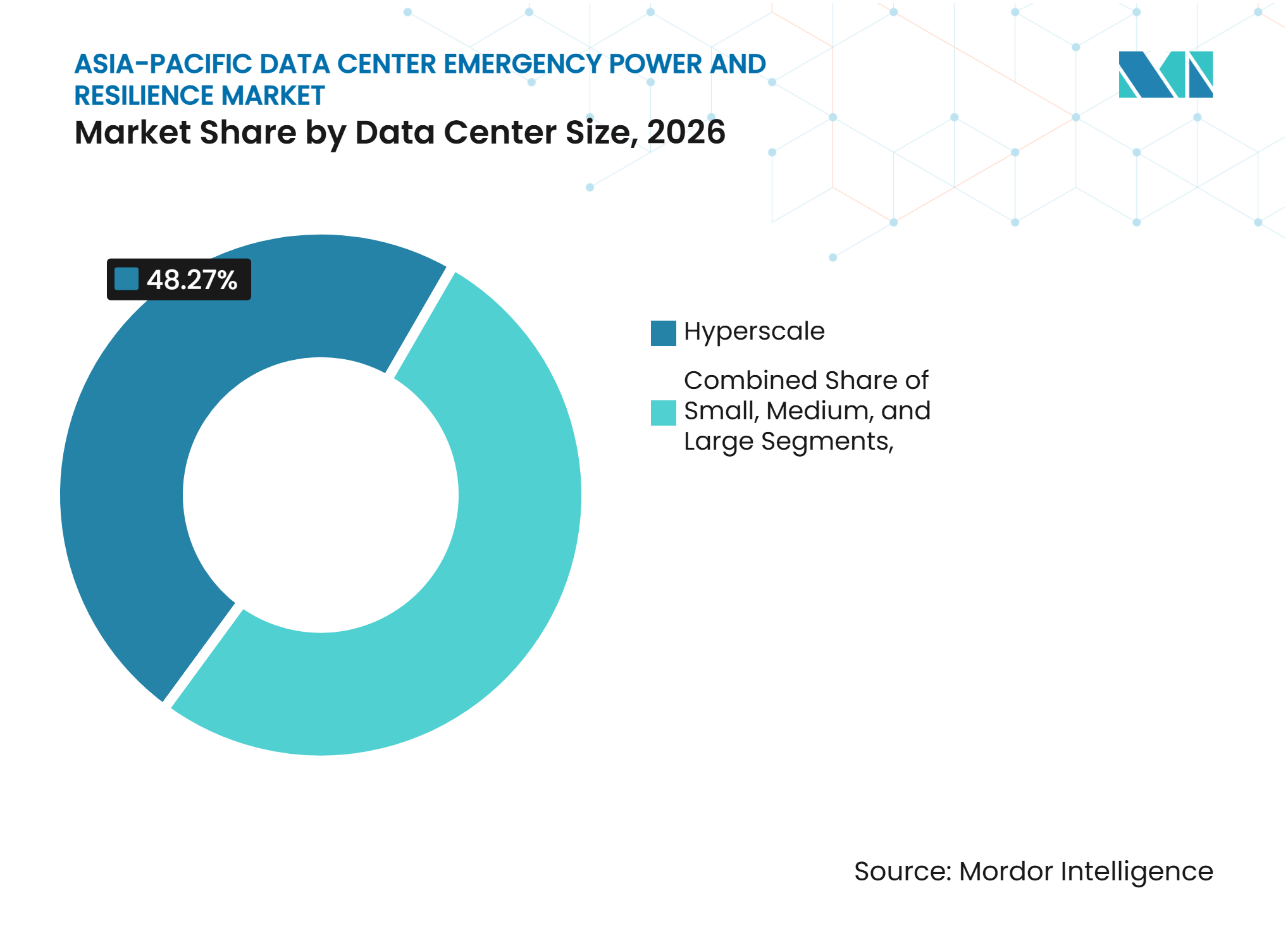
- By data center size, hyperscale facilities held 48.27% of revenue in 2026 and are projected to expand at a 17.62% CAGR through 2032.
- By data center type, cloud service providers held 36.64% of revenue in 2026 and are expected to expand at a 15.38% CAGR through 2032.
- By geography, China held 39.57% of the Asia-Pacific data center emergency power and resilience market revenue in 2026, while India is projected to expand at a 17.91% CAGR through 2032.
Note: Market numbers in this report are based on Mordor Intelligence's proprietary estimation framework, which combines nine months of actuals with Q4 projections for base year 2026.
Market Trends and Insights
Drivers Impact Analysis of Asia-Pacific Data Center Emergency Power and Resilience Market*
| Driver | (~) % Impact on CAGR Forecast | Geographic Relevance | Impact Timeline |
|---|---|---|---|
| Hyperscale and AI-Led Data Center Expansion | +4.2% | Asia-Pacific, with emphasis on China, India, and Singapore | Short term (≤ 2 years) |
| Cloud, 5G, and Digital Service Growth | +2.8% | Asia-Pacific, with emphasis on China, India, Japan, and Southeast Asia | Medium term (2-4 years) |
| Data Sovereignty and Government Digital Infrastructure Programs | +2.1% | India, China, and Singapore | Medium term (2-4 years) |
| Rising Rack Power Density and Tier III and Tier IV Reliability Requirements | +1.9% | Singapore, Japan, China, India, and Southeast Asia | Short term (≤ 2 years) |
| Substation Connection Delays Driving On-Site Resilience | +1.4% | Japan, South Korea, and Singapore | Short term (≤ 2 years) |
| Intermittent Renewable Supply Increasing the Need for Firming Storage | +1.0% | Asia-Pacific, particularly India and western China | Long term (≥ 4 years) |
| Source: Mordor Intelligence | |||
Hyperscale and AI-Led Data Center Expansion
AI workloads are changing how operators size backup power for data centers. AI-optimized racks can demand 20 kW to 130 kW, compared with 5 kW to 10 kW in traditional cloud installations, which raises the backup capacity needed for peak workloads. Training runs can produce demand spikes above normal utilization, so operators must plan for a wider operating range. The International Energy Agency expects AI and data center electricity demand to place greater pressure on power systems, increasing the value of flexible and reliable site infrastructure.[1] This places the Asia-Pacific data center emergency power and resilience market closer to core capacity planning rather than a separate compliance purchase. Suppliers that can support larger load blocks and factory-integrated equipment are better positioned for these projects.
Cloud, 5G, and Digital Service Growth
Cloud adoption and 5G deployment are extending backup-power demand across centralized campuses and distributed network sites. The Asia-Pacific data center emergency power and resilience market benefits when cloud providers add capacity and telecommunications networks add edge computing equipment. Edge sites need UPS protection and monitoring that can meet service continuity requirements in locations with less space and fewer on-site technicians. Digital services are also moving more computing activity closer to users, increasing the number of smaller installations that need dependable power continuity. This adds a distributed layer of demand alongside procurement by hyperscale operators. Equipment suppliers need regional service coverage because these projects are spread across many cities and countries.
Data Sovereignty and Government Digital Infrastructure Programs
Data localization requirements lead providers to place computing capacity and redundancy within national borders. China’s East Data West Computing initiative directs capacity toward western areas, where renewable resources are more available but backup requirements can differ from those in coastal hubs. Local infrastructure programs also make the installed base of backup equipment more durable, as power systems must be maintained throughout the life cycle of sovereign compute facilities. The Asia-Pacific data center emergency power and resilience market, therefore, includes recurring maintenance, testing, and fuel management work after the original equipment sale. Local manufacturing, commissioning capacity, and spare parts availability are relevant in supplier selection. These factors favor companies that can meet country-specific requirements without relying on a distant service network.
Rising Rack Power Density and Tier III and Tier IV Reliability Requirements
Tier III and Tier IV facilities require redundancy that can maintain critical operations during equipment failures or planned maintenance. Higher-density GPU clusters increase the absolute backup capacity required for each rack and the wider electrical distribution system. State Grid Jiaxing deployed a dual-loop supply design that includes diesel generators, UPS systems, and batteries at a major computing center in the Yangtze River Delta.[2] The company is also using a virtual power plant approach to coordinate flexible assets, demonstrating how backup systems can become more active grid resources. The International Energy Agency has identified flexible operation of data center assets as an area of increasing policy attention. This broadens the value proposition for systems that can communicate with site controls and respond quickly to power conditions.
Restraints Impact Analysis of Asia-Pacific Data Center Emergency Power and Resilience Market*
| Restraint | (~) % Impact on CAGR Forecast | Geographic Relevance | Impact Timeline |
|---|---|---|---|
| High Upfront Cost of High-Efficiency Resilience Systems | -2.1% | Asia-Pacific, with emphasis on India and Southeast Asia | Medium term (2-4 years) |
| Grid, Land, and Interconnection Constraints in Tier-1 Hubs | -1.7% | Japan, Singapore, and South Korea | Short term (≤ 2 years) |
| Limited Availability of Mission-Critical Power and Liquid-Cooling Technicians | -1.2% | Asia-Pacific and Southeast Asia | Medium term (2-4 years) |
| Fuel Logistics and Emissions Compliance Risk for Long-Duration Generator Backup | -0.9% | Singapore, Japan, and India | Long term (≥ 4 years) |
| Source: Mordor Intelligence | |||
High Upfront Cost of High-Efficiency Resilience Systems
Hybrid battery-diesel and fuel-cell platforms require more capital than conventional diesel-only configurations. The cost includes engineering, controls integration, commissioning, and changes to established UPS and generator systems. This hurdle is greater for enterprise and colocation operators that lack the balance-sheet capacity of large cloud providers. Imported equipment can also create financing and foreign exchange pressure in parts of Southeast Asia. These conditions preserve a role for diesel systems even when hybrid equipment offers operational or environmental advantages. The Asia-Pacific data center emergency power and resilience market consequently contains different procurement paths for hyperscale customers and mid-sized operators.
Grid, Land, and Interconnection Constraints in Tier-1 Hubs
Grid connections in the most concentrated data center locations can delay new construction and affect project economics. King and Wood Mallesons reported that connection processes near Tokyo can take more than 10 years in some cases. Singapore also uses a government-managed process for allocating data center capacity, which adds planning requirements to the normal site development process. Operators may install more on-site resilience to protect service delivery while primary supply is constrained. This raises capital requirements and gives an advantage to well-funded developers. It also directs some expansion toward Malaysia, Indonesia, and Thailand, where new campuses can be planned around different power availability conditions.
*Our forecasts treat driver/restraint impacts as directional, not additive. The impact forecasts reflect baseline growth, mix effects, and variable interactions.
Asia-Pacific Data Center Emergency Power and Resilience Market Segment Analysis
By Equipment Type:
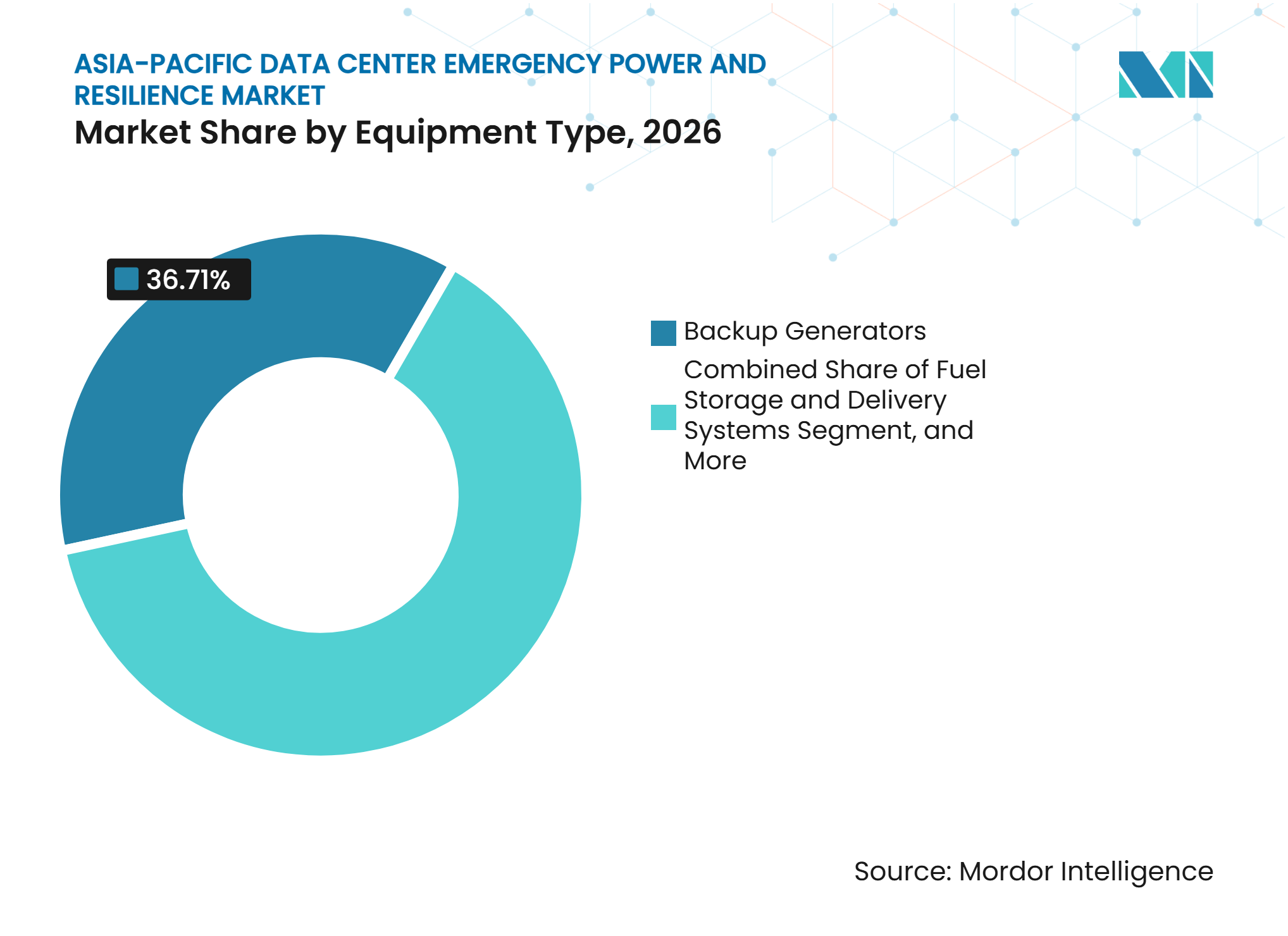
Generators Lead as Batteries AccelerateBackup generators accounted for 36.71% of the Asia-Pacific data center emergency power and resilience market share in 2026, reflecting their established role during long outages. A large data center uses generators as the main long-duration layer after UPS systems cover immediate power continuity. Automatic transfer switches, fuel storage, distribution equipment, and on-site power systems support separate parts of the same resilience design. Generator procurement remains closely linked to the scale of a site and its redundancy target. Suppliers with proven equipment, local service teams, and installed-base relationships retain an advantage in high-availability projects. Generator systems also remain familiar to facilities teams and can be specified around established testing, maintenance, and fuel-handling processes. This supports continued demand for conventional equipment while operators introduce new technologies in selected applications.
Backup batteries are projected to expand at a 16.26% CAGR through 2032. Their rapid response can support the seconds between a grid interruption and generator operation, while also fitting with on-site battery energy storage. Battery-first transfer arrangements can reduce reliance on generator starts for short interruptions. Lithium-ion systems can be part of a wider controls strategy that combines solar generation, storage, and generator capacity. Microgrids are gaining relevance in Indian Tier-2 and Tier-3 locations because self-sufficient power planning affects site selection. This does not remove the need for fuel storage or generator maintenance at critical facilities. Instead, it allows operators to assign each asset a defined role in a coordinated response to outages, grid stress, and short-duration power fluctuations. The data center backup power industry is therefore retaining generators for duration while using batteries for speed, control, and integration.



By Power Capacity:
Large Campuses Favor the 20 MW and Above TierThe 20 MW and above tier held 43.28% of revenue in 2026 and is projected to expand at a 15.92% CAGR through 2032. This tier reflects the pipeline of large campuses built for hyperscale and AI workloads. Bridge Data Centers planned a 270 MW Malaysian project supported by an energy solution arrangement with SK Innovation that includes energy storage and fuel-cell auxiliary power.[3] These large projects require equipment providers to supply consistent specifications across generator, UPS, switching, and controls packages. Their scale also makes installation scheduling, commissioning capacity, and access to replacement equipment important commercial factors. A supplier that can coordinate delivery across several sites can reduce variability for an operator that is expanding a regional campus network.
Below 1 MW, 1 MW to below 5 MW, and 5 MW to below 20 MW tiers serve enterprise sites, carrier-grade colocation facilities, and edge computing locations. The 5 MW to below 20 MW range is relevant in Malaysia, Indonesia, and Thailand as data center capacity expands beyond established hubs. Local electrical requirements can affect the specification of mid-sized systems and favor suppliers with regional experience. Smaller sites also need equipment that is compact, serviceable, and compatible with limited on-site staffing. Their procurement process differs from a hyperscale tender because resilience choices are often made with local developers and utilities. These projects often prioritize equipment availability, installation practicality, and dependable local support over a fully bespoke configuration. This creates a broad base of opportunities below the largest campus tier.
By Backup Power Technology:
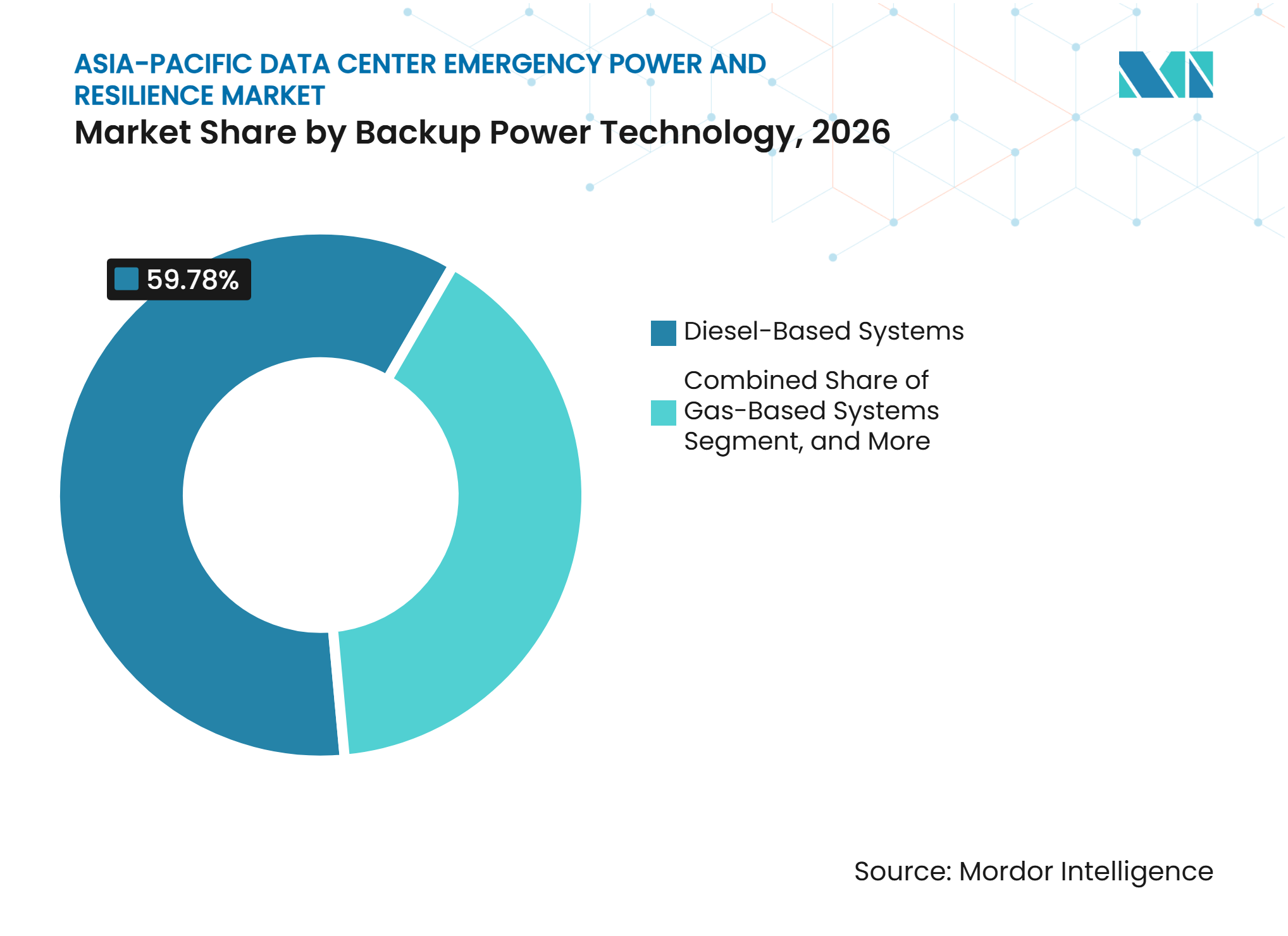
Diesel Retains Scale as Fuel Cells EmergeDiesel-based systems held 59.78% of revenue in 2026, while fuel cell and other emerging systems are projected to expand at a 16.39% CAGR through 2032. Diesel remains the established choice because it can provide dependable, long-duration output for critical facilities. Bridge Data Centers and EcoCeres completed an HVO-powered backup-fuel pilot in May 2026 that covered generator startup, load transfer, and sustained operation at data center campuses.[4] The companies stated that the fuel could reduce greenhouse gas emissions by up to 90% compared with fossil diesel, without generator modifications. The pilot also shows that alternative fuel decisions can be tested within existing generator fleets rather than requiring a complete replacement program. This provides a practical route for operators who want lower-emission fuel without immediately replacing installed generators.
Gas-based systems offer cleaner combustion than diesel in suitable locations, while battery-based systems offer fast response and potential grid interaction. Honda began a demonstration in Japan that uses repurposed vehicle fuel cells to support a Mitsubishi-operated data center with hydrogen from Tokuyama’s electrolysis business. This project tests whether an existing hydrogen supply chain can support stationary power applications. Battery assets also offer operational flexibility when operators need to manage site load or support grid conditions. The International Energy Agency has noted that data center load flexibility can become more valuable as power systems respond to rising AI demand. Operators must still assess local fuel access, safety requirements, maintenance skills, and the time needed to restore each technology after an event. The technology mix will therefore change gradually because reliability, fuel availability, and site economics differ across Asia-Pacific.

By Service Type:
Maintenance Leads as Resilience Consulting ExpandsPreventive and corrective maintenance accounted for 27.59% of revenue in 2026, supported by service obligations for generators and UPS systems at high-availability facilities. Regular inspections, testing, and repairs are required because backup equipment must perform reliably after long periods without use. Maintenance providers also manage warranty requirements, spare parts, and planned shutdown windows. These activities create recurring work after the original installation is complete. The service relationship can influence later equipment upgrades because operators value a provider that understands the installed architecture. This work can be especially important where several backup components must operate in sequence during a disturbance. This makes maintenance a stable part of the Asia-Pacific data center emergency power and resilience market.
Power resilience consulting and assessment is projected to expand at a 16.51% CAGR through 2032. AI clusters can create variable loads, making capacity planning and failure-response design more difficult. Operators are therefore assessing generator sizing, battery duration, fuel storage, and control settings before a facility enters service. Fuel management and emergency readiness services must also adjust as HVO and other alternative fuels are incorporated into backup arrangements. Load-bank testing and system validation are becoming more important as large campuses are commissioned at speed. These services help project teams identify configuration issues before a facility is placed under critical load. Consulting activity supports a shift from reacting to failures toward designing and testing resilience earlier in the project cycle.
By Data Center Size:
Hyperscale Facilities Set the Market PaceHyperscale facilities accounted for 48.27% of revenue in 2026 and are projected to grow at a 17.62% CAGR through 2032. These facilities require large backup systems because redundancy and distribution losses increase the capacity needed beyond the IT load itself. Vertiv reported in its 2026 second-quarter earnings call that Asia-Pacific hyperscale projects were becoming larger. Larger projects increase the value of prefabricated modules that integrate power components prior to site delivery. This can shorten commissioning time and reduce the coordination needed across several equipment suppliers. The resulting projects shape the technical and commercial standards used in the Asia-Pacific data center emergency power and resilience market.
Small and medium data centers continue to serve enterprise edge deployments and 5G-related compute needs. Large data centers occupy a middle position because they require dedicated resilience planning yet may still seek a single provider for a full system. This approach can reduce handoffs between UPS, switching, generator, and controls suppliers. Distributed sites also create demand for UPS equipment in the 10 kVA to 500 kVA range. Their needs complement hyperscale procurement rather than replacing it. Service access, equipment footprint, and the ability to complete maintenance with limited site staffing are central selection factors for these operators. The data center backup power industry must therefore support both repeatable modules for major campuses and serviceable systems for smaller locations.
By Data Center Type:
Cloud Service Providers Shape Procurement StandardsCloud service providers held 36.64% of revenue in 2026 and are projected to expand at a 15.38% CAGR through 2032. Their requirements for response time, fuel type, remote monitoring, and service availability influence specifications used by other customer groups. Colocation providers often align with these requirements because they host cloud workloads. Enterprise and edge facilities adopt some of the same standards while tailoring designs to local power conditions. This creates a route through which cloud procurement affects a wider customer base. It also reinforces demand for suppliers that can provide standardized equipment and regional support.
Colocation providers link hyperscaler requirements with locally available facilities and power infrastructure. Enterprise and edge deployments are increasing in unit volume where data localization and network architecture limit reliance on distant processing sites. Financial services, manufacturing, and e-commerce customers are key sources of this distributed demand across China, India, and Japan. Schneider Electric stated that its India data center business was advancing at a double-digit rate and was expected to outpace its broader India operations over the following 4 years to 5 years. The company example illustrates the scale of demand that cloud-related capacity can create to support electrical infrastructure. It also shows why colocation and enterprise customers often seek equipment that aligns with cloud-provider expectations for monitoring, response time, and maintenance discipline. Customer diversity reduces reliance on any one facility type, even though cloud providers remain the main standard-setters.
Geography Analysis
China
China held 39.57% of the Asia-Pacific data center emergency power and resilience market share in 2026. Large construction activity and national policy support its role in regional demand. China’s data center electricity consumption reached 140 billion kWh in 2024, and projections cited by Caixin Global indicate it will reach 400 billion kWh by 2030. State Grid Jiaxing has applied a dual-loop design with diesel generators, UPS systems, and batteries at a major high-performance computing facility. Its virtual power plant work shows how backup assets can be coordinated as adjustable capacity rather than held only for outages. East Data West Computing is shifting some capacity toward interior provinces with more renewable resources. These locations can require longer fuel logistics and more on-site resilience than coastal centers. The Asia-Pacific data center emergency power and resilience market size in China benefits from both large campus construction and the need to adapt power designs to different regional grid conditions. Suppliers that can integrate controls, storage, and generator equipment are well placed to support this transition.
India
India is projected to expand at a 17.91% CAGR through 2032. Its data center power capacity is expected to rise from 1.5 GW in financial year 2026 to 8 GW in financial year 2031, creating a substantial need for backup equipment and related services. India’s data sovereignty requirements and hyperscale commitments are supporting a longer pipeline of local development. Grid reliability can vary across new development zones, making on-site systems more relevant to facility planning. Global suppliers with regional manufacturing, installation, and service capacity have an advantage as commissioning schedules become more compressed. Schneider Electric identified strong demand for AI-ready infrastructure in India, with its data center business expected to outpace its broader domestic operations. The Asia-Pacific data center emergency power and resilience market share represented by India is likely to be shaped by suppliers' ability to combine standardized equipment with country-level service. Modular systems can help operators bring capacity online more quickly. Local servicing also matters because project owners need continuous testing and maintenance after commissioning.
Japan, Singapore, and Secondary Markets
Japan, Singapore, Malaysia, Indonesia, and Thailand offer different demand conditions, with the final 3 countries gaining attention where capacity in established hubs is constrained. Near Tokyo, grid connections can take more than 10 years, according to the APAC regulatory guide published by King and Wood Mallesons. Singapore’s government-managed application process adds an additional planning factor for new data center capacity. These conditions raise the need for on-site resilience while making project delivery more difficult. Malaysia, Indonesia, and Thailand can accommodate new campuses that cannot secure suitable capacity in Tier-1 locations. Digital Edge has described its CGK Campus in Indonesia as a 500-MW facility with the capacity to scale to 1 GW. The HVO backup-fuel pilot completed by Bridge Data Centers and EcoCeres provides a regional operating example for lower-emission generator fuel. The planned Digital Infrastructure Act in Singapore will establish resilience and security standards that can influence procurement decisions. These markets offer a mix of regulatory influence, grid constraints, and room for large new builds.
Competitive Landscape
Market Concentration
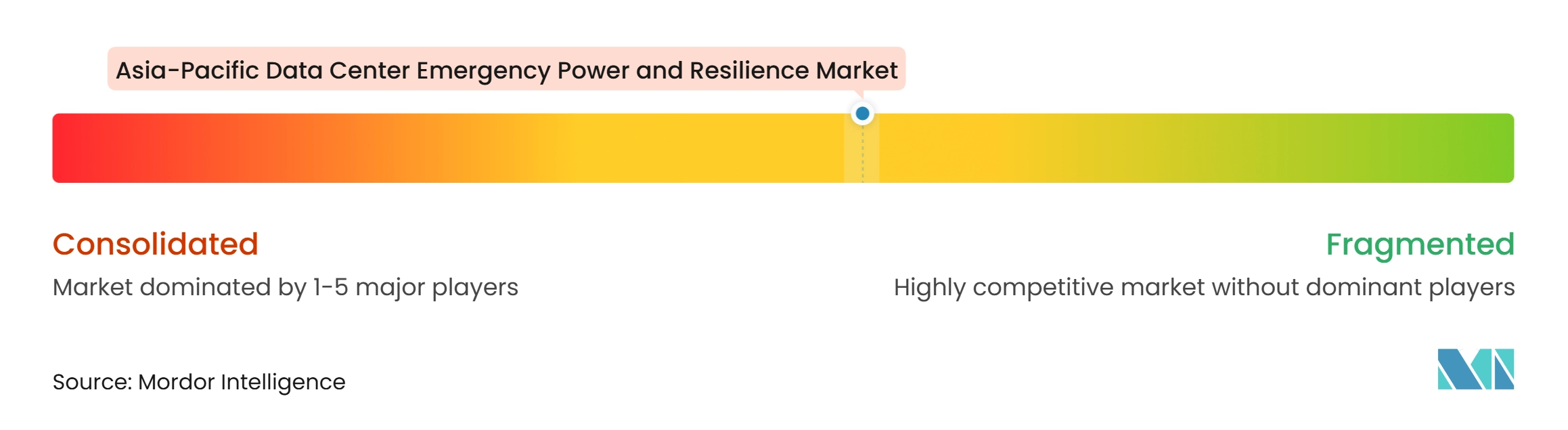
The Asia-Pacific data center emergency power and resilience market is concentrated in large generator projects but remains fragmented across UPS and battery solutions. Established suppliers compete through equipment reliability, service coverage, factory capacity, and the ability to support complex projects. Vertiv, Schneider Electric, Huawei Digital Power, ABB, and Eaton are among the companies active in UPS and electrical infrastructure. Vertiv confirmed a new manufacturing facility in Johor, Malaysia during its 2026 second-quarter earnings call. The facility supports regional demand for data center power equipment. Integrated, prefabricated solutions are becoming more important because they reduce the on-site coordination needed across UPS, distribution, and switching equipment. Vertiv has used PowerNexus at the Gunsan AI Data Center in South Korea, showing the application of this modular approach.
Suppliers are also expanding through acquisition and product development. Eaton acquired Fibrebond Corporation in April 2025 and Resilient Power Systems Inc. in July 2025 to strengthen its capabilities for modular power and solid-state transformer technology. These actions respond to demand for higher-density data center systems. Socomec launched its DELPHYS XM UPS and DIRIS A-100 and A-200 power quality meters in March 2025 for modern power-management needs. Competition increasingly depends on whether suppliers can deliver integrated systems, not only standalone equipment. Regional manufacturing and local commissioning capacity can be decisive where hyperscale projects have tight delivery schedules.
New battery chemistries, energy controls, and longer-duration backup systems create opportunities beyond conventional generators. Rebellions and Standard Energy have developed the Dopamine platform, which combines neural processing unit servers and vanadium-ion battery energy storage to manage power flow. This reflects a move toward linking computing demand with energy management at the site level. Fuel-cell equipment is also being evaluated for data center applications, as shown by the Honda and Mitsubishi demonstration in Japan. Chinese manufacturers can compete on domestic cost and are extending their reach into Southeast Asia. Customers will compare long-duration capability, integration with existing electrical assets, and the availability of local technical support before adopting these approaches at scale. This leaves space for specialists that can prove performance in demanding operational conditions and work alongside established equipment vendors. The Asia-Pacific data center emergency power and resilience market rewards suppliers that can offer reliable systems, responsive support, and credible plans for lower-emission operation. The Asia-Pacific data center emergency power and resilience market also requires vendors to demonstrate that new systems can fit established operating procedures, site layouts, testing routines, and service commitments. This requirement can slow adoption but provides a clear route for suppliers that combine new technology with practical implementation support. The data center backup power industry continues to offer room for companies specializing in controls, alternative fuels, and predictive maintenance.
Asia-Pacific Data Center Emergency Power and Resilience Industry Leaders
-
ABB Ltd.
-
Schneider Electric SE
-
Vertiv Holdings Co
-
Eaton Corporation plc
-
Huawei Digital Power Technologies Co., Ltd.
- *Disclaimer: Major Players sorted in no particular order
Asia-Pacific Data Center Emergency Power and Resilience Market Companies Covered in this Report
- ABB Ltd.
- Schneider Electric SE
- Vertiv Holdings Co
- Eaton Corporation plc
- Huawei Digital Power Technologies Co., Ltd.
- Caterpillar Inc.
- Cummins Inc.
- Rolls-Royce Holdings plc
- Delta Electronics, Inc.
- Legrand SA
- Mitsubishi Electric Corporation
- Socomec Group S.A.
- Piller Power Systems Ltd.
- Rittal GmbH & Co. KG
- Kohler Co.
- Generac Holdings Inc.
- Mitsubishi Heavy Industries, Ltd.
- Yanmar Holdings Co., Ltd.
- Fuji Electric Co., Ltd.
- Toshiba Energy Systems & Solutions Corporation
- INNIO Group Holding GmbH
- HITEC Power Protection B.V.
Recent Industry Developments in Asia-Pacific Data Center Emergency Power and Resilience Market
- October 2026: Schneider Electric unveiled the Galaxy VXL high-density modular UPS, delivering up to 1.25 MW in a single frame with a 31% reduction in lifecycle CO₂ emissions, and introduced software-defined medium-voltage switchgear enabling up to 3x faster ordering and 2x faster commissioning for AI-ready power portfolios.
- August 2026: GE Vernova announced its medium-voltage UPS system for the data center sector, designed to stabilize large hyperscale facilities at the medium-voltage bus level. The company expects to begin shipping in mid-2027, with the first project energized in late 2027.
- May 2026: Bridge Data Centres and EcoCeres completed Asia-Pacific's inaugural HVO-powered backup-fuel pilot at BDC data center campuses, covering generator startup, load transfer, and sustained operations under data center conditions. HVO reduces greenhouse-gas emissions by up to 90% versus fossil diesel with no generator modifications, BDC confirmed wider Asia-Pacific deployment plans.
- May 2026: Schneider Electric confirmed its India data center business is growing at a double-digit pace and is expected to outpace broader India operations over the next 4-5 years, driven by AI-ready infrastructure demand.
Asia-Pacific Data Center Emergency Power and Resilience Market Report Scope
The Asia-Pacific data center emergency power and resilience market covers revenue from emergency power and resilience systems deployed in data centers across China, India, Southeast Asia, Australia, and other regional markets. Growth is driven by rapid regional digitalization, massive hyperscale construction booms, widespread data-localization mandates, and the critical necessity for high-capacity backup infrastructure to support scaling urban digital demands.
The Asia-Pacific Data Center Emergency Power and Resilience Market Report is Segmented by Equipment Type (Backup Generators, Uninterruptible Power Supply Systems, Backup Batteries, Automatic Transfer Switches and Switching Equipment, Fuel Storage and Delivery Systems, and Microgrid and On-Site Power Systems), Power Capacity (Below 1 MW, 1 MW to Below 5 MW, 5 MW to Below 20 MW, and 20 MW and Above), Backup Power Technology (Diesel-Based Systems, Gas-Based Systems, Battery-Based Systems, and Fuel Cell and Other Emerging Systems), Service Type (Installation and Commissioning, Preventive and Corrective Maintenance, Load Bank Testing and System Validation, Fuel Management and Emergency Readiness Services, and Power Resilience Consulting and Assessment), Data Center Size (Small, Medium, Large, and Hyperscale), Data Center Type (Colocation, Cloud Service Providers (CSPs), and Enterprise / Edge), and Country (China, Japan, India, Singapore, and Rest of Asia-Pacific). The Market Forecasts are Provided in Terms of Value (USD).
Segmentation Overview
| Backup Generators |
| Uninterruptible Power Supply Systems |
| Backup Batteries |
| Automatic Transfer Switches and Switching Equipment |
| Fuel Storage and Delivery Systems |
| Microgrid and On-Site Power Systems |
| Below 1 MW |
| 1 MW to Below 5 MW |
| 5 MW to Below 20 MW |
| 20 MW and Above |
| Diesel-Based Systems |
| Gas-Based Systems |
| Battery-Based Systems |
| Fuel Cell and Other Emerging Systems |
| Installation and Commissioning |
| Preventive and Corrective Maintenance |
| Load Bank Testing and System Validation |
| Fuel Management and Emergency Readiness Services |
| Power Resilience Consulting and Assessment |
| Small |
| Medium |
| Large |
| Hyperscale |
| Colocation |
| Cloud Service Providers (CSPs) |
| Enterprise / Edge |
| China |
| Japan |
| India |
| Singapore |
| Rest of Asia-Pacific |
| By Equipment Type | Backup Generators |
| Uninterruptible Power Supply Systems | |
| Backup Batteries | |
| Automatic Transfer Switches and Switching Equipment | |
| Fuel Storage and Delivery Systems | |
| Microgrid and On-Site Power Systems | |
| By Power Capacity | Below 1 MW |
| 1 MW to Below 5 MW | |
| 5 MW to Below 20 MW | |
| 20 MW and Above | |
| By Backup Power Technology | Diesel-Based Systems |
| Gas-Based Systems | |
| Battery-Based Systems | |
| Fuel Cell and Other Emerging Systems | |
| By Service Type | Installation and Commissioning |
| Preventive and Corrective Maintenance | |
| Load Bank Testing and System Validation | |
| Fuel Management and Emergency Readiness Services | |
| Power Resilience Consulting and Assessment | |
| By Data Center Size | Small |
| Medium | |
| Large | |
| Hyperscale | |
| By Data Center Type | Colocation |
| Cloud Service Providers (CSPs) | |
| Enterprise / Edge | |
| By Country | China |
| Japan | |
| India | |
| Singapore | |
| Rest of Asia-Pacific |
Key Questions Answered in the Report
What is the Asia-Pacific data center emergency power and resilience market size?
The Asia-Pacific data center emergency power and resilience market size is expected to grow from USD 3.71 billion in 2026 to USD 4.23 billion in 2027 and is forecast to reach USD 8.37 billion by 2032 at a 14.62% CAGR over 2027-2032.
Which equipment type leads demand for data center backup power in Asia-Pacific?
Backup generators led with 36.71% of revenue in 2026 because they remain the established solution for long-duration outages.
Which backup technology is expected to expand fastest through 2032?
Fuel cell and other emerging systems are projected to expand at a 16.39% CAGR through 2032, while diesel-based systems remain the largest technology category.
Why are batteries becoming more important for data centers in Asia-Pacific?
Backup batteries are projected to expand at a 16.26% CAGR because they respond quickly to interruptions and can support storage and site-control strategies.
Which country is expected to advance fastest in Asia-Pacific?
India is projected to expand at a 17.91% CAGR through 2032 as power capacity and local data center development increase.
How do hyperscale facilities affect backup-power procurement?
Hyperscale facilities held 48.27% of revenue in 2026 and require larger, standardized, and often prefabricated resilience systems.