
Asia-Pacific Data Center Distributed Energy Resources Market Size and Share
Market Overview
| Study Period | 2021 - 2032 |
|---|---|
| Forecast Data Period | 2027 - 2032 |
| Base Year Market Size (2026) | USD 6.87 Billion |
| Market Size (2027) | USD 8.16 Billion |
| Market Size (2032) | USD 19.68 Billion |
| Growth Rate (2027 - 2032) | 19.26 % |
| Market Concentration | Medium |
Major Players *Disclaimer: Major Players sorted in no particular order Image © Mordor Intelligence. Reuse requires attribution under CC BY 4.0. | |
Asia-Pacific Data Center Distributed Energy Resources Market Analysis by Mordor Intelligence
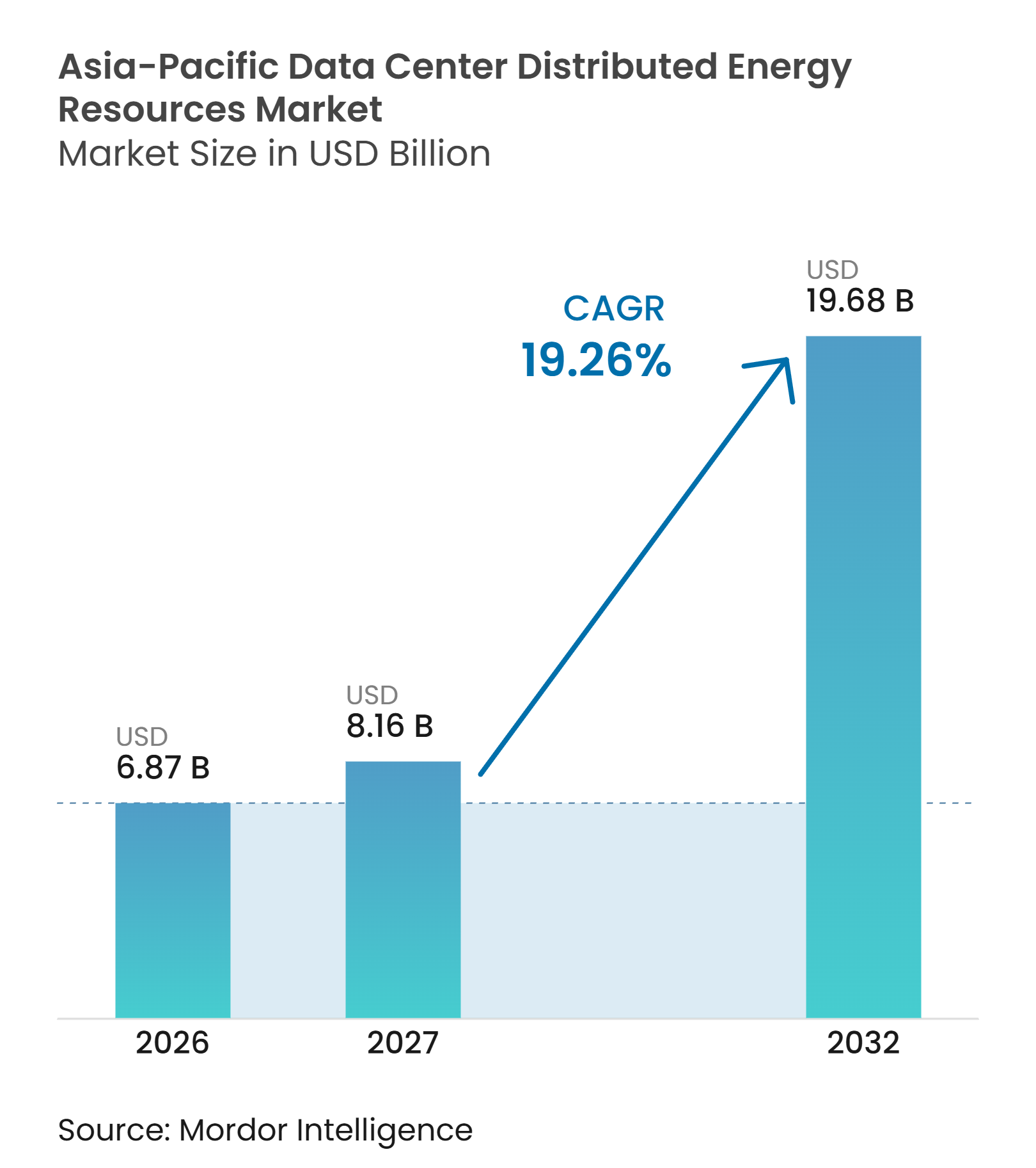
The Asia-Pacific data center distributed energy resources market size is expected to grow from USD 6.87 billion in 2026 to USD 8.16 billion in 2027, and is forecast to reach USD 19.68 billion by 2032, at a 19.26% CAGR over 2027-2032. Rising rack densities and larger AI workloads are changing onsite power from a backup requirement into a core part of facility design. Operators increasingly need generation, storage, controls, and renewable supply that can work together when grid capacity is limited. This need also creates an opportunity for providers to shorten deployment timelines and offer flexible commercial models. Cost, permitting, and fuel supply constraints will continue to shape technology choices across the region. The Asia-Pacific data center distributed energy resources market is therefore moving toward integrated systems that improve resilience, manage power costs, and support lower-carbon operations.
Key Report Takeaways
- By primary energy resource, Battery Energy Storage Systems held 35.18% of the Asia-Pacific data center distributed energy resources market share in 2026, while Fuel Cells are projected to expand at a 20.04% CAGR through 2032.
- By system configuration, Hybrid Distributed Energy Systems accounted for 56.21% of the Asia-Pacific data center distributed energy resources market, while Virtual Power Plant-Connected Resources are expected to expand at a 20.68% CAGR through 2032.
- By ownership model, Data Center-Owned systems held 57.88% of the Asia-Pacific data center distributed energy resources market, while Energy-as-a-Service is projected to expand at a 20.93% CAGR through 2032.
- By primary application, Backup Power and Resilience accounted for 36.14% of the Asia-Pacific data center distributed energy resources market, while Grid and Ancillary Services are expected to expand at a 20.35% CAGR through 2032.
- By data center size, Hyperscale facilities held 58.13% of the Asia-Pacific data center distributed energy resources market and are projected to expand at a 21.37% CAGR through 2032.
- By data center type, Colocation held 67.44% of the Asia-Pacific data center distributed energy resources market, while Cloud Service Providers are expected to expand at a 21.68% CAGR through 2032.
- By geography, China held 29.12% of the Asia-Pacific data center distributed energy resources market, while India is projected to expand at a 19.78% CAGR through 2032.
Note: Market numbers in this report are based on Mordor Intelligence's proprietary estimation framework, which combines nine months of actuals with Q4 projections for base year 2026.
Market Trends and Insights
Drivers Impact Analysis of Asia-Pacific Data Center Distributed Energy Resources Market*
| Driver | (~) % Impact on CAGR Forecast | Geographic Relevance | Impact Timeline |
|---|---|---|---|
| AI and Hyperscale Workloads Increasing Onsite Power Requirements | +8.5% | Global, concentrated in China, India, Japan, South Korea, and Singapore | Short term (≤ 2 years) |
| Grid Interconnection Delays and Local Power Shortages | +4.2% | Asia-Pacific-wide, acute in Malaysia, India, Singapore, and South Korea | Short term (≤ 2 years) |
| Renewable Energy and Carbon-Abatement Commitments | +2.8% | Strongest in Singapore, Japan, Australia, and China | Medium term (2-4 years) |
| Rising Electricity Prices and Demand-Charge Exposure | +1.5% | Asia-Pacific-wide, most acute in Singapore, Japan, and Australia | Short term (≤ 2 years) |
| Factory-Built Power Modules Shortening Data Center Deployment Timelines | +0.9% | North Asia and Southeast Asia, with spillover to India and Australia | Medium term (2-4 years) |
| Grid-Forming Storage Supporting Ancillary Services | +0.7% | Singapore, South Korea, Japan, and Australia | Long term (≥ 4 years) |
| Source: Mordor Intelligence | |||
AI and Hyperscale Workloads Increasing Onsite Power Requirements
Asia-Pacific data center electricity demand is projected to nearly triple by 2030 from 2025 levels, placing immediate pressure on power systems that were not designed for concentrated digital loads. The ASEAN guide reports that rack power density is moving from 8-12 kW toward 50 kW per rack by 2027, particularly where AI computing is deployed. That change requires systems capable of handling sudden load changes without compromising critical equipment. It also makes storage and onsite generation relevant earlier in project planning, rather than after a facility has secured a grid connection. The Asia-Pacific data center distributed energy resources market benefits from an integrated power design, which gives operators more choices in site selection. Secondary cities with renewable resources or gas infrastructure can become more practical locations when developers are not solely dependent on immediate grid expansion.
Grid Interconnection Delays and Local Power Shortages
Grid limitations are becoming a practical constraint on data center delivery in several Asian markets. Johor more than doubled its data center capacity from 401 MW to 897 MW in 2025, while the development pipeline could require nearly half of the state’s electricity generation capacity. Such concentration increases the value of equipment that can support a facility before a full grid upgrade is completed. Onsite systems can also reduce exposure to connection delays where existing gas or renewable assets are available. Hitachi’s 2026 collaboration with Bloom Energy showed that solid oxide fuel cells can be operated as modular onsite power units for Japanese data centers. The Asia-Pacific data center distributed energy resources market therefore has a clear opening for suppliers that can combine dependable power equipment with faster construction schedules.
Renewable Energy and Carbon-Abatement Commitments
Renewable supply has become closely linked to the expansion plans of data center operators and their large tenants. The ASEAN guide indicates that renewable supply without large battery storage could cover up to 30% of regional data center electricity demand by 2030. Storage is important because data center demand continues even during periods when solar or wind output varies. In Inner Mongolia, a certified green-power direct-connection project in Ulanqab achieved a 38.74% renewable-energy substitution rate and avoided 567,000 tonnes of CO₂ each year. This type of project provides developers with a practical model for integrating generation, storage, and loads under local policy requirements. The Asia-Pacific data center distributed energy resources market is driven by compliance needs that increasingly favor systems capable of documenting renewable energy use, power quality, and dispatch performance.
Rising Electricity Prices and Demand-Charge Exposure
Large facilities face greater operating risk when their highest demand occurs over short periods. AI workloads can create sharp load changes that make conventional electricity procurement less predictable for operators. Battery systems can be dispatched during high-demand intervals, reducing the need to draw the full peak requirement from the grid. This operating role improves the economic case for storage even when a facility already has reliable utility supply. The ASEAN guide identifies energy efficiency, renewable procurement, and resilient power as linked parts of sustainable data center planning. As a result, the Asia-Pacific data center distributed energy resources market can benefit from procurement models that place cost management and uptime within one operating plan.
Restraints Impact Analysis of Asia-Pacific Data Center Distributed Energy Resources Market*
| Restraint | (~) % Impact on CAGR Forecast | Geographic Relevance | Impact Timeline |
|---|---|---|---|
| High Upfront Cost and Long Payback for Multi-Technology Systems | -3.2% | Global, most acute in Southeast Asia, India, and emerging Asia-Pacific markets | Medium term (2-4 years) |
| Hydrogen Availability and Fuel-Cell Supply-Chain Constraints | -1.8% | Asia-Pacific-wide, strongest supply readiness in Japan and South Korea | Long term (≥ 4 years) |
| Permitting, Fire-Safety, and Interconnection Complexity | -1.1% | Asia-Pacific-wide, concentrated in India, China, and Southeast Asia | Medium term (2-4 years) |
| Battery Degradation Under High-Cycling AI Load Profiles | -0.7% | Global, with highest operational risk at hyperscale AI data centers | Short term (≤ 2 years) |
| Source: Mordor Intelligence | |||
High Upfront Cost and Long Payback for Multi-Technology Systems
An integrated 100 MW distributed energy resources system may require more than USD 200 million in capital, which can delay investment when operators have strict infrastructure return targets. A system that combines solar, storage, fuel cells, controls, and backup equipment also needs more specialized design and operating capability. This can be difficult for smaller colocation providers and developers entering new markets. Research from the University of Strathclyde found that workload-specific electrochemical aging models can improve projected battery lifetime by 17%, showing why generic asset assumptions may misprice storage systems serving AI loads. Better operating data can reduce uncertainty, but it does not remove the initial funding challenge. The Asia-Pacific data center distributed energy resources market is consequently more likely to favor phased deployments, third-party ownership, and Energy-as-a-Service contracts where capital constraints are significant.
Hydrogen Availability and Fuel-Cell Supply-Chain Constraints
Fuel cells offer on-site power generation, but their use at scale depends on reliable gas and hydrogen supplies. The U.S. Department of Energy’s analysis found that Australia, India, Indonesia, and New Zealand had confirmed readiness to export hydrogen in the Indo-Pacific, while many markets still need transport and port infrastructure.[1] That uneven readiness makes Japan and South Korea more suitable early markets for some fuel cell configurations. Other countries may continue to rely on natural gas-fed systems while hydrogen supply networks develop. Supply equipment and qualified service capacity must also expand with demand for large projects. This constraint may slow adoption in some areas of the Asia-Pacific data center distributed energy resources market even when operators value fuel cells for their compact footprint and grid independence.
*Our forecasts treat driver/restraint impacts as directional, not additive. The impact forecasts reflect baseline growth, mix effects, and variable interactions.
Asia-Pacific Data Center Distributed Energy Resources Market Segment Analysis
By Primary Energy Resource:
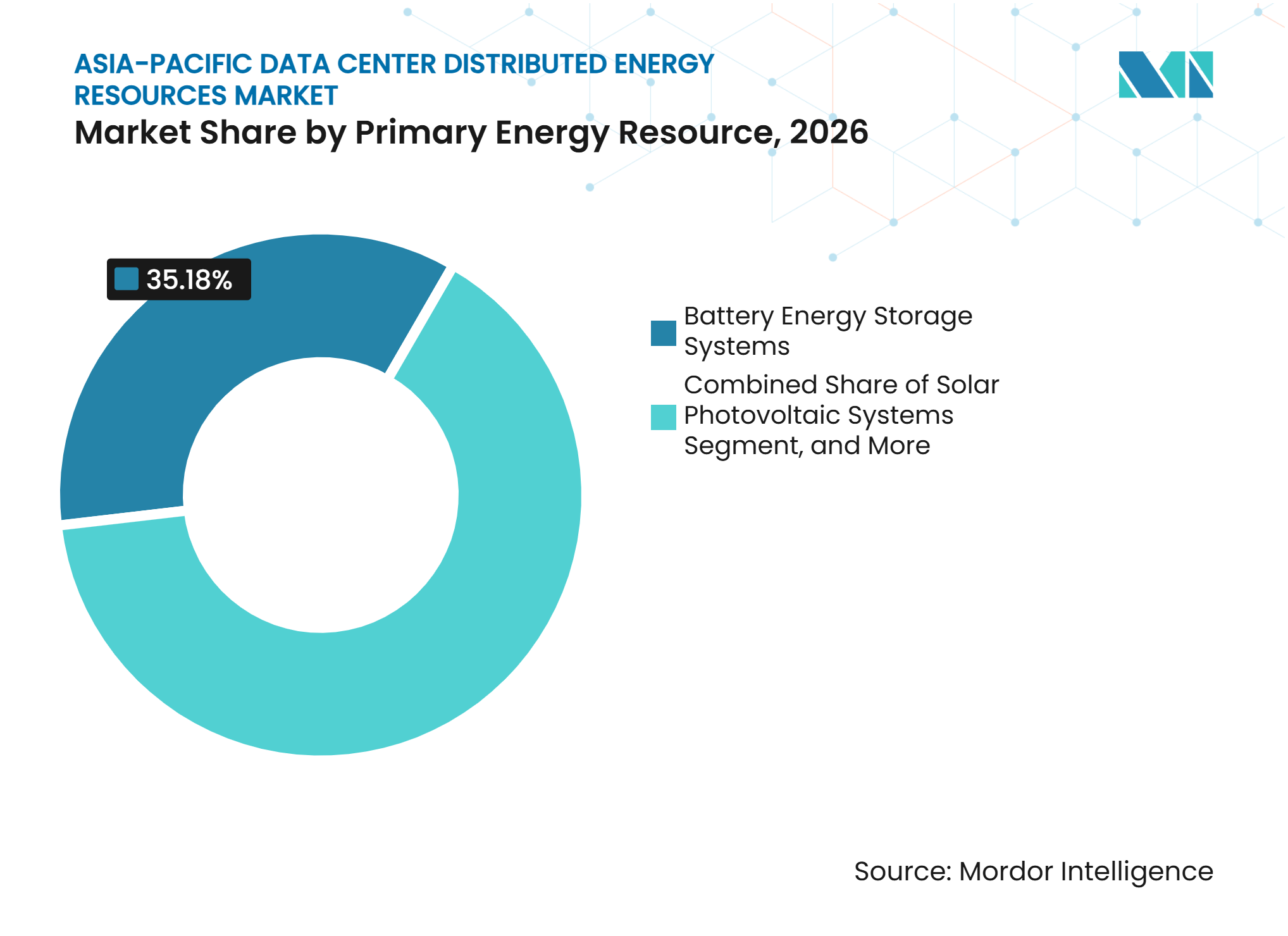
Batteries Lead While Fuel Cells Gain GroundBattery Energy Storage Systems accounted for 35.18% of the Asia-Pacific data center distributed energy resources market in 2026. Batteries serve both as backup equipment and as fast-response assets that maintain voltage and frequency quality during rapid changes in computing load. Their operational flexibility is important in facilities that must protect sensitive servers while managing short spikes in electricity demand. China accounted for 60% of global battery storage additions in 2025, which supports a broad regional supply base for stationary storage equipment. Solar photovoltaic systems remain a complementary resource for campuses with sufficient land or rooftop space. Natural gas and combined heat and power systems remain relevant when rapid access to firm on-site generation is the primary project requirement. The regional supply chain also gives buyers several options across cell technology, power conversion equipment, and energy management software. These factors keep batteries central to the Asia-Pacific data center distributed energy resources market as operators look for systems that can serve multiple functions throughout the asset's life.
Fuel Cells are projected to expand at a 20.04% CAGR through 2032, faster than other primary energy resources. Their principal value is the ability to provide continuous on-site power with a smaller land footprint than some alternatives. Japan and South Korea are natural early markets because fuel infrastructure, operating experience, and policy support are more established. Hitachi and Bloom Energy began a collaboration in Japan in September 2026 after a pilot demonstrated remote output adjustment and scalable multi-unit operation. Fuel cells remain less accessible in India and Southeast Asia, where hydrogen supply and service networks are still developing. The segment will therefore follow different paths across the region rather than displace batteries in every location. Buyers are likely to use fuel cells alongside storage and renewable supply when resilience and site constraints justify the added system cost. This technology mix allows data center operators to match power equipment with the reliability needs of each campus.



By System Configuration:
Hybrid Systems Lead While VPP Connections Create New Revenue PathsHybrid Distributed Energy Systems accounted for 56.21% of the Asia-Pacific data center distributed energy resources market share in 2026. Large AI facilities need more than one power source because no single technology can consistently deliver resilience, lower emissions, fast response, and cost management. A hybrid design can combine renewable generation, batteries, fuel cells, conventional backup units, and control software. This configuration also gives operators more flexibility when local grid conditions or fuel availability change. The Ulanqab project in Inner Mongolia illustrates how renewable generation, storage, and data center load can be coordinated under a direct-connection model. Hybrid systems are especially relevant for campuses above 100 MW because outage risk and grid exposure increase with scale. The Asia-Pacific data center distributed energy resources market is likely to retain this configuration as the leading option because it allows for phased expansion without redesigning the entire power system. It also offers room to add new resources as policy and commercial conditions evolve.
Virtual Power Plant-Connected Resources are expected to expand at a 20.68% CAGR through 2032. A virtual power plant connection enables storage and flexible demand to respond to external grid signals in addition to serving the data center. Singapore’s SP Group launched a virtual power plant platform in 2025 to aggregate distributed energy resources for ancillary services. Samsung SDS’s Suwon campus is enrolled in Enel X Korea’s demand response virtual power plant program, demonstrating how a large digital site can participate in grid flexibility activities. ISO 50001 is increasingly relevant to energy management programs because it provides a structured basis for monitoring and improving energy use. Once software and controls are installed, an operator can add grid service participation without necessarily adding new battery hardware. This can strengthen the financial case for investments that were initially made for resilience. Suppliers that can provide secure controls, performance data, and market integration will have a stronger position in this part of the regional power equipment landscape.
By Ownership Model:
Data Center-Owned Systems Lead While Energy-as-a-Service Broadens AccessData Center-Owned systems held 57.88% of the 2026 market. Direct ownership gives hyperscale operators control over critical energy assets, including maintenance schedules, power dispatch, carbon accounting, and operating data. This approach can be attractive when a campus has enough scale to justify an internal engineering and procurement capability. Owners can also retain the value created through peak management and grid services where local frameworks allow participation. Renewable projects that combine direct supply with storage can strengthen this control over both reliability and reporting. The Ulanqab green-power project provides an example of a co-located structure that links energy resources with digital load. Direct ownership is likely to remain common among large operators that treat energy infrastructure as a strategic operating asset. It can also support consistent design standards across several campuses in the Asia-Pacific data center distributed energy resources market.
Energy-as-a-Service is projected to expand at a 20.93% CAGR through 2032. This model shifts some upfront capital, technical delivery, and operational responsibilities to a specialist provider. It is particularly relevant for operators in India and Southeast Asia that need complex energy systems but may not want to build an in-house power organization. A service provider can package generation, storage, monitoring, and maintenance into a contract aligned with facility use. This reduces the need to commit capital to every part of a multi-technology installation at the start of a project. It can also help providers standardize equipment across smaller or rapidly expanding sites. The model does not eliminate the need for careful contract design, as power availability, fuel costs, and performance guarantees remain important. Still, it gives the Asia-Pacific data center distributed energy resources market a route to adoption beyond the largest hyperscale buyers. It also creates a role for firms that can finance, operate, and optimize energy assets over long contract periods.
By Primary Application:
Backup Power Leads While Grid Services ExpandBackup Power and Resilience accounted for 36.14% of the 2026 market. Reliable backup remains the core use case because data centers cannot accept extended interruptions to critical computing and storage services. Batteries can provide immediate response while other on-site resources cover longer-duration events. This layered approach is becoming more important as rack density rises and individual power disturbances can affect larger computing loads. The ASEAN sustainable data center guide connects reliable power planning with efficiency and renewable integration across the facility lifecycle. Backup equipment can therefore be designed as part of a broader operating system rather than kept only for emergencies. This supports the transition toward assets that protect uptime and create value in routine operation. The Asia-Pacific data center distributed energy resources market continues to be anchored by resilience, as it is the basic condition for all other applications.
Grid and Ancillary Services are expected to expand at a 20.35% CAGR through 2032. Operators can use batteries and flexible loads to participate in demand response, frequency regulation, and reserve programs where market rules permit. This creates a way to earn or preserve value from equipment that would otherwise remain idle outside an outage. Singapore, Japan, South Korea, and Australia have established programs that make grid flexibility more practical for large energy users. The Enel X Korea case involving Samsung SDS shows that a data center campus can be managed as a dispatchable participant through virtual power plant arrangements. Participation requires dependable controls, accurate metering, and safeguards that keep data center operations ahead of external grid requests. Vendors with integrated dispatch software may have an advantage, as they can coordinate multiple applications within the same battery system. This use case shifts the commercial logic of on-site power from risk mitigation to an asset that can also support operating returns.
By Data Center Size:
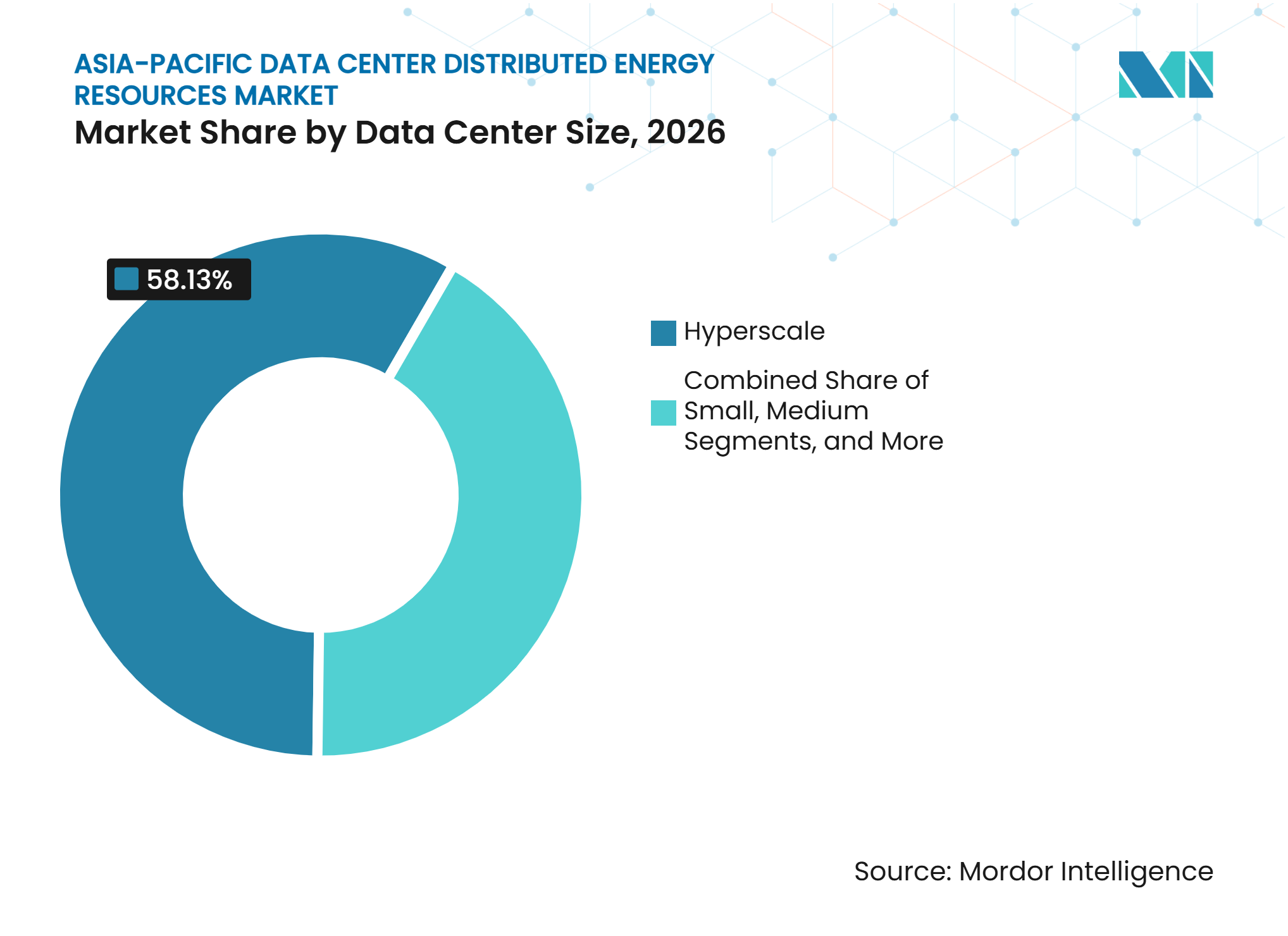
Hyperscale Facilities Drive Volume and ExpansionHyperscale facilities held 58.13% of the 2026 market and are projected to expand at a 21.37% CAGR through 2032. Large campuses concentrate substantial electricity demand in one place, which makes their power procurement comparable to that of a local utility customer. They also have the financial scale to evaluate multi-resource systems and long-term supply agreements. The ASEAN guide notes that rising AI rack density is increasing the importance of resilient and sustainable power design for new data centers. A hyperscale project can support investment in larger storage systems, dedicated renewable contracts, and advanced control platforms. These sites often require a staged power plan that aligns equipment installation with server deployment. The Asia-Pacific data center distributed energy resources market benefits because a single large campus can create demand for multiple technologies and long-term service contracts. The segment is also influential because hyperscalers often set procurement standards that suppliers must meet to serve the broader market.
Medium and large data centers remain important, particularly for colocation providers in India’s secondary cities and across Southeast Asia. Their projects may not require the same scale of generation as a hyperscale campus, but they still need dependable backup and power quality management. Edge facilities create an additional opportunity for modular systems below 10 MW where space and local grid conditions determine technology selection. Factory-built modules can be useful in these settings because they simplify installation and can be added as customer demand rises. Storage suppliers can tailor systems for each load profile rather than apply a uniform design across all facilities. This broadens the customer base beyond the largest cloud operators. It also encourages providers to offer standardized equipment packages with remote monitoring and simpler maintenance requirements. The resulting mix of large campuses and smaller distributed sites supports varied demand within the Asia-Pacific data center distributed energy resources market.

By Data Center Type:
Colocation Leads While Cloud Providers Build New CapacityColocation operators held 67.44% of the 2026 market. These operators serve multiple customers and must demonstrate dependable power capacity to retain existing tenants and attract new ones. Energy-inclusive and lower-carbon lease terms can make onsite distributed energy resources a commercial differentiator. Colocation providers also need to manage mixed tenant load profiles, which increases the value of storage and control systems capable of responding quickly. The ASEAN guide provides a regional framework linking sustainable facility design with resilient power systems and resource efficiency. This framework can help operators compare design choices as customer sustainability requirements become more detailed. Colocation remains central to the Asia-Pacific data center distributed energy resources market because it represents a large installed base with recurring needs for capacity, uptime, and tenant reporting. Many sites can also be upgraded over time as power contracts and customer expectations change.
Cloud Service Providers are projected to expand at a 21.68% CAGR through 2032. Self-built cloud campuses commonly need more complex power systems because their computing loads, operating standards, and growth plans are closely managed by the same organization. These facilities can combine solar, battery storage, fuel cells, and virtual power plant connectivity where site conditions warrant it. Their longer planning horizon can support investments that take time to integrate with renewable procurement and grid services. Large cloud operators are also more likely to seek common technical standards across countries, which raises the importance of proven equipment performance. Hitachi and Bloom Energy’s work in Japan is relevant because it demonstrates a modular on-site power approach for data center use.[2] Cloud campuses may generate higher demand for energy equipment per MW because they combine multiple resources at a single site. This makes them an important source of future project value even though colocation currently has the larger installed base.
Geography Analysis
China: Scale and Policy Support the Largest Regional Position
China accounted for 29.12% of the Asia-Pacific data center distributed energy resources market in 2026. National hub projects are supported by a source-network-load-storage policy approach that encourages coordinated renewable generation, storage, and major digital loads. The Ulanqab green-power direct-connection project reached a 38.74% renewable-energy substitution rate while avoiding 567,000 tonnes of CO₂ annually. China also accounted for 60% of global battery storage additions in 2025, giving developers access to a deep equipment supply base.[3] Developers must still meet local grid, land, and environmental requirements as projects become larger. China remains important because its project pipeline influences regional equipment demand and supplier pricing.
India: Strong Capacity Expansion Supports Faster Demand for Onsite Power
India is projected to expand at a 19.78% CAGR through 2032. Green Open Access rules and the Bureau of Energy Efficiency’s Energy Conservation and Sustainable Building Code 2024 support greater attention to renewable procurement and efficient building design. Hybrid configurations that combine rooftop solar, battery storage, and firm backup are relevant where grid availability differs by location. This supports the Asia-Pacific data center distributed energy resources market by increasing demand for systems that integrate energy supply, controls, and reporting.
Japan, South Korea, Australia, Singapore, and Southeast Asia: Diverse Operating Models Shape Deployment
Japan and South Korea offer early fuel cell opportunities because their gas networks, energy programs, and operating experience are relatively mature. Honda, Tokuyama, and Mitsubishi Corporation launched a 2025 Japanese demonstration that used by-product hydrogen and a stationary fuel cell power station with a capacity of up to 1,000 kW to power a distributed data center. South Korea can support virtual power plants and demand response applications, as evidenced by Samsung SDS’s collaboration with Enel X Korea. TEPCO Holdings signed a 20-year virtual power purchase agreement for up to 10 MW of rooftop solar to support Equinix Singapore in 2025. Across Australia, Singapore, and Southeast Asia, varying land, grid, and regulatory conditions favor adaptable designs that integrate storage, on-site generation, renewable contracts, and grid participation.
Competitive Landscape
Market Concentration
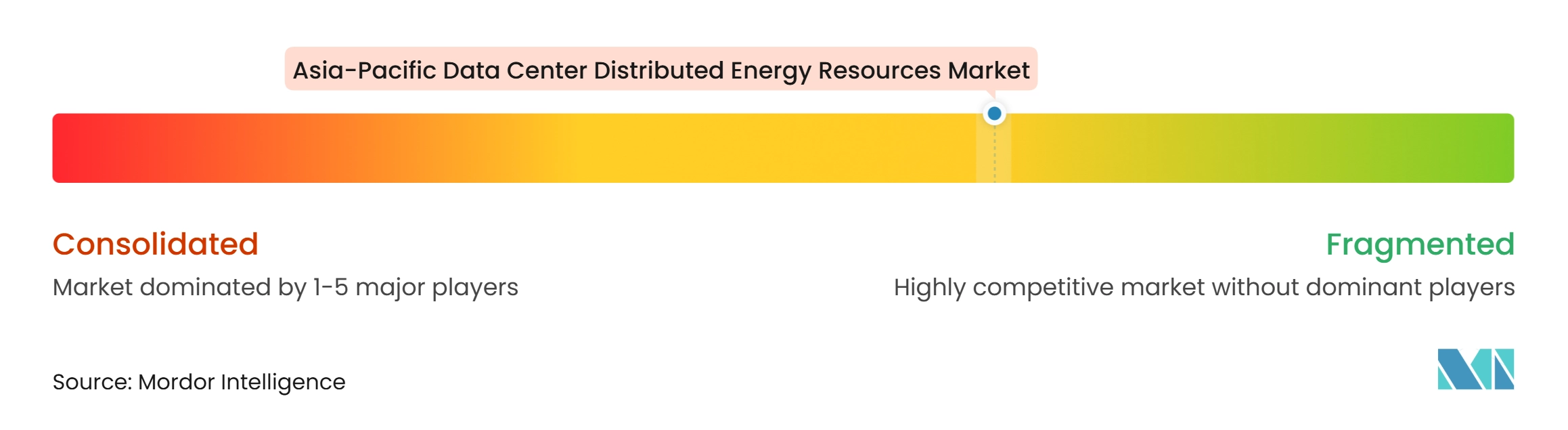
The Asia-Pacific data center distributed energy resources market is moderately fragmented because no vendor leads all major technology categories. Battery storage suppliers compete on manufacturing scale, equipment cost, and delivery schedules, while fuel cell suppliers compete on continuous onsite generation and deployment speed. Buyers commonly select a portfolio of suppliers for a large project because solar, microgrid, and controls providers often partner with technology specialists. Competition is therefore shaped by project needs rather than a single standardized technology choice.
Sungrow and ERS Energy advanced 1 GWh of energy storage deployments across Southeast Asia in September 2026, including projects in Malaysia and the Philippines. The development shows how battery suppliers are extending their regional presence through local project partnerships. Bloom Energy expanded its AI infrastructure partnership with Brookfield to USD 25 billion in June 2026.[4] Bloom Energy also expanded its relationship with Oracle in April 2026, with Oracle intending to procure up to 2.8 GW of fuel cell systems. These agreements show that vendors are seeking long-term customer and financing relationships, not only individual equipment orders.
The Asia-Pacific data center distributed energy resources market has open opportunities in virtual power plant software, multi-technology optimization, and Energy-as-a-Service offerings. NFPA notes that established codes and standards can support safe data center growth as power systems expand. This focus favors suppliers that can provide documented design, safety, and operating practices. Partnerships among equipment makers, power providers, financiers, and data center developers remain important because projects require multiple capabilities simultaneously. Buyers retain bargaining power because a small group of hyperscale firms accounts for a meaningful share of new capacity demand.
Asia-Pacific Data Center Distributed Energy Resources Industry Leaders
-
Bloom Energy Corporation
-
Ballard Power Systems Inc.
-
FuelCell Energy, Inc.
-
Plug Power Inc.
-
Fluence Energy, Inc.
- *Disclaimer: Major Players sorted in no particular order
Asia-Pacific Data Center Distributed Energy Resources Market Companies Covered in this Report
- Bloom Energy Corporation
- Ballard Power Systems Inc.
- FuelCell Energy, Inc.
- Plug Power Inc.
- Doosan Fuel Cell Co., Ltd.
- Ceres Power Holdings plc
- Toshiba Energy Systems and Solutions Corporation
- Fuji Electric Co., Ltd.
- Mitsubishi Electric Corporation
- Delta Electronics, Inc.
- Sungrow Power Supply Co., Ltd.
- Trina Solar Co., Ltd.
- BYD Company Limited
- Fluence Energy, Inc.
- Powin, LLC
- Form Energy, Inc.
- ESS Tech, Inc.
- Redflow Limited
- Energy Vault Holdings, Inc.
- Stem, Inc.
Recent Industry Developments in Asia-Pacific Data Center Distributed Energy Resources Market
- September 2026: Hitachi announced a collaboration with Bloom Energy to deliver onsite solid oxide fuel cell power for data centers in Japan. A pilot at Hitachi’s Omika Works demonstrated remote output adjustment and multi-unit scalability.
- September 2026: Sungrow and ERS Energy achieved a 1 GWh milestone in Southeast Asia BESS deployments. The projects included a 441 MWh facility in Bahau, Malaysia, and a 556 MWh grid-forming BESS for ACEN in the Philippines that was designed to participate in the Wholesale Electricity Spot Market.
- June 2026: Bloom Energy and Brookfield expanded their AI infrastructure financing framework fivefold to USD 25 billion. The framework targets global fuel cell deployment for AI data centers under Brookfield’s USD 100 billion AI Infrastructure Fund.
- April 2026: Bloom Energy and Oracle expanded their strategic partnership. Oracle intends to procure up to 2.8 GW of fuel cell systems, with an initial 1.2 GW contracted for its global AI and cloud computing infrastructure build-out.
Asia-Pacific Data Center Distributed Energy Resources Market Report Scope
The Asia-Pacific Data Center Distributed Energy Resources Market comprises distributed energy technologies and energy management systems deployed across data centers in China, Japan, India, Australia, Singapore, South Korea, and the rest of Asia-Pacific. These solutions support increasing power requirements from AI, cloud, and hyperscale workloads while enabling renewable energy integration, grid-interactive operations, demand-response participation, peak-load management, resilience enhancement, and long-term sustainability objectives.
The Asia-Pacific Data Center Distributed Energy Resources Market Report is Segmented by Primary Energy Resource (Solar Photovoltaic Systems, Battery Energy Storage Systems, Fuel Cells, Natural Gas and Other Onsite Generation, Combined Heat and Power Systems, and Other Distributed Energy Resources), System Configuration (Standalone Distributed Energy Resources, Hybrid Distributed Energy Systems, Integrated Microgrids, and Virtual Power Plant-Connected Resources), Ownership Model (Data Center-Owned, Utility-Owned, Third-Party-Owned, and Energy-as-a-Service [EaaS]), Primary Application (Backup Power and Resilience, Energy Cost Optimization, Peak Shaving and Load Shifting, Renewable Energy Integration, Demand Response, and Grid and Ancillary Services), Data Center Size (Small, Medium, Large, and Hyperscale), Data Center Type (Colocation, Cloud Service Providers [CSPs], and Enterprise and Edge), and Geography (China, Japan, India, Australia, Singapore, South Korea, and Rest of Asia-Pacific). The Market Forecasts are Provided in Terms of Value (USD).
Segmentation Overview
| Solar Photovoltaic Systems |
| Battery Energy Storage Systems |
| Fuel Cells |
| Natural Gas and Other Onsite Generation |
| Combined Heat and Power Systems |
| Other Distributed Energy Resources |
| Standalone Distributed Energy Resources |
| Hybrid Distributed Energy Systems |
| Integrated Microgrids |
| Virtual Power Plant-Connected Resources |
| Data Center-Owned |
| Utility-Owned |
| Third-Party-Owned |
| Energy-as-a-Service (EaaS) |
| Backup Power and Resilience |
| Energy Cost Optimization |
| Peak Shaving and Load Shifting |
| Renewable Energy Integration |
| Demand Response |
| Grid and Ancillary Services |
| Small |
| Medium |
| Large |
| Hyperscale |
| Colocation |
| Cloud Service Providers (CSPs) |
| Enterprise and Edge |
| China |
| Japan |
| India |
| Australia |
| Singapore |
| South Korea |
| Rest of Asia-Pacific |
| By Primary Energy Resource | Solar Photovoltaic Systems |
| Battery Energy Storage Systems | |
| Fuel Cells | |
| Natural Gas and Other Onsite Generation | |
| Combined Heat and Power Systems | |
| Other Distributed Energy Resources | |
| By System Configuration | Standalone Distributed Energy Resources |
| Hybrid Distributed Energy Systems | |
| Integrated Microgrids | |
| Virtual Power Plant-Connected Resources | |
| By Ownership Model | Data Center-Owned |
| Utility-Owned | |
| Third-Party-Owned | |
| Energy-as-a-Service (EaaS) | |
| By Primary Application | Backup Power and Resilience |
| Energy Cost Optimization | |
| Peak Shaving and Load Shifting | |
| Renewable Energy Integration | |
| Demand Response | |
| Grid and Ancillary Services | |
| By Data Center Size | Small |
| Medium | |
| Large | |
| Hyperscale | |
| By Data Center Type | Colocation |
| Cloud Service Providers (CSPs) | |
| Enterprise and Edge | |
| By Geography | China |
| Japan | |
| India | |
| Australia | |
| Singapore | |
| South Korea | |
| Rest of Asia-Pacific |
Key Questions Answered in the Report
What is the size of the Asia-Pacific data center distributed energy resources market?
The market is valued at USD 6.87 billion in 2026 and is forecast to reach USD 19.68 billion by 2032, expanding at a 19.26% CAGR from 2027.
What is driving onsite energy investment at Asia-Pacific data centers?
Higher AI rack densities, grid constraints, renewable commitments, and the need for uninterrupted operations are increasing demand for integrated onsite power systems.
Which energy resource leads data center distributed energy resources deployment in Asia-Pacific?
Battery Energy Storage Systems lead with 35.18% share in 2026 because they support backup power, power quality, and peak demand management.
Why are fuel cells gaining attention for data center power?
Fuel Cells are projected to expand at a 20.04% CAGR through 2032 because they can provide firm onsite power with a compact footprint in suitable fuel supply locations.
Which data center customers create the strongest demand for distributed energy resources?
Colocation operators hold 67.44% of 2026 demand, while Cloud Service Providers are projected to expand fastest at a 21.68% CAGR through 2032.
Which country has the largest regional position?
China holds 29.12% share in 2026, supported by integrated renewable and storage policy structures and a large battery supply base.