
Asia-Pacific Data Center Disaster Recovery Infrastructure Market Size and Share
Market Overview
| Study Period | 2021 - 2032 |
|---|---|
| Forecast Data Period | 2027 - 2032 |
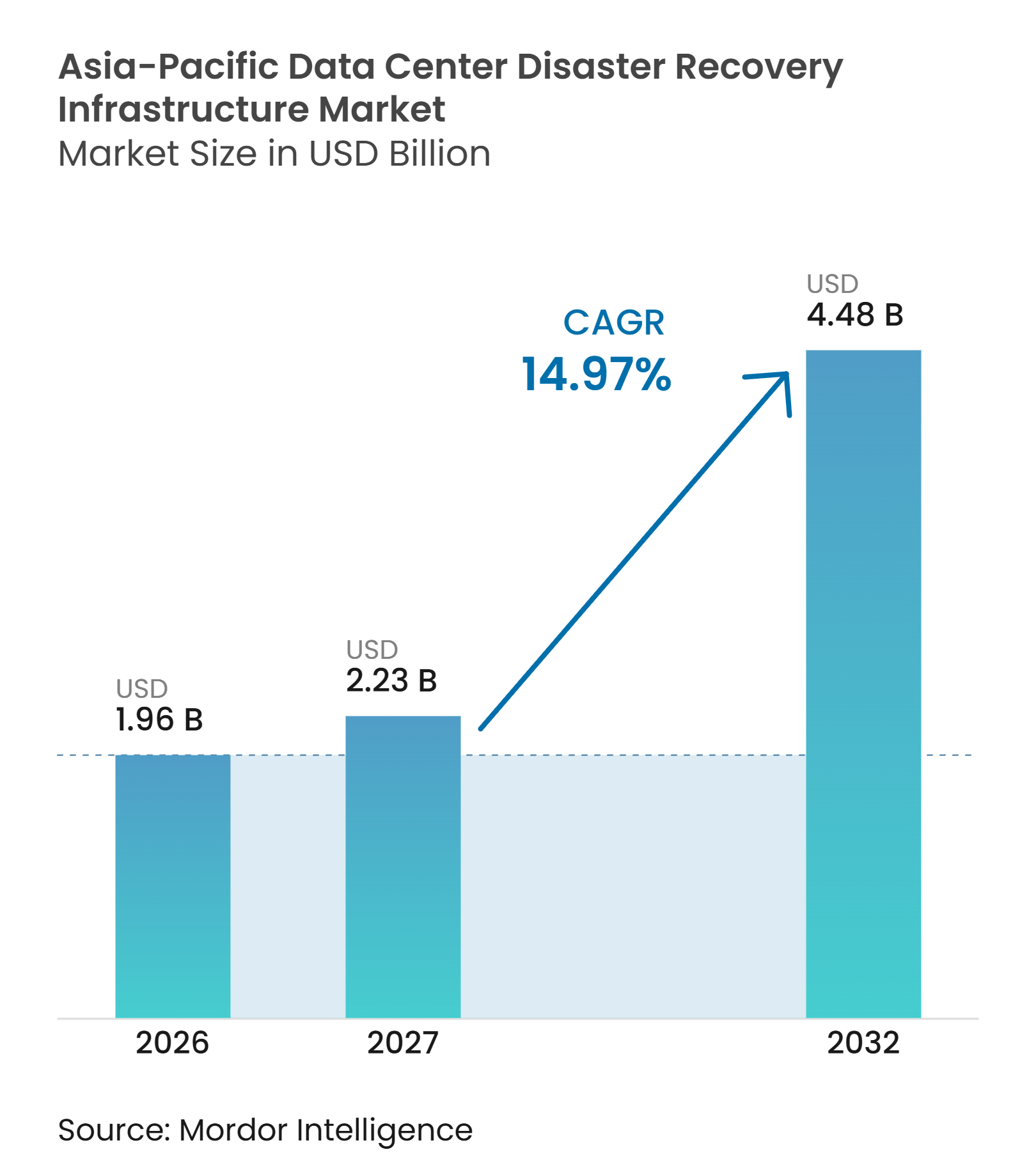
| Base Year Market Size (2026) | USD 1.96 Billion |
| Market Size (2027) | USD 2.23 Billion |
| Market Size (2032) | USD 4.48 Billion |
| Growth Rate (2027 - 2032) | 14.97 % |
| Market Concentration | Medium |
Major Players *Disclaimer: Major Players sorted in no particular order Image © Mordor Intelligence. Reuse requires attribution under CC BY 4.0. | |
Asia-Pacific Data Center Disaster Recovery Infrastructure Market Analysis by Mordor Intelligence
The Asia-Pacific data center disaster recovery infrastructure market size is valued at USD 1.96 billion in 2026 and is projected to reach USD 4.48 billion by 2032, expanding at a CAGR of 14.97% from 2027 to 2032. Ransomware exposure, hybrid computing, and new hyperscale capacity are increasing the number of workloads that need tested recovery plans. Enterprises are placing greater weight on immutable backups, recovery automation, and geographically separate recovery environments. Data localization rules are also making domestic recovery capacity more important in large markets such as China and India. Providers that combine in-country infrastructure, automation, and managed operations are positioned to address this demand across the Asia-Pacific data center disaster recovery infrastructure market.
Key Report Takeaways
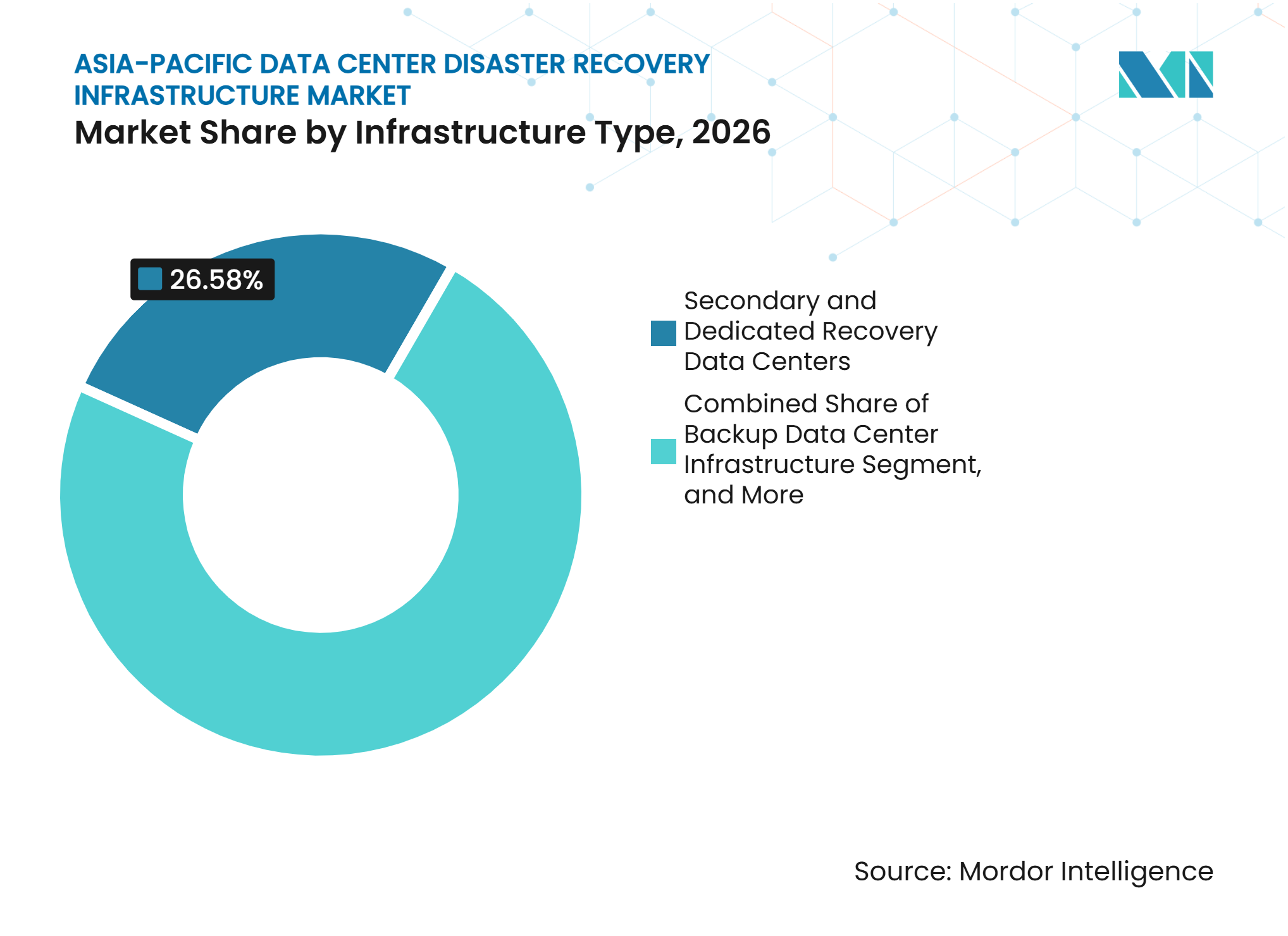
- By infrastructure type, Secondary and Dedicated Recovery Data Centers held 26.58% of the Asia-Pacific data center disaster recovery infrastructure market share in 2026, while Cloud-Based Disaster Recovery Infrastructure is projected to expand at a 15.43% CAGR through 2032.
- By deployment model, On-Premises Disaster Recovery held 29.83% of market share in 2026, while Disaster Recovery-as-a-Service is projected to expand at a 15.52% CAGR through 2032.
- By recovery architecture, Active-Passive held 24.69% of market share in 2026, while Continuous Data Replication is projected to expand at a 15.38% CAGR through 2032.
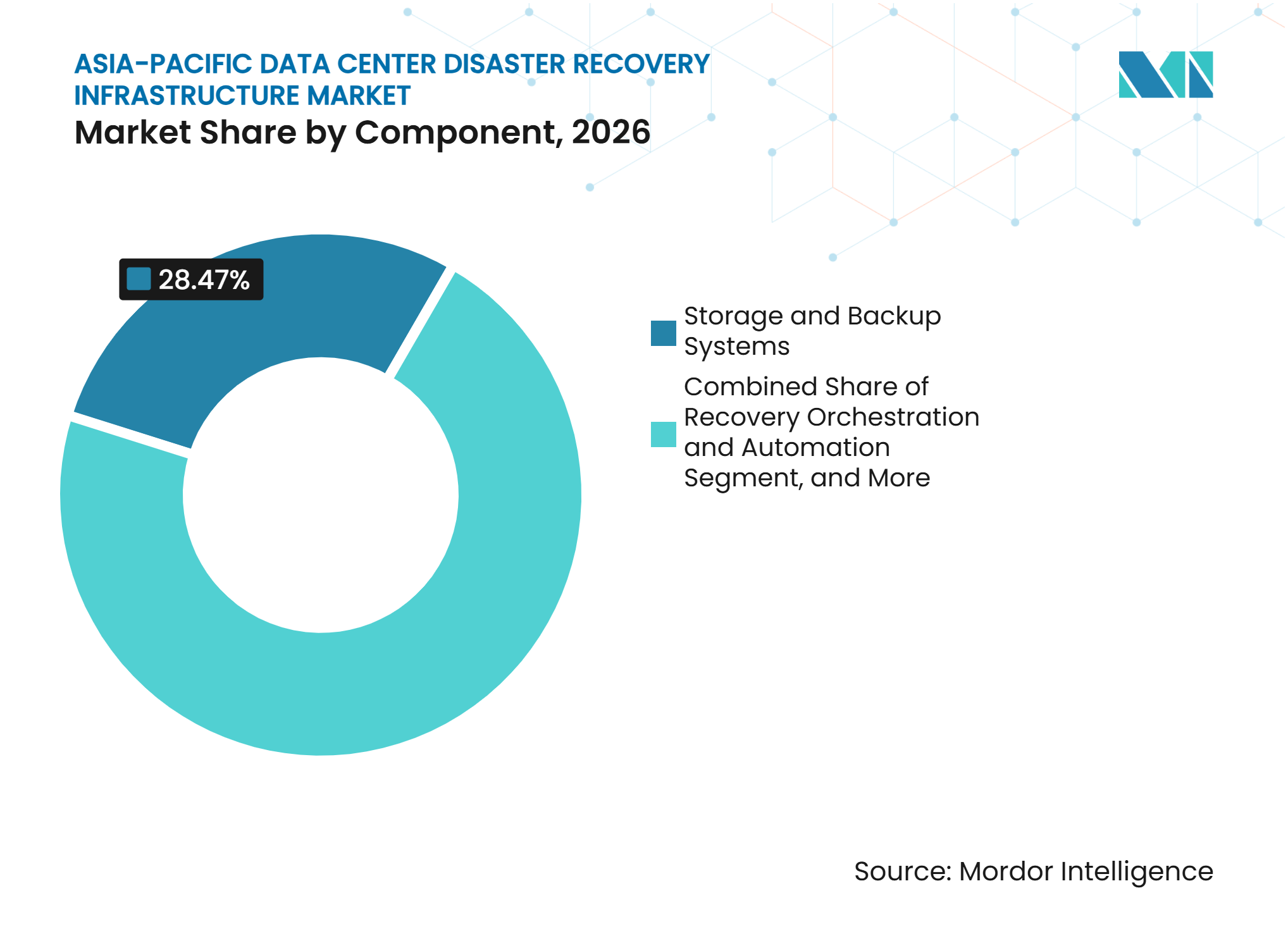
- By component, Storage and Backup Systems held 28.47% of market share in 2026, while Recovery Orchestration and Automation is projected to expand at a 15.46% CAGR through 2032.
- By application, Critical Business Application Recovery held 33.92% of market share in 2026, while Cloud-Native Application Recovery is projected to expand at a 15.56% CAGR through 2032.
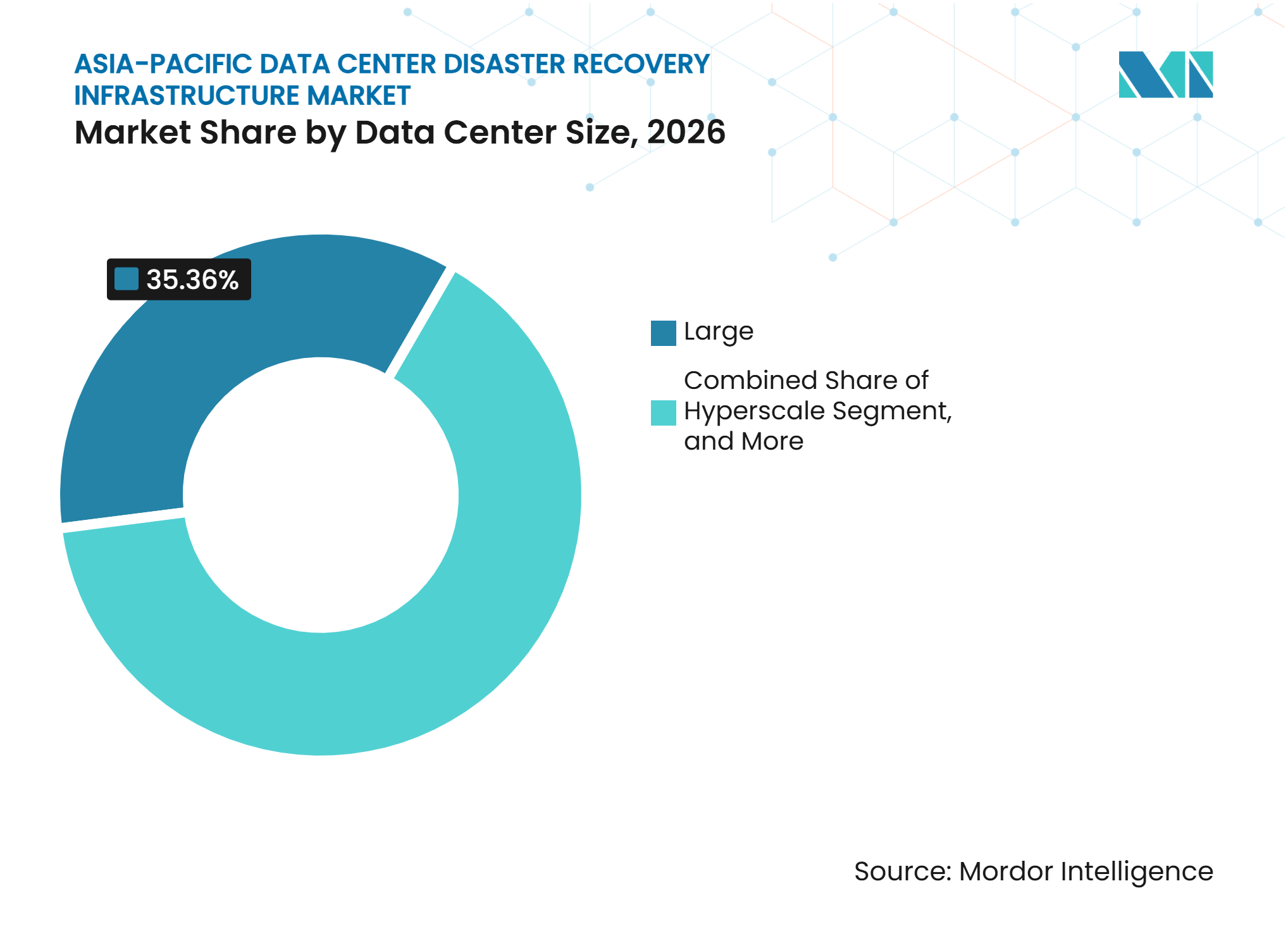
- By data center size, Large Data Center Installations held 35.36% of market share in 2026, while Hyperscale Data Center Installations are projected to expand at a 15.42% CAGR through 2032.
- By data center type, Colocation Data Centers held 44.17% of market share in 2026, while Cloud Service Providers are projected to expand at a 15.48% CAGR through 2032.
- By geography, China held 41.24% of market share in 2026, while India is projected to expand at a 15.54% CAGR through 2032.
Note: Market numbers in this report are based on Mordor Intelligence's proprietary estimation framework, which combines nine months of actuals with Q4 projections for base year 2026.
Market Trends and Insights
Drivers Impact Analysis of Asia-Pacific Data Center Disaster Recovery Infrastructure Market*
| Driver | (~) % Impact on CAGR Forecast | Geographic Relevance | Impact Timeline |
|---|---|---|---|
| Rising Ransomware and Cyberattack Exposure | +2.5% | Global, with concentration in China, India, Japan, Australia, and South Korea | Short term (≤ 2 years) |
| Accelerating Cloud and Hybrid IT Adoption | +2.0% | China, India, Australia, Japan, and Southeast Asia | Medium term (2-4 years) |
| Expansion of Hyperscale and Regional Data Center Capacity | +1.8% | Malaysia, India, Australia, Japan, South Korea, Indonesia, and Vietnam | Medium term (2-4 years) |
| Tightening Operational Resilience and Data Protection Requirements | +1.5% | Singapore, Australia, India, Japan, and South Korea | Medium term (2-4 years) |
| Increasing Need for Geo-Distributed Recovery Across Hazard Zones | +1.2% | Japan, the Philippines, Indonesia, Bangladesh, and Pacific Island nations | Long term (≥ 4 years) |
| Recovery Automation for AI and Data-Intensive Workloads | +1.0% | China, India, Japan, and South Korea | Long term (≥ 4 years) |
| Source: Mordor Intelligence | |||
Rising Ransomware and Cyberattack Exposure
ThreatBook recorded 4,068 ransomware incidents among 15,205 security incidents analyzed across Asia-Pacific from June 2025 to June 2026. It also reported that 57% of initial ransom payments exceeded USD 1 million, illustrating the financial exposure associated with a successful attack. Organizations can no longer treat recovery as a process that begins after an outage, because attackers often target backup repositories and management systems. This is raising demand for immutable copies, isolated recovery environments, and clean recovery points that can be verified before systems are restored. The Asia-Pacific data center disaster recovery infrastructure market is therefore moving toward recovery designs that connect cyber detection with backup, replication, and failover procedures. This change also makes recovery testing a recurring operational requirement rather than an annual exercise.
Accelerating Cloud and Hybrid IT Adoption
Hybrid environments require recovery plans that can protect workloads across private infrastructure, public cloud platforms, and edge locations. Broadcom found that 94% of surveyed enterprises in Asia-Pacific and Japan used an intentional mix of public and private clouds, while 67% were considering workload repatriation from public cloud. Repatriation can create recovery gaps because replication policies, recovery priorities, and network paths must be redesigned when workloads move. Broadcom also reported that 88% of surveyed organizations trusted private cloud for security and compliance, supporting continued use of controlled infrastructure for sensitive systems. The Asia-Pacific data center disaster recovery infrastructure market benefits when enterprises need a single recovery policy across several operating environments. Vendors that simplify orchestration across cloud and on-premises systems can reduce the manual work that complicates these deployments.
Expansion of Hyperscale and Regional Data Center Capacity
New data center campuses create more production workloads, but they also create demand for separate capacity that can support recovery. Digital Edge committed USD 4.5 billion to develop its 500 MW CGK Campus in Bekasi, Indonesia, with its first phase scheduled for Q4 2026. The campus is designed as a carrier-neutral hub that can support the connectivity required for recovery traffic between sites. Vantage Data Centers completed a USD 1.6 billion equity investment in its Asia-Pacific platform and closed its acquisition of Yondr Group's 300 MW-plus campus in Johor in November 2025. Such multi-site platforms can make it easier for enterprises to deploy regional recovery plans rather than relying solely on a central hub. This regional buildout broadens the choices available for low-latency replication and domestic recovery capacity.
Tightening Operational Resilience and Data Protection Requirements
Operational resilience rules are pushing enterprises to document, test, and govern recovery procedures more closely. Australia's Prudential Standard CPS 230 applies to regulated financial firms and places greater emphasis on service continuity, material service providers, and operational risk controls.[1] The Australian Cyber Security Act also introduced a ransomware payment reporting obligation, strengthening management attention on cyber incident preparedness. In India, the Reserve Bank of India requires payment system data to be stored only in India, which supports demand for domestic backup and recovery capacity. These requirements make recovery architecture a compliance matter as well as a technology purchase. The Asia-Pacific data center disaster recovery infrastructure industry is consequently seeing greater interest in tested, auditable recovery services.
Restraints Impact Analysis of Asia-Pacific Data Center Disaster Recovery Infrastructure Market*
| Restraint | (~) % Impact on CAGR Forecast | Geographic Relevance | Impact Timeline |
|---|---|---|---|
| High Power, Cooling, Bandwidth, and Secondary-Site Costs | -1.5% | Global, with greater impact in emerging Asia-Pacific markets | Long term (≥ 4 years) |
| Fragmented Data Residency and Cross-Border Replication Rules | -1.2% | China, India, and Southeast Asia | Medium term (2-4 years) |
| Shortage of Multicloud Recovery Engineering Skills | -0.8% | Global, with greater impact in emerging Asia-Pacific economies | Medium term (2-4 years) |
| Incomplete Composite-Failure Testing Across Power, Network, and Cloud Dependencies | -0.5% | Global, with elevated exposure in Japan, the Philippines, and other high-hazard areas | Long term (≥ 4 years) |
| Source: Mordor Intelligence | |||
High Power, Cooling, Bandwidth, and Secondary-Site Costs
A secondary site requires power, cooling, connectivity, hardware, and ongoing testing even when it is not handling production workloads. These costs can be difficult for mid-sized enterprises, particularly where grid capacity and high-quality connectivity are constrained. Digital Edge's planned Indonesian campus targets a power usage effectiveness of 1.25, underscoring how power efficiency has become important to the economics of new capacity. Cross-site replication also requires sufficient bandwidth, especially when organizations seek low recovery point objectives. This pressure supports managed recovery models, which can convert infrastructure costs into recurring service charges. It can still limit adoption of active-active designs among buyers whose recovery requirements do not justify continuous duplicate capacity.
Fragmented Data Residency and Cross-Border Replication Rules
Data residency rules can limit the locations where an enterprise stores or replicates sensitive workloads. China's Cybersecurity Law, Data Security Law, and Personal Information Protection Law set rules for the handling and cross-border transfer of data. India's payment data localization requirement similarly restricts the operating choices available to affected payment system providers. Indonesia's Personal Data Protection Law provides a further national framework for personal data processing and cross-border transfers. The resulting mix of rules can require separate recovery topologies, separate contracts, and local operational support. It can also delay deployment where legal and technical assessments are not coordinated early.
*Our forecasts treat driver/restraint impacts as directional, not additive. The impact forecasts reflect baseline growth, mix effects, and variable interactions.
Asia-Pacific Data Center Disaster Recovery Infrastructure Market Segment Analysis
By Infrastructure Type:
Cloud-Based Recovery Scales While Dedicated Sites Remain RelevantSecondary and Dedicated Recovery Data Centers held 26.58% of the Asia-Pacific data center disaster recovery infrastructure market share in 2026. Financial services, public agencies, and utilities use dedicated facilities when they need predictable recovery performance and direct control over sensitive workloads. Domestic physical separation can also support compliance where offshore replication is restricted. Cloud-Based Disaster Recovery Infrastructure is projected to expand at a 15.43% CAGR through 2032 as enterprises avoid building additional recovery campuses.
Cloud recovery lets organizations use geographically separated availability zones without procuring every element of a secondary site. AWS expanded Elastic Disaster Recovery to Bangkok, Malaysia, New Zealand, and Taipei in July 2026, widening the regional coverage available for cloud-based recovery.[2] Replication and data protection tools are also moving from periodic backups toward continuous replication. The Asia-Pacific data center disaster recovery infrastructure market will continue to support both models because localization rules and application criticality differ by workload.



By Deployment Model:
Managed Recovery Changes Enterprise Cost StructuresOn-Premises Disaster Recovery held 29.83% of regional spending in 2026. Regulated enterprises in China and India continue to maintain direct control, with application data required to remain within national boundaries. On-premises recovery also provides predictable control over network configuration, security policies, and hardware performance. Disaster Recovery-as-a-Service is projected to expand at a 15.52% CAGR through 2032 as more buyers prefer recurring service charges over dedicated recovery-site capital spending.
Wipro and Rubrik launched Enterprise Resilience as a Service in August 2026, combining managed services with Rubrik's cyber and data resilience platform. Local cloud capacity is also helping providers address data-residency concerns. Veeam launched Veeam Data Cloud in Indonesia in September 2025 on Microsoft Azure, offering locally hosted Microsoft 365 backup and recovery. These offerings preserve a managed model while placing recovery data within the required jurisdiction.
By Recovery Architecture:
Continuous Replication Raises Recovery ExpectationsActive-Passive architectures held 24.69% of market share in 2026 because a standby environment offers a practical balance between resilience and cost. This model remains suitable for enterprises that can tolerate a defined recovery interval and do not need identical production capacity at both sites. Existing staff practices and service agreements also support continued use of active-passive configurations. Continuous Data Replication is projected to expand at a 15.38% CAGR through 2032 as financial, trading, and AI workloads require more current data copies.
SmartX released ECP 6.3 in April 2026, with native synchronous replication at RPO for hyperconverged infrastructure. Active-active configurations can reduce interruption for high-value services, but their duplicate capacity and operational complexity remain significant. South Korea's government program includes active-active recovery for 13 critical information systems, showing where the architecture is most justified. The Asia-Pacific data center disaster recovery infrastructure industry therefore retains several architectures rather than uniformly adopting a single topology.
By Component:
Automation Gains Weight Alongside Backup StorageStorage and Backup Systems held 28.47% of component spending in 2026, making them the leading component category. Immutable and isolated backup repositories are important because ransomware can affect both production data and accessible backups. Cyber-resilient storage is becoming a basic requirement for workloads that cannot tolerate data loss. Recovery Orchestration and Automation is projected to expand at a 15.46% CAGR through 2032 as enterprises reduce dependence on manual failover runbooks.
Arcserve Japan announced its Cyber Resilient Storage lineup in September 2025 for cloud and on-premises workloads. Synology introduced the DP7200 in May 2025 with support for 150,000 workloads across 2,500 sites, including immutable backup and multifactor authentication controls. Automation can sequence technical recovery steps, confirm dependencies, and provide an audit trail after an event. This makes orchestration a more strategic part of purchasing decisions in the Asia-Pacific data center disaster recovery infrastructure market.

By Application:
Cloud-Native Workloads Outpace Legacy Recovery NeedsCritical Business Application Recovery held 33.92% of application spending in 2026. Banks, telecommunications providers, governments, and manufacturers prioritize applications with contractual, regulatory, or public-service continuity requirements. These workloads commonly have explicit recovery time objectives, which makes their demand more consistent. Cloud-Native Application Recovery is projected to expand at a 15.56% CAGR through 2032 as containerized services become more common.
Cloud-native applications require recovery plans that preserve containers, persistent volumes, configuration states, and service relationships. Arcfra released Kubernetes Engine 1.5 in November 2025 with cross-site active-active disaster recovery and real-time synchronization for containerized workloads. Traditional virtual-machine recovery tools remain important because VMware and Hyper-V estates are still extensive across the region. The fastest growth is likely to come from tools that cover both established virtual machines and newer cloud-native application layers.
By Data Center Size:
Hyperscale Facilities Extend the Recovery FootprintLarge Data Center Installations held 35.36% of regional spending in 2026. These 10-100 MW campuses support financial institutions, public cloud, telecommunications, and enterprise recovery operations. Their scale allows organizations to maintain dedicated power, cooling, connectivity, and operational staff for recovery. Hyperscale Data Center Installations are projected to expand at a 15.42% CAGR through 2032 as global operators extend regional capacity.
Large platforms can bring more native recovery services closer to enterprise workloads. Vantage's Asia-Pacific platform reached 1 GW of operational and planned IT capacity after its 2025 investment and Johor acquisition. Smaller facilities remain relevant for edge workloads in manufacturing, health care, and retail where long network paths can impede recovery. The regional opportunity therefore includes both centralized hyperscale recovery and distributed local recovery nodes.
By Data Center Type:
Colocation Leads While Cloud Providers Grow FasterColocation Data Centers held 44.17% of regional spending in 2026. They offer physical separation from a customer's primary site, carrier-neutral connectivity, and managed power and cooling. This model is useful where a company needs a domestic secondary location without owning a second campus. Cloud Service Providers are projected to expand at a 15.48% CAGR through 2032 as more enterprises adopt hyperscaler-native recovery services.
AWS Elastic Disaster Recovery became available in 36 regions after its July 2026 expansion, including the new Asia-Pacific locations. Colocation providers still serve applications that need physical isolation, specialized connectivity, or country-specific data control. Enterprise and edge data centers also remain important for workloads that require local recovery due to latency or operational technology requirements. The Asia-Pacific data center disaster recovery infrastructure market has room for these models, as they address diverse service and compliance needs.
Geography Analysis
China: Domestic Infrastructure Supports the Largest Regional Base
China accounted for 41.24% of the Asia-Pacific data center disaster recovery infrastructure market in 2026. Its position reflects a large base of critical infrastructure operators, extensive domestic capacity, and rules favoring local handling of sensitive data. The Cybersecurity Law, Data Security Law, and Personal Information Protection Law influence cross-border data transfers and recovery-site choices. Information2 launched i2Backup V9 in June 2025 and reported a petabyte-scale deployment at the Industrial and Commercial Bank of China with cross-domain replication and multi-site redundancy.[3] The China segment will remain centered on sovereign recovery capacity, domestic vendor support, and a mix of active-active and active-passive architectures.
India: Threat Exposure and Localization Drive Rapid Adoption
India is projected to expand at a 15.54% CAGR through 2032, the fastest geographic rate in the Asia-Pacific data center disaster recovery infrastructure market. The Reserve Bank of India requires payment-system data to be stored in India, supporting local backup, replication, and recovery capacity. A June 2026 fire at a New Delhi data center damaged operations and affected multiple customers, showing the consequences of inadequate site resilience and recovery readiness. The India Digital Personal Data Protection Act is another compliance factor, and the strongest opportunity is for services that combine recovery testing, domestic data control, and cyber resilience.
Japan, South Korea, Australia, and Rest of Asia-Pacific: Resilience Spending Broadens Beyond Core Markets
Japan's mature resilience culture reflects seismic risk, while South Korea is expanding public-sector recovery capacity after a 2025 government data center disruption. Hitachi, Hitachi Vantara, and NTT Docomo Business demonstrated automated recovery across sites more than 600 km apart in August 2026, with business resuming in 10 minutes. South Korea announced a KRW 300 billion (USD 210 million) national program for 693 government information systems in February 2026. Australia is shaped by CPS 230, IRAP assessments, and ransomware payment reporting, while Indonesia, Malaysia, the Philippines, and Vietnam gain potential from new local rules and capacity. Digital Edge's 500 MW Bekasi project provides an emerging infrastructure anchor for Indonesian recovery deployments.
Competitive Landscape
Market Concentration
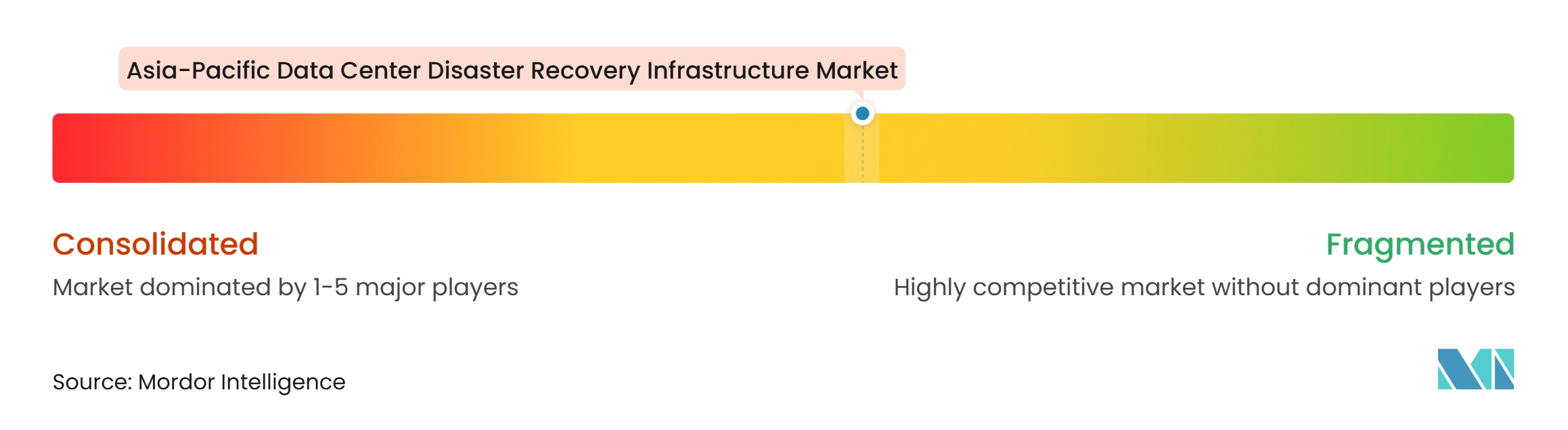
The Asia-Pacific data center disaster recovery infrastructure market is moderately fragmented, and it includes global data protection vendors, infrastructure vendors, cloud providers, and regional systems integrators. Veeam, Commvault, Rubrik, Cohesity, Veritas, and Acronis compete in backup, replication, and cyber recovery. Amazon Web Services, Microsoft, Google, and Oracle bundle recovery functions within cloud platforms. Dell Technologies, Hewlett Packard Enterprise, NetApp, and Broadcom embed them within infrastructure products. NTT DATA, Tata Consultancy Services, HCL Technologies, and Wipro add regional delivery and managed operations for regulated buyers.
Product strategies are moving from backup and restore toward cyber-aware recovery. Commvault launched Cloud Unity in October 2025 with AI-driven Synthetic Recovery to restore clean content across backup points. Rubrik and Wipro launched Enterprise Resilience as a Service in August 2026 to provide continuous management of data, infrastructure, and identity recovery. Veeam's locally hosted Indonesian service demonstrates how in-country cloud capacity can meet data residency requirements.
The largest opportunity is among mid-sized enterprises in Indonesia, the Philippines, Vietnam, and other developing regional markets where cold standby arrangements remain common. Providers that offer a practical path from backup to tested recovery can address buyers that lack in-house recovery skills. Partnerships remain important because local service organizations can provide compliance support and incident response capabilities. Rubrik expanded its cyber recovery services into Australia and New Zealand through a partnership with Harbor Solutions in June 2025.[4] Competition will remain strong because cloud platforms can bundle recovery, while specialist vendors compete through recovery assurance, local support, and clean-copy retention.
Asia-Pacific Data Center Disaster Recovery Infrastructure Industry Leaders
-
Fujitsu Limited
-
NTT DATA Corporation
-
Tata Consultancy Services Limited
-
HCL Technologies Limited
-
Wipro Limited
- *Disclaimer: Major Players sorted in no particular order
Asia-Pacific Data Center Disaster Recovery Infrastructure Market Companies Covered in this Report
- Fujitsu Limited
- NTT DATA Corporation
- Tata Consultancy Services Limited
- HCL Technologies Limited
- Wipro Limited
- Veritas Technologies LLC
- Hewlett Packard Enterprise Company
- Dell Technologies Inc.
- NetApp, Inc.
- International Business Machines Corporation
- Microsoft Corporation
- Amazon Web Services, Inc.
- Google LLC
- Oracle Corporation
- Cisco Systems, Inc.
- Broadcom Inc.
- Veeam Software Group GmbH
- Commvault Systems, Inc.
- Rubrik, Inc.
- Cohesity, Inc.
- Acronis International GmbH
- Huawei Technologies Co., Ltd.
- Rackspace Technology, Inc.
Recent Industry Developments in Asia-Pacific Data Center Disaster Recovery Infrastructure Market
- November 2026: NTT DATA opened its third Jakarta data center, JKT2A, with 12 MW of AI-ready IT capacity and launched APN Connect, an all-photonics network service connecting JKT2 and JKT2A to JKT3 over 35 km, enabling real-time inter-site data synchronization and disaster recovery. The facility is the first to offer IOWN APN-based photonics connectivity in Indonesia, strengthening NTT DATA's ability to serve enterprises with Asia-Pacific disaster recovery obligations from a sovereign Indonesian footprint.
- August 2026: Wipro Limited and Rubrik launched Enterprise Resilience as a Service from Bengaluru, India, combining Wipro's AI-powered WINGS delivery platform with Rubrik's unified cyber and data resilience platform. ERaaS shifts disaster recovery from a periodic, incident-triggered function to a continuously managed, self-optimizing enterprise capability covering data, infrastructure, and identity recovery at scale.
- August 2026: Hitachi, Hitachi Vantara, and NTT Docomo Business announced a fully automated end-to-end system recovery across data centers more than 600 km apart, encompassing operating systems, databases, and applications, with business resumption achieved in 10 minutes using IOWN APN technology and Red Hat OpenShift. The demonstration confirmed production-grade viability for geo-distributed active-passive disaster recovery for critical infrastructure operators across Japan's seismic areas.
- July 2026: Amazon Web Services expanded AWS Elastic Disaster Recovery to six additional regions, including Asia-Pacific Bangkok, Asia-Pacific Malaysia, Asia-Pacific New Zealand, and Asia-Pacific Taipei, bringing total DRS availability to 36 global regions. This expansion reduces the geographic gap in cloud-native disaster recovery coverage across Southeast Asian and Pacific markets.
Asia-Pacific Data Center Disaster Recovery Infrastructure Market Report Scope
The Asia-Pacific Data Center Disaster Recovery Infrastructure Market refers to the collective ecosystem of physical assets, software systems, and network facilities designed to ensure business continuity and data preservation for data centers across Asia-Pacific nations during disruptive events.
The Asia-Pacific Data Center Disaster Recovery Infrastructure Market Report is Segmented by Infrastructure Type (Secondary and Dedicated Recovery Data Centers, Backup Data Center Infrastructure, Replication and Data Protection Infrastructure, Failover and Recovery Orchestration Infrastructure, Backup Storage Infrastructure, Network and Connectivity Infrastructure for Recovery, and Cloud-Based Disaster Recovery Infrastructure), Deployment Model (On-Premises Disaster Recovery, Colocation-Based Recovery, Cloud-Based Disaster Recovery, Hybrid Disaster Recovery, and Disaster Recovery-as-a-Service (DRaaS)), Recovery Architecture (Active-Active, Active-Passive, Warm Standby, Cold Standby, Backup and Restore, and Continuous Data Replication), Component (Compute and Server Infrastructure, Storage and Backup Systems, Data Replication Software, Network and Connectivity Systems, Recovery Orchestration and Automation, and Monitoring, Testing, and Failover Management), Application (Critical Business Application Recovery, Database and Data Platform Recovery, Virtual Machine and Workload Recovery, Cloud-Native Application Recovery, Enterprise IT Recovery, and High-Availability and Continuous Service Restoration), Data Center Size (Small, Medium, Large, and Hyperscale), Data Center Type (Colocation, Cloud Service Providers (CSPs), and Enterprise and Edge), and Geography (China, India, Japan, South Korea, Australia, and Rest of Asia-Pacific). The Market Forecasts are Provided in Terms of Value (USD).
Segmentation Overview
| Secondary and Dedicated Recovery Data Centers |
| Backup Data Center Infrastructure |
| Replication and Data Protection Infrastructure |
| Failover and Recovery Orchestration Infrastructure |
| Backup Storage Infrastructure |
| Network and Connectivity Infrastructure for Recovery |
| Cloud-Based Disaster Recovery Infrastructure |
| On-Premises Disaster Recovery |
| Colocation-Based Recovery |
| Cloud-Based Disaster Recovery |
| Hybrid Disaster Recovery |
| Disaster Recovery-as-a-Service (DRaaS) |
| Active-Active |
| Active-Passive |
| Warm Standby |
| Cold Standby |
| Backup and Restore |
| Continuous Data Replication |
| Compute and Server Infrastructure |
| Storage and Backup Systems |
| Data Replication Software |
| Network and Connectivity Systems |
| Recovery Orchestration and Automation |
| Monitoring, Testing, and Failover Management |
| Critical Business Application Recovery |
| Database and Data Platform Recovery |
| Virtual Machine and Workload Recovery |
| Cloud-Native Application Recovery |
| Enterprise IT Recovery |
| High-Availability and Continuous Service Restoration |
| Small |
| Medium |
| Large |
| Hyperscale |
| Colocation |
| Cloud Service Providers (CSPs) |
| Enterprise and Edge |
| China |
| India |
| Japan |
| South Korea |
| Australia |
| Rest of Asia-Pacific |
| By Infrastructure Type | Secondary and Dedicated Recovery Data Centers |
| Backup Data Center Infrastructure | |
| Replication and Data Protection Infrastructure | |
| Failover and Recovery Orchestration Infrastructure | |
| Backup Storage Infrastructure | |
| Network and Connectivity Infrastructure for Recovery | |
| Cloud-Based Disaster Recovery Infrastructure | |
| By Deployment Model | On-Premises Disaster Recovery |
| Colocation-Based Recovery | |
| Cloud-Based Disaster Recovery | |
| Hybrid Disaster Recovery | |
| Disaster Recovery-as-a-Service (DRaaS) | |
| By Recovery Architecture | Active-Active |
| Active-Passive | |
| Warm Standby | |
| Cold Standby | |
| Backup and Restore | |
| Continuous Data Replication | |
| By Component | Compute and Server Infrastructure |
| Storage and Backup Systems | |
| Data Replication Software | |
| Network and Connectivity Systems | |
| Recovery Orchestration and Automation | |
| Monitoring, Testing, and Failover Management | |
| By Application | Critical Business Application Recovery |
| Database and Data Platform Recovery | |
| Virtual Machine and Workload Recovery | |
| Cloud-Native Application Recovery | |
| Enterprise IT Recovery | |
| High-Availability and Continuous Service Restoration | |
| By Data Center Size | Small |
| Medium | |
| Large | |
| Hyperscale | |
| By Data Center Type | Colocation |
| Cloud Service Providers (CSPs) | |
| Enterprise and Edge | |
| By Geography | China |
| India | |
| Japan | |
| South Korea | |
| Australia | |
| Rest of Asia-Pacific |
Key Questions Answered in the Report
What is the Asia-Pacific data center disaster recovery infrastructure market size?
The Asia-Pacific data center disaster recovery infrastructure market is valued at USD 1.96 billion in 2026 and is projected to reach USD 4.48 billion by 2032, at a 14.97% CAGR from 2027 to 2032.
What is driving demand for disaster recovery infrastructure in Asia-Pacific?
Ransomware exposure, hybrid IT adoption, data-localization requirements, and new hyperscale capacity are increasing demand for tested recovery environments, immutable backups, and recovery automation.
Which infrastructure type leads spending in this sector?
Secondary and Dedicated Recovery Data Centers lead with 26.58% share in 2026, reflecting demand for controlled, physically separate facilities for regulated and critical workloads.
Why is disaster recovery-as-a-service expanding in Asia-Pacific?
Disaster Recovery-as-a-Service is projected to grow at 15.52% CAGR through 2032 because it can reduce the capital and operating burden of maintaining a secondary site.
Which country has the largest regional position?
China holds 41.24% share in 2026, supported by domestic data requirements, critical infrastructure demand, and a large domestic data center base.
Which geography is expected to grow fastest through 2032?
India is projected to grow at 15.54% CAGR through 2032, supported by rising cyber risk, local data requirements, and data center construction.