
Asia-Pacific Data Center Cyber-Physical Security Market Size and Share
Market Overview
| Study Period | 2021 - 2032 |
|---|---|
| Forecast Data Period | 2027 - 2032 |
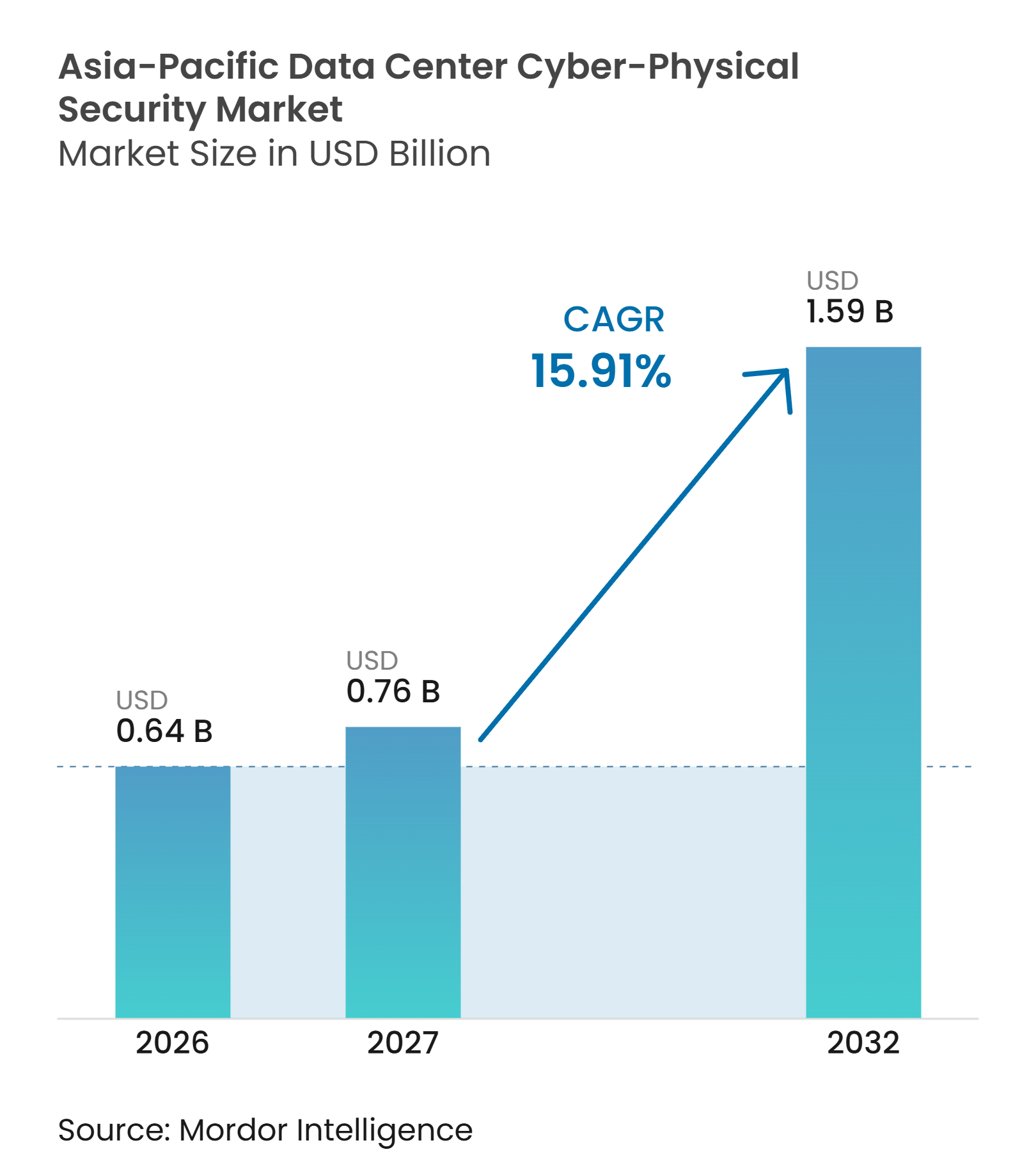
| Base Year Market Size (2026) | USD 0.64 Billion |
| Market Size (2027) | USD 0.76 Billion |
| Market Size (2032) | USD 1.59 Billion |
| Growth Rate (2027 - 2032) | 15.91 % |
| Market Concentration | Medium |
Major Players *Disclaimer: Major Players sorted in no particular order Image © Mordor Intelligence. Reuse requires attribution under CC BY 4.0. | |
Asia-Pacific Data Center Cyber-Physical Security Market Analysis by Mordor Intelligence
The Asia-Pacific data center cyber-physical security market size is projected to expand from USD 0.64 billion in 2026 and USD 0.76 billion in 2027 to USD 1.59 billion by 2032, registering a CAGR of 15.91% between 2027 and 2032. The Asia-Pacific data center cyber-physical security market is being shaped by a large regional construction pipeline and tighter operating requirements for critical facilities. Security is increasingly specified at the design stage for hyperscale facilities, rather than purchased as a discretionary site upgrade. Data localization rules also make documented access controls, incident records, and secure onshore infrastructure more important for operators. AI deployments raise the value concentrated in each rack and increase the consequences of tampering, theft, and insider misuse. Vendors that combine physical controls, operational technology visibility, and centralized management are better placed to serve distributed regional campuses.
Key Report Takeaways
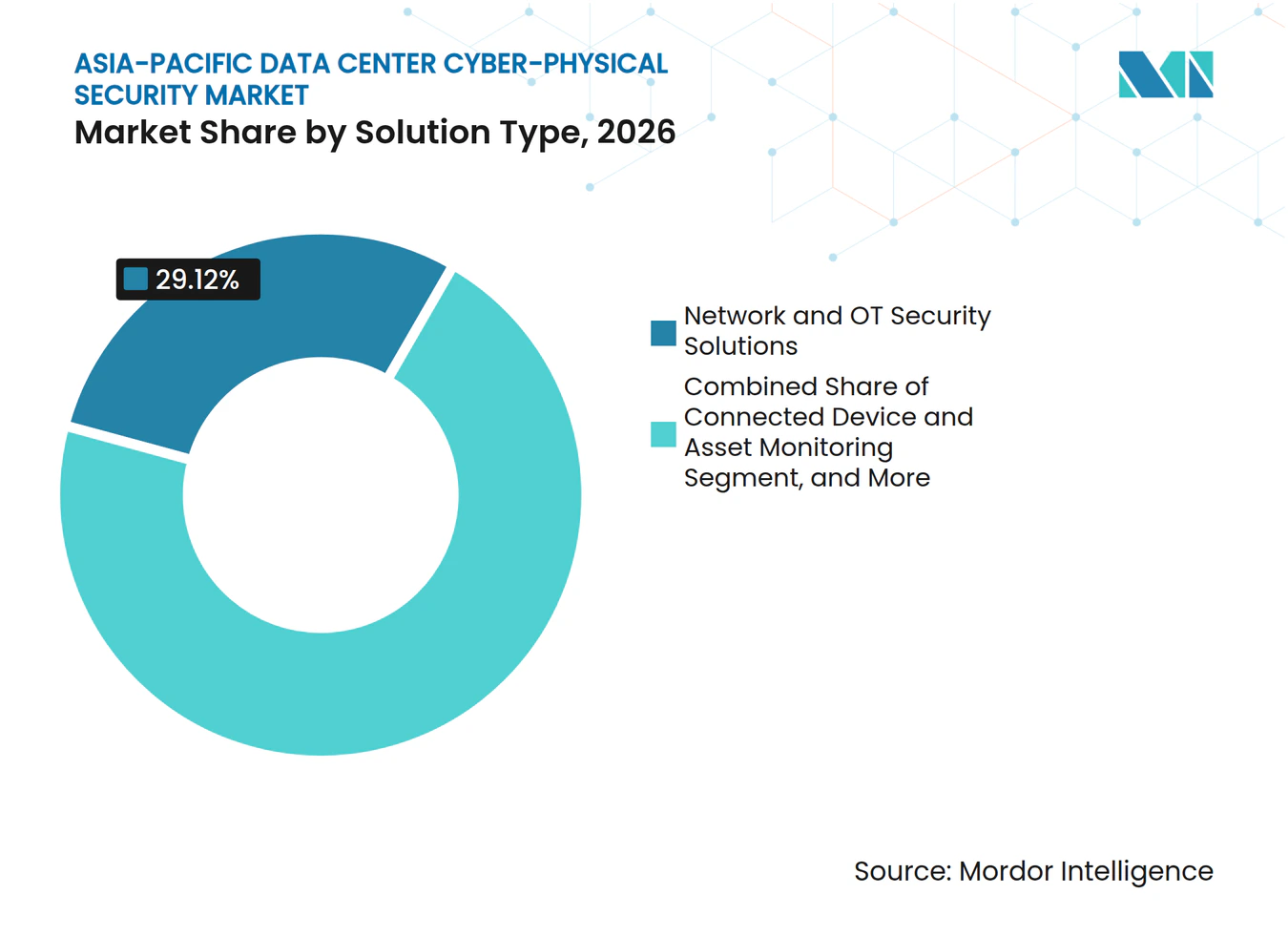
- By solution type, Network and OT Security Solutions held 29.12% of the Asia-Pacific data center cyber-physical security market share in 2026, while Unified Cyber-Physical Security Platforms are projected to expand at a 16.26% CAGR through 2032.
- By security layer, Integrated Security Operations Platforms accounted for 32.38% of the regional data center physical security market size in 2026 and are projected to expand at a 17.92% CAGR through 2032.
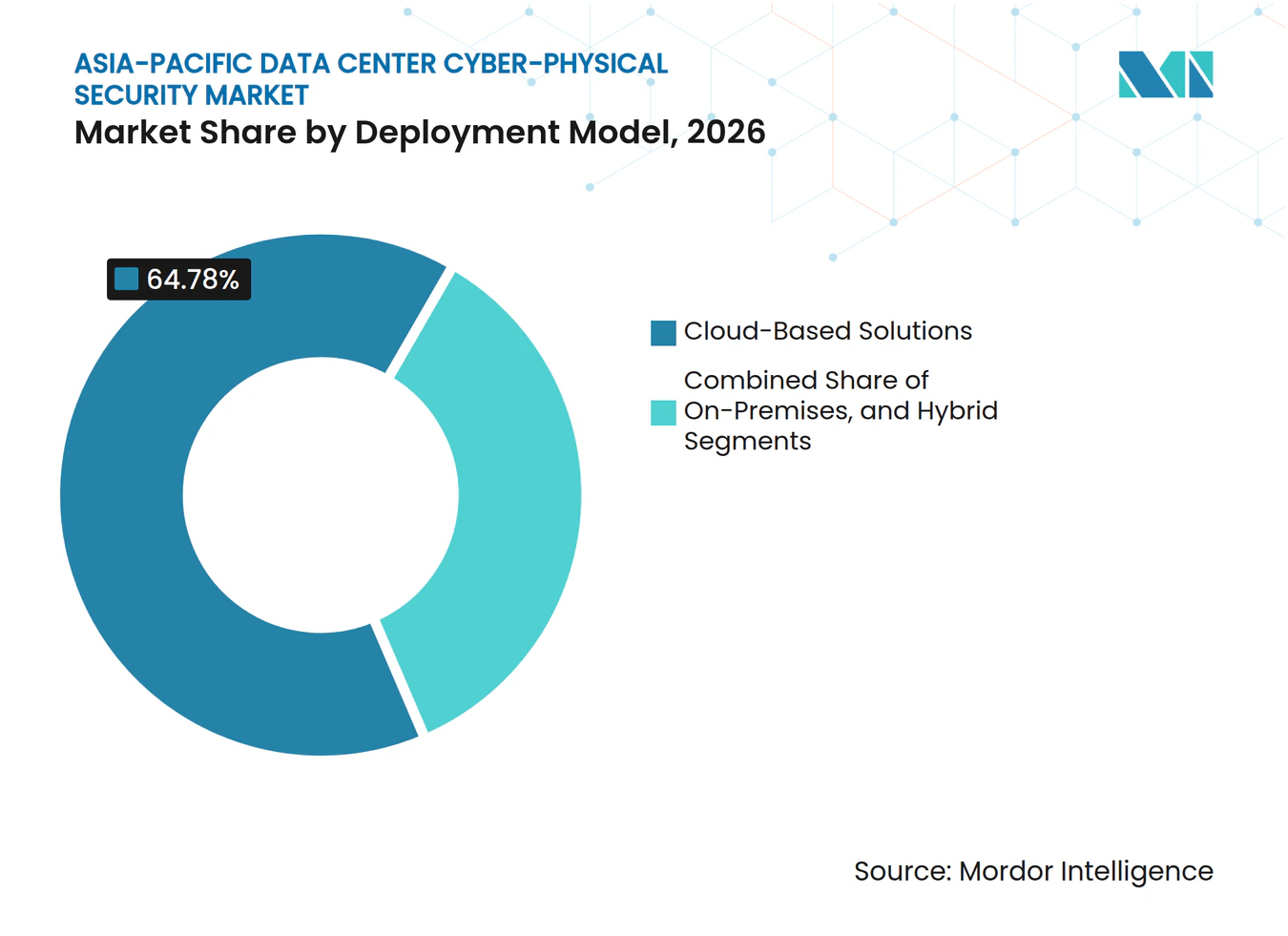
- By deployment model, Cloud-Based Solutions held 64.78% of revenue in 2026 and are projected to expand at an 18.39% CAGR through 2032.
- By service type, System Integration and Implementation held 26.54% of revenue in 2026, while Security Auditing and Compliance Services are projected to expand at a 16.59% CAGR through 2032.
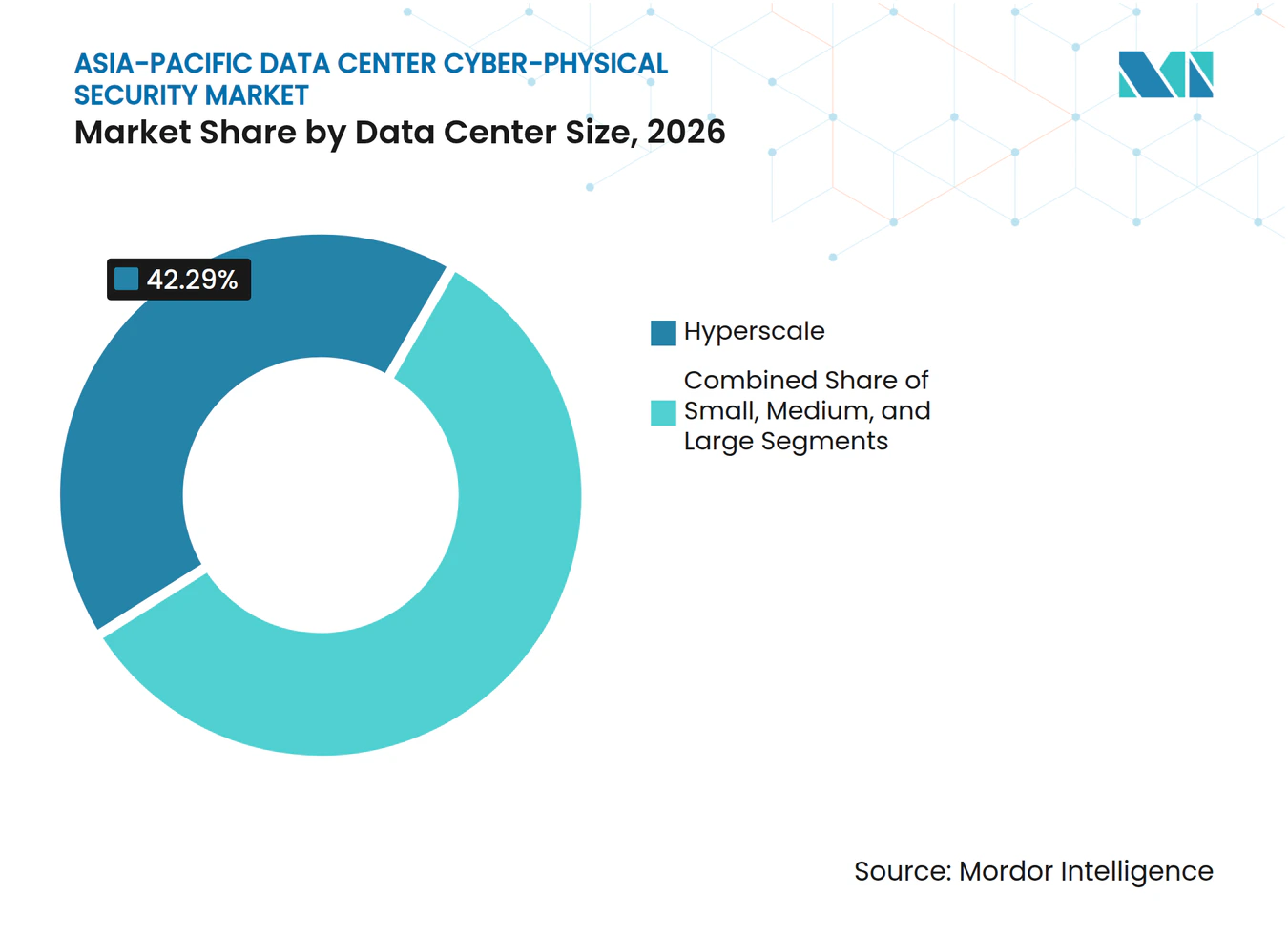
- By data center size, Hyperscale facilities accounted for 42.29% of revenue in 2026 and are projected to expand at a 17.27% CAGR through 2032.
- By data center type, Cloud Service Providers held 39.74% of revenue in 2026, while Edge Data Centers are projected to expand at a 17.38% CAGR through 2032.
- By geography, China held 37.53% of the Asia-Pacific data center cyber-physical security market revenue in 2026, while India is projected to expand at a 16.93% CAGR through 2032.
Note: Market numbers in this report are based on Mordor Intelligence's proprietary estimation framework, which combines nine months of actuals with Q4 projections for base year 2026.
Market Trends and Insights
Drivers Impact Analysis of Asia-Pacific Data Center Cyber-Physical Security Market*
| Driver | (~) % Impact on CAGR Forecast | Geographic Relevance | Impact Timeline |
|---|---|---|---|
| Hyperscale and Colocation Capacity Expansion | +4.2% | Global, highest concentration in China, India, Singapore, Japan | Short term (≤ 2 years) |
| Data Localization and Sovereign Cloud Requirements | +3.5% | China, India, Singapore, Japan | Medium term (2-4 years) |
| AI Workload Growth and High-Density Compute Deployment | +3.0% | Asia-Pacific core markets and second-tier cities | Medium term (2-4 years) |
| IT, OT and IoT Convergence in Data Center Operations | +2.3% | Global, most visible in hyperscale and colocation facilities | Long term (≥ 4 years) |
| Remote Operations and Reduced On-Site Staffing | +1.5% | Global, most pronounced in Singapore and Japan | Short term (≤ 2 years) |
| Cyber-Physical Protection of Dedicated Substations and Utility Systems | +1.1% | National, with early urgency in Singapore, Japan, China | Medium term (2-4 years) |
| Source: Mordor Intelligence | |||
Hyperscale and Colocation Capacity Expansion Sets the Security Investment Baseline
The Asia-Pacific data center cyber-physical security market benefits when new capacity is designed with perimeter surveillance, multifactor access control, environmental monitoring, and operational technology integration. These controls are normally specified in hyperscale contracts before construction is complete. Colocation operators also use security certifications to compete for large tenants with strict operational requirements. Facilities that cannot demonstrate Tier III or Tier IV resilience practices or ISO/IEC 27001-aligned controls can lose opportunities even when their pricing is competitive. This shifts procurement toward repeatable programs instead of isolated security projects. It also gives vendors clearer visibility into installation, integration, maintenance, and replacement demand. The Security Industry Association identifies outdated specifications and siloed systems as continuing resilience risks in data center facilities.
Data Localization and Sovereign Cloud Requirements Create a Non-Discretionary Security Spend Floor
The Asia-Pacific data center cyber-physical security market is supported by regulations that require operators to implement controlled access and document the handling of critical data. Singapore’s Digital Infrastructure Act requires qualifying facilities to meet physical security, business continuity, and incident reporting obligations. India’s Digital Personal Data Protection Rules 2025 require controlled access, retained logs, encrypted storage, and breach notification for relevant processing activities. China’s Personal Information Protection Law requires security assessments for certain cross-border transfers involving critical information infrastructure operators. These requirements encourage operators to retain evidence that facilities, access permissions, and incident processes are controlled. Compliance work can therefore continue even when broader capital spending becomes more cautious. It also increases demand for audit-ready access management and security operations records.
AI Workload Growth and High-Density Compute Deployment Raise Per-Rack Physical Security Stakes
The Asia-Pacific data center cyber-physical security market is gaining importance as training and inference systems concentrate greater asset value within each equipment row. AI-ready facilities need stronger controls around rack access, contractor activity, removable media, and management networks. Physical tampering and insider sabotage carry greater financial and service risks when high-value GPU systems are installed. NIST identifies physical access vulnerabilities and weak correlation between management-network activity and physical access events as important gaps in AI data center security practices.[1] This increases interest in biometric rack authentication, hardware security modules, and anomaly detection that connects physical and digital events. It also favors platforms that can help operators investigate an access event without moving across several disconnected tools. The effect is strongest where facilities are being commissioned quickly, and security architecture is still being finalized.
IT, OT, and IoT Convergence in Data Center Operations Expands the Cyber-Physical Attack Surface
The Asia-Pacific data center cyber-physical security market is responding to the wider use of connected building systems, power equipment, cooling assets, and access hardware. These systems increasingly communicate across shared networks rather than operating as separate facility components. ISACA notes that convergence between information technology and operational technology broadens the attack surface and can exceed the scope of traditionally organized security teams.[2] A compromised building automation system can affect temperature settings, power distribution, or door locks. Operators, therefore, need visibility across both facility commands and physical events. Vendors with only an IT or only an OT offering face a weaker position when customers seek integrated detection and response. This development supports security architectures that link access control, video, environmental telemetry, and operational technology monitoring.
Restraints Impact Analysis of Asia-Pacific Data Center Cyber-Physical Security Market*
| Restraint | (~) % Impact on CAGR Forecast | Geographic Relevance | Impact Timeline |
|---|---|---|---|
| High Deployment and Integration Costs | -2.8% | Global, most acute for enterprise-owned and smaller colocation facilities | Short term (≤ 2 years) |
| Retrofitting Constraints in Legacy Data Centers | -1.5% | Asia-Pacific core markets, particularly older facilities in China, Japan, and India tier-2 cities | Medium term (2-4 years) |
| Privacy and Data Sovereignty Concerns Around Biometrics and Video Analytics | -0.8% | Asia-Pacific-wide, most visible in Singapore, India, Australia, New Zealand | Long term (≥ 4 years) |
| Security Hardware Lead Times and Commissioning Delays | -0.6% | Southeast Asia and India new builds, linked to China-concentrated manufacturing | Short term (≤ 2 years) |
| Source: Mordor Intelligence | |||
High Deployment and Integration Costs Constrain Adoption Among Smaller Operators
The Asia-Pacific data center cyber-physical security market faces a cost barrier when operators seek to connect access control, video, building automation, and operational technology monitoring. A unified operations view often requires middleware, custom application interfaces, and commissioning specialists. These requirements can be difficult for smaller colocation providers to fund and operate. The capital requirement also extends beyond equipment, as systems require ongoing monitoring, maintenance, testing, and incident response. Data protection obligations can add requirements for security operations centers, event management systems, and protected backups. This turns security from a periodic compliance exercise into a continuous operating expense. Operators with constrained budgets may phase deployments, delaying the realization of a fully integrated architecture's value.
Retrofitting Constraints in Legacy Data Centers Slow Security Modernization Timelines
The Asia-Pacific data center cyber-physical security market must address facilities that were built before integrated cyber-physical security became a common design requirement. Older sites may have legacy cabling, proprietary building systems, and limited space for new equipment. Adding biometric readers, network cameras, and operational technology sensors can require custom engineering. Live facilities cannot accept prolonged service interruptions, so upgrades are commonly executed in stages. This stretches procurement across more than one budget cycle and slows the overall security uplift. The UN Environment Program notes that older facilities in emerging Asia-Pacific markets can show broader gaps in modernization and power efficiency. Security upgrades can consequently compete with cooling and power-efficiency investments for the same capital allocation.
*Our forecasts treat driver/restraint impacts as directional, not additive. The impact forecasts reflect baseline growth, mix effects, and variable interactions.
Asia-Pacific Data Center Cyber-Physical Security Market Segment Analysis
By Solution Type:
Network and OT Security Supports Converging ArchitecturesNetwork and OT Security Solutions held 29.12% of the Asia-Pacific data center cyber-physical security market share in 2026. This position reflects the need to secure networks connecting building systems, access hardware, and information technology infrastructure. Cooling units, power distribution modules, and environmental sensors increasingly communicate across shared systems. Security at this layer helps address both digital intrusion and unauthorized physical access. Operators also need to understand how a network event affects a facility command or access decision.
Unified Cyber-Physical Security Platforms are projected to expand at a 16.26% CAGR through 2032. The Asia-Pacific data center cyber-physical security market size for integrated platforms is supported by procurement that combines monitoring, event correlation, and identity management. Connected device and asset monitoring supplies the telemetry needed to detect changes across equipment. Integration and incident response services support the practical deployment of these platforms. Vendors that show interoperability across existing facility systems can reduce migration risk for customers. The gradual blending of these offerings makes the boundaries between solutions less distinct in daily operations.



By Security Layer:
Integrated Operations Platforms Centralize Security ManagementIntegrated Security Operations Platforms accounted for 32.38% of the regional data center physical security market size in 2026. The segment is also projected to expand at a 17.92% CAGR through 2032. This combination indicates that operators are prioritizing centralized management over standalone point products. Physical access control and video surveillance remain core requirements at every facility. Their value increasingly depends on integration with a common operations interface.
Environmental and infrastructure monitoring is also becoming more important as AI facilities use denser temperature, humidity, and power-quality sensing. Building management and facility control systems present a sensitive integration challenge because connection can improve response while expanding cyber-physical risk. Centralized platforms can create more complete incident records and support quicker investigation. Compliance requirements favor an architecture that can document access, alarms, and response actions. Separate interfaces for video, access, and intrusion detection can delay decisions in facilities that operate continuously. The Asia-Pacific data center cyber-physical security market, therefore, favors management layers that connect these controls without reducing operational resilience.
By Deployment Model:
Cloud-Based Deployment Centralizes Distributed OperationsCloud-Based Solutions held 64.78% of the regional data center physical security market share in 2026. They are projected to expand at an 18.39% CAGR through 2032. Distributed facilities with lean local teams benefit from centralized policy administration and monitoring. Regional operations centers can access video, alarms, and event records without maintaining a separate management platform at every site. This also reduces hardware provisioning requirements during the deployment of new facilities.
On-Premise Solutions retain a role where data sovereignty requirements or security classifications restrict the storage of biometric and video information in cloud environments. This is relevant for government-adjacent operations in China and selected Singapore deployments. Hybrid models allow operators to move analytics and access management functions to the cloud while keeping latency-sensitive access decisions local. The shift toward subscription models changes the position of hardware-focused security suppliers. It also creates opportunities for cloud-native providers to operate alongside traditional physical security vendors. The Asia-Pacific data center cyber-physical security market continues to require choices that balance control, latency, local storage, and centralized oversight.

By Service Type:
Compliance Services Outpace Conventional IntegrationSystem Integration and Implementation held 26.54% of service revenue in 2026. This reflects commissioning needs across a large regional construction program. New facilities need access control, surveillance, monitoring, network connectivity, and operations processes to work together. Integrators also help operators adapt equipment to site layouts and tenant requirements. Implementation remains essential because a security design has limited value until it functions reliably in the live facility.
Security Auditing and Compliance Services are projected to expand to a 16.59% CAGR through 2032. Regulatory obligations in India, Singapore, and Hong Kong increase the need for documented assessments, testing, and evidence of security posture. Cyber-physical risk assessments are also gaining importance because standard IT assessments may not cover contractor misuse, drone reconnaissance, or insider threats. Managed monitoring and detection services help lean operating teams maintain continuous coverage of access events and environmental alerts. Incident response and recovery services support documented action plans when an event occurs. The Asia-Pacific data center physical security industry is consequently shifting more service demand toward ongoing assurance rather than one-time installation.
By Data Center Size:
Hyperscale Facilities Set the Security StandardHyperscale facilities accounted for 42.29% of the regional data center physical security market share in 2026. They are projected to expand at a 17.27% CAGR through 2032. Large cloud and AI operators specify multifactor biometric access, broad video coverage, operational technology monitoring, and operations-center connectivity in new builds. These requirements are built into the facility program rather than considered after commissioning. Their scale also allows investment in specialist teams and integrated control environments.
Small and medium-sized facilities face a larger per-unit cost burden because platform and staffing costs do not decline in proportion to site size. Large facilities serving financial services and government tenants need event correlation that links access records with security telemetry. ANSI/TIA-942-C sets physical security requirements by facility tier and supports a multilayer approach. The regional data center physical security market size for these systems benefits where major facilities require auditable protection across perimeter, building, room, and rack levels. Smaller sites may adopt phased deployments because they must balance resilience investments with other operating priorities. This difference in purchasing capacity widens the implementation gap between hyperscale and smaller facilities.
By Data Center Type:
Cloud Provider Facilities Lead as Edge Deployments ExpandCloud Service Providers held 39.74% of the regional data center physical security market share in 2026. These facilities carry rigorous requirements because they must protect customer workloads, meet regulatory obligations, and maintain service trust. Layered access control often extends from the perimeter to individual racks. Biometric verification is used across several security zones. Continuous video monitoring supports investigation and deterrence in always-on environments.
Edge Data Centers are projected to expand at a 17.38% CAGR through 2032. Distributed inference deployments require lower-latency locations in second-tier cities and emerging Southeast Asian markets. Colocation sites must protect shared infrastructure while maintaining tenant-specific access permissions and audit trails. This increases demand for isolated access control, electronic key management, and zone-specific surveillance. The Asia-Pacific data center cyber-physical security market has an opportunity for compact platforms that can be remotely managed across many smaller locations. Such tools need to meet hyperscale security expectations without requiring a hyperscale operating team.
Geography Analysis
China held 37.53% of the regional data center physical security market share in 2026. The country’s Personal Information Protection Law, Cybersecurity Law, and Data Security Law support onshore infrastructure and verifiable physical security controls for critical information infrastructure. AI development in Beijing, Shanghai, and Jiangsu increases rack density and places more value in each secured area. Domestic vendors retain strong positions in China, while global integrators focus more heavily on other regional markets. This regulatory and competitive structure shapes the Asia-Pacific data center cyber-physical security market across the forecast period.
India is projected to expand at a 16.93% CAGR through 2032. The Digital Personal Data Protection Rules 2025 make controlled access, log retention, encrypted storage, and breach procedures more relevant to data center operators. Hyperscale investment in Mumbai, Chennai, and Hyderabad is driving demand for new facility security. India reported 20.41 million cybersecurity incidents in 2024, which reinforces the operational importance of stronger security controls.[3] Singapore has a highly regulated operating environment, and its Digital Infrastructure Act establishes licensing and resilience obligations for qualifying facilities. Japan continues to combine major data center capacity with a strong industrial technology base, which supports cyber-physical security investment.
Malaysia, South Korea, Thailand, Indonesia, and Hong Kong are becoming more relevant as operators develop facilities in Johor, Greater Seoul, Bangkok, and Greater Jakarta. New campuses in these locations can incorporate international security specifications from their initial design stage. Hong Kong’s Cybersecurity Ordinance, enacted in March 2025, extends incident reporting obligations to critical infrastructure operators, including data centers. Local commissioning and maintenance capability can be as important as product specifications because data center environments require fast support and reliable service coverage. Regional vendors with established deployment teams have an advantage when projects require local delivery. The regional data center physical security market size is therefore influenced by the ability to support new sites beyond the established regional hubs.
Competitive Landscape
Market Concentration
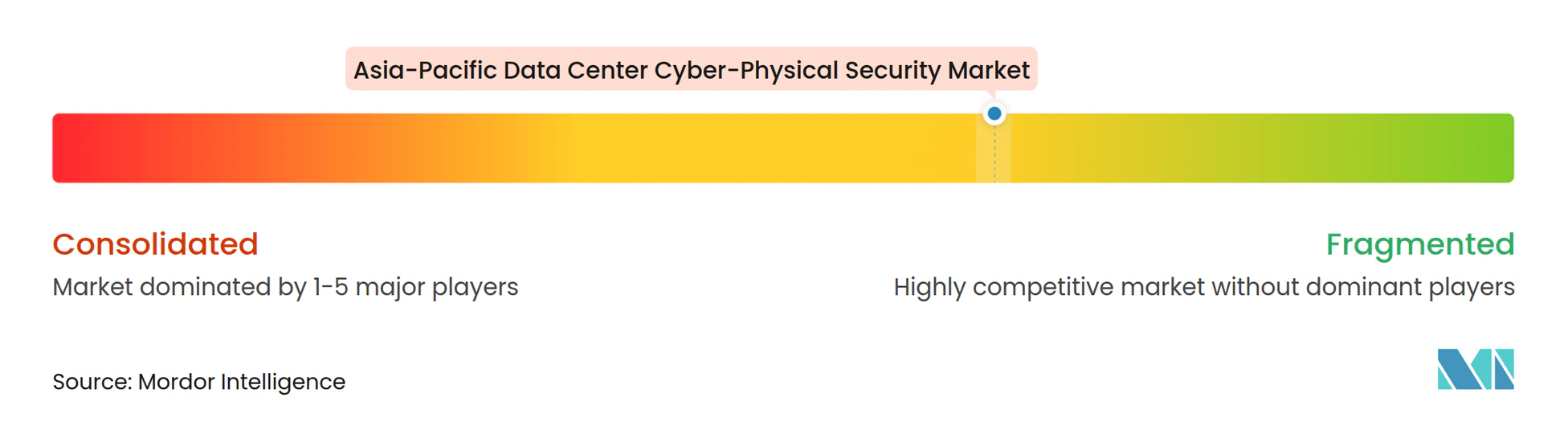
The Asia-Pacific data center cyber-physical security market is moderately fragmented in services and integration, while hardware and platform offerings are becoming more concentrated. Systems integrators with access control, surveillance, operational technology monitoring, and building management capabilities are well-positioned for complex bids. Customers often prefer a provider that can take responsibility for connected security architecture. Technology differentiation increasingly involves behavior-based video analytics, multispectral sensing, and monitoring of unusual building-management commands. Edge facilities remain an opening for compact, cloud-managed solutions because no purpose-built incumbent has a dominant position across the region.
Mitsubishi Electric completed the full acquisition of Nozomi Networks in January 2026, bringing operational technology visibility into a Japanese industrial group with established regional infrastructure relationships. Schneider Electric joined Nozomi Networks’ MSSP Elite Partner Program in February 2025 to provide managed OT and IoT security services. Nozomi Networks and Schneider Electric also introduced a security sensor embedded in Schneider SCADAPack 47xi Smart RTUs in August 2025. These moves show how vendors are combining product capabilities with managed detection and response. The Asia-Pacific data center cyber-physical security market rewards providers that can connect physical assets, industrial controls, and security operations without creating difficult deployment requirements.
Hardware-focused companies are also partnering with cloud-native software providers to remain relevant in cloud-managed environments. Integration specialists are expanding their compliance advisory practices to serve the rapidly growing auditing segment. ISO/IEC 27001 and TIA-942 requirements can act as entry barriers because customers need documented capability and consistent implementation. Regional regulatory knowledge is also valuable where operators must demonstrate compliance to local authorities. The Asia-Pacific data center physical security industry remains competitive because domestic vendors are strong in China while global suppliers and integrators compete across Singapore, India, Japan, and Southeast Asia. Service networks, integration capability, and compliance expertise are important alongside product performance.
Asia-Pacific Data Center Cyber-Physical Security Industry Leaders
-
ABB Ltd.
-
Axis Communications AB
-
Bosch Sicherheitssysteme GmbH
-
Johnson Controls International plc
-
Honeywell International Inc.
- *Disclaimer: Major Players sorted in no particular order
Asia-Pacific Data Center Cyber-Physical Security Market Companies Covered in this Report
- ABB Ltd.
- Axis Communications AB
- Bosch Sicherheitssysteme GmbH
- Johnson Controls International plc
- Honeywell International Inc.
- Schneider Electric SE
- Cisco Systems, Inc.
- Siemens AG
- Zhejiang Dahua Technology Co., Ltd.
- Hangzhou Hikvision Digital Technology Co., Ltd.
- Securitas Technology
- Convergint Technologies LLC
- ASSA ABLOY AB
- dormakaba Group
- Allegion plc
- Suprema Inc.
- NEC Corporation
- Genetec Inc.
- Motorola Solutions, Inc.
- Nedap N.V.
- Gallagher Group Limited
- IDEMIA
- SALTO Systems, S.L.
- Brivo Systems, LLC
- Waterfall Security Solutions
- Nozomi Networks Inc.
- Pelco, Inc.
Recent Industry Developments in Asia-Pacific Data Center Cyber-Physical Security Market
- September 2026: Johnson Controls joined Singapore's Sustainable Tropical Data Centre Testbed 2.0, contributing thermal management controls and engineering expertise to develop secure AI infrastructure designs for power- and water-constrained tropical markets. The collaboration positions Johnson Controls to influence next-generation facility security and operations standards across the region's most security-intensive data center environment.
- January 2026: Mitsubishi Electric Corporation completed its full acquisition of Nozomi Networks Inc. on January 28, 2026, following the definitive agreement announced September 9, 2025, in what Nozomi characterized as the largest OT security acquisition in history. Nozomi reported net revenue of USD 101.71 million in fiscal year 2025, up from USD 62.56 million in 2023, reflecting rapid demand for OT and cyber-physical security.
- January 2026: Johnson Controls expanded its Singapore Innovation Centre with an investment of up to USD 60 million over 5 years and planned expansion of engineering teams to 90-100 roles focused on thermal management, smart connectivity, and cybersecurity for Asia-Pacific data centers.
- January 2026: Nozomi Networks established its Asia-Pacific and Japan headquarters in Singapore on January 14, 2026, citing the Singapore Cybersecurity Act and OT Cybersecurity Masterplan 2024 as strategic alignment factors, with close to 100 regional customers at the time of announcement and teams expanding across sales, professional services, and customer success.
Asia-Pacific Data Center Cyber-Physical Security Market Report Scope
The Asia-Pacific Data Center Cyber-Physical Security Market includes revenue from cyber-physical security hardware, software, platforms, and services deployed in data centers across China, Japan, India, Singapore, Australia, and other Asia-Pacific countries. Rapid hyperscale and colocation expansion, AI infrastructure investment, edge data center growth, and increasing cyber-physical threat exposure are the primary market drivers.
The Asia-Pacific Data Center Cyber-Physical Security Market Report is Segmented by Solution Type (Unified Cyber-Physical Security Platforms, Connected Device and Asset Monitoring Solutions, Security Information and Event Correlation Solutions, Network and Operational Technology Security Solutions, Identity and Access Management Solutions, and Integration and Incident Response Services), Security Layer (Physical Access Control Systems, Video Surveillance Systems, Building Management and Facility Control Systems, Environmental and Infrastructure Monitoring Systems, and Integrated Security Operations Platforms), Deployment Model (On-Premise Solutions, Cloud-Based Solutions, and Hybrid Solutions), Service Type (Cyber-Physical Risk Assessment, System Integration and Implementation, Managed Monitoring and Detection, Incident Response and Recovery, and Security Auditing and Compliance Services), Data Center Size (Small, Medium, Large, and Hyperscale), Data Center Type (Colocation, Cloud Service Providers (CSPs), and Enterprise / Edge), and Country (China, Japan, India, Singapore, and Rest of Asia-Pacific). The Market Forecasts are Provided in Terms of Value (USD).
Segmentation Overview
| Unified Cyber-Physical Security Platforms |
| Connected Device and Asset Monitoring Solutions |
| Security Information and Event Correlation Solutions |
| Network and Operational Technology Security Solutions |
| Identity and Access Management Solutions |
| Integration and Incident Response Services |
| Physical Access Control Systems |
| Video Surveillance Systems |
| Building Management and Facility Control Systems |
| Environmental and Infrastructure Monitoring Systems |
| Integrated Security Operations Platforms |
| On-Premise Solutions |
| Cloud-Based Solutions |
| Hybrid Solutions |
| Cyber-Physical Risk Assessment |
| System Integration and Implementation |
| Managed Monitoring and Detection |
| Incident Response and Recovery |
| Security Auditing and Compliance Services |
| Small |
| Medium |
| Large |
| Hyperscale |
| Colocation |
| Cloud Service Providers (CSPs) |
| Enterprise / Edge |
| China |
| Japan |
| India |
| Singapore |
| Rest of Asia-Pacific |
| By Solution Type | Unified Cyber-Physical Security Platforms |
| Connected Device and Asset Monitoring Solutions | |
| Security Information and Event Correlation Solutions | |
| Network and Operational Technology Security Solutions | |
| Identity and Access Management Solutions | |
| Integration and Incident Response Services | |
| By Security Layer | Physical Access Control Systems |
| Video Surveillance Systems | |
| Building Management and Facility Control Systems | |
| Environmental and Infrastructure Monitoring Systems | |
| Integrated Security Operations Platforms | |
| By Deployment Model | On-Premise Solutions |
| Cloud-Based Solutions | |
| Hybrid Solutions | |
| By Service Type | Cyber-Physical Risk Assessment |
| System Integration and Implementation | |
| Managed Monitoring and Detection | |
| Incident Response and Recovery | |
| Security Auditing and Compliance Services | |
| By Data Center Size | Small |
| Medium | |
| Large | |
| Hyperscale | |
| By Data Center Type | Colocation |
| Cloud Service Providers (CSPs) | |
| Enterprise / Edge | |
| By Country | China |
| Japan | |
| India | |
| Singapore | |
| Rest of Asia-Pacific |
Key Questions Answered in the Report
What is the size of the Asia-Pacific data center cyber-physical security market?
The Asia-Pacific data center cyber-physical security market size is projected to expand from USD 0.64 billion in 2026 and USD 0.76 billion in 2027 to USD 1.59 billion by 2032, registering a CAGR of 15.91% between 2027 and 2032.
Which solution type leads the Asia-Pacific data center cyber-physical security market?
Network and OT Security Solutions lead with 29.12% of revenue in 2026, reflecting the need to protect connected facility and IT systems. These solutions help operators oversee the networks that link physical access, building systems, and operational assets.
Which deployment model is expanding fastest in data center physical security?
Cloud-Based Solutions held 64.78% of revenue in 2026 and are projected to expand at an 18.39% CAGR through 2032. Centralized monitoring and policy control are particularly useful for operators managing facilities across several countries.
Why do AI data centers need stronger physical security?
AI facilities concentrate high-value GPU hardware in each rack and need tighter controls for access, tampering, and event investigation. They also require reliable coordination between physical security events and activity on management networks.
Which country leads regional demand for data center security systems?
China held 37.53% of regional revenue in 2026, supported by onshore data and security assessment requirements. Its domestic supplier base and major AI development programs also strengthen security procurement at large facilities.
What services are likely to see the strongest demand?
Security Auditing and Compliance Services are projected to expand at a 16.59% CAGR through 2032 as regulatory requirements increase. Operators need assessment, evidence, monitoring, and response support to maintain a documented security posture.