
APAC Data Center Access Control Market Size and Share
Market Overview
| Study Period | 2021 - 2032 |
|---|---|
| Forecast Data Period | 2027 - 2032 |
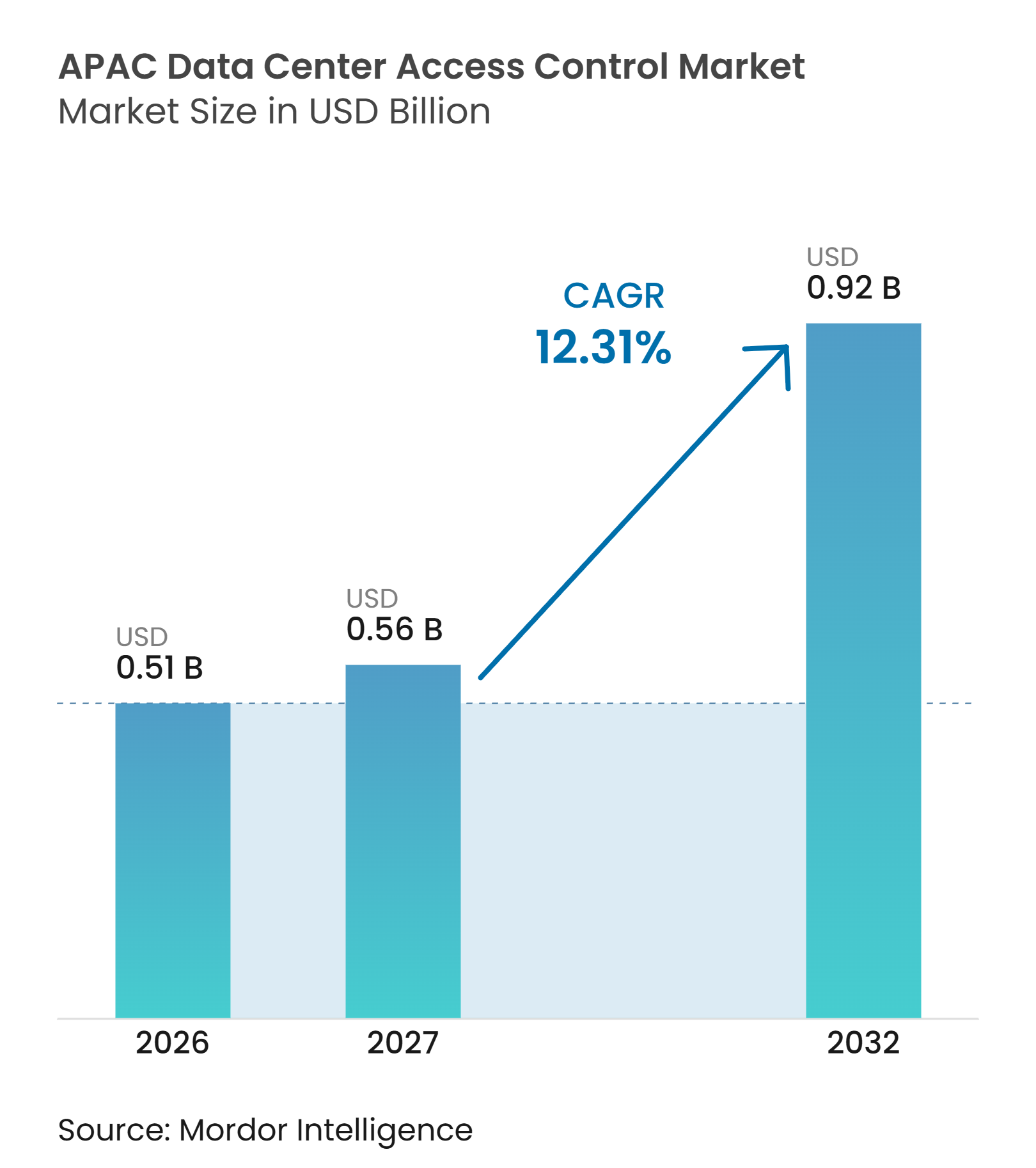
| Base Year Market Size (2026) | USD 0.51 Billion |
| Market Size (2027) | USD 0.56 Billion |
| Market Size (2032) | USD 0.92 Billion |
| Growth Rate (2027 - 2032) | 12.31 % |
| Market Concentration | Medium |
Major Players *Disclaimer: Major Players sorted in no particular order Image © Mordor Intelligence. Reuse requires attribution under CC BY 4.0. | |
APAC Data Center Access Control Market Analysis by Mordor Intelligence
The Asia-Pacific data center access control market size is expected to expand from USD 0.51 billion in 2026 to USD 0.92 billion by 2032 at a CAGR of 12.31% during 2027-2032. The Asia-Pacific data center access control market is benefiting from new data center construction, AI computing investment, and stricter requirements for protecting sensitive information. Physical access systems are becoming part of core facility design because operators must protect people, equipment, and restricted areas at the same time. Large operators increasingly need consistent controls across sites, which favors platforms that combine identity management, audit records, and device oversight. The Asia-Pacific data center access control market also offers opportunities for suppliers that can support both new construction and upgrades at operating sites. Cost, system compatibility, and privacy rules will remain important factors in buying decisions.
Key Report Takeaways
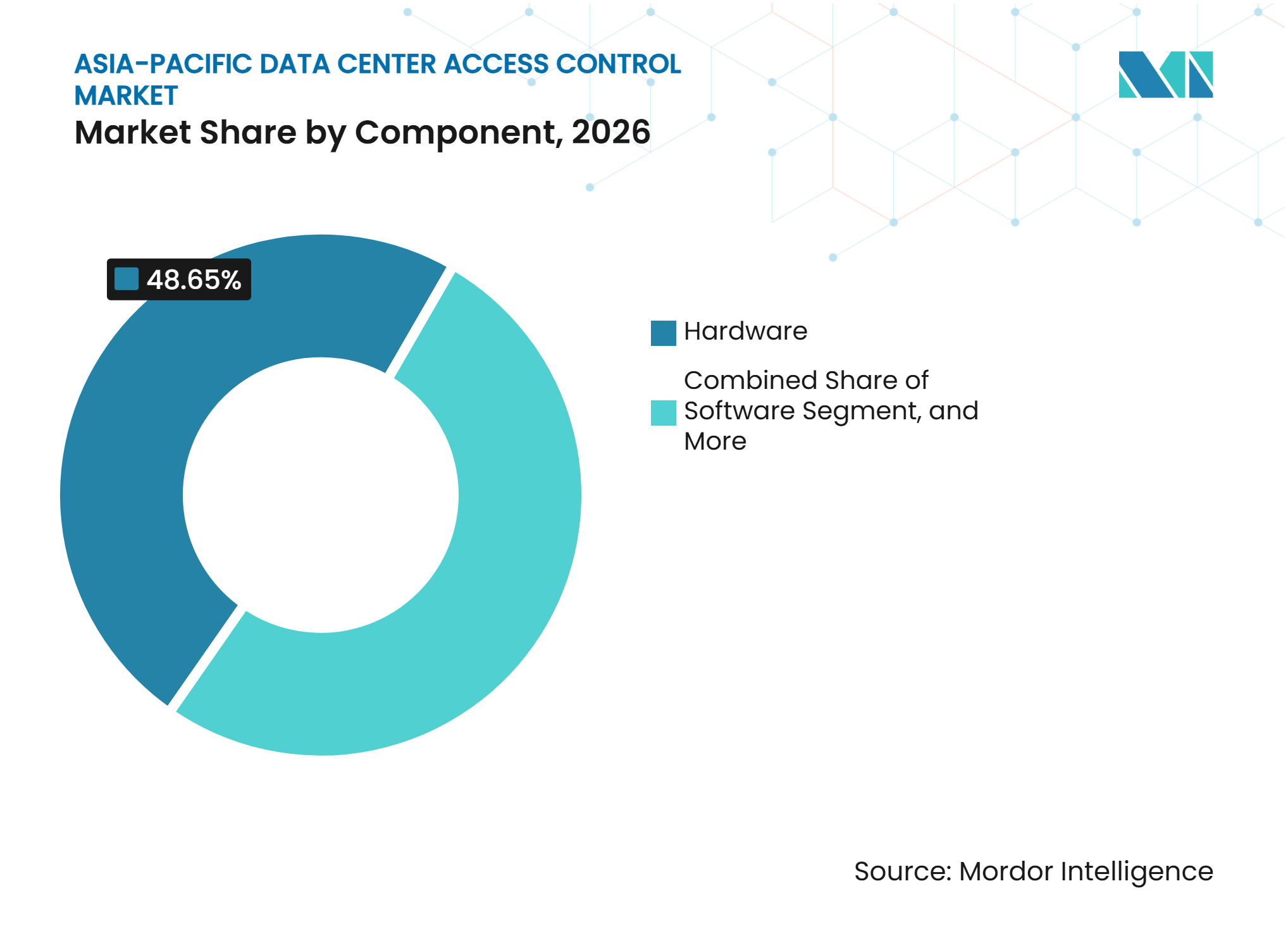
- By component, hardware held 48.65% of the Asia-Pacific data center access control market share in 2026, while installation, integration, and support services are projected to expand at a CAGR of 13.38% through 2032.
- By technology, card and credential-based systems held 34.15% of the Asia-Pacific data center access control market share in 2026, while mobile and digital credentials are projected to expand at a CAGR of 13.29% through 2032.
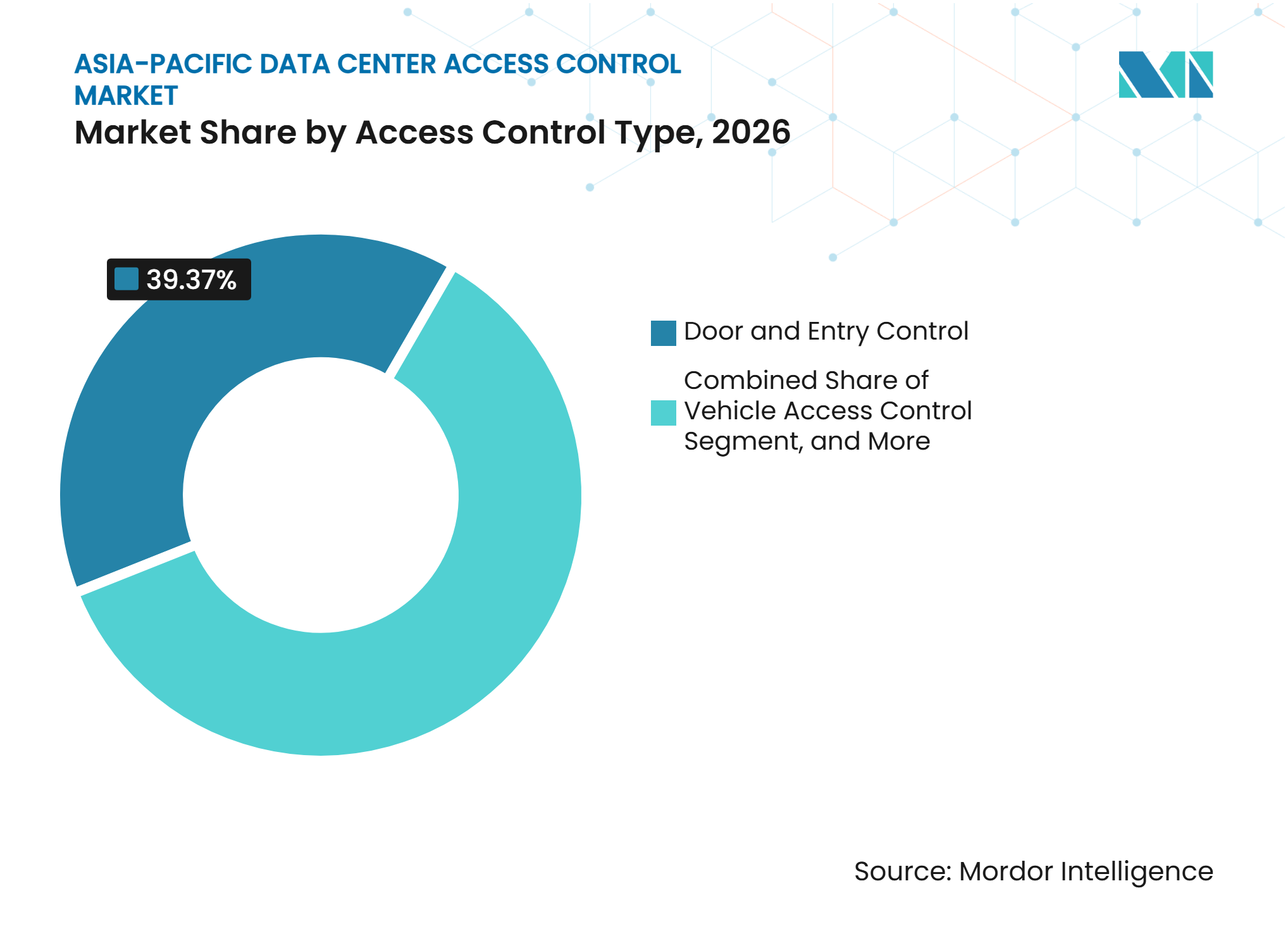
- By access control type, door and entry control accounted for 39.37% of the Asia-Pacific data center access control market size in 2026, while rack-level and restricted-zone access control is projected to expand at a CAGR of 13.77% through 2032.
- By deployment model, on-premise systems held 46.27% of the Asia-Pacific data center access control market share in 2026, while cloud-based systems are projected to expand at a CAGR of 13.85% through 2032.
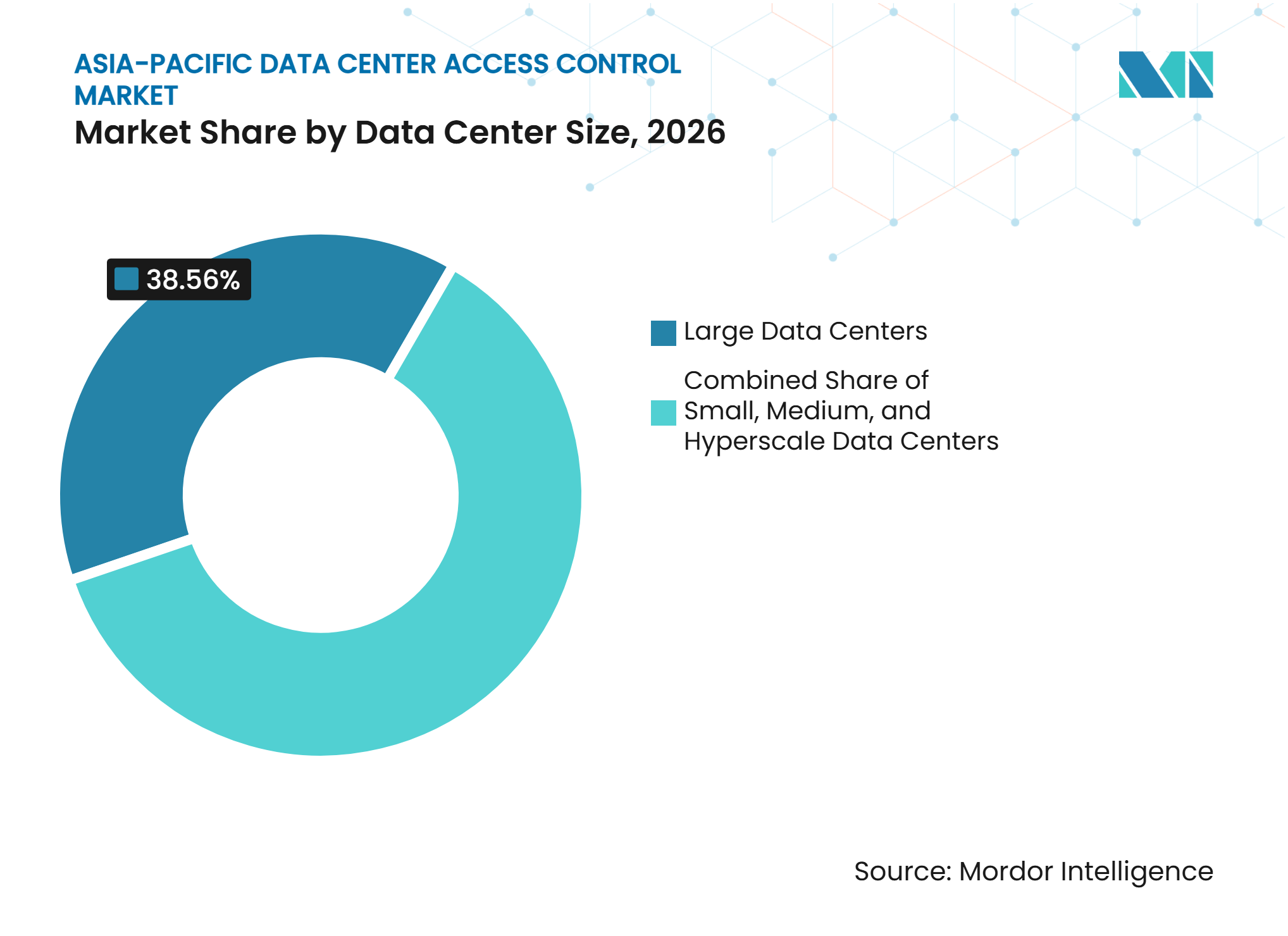
- By data center size, large facilities held 38.56% of the Asia-Pacific data center access control market share in 2026, while hyperscale facilities are projected to expand at a CAGR of 13.79% through 2032.
- By data center type, colocation facilities held 41.25% of the Asia-Pacific data center access control market share in 2026, while cloud service providers are projected to expand at a CAGR of 13.87% through 2032.
- By geography, China held 32.43% of the Asia-Pacific data center access control market share in 2026, while India is projected to expand at a CAGR of 13.81% through 2032.
Note: Market numbers in this report are based on Mordor Intelligence's proprietary estimation framework, which combines nine months of actuals with Q4 projections for base year 2026.
Market Trends and Insights
Drivers Impact Analysis of APAC Data Center Access Control Market*
| Driver | (~) % Impact on CAGR Forecast | Geographic Relevance | Impact Timeline |
|---|---|---|---|
| Expansion of Hyperscale and Colocation Data Centers | +2.8% | Asia-Pacific, centered on China, India, Malaysia, and Japan | Medium term (2-4 years) |
| AI Infrastructure and High-Density Computing Investment | +2.4% | China, India, Japan, Singapore, and Australia | Short term (≤ 2 years) |
| Data Localization and Critical Infrastructure Compliance | +1.9% | China, India, Vietnam, Indonesia, and Australia | Medium term (2-4 years) |
| Migration From Shared Credentials to Biometric and Multi-Factor Authentication | +1.7% | Asia-Pacific, led by Japan, South Korea, and Singapore | Short term (≤ 2 years) |
| Rack-Level Identity Enforcement in High-Density Facilities | +1.4% | China, India, and Southeast Asian hyperscale corridors | Medium term (2-4 years) |
| Power-Constrained Siting and Distributed Edge Deployment | +1.1% | Southeast Asia, India, and Rest of Asia-Pacific | Long term (≥ 4 years) |
| Source: Mordor Intelligence | |||
Expansion of Hyperscale and Colocation Data Centers
The Asia-Pacific data center access control market gains demand whenever a new facility, cage, or campus enters construction. Each project requires controls at gates, building entrances, data halls, tenant cages, and equipment areas. Colocation sites create particularly complex requirements because each tenant needs separate rights, records, and access revocation procedures. This raises the need for systems that can assign access by individual, company, location, and time. Physical access records also support audit requirements under PCI DSS and SOC 2, which strengthens the case for documented controls in colocation and cloud environments. Suppliers that can integrate identity, visitor, and contractor functions can address a wider share of each project.
AI Infrastructure and High-Density Computing Investment
AI-ready facilities use dense GPU equipment and have a larger number of restricted areas than conventional sites. Access policies must cover GPU cluster zones, power systems, cooling areas, and server cabinets rather than only the external building perimeter. This changes the Asia-Pacific data center access control market toward layered security designs with more readers, locks, and software connections per site. High-density facilities also make it important to know which authorized individual entered a sensitive zone and when. Rack-level controls are therefore becoming more relevant in locations that host high-value computing equipment. Vendors with connected systems for doors, cabinets, and identity workflows are better placed to meet this design requirement.
Data Localization and Critical Infrastructure Compliance
National data and critical infrastructure rules are increasing the need for traceable controls in data center operations. China’s Personal Information Protection Law and Data Security Law place security obligations on operators of critical information infrastructure. Vietnam’s Law on Data took effect on July 1, 2025, and adds local requirements for specified important and core data. Thailand’s 2025 government cloud guidance also places strong controls around sensitive government information.[1] These requirements make access records, clear authorization procedures, and restricted-area oversight more important for operators serving regulated workloads. The Asia-Pacific data center access control market benefits when suppliers can provide audit-ready records that fit local compliance processes.
Migration from Shared Credentials to Biometric and Multi-Factor Authentication
A card can be lost, copied, or shared, which makes single-credential access less suitable for sensitive data center areas. Operators are moving toward biometric checks and multi-factor processes where a higher level of identity assurance is needed. HID reported that 35% of security leaders identified integration complexity as a major barrier to unified security platforms, showing that technology adoption must be supported by practical implementation planning.[2] The shift can require new policies, identity workflows, training, and audit procedures in addition to reader replacement. HID introduced its Amico facial recognition reader for data centers, campuses, and government sites in ASEAN and India during 2025.[3] This service requirement can strengthen supplier relationships after installation.
Restraints Impact Analysis of APAC Data Center Access Control Market*
| Restraint | (~) % Impact on CAGR Forecast | Geographic Relevance | Impact Timeline |
|---|---|---|---|
| High Deployment and Integration Costs | -2.3% | Asia-Pacific, with greater effect in price-sensitive emerging economies | Short term (≤ 2 years) |
| Legacy-System Interoperability Constraints | -1.8% | Japan, China, and Australia | Medium term (2-4 years) |
| Biometric Privacy and Cross-Border Data Governance | -1.3% | China, India, Indonesia, and Vietnam | Medium term (2-4 years) |
| Power, Land, and Permitting Delays in New Facilities | -1.0% | Southeast Asia and India | Long term (≥ 4 years) |
| Source: Mordor Intelligence | |||
High Deployment and Integration Costs
Enterprise-grade access control requires spending on readers, locks, software, licenses, installation, and integration work. These costs can slow deployment where operators have limited capital budgets or operate sites across several countries. HID reported that 28% of security leaders cited high implementation costs as the principal obstacle to unified security platform adoption. Operators may instead phase their investment, starting with key doors and adding advanced controls later. Subscription-based cloud offerings can lower the initial payment by spreading costs across an operating period. This model is relevant in Southeast Asian countries where operators seek predictable per-door pricing.
Legacy-System Interoperability Constraints
Older access systems can use proprietary or early IP protocols that do not connect easily with newer biometric readers and cloud software. The Security Industry Association notes that data center physical security needs coordinated processes and technologies across the facility. Operators in Japan, China, and Australia may face a choice between replacing established hardware and maintaining a hybrid arrangement. Both paths can add cost, risk, and operational work. Open Supervised Device Protocol can support encrypted communication with modern readers over existing wiring, but adoption remains uneven across the region. Suppliers that offer API-led integration or compatibility modules have an advantage in retrofit projects.
*Our forecasts treat driver/restraint impacts as directional, not additive. The impact forecasts reflect baseline growth, mix effects, and variable interactions.
APAC Data Center Access Control Market Segment Analysis
By Component:
Hardware Leads While Services Become More ImportantHardware held 48.65% of the Asia-Pacific data center access control market share in 2026. The category includes biometric readers, card terminals, electronic locks, cabinet controllers, and related field equipment. New facilities need these products before an access policy can be put into operation. Hardware demand also remains important in retrofit projects where old devices no longer meet operational or security needs. The scale of a campus can require many access points across gates, building entrances, data halls, cages, and equipment rooms. This keeps physical equipment at the center of procurement decisions. Durable devices and support for widely used credentials matter because operators often manage mixed estates. Hardware suppliers must also demonstrate that products can fit with existing management software.
Installation, integration, and support services are projected to expand at a CAGR of 13.38% through 2032. The Asia-Pacific data center access control market size for these services is supported by the increasing complexity of multi-site deployments. Operators need help linking devices, defining roles, transferring records, and maintaining service levels. Managed services can help ensure that access policies remain consistent across different countries and facilities. Support contracts are particularly valuable where a colocation operator must manage many tenant identities and contractor visits. Software makes up the remaining component activity through access management platforms, identity tools, and policy engines. As regulated operators require clearer records, the ability to maintain an auditable system will remain a relevant service requirement. The component mix therefore shifts some value from initial device sales toward recurring technical support.



By Technology:
Cards Remain Established While Mobile Credentials AdvanceCard and credential-based systems held 34.15% of the Asia-Pacific data center access control market share in 2026. Their installed base reflects the practical value of simple and familiar access processes. Many mid-tier sites still use physical credentials where low cost and straightforward management are priorities. Cards can also work with older door controllers and established operating routines. Their limitations become clearer at higher-security boundaries because they can be lost, copied, or shared. Operators are therefore retaining cards for many uses while adding other forms of verification at sensitive locations. This preserves demand for credential issuance and compatible reader hardware. The segment remains relevant in both existing sites and cost-sensitive new installations.
Mobile and digital credentials are projected to expand at a CAGR of 13.29% through 2032. These systems allow operators to issue, change, or revoke access without collecting and distributing physical cards. They can reduce delays when contractors, employees, and temporary visitors need time-limited entry rights. Remote administration is useful for operators with facilities in several Asia-Pacific countries. Biometric systems are also gaining relevance at locations that need stronger identity verification. Fingerprint Cards announced a January 2026 deployment of AllKey technology through ActChip for rack-level biometric access in Indian data centers. PIN and keypad systems continue to serve lower-cost checkpoints, while multi-factor systems address higher-risk areas. The technology mix increasingly reflects the level of risk at each access point rather than a single facility-wide standard.
By Access Control Type:
Door Systems Lead While Rack-Level Controls AdvanceDoor and entry control accounted for 39.37% of the Asia-Pacific data center access control market size in 2026. It provides the baseline control layer at building entrances, mantraps, data halls, and cage partitions. Every new site needs door-level controls regardless of its size or operating model. This broad application supports consistent demand across construction and renovation work. The equipment can also support access logs that help operators examine entry events. Door systems often connect with visitor management and video systems to support a broader site security process. Their central role means that performance, reliability, and integration are key buying factors. The category will remain the largest foundation for physical access spending.
Rack-level and restricted-zone access control is projected to expand at a CAGR of 13.77% through 2032. AI infrastructure has increased the importance of securing valuable computing equipment at the final physical boundary. Controls can now be used at server cabinets, GPU clusters, power rooms, cooling areas, and other restricted locations. dormakaba acquired TANlock on July 1, 2025, adding electromechanical rack locks, authentication modules, and IP readers for data centers and critical infrastructure. Turnstiles help manage tailgating at busy entry points. Visitor and contractor systems support tracking where outside personnel need controlled access. Vehicle access systems also matter at large campuses with substantial maintenance, delivery, and construction activity. These uses broaden the value of a unified physical security platform.

By Deployment Model:
On-Premise Systems Lead While Cloud Systems Scale FasterOn-premise systems held 46.27% of the Asia-Pacific data center access control market share in 2026. Operators use them where local control, data sovereignty, and reliable site-level operation are important. This configuration can be attractive in regulated markets such as China and India. It lets the operator retain direct control over identity data storage and policy enforcement. On-premise deployment can also reduce reliance on continuous external connectivity. These strengths support its position in facilities with sensitive government, financial, or critical infrastructure workloads. The approach can, however, require local servers and more internal administrative resources. Operators must weigh these requirements against the benefits of central management.
Cloud-based systems are projected to expand at a CAGR of 13.85% through 2032. They allow a single management point to apply access policies across multiple facilities. This can help multinational operators maintain common rules and act quickly when an employee or contractor needs to be removed from the system. Cloud tools can also make audit information accessible to central security teams. The model is useful where a portfolio spans countries and where local site administration is limited. Hybrid systems combine local operation with cloud-based records and remote oversight. This can suit operators that need resilience and local control while seeking portfolio-wide visibility. The Asia-Pacific data center access control market is therefore likely to use several deployment models rather than a single uniform architecture.
By Data Center Size:
Large Facilities Lead While Hyperscale Sites Set the PaceLarge facilities held 38.56% of the Asia-Pacific data center access control market share in 2026. Established metropolitan locations such as Tokyo, Singapore, Sydney, and Mumbai host many enterprise and colocation facilities with substantial security needs. These sites often contain valuable assets and operate under strict client and compliance requirements. Their design can include biometric mantraps, secure cages, controlled data halls, and centralized identity systems. Large facilities also need access policies that cover employees, tenants, contractors, and visitors. This creates demand for both hardware and management software. The operating complexity of a large site supports ongoing service and integration requirements. Procurement decisions commonly focus on reliability, audit records, and the ability to extend the system over time.
Hyperscale facilities are projected to expand at a CAGR of 13.79% through 2032. Their campuses can include multiple buildings, power zones, cooling corridors, and high-density computing areas. A single site may therefore require thousands of access points and several layers of authorization. This leads to a higher need for design, integration, and support than simple floor-area measures would suggest. Suppliers must demonstrate that their systems can remain manageable at campus scale. Large construction activity in Johor Bahru, Mumbai, and Bangkok has increased attention on the access requirements of high-capacity facilities. Hyperscale buyers also expect controls that fit their wider identity and operational processes. The segment creates opportunities for vendors that combine robust devices with centralized policy management.
By Data Center Type:
Colocation Leads While Cloud Providers AdvanceColocation facilities held 41.25% of the Asia-Pacific data center access control market share in 2026. They must separate, document, and manage access for many tenants within the same site. Each customer cage can have distinct authorization, reporting, and contractual requirements. This creates more complex identity management than a single-operator facility. Visitor and contractor activity also requires clear approvals and event records. Operators need access systems that can apply policies at the cage and individual door level. Their clients often expect detailed reporting to support their own security reviews. These needs support ongoing spending on software, integration, and managed services.
Cloud service providers are projected to expand at a CAGR of 13.87% through 2032. New cloud regions increase the number of facilities that need standardized physical security processes. Providers often manage distributed portfolios, which increases the value of common credential policies and centralized reporting. Their sites can also serve sensitive workloads that require strong identity assurance. Enterprise and edge facilities are smaller but remain relevant as low-latency computing moves closer to end users. These sites may be lightly staffed and need practical remote oversight. Godrej Enterprises received a mandate from Yotta and NTT Data Center to deploy integrated key management within the Genetec security platform. This example shows the priority placed on audit-centered, integrated workflows rather than isolated hardware. Different facility types will continue to require controls adapted to their operating model.
Geography Analysis
China
China accounted for 32.43% of the Asia-Pacific data center access control market share in 2026. The country combines a large base of data center activity with strong requirements for handling sensitive information. The Personal Information Protection Law and Data Security Law shape the compliance context for operators of critical information infrastructure. These rules increase the importance of clear authorization procedures and records of physical entry. State-backed digital infrastructure and AI investment also support construction and upgrade activity in Tier-1 and Tier-2 locations. Domestic and international suppliers compete for projects, although local certification and procurement preferences affect market access. The Asia-Pacific data center access control market needs vendors to adapt products and documentation to local operating and compliance expectations. Both new facilities and upgrades to established systems support demand.
India
India is projected to expand at a CAGR of 13.81% through 2032. Data center capacity investment in Mumbai, Hyderabad, and other locations supports demand for access systems across new sites. The Digital Personal Data Protection Act increases the value of audit-ready controls for operators handling sensitive information. Physical entry records can help show that access to restricted systems is limited to authorized people. India is also seeing technology deployments that move biometric checks closer to individual equipment. Fingerprint Cards reported that its AllKey technology was used in a January 2026 solution for biometric server rack access in Indian data centers. Godrej Enterprises’ work with Yotta and NTT Data Center on Genetec-integrated key management also shows demand for connected, audit-focused operations. The India data center access control market size will be supported by both capacity additions and higher security requirements within operating facilities.
Japan, Singapore, Australia, and Rest of Asia-Pacific
Japan has a mature installed base, which makes system upgrades and interoperability particularly important. Its Act on the Protection of Personal Information and critical infrastructure expectations make secure identity processes relevant to facility operations. IDEMIA Public Security signed a December 2025 memorandum of understanding with Tsuzuki Denki to develop and deploy biometric and digital identity access management solutions in Japan. Singapore remains a regional distribution and technology hub despite limits on new supply, which supports demand for high-assurance security systems. Australia’s critical infrastructure protection framework shapes access decisions at the design stage for relevant facilities. Indonesia, Vietnam, Thailand, and Malaysia are adding data center capacity under cloud and AI programs, but cost sensitivity and uneven regulatory maturity affect the speed of upgrades. Malaysia’s Johor corridor is attracting larger facilities, where campus-scale controls and contractor oversight become more important. The broader Asia-Pacific data center access control market share is therefore influenced by different mixes of regulation, construction activity, installed-base age, and local operating conditions.
Competitive Landscape
Market Concentration
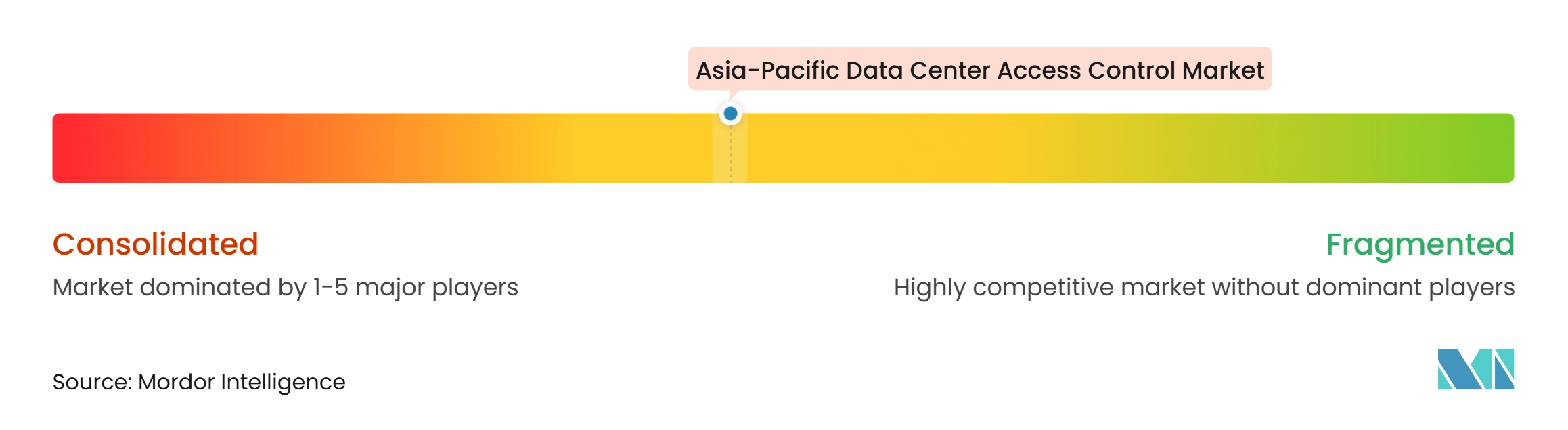
The Asia-Pacific data center access control market is moderately consolidated. Established suppliers retain strong positions through installed hardware, credentials, and long-term support arrangements. ASSA ABLOY’s HID Global, Honeywell, dormakaba, Gallagher Group, Verkada, and Suprema are active across different parts of the value chain. Incumbents benefit when operators need proven hardware compatibility and established service networks. Newer cloud-focused suppliers compete on simpler deployment and subscription models. Specialized providers also compete in biometric identification and cabinet-level protection. The result is a market where large vendors lead broad deployments while focused suppliers can win defined technical requirements.
Product breadth is becoming an important competitive factor. dormakaba expanded its data center and critical infrastructure offering through the 2025 acquisition of TANlock. The company later presented its expanded portfolio for critical infrastructure at ISC West 2026. Honeywell announced a March 2026 collaboration with Rhombus to combine AI-driven video and access control in a cloud solution. These actions show that suppliers are combining access, video, analytics, and cabinet security into more integrated offerings. The competitive advantage lies in reducing the number of separate systems that an operator must manage. Suppliers also need local channels and implementation capability in major Asia-Pacific markets.
HID’s identity and credential portfolio supports its role in deployments that need interoperable credentials and stronger authentication. Suprema integrates biometric devices with cloud management platforms, which can support organizations seeking less on-premise infrastructure. Verkada competes with cloud-managed physical security systems and regional channel expansion. The Asia-Pacific data center access control market has room for providers that link visitor management, contractor controls, doors, cages, and racks under one policy structure. Interoperability remains a key decision point because many operators have mixed estates. A supplier that can work with legacy hardware while enabling gradual modernization can be more attractive than one that requires complete replacement.
APAC Data Center Access Control Industry Leaders
-
ASSA ABLOY AB
-
Johnson Controls International plc
-
Honeywell International Inc.
-
dormakaba Holding AG
-
Suprema Inc.
- *Disclaimer: Major Players sorted in no particular order
APAC Data Center Access Control Market Companies Covered in this Report
- ASSA ABLOY AB
- Johnson Controls International plc
- Honeywell International Inc.
- dormakaba Holding AG
- Suprema Inc.
- HID Global Corporation
- Allegion plc
- Siemens AG
- Schneider Electric SE
- Bosch Security Systems
- Genetec Inc.
- Gallagher Group Limited
- Axis Communications AB
- NEC Corporation
- Verkada Inc.
- Nedap N.V.
- Identiv, Inc.
- Salto Systems, S.L.
- Brivo Systems, LLC
- IDEMIA
- LenelS2 (Carrier Global Corporation)
Recent Industry Developments in APAC Data Center Access Control Market
- August 2026: IDEMIA Public Security announced it had reduced face recognition identification errors by more than 40% compared with its previous NIST benchmark results, reinforcing its competitive position in biometric access control for data centers, government facilities, and high-security infrastructure.
- March 2026: dormakaba showcased its expanded data center portfolio at ISC West 2026, including rack-level TANlock solutions for data center customers.
- March 2026: Honeywell announced a collaboration with Rhombus to deliver integrated AI-powered video surveillance and access control as a unified cloud solution.
- February 2026: Fingerprint Cards AB announced that its AllKey biometric technology was deployed in a rack-level access control solution developed by ActChip for Dynamic Technologies, targeting Indian data center operators.
APAC Data Center Access Control Market Report Scope
The Asia-Pacific Data Center Access Control Market comprises security solutions that manage, authenticate, and monitor physical access to data center facilities, critical infrastructure, and restricted zones. These systems help prevent unauthorized entry, safeguard high-value IT assets, and ensure operational continuity through identity verification, access authorization, real-time monitoring, and audit capabilities. Market growth is driven by rising cybersecurity risks, increasing investments in hyperscale and colocation data centers, stricter compliance requirements, and the growing need for robust physical security across mission-critical digital infrastructure.
The Asia-Pacific Data Center Access Control Market Report is Segmented by Component (Hardware, Software, and Installation, Integration, and Support Services), Technology (Card and Credential-Based Systems, Biometric Systems, Mobile and Digital Credentials, PIN and Keypad Systems, and Multi-Factor Authentication Systems), Access Type (Door and Entry Control, Turnstiles and Personnel Entry Systems, Vehicle Access Control, Visitor and Contractor Management, and Rack-Level and Restricted-Zone Access Control), Deployment (On-Premises Systems, Cloud-Based Systems, and Hybrid Systems), Size (Small, Medium, Large, and Hyperscale), Type (Colocation, Cloud Service Providers, and Enterprise and Edge), and Geography (China, India, Japan, Australia, Singapore, and Rest of Asia-Pacific). The Market Forecasts are Provided in Terms of Value (USD).
Segmentation Overview
| Hardware |
| Software |
| Installation, Integration, and Support Services |
| Card and Credential-Based Systems |
| Biometric Systems |
| Mobile and Digital Credentials |
| PIN and Keypad Systems |
| Multi-Factor Authentication Systems |
| Door and Entry Control |
| Turnstiles and Personnel Entry Systems |
| Vehicle Access Control |
| Visitor and Contractor Management |
| Rack-Level and Restricted-Zone Access Control |
| On-Premise Systems |
| Cloud-Based Systems |
| Hybrid Systems |
| Small |
| Medium |
| Large |
| Hyperscale |
| Colocation |
| Cloud Service Providers (CSPs) |
| Enterprise / Edge |
| China |
| India |
| Japan |
| Australia |
| Singapore |
| Rest of Asia-Pacific |
| By Component | Hardware |
| Software | |
| Installation, Integration, and Support Services | |
| By Technology | Card and Credential-Based Systems |
| Biometric Systems | |
| Mobile and Digital Credentials | |
| PIN and Keypad Systems | |
| Multi-Factor Authentication Systems | |
| By Access Control Type | Door and Entry Control |
| Turnstiles and Personnel Entry Systems | |
| Vehicle Access Control | |
| Visitor and Contractor Management | |
| Rack-Level and Restricted-Zone Access Control | |
| By Deployment Model | On-Premise Systems |
| Cloud-Based Systems | |
| Hybrid Systems | |
| By Data Center Size | Small |
| Medium | |
| Large | |
| Hyperscale | |
| By Data Center Type | Colocation |
| Cloud Service Providers (CSPs) | |
| Enterprise / Edge | |
| By Geography | China |
| India | |
| Japan | |
| Australia | |
| Singapore | |
| Rest of Asia-Pacific |
Key Questions Answered in the Report
What is the Asia-Pacific data center access control market size?
The Asia-Pacific data center access control market size is USD 0.51 billion in 2026 and is expected to reach USD 0.90 billion by 2032.
What is the forecast CAGR for data center access control in Asia-Pacific?
The market is expected to expand at a CAGR of 12.31% during 2027-2032.
Which component holds the largest share in Asia-Pacific data center access control?
Hardware leads with a 48.65% share in 2026, supported by demand for readers, locks, terminals, and controllers.
Which access control technology is expanding fastest in Asia-Pacific data centers?
Mobile and digital credentials are projected to expand at a CAGR of 13.29% through 2032.
Why are rack-level controls becoming more important for data centers?
AI and high-density computing increase the need to secure server cabinets, GPU clusters, and other high-value restricted zones.
Which geography is expanding fastest for data center access control in Asia-Pacific?
India is projected to expand at a CAGR of 13.81% through 2032, supported by data center capacity additions and demand for audit-ready systems.