
Asia-Pacific Bottling Line Accumulating and Collating Machinery Market Size and Share
Market Overview
| Study Period | 2021 - 2032 |
|---|---|
| Forecast Data Period | 2027 - 2032 |
| Base Year Market Size (2026) | USD 457.35 Million |
| Market Size (2027) | USD 488.91 Million |
| Market Size (2032) | USD 701.57 Million |
| Growth Rate (2027 - 2032) | 7.49 % |
| Market Concentration | Medium |
Major Players *Disclaimer: Major Players sorted in no particular order Image © Mordor Intelligence. Reuse requires attribution under CC BY 4.0. | |
Asia-Pacific Bottling Line Accumulating and Collating Machinery Market Analysis by Mordor Intelligence
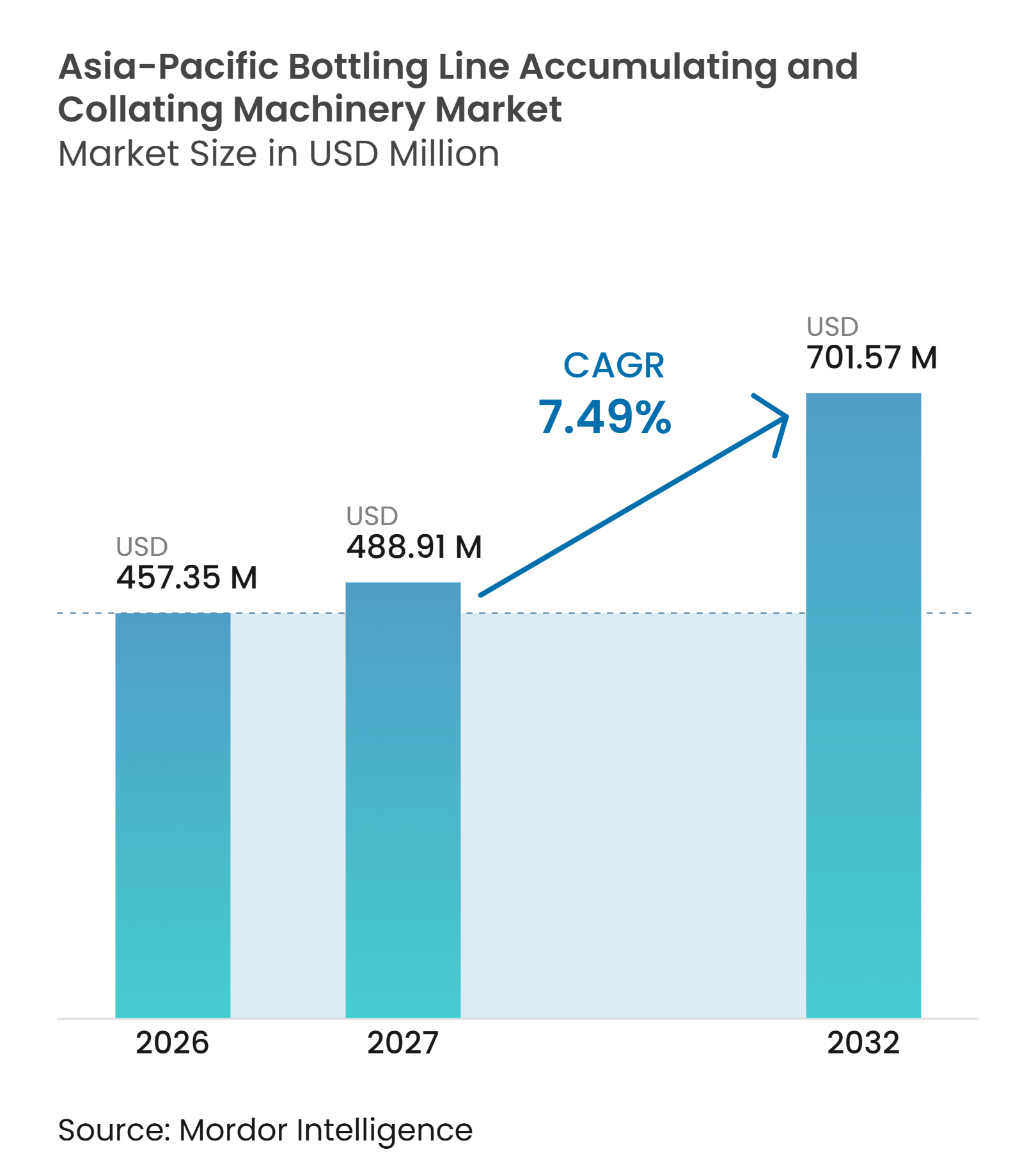
The Asia-Pacific Bottling Line Accumulating and Collating Machinery Market size is expected to increase from USD 457.35 million in 2026 to USD 488.91 million in 2027 and reach USD 701.57 million by 2032, growing at a CAGR of 7.49% over 2027-2032. The market is supported by investment in high-throughput, flexible beverage and pharmaceutical production lines across China, India, and Southeast Asia. Accumulation and collation equipment protects line continuity by absorbing short stoppages between filling, labeling, packing, and palletizing equipment. This function becomes especially important in integrated bottling projects because a disruption at this point can halt the entire production line. Suppliers are increasingly combining these modules with line controls, maintenance tools, and turnkey engineering rather than selling stand-alone equipment. High project costs and shortages of automation and maintenance personnel remain material limits for smaller producers in price-sensitive markets.
Key Report Takeaways
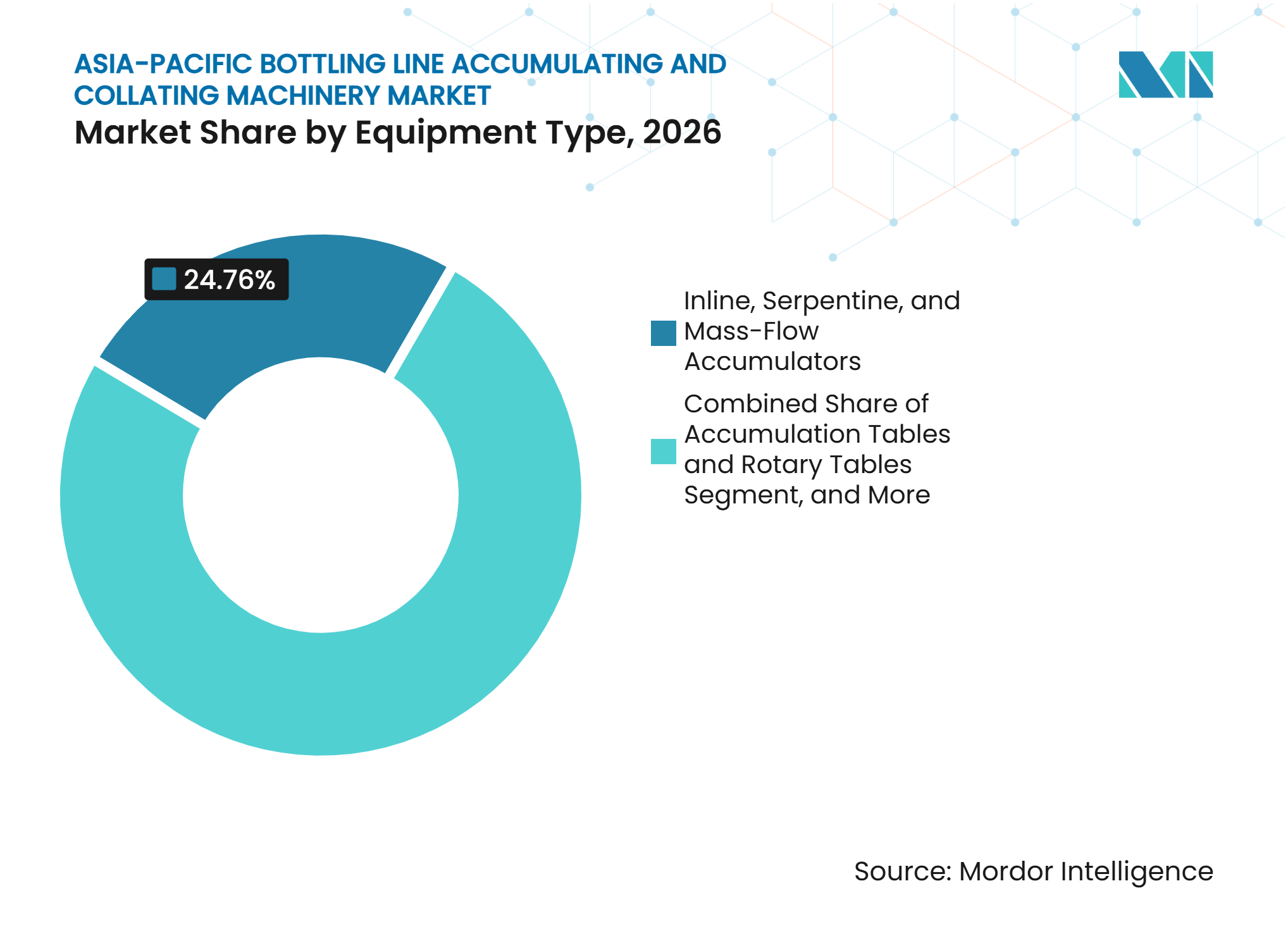
- By equipment type, Inline, Serpentine, and Mass-Flow Accumulators held 24.76% of the Asia-Pacific bottling line accumulating and collating machinery market share in 2026, while Alpine, Spiral, and Vertical Accumulators are projected to expand at a 8.18% CAGR through 2032.
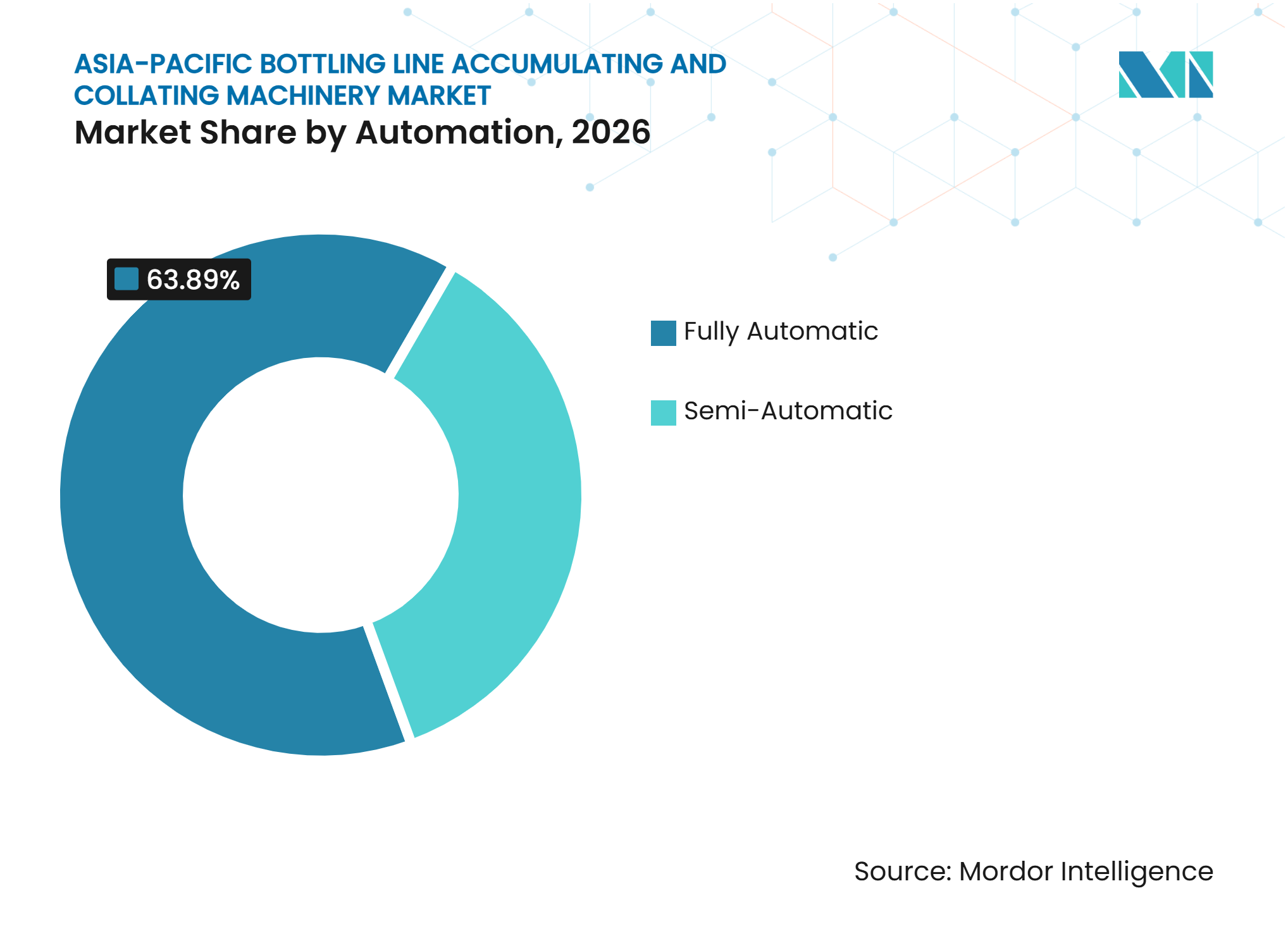
- By automation level, Fully Automatic systems accounted for 63.89% of the Asia-Pacific bottling line accumulating and collating machinery market size in 2026 and are projected to grow at a CAGR of 8.46% through 2032.
- By end user, Beverage Producers held 53.64% of the market share in 2026, while Pharmaceutical and Healthcare Producers are expected to grow at a 8.32% CAGR through 2032.
- By material type, Plastic held 58.32% of the market share in 2026, while Metal and Aluminum machinery is forecast to grow at a 8.23% CAGR through 2032.
- By container shape, Round Containers accounted for 68.47% of the market share in 2026, while Specialty and Irregular Geometries Containers are expected to expand at a 8.37% CAGR through 2032.
- By geography, China captured 43.28% of the market share in 2026, while India is projected to grow at a 8.39% CAGR through 2032.
Note: Market numbers in this report are based on Mordor Intelligence's proprietary estimation framework, which combines nine months of actuals with Q4 projections for base year 2026.
Market Trends and Insights
Drivers Impact Analysis of Asia-Pacific Bottling Line Accumulating and Collating Machinery Market*
| Driver | (~) % Impact on CAGR Forecast | Geographic Relevance | Impact Timeline |
|---|---|---|---|
| Automated High-Speed Bottling Line Adoption | +2.1% | China, India, Southeast Asia, including Vietnam, Indonesia, and Thailand | Short term (≤ 2 years) |
| Format Flexibility and Rapid Changeovers | +1.5% | China, India, South Korea, and Australia | Short term (≤ 2 years) |
| Bottled Water, Functional Beverage, Dairy Drink, and Ready-to-Drink Growth | +1.3% | China, India, Southeast Asia, and Japan | Medium term (2-4 years) |
| Integrated Line Control and Predictive Maintenance Requirements | +0.9% | China, India, Japan, and South Korea | Medium term (2-4 years) |
| Contract Manufacturing and Co-Packing Capacity Expansion | +0.7% | Vietnam, Thailand, Philippines, and South Korea | Long term (≥ 4 years) |
| Lightweight and Non-Round Container Handling | +0.5% | China, India, and Australia | Medium term (2-4 years) |
| Source: Mordor Intelligence | |||
Rising Adoption of Automated High-Speed Bottling Lines
Throughput requirements are increasing across the Asia-Pacific bottling line, driving the accumulation and consolidation of machinery as producers replace semi-automated stages. HCCB commissioned a Kinley Water line at its Avinya facility in Telangana in April 2026, with an output of 1,350 bottles per minute for 500 ml PET containers. This level of output requires buffers that can manage downstream micro-stoppages without stopping the filler. Tech-Long launched 2 self-manufactured 72,000 BPH blowing-labeling-filling-capping combi lines in December 2025.[1] The company integrated bottle blowing, non-contact filling, and capping into a continuous process, increasing the need for controlled product flow between machines.
Demand for Format Flexibility and Rapid Changeovers
Beverage and pharmaceutical plants are running more stock-keeping units on the same assets. Energy drinks may use 250 ml slim cans, still water may use 10-liter flat-sided containers, and pharmaceutical products may require small non-round bottles. This combination makes accumulation a line-management issue rather than a fixed conveyor design choice. Sidel states that its Cermex RoboSELEX bottle collating system can handle lightweight bottle shapes, including conical, asymmetrical, and small-base designs, at up to 320 products per minute. The system also reduces the need for intermediate accumulation stages in selected applications.
Growth of Bottled Water, Functional Beverages, Dairy Drinks, and Ready-to-Drink Products
Investment in bottled water, functional beverages, dairy drinks, and ready-to-drink products is driving the expansion of high-speed packaging projects. Suntory PepsiCo Vietnam Beverage opened its USD 300 million Tay Ninh manufacturing plant in 2025. The facility can produce 84,000 PET bottles per hour and includes an automated warehouse and robotic material handling. This creates related demand for buffer zones and collation equipment. SIG stated that India’s dairy sector was valued at USD 150 billion and that only 10% was packaged, when discussing its 2025 investment plans. Packaged dairy and beverage applications require hygienic material handling and dependable movement through filling and secondary packaging stages.
Integrated Line Control and Predictive Maintenance Requirements
Operators increasingly measure downtime in lost output per minute. They want accumulation systems to contribute data and active control, rather than providing only passive buffering. Sensors can track buffer levels, container spacing, and line pressure, allowing the equipment to respond before a jam disrupts production. This is particularly important on lines where the filler, labeler, packer, and palletizer operate at different speeds. The result is stronger demand for speed modulation and sensor-based jam prevention. Tech-Long’s Digital Aseptic Filling Production Line and Intelligent Blowing-Labeling-Filling-Capping Combi Machine were selected for a China Machinery Industry Federation promotion list in 2025.
Restraints Impact Analysis of Asia-Pacific Bottling Line Accumulating and Collating Machinery Market*
| Restraint | (~) % Impact on CAGR Forecast | Geographic Relevance | Impact Timeline |
|---|---|---|---|
| High Capital Intensity of Integrated Bottling Lines | -1.2% | Southeast Asia and India, especially Tier 2 and Tier 3 producers | Short term (≤ 2 years) |
| Multi-Country Compliance and Qualification Requirements | -0.8% | ASEAN markets, India, South Korea, and Australia | Medium term (2-4 years) |
| Shortage of Skilled Automation and Maintenance Personnel | -0.6% | Vietnam, Thailand, Indonesia, and Philippines | Long term (≥ 4 years) |
| Container Instability, Lightweighting, and Product Damage Risk | -0.3% | China, India, and Australia | Medium term (2-4 years) |
| Source: Mordor Intelligence | |||
High Capital Intensity of Integrated Bottling Lines
A fully integrated high-speed bottling line can require an investment of over USD 10 million for a mid-tier producer in India or Southeast Asia. Accumulation and conveying infrastructure can account for 15%-25% of the total line cost. This cost is incurred early in the project, before the producer receives revenue from higher output. Regional producers often have limited access to leasing structures for packaging equipment. The financing challenge is more acute where packaged beverage demand is growing, but producers remain fragmented. Accumulation and collation equipment protects throughput rather than directly creating it. This can make the investment case less visible than the case for a filler or labeler. Legacy sites also face space limitations because spiral towers require vertical clearance and horizontal serpentine systems require long floor layouts.
Complex Multi-Country Compliance and Qualification Requirements
Producers distributing products across Asia-Pacific face different qualification requirements in each country. The issue is particularly relevant in pharmaceutical and food-grade applications, where material-contact surfaces and traceability controls must comply with local regulations. India’s revised Schedule M provisions align manufacturing requirements with World Health Organization good manufacturing practices. This raises the sanitary engineering standard for bottling equipment used in pharmaceutical production. It also supports demand for validation documents and cleanable designs. Compliance work raises engineering and documentation costs for machinery builders serving multiple countries.
*Our forecasts treat driver/restraint impacts as directional, not additive. The impact forecasts reflect baseline growth, mix effects, and variable interactions.
Asia-Pacific Bottling Line Accumulating and Collating Machinery Market Segment Analysis
By Equipment Type:
Spiral Systems Gain Share in Space-Constrained LinesAlpine, Spiral, and Vertical Accumulators are projected to grow at an 8.18% CAGR from 2027 to 2032. Urban production zones in India, Vietnam, and Indonesia often limit available floor space for line expansion. Vertical buffer designs can offer comparable buffering capacity with less horizontal space than serpentine layouts. This makes them practical when a plant wants to add capacity without extensive building changes. Container geometry also influences equipment selection because mass-flow handling can add pressure to lightweight bottles. Dabrico notes that accumulation systems are designed around the product's stability and movement needs.[2] This issue becomes more relevant as producers reduce bottle weight.
Inline, Serpentine, and Mass-Flow Accumulators held 24.76% of the Asia-Pacific bottling line accumulating and collating machinery market share in 2026. They remain well suited to high-volume, continuous-flow beverage facilities, especially in China. Circular containers can move at high density through these systems as long as product pressure remains acceptable. The Asia-Pacific bottling line accumulating and collating machinery market size for this equipment group remains supported by established beverage capacity. Sidel’s RoboSELEX system offers another direction, as it can collate some light bottles without an intermediate accumulation step. This may reshape specifications for flexible, multi-product lines rather than replace conventional buffers in every application.



By Material Type:
Metal and Aluminum Gains from Pharmaceutical and Aseptic DemandMetal and Aluminum machinery is projected to grow at an 8.23% CAGR from 2027 to 2032. Pharmaceutical and aseptic beverage producers require stainless steel product-contact surfaces, clean-in-place compatibility, and resistance to humid operating conditions. Pasteurization and hot-fill processes can further increase demand for durable hygienic equipment. This investment expands the base of pharmaceutical-grade packaging lines. It supports continued procurement of sanitary accumulation and collation systems.
Plastic held 58.32% of the Asia-Pacific bottling line accumulating and collating machinery market share in 2026. Beverage producers use these systems extensively for water and carbonated soft drink lines where stainless product contact is not required. Their cost profile is important for lines that require long conveyor runs. Suppliers are improving these systems with food-grade polymer chain covers and lower-friction transfer surfaces. These measures maintain plastic’s role in high-volume beverage applications.
By Container Shape:
Irregular Geometry Raises Engineering RequirementsSpecialty and Irregular Geometries Containers are expected to expand at an 8.37% CAGR through 2032. Premium still water, functional drinks, and pharmaceutical products are increasing the use of square, oval, and asymmetrical container formats. Sidel introduced its Nitro Square PET bottle for nitrogen-dosed still water in 2025. Such shapes may require custom tooling, whereas conventional circular star wheels are used for others. They also require more controlled movement through accumulation zones. The equipment must limit pressure and protect containers from scuffing or deformation.
Round Containers accounted for 68.47% of the Asia-Pacific bottling line accumulating and collating machinery market share in 2026. Still water and carbonated soft drinks account for much of this demand because circular containers are efficient in mass-flow accumulation. Plants may still need to switch between round, oval, and square profiles during a shift. This increases the importance of adjustable rails, controlled zone speeds, and sensing systems. Puck conveyors can stabilize non-round containers by using external carriers during transport. As the variety of formats rises, suppliers will need to combine high-density handling with controlled movement for less-stable products.
By Automation Level:
Fully Automatic Systems Become the Standard DesignFully Automatic systems held 63.89% of the Asia-Pacific bottling line accumulating and collating machinery market share in 2026 and are forecast to grow at an 8.46% CAGR through 2032. Producers are weighing labor cost, product loss, and downtime alongside the purchase price of the equipment. This has improved the economics of automatic systems even for mid-volume sites. China’s Pearl River Delta and South Korea are key locations where skilled line operators can command higher wages. This makes automated control, inspection, and product transfer more attractive. The largest segment, also the fastest-growing, shows a continued move away from manual intervention in new projects.
Semi-Automatic systems retain a role among smaller producers in Southeast Asia and India’s Tier 2 and Tier 3 manufacturing centers. Their specifications are declining in new projects as financing options and local technical support improve. Tech-Long states that its intelligent combi system reaches overall efficiency of at least 95%, reduces footprint by 70%, and cuts labor costs by more than 50% compared with equivalent stand-alone combinations. These benefits strengthen the case for linked automation in the Asia-Pacific bottling line accumulating and collating machinery market. The equipment must also remain serviceable for plants with limited in-house automation staff. This creates an opening for suppliers that pair automation with training and remote support.

By End User:
Pharmaceutical Requirements Lift System SpecificationsPharmaceutical and Healthcare Producers are forecast to grow at an 8.32% CAGR from 2027 to 2032. Aseptic drug-product filling is moving toward integrated line designs that also serve oral rehydration solutions, liquid vitamins, and pediatric suspensions. These applications require pharmaceutical-grade stainless steel, compatible enclosures, and formal validation documentation. The resulting equipment can cost more than comparable beverage-grade systems. This changes the product mix of the Asia-Pacific bottling line accumulating and collating machinery market. It also increases the importance of hygienic design and traceable operating controls.
Beverage Producers held 53.64% of the Asia-Pacific bottling line accumulating and collating machinery market share in 2026. Their large installed base supports replacement projects, capacity additions, and format-change upgrades. Beverage lines also require reliable buffering between high-speed filling, labeling, and end-of-line equipment. Pharmaceutical investment adds a distinct demand stream rather than simply replacing beverage demand. Suppliers that can serve both applications may benefit from shared automation needs while adapting their materials and documentation to each end-user's requirements.
Geography Analysis
China: Domestic Suppliers Strengthen the Largest National Base
China held 43.28% of the Asia-Pacific bottling line accumulating and collating machinery market share in 2026. The country combines a large beverage production base with local machinery suppliers that compete on cost, lead times, and throughput. Domestic engineering capacity is increasingly relevant in high-speed and aseptic applications that previously favored European suppliers. Tech-Long’s 2025 launch of 72,000 BPH combi lines demonstrates its focus on high-output integrated equipment. The government’s broader manufacturing policy direction continues to support automation and local equipment capability. Connected controls and line-level data systems are becoming more important in new specifications. This creates a competitive environment in which local suppliers can pair capital-cost advantages with digital capabilities.
India: Capacity Investment Supports the Fastest Growth Rate
India is projected to record an 8.39% CAGR from 2027 to 2032, the highest rate among the regional geographies. Krones is set to open its Vemagal facility in Karnataka in August 2026, with an investment of INR 315 crore (USD 37.7 million) and a manufacturing area of 16,000 square meters. The facility produces ErgoBloc packaging systems capable of handling up to 100,000 containers per hour. Local manufacturing can reduce delivery times for Indian beverage producers purchasing integrated lines. Varun Beverages upgraded 4 carbonated soft drink lines at its Supa plant in Pune during July 2025, adding automated wrapping, palletizing, and packaging equipment. The pharmaceutical incentive program adds a parallel source of demand for validated and sanitary accumulation systems. Schedule M compliance factors further reinforce the value of hygienic design in pharmaceutical projects.
Japan, South Korea, Australia, and Southeast Asia: Different Operating Needs Support Investment
Japan has a mature, high-value environment where labor constraints and multi-stock-keeping-unit portfolios support investment in automated changeovers and connected maintenance. South Korea’s contract manufacturing base requires flexible buffer systems across multiple beverage formats. Krones reports that Samyang Packaging operates 7 bottling lines at Gwanghyewon, including 3 PET-AseptBloc L lines that process containers from 230 ml to 1.8 liters at 40,000 BPH.[3] Australia also sets high throughput benchmarks, as Nu-Pure commissioned a 100,000 BPH Krones ErgoBloc L line in October 2025. In Southeast Asia, contract manufacturing is expanding capacity for ready-to-drink beverages and dairy products. DenEast began work on a Sidel aseptic PET line in Vietnam in March 2025, while Actron Industries started commercial production with a SIG aseptic line in the Philippines in 2026. These projects create demand for flexible flow control, rapid volume changes, and line equipment that supports food safety requirements.
Competitive Landscape
Market Concentration
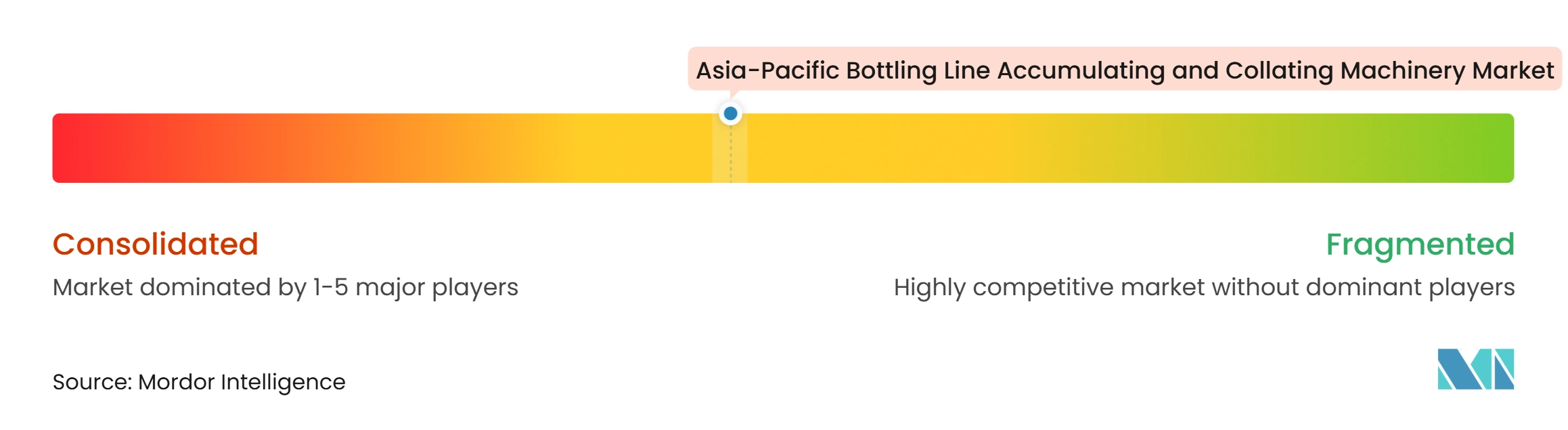
The Asia-Pacific bottling line accumulating and collating machinery market is moderately concentrated. Krones and Sidel compete as full-line integrators with established positions in high-speed and aseptic applications. Tech-Long and Newamstar represent China-based suppliers that compete more directly in mid-tier and increasingly high-speed projects. Specialized accumulation and conveying providers serve narrower equipment needs. The market structure favors suppliers that can connect accumulation modules with the wider filling, labeling, packing, and palletizing line. This integration reduces coordination work for customers and makes equipment availability a shared design objective.
Krones has expanded its local presence in India through the Vemagal facility, strengthening its ability to serve projects with shorter delivery requirements. The company also completed acquisitions of a 60% interest in GHS Separationstechnik and all of Can Systems Worldwide in 2026. These moves extend its process technology and filling and canning capabilities. Tech-Long’s 72,000 BPH combi-line launch is another strategic move, targeting high-speed production with an integrated platform. Sidel’s continued work on flexible bottle-collation equipment addresses the rising need to handle lightweight and irregular formats.
Pharmaceutical-grade hygienic design and flexible, high-speed collation remain areas of high customer demand. Systems may need cleanroom-compatible designs, rapid mechanical changes, and validation documentation simultaneously. Digital monitoring is another competitive factor, as operators increasingly expect remote visibility into buffer levels, line speed, and potential faults. Regional suppliers can compete through faster service visits and spare-parts availability. Larger vendors can compete through broader line integration, reference installations, and multi-country compliance experience. The Asia-Pacific bottling line accumulating and collating machinery market therefore rewards both engineering capability and local support capacity.
Asia-Pacific Bottling Line Accumulating and Collating Machinery Industry Leaders
-
Krones AG
-
KHS GmbH
-
Tetra Pak International S.A.
-
Syntegon Technology GmbH
-
Coesia S.p.A.
- *Disclaimer: Major Players sorted in no particular order
Asia-Pacific Bottling Line Accumulating and Collating Machinery Market Companies Covered in this Report
- Krones AG
- KHS GmbH
- Tetra Pak International S.A.
- Syntegon Technology GmbH
- Coesia S.p.A.
- SMI S.p.A.
- SACMI Imola S.C.
- OCME S.r.l.
- Serac Group SAS
- Aetna Group S.p.A.
- Robopac S.p.A.
- ProMach, Inc.
- Barry-Wehmiller Companies, Inc.
- Douglas Machine Inc.
- Delkor Systems, Inc.
- Cama Group S.p.A.
- Bradman Lake Group Ltd.
- IC Filling Systems S.r.l.
- Zhangjiagang King Machine Co., Ltd.
- Newamstar Packaging Machinery Co., Ltd.
- Shanghai Lilan Machinery Equipment Co., Ltd.
- Hilden Packaging Machines Pvt. Ltd.
- Intralox, L.L.C.
- Ambaflex International B.V.
- Hytrol Conveyor Company, Inc.
Recent Industry Developments in Asia-Pacific Bottling Line Accumulating and Collating Machinery Market
- November 2026: Newamstar signed a long-term strategic cooperation agreement with Shanghai Xinfazhan Group, including a contract for a 72,000-BPH integrated blow-fill-cap beverage production line. The agreement extends the Chinese builder's presence in ultra-high-speed aseptic filling, a segment historically dominated by European suppliers.
- October 2026: Newamstar unveiled a "lights-out factory" solution at an industry exhibition in China, designed to enable unmanned operations across 5 core production procedures including production changeover, quality inspection, material handling, and truck loading, showcasing an integrated 48,000-BPH blow-labeling-filling-capping unit relying on autonomous accumulation flow management.
- June 2026: Krones AG completed 2 portfolio-expansion acquisitions, a 60% stake in GHS Separationstechnik GmbH for solid-liquid separation in juice and food processing, and a full acquisition of Can Systems Worldwide, a Dutch company specializing in filling and canning equipment.
- April 2026: HCCB commissioned a high-speed Kinley Water production line at its Avinya Greenfield Factory in Telangana, India, capable of 1,350 bottles per minute for 500 ml PET containers, integrating HMI-based centralized monitoring and an advanced dosing system with an integrated automation framework.
Asia-Pacific Bottling Line Accumulating and Collating Machinery Market Report Scope
The Asia-Pacific bottling line accumulating and collating machinery market comprises equipment designed to manage, organize, and synchronize bottles, containers, and packaged products during bottling operations. Accumulating machinery temporarily stores products to balance production line speeds and prevent disruptions, while collating machinery arranges products into predefined patterns for secondary packaging, palletizing, or distribution. These systems support operational efficiency, reduce downtime, and improve throughput across beverage, food, pharmaceutical, and other packaging industries.
The Asia-Pacific Bottling Line Accumulating and Collating Machinery Market Report is Segmented by Equipment Type (Bi-Directional and Recirculating Accumulators, Alpine, Spiral, and Vertical Accumulators, Inline, Serpentine, and Mass-Flow Accumulators, Standalone Collators and Grouping Systems, Bottle Laners, Combiners, and Lane Dividers, Accumulation Tables and Rotary Tables, and Other Equipment Types), Material Type (Plastic, Glass, Metal and Aluminum, and Carton and Composite Containers), Container Shape (Round Containers, Non-Round / Shaped Containers, and Specialty and Irregular Geometries Containers), Automation (Semi-Automatic, and Fully Automatic), End User (Beverage Producers, Food and Dairy Producers, Pharmaceutical and Healthcare Producers, Personal Care and Cosmetics Producers, Chemical and Household Product Producers, and Other End Users), and Geography (China, India, Japan, South Korea, Australia, Southeast Asia, and Rest of Asia-Pacific). The Market Forecasts are Provided in Terms of Value (USD).
Segmentation Overview
| Bi-Directional and Recirculating Accumulators |
| Alpine, Spiral, and Vertical Accumulators |
| Inline, Serpentine, and Mass-Flow Accumulators |
| Standalone Collators and Grouping Systems |
| Bottle Laners, Combiners, and Lane Dividers |
| Accumulation Tables and Rotary Tables |
| Other Equipment Types |
| Plastic |
| Glass |
| Metal and Aluminum |
| Carton and Composite Containers |
| Round Containers |
| Non-Round / Shaped Containers |
| Specialty and Irregular Geometries Containers |
| Semi-Automatic |
| Fully Automatic |
| Beverage Producers |
| Food and Dairy Producers |
| Pharmaceutical and Healthcare Producers |
| Personal Care and Cosmetics Producers |
| Chemical and Household Product Producers |
| Other End Users |
| China |
| India |
| Japan |
| South Korea |
| Australia |
| Southeast Asia |
| Rest of Asia-Pacific |
| By Equipment Type | Bi-Directional and Recirculating Accumulators |
| Alpine, Spiral, and Vertical Accumulators | |
| Inline, Serpentine, and Mass-Flow Accumulators | |
| Standalone Collators and Grouping Systems | |
| Bottle Laners, Combiners, and Lane Dividers | |
| Accumulation Tables and Rotary Tables | |
| Other Equipment Types | |
| By Material Type | Plastic |
| Glass | |
| Metal and Aluminum | |
| Carton and Composite Containers | |
| By Container Shape | Round Containers |
| Non-Round / Shaped Containers | |
| Specialty and Irregular Geometries Containers | |
| By Automation | Semi-Automatic |
| Fully Automatic | |
| By End User | Beverage Producers |
| Food and Dairy Producers | |
| Pharmaceutical and Healthcare Producers | |
| Personal Care and Cosmetics Producers | |
| Chemical and Household Product Producers | |
| Other End Users | |
| By Geography | China |
| India | |
| Japan | |
| South Korea | |
| Australia | |
| Southeast Asia | |
| Rest of Asia-Pacific |
Key Questions Answered in the Report
What is the Asia-Pacific bottling line accumulating and collating machinery market size?
The Asia-Pacific Bottling Line Accumulating And Collating Machinery Market size is expected to increase from USD 457.35 million in 2026 to USD 488.91 million in 2027 and reach USD 701.57 million by 2032, growing at a CAGR of 7.49% over 2027-2032.
What is driving demand for bottling line accumulation equipment in Asia-Pacific?
High-speed bottling investment, broader automation, format flexibility, and growing beverage and pharmaceutical capacity are the main demand factors. The equipment helps protect line continuity between filling, labeling, packing, and palletizing machines. It can absorb short interruptions downstream and reduce the risk that an issue at one station stops the filler or affects the wider production schedule.
Which equipment type is growing fastest in Asia-Pacific bottling lines?
Alpine, Spiral, and Vertical Accumulators are projected to grow at an 8.18% CAGR through 2032.
Why are fully automatic accumulation systems gaining adoption?
Fully Automatic systems held 63.89% share in 2026 and are projected to grow at an 8.46% CAGR.
Which country has the largest share of Asia-Pacific bottling machinery demand?
China held 43.28% share in 2026. Its position is supported by a large beverage production base, domestic machinery capability, and rising investment in integrated high-speed and aseptic equipment.