
Asia-Pacific Agricultural Technical Textile Market Size and Share
Market Overview
| Study Period | 2021 - 2032 |
|---|---|
| Forecast Data Period | 2027 - 2032 |
| Base Year Market Size (2026) | USD 8.54 Billion |
| Market Size (2027) | USD 8.96 Billion |
| Market Size (2032) | USD 11.73 Billion |
| Growth Rate (2027 - 2032) | 5.54 % |
| Market Concentration | Low |
Major Players *Disclaimer: Major Players sorted in no particular order Image © Mordor Intelligence. Reuse requires attribution under CC BY 4.0. | |
Asia-Pacific Agricultural Technical Textile Market Analysis by Mordor Intelligence
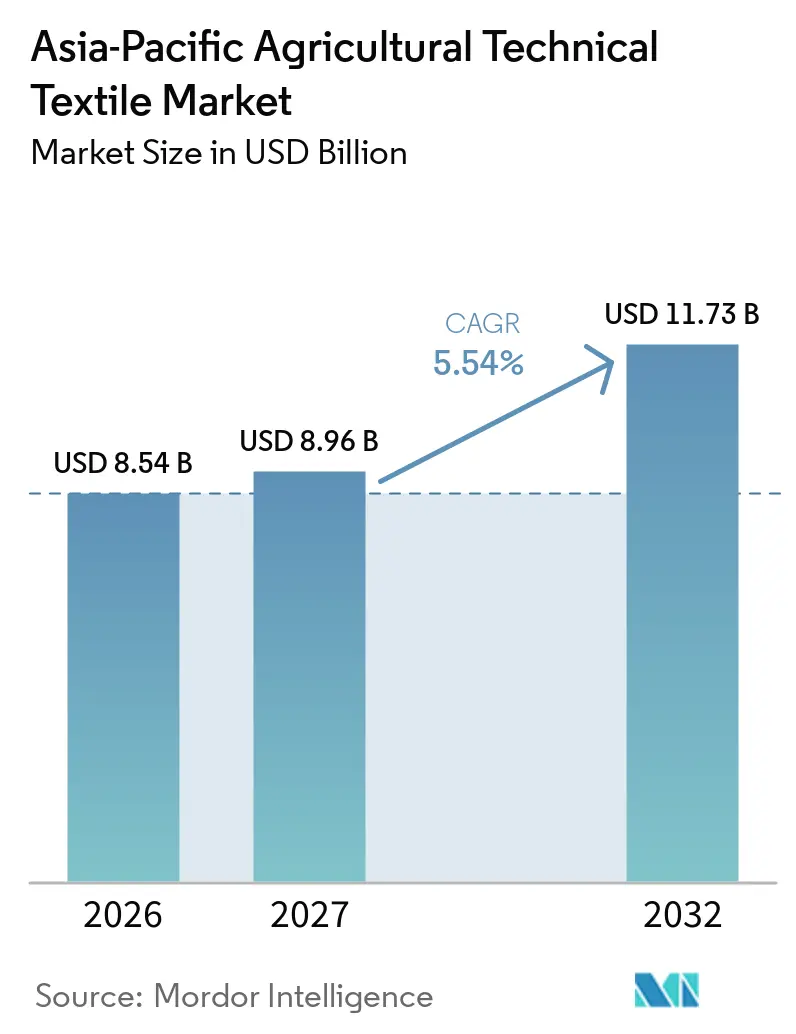
The Asia-Pacific Agricultural Technical Textile Market size is projected to be USD 8.54 billion in 2026, USD 8.96 billion in 2027, and reach USD 11.73 billion by 2032, growing at a CAGR of 5.54% from 2027 to 2032.
Demand is supported by less predictable weather, higher expectations for produce quality, and the need to improve output from limited farmland. Agrotextiles are becoming part of longer-term growing systems rather than occasional inputs, especially where growers manage insects, heat, and rainfall risk. The Asia-Pacific agricultural technical textile market also benefits when protected cultivation programs make high-specification nets and screens more accessible to growers. Public investment in food production and climate resilience supports this shift because it directs attention to infrastructure that protects yields. The competitive opportunity lies in durable products, local distribution, and systems that combine textiles with greenhouse and irrigation equipment.
Key Report Takeaways
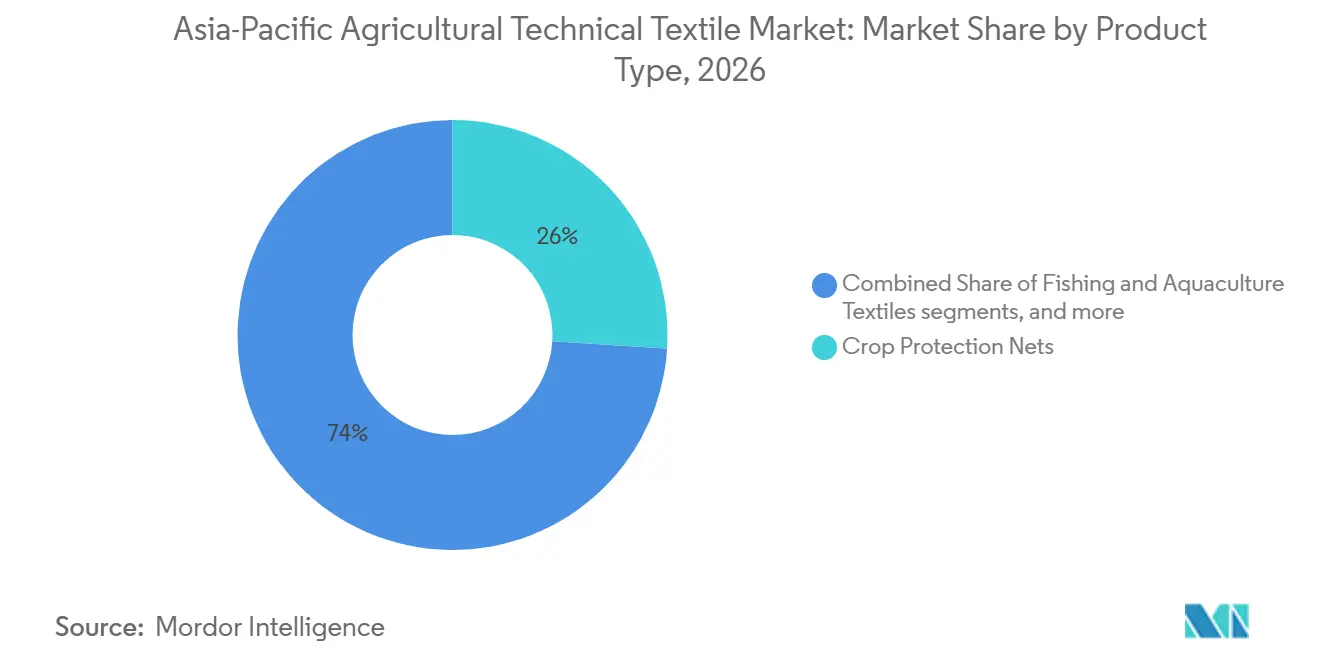
- By product type, crop protection nets accounted for 26% of the Asia-Pacific agricultural technical textile market share in 2026, while agricultural shade nets and greenhouse climate screens are projected to be the fastest-growing, registering an 8.0% CAGR through 2032.
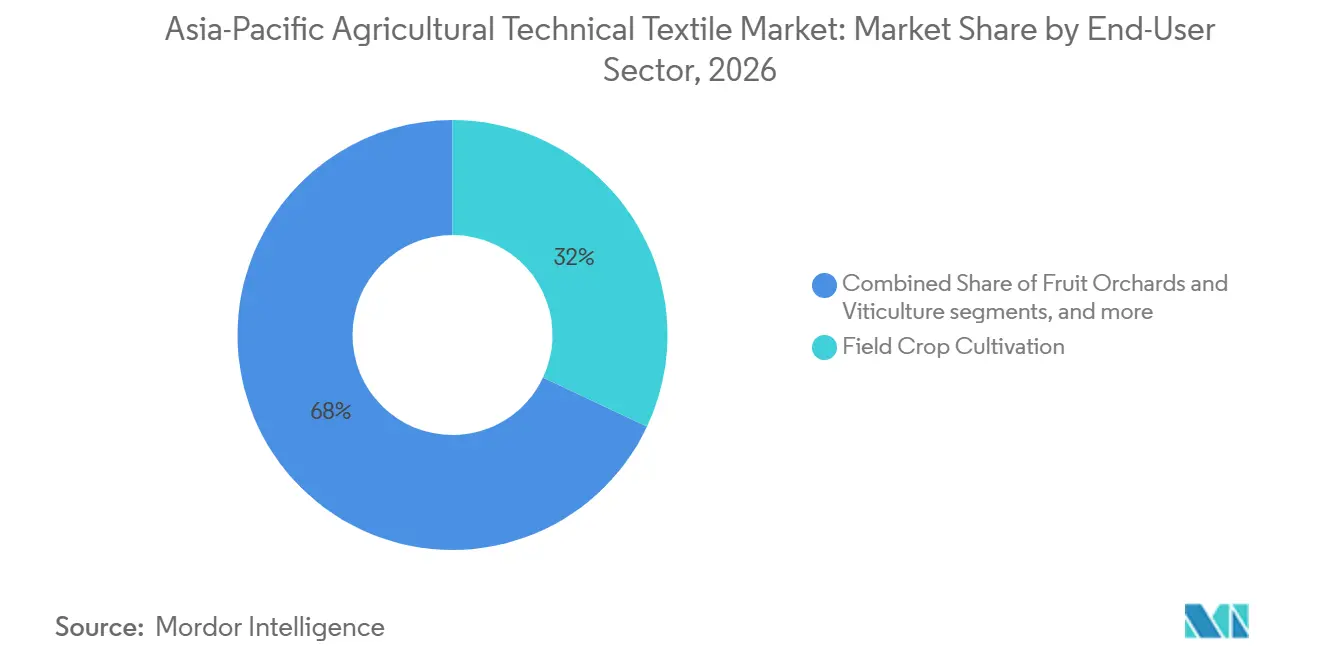
- By end-use sector, field crop cultivation accounted for 32% of the Asia-Pacific agricultural technical textile market size in 2026, while vegetable, floriculture, and nursery cultivation are projected to be the fastest-growing end-use sector, registering a 7.5% CAGR through 2032.
- By geography, China accounted for 32% of the Asia-Pacific revenue share in 2026, while India is projected to grow at a 7.5% CAGR through 2032.
Note: Market numbers in this report are based on Mordor Intelligence's proprietary estimation framework, which combines nine months of actuals with Q4 projections for base year 2026.
Market Trends and Insights
Drivers Impact Analysis of Asia-Pacific Agricultural Technical Textile Market*
| Driver | (~) % Impact on CAGR Forecast | Geographic Relevance | Impact Timeline |
|---|---|---|---|
| Rising Demand for Agricultural Output and Higher-Quality Produce | +1.5% | China, India, Vietnam, and Indonesia | Short term (≤ 2 years) |
| Expansion of Protected Cultivation and Controlled-Environment Agriculture | +1.2% | China, India, South Korea, Japan, and Australia | Medium term (2-4 years) |
| Climate Variability and Extreme-Weather Crop Protection | +0.9% | Asia-Pacific, especially South and Southeast Asia | Short term (≤ 2 years) |
| Government Support for Sustainable and Resource-Efficient Agriculture | +0.7% | India, China, South Korea, Japan, and ASEAN | Medium term (2-4 years) |
| Agrotextile Integration With Sensors and Precision Irrigation | +0.5% | Japan, South Korea, Australia, and early adopters in China | Long term (≥ 4 years) |
| Modular Systems for Fragmented Smallholder Farms | +0.3% | India, Indonesia, Vietnam, and the Philippines | Long term (≥ 4 years) |
| Source: Mordor Intelligence | |||
Rising Demand for Agricultural Output and Higher-Quality Produce
Food security pressure is increasing the use of agrotextiles as growers seek more reliable yields without a matching rise in chemical inputs. The OECD-FAO outlook expects Asia to remain a major center for staple crops and processing, while demand for higher-quality fruit, vegetables, and floriculture rises with income growth. Anti-insect nets, shade nets, and crop covers can limit pest exposure and heat stress, which helps growers meet buyer requirements for residue-conscious produce. This makes the Asia-Pacific agricultural technical textile market relevant to both domestic food supply and export-oriented cultivation. As growers move toward higher-value crops, they are more likely to select multi-season products with several protective functions. That progression supports demand for longer-lasting nets rather than single-season materials.
Expansion of Protected Cultivation and Controlled-Environment Agriculture
Protected cultivation raises textile use per hectare because greenhouses and covered structures need screens, nets, and crop covers throughout the growing cycle. India’s horticulture support framework includes assistance for protected cultivation, while technical-textile initiatives support equipment and application development. South Korea allocated USD 8.9 million in 2025 for ICT-integrated smart greenhouse construction, including a 50% subsidy for qualifying operators. Japan also issued a second public call in June 2025 for its Smart Greenhouse Expansion Promotion program.[1] These programs favor higher-performance screens and shade nets over basic materials. The Asia-Pacific agricultural technical textile market therefore gains from both new installations and upgrades of older protected structures.
Climate Variability and Extreme-Weather Crop Protection
More frequent weather disruption is making preventive crop protection a practical investment for a wider group of growers. A 2025 scientific study found that climatic extremes had reduced yields of key cereal crops in Asia-Pacific by 9-10%. FAO reported that Asia accounted for 47% of global agricultural disaster losses, totaling USD 1.53 trillion over three decades. In the Philippines, cyclones and monsoon flooding caused USD 19 million in agricultural losses during 2025 and affected 43,741 hectares. Anti-hail nets, windbreaks, and floating row covers are becoming relevant beyond high-value export crops. This widens the potential customer base for the Asia-Pacific agricultural technical textile market.
Government Support for Sustainable and Resource-Efficient Agriculture
Government programs are supporting agrotextile adoption through farmer assistance, research, and manufacturing incentives. India’s National Technical Textiles Mission had an approved budget of USD 177 million through 2025-26 and included 14 agrotextile research projects. The projects cover insecticidal nets, biodegradable mulch, smart crop covers, and aquaculture textiles. The Climate-Smart Agro-Textile Demonstration Centre in Navsari had trained 576 farmers by August 2025 using monitored field applications. India’s technical-textile production incentive program also provides a supply-side foundation for domestic manufacturing. These measures can reduce adoption barriers and strengthen the domestic supplier base for the Asia-Pacific agricultural technical textile market.
Restraints Impact Analysis of Asia-Pacific Agricultural Technical Textile Market*
| Restraint | (~) % Impact on CAGR Forecast | Geographic Relevance | Impact Timeline |
|---|---|---|---|
| High Initial Investment in Protected Farming Systems | -1.2% | India, Indonesia, Vietnam, the Philippines, and the rest of Asia-Pacific | Short term (≤ 2 years) |
| Volatility in Polyethylene and Polypropylene Feedstock Prices | -0.8% | Asia-Pacific, especially China, India, and Southeast Asia | Short term (≤ 2 years) |
| Agricultural Plastic Waste and Limited Rural Recycling Infrastructure | -0.5% | Southeast Asia, India, and Pacific economies | Medium term (2-4 years) |
| Inconsistent Product Standards and Limited Grower Technical Awareness | -0.3% | ASEAN emerging economies and Rest of Asia-Pacific | Long term (≥ 4 years) |
| Source: Mordor Intelligence | |||
High Initial Investment in Protected Farming Systems
The initial cost of protected cultivation remains a major barrier for smaller farms. Agrotextile components can represent 20-35% of the setup cost for a polyhouse or shade-net house. Support programs can reduce the burden, but growers may still need financing before they can install a complete system. ADB estimates that Asia-Pacific needs USD 68 billion in annual targeted agricultural investment to address food production and climate risks.[2] This financing gap separates commercial growers that can choose premium systems from price-sensitive farms that cannot. It can limit value growth in the Asia-Pacific agricultural technical textile market even where basic product demand remains strong.
Volatility in Polyethylene and Polypropylene Feedstock Prices
Polyethylene and polypropylene are core materials for shade nets, crop-protection netting, and nonwoven covers. Changes in energy prices, supply disruptions, and capacity imbalances make production costs difficult to manage. The OECD-FAO outlook notes that volatility in agricultural input costs can weaken farm investment planning. Manufacturers without integrated raw-material supply can face narrower margins and may reduce investment in UV-stabilized or multifunctional grades. FAO has also identified the affordability and supply reliability of agricultural plastics as a risk for smallholder systems. The result can be weaker availability of higher-specification products across the Asia-Pacific agricultural technical textile market.
*Our forecasts treat driver/restraint impacts as directional, not additive. The impact forecasts reflect baseline growth, mix effects, and variable interactions.
Asia-Pacific Agricultural Technical Textile Market Segment Analysis
By Product Type:
Crop Protection Nets Lead Demand While Climate Screens AdvanceCrop protection nets held 26.0% of the Asia-Pacific agricultural technical textile market size in 2026. Their position reflects longstanding use in rice, citrus, vegetable, and floriculture cultivation across the region. Anti-insect nets form the largest subcategory because growers use them to support pest management and residue-conscious production. Anti-hail and anti-bird nets are also becoming more relevant in typhoon-prone areas of the Philippines, Vietnam, and China.
Agricultural shade nets and greenhouse climate screens are the fastest-growing product category for 2027-2032, registering an 8.0% CAGR. Their demand is linked to controlled-environment horticulture and replacement of basic screens with thermoreflective, light-diffusing, and energy-saving materials. Crop covers and plant-protection fleece are extending beyond Japan and South Korea into elevated areas of India, Taiwan, and Vietnam where temperature risk affects crop planning. Fishing and aquaculture textiles form a separate demand group in China, Vietnam, Indonesia, and Taiwan. Mulch mats and ground covers also support water conservation and physical weed control. Research supported through India’s technical-textile program includes natural-fiber mulch and crop-cover development. These smaller applications widen the customer base, but Crop Protection Nets remain the main volume anchor for the Asia-Pacific agricultural technical textile industry. Product suppliers can differentiate through service life, climate performance, and ease of installation.

By End-Use Sector:
Field Crops Provide Volume While Horticulture Gains MomentumField crop cultivation held 32.0% of the Asia-Pacific agricultural technical textile market size in 2026. Its lead reflects the large areas planted with rice, wheat, maize, and cotton in China, India, Indonesia, and Vietnam. Windbreak netting and anti-pest fleece support much of this demand. Product specifications are generally lower than those used in controlled horticulture, so the segment anchors volume more than margins.
Vegetable, floriculture and nursery cultivation is the fastest-growing end-use sector for 2027-2032, registering a 7.5% CAGR. Its growth is supported by fresh-produce demand, export standards, and the gradual move of vegetable and flower production into covered facilities. Fruit orchards and viticulture use anti-hail nets and enclosure systems where crop values justify the investment. The main locations include Japan, South Korea, India’s Himalayan belt, and Australia’s grape-growing areas. Fisheries and aquaculture have a separate technical requirement for containment, predator, and cage netting. Vietnam’s aquaculture sector and Indonesia’s marine operations remain active demand centers in 2025 and later. Forestry, landscape cultivation, livestock, and forage operations provide smaller but stable uses for erosion control, nursery establishment, and bale wrap. This mix gives the Asia-Pacific agricultural technical textile industry several sources of demand beyond broad-acre crops.
Geography Analysis
China held 32.0% of regional demand in 2026. The country combines large protected cultivation capacity with significant commercial fishing and aquaculture netting activity. Domestic producers with polymer-to-netting integration serve local demand and export commodity-grade shade nets and mulch products into Southeast Asia. Their cost position is a challenge for European suppliers in volume applications.
India is identified as the fastest-growing geography for 2027-2032, registering a 7.5% CAGR. Its growth is tied to protected-cultivation assistance, technical-textile programs, and local manufacturing support.[3]Japan and South Korea are premium demand centers because ICT-integrated greenhouses need thermoreflective screens, light-diffusing textiles, and durable covers. South Korea’s 2025 smart greenhouse funding provides USD 8.9 million for eligible construction projects. Japan’s June 2025 tender supports data-driven controlled-environment agriculture. Australia contributes specialized demand from horticulture and aquaculture. Taiwan adds a technically developed market for aquaculture netting and protected vegetable cultivation. These countries give the Asia-Pacific agricultural technical textile market a higher-value product mix than large commodity markets.
Vietnam and Indonesia are important Southeast Asian growth areas because vegetable exports and aquaculture are expanding at the same time. Vietnam’s plastic compliance framework encourages suppliers to consider recyclable or bio-based alternatives. Indonesia’s stated intention to introduce a plastic waste responsibility system points in the same direction. In the Philippines, agricultural losses of USD 19 million in 2025 are encouraging consideration of windbreak and crop-cover systems. Pakistan, Bangladesh, and Sri Lanka add smaller demand for shade nets and row covers through smallholder adoption. The regional opportunity depends on affordable systems, local supply, and trusted product performance.
Competitive Landscape
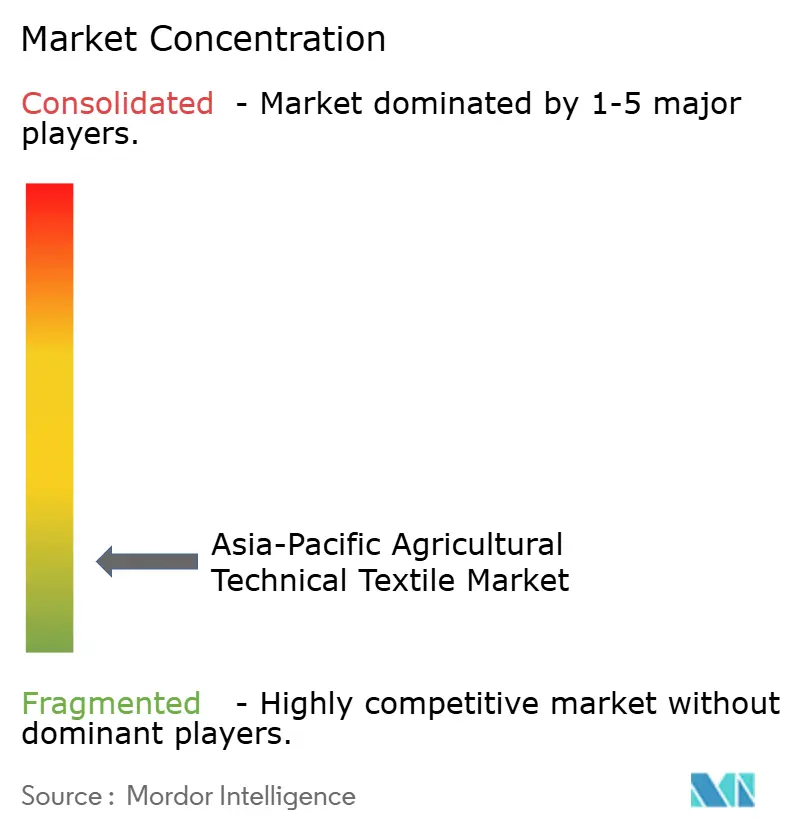
The Asia-Pacific agricultural technical textile market is fragmented. Global suppliers, Indian manufacturers, and Chinese producers compete across different product groups and countries. Competition depends on application knowledge, product performance, and regional distribution. Chinese producers have a cost advantage in commodity shade nets and crop-protection products because some operate integrated polymer and netting supply chains. Their position is less secure in premium export applications where certification and product consistency matter.
Indian manufacturers benefit from proximity to the region’s fastest-growing demand base and from the policy emphasis on domestic technical textiles. Garware Technical Fibres reported FY2025 net sales of USD 184 million, up 16.2% year over year, supported by its geosynthetics and aquaculture activities. In July 2025, Garware acquired Offshore & Trawl Supply and Advanced Mooring Supply, extending its marine technical capability. Freudenberg Performance Materials, Beaulieu Technical Textiles, Mitsui Chemicals, and RKW Group remain relevant through nonwoven crop covers, UV-stabilized yarns, and greenhouse performance products. RKW used Agritechnica Asia 2025 to present its agricultural portfolio in Vietnam, signaling its interest in Southeast Asian customers.
Product development is focused on biodegradable mulch, higher-durability netting, and textile systems that work with sensors and irrigation controls. The Navsari agrotextile center offers a practical example of this approach by monitoring microclimate conditions across textile applications. Amcor completed its acquisition of Berry Global in April 2025, creating a combined company with USD 15 billion in annual sales and a wider position in flexible materials. Suppliers that combine reliable local access with stronger product specifications are well placed in the Asia-Pacific agricultural technical textile market.
Asia-Pacific Agricultural Technical Textile Industry Leaders
-
Amcor plc
-
Garware Technical Fibres Limited
-
Beaulieu Technical Textiles
-
Freudenberg Performance Materials
-
Shandong Rainbow Shading Technology Co., Ltd.
- *Disclaimer: Major Players sorted in no particular order
Asia-Pacific Agricultural Technical Textile Market Companies Covered in this Report
- Amcor plc
- Garware Technical Fibres Limited
- Beaulieu Technical Textiles
- Freudenberg Performance Materials
- Shandong Rainbow Shading Technology Co., Ltd.
- SRF Limited
- Belton Industries, Inc.
- Hy-Tex (U.K.) Ltd.
- Diatex
- Koninklijke Ten Cate bv
- HUESKER Synthetic GmbH
- RKW Group
- Tama Group
- Ginegar Plastic Products Ltd.
- Mitsui Chemicals, Inc.
- Neo Corp International Limited
- Visaka Industries Limited
- Thai Charoen Thong Karntor Co., Ltd.
- KT Exports (India) Pvt. Ltd.
- EYOUAGRO
Recent Industry Developments in Asia-Pacific Agricultural Technical Textile Market
- March 2026: India’s Ministry of Textiles approved 16 new research projects under the National Technical Textiles Mission (NTTM). These projects cover advanced technical textile products, high-performance fibers, smart and functional textiles, and other applications. The initiative aims to support indigenous innovation and commercialization, creating potential opportunities for agricultural technical textiles, including crop-protection fabrics and specialized agricultural coverings.
- July 2025: Garware Technical Fibres completed the strategic acquisition of two Norwegian companies, Offshore & Trawl Supply and Advanced Mooring Supply, funded through internal accruals. OTS adds synthetic fiber rope manufacturing for fisheries and aquaculture, while AMS expands the company’s marine technical capabilities.
- April 2025: Amcor plc completed its all-stock merger with Berry Global Group, creating a combined company with annual sales of USD 15 billion across more than 400 locations in 40+ countries.
Asia-Pacific Agricultural Technical Textile Market Report Scope
The Asia-Pacific Agricultural Technical Textile Market Report is Segmented by Product Type (Crop Protection Nets, Fishing and Aquaculture Textiles, Crop Covers and Plant Protection Fleece, and More), by End-User Sector (Field Crop Cultivation, Fruit Orchards and Viticulture, and More), and by Geography (China, Japan, India, Taiwan, and More). The Report Offers Market Size and Forecasts in Value (USD) for all the Above Segments.
Segmentation Overview
| Crop Protection Nets | Anti-Insect and Pest Protection Nets |
| Anti-Hail and Weather Protection Nets | |
| Anti-Bird and Wildlife Protection Nets | |
| Agricultural Windbreak Nets | |
| Agricultural Shade Nets and Greenhouse Climate Screens | Agricultural Shade Nets |
| Thermo-Reflective and Light-Diffusion Screens | |
| Thermal and Energy-Saving Greenhouse Screens | |
| Greenhouse Blackout and Light-Control Screens | |
| Crop Covers and Plant Protection Fleece | Nonwoven Floating Row Covers |
| Frost and Thermal Protection Textiles | |
| Other Woven and Knitted Crop Covers | |
| Fishing and Aquaculture Textiles | Commercial Fishing Nets |
| Aquaculture Cage and Containment Nets | |
| Specialized Aquaculture Protection Nets | |
| Mulch Mats and Agricultural Ground Covers | |
| Nursery, Plant Support and Forestry Textiles | |
| Harvesting and Forage Management Textiles | |
| Other Agricultural Technical Textiles |
| Field Crop Cultivation |
| Vegetable, Floriculture and Nursery Cultivation |
| Fruit Orchards and Viticulture |
| Forestry and Landscape Cultivation |
| Livestock and Forage Operations |
| Fisheries and Aquaculture |
| China |
| Japan |
| India |
| South Korea |
| Taiwan |
| Australia |
| Indonesia |
| Vietnam |
| Rest of Asia-Pacific |
| By Product Type | Crop Protection Nets | Anti-Insect and Pest Protection Nets |
| Anti-Hail and Weather Protection Nets | ||
| Anti-Bird and Wildlife Protection Nets | ||
| Agricultural Windbreak Nets | ||
| Agricultural Shade Nets and Greenhouse Climate Screens | Agricultural Shade Nets | |
| Thermo-Reflective and Light-Diffusion Screens | ||
| Thermal and Energy-Saving Greenhouse Screens | ||
| Greenhouse Blackout and Light-Control Screens | ||
| Crop Covers and Plant Protection Fleece | Nonwoven Floating Row Covers | |
| Frost and Thermal Protection Textiles | ||
| Other Woven and Knitted Crop Covers | ||
| Fishing and Aquaculture Textiles | Commercial Fishing Nets | |
| Aquaculture Cage and Containment Nets | ||
| Specialized Aquaculture Protection Nets | ||
| Mulch Mats and Agricultural Ground Covers | ||
| Nursery, Plant Support and Forestry Textiles | ||
| Harvesting and Forage Management Textiles | ||
| Other Agricultural Technical Textiles | ||
| By End-Use Sector | Field Crop Cultivation | |
| Vegetable, Floriculture and Nursery Cultivation | ||
| Fruit Orchards and Viticulture | ||
| Forestry and Landscape Cultivation | ||
| Livestock and Forage Operations | ||
| Fisheries and Aquaculture | ||
| By Geography | China | |
| Japan | ||
| India | ||
| South Korea | ||
| Taiwan | ||
| Australia | ||
| Indonesia | ||
| Vietnam | ||
| Rest of Asia-Pacific | ||
Key Questions Answered in the Report
What is the projected value of the Asia-Pacific agricultural technical textile market by 2032?
The market is forecast to reach USD 11.73 billion by 2032, from USD 8.54 billion in 2026, at a 5.54% CAGR during 2027-2032.
Which product category has the largest position in Asia-Pacific agricultural technical textiles?
Crop protection nets lead product demand with a 26.0% share in 2026.
Which end-use sector leads to demand for agricultural technical textiles in Asia-Pacific?
Field crop cultivation holds the largest position, accounting for 32.0% of demand in 2026.
Which country has the largest regional position?
China leads with 32.0% of regional demand in 2026, supported by protected cultivation and aquaculture activity.
Which country is expected to grow fastest through 2032?
India is identified as the fastest-growing geography, registering a 7.5% CAGR, and supported by protected cultivation, technical-textile, and farm-training programs.
What factors limit adoption of agricultural technical textiles?
High protected-farming costs, feedstock price changes, plastic waste requirements, inconsistent standards, and limited grower training can limit adoption.