
Asia-Pacific 5G Device Market Size and Share
Market Overview
| Study Period | 2020 - 2031 |
|---|---|
| Forecast Data Period | 2026 - 2031 |
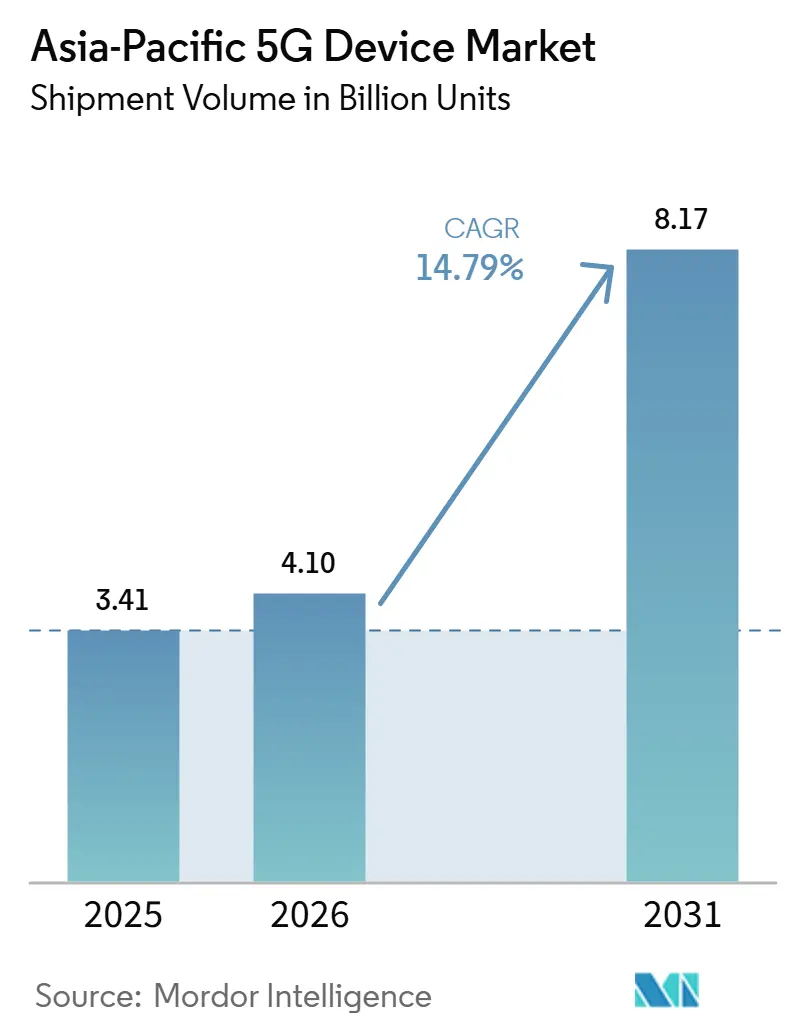
| Base Year Market Size (2025) | 3.41 Billion units |
| Market Volume (2026) | 4.10 Billion units |
| Market Volume (2031) | 8.17 Billion units |
| Growth Rate (2026 - 2031) | 14.79 % |
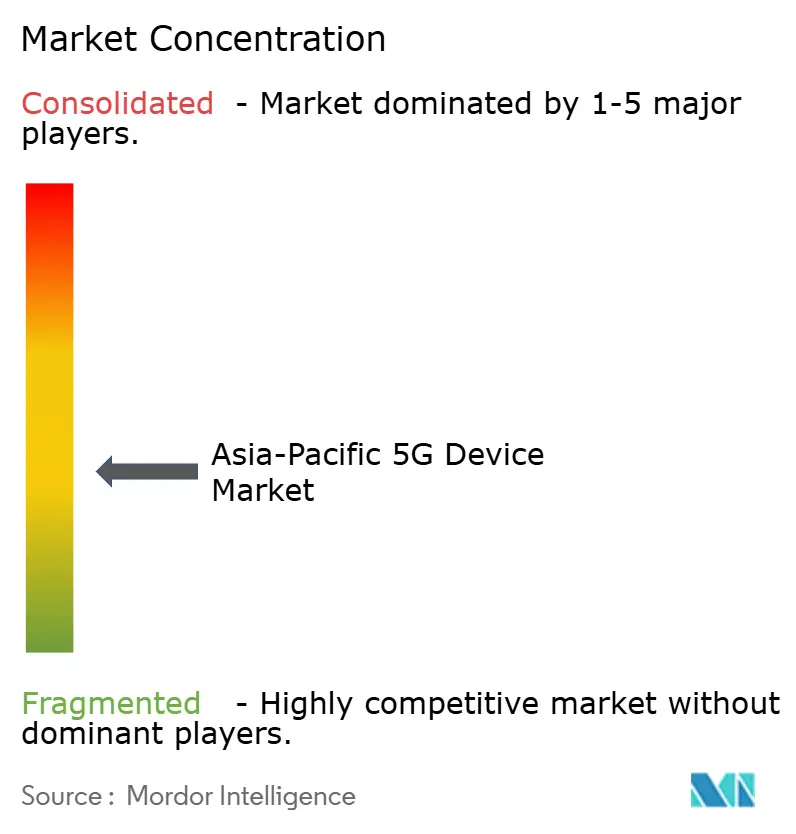
| Market Concentration | Medium |
Major Players *Disclaimer: Major Players sorted in no particular order Image © Mordor Intelligence. Reuse requires attribution under CC BY 4.0. | |
Asia-Pacific 5G Device Market Analysis by Mordor Intelligence
The Asia-Pacific 5G Device Market size in terms of shipment volume is expected to grow from 3.41 billion units in 2025 to 4.10 billion units in 2026 and is forecast to reach 8.17 billion units by 2031 at 14.79% CAGR over 2026-2031. The Asia-Pacific 5G device market is supported by the ongoing expansion of network coverage, which shortens replacement cycles across consumer, business, and industrial use cases. The Asia-Pacific 5G device market also benefits when network upgrades are paired with practical device pricing and broad retail availability. China’s base-station buildout remains central to regional demand, while India broadens the addressable base through lower-cost handsets. Investment in fixed wireless access also creates demand for customer-premises equipment that is not tied to smartphone replacement cycles. Private networks extend the Asia-Pacific 5G device market into factories, energy sites, mines, and logistics facilities, where purchases follow capital spending and operational requirements. Competition, therefore, depends on product cost, distribution, component availability, and the ability to obtain approvals across several national markets.
Key Report Takeaways
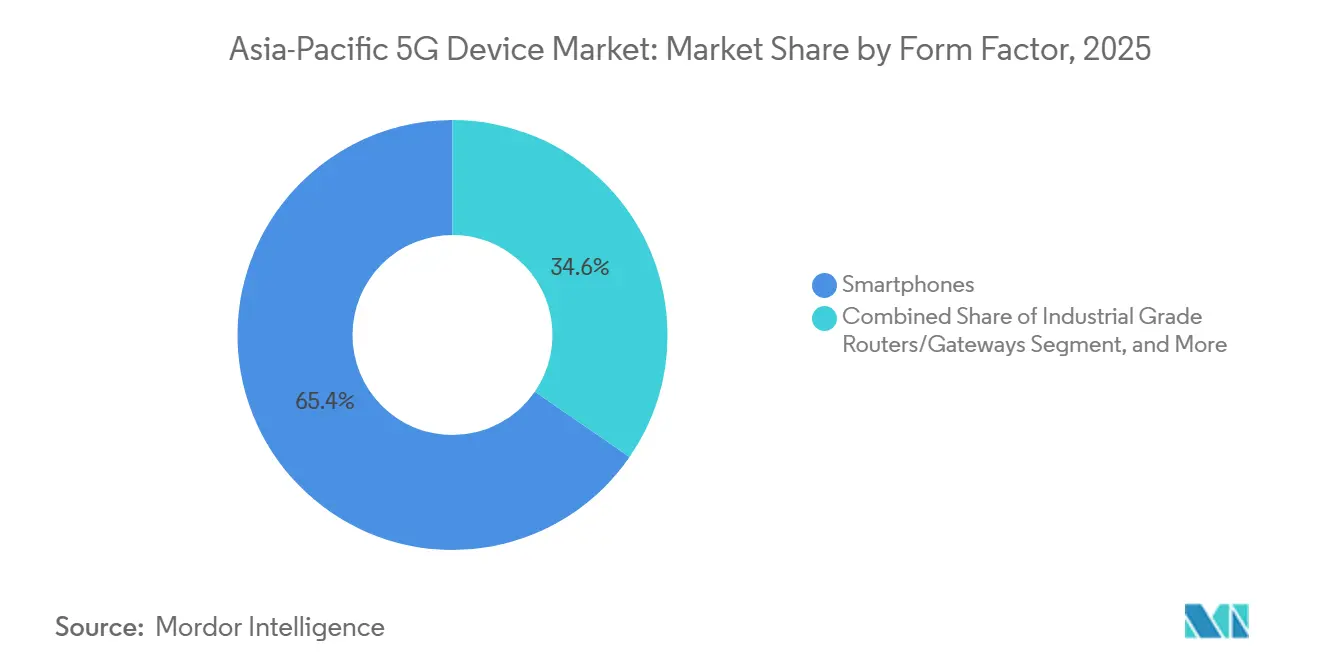
- By form factor, smartphones held 65.40% volume share of the Asia-Pacific 5G device market in 2025, while wearables and XR devices are projected to expand at a 16.25% CAGR through 2031.
- By spectrum support, sub-6 GHz devices accounted for 59.66% volume share of the Asia-Pacific 5G device market in 2025, while mmWave devices are projected to grow at a 16.05% CAGR through 2031.
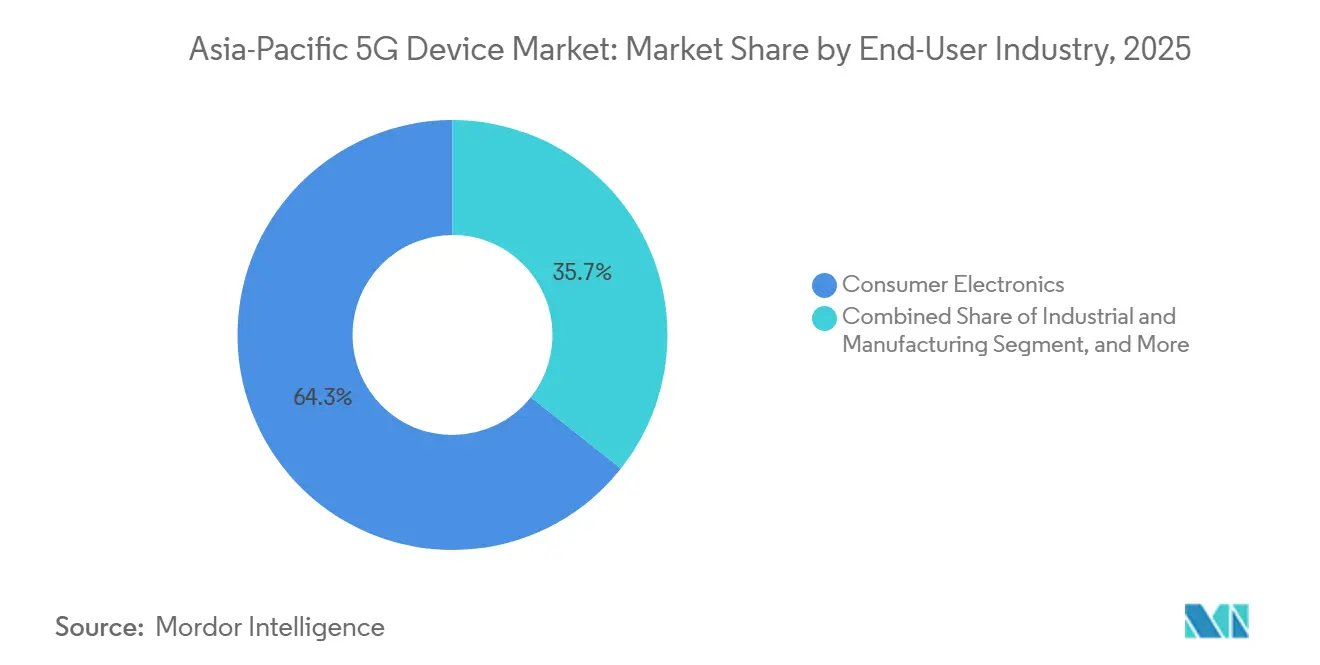
- By end-user industry, consumer electronics held 64.33% volume share of the Asia-Pacific 5G device market in 2025, while automotive and transportation are projected to advance at a 16.39% CAGR through 2031.
- By application, enhanced mobile broadband (eMBB) captured 55.79% volume share of the Asia-Pacific 5G device market in 2025, while ultra-reliable low-latency communications is projected to grow at a 16.69% CAGR through 2031.
- By country, China accounted for 54.15% of the Asia-Pacific 5G device market volume in 2025, while India is projected to expand at a 17.09% CAGR through 2031.
Note: Market size and forecast figures in this report are generated using Mordor Intelligence’s proprietary estimation framework, updated with the latest available data and insights as of January 2026.
Market Trends and Insights
Drivers Impact Analysis of Asia-Pacific 5G Device Market*
| Driver | (~) % Impact on CAGR Forecast | Geographic Relevance | Impact Timeline |
|---|---|---|---|
| 5G Network Rollout and Device Upgrade Cycles | +4.5% | Global, concentrated in China, India, and ASEAN | Short term (≤ 2 years) |
| Mid-Range 5G Smartphone Penetration in Asia-Pacific | +3.8% | India, Southeast Asia, and South Asia emerging markets | Short term (≤ 2 years) |
| Industrial 5G and Private Network Device Adoption | +2.2% | China, Japan, South Korea, and ASEAN manufacturing hubs | Medium term (2-4 years) |
| Fixed Wireless Access Substitution for Last-Mile Broadband | +1.8% | India, Indonesia, Philippines, island, and rural ASEAN markets | Medium term (2-4 years) |
| 5G RedCap and Low-Power Device Enablement | +1.2% | China, ASEAN, and India | Medium term (2-4 years) |
| AI-Ready Handsets and Premium Device Refresh Demand | +0.7% | China, South Korea, Japan, and premium urban segments | Long term (≥ 4 years) |
| Source: Mordor Intelligence | |||
5G Network Rollout and Device Upgrade Cycles
China’s network scale remains a major source of demand for the Asia-Pacific 5G device market. China had 4.838 million 5G base stations at the end of 2025 and 4.958 million at the end of March 2026.[1]China’s State Council Information Office, “China’s 5G Base Stations Top 4.958 Million at End of March 2026,” CGTN, news.cgtn.com 5G-Advanced service had reached 330 Chinese cities in early 2026, creating demand for devices that can support more advanced network functions. Across the region, 69 operators in 26 countries had launched commercial 5G by mid-2025, with 13 operators deploying networks and 17 planning services. Regional telecom operators have committed USD 254 billion to network infrastructure through 2030, with 5G as the main focus. The retirement of older networks in Singapore, India, and New Zealand has also led to delayed replacement decisions being converted into device purchases.
Mid-Range 5G Smartphone Penetration in Asia-Pacific
India illustrates how lower device prices are expanding the Asia-Pacific 5G device market. More than 90% of smartphones shipped in India in 2025 were 5G-enabled, while monthly 5G data traffic rose 70% year over year to 12.9 exabytes. Nearly 47% of India’s mobile broadband traffic was carried on 5G during that year. Shipments of 5G handsets priced below USD 100 increased more than tenfold, indicating that radio hardware has reached the entry-level. Qualcomm introduced Snapdragon 6 Gen 5 and Snapdragon 4 Gen 5 platforms in India in May 2026, placing the country at the center of development for mid-range and entry devices.[2]Qualcomm Technologies, “Qualcomm Unveils Two New Snapdragon Mobile Platforms,” Qualcomm Newsroom, qualcomm.com This price range is likely to shape regional shipment volumes, as it serves both first-time 5G buyers and replacement customers.
Industrial 5G and Private Network Device Adoption
Private networks are creating demand for routers, gateways, and rugged modules beyond the consumer device base. This broadens the Asia-Pacific 5G device market beyond the purchase decisions of handset users. Asia-Pacific had 360 unique private LTE and 5G customer deployments by mid-2025, representing 20% of the global total. Manufacturing led adoption, followed by mining, education, and smart-city infrastructure. China’s manufacturing programs support purchases of connected equipment for automated production systems. SoftBank Corp., Murata Manufacturing, and the CC-Link Partner Association demonstrated time-sensitive networking over 5G with an average synchronization accuracy of 122 nanoseconds in February 2026.[3]SoftBank Corp., Murata Manufacturing, and CC-Link Partner Association, “In World First, SoftBank, Murata and CLPA Achieve TSN Over 5G,” SoftBank Newsroom, softbank.jp The result showed that wireless 5G can meet the performance requirements of selected industrial control applications, supporting demand for specialized devices.
Fixed Wireless Access Substitution for Last-Mile Broadband
Fixed wireless access adds a separate demand base for the Asia-Pacific 5G device market through indoor routers and outdoor customer-premises units. Asia-Pacific fixed wireless connections are rising at a double-digit CAGR, and the regional count is expected to triple by 2029. The region is expected to contribute more than 45% of global fixed wireless connections by that year. Island geography in Indonesia and rural areas in India can make fiber installation more costly than a 5G deployment. JioAirFiber reached 9.5 million subscribers by September 2025, and India’s total 5G fixed wireless subscriber base exceeded 10 million by late 2025. Fibocom began large-scale production of its Fx550 module in March 2026, which supports 5G fixed wireless and broadband IoT equipment.
Restraints Impact Analysis of Asia-Pacific 5G Device Market*
| Restraint | (~) % Impact on CAGR Forecast | Geographic Relevance | Impact Timeline |
|---|---|---|---|
| High Bill of Materials for 5G Devices and RF Components | -1.8% | Global, most acute in Southeast Asia’s mid-range segment | Medium term (2-4 years) |
| mmWave Cost and Integration Complexity | -1.2% | Japan, South Korea, and select Chinese urban markets | Medium term (2-4 years) |
| Supply Chain Dependence on Advanced Semiconductors | -0.9% | Global, heightened for OEMs with constrained chipset access | Long term (≥ 4 years) |
| Industrial Integration Complexity Across Legacy Systems | -0.5% | Manufacturing hubs in China, India, Vietnam, and Indonesia | Medium term (2-4 years) |
| Source: Mordor Intelligence | |||
High Bill of Materials for 5G Devices and RF Components
The cost of RF components limits how quickly 5G hardware can move into lower-priced devices. A flagship 5G handset requires USD 15 to USD 25 of FR1 RF components and USD 20 to USD 80 for each mmWave antenna-in-package module. The total RF front-end cost can therefore range from USD 35 to USD 105 per device, or 5% to 15% of the handset bill of materials. Memory and storage account for more than 30% of the bill of materials in smartphones priced below USD 200. More than 60% of devices shipped in Southeast Asia fall into this price band, so component inflation can affect affordability and manufacturer margins. RF front-end lead times of 16 to 26 weeks in 2026 add procurement pressure as AI infrastructure competes for advanced packaging and wafer capacity.
mmWave Cost and Integration Complexity
mmWave devices accounted for less than 10% of regional shipments in 2025 and remain concentrated in Japan, South Korea, and selected Chinese urban areas. Their cost is 20% to 30% higher than comparable sub-6 GHz devices because of antenna-in-package production, beamforming components, and thermal requirements. Japan targets 50,000 millimeter-wave base stations by 2027, indicating further network expansion for this device category. Type approval in China, India, and South Korea requires certification cycles of 6 to 12 weeks for mmWave-capable devices. These costs and approval timelines create greater obstacles for smaller device makers. High-value uses in enterprise sites, factories, and large venues are therefore likely to develop before broad consumer adoption.
*Our forecasts treat driver/restraint impacts as directional, not additive. The impact forecasts reflect baseline growth, mix effects, and variable interactions.
Asia-Pacific 5G Device Market Segment Analysis
By Form Factor:
Smartphones Lead, Wearables and XR AccelerateSmartphones held 65.40% of regional device volume in 2025, supported by the region’s mobile-first customer base and handset manufacturing capacity. China Mobile’s 5G subscriber base exceeded 1.2 billion mobile users at the end of September 2025. This installed base supports shipments of 5G devices across the Asia-Pacific market, including low-cost, mid-range, and premium tiers. Customer-premises equipment is the second-largest form-factor contributor by deployment velocity because fixed wireless services require routers and outdoor units. Industrial routers, gateways, modules, and hotspots have smaller volumes but higher unit values than mainstream consumer devices.
Wearables and XR devices are projected to grow at a 16.25% CAGR from 2026 to 2031. Singapore, South Korea, Japan, and major Chinese cities already have 5G standalone coverage that can support lower-latency spatial computing. SoftBank Corp., Ericsson Japan, and Qualcomm Technologies completed a commercial 5G standalone XR streaming field trial in Tokyo during December 2025. South Korea’s enterprise and AR/VR uses are also encouraging device makers to pursue mmWave-capable and enhanced sub-6 GHz platforms. India’s production-linked incentive program has attracted investment in electronics assembly and supports lower unit costs for consumer devices.



By Spectrum Support:
Sub-6 GHz Foundations Enable mmWave GrowthSub-6 GHz devices accounted for 59.66% of the Asia-Pacific 5G device market size in 2025. The band provides broad coverage, lower integration cost, and accessible regulatory conditions across diverse regional markets. Its position is particularly durable where 5G coverage is centered on n77 and n78 spectrum. Consumer price sensitivity also limits the near-term addressable base for mmWave hardware. Hybrid devices that support both sub-6 GHz and mmWave remain concentrated in premium and enterprise use cases in Japan and South Korea.
mmWave devices are projected to expand at a 16.05% CAGR through 2031 from a smaller 2025 base. Demand in the Asia-Pacific 5G device market is driven by private networks, semiconductor plants, and high-density venues that require high throughput and low latency. ASE Technology has announced plans for a 5G mmWave NR-DC standalone smart factory targeting a 600 Mbps uplink over 2.6 GHz and 28 GHz links. Japan and South Korea apply strict type-approval rules for the N257 and N258 bands. Established certification records can favor Samsung Electronics, Qualcomm, and Sony Group in this premium tier.
By End-User Industry:
Consumer Electronics Dominant, Automotive Grows FastestConsumer electronics accounted for 64.33% of regional device volume in 2025. Smartphones, smart televisions, tablets, and wearables make up the largest installed base in this category. Industrial and manufacturing users are adopting private networks when Wi-Fi is unreliable or when mobile robots require continuous handovers. Healthcare is an early adopter of 5G hardware for remote monitoring, imaging, and robotic-assisted surgery. Utilities also use modules for grid automation, pipeline monitoring, and distributed energy management.
Automotive and transportation are projected to grow at a 16.39% CAGR from 2026 to 2031. China’s C-V2X mandate aims to deploy in more than 40 cities by 2028. Quectel introduced the AR588MA in January 2026 as a 5G-Advanced automotive-grade cellular module compliant with 3GPP Release 18. Japan is studying the allocation of the 5.9 GHz C-V2X spectrum for FY 2026. Hardware requirements are therefore moving ahead of broad deployment in several automotive programs.
By Application:
eMBB Anchors Volume, URLLC Grows FastestEnhanced mobile broadband (eMBB) accounted for 55.79% of the 2025 application mix. Smartphone-led data use remains the largest application for the Asia-Pacific 5G device market. India’s average monthly data usage reached 31 GB per subscriber in 2025, up from 27.5 GB in 2024. AI-supported applications, 4K streaming, cloud gaming, and content creation sustain this demand. mMTC supports sensors in smart-city, agricultural, and logistics applications.
URLLC is projected to expand at a 16.69% CAGR from 2026 to 2031. Release 16 specifies sub-millisecond latency at 99.999% reliability for relevant 5G configurations. This capability supports real-time industrial control, remote surgical robotics, and time-sensitive automation. South Korea launched a USD 11.6 million AI-RAN validation project in July 2026 for low-latency industrial AI uses. The Hyundai-Samsung trial at Hyundai’s Ulsan facility used 5G RedCap for sensors, cameras, and automated guided vehicles in early 2026.
Geography Analysis
China 5G Device Market
China held 54.15% of regional device volume in 2025, supported by its large domestic network and device supply base. The country had 4.958 million 5G base stations at the end of March 2026. Its ecosystem spans chipsets, modules, and branded handsets, including MediaTek, HiSilicon, Quectel, Fibocom, MeiG Smart Technology, Huawei, Xiaomi, OPPO, and Vivo. China plans to move more than 75% of mobile network traffic to 5G by 2027. The 5G-Advanced rollout in 330 cities and the C-V2X infrastructure buildout supported continued demand across specialized use cases.
Japan and South Korea 5G Device Market
Japan and South Korea are lower-volume but higher-value markets that favor premium and mmWave-capable devices. SoftBank reported a 30% improvement in 5G throughput using Transformer AI-RAN architectures during August 2025. South Korea’s July 2026 AI-RAN initiative supports ultra-low-latency industrial networks. Japan’s Radio Law process and South Korea’s KC certification process favor suppliers with established compliance records.
APAC 5G Device Market
India is projected to record the fastest country-level CAGR at 17.09% through 2031. Nokia projects that India’s 5G subscriber base will exceed 1 billion by 2031. ASEAN adds another layer of Asia-Pacific 5G device market growth as coverage expands across Indonesia, Vietnam, Thailand, and Malaysia. Singapore completed nationwide 5G standalone coverage in 2025, while Malaysia’s JENDELA program targets 80% population coverage. Pakistan’s March 2026 spectrum auction is expected to drive new commercial 5G services and device demand in the region.
Competitive Landscape
The Asia-Pacific 5G device market is moderately fragmented among OEM brands but more concentrated in chipsets and RF components. This structure makes downstream competition in the Asia-Pacific 5G device market dependent on upstream supply availability. Samsung, Xiaomi, OPPO, Apple, and Huawei compete in smartphones through product updates, software, AI functions, cameras, design, and retail reach. Module and customer-premises equipment suppliers such as Quectel, Fibocom, SIMCom, MeiG Smart Technology, and Askey Computer compete on platform support, design flexibility, and certification coverage. Their main opportunities are industrial, IoT, and fixed wireless applications rather than mass-market brand recognition.
Huawei introduced the Pura 90s Pro and Pura 90s Pro Max in Malaysia in July 2026, both powered by the Kirin 9030S chipset. Quectel launched the AR588MA automotive module in January 2026, using Release 18 compliance to pursue long automotive design cycles. Quectel and MediaTek also introduced a 5G-Advanced and Wi-Fi 8 customer-premises equipment reference design in March 2026. These actions show that component suppliers are using standards support and validated designs to secure positions before full-scale deployment.
5G RedCap is a developing opportunity for industrial sensors, wearables, and asset trackers that need more capability than narrowband IoT but do not require full 5G hardware. Quectel expanded its RedCap portfolio with the RM255C-GL in March 2026. Fibocom began mass production of the Fx550 module in the same month for fixed wireless and broadband IoT applications. Earlier compliance with 3GPP Release 17 and Release 18 can provide longer design-win lead times in enterprise programs. This favors module suppliers with broad product portfolios while sustaining the role of Qualcomm and Samsung in the chipset tier.
Asia-Pacific 5G Device Industry Leaders
Apple Inc.
Samsung Electronics Co., Ltd.
Xiaomi Corporation
Huawei Technologies Co., Ltd.
ZTE Corporation
- *Disclaimer: Major Players sorted in no particular order
Asia-Pacific 5G Device Market Companies Covered in this Report
- Apple Inc.
- Samsung Electronics Co., Ltd.
- Xiaomi Corporation
- Huawei Technologies Co., Ltd.
- ZTE Corporation
- Sony Group Corporation
- D-Link Corporation
- Nokia Corporation
- Fibocom Wireless Inc.
- Inseego Corp.
- HTC Corporation
- Askey Computer Corp.
- Lenovo Group Limited
- Qualcomm Incorporated
- MediaTek Inc.
- Quectel Wireless Solutions Co., Ltd.
- MeiG Smart Technology Co., Ltd.
- SIMCom Wireless Solutions Co., Ltd.
- OPPO (OPPO Mobile Telecommunications Corp. Ltd.)
- Vivo Mobile Communication Co., Ltd.

Recent Industry Developments in Asia-Pacific 5G Device Market
- July 2026: Samsung Electronics unveiled the Galaxy Z Fold8 Ultra, Galaxy Z Fold8, and Galaxy Z Flip8 at Galaxy Unpacked in London on July 22, 2026. Powered by the Qualcomm Snapdragon 8 Elite Gen 5 chipset and featuring Flex Titanium display architecture, the lineup introduced Samsung's first Ultra-branded book-style foldable with a 5,000 mAh silicon-carbon battery and Galaxy AI features built on Android 17, expanding the premium 5G foldable tier that commands the highest average selling prices in Asia-Pacific's consumer device market.
- July 2026: Huawei held its global flagship product launch event in Kuala Lumpur, Malaysia, on July 14, 2026, unveiling the Pura 90s Pro Max and Pura 90s Pro, the company’s first international 5G flagship smartphones since export restrictions curtailed its global chipset access in 2019. The Kirin 9030S-powered devices launched at MYR 3,699 (USD 851, using Bank Negara Malaysia's 2026 average exchange rate) for the Pro base configuration, with initial availability in Malaysia, Singapore, the Middle East, and Europe.
- May 2026: Qualcomm Technologies globally introduced the Snapdragon 6 Gen 5 and Snapdragon 4 Gen 5 mobile platforms at its third annual Snapdragon for India event in New Delhi on May 7, 2026, making India the global launchpad for both chips. Commercial devices from OPPO, realme, Xiaomi, and Honor are scheduled for the second half of 2026, targeting the mid-range and entry 5G tiers that drive the highest volume growth across Asia-Pacific.


Asia-Pacific 5G Device Market Report Scope
The Asia-Pacific 5G device market volume is measured by the annual shipment of 5G devices (in units), including smartphones, customer-premises equipment, routers, gateways, modules, laptops, tablets, hotspots, and wearables, across sub-6 GHz, mmWave, and hybrid spectrum configurations for applications such as enhanced mobile broadband (eMBB), ultra-reliable low-latency communications (URLLC), massive machine-type communications (mMTC), fixed wireless access (FWA), and vehicle-to-everything (V2X).
The Asia-Pacific 5G device market report is segmented by form factor (smartphones, customer-premises equipment (indoor/outdoor), industrial grade routers/gateways, modules, laptops/tablets, hotspots, and wearables and XR devices), spectrum support (sub-6 GHz, mmWave, and hybrid (sub-6 GHz and mmWave)), end user industry (consumer electronics, industrial and manufacturing, automotive and transportation, healthcare, energy and utilities, and enterprise/commercial), application (enhanced mobile broadband (eMBB), ultra-reliable low-latency comms (URLLC), massive machine-type comms (mMTC), fixed wireless access, and vehicle-to-everything (V2X)), and country (China, Japan, India, South Korea, ASEAN, and rest of Asia-Pacific). The market forecasts are provided in terms of volume (units).
| Smartphones |
| Customer-Premises Equipment (Indoor/Outdoor) |
| Industrial Grade Routers/Gateways |
| Modules |
| Laptops/Tablets |
| Hotspots |
| Wearables and XR Devices |
| Sub-6 GHz |
| mmWave |
| Hybrid (Sub-6 GHz and mmWave) |
| Consumer Electronics |
| Industrial and Manufacturing |
| Automotive and Transportation |
| Healthcare |
| Energy and Utilities |
| Enterprise/Commercial |
| Enhanced Mobile Broadband (eMBB) |
| Ultra-Reliable Low-Latency Comms (URLLC) |
| Massive Machine-Type Comms (mMTC) |
| Fixed Wireless Access |
| Vehicle-to-Everything (V2X) |
| China |
| Japan |
| India |
| South Korea |
| ASEAN |
| Rest of Asia-Pacific |
| By Form Factor | Smartphones |
| Customer-Premises Equipment (Indoor/Outdoor) | |
| Industrial Grade Routers/Gateways | |
| Modules | |
| Laptops/Tablets | |
| Hotspots | |
| Wearables and XR Devices | |
| By Spectrum Support | Sub-6 GHz |
| mmWave | |
| Hybrid (Sub-6 GHz and mmWave) | |
| By End-User Industry | Consumer Electronics |
| Industrial and Manufacturing | |
| Automotive and Transportation | |
| Healthcare | |
| Energy and Utilities | |
| Enterprise/Commercial | |
| By Application | Enhanced Mobile Broadband (eMBB) |
| Ultra-Reliable Low-Latency Comms (URLLC) | |
| Massive Machine-Type Comms (mMTC) | |
| Fixed Wireless Access | |
| Vehicle-to-Everything (V2X) | |
| By Country | China |
| Japan | |
| India | |
| South Korea | |
| ASEAN | |
| Rest of Asia-Pacific |


Key Questions Answered in the Report
What is the size of the Asia-Pacific 5G device market?
The Asia-Pacific 5G device market was 3.41 billion units in 2025, is estimated at 4.1 billion units in 2026, and is forecast to reach 8.17 billion units by 2031 at a 14.79% CAGR.
Which form factor leads regional 5G device shipments?
Smartphones led with 65.40% of device volume in 2025. Wearables and XR devices are projected to record the fastest form-factor growth at a 16.25% CAGR through 2031.
Why is India important for regional 5G device demand?
India is projected to grow at a 17.09% CAGR through 2031. More than 90% of smartphones shipped in India in 2025 were 5G-enabled.
What applications will drive 5G device adoption?
EMBB led the application mix with 55.79% of 2025 volume. URLLC is projected to grow fastest at a 16.69% CAGR as industrial control and automation uses expand.
How does fixed wireless access affect 5G hardware demand?
Fixed wireless access creates demand for customer-premises equipment, including indoor routers and outdoor units, independent of smartphone upgrade cycles.
Which end-user category is growing fastest?
Automotive and transportation is projected to grow at a 16.39% CAGR through 2031, supported by C-V2X deployments and connected-vehicle programs.
Page last updated on:





