
ASEAN Textile Machinery Market Size and Share
Market Overview
| Study Period | 2020 - 2031 |
|---|---|
| Forecast Data Period | 2026 - 2031 |
| Base Year Market Size (2025) | USD 2.39 Billion |
| Market Size (2026) | USD 2.47 Billion |
| Market Size (2031) | USD 3.17 Billion |
| Growth Rate (2026 - 2031) | 5.12 % |
| Market Concentration | Medium |
Major Players *Disclaimer: Major Players sorted in no particular order Image © Mordor Intelligence. Reuse requires attribution under CC BY 4.0. | |
ASEAN Textile Machinery Market Analysis by Mordor Intelligence
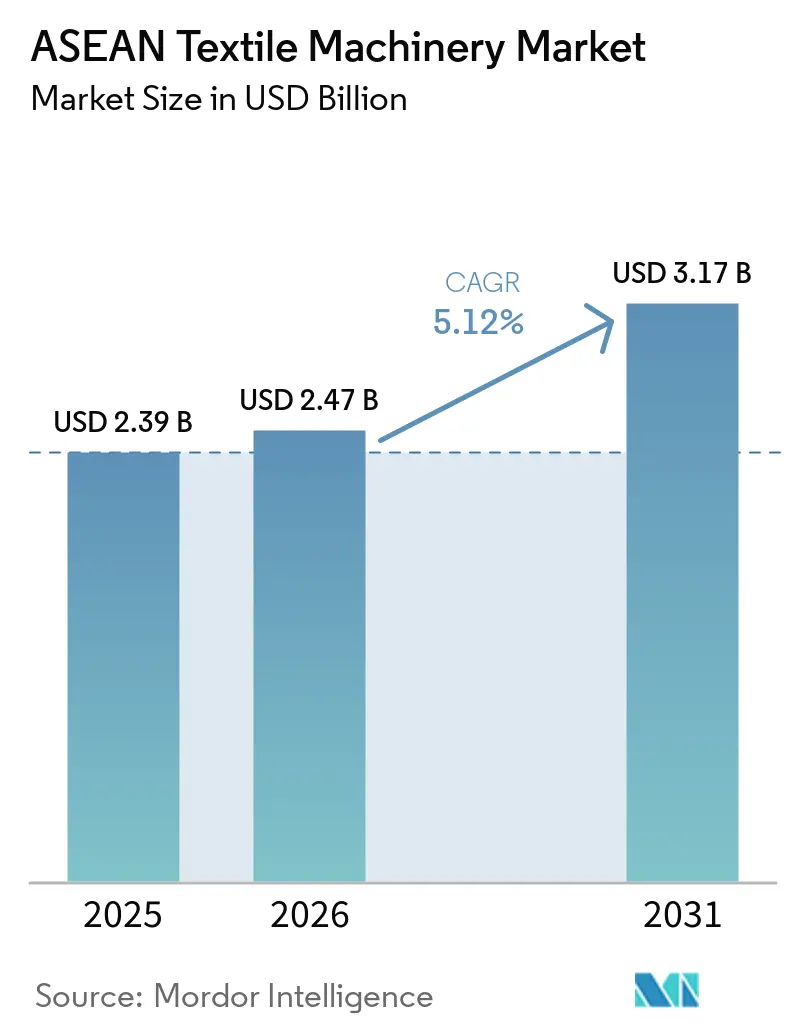
The ASEAN Textile Machinery Market size is expected to increase from USD 2.39 billion in 2025 to USD 2.47 billion in 2026 and reach USD 3.17 billion by 2031, growing at a CAGR of 5.12% over 2026-2031.
The ASEAN textile machinery market is supported by a continued shift in textile and apparel sourcing toward Southeast Asia, as manufacturers diversify supply chains and strengthen regional production networks. Manufacturing foreign direct investment in ASEAN reached USD 44 billion in 2024, with apparel and supply-chain-intensive activities among the main areas of investment. New capacity requires equipment across spinning, weaving, dyeing, finishing, and quality-control operations, while replacement demand favors machinery that reduces energy use and supports production visibility. Regional buyers are placing more importance on digital monitoring and traceability as they replace older machinery and respond to customer requirements. The market faces pressure from trade measures, financing costs, and a constrained supply of technically qualified operators. Premium European and Japanese suppliers must compete on value against lower-priced Chinese and domestic alternatives.
Key Report Takeaways
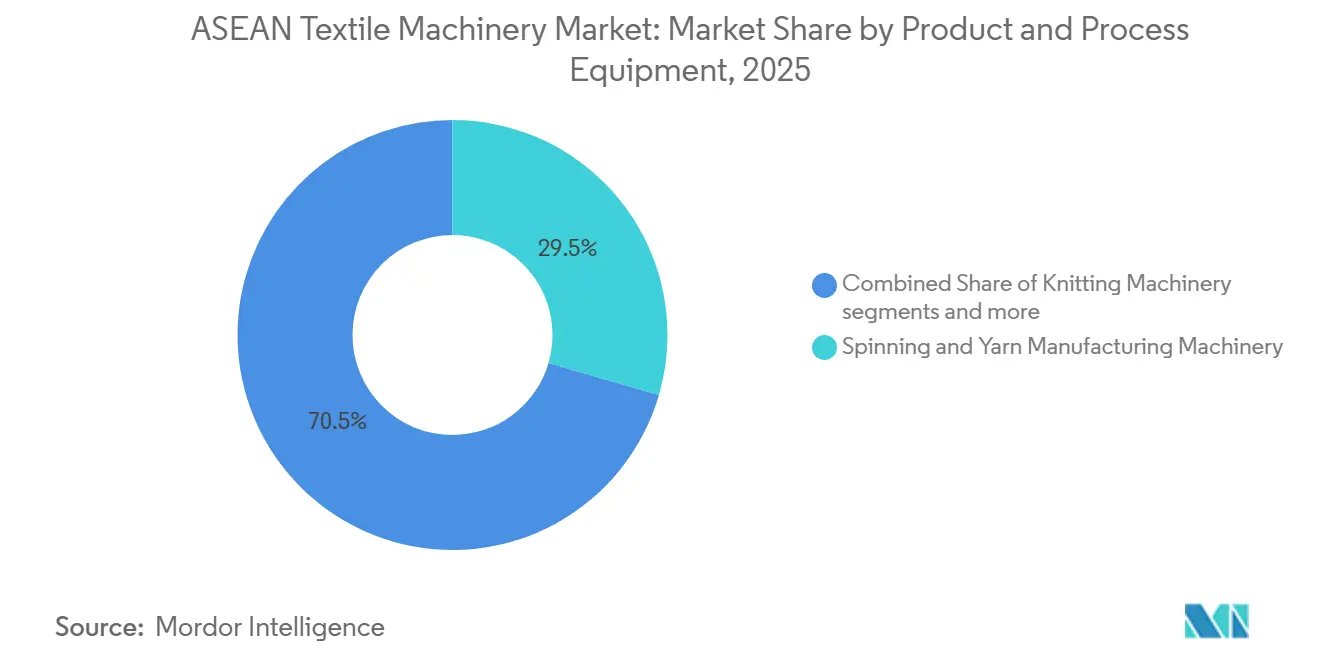
- By product and process equipment, spinning and yarn manufacturing machinery held 29.5% of the ASEAN textile machinery market share in 2025, while textile printing machinery is forecast to expand at a 6.9% CAGR through 2031.
- By source of supply, imported machinery held 68.5% of the ASEAN textile machinery market size in 2025 and is forecast to grow at a 5.8% CAGR through 2031.
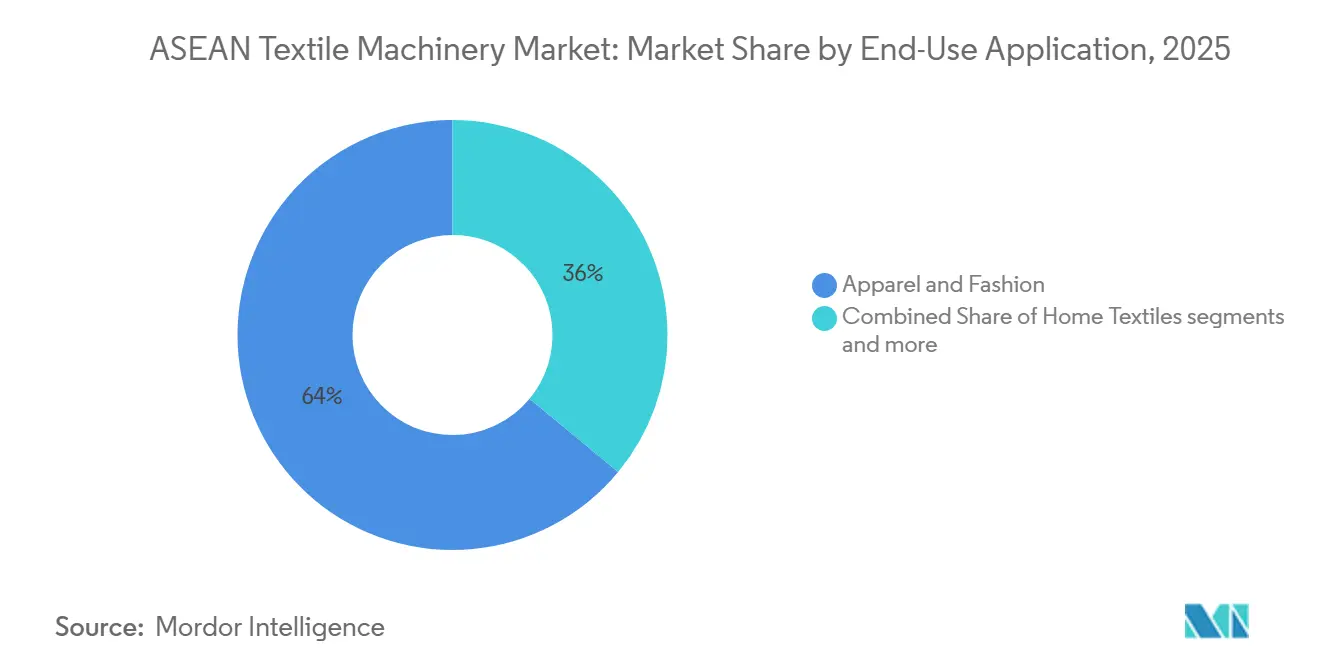
- By end-use application, apparel and fashion accounted for 64% of the regional total in 2025, while industrial and technical textiles is forecast to grow at a 7.4% CAGR through 2031.
- By geography, Vietnam accounted for 31.5% of the regional total in 2025, while Indonesia is forecast to expand at a 6.3% CAGR through 2031.
Note: Market size and forecast figures in this report are generated using Mordor Intelligence’s proprietary estimation framework, updated with the latest available data and insights as of January 2026.
ASEAN Textile Machinery Market Trends and Insights
Drivers Impact Analysis*
| Driver | (~) % Impact on CAGR Forecast | Geographic Relevance | Impact Timeline |
|---|---|---|---|
| Supply-Chain Diversification Into ASEAN | +1.8% | Vietnam, Indonesia, Cambodia, Thailand | Short term (≤ 2 years) |
| Expansion of Export-Oriented Apparel and Textile Capacity | +1.5% | Vietnam, Cambodia, Philippines | Medium term (2-4 years) |
| Automation to Offset Skilled-Labor Constraints | +1% | ASEAN-wide | Medium term (2-4 years) |
| Investment in Higher-Value Technical Textiles | +0.8% | Thailand, Malaysia, Vietnam | Long term (≥ 4 years) |
| Textile-Mill Decarbonization and Water-Efficiency Requirements | +0.5% | Vietnam, Indonesia, ASEAN-wide spillover | Medium term (2-4 years) |
| Retrofitting of Installed Machinery with Digital Monitoring | +0.3% | ASEAN-wide | Short term (≤ 2 years) |
| Source: Mordor Intelligence | |||
Supply-Chain Diversification Into ASEAN
The relocation of textile and apparel production away from China is creating equipment demand across the ASEAN textile machinery market, particularly where investors establish new upstream capacity instead of relying on imported fabrics. ASEAN manufacturing investment has benefited as companies diversify supply chains and seek production locations with stronger access to export markets, helping make the region more relevant to global sourcing strategies.[1] Vietnam and Indonesia remain central destinations because each combines a large textile base, established export relationships, and the ability to absorb foreign investment in production assets. New projects increasingly require integrated operations rather than basic cut-make-trim facilities, since buyers need dependable rules-of-origin documentation and closer oversight of material supply. This requires coordinated investment from yarn preparation through fabric formation, finishing, inspection, and quality control. It also favors suppliers that can support several stages of a project, maintain machinery after installation, and provide comparable operating standards across regional factory networks.
Expansion of Export-Oriented Apparel and Textile Capacity
Vietnam’s textile and garment exports reached USD 46 billion in 2025, and the sector targeted USD 47 billion to USD 48 billion in exports during 2026. This large export base keeps capacity investment active across the ASEAN textile machinery market because producers need to maintain delivery performance, product quality, and cost control for international customers. Export-oriented projects need equipment for yarn, fabric formation, dyeing, finishing, and quality-control operations, rather than only machines used in garment assembly. Equipment needs become more extensive when facilities bring several production processes together at one location and seek greater control over material availability. Laboratories and inspection systems become more important because exporters need dependable quality records, traceability information, and evidence that production complies with customer requirements. Capacity growth therefore raises demand across the textile chain and supports a wider range of equipment purchases by integrated mills.
Automation to Offset Skilled-Labor Constraints
The 6 largest ASEAN economies faced a combined skilled-worker shortfall of 6.6 million workers in 2025, and manufacturing was among the affected sectors.[2] Vietnam’s textile and garment workforce also had a large skills gap, with more than 80% of the sector’s 3.4 million workers lacking formal technical qualifications. Mills are responding with machinery that reduces manual interventions, standardizes operating tasks, and gives supervisors clearer information about production quality and machine conditions. Rieter’s Digital Spinning Suite ESSENTIAL was installed with a second compact-spinning system at PT Embee Plumbon Tekstil in Indonesia and provides real-time production and quality data. Digital systems support maintenance planning and more consistent output, but their benefits depend on workers being able to interpret alarms, production data, and quality trends. Workforce development and automation are therefore complementary requirements for mills seeking to use advanced equipment effectively.
Investment in Higher-Value Technical Textiles
Industrial and technical textiles are extending the ASEAN textile machinery market beyond conventional apparel production and toward applications with more demanding material requirements. Thailand’s ANTEX Asia 2025 highlighted demand linked to healthcare, automotive, filtration, and construction uses, all of which require production controls that differ from standard apparel manufacturing. These end uses require nonwoven lines, technical weaving machinery, precise finishing systems, and controlled quality processes that can deliver repeatable functional performance. Vietnam is also receiving investment linked to circular textile production, including Syre’s proposed USD 700 million to USD 1 billion polyester recycling complex in Binh Dinh.[3] Specialized equipment usually costs more than machinery designed for standard apparel applications, particularly where it handles technical fibers, recycled inputs, or demanding quality specifications. This shifts spending toward higher-value machinery, while success depends on manufacturers developing the process skills, customer relationships, and reliable demand needed for specialized output.
Restraints Impact Analysis*
| Restraint | (~) % Impact on CAGR Forecast | Geographic Relevance | Impact Timeline |
|---|---|---|---|
| High Imported Equipment and Financing Costs | -0.8% | ASEAN-wide, especially Indonesia and Cambodia | Short term (≤ 2 years) |
| Volatile Textile-Capacity Utilization and Order Cycles | -0.6% | ASEAN-wide | Medium term (2-4 years) |
| Fragmented After-Sales Service and Spare-Parts Coverage | -0.4% | Cambodia, Philippines, Rest of ASEAN | Medium term (2-4 years) |
| Uneven Technical Skills for Advanced Machinery | -0.2% | ASEAN-wide, especially Vietnam and Indonesia | Medium term (2-4 years) |
| Source: Mordor Intelligence | |||
High Imported-Equipment and Financing Costs
Premium machinery from European and Japanese suppliers can be difficult for smaller ASEAN mills to finance because the purchase often requires imported equipment, foreign-currency payments, and complementary spending on installation and training. Indonesia’s textile import rules and duties on imported cotton yarn show how policy can create overlapping costs for operators that depend on imported inputs and equipment. The World Bank identifies capital constraints as a central barrier to textile-sector equipment upgrades in lower-income manufacturing settings. Currency movements can raise the local cost of a machine even when the supplier’s list price is unchanged, which complicates investment budgets for operators with limited reserves. Larger exporters can often obtain trade finance, while smaller companies face collateral requirements, higher interest-rate exposure, and longer approval processes. Suppliers that provide local service, financing support, or phased upgrades may be better placed to address this constraint.
Volatile Textile-Capacity Utilization and Order Cycles
Machinery investment depends on reliable order books, but export-oriented textile producers remain exposed to shifts in buyer purchasing, inventory adjustments, and trade-policy uncertainty. The ASEAN Investment Report 2025 noted that tariff escalation and geopolitical tensions challenged the investment outlook, creating a more cautious setting for factory investment decisions. When brands reduce orders during inventory adjustments, mills may postpone equipment commitments until production utilization improves and cash flow becomes more predictable. Lower garment orders can then reduce fabric demand, yarn demand, and operating rates at spinning mills, affecting several machinery categories at once. Indonesian safeguard duties on imported cotton yarn were introduced against pressure on domestic spinners.
*Our forecasts treat driver/restraint impacts as directional, not additive. The impact forecasts reflect baseline growth, mix effects, and variable interactions.
Segment Analysis
By Product and Process Equipment: Spinning Anchors the Base, Digital Printing Reshapes the Growth Curve
Spinning and yarn manufacturing machinery held 29.5% of the ASEAN textile machinery market size in 2025, reflecting the established yarn-production base in Vietnam and Indonesia, which supplies both regional apparel plants and international fabric supply chains. Mills in this segment need reliable yarn quality, stable productivity, and lower waste across several fiber types. Rieter supplied a second complete compact-spinning system to PT Embee Plumbon Tekstil in Indonesia, including the C80 card, K47 compact machine, and Autoconer X6 winder. The installation used Digital Spinning Suite ESSENTIAL to provide real-time production information, helping the mill monitor quality and operating performance. Weaving and weaving-preparation machinery ranked second, while knitting, nonwoven, dyeing, finishing, and testing equipment completed a product range that increasingly favors connected, full-line solutions.
Textile printing machinery is forecast to grow at a 6.9% CAGR through 2031, making it the fastest-growing product category. Digital printing supports reduced water and dye use, while allowing manufacturers to respond more quickly to customer requirements for varied designs and smaller order volumes. Saurer introduced the CompactTwister and Autocard SC8 at ITMA Asia + CITME Singapore 2025, while Picanol introduced the OmniPlus-i Connect with EcoBoost technology. Picanol stated that EcoBoost can save up to 1.5 kW per weaving machine, showing the priority that mills are placing on lower operating costs. Testing and inspection systems also become more relevant as producers need stronger quality, traceability, and compliance records for export customers.

By Source of Supply: Import Dependence Persists as Domestic Capability Matures
Imported machinery accounted for 68.5% of the ASEAN textile machinery market in 2025. European and Japanese platforms continue to offer the precision, efficiency, durability, and digital controls sought by export-oriented mills working to demanding customer specifications. Domestic manufacturing in Indonesia is more active in basic looms, entry-level spindle frames, and auxiliary equipment, serving a broader base of smaller operators. The Ministry of Industry reported interest from Swedish, Chinese, and Japanese companies in integrated yarn and textile machinery manufacturing during the second half of 2025. This points to gradual local capacity growth, but it does not remove the region’s dependence on imported high-performance equipment for specialized processes.
Imported machinery is also forecast to grow at a 5.8% CAGR through 2031, supported by continued demand for specialized equipment. Import dependence creates exposure to exchange rates, shipping costs, financing terms, and import procedures, especially for mills that have limited in-house procurement resources. Indonesia reinstated Technical Consideration requirements for textile product imports through Ministry of Industry Regulation No. 27 of 2025. The process can add administrative work for smaller companies without dedicated import teams and can delay decisions when project timing is important. Indonesia’s restructuring support can reimburse up to 40% for certain domestically produced machinery purchases by smaller operators, improving the case for some local purchases. The ASEAN textile machinery market will still require imports for specialized applications, while local suppliers can gain ground where service access, price, and public support matter most.
By End-Use Application: Apparel Anchors Volume, Technical Textiles Expand the Value Frontier
Apparel and fashion accounted for 64% of the ASEAN textile machinery market size in 2025, reflecting ASEAN’s established position in global garment production and its extensive network of textile and apparel exporters. Vietnam’s apparel exports were USD 38 billion in 2025 and represented 80%+ of the country’s textile and garment exports. This demand base supports spending on spinning, weaving, knitting, dyeing, and finishing systems that help mills meet volume, delivery, and fabric-quality requirements. Home textiles formed a mid-tier end-use group, with demand for bedding, towels, and upholstery fabrics concentrated in Thailand and Indonesia. Apparel volumes remain the main reason many regional mills modernize production lines, even as they seek opportunities in more specialized fabric categories.
Industrial and technical textiles are forecast to grow at a 7.4% CAGR through 2031, making it the fastest-growing end-use category. The segment serves automotive, construction, healthcare, agricultural, filtration, and protective applications that need specialized processing equipment and more controlled manufacturing conditions. ANTEX Asia 2025 reinforced Thailand’s role in nonwoven technology across hygiene, medical, and filtration supply chains.Technical-textile installations commonly require higher-cost machinery than conventional apparel lines because they need specialized material handling, precise processing, and reliable quality systems. This shifts spending toward greater machinery value per facility as the end-use mix changes.
Geography Analysis
Vietnam held the largest country position in 2025, supported by USD 46 billion in textile and garment exports. Vietnam targeted USD 47 billion to USD 48 billion in textile and garment exports during 2026, which continued to support investment in capacity, productivity, and machinery modernization. Its large foreign-invested mill base supports demand for new lines and replacement projects across spinning, fabric production, dyeing, and finishing. VIATT 2025, supported by the Ministry of Industry and Trade, reinforced Vietnam’s role as a regional sourcing and technology venue for suppliers and mill buyers.
Indonesia was the fastest-growing country market through the forecast period, supported by investment interest and a large domestic textile production base. Its machinery-restructuring support can help smaller operators invest in local equipment and reduce the cost of replacing selected older assets. The country also has a domestic manufacturing base that supports service, maintenance, component supply, and equipment relationships with local mills. Trade pressure and lower-priced imports remain constraints for investment decisions and capacity utilization. Indonesia’s ASEAN textile machinery market size is supported by both capacity investment and replacement demand as mills seek productivity and cost improvements.
Thailand and Malaysia held mid-tier positions with demand increasingly focused on higher-value textile applications rather than only conventional apparel production. Thailand’s nonwoven activity supports machinery needs in hygiene, medical, and filtration applications, where product consistency and process control are important. Cambodia and the Philippines remain smaller markets where the scale of upstream capacity investment is the key variable for machinery demand. Myanmar and other ASEAN countries are smaller users of advanced equipment but represent future demand as manufacturing bases, export relationships, and local technical capability develop.
Competitive Landscape
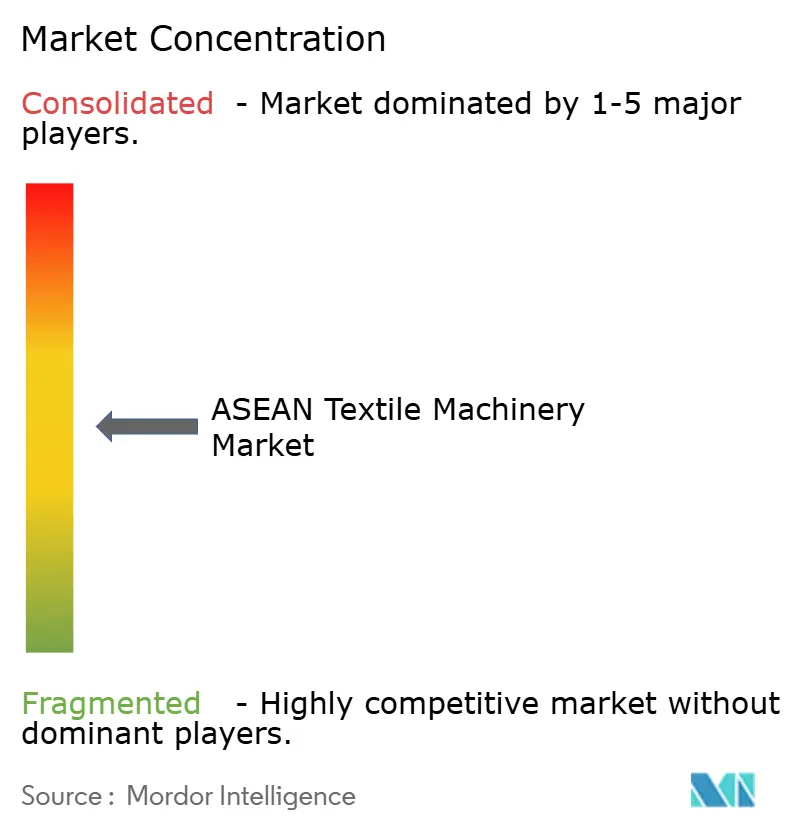
The ASEAN textile machinery market exhibits a medium level of market concentration, although premium technology categories are concentrated among established suppliers with broad product portfolios and established regional service networks. Rieter, Saurer, Trützschler, Picanol, KARL MAYER, Itema, and Benninger are important European suppliers in spinning, weaving, and technical-textile equipment. Toyota Industries, Murata Machinery, SHIMA SEIKI, and TMT Machinery also hold positions with quality-focused mills, particularly where buyers value established machine performance. Chinese and local assemblers compete more directly in commodity equipment through lower prices and accessible supply.
Suppliers are extending relationships beyond the initial machinery sale through software, data tools, service contracts, and lifecycle support that help mills maintain output over longer equipment lives. Picanol presented an AI-enhanced PicConnect platform at ITM 2026 alongside its OmniPlus-i Connect airjet machine, combining machinery features with a digital customer interface. Rieter’s Digital Spinning Suite ESSENTIAL similarly connects equipment performance with ongoing production data and real-time operating information. Rieter completed its acquisition of Barmag from OC Oerlikon in January 2026 for CHF 713 million (USD 858 million), and added Barmag, Neumag, and Nonwoven products to its Man-Made Fiber Division. This widened its offering for filament yarn and nonwoven applications, which are increasingly relevant to technical and circular-textile investment.
Mid-tier after-sales support remains a gap in several ASEAN countries, particularly where mills operate mixed fleets from different suppliers and installation years. Mills operating machinery that is 10 to 20 years old may need retrofit kits, spare parts, field service, training support, and digital-monitoring upgrades. Component suppliers such as Groz-Beckert and Stäubli can compete through precision parts, jacquard systems, and related services that improve existing machines. This creates room for local service partners and specialized upgrade providers that can respond quickly to mill operating needs.
ASEAN Textile Machinery Industry Leaders
-
Rieter Holding AG
-
Saurer Intelligent Technology AG
-
Trützschler Group SE
-
Murata Machinery, Ltd.
-
Toyota Industries Corporation
- *Disclaimer: Major Players sorted in no particular order
Recent Industry Developments
- June 2026: Picanol exhibited the AI-enhanced PicConnect digital platform at ITM 2026 Istanbul alongside the OmniPlus-i Connect airjet machine with EcoBoost energy-saving capability, demonstrating the company's strategy of using software upgrades to deepen customer relationships and defend installed-base loyalty.
- January 2026: Rieter completed the acquisition of Barmag from OC Oerlikon for CHF 713 million (USD 858 million), integrating the Oerlikon Barmag, Oerlikon Neumag, and Oerlikon Nonwoven product portfolios into a newly created Man-Made Fiber Division. The combined entity strengthens Rieter's technology offering for ASEAN filament-yarn and nonwoven machinery buyers.
ASEAN Textile Machinery Market Report Scope
The ASEAN Textile Machinery Market is Segmented by Product and Process Equipment (Spinning, Weaving, Knitting, Nonwoven, Dyeing, Processing, and More), by Source of Supply (Domestic and Imported Machinery), by End-Use Application (Apparel, Home Textiles, Industrial and Technical Textiles, and Others), and by Geography (Vietnam, Indonesia, Thailand, Malaysia and more). The Market Forecasts are Provided in Terms of Value (USD).
| Spinning and Yarn Manufacturing Machinery |
| Weaving and Weaving Preparation Machinery |
| Knitting Machinery |
| Nonwoven Machinery |
| Textile Dyeing, Processing and Finishing Machinery |
| Textile Printing Machinery |
| Textile Testing, Inspection and Quality-Control Equipment |
| Others (Textile Material Handling Equipment, Humidification Systems, Fibre-Recovery Machinery, Doffing and Packaging Systems, etc.) |
| Domestically Manufactured Machinery |
| Imported Machinery |
| Apparel and Fashion |
| Home Textiles |
| Industrial and Technical Textiles |
| Others (Automotive Textiles, Medical and Hygiene Textiles, Geotextiles, Agrotextiles, Protective Textiles, Carpets and Floor Coverings, and Specialty Textile Applications) |
| Vietnam |
| Indonesia |
| Thailand |
| Malaysia |
| Cambodia |
| Philippines |
| Rest of ASEAN |
| By Product and Process Equipment | Spinning and Yarn Manufacturing Machinery |
| Weaving and Weaving Preparation Machinery | |
| Knitting Machinery | |
| Nonwoven Machinery | |
| Textile Dyeing, Processing and Finishing Machinery | |
| Textile Printing Machinery | |
| Textile Testing, Inspection and Quality-Control Equipment | |
| Others (Textile Material Handling Equipment, Humidification Systems, Fibre-Recovery Machinery, Doffing and Packaging Systems, etc.) | |
| By Source of Supply | Domestically Manufactured Machinery |
| Imported Machinery | |
| By End-Use Application | Apparel and Fashion |
| Home Textiles | |
| Industrial and Technical Textiles | |
| Others (Automotive Textiles, Medical and Hygiene Textiles, Geotextiles, Agrotextiles, Protective Textiles, Carpets and Floor Coverings, and Specialty Textile Applications) | |
| By Geography | Vietnam |
| Indonesia | |
| Thailand | |
| Malaysia | |
| Cambodia | |
| Philippines | |
| Rest of ASEAN |
Key Questions Answered in the Report
What is the projected value of the ASEAN textile machinery market by 2031?
The ASEAN textile machinery market is forecast to reach USD 3.17 billion by 2031, increasing from USD 2.47 billion in 2026 at a 5.1% CAGR.
Which ASEAN country leads textile machinery demand?
Vietnam held the largest country position in 2025, supported by USD 46 billion in textile and garment exports.
What equipment category has the largest demand in ASEAN?
Spinning and yarn manufacturing machinery held the largest product and process equipment position in 2025 because Vietnam and Indonesia have substantial yarn-production capacity.
Why is textile printing equipment growing in ASEAN?
Producers are adopting digital inkjet printing to support shorter runs, faster style changes, lower water use, and lower dye consumption.
Which end-use application is growing fastest?
Industrial and technical textiles is the fastest-growing end-use category because healthcare, automotive, filtration, construction, and protective applications need specialized fabrics and equipment.
What limits investment in advanced textile machinery?
High import and financing costs, variable mill utilization, fragmented service coverage, and uneven technical skills can delay equipment investment.