
Artisanal Ice Cream Market Size and Share
Market Overview
| Study Period | 2021 - 2031 |
|---|---|
| Market Size (2026) | USD 8.69 Billion |
| Market Size (2031) | USD 12.16 Billion |
| Growth Rate (2026 - 2031) | 6.97 % |
| Fastest Growing Market | Asia-Pacific |
| Largest Market | Europe |
| Market Concentration | Low |
Major Players
*Disclaimer: Major Players sorted in no particular order Image © Mordor Intelligence. Reuse requires attribution under CC BY 4.0. |
|
Artisanal Ice Cream Market Analysis by Mordor Intelligence
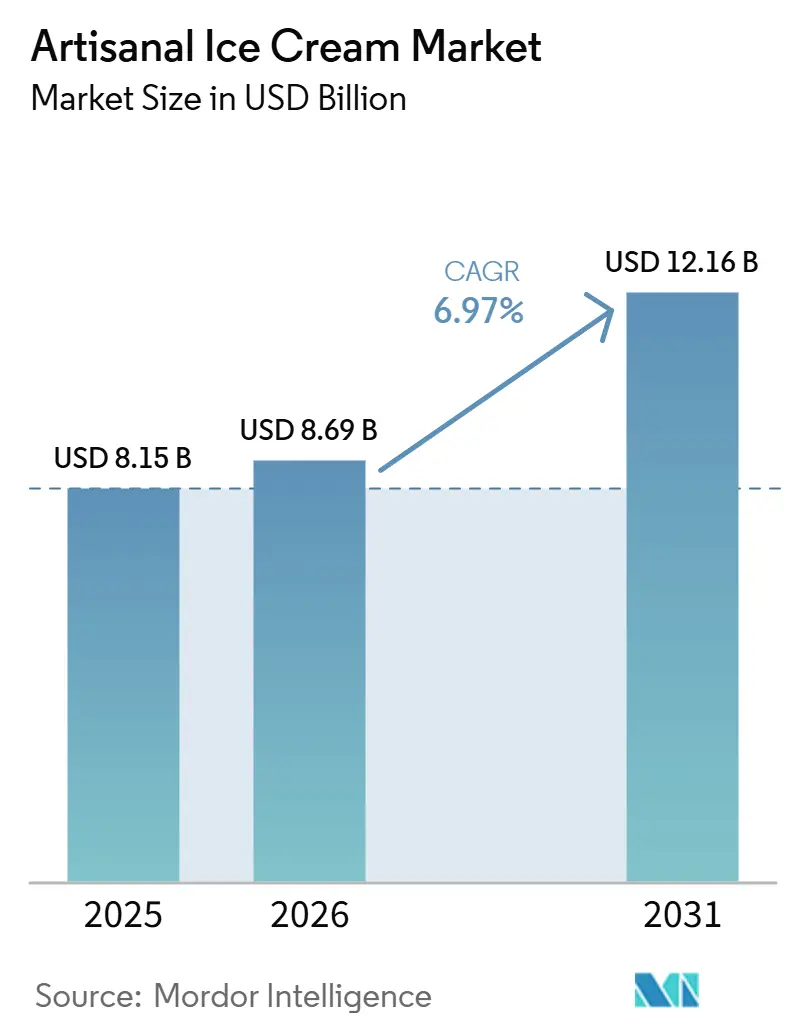
The artisanal ice cream market size is expected to grow from USD 8.15 billion in 2025 to USD 8.69 billion in 2026 and is forecast to reach USD 12.16 billion by 2031 at a 6.97% CAGR over 2026-2031. The market is experiencing steady growth, driven by rising consumer preference for premium dessert experiences, clean-label ingredients, and unique flavor offerings that differentiate handcrafted products from mass-market alternatives. Consumers are increasingly seeking high-quality, small-batch ice creams made with natural ingredients, locally sourced inputs, and innovative seasonal flavors, prompting manufacturers to expand their premium product portfolios. The growing popularity of plant-based formulations, along with the influence of social media, food tourism, and experiential retail concepts, continues to support market demand. Product innovation, premium positioning, and the expansion of specialty retail are further supporting the long-term development of the artisanal ice cream market.
Key Report Takeaways
- By product formulation, dairy-based products held 72.55% share in 2025, while plant-based products are forecast to grow at an 8.36% CAGR from 2026 to 2031.
- By flavor, chocolate held 30.37% share in 2025, while other flavors are forecast to grow at a 7.66% CAGR from 2026 to 2031.
- By distribution channel, specialty stores held 35.66% share in 2025, while online retail stores are forecast to grow at an 8.47% CAGR from 2026 to 2031.
- By geography, Europe held 34.35% share in 2025, while Asia-Pacific is forecast to grow at an 8.65% CAGR from 2026 to 2031.
Note: Market size and forecast figures in this report are generated using Mordor Intelligence’s proprietary estimation framework, updated with the latest available data and insights as of January 2026.
Global Artisanal Ice Cream Market Trends and Insights
Drivers Impact Analysis*
| Driver | (~) % Impact on CAGR Forecast | Geographic Relevance | Impact Timeline |
|---|---|---|---|
| Growing consumer preference for premium dessert experiences | +1.6% | Global, concentrated in North America and Europe | Medium term (2–4 years) |
| Demand for clean-label and natural ingredients | +1.2% | Global, fastest adoption in North America and Asia-Pacific | Long term (≥ 4 years) |
| Rising demand for unique, innovative, and seasonal flavor offerings | +1.0% | Global, concentrated in Europe and Asia-Pacific | Short term (≤ 2 years) |
| Increasing popularity of plant-based and dietary-specific formulations | +0.9% | Global, strongest in Europe and North America | Medium term (2–4 years) |
| Growing influence of social media and food tourism | +0.7% | Global, strongest in Asia-Pacific and Middle East and Africa | Short term (≤ 2 years) |
| Growing consumer preference for locally sourced and small-batch foods | +0.5% | North America and Europe | Long term (≥ 4 years) |
| Source: Mordor Intelligence | |||
Growing consumer preference for premium dessert experiences
Consumers are increasingly seeking premium dessert experiences that emphasize high-quality ingredients, handcrafted production, and distinctive flavors, driving demand for artisanal ice cream. The growing preference for indulgent yet authentic food products has encouraged manufacturers to introduce small-batch offerings featuring unique recipes, seasonal ingredients, and chef-inspired creations. Consumers value the freshness, craftsmanship, and premium positioning associated with artisanal brands, distinguishing them from mass-produced alternatives. As a result, producers continue to expand their premium product portfolios and experiential retail concepts to meet evolving consumer expectations and support market growth.
Demand for clean-label and natural ingredients
Growing consumer awareness of ingredient quality and food transparency is driving demand for artisanal ice cream made with natural ingredients, recognizable labels, and minimal processing. According to the 2025 IFIC Food & Health Survey, 28% of consumers define a healthy food as one that is minimally or not processed[1]Source: International Food Information Council, "2025 IFIC Food & Health Survey",ific.org. The same survey found that 25% consumers consider limited or no artificial ingredients or preservatives to be a key characteristic of healthy foods[2]Source: International Food Information Council, "2025 IFIC Food & Health Survey",ific.org. These shifting consumer preferences are encouraging artisanal ice cream manufacturers to reformulate products with simpler ingredient lists and premium-quality ingredients, supporting market growth.
Rising demand for unique, innovative, and seasonal flavor offerings
Consumers are increasingly seeking unique and memorable dessert experiences, driving demand for artisanal ice cream with innovative, seasonal, and globally inspired flavors. Manufacturers are responding by introducing limited-edition collections, locally inspired recipes, and fusion flavor combinations to encourage product trial and repeat purchases. The growing popularity of premium indulgence has further accelerated the adoption of chef-crafted and small-batch flavor innovations across retail channels. This continued focus on flavor differentiation enables artisanal ice cream brands to strengthen their market positioning and appeal to evolving consumer preferences.
Increasing popularity of plant-based and dietary-specific formulations
Growing consumer interest in plant-based and diet-specific products is encouraging artisanal ice cream manufacturers to expand dairy-free formulations made from oat, almond, coconut, and other plant-based ingredients. According to the Plant Based Foods Association's 2024 State of the Marketplace Report, 59% of United States households purchased plant-based foods during the year, demonstrating widespread adoption of plant-based alternatives[3]Source: Plant Based Foods Association, "2024 Plant-Based Foods State of the Marketplace Report [May 2025] - Paid",plantbasedfoods.org. This expanding consumer base continues to support the development and commercialization of plant-based artisanal ice cream products.
Restraints Impact Analysis*
| Restraint | (~) % Impact on CAGR Forecast | Geographic Relevance | Impact Timeline |
|---|---|---|---|
| High production costs and ingredient price volatility | -0.5% | Global, most acute in Europe and South America | Medium term (2–4 years) |
| Short shelf life and cold-chain sensitivity | -0.4% | Global, most acute in Asia-Pacific and Middle East and Africa | Long term (≥ 4 years) |
| Limited scalability of authentic small-batch production | -0.3% | Global | Long term (≥ 4 years) |
| Strong competition from industrial ice cream brands | -0.4% | Global, most acute in North America | Medium term (2–4 years) |
| Source: Mordor Intelligence | |||
High production costs and ingredient price volatility
Artisanal ice cream manufacturers face significant cost pressures due to their reliance on premium ingredients, small-batch production methods, and labor-intensive manufacturing processes. Fluctuations in the prices of key raw materials, including dairy, cocoa, vanilla, fruits, and nuts, can substantially increase production costs and compress profit margins, particularly for independent producers with limited purchasing power. Maintaining consistent product quality while managing rising ingredient and operational costs remains a persistent challenge for market participants. These cost pressures can also limit pricing flexibility, product innovation, and the expansion of artisanal ice cream businesses.
Short shelf life and cold-chain sensitivity
Artisanal ice cream typically has a shorter shelf life than conventional products due to the use of natural ingredients and fewer artificial stabilizers or preservatives. Maintaining product quality requires a reliable cold-chain infrastructure across storage, transportation, and retail distribution, as temperature fluctuations can affect texture, flavor, and product safety. These handling requirements increase logistics complexity and operational costs, particularly for small-scale producers expanding into new markets. Cold-chain dependence and limited product stability can therefore constrain broader distribution and market growth.
*Our forecasts treat driver/restraint impacts as directional, not additive. The impact forecasts reflect baseline growth, mix effects, and variable interactions.
Segment Analysis
By Product Formulation: Dairy-Based Scale Versus Plant-Based Momentum
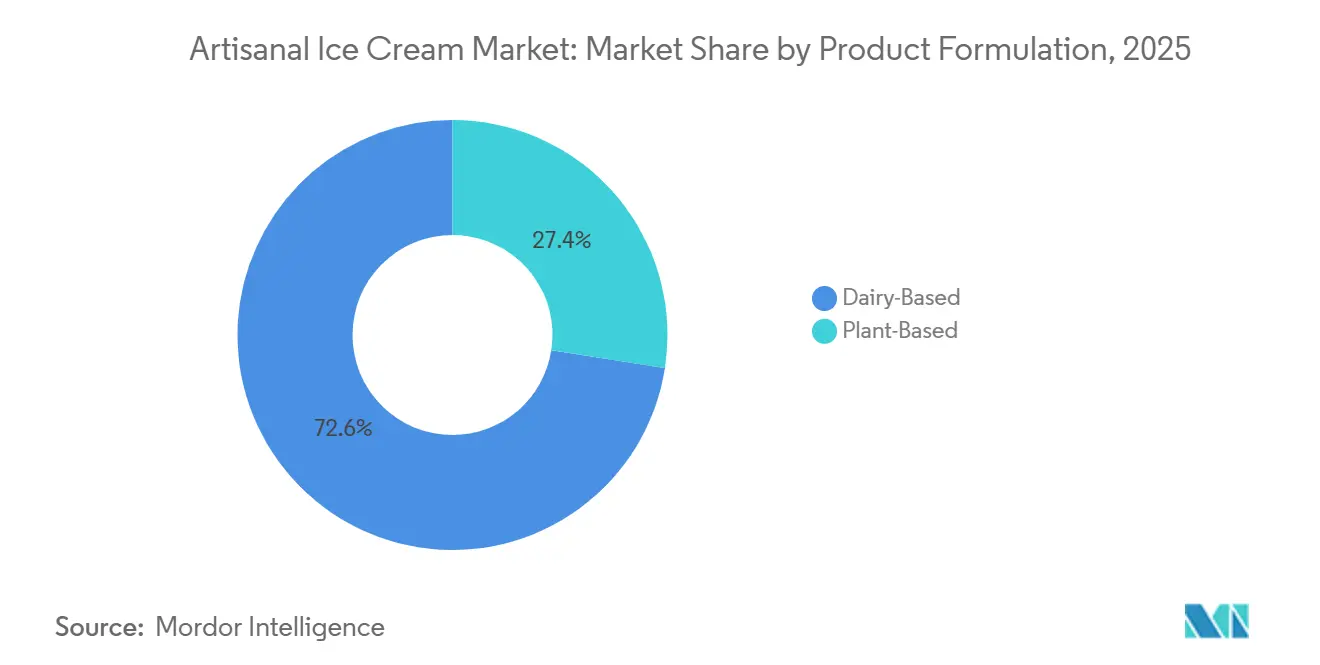
The dairy-based segment accounts for the largest share of the artisanal ice cream market, representing 72.55% of the market in 2025. This dominance is driven by strong consumer preference for traditional recipes, rich texture, and authentic flavor profiles associated with artisanal ice cream. Dairy-based formulations continue to benefit from established production methods, high-quality dairy ingredients, and widespread availability across specialty ice cream parlors and premium retail channels.
The plant-based segment is expected to register the fastest growth, expanding at a CAGR of 8.36% during the forecast period. This growth is supported by increasing consumer demand for vegan, lactose-free, and flexitarian food options, prompting manufacturers to diversify their portfolios with oat-, almond-, coconut-, soy-, and cashew-based formulations. Ongoing innovation in plant-based ingredients and clean-label products is further supporting the segment's growth.


By Flavor: Chocolate Leads but Other Profiles Define the Growth Frontier
The traditional flavors segment holds the largest share of the artisanal ice cream market, with chocolate accounting for 30.37% of the market in 2025. The segment's dominance is driven by strong consumer preference for familiar flavor profiles that appeal broadly across all age groups. Consistent demand, year-round availability, and widespread presence across specialty scoop shops and premium retail channels continue to reinforce the segment's position.
The other flavors segment is projected to register the fastest growth, expanding at a CAGR of 7.66% during the forecast period. This segment comprises distinctive flavor profiles beyond established categories, including botanical infusions, floral notes, spice-inspired recipes, seasonal specialties, and regionally inspired creations. Growing consumer interest in premium, limited-edition, and experiential dessert offerings is encouraging artisanal ice cream manufacturers to continuously introduce innovative flavors, supporting the segment's rapid growth.
By Distribution Channel: Specialty Stores Anchor Quality; Online Retail Stores Accelerate Reach
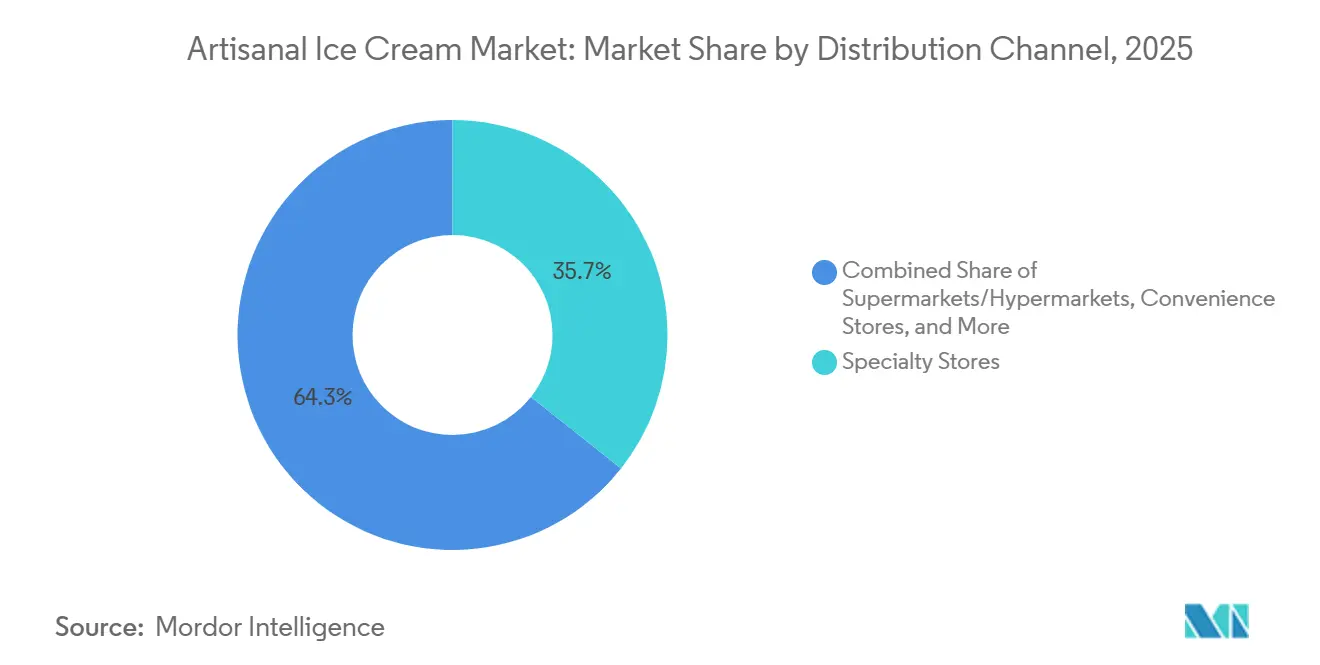
The specialty stores segment accounts for the largest share of the artisanal ice cream market, representing 35.66% of the market in 2025. This segment's position is driven by consumers' preference for freshly prepared, handcrafted ice cream served in an immersive retail environment that emphasizes quality, authenticity, and premium experiences. These outlets also allow manufacturers to showcase seasonal flavors, customize offerings, and strengthen direct engagement with consumers, supporting repeat purchases and brand loyalty.
The online retail stores segment is projected to register the fastest growth, expanding at a CAGR of 8.47% during the forecast period. Growth is supported by the increasing adoption of e-commerce platforms, quick-commerce services, and direct-to-consumer business models that improve product accessibility and convenience. Investments in temperature-controlled delivery solutions and digital marketing strategies are further enabling artisanal ice cream brands to expand their customer reach beyond traditional retail locations.

Geography Analysis
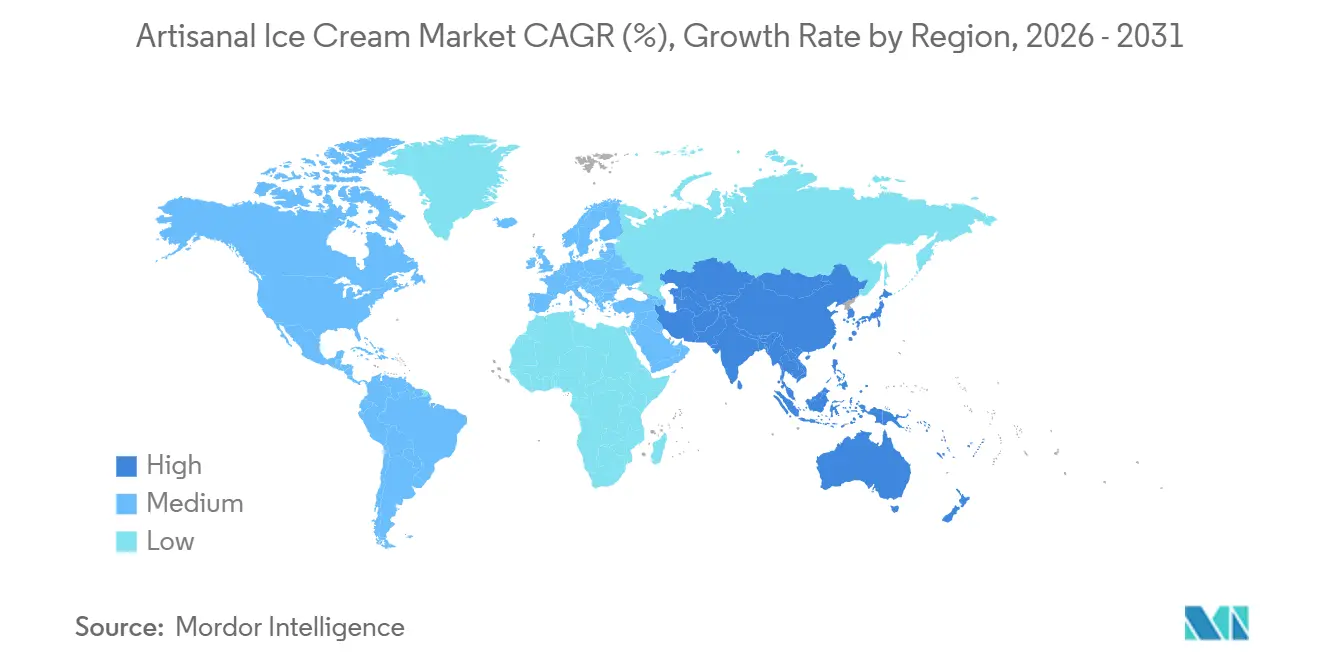
Europe accounts for the largest share of the artisanal ice cream market, representing 34.35% of the market in 2025. The region's position is supported by its well-established gelato culture, strong consumer preference for premium handcrafted desserts, and an extensive network of specialty ice cream parlors. Countries such as Italy, the United Kingdom, Spain, and France continue to drive demand through high consumption of artisanal ice cream, ongoing product innovation, and a mature premium food retail ecosystem.
Asia-Pacific is projected to register the fastest growth, expanding at a CAGR of 8.65% during the forecast period. Rising disposable incomes, rapid urbanization, and increasing consumer interest in premium desserts are driving market expansion across countries such as China, India, Japan, South Korea, and Australia. Manufacturers are introducing regionally inspired flavors, plant-based formulations, and experiential retail formats to cater to evolving consumer preferences. The growth of e-commerce and quick-commerce platforms is further improving product accessibility.
The North America market continues to witness steady growth, supported by strong demand for premium, clean-label, and small-batch frozen desserts across the United States and Canada. South America and the Middle East and Africa are emerging markets, where expanding premium food retail, tourism, and urban consumer spending are creating new opportunities for artisanal ice cream brands. Growing investments in cold-chain infrastructure and specialty retail outlets are expected to further support market development across these regions.

Competitive Landscape
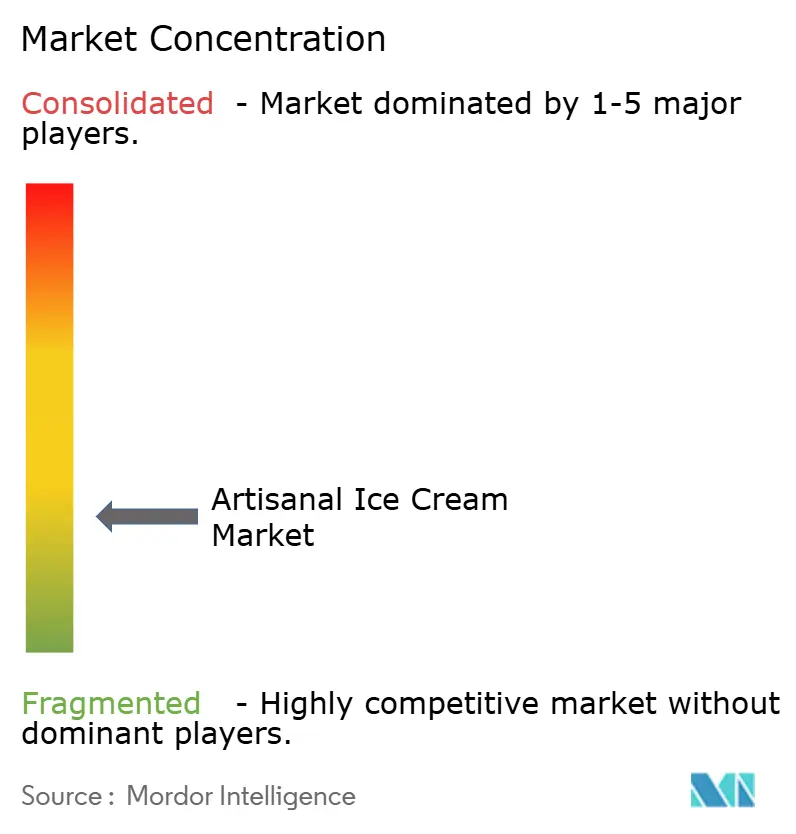
The artisanal ice cream market is highly fragmented, with multinational food companies and independent premium brands competing on product quality, flavor innovation, and brand identity. Global companies such as Unilever PLC, Nestlé S.A., and Froneri International Limited leverage extensive distribution networks and premium ice cream portfolios, while specialist brands including Jeni's Splendid Ice Creams LLC and Salt & Straw differentiate themselves through handcrafted production, locally sourced ingredients, seasonal flavors, and experiential retail formats. Product innovation, premium positioning, and expansion across specialty retail and foodservice channels remain the primary competitive strategies among market participants.
Market participants are increasingly investing in new product development, geographic expansion, and direct-to-consumer channels to strengthen their market presence. Limited-edition flavors, clean-label formulations, plant-based alternatives, and collaborations with chefs or local producers have become key approaches for attracting consumers and building brand differentiation. Companies are also expanding their retail footprints through company-owned stores, franchising, and partnerships with premium grocery retailers, while strengthening digital and e-commerce capabilities to improve customer engagement.
The market continues to present opportunities for emerging artisanal brands focused on regional flavors, locally sourced ingredients, and small-batch production. Growing consumer demand for authentic, premium dessert experiences is enabling independent producers to establish strong regional positions despite competition from larger manufacturers. Improvements in cold-chain logistics, premium retail infrastructure, and online delivery platforms are further supporting the expansion of smaller brands into new markets and customer segments.
Artisanal Ice Cream Industry Leaders
-
Jeni's Splendid Ice Creams LLC.
-
Unilever PLC
-
Salt & Straw
-
Nestlé S.A.
-
Froneri International Limited
- *Disclaimer: Major Players sorted in no particular order

Recent Industry Developments
- December 2025: Salt & Straw expanded its retail footprint by opening two new scoop shops on the Las Vegas Strip. The expansion introduced the brand to one of the world's largest tourism destinations and included an exclusive "Icons Series" menu featuring its signature flavors.
- September 2025: Jeni's Splendid Ice Creams launched its Fellowship Model franchising program. The initiative enables entrepreneurs to open Jeni's scoop shops in new markets, supporting the company's expansion strategy while preserving its artisanal retail concept.
- October 2025: Van Leeuwen Ice Cream accelerated its retail expansion. The company opened 29 new scoop shops during 2025, expanding its footprint to nearly 100 locations and strengthening its presence in the premium artisanal ice cream market.


Global Artisanal Ice Cream Market Report Scope
The Artisanal Ice Cream Market comprises premium frozen desserts produced using small-batch methods, high-quality ingredients, and distinctive flavors, with an emphasis on craftsmanship, authenticity, and product quality. The market is driven by growing consumer demand for premium dessert experiences, clean-label formulations, and innovative flavor offerings across retail and foodservice channels. The market is segmented by product formulation into dairy-based and plant-based. By flavor, the market is segmented into vanilla, chocolate, fruit flavors, nut flavors, and exotic, botanical, and seasonal flavors. Based on distribution channel, the market is segmented into specialty stores and scoop shops, supermarkets and hypermarkets, convenience stores, online retail and direct-to-consumer, foodservice and hospitality, and ice cream trucks, events, and pop-ups. The study also covers the market across North America, Europe, Asia-Pacific, South America, and the Middle East and Africa.
| Dairy-Based |
| Plant-Based |
| Vanilla |
| Chocolate |
| Fruit Flavors |
| Nut Flavors |
| Other Flavors |
| Specialty Stores |
| Supermarkets/Hypermarkets |
| Convenience Stores |
| Online Retail Stores |
| Other Distribution Channels |
| North America | United States |
| Canada | |
| Mexico | |
| Rest of North America | |
| Europe | Germany |
| United Kingdom | |
| Italy | |
| France | |
| Spain | |
| Netherlands | |
| Poland | |
| Belgium | |
| Sweden | |
| Rest of Europe | |
| Asia-Pacific | China |
| India | |
| Japan | |
| Australia | |
| Indonesia | |
| South Korea | |
| Thailand | |
| Singapore | |
| Rest of Asia-Pacific | |
| South America | Brazil |
| Argentina | |
| Colombia | |
| Chile | |
| Peru | |
| Rest of South America | |
| Middle East and Africa | South Africa |
| Saudi Arabia | |
| United Arab Emirates | |
| Nigeria | |
| Egypt | |
| Morocco | |
| Turkey | |
| Rest of Middle East and Africa |
| By Product Formulation | Dairy-Based | |
| Plant-Based | ||
| By Flavor | Vanilla | |
| Chocolate | ||
| Fruit Flavors | ||
| Nut Flavors | ||
| Other Flavors | ||
| By Distribution Channel | Specialty Stores | |
| Supermarkets/Hypermarkets | ||
| Convenience Stores | ||
| Online Retail Stores | ||
| Other Distribution Channels | ||
| By Geography | North America | United States |
| Canada | ||
| Mexico | ||
| Rest of North America | ||
| Europe | Germany | |
| United Kingdom | ||
| Italy | ||
| France | ||
| Spain | ||
| Netherlands | ||
| Poland | ||
| Belgium | ||
| Sweden | ||
| Rest of Europe | ||
| Asia-Pacific | China | |
| India | ||
| Japan | ||
| Australia | ||
| Indonesia | ||
| South Korea | ||
| Thailand | ||
| Singapore | ||
| Rest of Asia-Pacific | ||
| South America | Brazil | |
| Argentina | ||
| Colombia | ||
| Chile | ||
| Peru | ||
| Rest of South America | ||
| Middle East and Africa | South Africa | |
| Saudi Arabia | ||
| United Arab Emirates | ||
| Nigeria | ||
| Egypt | ||
| Morocco | ||
| Turkey | ||
| Rest of Middle East and Africa | ||


Key Questions Answered in the Report
What is the forecast growth rate for artisanal ice cream?
The artisanal ice cream market is forecast to grow at a 6.97% CAGR from 2026 to 2031, reaching USD 12.16 billion by 2031.
Which product formulation leads artisanal ice cream sales?
Dairy-based products led the artisanal ice cream market with 72.55% share in 2025, supported by established consumer preferences and supply chains.
Which sales channel is growing the fastest for artisanal ice cream?
In the artisanal ice cream market, online retail stores are forecast to expand at an 8.47% CAGR through 2031, supported by direct sales and quick-commerce delivery.
Which region has the largest artisanal ice cream presence?
Europe held 34.35% of the artisanal ice cream market in 2025, supported by Italy's gelato ecosystem and premium retail activity.
Page last updated on:





