
Arthroscopic Shavers Market Size and Share
Market Overview
| Study Period | 2020 - 2031 |
|---|---|
| Market Size (2026) | USD 0.61 Billion |
| Market Size (2031) | USD 1.02 Billion |
| Growth Rate (2026 - 2031) | 11.01 % |
| Fastest Growing Market | Asia-Pacific |
| Largest Market | North America |
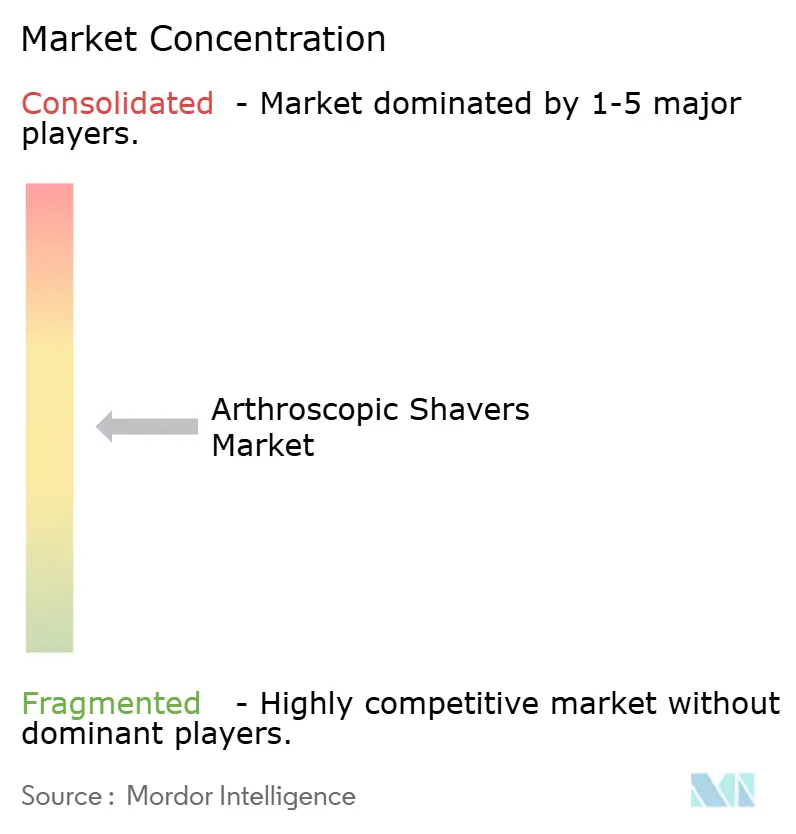
| Market Concentration | Medium |
Major Players *Disclaimer: Major Players sorted in no particular order Image © Mordor Intelligence. Reuse requires attribution under CC BY 4.0. | |
Arthroscopic Shavers Market Analysis by Mordor Intelligence
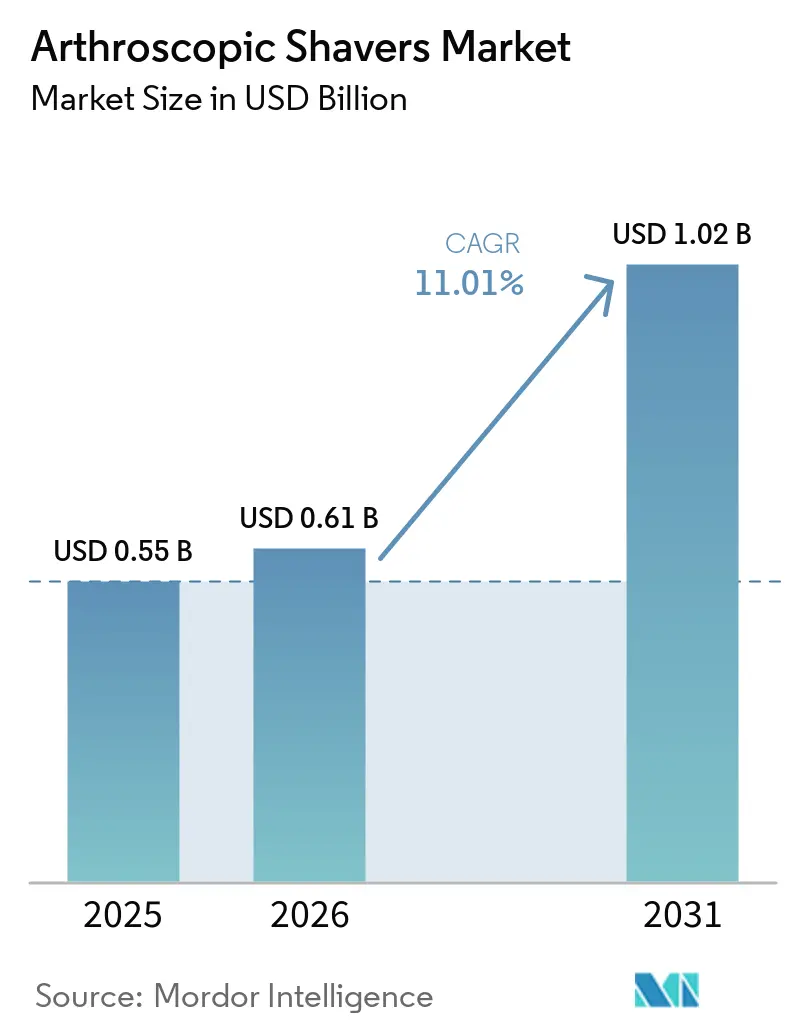
The Arthroscopic Shavers Market size was valued at USD 0.55 billion in 2025 and is estimated to grow from USD 0.61 billion in 2026 to reach USD 1.02 billion by 2031, at a CAGR of 11.01% during the forecast period (2026-2031).
The arthroscopic shavers market is shaped by a move toward single-use blades and burrs, which expands recurring consumable demand. The movement of elective procedures from hospital operating rooms to ambulatory surgical centers also changes demand toward compact, flexible systems. Vendors with broad blade, burr, and fluid-management portfolios are better placed to serve this demand pattern than companies focused on console placements. This transition can place pressure on equipment pricing while creating more frequent purchasing cycles for procedure-specific consumables. Integrated systems that fit visualization and operating room workflows can also influence supplier selection.
Key Report Takeaways
By product type, Shaver Blades & Burrs held 52.4% of the arthroscopic shavers market share in 2025, while Accessories & Consumables is forecast to grow at an 11.8% CAGR through 2031.
By power source, Electric Systems held 71.6% of the arthroscopic shavers market share in 2025, while Battery-Powered Systems is forecast to grow at an 11.9% CAGR through 2031.
By application, Knee Arthroscopy held 48.7% of the arthroscopic shavers market share in 2025, while Hip Arthroscopy is forecast to grow at an 11.5% CAGR through 2031.
By end user, Hospitals held 63.5% of the arthroscopic shavers market share in 2025, while Ambulatory Surgical Centers is forecast to grow at an 11.7% CAGR through 2031.
By geography, North America held 42.5% of the arthroscopic shavers market share in 2025, while Asia Pacific is forecast to grow at a 12.3% CAGR through 2031.
Arthrex held 30% of global sports medicine revenue in 2025, while Smith+Nephew held 23%.
Note: Market size and forecast figures in this report are generated using Mordor Intelligence’s proprietary estimation framework, updated with the latest available data and insights as of January 2026.
Market Trends and Insights
Drivers Impact Analysis of Arthroscopic Shavers Market*
| Driver | (~) % Impact on CAGR Forecast | Geographic Relevance | Impact Timeline |
|---|---|---|---|
| Rising Orthopedic And Sports-Injury Procedure Volumes | +3.1% | Global | Short term (≤ 2 years) |
| Shift Toward Minimally Invasive And Outpatient Arthroscopy | +2.7% | North America and Europe, with spillover to Asia Pacific | Medium term (2-4 years) |
| Disposable Shaver Adoption For Infection-Control Workflows | +2% | North America and Europe, expanding globally | Medium term (2-4 years) |
| Precision Cutting And Visualization Integration | +1.5% | Global, concentrated in North America, Germany, and Japan | Long term (≥ 4 years) |
| Underdiagnosed Joint Disease And Expanding Orthopedic Access In Asia Pacific | +1.4% | Asia Pacific, with spillover to the Middle East and Africa | Long term (≥ 4 years) |
| Source: Mordor Intelligence | |||
Rising Orthopedic And Sports-Injury Procedure Volumes
Sports medicine procedure volumes remain a direct source of demand for the arthroscopic shavers market. Global sports medicine sales reached USD 7.6 billion in 2025, rising 5.8% from 2024. The United States [1]generated USD 5 billion of this total in 2025 and recorded 5.9% annual growth. Higher case volumes support demand for blades, burrs, and handpieces used in routine joint procedures. Complex joint-preservation procedures also require precise cutting and tissue removal. These requirements support demand for specialized blade geometries and faster tissue removal across the arthroscopic shavers market.
Shift Toward Minimally Invasive And Outpatient Arthroscopy
Ambulatory surgical centers are changing the settings in which arthroscopic shavers are purchased and used. These facilities favor compact systems, simple setup, and sterile consumables that support efficient patient turnover. The shift reduces the appeal of capital-intensive console arrangements for some procedures. It also encourages providers to select cordless handpieces that reduce cable management needs in multipurpose rooms. Manufacturers are adapting their product offerings toward lightweight systems and procedure packs. This channel gives the arthroscopic shavers market a route to higher-frequency consumable use.
Disposable Shaver Adoption For Infection-Control Workflows
Reusable handpieces remain subject to cleaning and reprocessing requirements. A 2025 study found visible debris or discoloration in all inspected arthroscopic shaver handpiece lumens after standard reprocessing, and re-cleaning did not produce clean instruments in the tested cases. The finding makes infection-control governance an important consideration in procurement decisions. Sterile single-use blades can reduce the dependence on complex reprocessing workflows. Reusable systems still retain a role where facilities prioritize equipment reuse and can maintain validated sterilization practices. positions its diamond-like carbon coating as a means to reduce friction and particulate generation at the cutting tip.
Precision Cutting And Visualization Integration
The arthroscopic shavers market is increasingly linked with visualization, navigation, and operating room management systems. Arthrex[2] introduced the Synergy Power system in June 2025 for sports medicine, arthroplasty, trauma, and distal extremity applications. KARL STORZ and Smith+Nephew announced a strategic relationship in February 2026 that connects Smith+Nephew sports medicine and resection products with KARL STORZ visualization and operating room technologies. These arrangements can increase switching costs where hospitals purchase connected systems under broader agreements. They also make standalone systems more vulnerable when they cannot integrate with established visualization platforms. Product differentiation now includes compatibility with the broader surgical environment.
Restraints Impact Analysis of Arthroscopic Shavers Market*
| Restraint | (~) % Impact on CAGR Forecast | Geographic Relevance | Impact Timeline |
|---|---|---|---|
| Capital And Per-Procedure Cost Of Powered Systems | -1.8% | Global, most acute in Asia Pacific and South America | Short term (≤ 2 years) |
| Regulatory And Reprocessing Burden | -1.4% | North America and Europe, expanding to Asia Pacific as standards harmonize | Medium term (2-4 years) |
| Surgeon Training And Procedure-Standardization Gaps | -0.9% | Middle East and Africa, South America, and tier 2 and tier 3 Asia Pacific cities | Long term (≥ 4 years) |
| Metal-Particulate And Sustainability Scrutiny For Shaver Consumables | -0.7% | Europe and North America, with early awareness in Asia Pacific | Medium term (2-4 years) |
| Source: Mordor Intelligence | |||
Capital and Per-Procedure Cost Of Powered Systems
The capital cost of a powered shaver system can limit adoption in smaller facilities and price-sensitive health systems. This challenge is more pronounced where providers have limited budgets for console replacement and service contracts. Manual and basic reusable configurations can remain attractive when the per-procedure cost of advanced systems is difficult to justify. Bundled service, training, and warranty programs can add to the initial procurement cost. Such arrangements may be harder to place in lower-budget facilities. The arthroscopic shavers market, therefore, faces uneven adoption of premium cordless and integrated systems.
Regulatory And Reprocessing Burden
The 2025 Lumens 2.0 findings underline the difficulty of cleaning narrow instrument channels under real-world processing conditions. Reusable handpiece suppliers must maintain documentation and instructions that support validated reprocessing. European Union requirements under EU MDR add post-market surveillance and clinical documentation duties for reusable medical devices. ISO 17664-1 and ISO 15883 set important technical expectations for device processing and washer-disinfectant systems. These obligations can consume research and regulatory resources, particularly for smaller suppliers. Larger manufacturers can often manage compliance requirements more easily because they have established regulatory capabilities.
*Our forecasts treat driver/restraint impacts as directional, not additive. The impact forecasts reflect baseline growth, mix effects, and variable interactions.
Arthroscopic Shavers Market Segment Analysis
By Product Type:
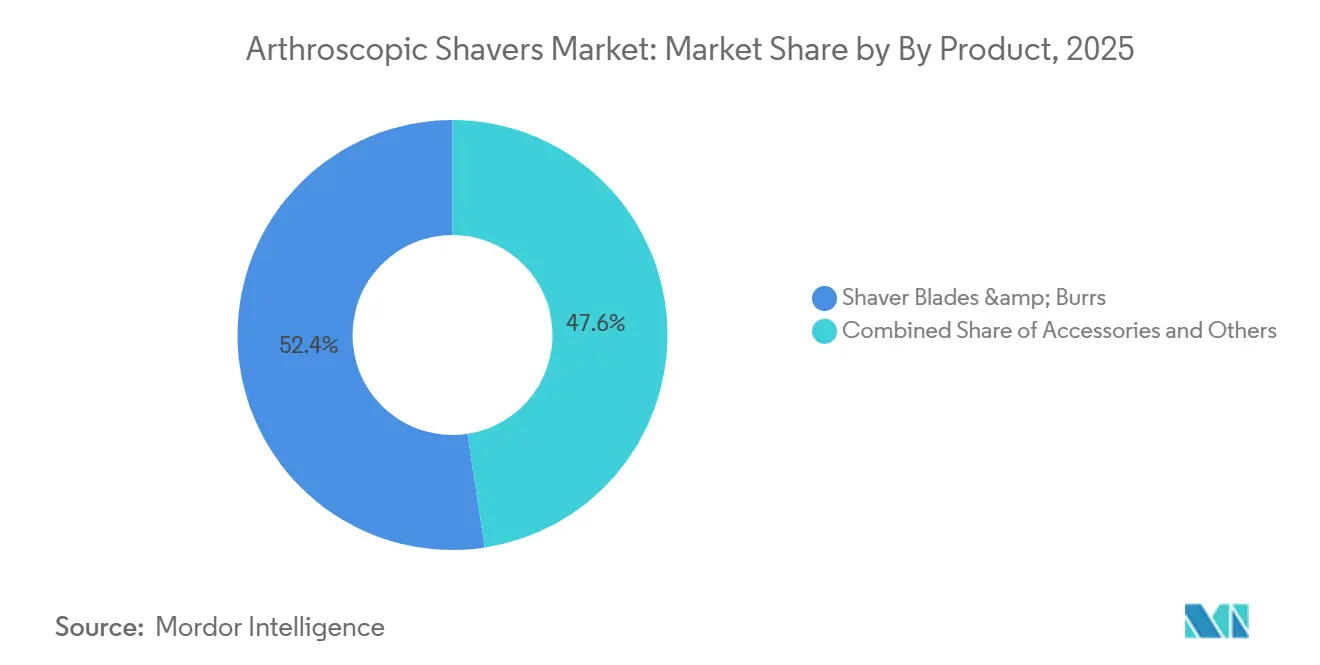
Consumable Mix Supports Recurring RevenueShaver Blades & Burrs accounted for 52.4% of the arthroscopic shavers market size in 2025. Their position reflects the frequent replacement requirements of blades in hospital and outpatient procedures. The installed base of compatible systems also supports continuing blade purchases after the original equipment sale. Accessories & Consumables is forecast to grow at an 11.8% CAGR through 2031. Sterile packs, fluid-management sets, and procedure-specific burr kits support this growth. These products can add spending beyond the primary blade used in each procedure.
Shaver Handpieces and Consoles form the durable equipment layer of the category. Replacement cycles for these systems are commonly longer than consumable purchasing cycles. Battery-powered handpieces can shorten refresh decisions when providers replace older tethered equipment. Product suppliers must balance the demand for recurring consumable revenue with the need to maintain compatible equipment platforms. A 2025 life-cycle study found that replacing reusable equipment with reusable alternatives reduced carbon-dioxide-equivalent emissions by 54% per rotator cuff repair case. This consideration can support reusable equipment choices where sustainability requirements shape procurement.

By Power Source:
Cordless Systems Change Equipment PreferencesElectric Systems held 71.6% of the arthroscopic shavers market share in 2025. Their leading position reflects decades of console installation and familiarity among surgical teams. Existing electric platforms create ongoing demand for compatible blades and handpieces. Battery-Powered Systems is forecast to expand at an 11.9% CAGR through 2031. Cordless designs reduce reliance on fixed power infrastructure in procedure rooms. They also simplify room setup and cable management for providers.
The cordless approach aligns with the operating model of ambulatory surgical centers. These centers often value flexible rooms that can accommodate more than one type of procedure. Arthrex launched its Synergy Power system in 2025 with a battery-powered platform designed for several orthopedic specialties. The product illustrates the wider move away from fully tethered system designs. Pneumatic systems depend on compressed-gas infrastructure and remain less suited to self-contained outpatient configurations. Their relevance may continue to decrease as new facilities favor cordless equipment.
By Application:
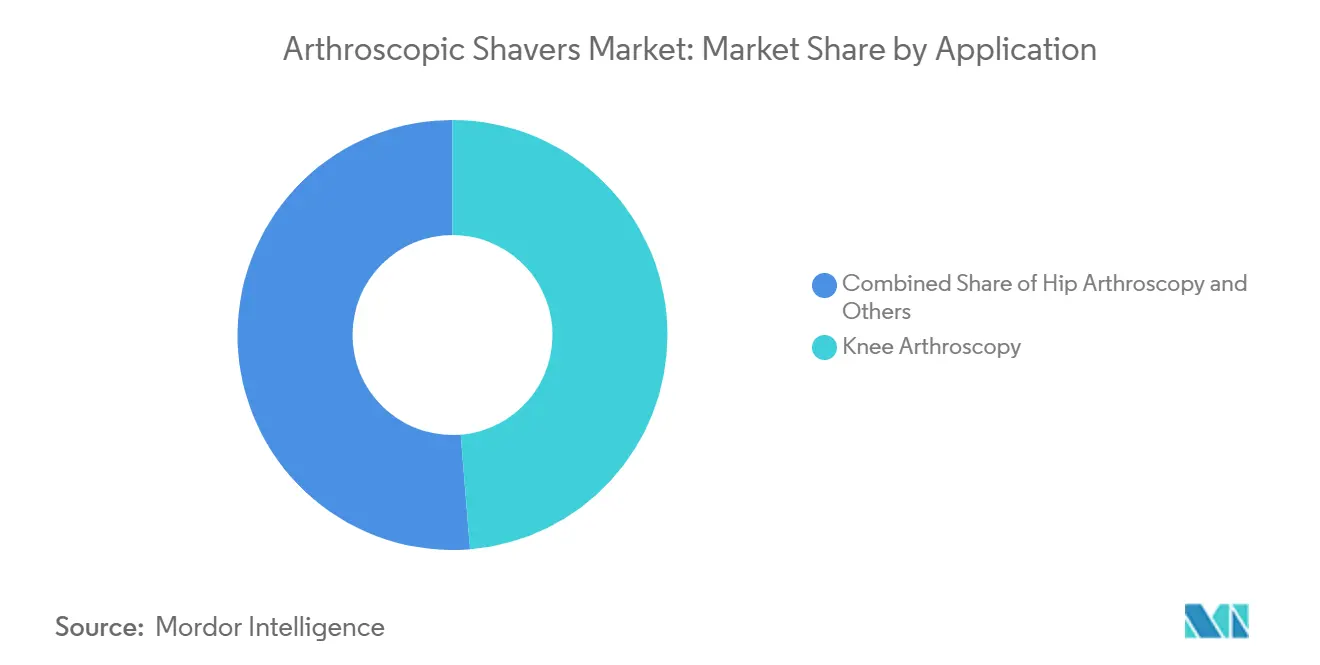
Knee Procedures Lead While Hip Procedures ExpandKnee Arthroscopy held 48.7% of the arthroscopic shavers market size in 2025. Meniscectomy, anterior cruciate ligament reconstruction, and cartilage debridement support repeat use of shaver blades in these workflows. Hospitals and ambulatory surgical centers both use these products for knee procedures. Hip Arthroscopy is forecast to expand at an 11.5% CAGR through 2031. Improved identification of femoroacetabular impingement and labral conditions supports this demand. Hip procedures require blade use for acetabular margin preparation and tissue management.
Shoulder and elbow procedures remain relevant to supplier portfolios. Smith+Nephew[3] completed its acquisition of Integrity Orthopedics in January 2026, adding the Tendon Seam rotator cuff repair system and the REGENETEN bioinductive implant to its shoulder offering. The company identified an estimated 500,000 annual rotator cuff repair procedures in the United States in its announcement. Other arthroscopy applications include ankle, wrist, and small-joint procedures. These applications can benefit as multi-portal techniques move into smaller anatomical spaces. They nevertheless remain a smaller part of the product mix.
By End User:
Outpatient Growth Alters Purchasing CriteriaHospitals accounted for 63.5% of the arthroscopic shavers market share in 2025. Complex multi-ligament cases, revision arthroscopy, and procedures requiring inpatient support remain concentrated in hospitals. Large health systems often purchase through group purchasing organizations and integrated delivery networks. These channels favor multiyear agreements that combine systems, blades, and fluid-management products. Broad product compatibility can therefore matter more than unit price alone. Centralized purchasing may present challenges for specialized suppliers with narrow portfolios.
Ambulatory Surgical Centers is forecast to grow at an 11.7% CAGR through 2031. Its growth supports demand for streamlined systems, sterile blades, and simple room setup. The setting also favors equipment that avoids multiple consoles and extensive infrastructure. Zimmer Biomet states that its sports medicine portfolio includes technologies for tissue resection, fluid management, and related procedural needs. High-volume hospital use of reusable handpieces also requires close attention to reprocessing validation. Sterilization failures can create clinical and operational risk for facilities that use reusable devices.
Geography Analysis
North America Arthroscopic Shavers Market
North America held 42.5% of the arthroscopic shavers market size in 2025. The region benefits from a large sports medicine base and established consumable replacement practices. United States sports medicine sales reached USD 5 billion in 2025, increasing 5.9% from 2024. The region has a developed outpatient procedure environment and strong demand for products that support fast room turnover. Hospitals still represent a major source of volume for complex procedures. Ambulatory surgical centers create an additional channel for cordless handpieces and sterile consumables.
Europe Arthroscopic Shavers Market
Europe remains a significant market because of established orthopedic training, insurance coverage, and hospital infrastructure. The region is also exposed to strict regulatory and reprocessing expectations for reusable devices. These factors can favor suppliers that provide clear cleaning documentation and validated processing instructions. Cordless equipment can fit the expansion of outpatient surgical models across European health systems. Sustainability considerations may also influence choices between reusable and disposable products. Suppliers must therefore balance infection-control needs with environmental procurement considerations.
APAC, MEA and South America Arthroscopic Shavers Market
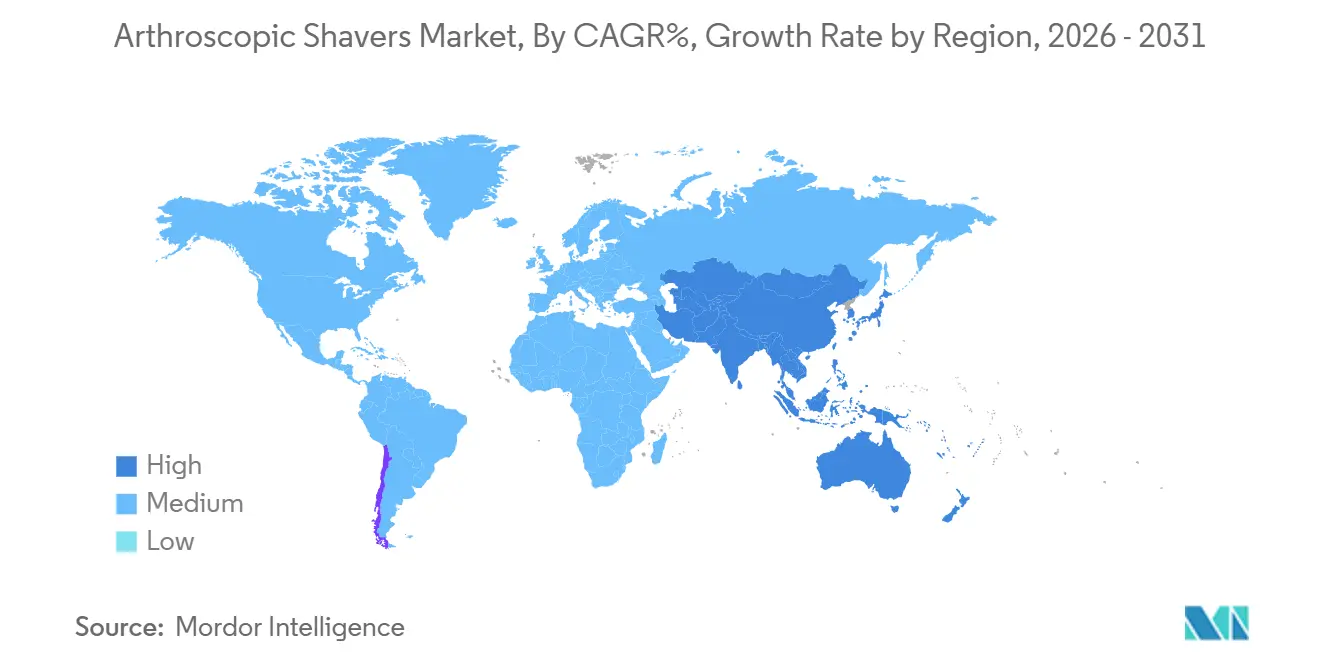
Asia Pacific is forecast to grow at a 12.3% CAGR through 2031. China, India, Japan, and South Korea each present distinct purchasing conditions. India offers expansion potential through underserved orthopedic care needs and growing private hospital networks. South Korea supports advanced equipment demand through developed hospitals and sports medicine activity. Japan has a mature healthcare system where infection prevention and consumable use can support adoption. The Middle East and Africa are developing sports medicine capacity through hospital modernization, while South America is led by Brazil’s elective procedure access and sports injury care needs.
Competitive Landscape
The arthroscopic shavers market is moderately consolidated among leading suppliers and more fragmented below that group. Arthrex held 30% of global sports medicine revenue in 2025, while Smith+Nephew held 23%. Their combined position gives both companies broad influence in sports medicine purchasing. Arthrex supports its product position through surgeon education, procedure-specific blades, and ambulatory surgical center resources. Smith+Nephew continues to extend its sports medicine portfolio through product and acquisition activity. Stryker, DePuy Synthes, and CONMED compete through bundled equipment and consumable contracts.
KARL STORZ[4] and Smith+Nephew announced their strategic relationship in February 2026 to align sports medicine and resection products with 4K visualization and operating room management technologies. This approach places arthroscopic cutting tools within a wider operating room platform. KARL STORZ also announced partnerships with Moon Surgical and Sovato in July 2026 to expand its robotics and digital operating room ecosystem. Arthrex introduced Synergy Power in June 2025 to serve a broad set of orthopedic uses with a battery-powered system. These actions show that companies are competing through connected systems as well as cutting performance. Suppliers without compatible visualization and workflow capabilities can face greater price competition.
Demand remains open for simple systems that combine cutting, fluid management, and practical outpatient use. Zimmer Biomet’s sports medicine offering covers products used in tissue resection and fluid management, which reflects the value of a broader procedural offering. CONMED uses diamond-like carbon coating technology to address friction and particulate concerns in shaver applications. Richard Wolf, B. Braun Melsungen, and Olympus retain positions based on precision instruments and hospital relationships. Smaller suppliers serve price-sensitive settings where compatible third-party blades are more widely accepted. The competitive structure leaves room for lower-cost systems, but leading suppliers retain advantages through installed bases and broader portfolios.
Arthroscopic Shavers Industry Leaders
-
Stryker Corporation
-
Smith & Nephew plc
-
Medtronic plc
-
DePuy Synthes Companies
-
Zimmer Biomet Holdings, Inc.
- *Disclaimer: Major Players sorted in no particular order
Arthroscopic Shavers Market Companies Covered in this Report
- Arthrex
- Stryker
- Smiths Group
- Medtronic
- Karl Storz
- Conmed
- Zimmer Biomet
- DePuy Synthes Companies
- Olympus
- Richard Wolf
- B. Braun
- De Soutter Medical Limited
- Integra LifeSciences
- DJO Global
- GPC Medical Ltd.
- Joimax
- Sklar Surgical Instruments
- Tulpar Medical Solutions
- Integrated Endoscopy, Inc.
- Auxein Medical Pvt. Ltd.
Recent Industry Developments in Arthroscopic Shavers Market
- July 2026: KARL STORZ announced strategic partnerships with Moon Surgical and Sovato in the United States, integrating 3D visualization, robotic technologies, and digital OR capabilities into a connected surgical ecosystem. The partnerships are planned for global rollout, positioning KARL STORZ as an open-platform enabler in robot-assisted orthopedic and minimally invasive surgery.
- July 2026: Medtronic unveiled Touch Surgery Aide, an AI-native surgical computing platform for real-time AI during robotic-assisted procedures, at the Society of Robotic Surgery 2026 Annual Meeting. Its Instrument Exit Point application received FDA clearance, representing Medtronic’s first real-time AI application for robotic surgery and a significant step toward AI-embedded OR infrastructure.
- February 2026: KARL STORZ and Smith+Nephew announced a strategic relationship to align Smith+Nephew’s sports medicine and resection portfolio with KARL STORZ’s 4K visualization and OR management technologies. The partnership targets multispecialty hospital ORs and ambulatory surgical centers where visualization-integrated sports medicine workflows are a differentiating procurement factor.
Global Arthroscopic Shavers Market Report Scope
Segmentation Overview
| Shaver Consoles |
| Shaver Handpieces |
| Shaver Blades and Burrs |
| Accessories & Consumables |
| Electric Systems |
| Battery-Powered Systems |
| Pneumatic Systems |
| Knee Arthroscopy |
| Shoulder & Elbow Arthroscopy |
| Hip Arthroscopy |
| Other Arthroscopy Procedures |
| Hospitals |
| Ambulatory Surgical Centers |
| Orthopedic Specialty Clinics |
| North America | United States |
| Canada | |
| Mexico | |
| Europe | Germany |
| United Kingdom | |
| France | |
| Italy | |
| Spain | |
| Rest of Europe | |
| Asia-Pacific | China |
| India | |
| Japan | |
| South Korea | |
| Australia | |
| Rest of Asia-Pacific | |
| Middle East & Africa | GCC |
| South Africa | |
| Rest of Middle East and Africa | |
| South America | Brazil |
| Argentina | |
| Rest of South America |
| By Product Type | Shaver Consoles | |
| Shaver Handpieces | ||
| Shaver Blades and Burrs | ||
| Accessories & Consumables | ||
| By Power Source | Electric Systems | |
| Battery-Powered Systems | ||
| Pneumatic Systems | ||
| By Application | Knee Arthroscopy | |
| Shoulder & Elbow Arthroscopy | ||
| Hip Arthroscopy | ||
| Other Arthroscopy Procedures | ||
| By End User | Hospitals | |
| Ambulatory Surgical Centers | ||
| Orthopedic Specialty Clinics | ||
| By Geography | North America | United States |
| Canada | ||
| Mexico | ||
| Europe | Germany | |
| United Kingdom | ||
| France | ||
| Italy | ||
| Spain | ||
| Rest of Europe | ||
| Asia-Pacific | China | |
| India | ||
| Japan | ||
| South Korea | ||
| Australia | ||
| Rest of Asia-Pacific | ||
| Middle East & Africa | GCC | |
| South Africa | ||
| Rest of Middle East and Africa | ||
| South America | Brazil | |
| Argentina | ||
| Rest of South America | ||
Key Questions Answered in the Report
What is the projected growth rate for arthroscopic shavers?
The arthroscopic shavers market is forecast to grow at an 11% CAGR from 2026 to 2031.
Which product category leads arthroscopic shaver revenue?
Shaver Blades & Burrs led with 52.4% of 2025 revenue, reflecting recurring replacement demand.
Why are battery-powered arthroscopic shavers gaining adoption?
Battery-Powered Systems is forecast to grow at an 11.9% CAGR because cordless designs support flexible outpatient procedure rooms.
Which procedure supports the fastest application growth?
Hip Arthroscopy is forecast to grow at an 11.5% CAGR through 2031 as diagnosis and treatment of hip joint conditions expand.
How are ambulatory surgical centers affecting demand?
Ambulatory Surgical Centers is forecast to grow at an 11.7% CAGR and favors compact systems, sterile consumables, and efficient setup.
Which region is expected to grow the fastest?
Asia Pacific is forecast to grow at a 12.3% CAGR through 2031, supported by differing opportunities across China, India, Japan, and South Korea.