
Aromatherapy Market Size and Share
Market Overview
| Study Period | 2022 - 2032 |
|---|---|
| Market Size (2027) | USD 11.05 Billion |
| Market Size (2032) | USD 16.09 Billion |
| Growth Rate (2027 - 2032) | 7.80 % |
| Fastest Growing Market | Europe |
| Largest Market | North America |
| Market Concentration | Low |
Major Players *Disclaimer: Major Players sorted in no particular order Image © Mordor Intelligence. Reuse requires attribution under CC BY 4.0. | |
Aromatherapy Market Analysis by Mordor Intelligence
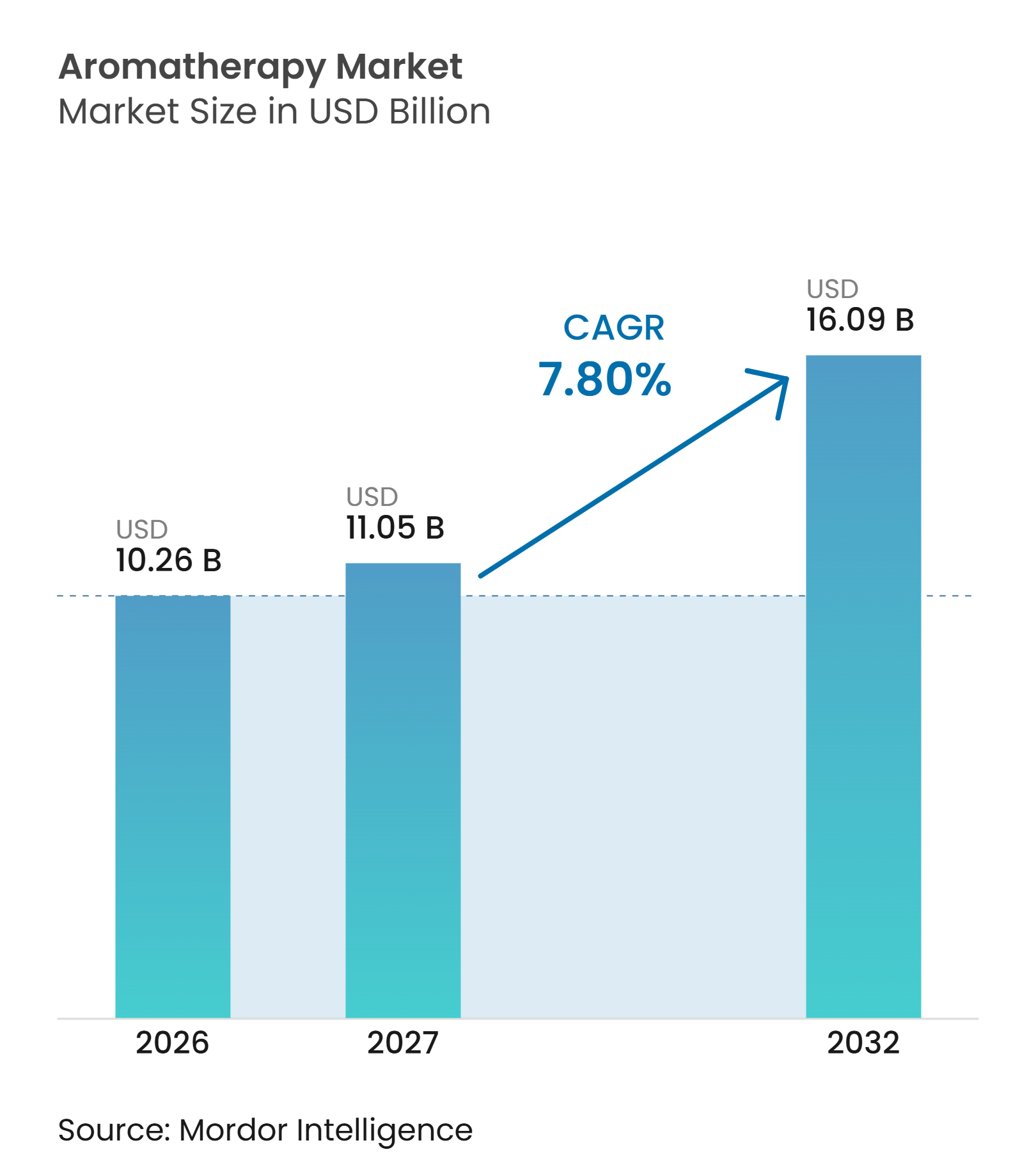
The aromatherapy market size is projected to expand from USD 10.26 billion in 2026 and USD 11.05 billion in 2027 to USD 16.09 billion by 2032, and is expected to reach a CAGR of 7.80% between 2027 and 2032. The forecast remains below a double-digit rate because the supplied estimates do not support a higher growth assumption. Demand is supported by consumer interest in natural wellness, sleep support, stress management, and personal care products that use essential oils. Product suppliers are also finding demand from spas, hotels, healthcare settings, and retail channels, which spreads revenue across more than one buying environment. Quality controls, evidence for topical uses, and compliance requirements are becoming more important to competitive positioning, while safety, adulteration, and sustainability concerns remain constraints.
Key Report Takeaways
-
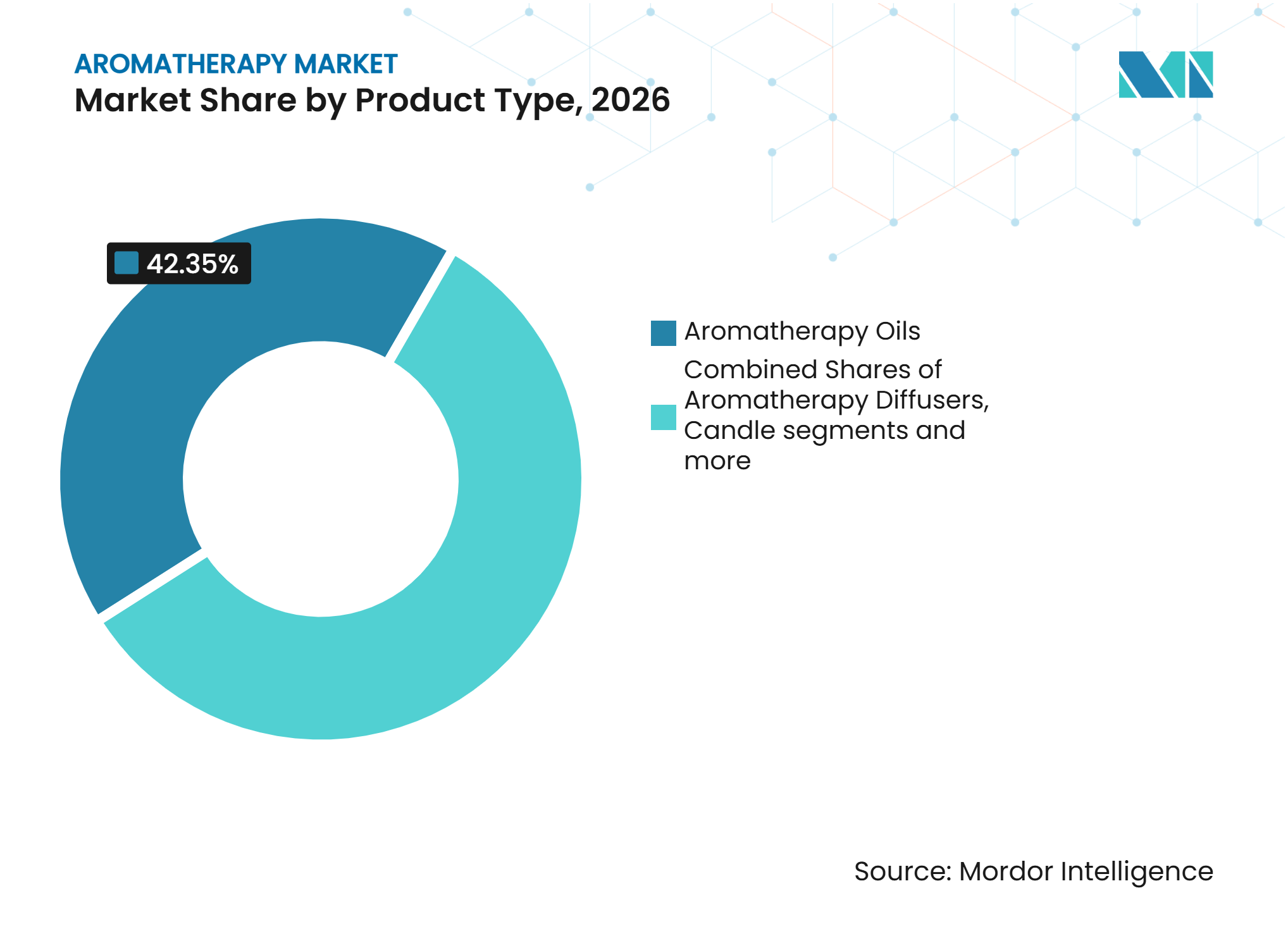
By product type, Aromatherapy Oils held 42.35% of the aromatherapy market share in 2026, while Aromatherapy Diffusers are forecast to grow at a 7.91% CAGR through 2032.
-
By application, Relaxation and Stress Management accounted for 41.28% of the aromatherapy market share in 2026, while Skin and Hair Care is forecast to grow at an 8.12% CAGR through 2032.
-
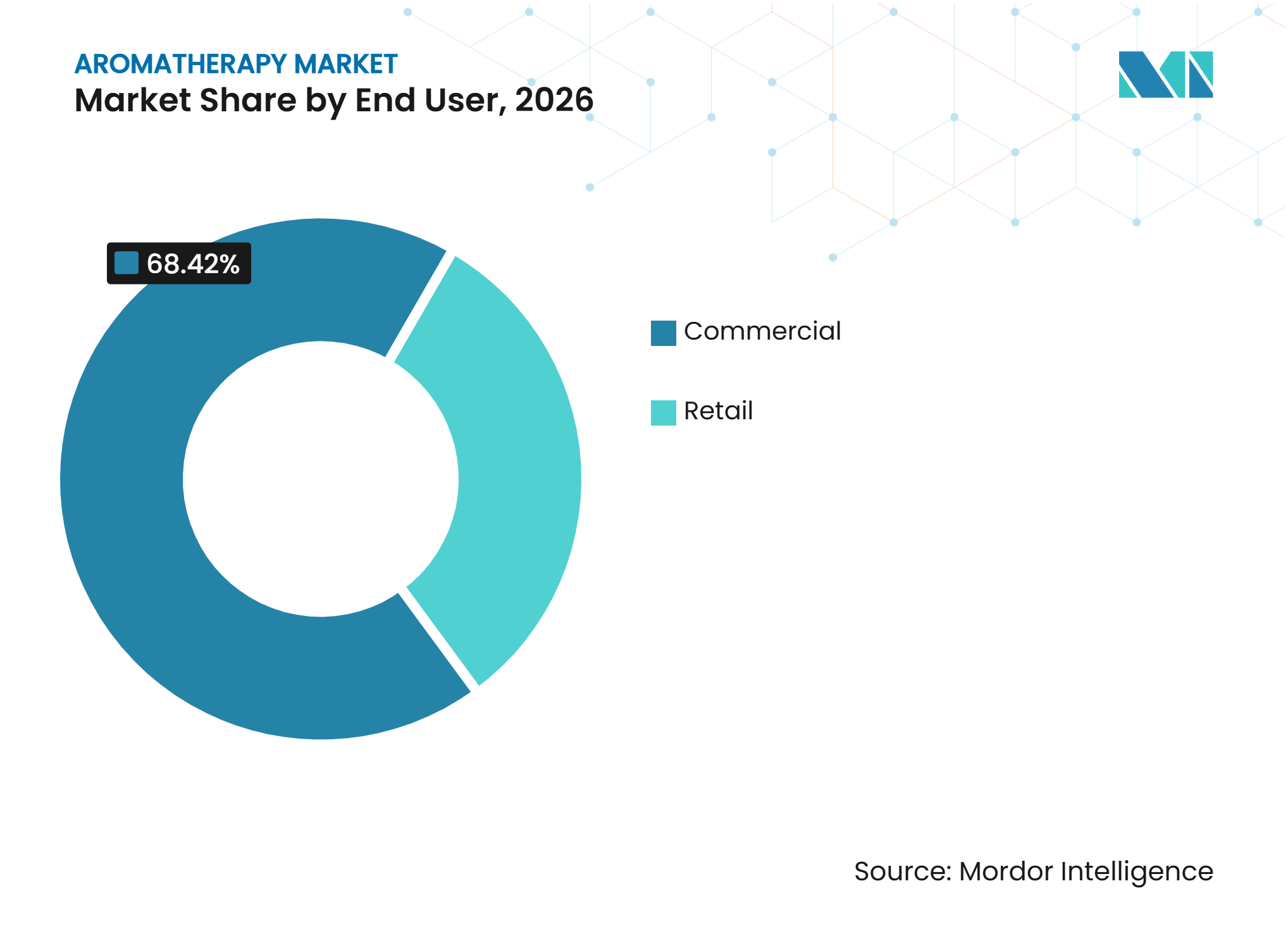
By end user, Commercial held 68.42% of the aromatherapy market share in 2026, while Retail is forecast to grow at an 8.55% CAGR through 2032.
-
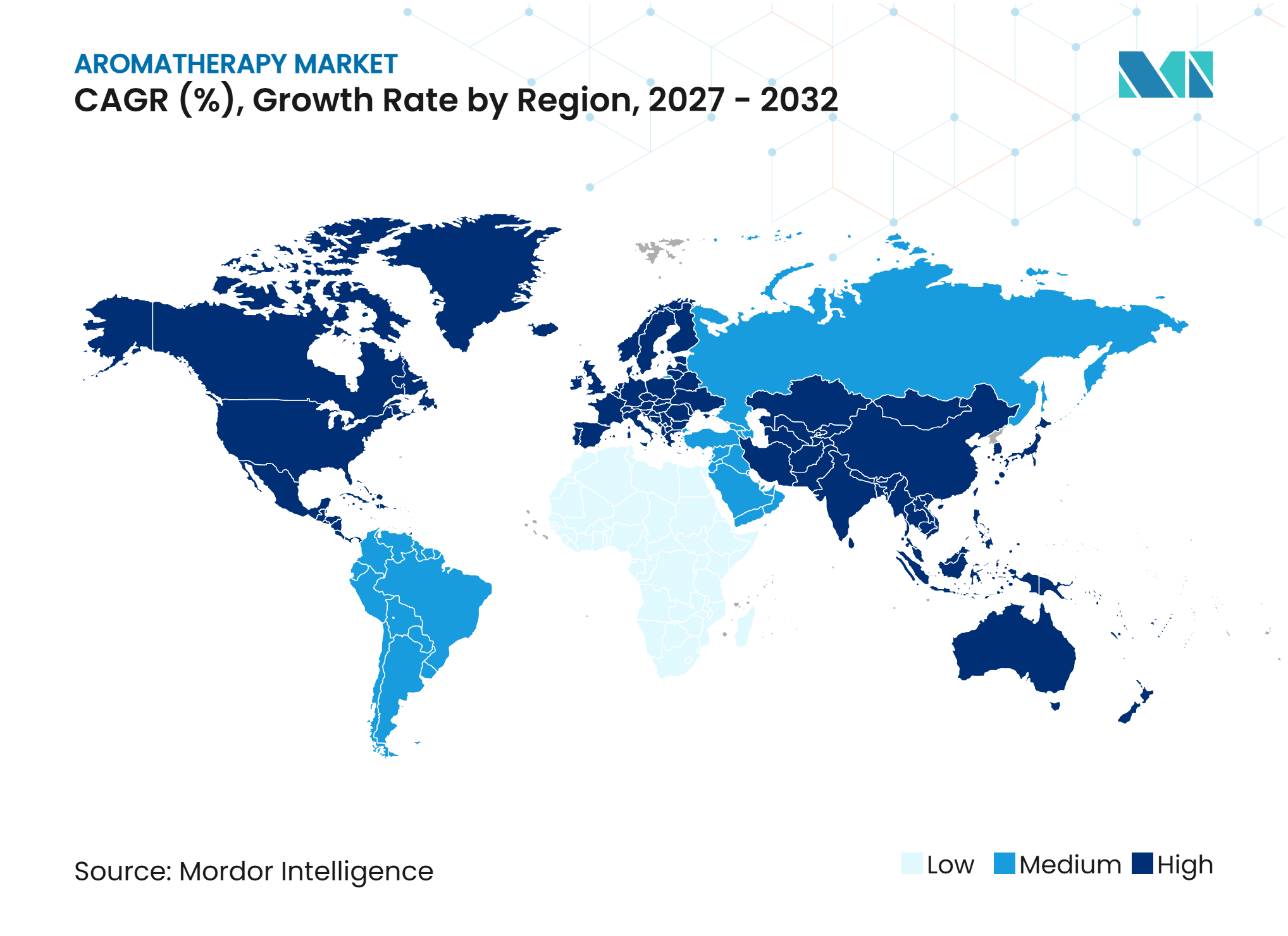
By geography, North America held 45.32% of the aromatherapy market share in 2026, while Europe is forecast to grow at an 8.13% CAGR through 2032.
Note: Market numbers in this report are based on Mordor Intelligence's proprietary estimation framework, which combines nine months of actuals with Q4 projections for base year 2026.
Market Trends and Insights
Drivers Impact Analysis of Aromatherapy Market*
| Driver | (~) % Impact on CAGR Forecast | Geographic Relevance | Impact Timeline |
|---|---|---|---|
| Growing consumer preference for natural and plant-based wellness products | +2.0% | Global | Medium term (2–4 years) |
| Rising prevalence of stress and anxiety | +1.5% | Global | Short term (≤ 2 years) |
| Increasing demand for sleep-enhancing products | +1.2% | North America, Europe, Asia-Pacific | Medium term (2–4 years) |
| Growing adoption of complementary and alternative therapies | +0.8% | North America, Europe | Long term (≥ 4 years) |
| Increasing penetration of aromatherapy diffusers | +1.0% | Global, led by Asia-Pacific | Short term (≤ 2 years) |
| Growing incorporation of aromatherapy into healthcare and hospitality facilities | +0.7% | North America, Europe, Middle East and Africa | Medium term (2–4 years) |
| Source: Mordor Intelligence | |||
Growing Preference for Natural and Plant-Based Wellness Products
Consumer interest in plant-derived wellness products supports demand for essential oils, blends, and diffuser systems in the aromatherapy market. A 2025 MDPI study of 1,848 adults in Bulgaria found that 68.7% used essential oils, and use was associated with younger people and people with higher education levels[1]. This pattern places demand among consumer groups that are active buyers of personal care and wellness products. Diffusers extend the category beyond direct topical use and allow consumers to create routines around scent in homes, workplaces, and hospitality settings. Ultrasonic models remain widely used because of their accessibility, while nebulizing systems are gaining attention where coverage area and oil-free particle delivery matter. This combination of natural-product demand and hardware adoption broadens the aromatherapy market across retail and commercial channels.
Rising Prevalence of Stress and Anxiety
Stress management remains a central use case for the aromatherapy market because consumers often seek accessible, nonprescription wellness products. Relaxation and Stress Management held 41.28% of revenue in 2026, which gives suppliers a large base for blends, candles, sprays, and diffusion formats. A perioperative study published in the Journal of Perianesthesia Nursing in 2025 found that a single-packet delivery method scored 81.8 on the System Usability Scale, compared with 62.5 for a conventional bottled method[2]. The result indicates that product format can influence whether healthcare staff can use aromatherapy within routine care processes. Institutional products must meet a different standard from consumer products because they need convenient packaging, repeatable use, and appropriate safety controls. These requirements create an opportunity for suppliers that can adapt blends and packaging to care settings.
Increasing Demand for Sleep-Enhancing Products
Sleep-related products give the aromatherapy market a functional position that can support higher-value products when claims are carefully managed. Consumers want clearer explanations of the role different scents may play in relaxation and sleep routines, which leaves room for better product education. Sleep-oriented products can include oils, diffuser blends, sprays, and personal-care items, allowing brands to offer consistent routines across formats. A systematic review published in Frontiers in 2025 found evidence for skin-care applications of essential oils, including tea tree oil nanoemulsions in acne studies. The broader evidence base encourages formulators to distinguish products with substantiated topical uses from products that rely only on fragrance narratives. Sleep positioning therefore works best when brands pair clear use instructions with responsible safety and ingredient information.
Growing Adoption of Complementary and Alternative Therapies
The use of aromatherapy in complementary care, hotels, spas, and other commercial sites adds volume demand that does not depend only on individual retail purchases. Commercial buyers often need larger pack sizes, equipment, replenishment arrangements, and reliable product specifications. Hotels and spas can use scent as part of guest experience programs, while healthcare facilities focus more strongly on safety, compatibility, and repeatable application. The aromatherapy industry benefits when suppliers can serve both settings without presenting consumer-oriented claims as clinical outcomes.
Restraints Impact Analysis of Aromatherapy Market*
| Restraint | (~) % Impact on CAGR Forecast | Geographic Relevance | Impact Timeline |
|---|---|---|---|
| Risk of allergic reactions and skin irritation | -0.6% | Global | Short term (≤ 2 years) |
| Inconsistent quality and adulteration of essential oils | -0.5% | Global, most acute in North America and Asia | Medium term (2–4 years) |
| Competition from alternative wellness products | -0.7% | North America, Europe | Medium term (2–4 years) |
| Concerns regarding environmental sustainability and biodiversity | -0.4% | Europe, Asia-Pacific core | Long term (≥ 4 years) |
| Source: Mordor Intelligence | |||
Risk of Allergic Reactions and Skin Irritation
Allergic reactions, skin irritation, inconsistent composition, and adulteration can weaken trust in the aromatherapy market. The Bulgarian survey from MDPI found that 4% of essential-oil users reported contact dermatitis or allergic reactions. A 2025 Frontiers review also identified associations between dermatitis and lavender, peppermint, and tea tree oils, while noting that composition can vary by origin, extraction, and storage. Suppliers that use stronger authentication methods and accredited laboratories can provide a clearer quality signal to retail and institutional buyers.
Competition From Alternative Wellness Products
The aromatherapy market also competes with other wellness products that offer relaxation, sleep, and personal-care benefits. Consumers can choose fragrance products, supplements, massage services, meditation tools, topical skin care, and other formats instead of essential-oil products. This makes differentiated product design and clear evidence especially important in mature retail environments. Environmental pressure adds another challenge because natural ingredients depend on crops, ecosystems, and responsible harvesting practices. IFF opened its first Forest Lab in Brazil in November 2026 to identify potential fragrance and beauty ingredients from Atlantic Forest species, using scent-capture technology without harvesting the plants. Such initiatives show how ingredient businesses are addressing biodiversity while seeking more resilient natural-material pipelines.
*Our forecasts treat driver/restraint impacts as directional, not additive. The impact forecasts reflect baseline growth, mix effects, and variable interactions.
Aromatherapy Market Segment Analysis
By Product Type:
Oils Anchor Revenue While Diffusers Lead Hardware GrowthAromatherapy Oils held 42.35% of revenue in 2026, giving the segment the largest position in product-type demand. The format includes essential oils, carrier oils, proprietary blends, and massage oils, which allows suppliers to serve entry-level and premium price points. Aromatherapy Diffusers are forecast to grow at a 7.91% CAGR through 2032, supported by home use, hospitality demand, and the appeal of connected home devices. Ultrasonic products are widely adopted because they are simple to use, while nebulizing systems are relevant where room coverage and oil-free delivery are priorities.
The aromatherapy market size for oil-based products is reinforced by their use in personal care and dermocosmetic formulations. The 2025 systematic review from Frontiers reported topical evidence for several essential oils and described tea tree oil nanoemulsions that reduced total acne lesions from 23.7 at baseline to 10.7 after 12 weeks. These findings support product development tied to specific topical needs rather than broad, unqualified benefit statements.



By Application:
Stress Management Maintains Primacy While Skin and Hair Care AcceleratesRelaxation and Stress Management accounted for 41.28% of the aromatherapy market size in 2026, making it the largest application. This demand base supports oils, blends, and ambient formats that can be used during personal routines or commercial experiences. The category remains closely linked to consumers who want simple ways to support relaxation without prescription products. Sleep Management and Insomnia is an adjacent application with room for product education and carefully framed use guidance. Pain and Muscle Relief has a more limited consumer role outside clinical settings because therapeutic claims face restrictions in major markets. Other applications, including respiratory and immune-support formats, are also present in pharmacy and wellness channels.
Skin and Hair Care is forecast to grow at an 8.12% CAGR through 2032, the fastest rate among the listed applications. The aromatherapy industry benefits from the inclusion of essential oils in topical formulations, although formulations need appropriate safety assessment and substantiation. Scientific evidence is more valuable in this segment because consumers expect ingredients to perform a clear cosmetic function. The Frontiers review provides a foundation for products that use ingredients such as tea tree oil within properly designed formulations.
By End User:
Commercial Demand Leads While Retail Gains PaceCommercial users held 68.42% of revenue in 2026, supported by the purchasing scale of hotels, resorts, spas, and healthcare facilities. These buyers use large-format oils, automated diffusion systems, tailored blends, and ongoing servicing arrangements. Commercial demand is valuable because it may involve repeat orders and equipment-related relationships rather than individual transactions. Healthcare and rehabilitation facilities have distinct needs for packaging, workflow fit, and product documentation. The perioperative study from the Journal of Perianesthesia Nursing showed that usability can differ sharply between delivery systems, which makes product design relevant to adoption in professional settings. Providers seeking commercial contracts must address these practical requirements as well as scent quality.
Retail is forecast to grow at an 8.55% CAGR through 2032, the highest rate across end users. Online discovery makes it easier for consumers to learn about products and compare oil types, blends, and delivery devices. Physical stores still matter because pharmacies can provide credibility for carefully positioned products, while supermarkets offer reach and specialty stores support product education. Direct-to-consumer sales also give brands a way to explain sourcing, quality testing, and usage methods in more detail.

Geography Analysis
North America
North America held 45.32% of revenue in 2026, the largest regional position in the aromatherapy market. The region benefits from established consumer wellness spending, essential-oil distribution networks, and broad availability across retail channels. The United States Modernization of Cosmetics Regulation Act has increased attention to facility registration, product listing, safety substantiation, and adverse-event reporting for cosmetics. These compliance factors raise the importance of well-documented formulation, quality systems, and supplier traceability. Young Living reported that its Spanish Fork quality-control laboratory received American Association for Laboratory Accreditation (A2LA) accreditation to ISO/IEC 17025:2017 in January 2025.
Europe
Europe is forecast to grow at an 8.13% CAGR through 2032, making it the fastest-growing listed regional segment in the aromatherapy market. Demand for natural products, established pharmacy distribution, and strong consumer interest in quality products support regional growth. The European Commission began an evaluation of the EU Cosmetics Regulation in February 2025, which places greater attention on how cosmetic products are regulated across the region. The Scientific Committee on Consumer Safety also issued a preliminary opinion on tea tree oil concentration limits in June 2025, according to NATRUE[3]. These regulatory influences can increase reformulation and documentation needs while favoring suppliers with stronger safety and quality processes.
Asia-Pacific, South America, Middle East and Africa
Japan is a major demand center within the aromatherapy market in Asia-Pacific, while Southeast Asian countries offer consumer growth and supply-chain capacity. Robertet opened a production facility in Indonesia in 2025, expanding its Asia-Pacific raw-material and production footprint. South America combines growing ingredient activity with consumer demand in Brazil and Colombia, and Givaudan acquired a majority stake in Vollmens Fragrances in Brazil in September 2025 to extend regional commercial reach. In the Middle East and Africa, scent culture and luxury hospitality support premium positioning, while pharmacy and health-store distribution is expanding in selected African markets.
Competitive Landscape
Market Concentration
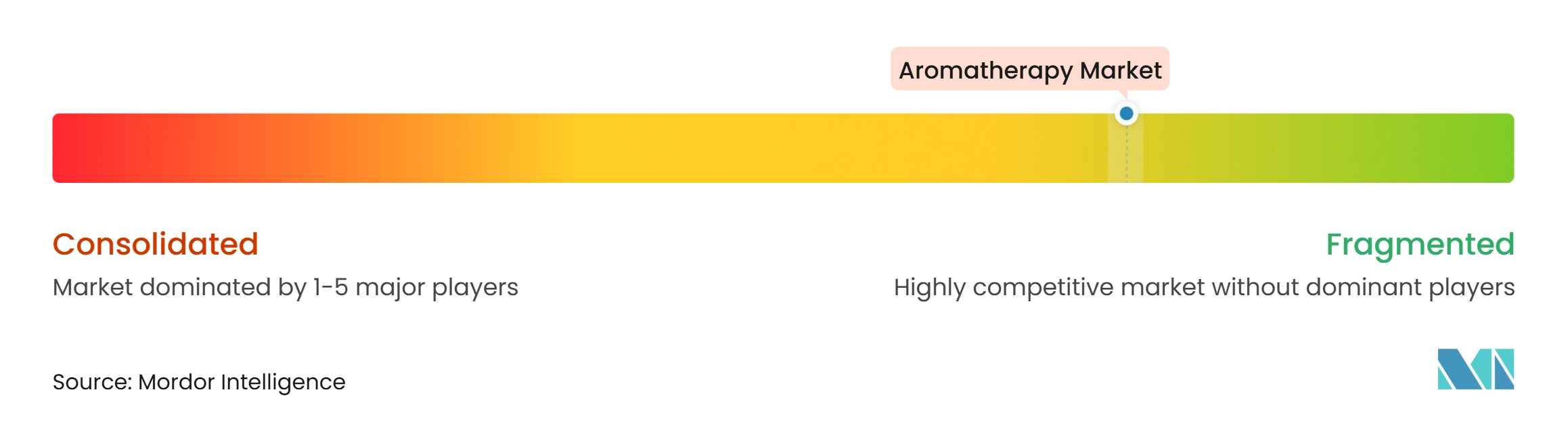
The aromatherapy market has a low concentration and a fragmented structure. Competition includes regional specialty brands, direct-selling businesses, natural-cosmetic brands, and ingredient suppliers. Consumer-facing brands increasingly compete on ingredient transparency, sourcing information, safety testing, and evidence for product performance. Young Living and Plant Therapy are relevant in North American direct selling and specialty retail. In Europe, Puressentiel emphasizes a pharmacy-oriented and clinically supported model, while Neal's Yard Remedies follows a heritage-naturals approach.
Product quality is becoming a practical competitive tool as buyers seek reliable essential-oil composition and safety information in the aromatherapy market. Suppliers that use accredited laboratories, detailed certificates of analysis, and traceable sourcing can more effectively serve institutional and premium retail buyers. The aromatherapy market has white space in standardized product formats for hospitals and long-term care providers, where workflow and safety requirements can differ from retail use.
International Fragrance Association guidance and ISO/IEC 17025 laboratory accreditation can operate as important quality signals for institutional buyers. Suppliers that can demonstrate consistent composition and responsible sourcing may have an advantage as compliance expectations increase. Robertet reported 7.6% organic revenue growth in 2025 and stated that its Raw Materials division grew 12.4%.
Aromatherapy Industry Leaders
-
Young Living Essential Oils, LC
-
NOW Health Group, Inc.
-
Plant Therapy, LLC
-
Saje Natural Wellness Inc.
-
Mountain Rose Herbs
- *Disclaimer: Major Players sorted in no particular order
Aromatherapy Market Companies Covered in this Report
- Young Living Essential Oils, LC
- NOW Health Group, Inc.
- Plant Therapy, LLC
- Saje Natural Wellness Inc.
- Edens Garden, Inc.
- Mountain Rose Herbs
- Aura Cacia
- Neal's Yard Remedies Limited
- Tisserand Aromatherapy Limited
- Puressentiel SAS
- Florihana SAS
- Pranarôm International S.A.
- Biolandes SAS
- Robertet SA
- Givaudan SA
- International Flavors & Fragrances Inc.
- Symrise AG
- Stadler Form AG
- Vitruvi, Inc.
Recent Industry Developments in Aromatherapy Market
- June 2026: dōTERRA introduced its limited-time Endless Summer collection, featuring the Endless Summer Sunshine Blend, a new Hair & Body Mist, and a Sunshine Blend + Pilot Diffuser Bundle. The essential oil blend combines grapefruit, green mandarin, manuka, and other botanical ingredients.
- June 2026: AERON announced the upcoming introduction of Au Naturel, a plant-based plug-in fragrance collection under its Belle Aroma brand. The collection features three essential oil blends: On Eagles' Wings, Peaceful, Easy Feeling, and Walking on Sunshine. The formulation is designed to diffuse essential oil blends through plug-in fragrance devices while addressing compatibility and clogging issues associated with conventional essential oil formulations.
- October 2025: Kohler introduced Sprig Essential Oils as an addition to its wellness product portfolio. The range features four blends: Breathe, Recharge, Relax, and Sleep, formulated using combinations of eucalyptus, mint, bergamot, lemongrass, chamomile, grapefruit, lavender, and vanilla.
- April 2025: Ripple⁺ Home launched its first REED Diffuser collection, featuring six fragrance variants developed in collaboration with master perfumers in Grasse, France. The collection includes POWER, RELAX, DREAM, BOOST, FOCUS, and HAPPY, with aromatic compositions incorporating botanical and floral notes such as eucalyptus, bergamot, cedarwood, jasmine, and vetiver.
Global Aromatherapy Market Report Scope
The aromatherapy market comprises products that use plant-derived aromatic substances, primarily essential oils, to support physical and emotional well-being through inhalation, topical application, and other aromatherapy practices.
The report analyzes the aromatherapy market by product type, application, end user, and geography. By product type, the market is segmented into aromatherapy oils, aromatherapy diffusers, aromatherapy candles, aromatherapy sprays and mists, and other products. Aromatherapy oils include essential oils, carrier oils, aromatherapy blends, massage oils, and other oil-based products. Aromatherapy diffusers are categorized into ultrasonic diffusers, nebulizing diffusers, and other types. Based on application, the market is divided into relaxation and stress management, sleep management and insomnia, skin and hair care, pain and muscle relief, and other applications. By end user, the market covers commercial and retail segments. The commercial segment includes spas, wellness centers, hotels, resorts, healthcare facilities, and other establishments, while the retail segment covers products purchased by individual consumers for personal and household use. Geographically, the report covers North America, Europe, Asia-Pacific, South America, and the Middle East and Africa. The market sizing has been done in value terms in USD for all the abovementioned segments.
Segmentation Overview
| Aromatherapy Oils | Essential Oils |
| Carrier Oils | |
| Aromatherapy Blends | |
| Massage Oils | |
| Others | |
| Aromatherapy Diffusers | Ultrasonic Diffusers |
| Nebulizing Diffusers | |
| Others | |
| Aromatherapy Candles | |
| Aromatherapy Sprays and Mists | |
| Others |
| Relaxation and Stress Management |
| Sleep Management and Insomnia |
| Skin and Hair Care |
| Pain and Muscle Relief |
| Others |
| Commercial |
| Retail |
| North America | United States |
| Canada | |
| Mexico | |
| Rest of North America | |
| Europe | Germany |
| United Kingdom | |
| France | |
| Italy | |
| Spain | |
| Netherlands | |
| Sweden | |
| Poland | |
| Belgium | |
| Rest of Europe | |
| Asia-Pacific | China |
| India | |
| Japan | |
| Australia | |
| South Korea | |
| Vietnam | |
| Indonesia | |
| Rest of Asia-Pacific | |
| South America | Brazil |
| Argentina | |
| Chile | |
| Peru | |
| Colombia | |
| Rest of South America | |
| Middle East and Africa | United Arab Emirates |
| Saudi Arabia | |
| South Africa | |
| Nigeria | |
| Rest of Middle East and Africa |
| Product Type | Aromatherapy Oils | Essential Oils |
| Carrier Oils | ||
| Aromatherapy Blends | ||
| Massage Oils | ||
| Others | ||
| Aromatherapy Diffusers | Ultrasonic Diffusers | |
| Nebulizing Diffusers | ||
| Others | ||
| Aromatherapy Candles | ||
| Aromatherapy Sprays and Mists | ||
| Others | ||
| Application | Relaxation and Stress Management | |
| Sleep Management and Insomnia | ||
| Skin and Hair Care | ||
| Pain and Muscle Relief | ||
| Others | ||
| End-User | Commercial | |
| Retail | ||
| By Geography | North America | United States |
| Canada | ||
| Mexico | ||
| Rest of North America | ||
| Europe | Germany | |
| United Kingdom | ||
| France | ||
| Italy | ||
| Spain | ||
| Netherlands | ||
| Sweden | ||
| Poland | ||
| Belgium | ||
| Rest of Europe | ||
| Asia-Pacific | China | |
| India | ||
| Japan | ||
| Australia | ||
| South Korea | ||
| Vietnam | ||
| Indonesia | ||
| Rest of Asia-Pacific | ||
| South America | Brazil | |
| Argentina | ||
| Chile | ||
| Peru | ||
| Colombia | ||
| Rest of South America | ||
| Middle East and Africa | United Arab Emirates | |
| Saudi Arabia | ||
| South Africa | ||
| Nigeria | ||
| Rest of Middle East and Africa | ||
Key Questions Answered in the Report
What is the projected growth rate for aromatherapy market through 2032?
The aromatherapy market forecast projects a 7.80% CAGR from 2027 to 2032, with value rising from USD 11.06 billion in 2027 to USD 16.09 billion by 2032.
Which aromatherapy product category holds the largest revenue share?
Aromatherapy Oils lead product demand with 42.35% of share in 2026.
Which application is growing fastest through 2032?
Skin and Hair Care is forecast to grow at an 8.12% CAGR through 2032.
Which end-user segment accounts for the largest share of demand?
Commercial buyers account for 68.42% of share in 2026, led by hotels, spas, and healthcare settings.